
How I Taught My Grandmother to Read Questions and Answers | Class 9 Kaveri
Checked against NCERT Kaveri, first edition January 2026, pages 1–22 and listening transcript 259. Personal, discussion and creative responses are samples: adapt them to your experience. This independent study guide is not an official NCERT answer key.
Chapter Overview
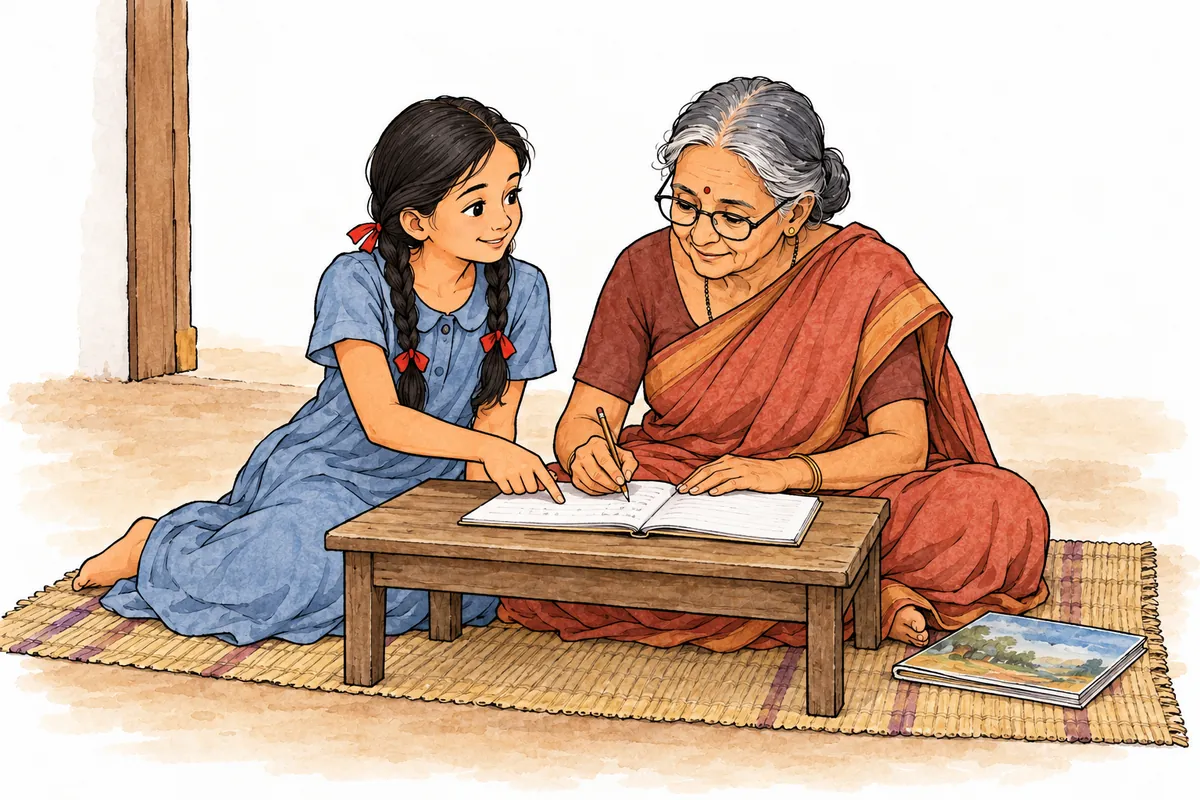
This heart-warming true story by Sudha Murty opens the new Kaveri textbook with the theme that learning has no age bar. A twelve-year-old girl in a north Karnataka village reads a serialised Kannada novel aloud to her grandmother, Krishtakka, every week. When the girl goes away for a wedding, the grandmother — who never had the chance to go to school — realises how helpless she is without the ability to read. What follows is a moving role reversal: the granddaughter becomes the teacher, and the sixty-two-year-old grandmother becomes the most hardworking student imaginable. The chapter celebrates determination, self-respect, the dignity of literacy and the special bond between generations.
About the Author – Sudha Murty
Sudha Murty writes in English and Kannada. In this autobiographical account she recalls teaching her grandmother to read as a twelve-year-old. The narrator later became a Computer Science teacher, a connection she makes within the story. Kaveri’s introduction also notes Murty’s Padma Shri and Padma Bhushan honours.
Summary in English
The narrator, a girl of about twelve, stays with her grandparents in a village in north Karnataka, where newspapers arrive late and the weekly magazine comes a day after publication. Triveni’s novel Kashi Yatre is appearing as a serial in the weekly Karmaveera. It is the story of an old lady with an ardent desire to visit Kashi, who in the end gives away all her savings for the wedding of a poor orphan girl, deciding that the girl’s happiness matters more than her own pilgrimage. The narrator’s grandmother, Krishtakka, never went to school and cannot read. Every Wednesday the narrator reads the new episode aloud, and the grandmother — who, like the heroine, has never been to Kashi — listens with complete concentration, repeats it by heart and discusses it with her friends in the temple courtyard.
When the narrator goes to a neighbouring village for a wedding, planned for two days, she ends up staying a week. On returning, she finds her grandmother in tears — something she has never seen before. That night on the terrace, Krishtakka tells her life story: she lost her mother young, her father remarried, and girls’ education was not thought essential then, so she never went to school. Unable to read the new episode of Kashi Yatre, she rubbed her hands over the pages helplessly and felt utterly dependent — “what use is money when I cannot be independent?” She resolves to learn the Kannada alphabet, setting Saraswati Puja day during Dassara as her deadline. The narrator laughs at her age — grey hair, wrinkles, spectacles — but Avva calmly replies that for a good cause a determined person can overcome any obstacle, for learning has no age bar. She proves a wonderful student, reading, repeating, writing and reciting tirelessly. On Dassara day she gifts the narrator frock material and touches her feet — honouring her not as a granddaughter but as a teacher, for the scriptures say a teacher deserves respect irrespective of gender and age. The narrator gifts her the newly published novel Kashi Yatre; the grandmother instantly reads its title, author’s name and publisher’s name, and the narrator knows her first student has passed with flying colours.
Summary in Hindi (सारांश हिंदी में)
कथावाचिका लगभग बारह वर्ष की लड़की है जो उत्तर कर्नाटक के एक गाँव में अपने दादा-दादी के साथ रहती है। उन दिनों गाँव में अखबार देर से और साप्ताहिक पत्रिका एक दिन बाद पहुँचती थी। उस समय कन्नड़ की लोकप्रिय लेखिका त्रिवेणी का उपन्यास काशी यात्रे साप्ताहिक पत्रिका कर्मवीर में धारावाहिक रूप से छप रहा था। यह एक ऐसी वृद्धा की कहानी है जो काशी जाकर भगवान विश्वेश्वर के दर्शन करना चाहती है, परंतु अंत में अपनी सारी जमा-पूँजी एक अनाथ लड़की के विवाह के लिए दे देती है — उसके लिए उस लड़की की खुशी काशी की पूजा से बड़ा पुण्य थी। कथावाचिका की दादी कृष्टक्का कभी विद्यालय नहीं गईं, इसलिए पढ़ नहीं सकती थीं। हर बुधवार पोती उन्हें नई किस्त पढ़कर सुनाती और दादी पूरी एकाग्रता से सुनकर उसे कंठस्थ कर लेतीं तथा मंदिर के प्रांगण में सहेलियों से उसकी चर्चा करतीं।
एक बार कथावाचिका पड़ोस के गाँव में विवाह में गई और एक सप्ताह बाद लौटी। लौटने पर दादी की आँखों में आँसू थे। उस रात छत पर दादी ने अपनी जीवन-कथा सुनाई — बचपन में माँ का देहांत, पिता का दूसरा विवाह, और उस समय लड़कियों की शिक्षा को आवश्यक न मानना — इसी कारण वे कभी पढ़ नहीं सकीं। पत्रिका आई तो वे पन्नों पर हाथ फेरती रहीं पर कुछ समझ न सकीं। उन्होंने कहा — “पैसा किस काम का, जब मैं आत्मनिर्भर ही नहीं हूँ?” उन्होंने निश्चय किया कि वे कल से कन्नड़ वर्णमाला सीखेंगी और दशहरे में सरस्वती पूजा के दिन तक स्वयं उपन्यास पढ़कर दिखाएँगी। पोती हँसी, पर दादी ने शांत भाव से कहा — अच्छे उद्देश्य के लिए दृढ़ संकल्प हो तो हर बाधा पार हो सकती है; सीखने की कोई उम्र नहीं होती। वे एक आदर्श विद्यार्थिनी बनीं — पढ़ना, दोहराना, लिखना, सुनाना। दशहरे के दिन उन्होंने पोती को फ्रॉक का कपड़ा भेंट किया और उसके पैर छुए — पोती के नहीं, अपनी गुरु के। पोती ने उन्हें काशी यात्रे उपन्यास भेंट किया, जिसका शीर्षक और लेखिका का नाम दादी ने तुरंत स्वयं पढ़ लिया। पोती समझ गई कि उसकी पहली विद्यार्थिनी शानदार सफलता के साथ उत्तीर्ण हो गई है।
Word Meanings (शब्दार्थ)
| Word | English Meaning | हिंदी अर्थ |
|---|---|---|
| convincing | believable | विश्वसनीय |
| ardent | keen, very enthusiastic | उत्कट, प्रबल |
| punya | virtue earned through good deeds | पुण्य |
| protagonist | main character | मुख्य पात्र |
| episode | a part of a story | किस्त, अंक |
| savouring | enjoying it to the fullest | भरपूर आनंद लेना |
| immensely | extremely | अत्यधिक |
| orphan | a child whose parents are dead | अनाथ |
| courtyard | open space near a building | आँगन, प्रांगण |
| helpless | unable to do anything for oneself | असहाय, बेबस |
| embarrassed | feeling shy or awkward | संकोची, शर्मिंदा |
| well-off | rich, wealthy | संपन्न |
| determination | firmness in achieving a goal | दृढ़ संकल्प |
| obstacle | something that blocks progress | बाधा, रुकावट |
| deadline | fixed date by which work must be done | समय-सीमा |
| wrinkled | having lines on the skin due to age | झुर्रीदार |
| spectacles | eyeglasses | चश्मा |
| independent | not needing others’ help | आत्मनिर्भर |
| recite | say aloud from memory | कंठस्थ सुनाना |
| taken aback | surprised by something unexpected | चकित, हक्का-बक्का |
| scriptures | holy writings | धर्मग्रंथ |
| irrespective of | without considering | बिना भेद किए |
| passed with flying colours | (idiom) succeeded brilliantly | शानदार सफलता पाना |
| age bar | age limit or restriction | आयु की सीमा |
NCERT Exercise Solutions
Reflect and Respond
I. Complete the given word web.
(Centre of the web: “Why is it important to learn how to read and write?”)
• To become independent in daily life • To gain knowledge and information • To read books, newspapers and magazines on our own • To communicate through letters and messages • To get better job opportunities • To live with confidence, dignity and self-respect
II. Read the questions given below and share your answers with your classmates and teacher.
1. Which language(s) do your grandparents or elderly relatives speak?
2. How do they spend their time? How do you spend time with them?
3. What is your favourite experience with them?
4. What is something that the elderly in your family cannot do easily but enjoy watching you do?
1. My grandparents speak Hindi at home and understand a little English. My grandmother also speaks her native dialect with her sisters.
2. They spend their time reading the newspaper, gardening and watching devotional programmes. I spend evenings with them — we take walks and they tell me stories of their childhood.
3. My favourite experience was cooking festival sweets with my grandmother, who narrated stories of her village while we worked.
4. They cannot easily use a smartphone, but they enjoy watching me make video calls to our relatives and show them old photographs on the screen.
III. Read the following passage. Match the highlighted words with their meanings given in the box below.
| Highlighted word | Meaning (from the box) |
|---|---|
| (i) protagonist | 7. main character |
| (ii) debate | 4. discussion |
| (iii) episode | 5. a part of a story |
| (iv) community | 3. people living in one particular area |
| (v) concentration | 6. focus |
| (vi) eagerly | 1. excitedly |
| (vii) convincing | 2. believable |
| (viii) guided | 8. directed |
Check Your Understanding (after Part I)
I. Complete the cause and effect table given below based on Part I of the story. Share your answers with your classmates and teacher.
| Cause | Effect |
|---|---|
| 1. (i) In those days, the transport system was not very good. | The morning papers arrived late in the day and weekly magazines would come one day late. |
| 2. The grandmother, Krishtakka, never went to school. | (ii) She could not read Kashi Yatre herself; every Wednesday the narrator read the new episode aloud to her. |
| 3. (iii) The grandmother had never been to Kashi and identified herself with the novel’s protagonist. | She was deeply interested in the story and discussed it with her friends. |
| 4. The narrator went to a wedding for a week. | (iv) The grandmother could not read the new episode of Kashi Yatre; she felt dependent, helpless and was in tears. |
| 5. (v) She lost her mother as a young girl, her father remarried and was busy, and in those days people never considered education essential for girls. | The grandmother never went to school. |
| 6. The grandmother regretted not going to school. | (vi) She made sure that her children and grandchildren studied well. |
II. Do you think the narrator expected to see her grandmother in tears when she returned to the village? If yes, why? If no, why not?
No, the narrator did not expect to see her grandmother in tears. She herself says she had never seen her grandmother cry even in the most difficult situations, which shows that Krishtakka was a strong-willed woman who faced every hardship calmly. Moreover, the narrator had gone away only for a week, for a happy occasion — a wedding. So the sight of tears on her grandmother’s face was completely unexpected, and it surprised and worried her deeply.
III. How might the narrator help her grandmother to fulfil her desire to learn to read and write?
The narrator could become her grandmother’s teacher. She could begin with the Kannada alphabet, move step by step to words and sentences, and fix a regular time for daily lessons. She could give her homework of reading, repeating, writing and reciting, check it patiently and encourage every bit of progress. Using Kashi Yatre itself as reading material would keep her grandmother motivated, since she already loved the story. Above all, the narrator could offer what every learner needs — patience, affection and constant encouragement.
Check Your Understanding (after Part II)
I. State whether the following sentences are true or false. Share your answers with your classmates and teacher.
| Statement | True/False |
|---|---|
| 1. The grandmother wanted to learn the Kannada alphabet to gain independence. | True — she said, “I want to be independent.” |
| 2. The grandmother asked someone in the village to read Kashi Yatre to her while the narrator was away. | False — she was too embarrassed to ask anybody. |
| 3. The narrator was the grandmother’s first teacher and taught her how to read Kannada. | True — “I was her only teacher and she was my first student.” |
| 4. The grandmother believed that there was no age limit for learning. | True — “For learning there is no age bar.” |
| 5. The grandmother touched the narrator’s feet as a mark of respect for her as a teacher. | True — she honoured her as a teacher, not as a granddaughter. |
| 6. The narrator was disappointed with the progress her grandmother made in learning to read. | False — her student “passed with flying colours.” |
Critical Reflection
I. Read the extracts given below and answer the questions that follow.
‘Avva, is everything all right? Are you okay?’
I used to call her Avva, which means mother in the Kannada spoken in north Karnataka.
She nodded but did not reply. I did not understand and forgot about it. In the night, after dinner, we were sleeping in the open terrace of our house. It was a summer night and there was a full moon. Avva came and sat next to me. Her affectionate hands touched my forehead.
(i) Complete the following sentence with the appropriate option.
The phrase ‘never seen her cry in the most difficult situations’ tells us that the grandmother was ________________.
A. strong-willed B. understanding C. considerate D. bold
A. strong-willed. Never crying even in the hardest situations shows her unusual inner strength.
(ii) Complete the following with the correct option from those given in the brackets.
Grandmother did not reply when the narrator asked if she was alright because she might have been too ________________ (emotional/tired) to respond.
emotional — she was too overcome by her feelings to speak at that moment.
(iii) Identify the clue from the extract that indicates a rural setting with traditional customs.
The family sleeping in the open terrace of the house on a summer night, and the narrator calling her grandmother “Avva” — the word for mother in the Kannada of north Karnataka — indicate a rural setting with traditional customs.
(iv) Which lines of the extract establish a tender atmosphere?
The closing lines — “It was a summer night and there was a full moon. Avva came and sat next to me. Her affectionate hands touched my forehead” — establish a tender, loving atmosphere.
(v) Which of the following aspect is NOT emphasised in the given extract?
A. the emotional turmoil of the grandmother B. the affectionate bond between the narrator and her grandmother C. the grandmother’s regret over her lack of education D. the narrator’s concern for her grandmother
C. the grandmother’s regret over her lack of education — this is revealed only later in the story, not in this extract.
I saw the determination on her face. Yet I laughed at her.
‘Avva, at this age of sixty-two you want to learn the alphabet? All your hair is grey, your hands are wrinkled, you wear spectacles and you work so much in the kitchen…’
Childishly I made fun of the old lady. But she just smiled.
‘For a good cause if you are determined, you can overcome any obstacle. I will work harder than anybody but I will do it. For learning there is no age bar.’
(i) What does the grandmother’s statement, “I want to be independent,” reveal about her character?
A. She wanted to be literate. B. She desires self-sufficiency. C. She wants to prove her intelligence to others. D. She feels pressured by society to learn.
B. She desires self-sufficiency. She wants to depend on no one for her reading.
(ii) Fill in the blank with the appropriate option from those given in brackets.
The grandmother’s determination shows that learning has no ________________. (age limit/gender bias/cultural barriers)
age limit
(iii) Complete the following with a suitable reason.
The narrator laughs at her grandmother’s decision to learn the alphabet at the age of sixty-two because ________________.
…she finds it amusing that an old lady with grey hair, wrinkled hands and spectacles, who works so much in the kitchen, now wants to start learning the alphabet like a small child.
(iv) List any two qualities displayed by the grandmother.
Determination — she fixes a hard deadline and vows to work harder than anybody; and calm self-confidence — she only smiles at her granddaughter’s teasing and stays firm on her decision.
(v) How can we say that the narrator is making assumptions about her grandmother?
The narrator judges her grandmother by her age and appearance — grey hair, wrinkled hands, spectacles and kitchen work — and assumes that such an old lady cannot learn the alphabet. She measures ability by age rather than by will-power, and the grandmother’s success later proves this assumption completely wrong.
II. Answer the following questions.
1. Why do you think the grandmother felt embarrassed to ask someone else to read to her while the narrator was away?
The text says she felt embarrassed, dependent and helpless. A reasonable inference is that she felt more comfortable revealing this difficulty to her affectionate granddaughter than to another villager. The story does not say that her inability to read was a secret, nor that the villagers would ridicule her. Needing help does not reduce anyone’s dignity.
2. Why does the narrator initially laugh at her grandmother’s determination to learn at the age of sixty-two?
Being only twelve, the narrator connects learning with school-going age. The idea of her grey-haired, wrinkled, bespectacled grandmother, always busy in the kitchen, starting from the alphabet sounds comical to her. Her laughter reflects an immature assumption about age and learning. The narrator herself admits making fun of her grandmother; her later care and teaching show how her understanding changes.
3. What significance does the story of Kashi Yatre have in both the grandmother’s life and the story?
The novel mirrors the grandmother’s own life — like its old heroine, she has never been to Kashi, and she identifies herself completely with the protagonist. Her love for this one story makes her dependence unbearable when she cannot read it, and it becomes the spark for her decision to learn. At the end, when she instantly reads the title Kashi Yatre on the gifted novel, the same book becomes the proof of her success — the emotional heart of the chapter.
4. What does the grandmother’s desire to learn the Kannada alphabet reflect about her?
It reflects her courage, self-respect and refusal to accept helplessness as fate. She values independence over comfort — instead of arranging for someone to read to her, she chooses the much harder path of learning herself at sixty-two. It also shows her deep love for stories and her belief that it is never too late to grow.
5. What lessons can we infer from the grandmother’s action of touching the narrator’s feet?
First, knowledge deserves honour irrespective of the teacher’s age — the moment the granddaughter became her teacher, the grandmother treated her as a guru. Second, true humility is a mark of greatness: a respected elder bowing to a child shows rare largeness of heart. Third, gratitude should be expressed openly and sincerely. As she herself says, the scriptures teach that a teacher should be respected, irrespective of gender and age.
6. What does the following line tell us about the broader theme of the story? ‘For a good cause if you are determined, you can overcome any obstacle.’
This line carries the central message of the story: determination, sustained practice and supportive teaching can help a learner overcome substantial barriers. The grandmother lives these words: she sets a deadline, works harder than anybody and learns to read by the chosen Dassara deadline; the exact duration of tuition is not stated. Her journey from helpless tears to confident reading proves that learning truly has no age bar.
7. How effectively does the story highlight the value of education in supporting personal independence?
The story highlights it very effectively because it shows rather than preaches. One helpless evening turns an otherwise resilient woman feel deeply distressed — not poverty or illness, but the inability to read. Her words, “We are well-off, but what use is money when I cannot be independent?”, state the truth powerfully: education is not merely knowledge, it is dignity, self-reliance and the freedom to reach the world on one’s own. Her transformation makes this argument unforgettable.
Vocabulary and Structures in Context
I. The expression ‘hide and seek’ is used in the text. This is called a binomial. Match the binomials in Column 1 with their meanings in Column 2.
| Column 1 | Column 2 |
|---|---|
| 1. sink or swim | (vii) succeed or fail without help |
| 2. on and off | (v) sometimes, occasionally |
| 3. mix and match | (i) put different things together to get a range of possibilities |
| 4. all or nothing | (viii) something to be done completely or not at all |
| 5. part and parcel | (ii) complete part of or belong to |
| 6. pick and choose | (iii) choose only the best (things, people, etc.) |
| 7. sooner or later | (iv) at sometime in the future |
| 8. leaps and bounds | (vi) increase or develop very quickly |
Sentences: 1. Hard work is part and parcel of a student’s life. 2. It rained on and off the whole day. 3. Sooner or later, the truth always comes out. 4. Her reading skills improved by leaps and bounds after daily practice. 5. The new employee was left to sink or swim on his first project.
II. Make words by adding the suitable prefixes (un, im, dis, in, mis, extra) to the words in Column 1.
| Column 1 | Column 2 |
|---|---|
| 1. popular | (i) unpopular (example given) |
| 2. belief | (ii) disbelief |
| 3. important | (iii) unimportant |
| 4. respect | (iv) disrespect |
| 5. correct | (v) incorrect |
| 6. continue | (vi) discontinue |
| 7. understand | (vii) misunderstand |
| 8. ordinary | (viii) extraordinary |
| 9. interesting | (ix) uninteresting |
| 10. possible | (x) impossible |
III. Identify any five words with prefixes from the story and make sentences using each.
unhappy (un-) — Her face was unhappy and her eyes were filled with tears. • unusual (un-) — It was unusual for an elder to touch a youngster’s feet. • unfortunately (un-) — Unfortunately, the talented writer died very young. • independent (in-) — Education made the old lady independent. • irrespective (ir-) — A teacher deserves respect irrespective of age.
IV. Match the idioms related to ‘learning’ given in Column 1 with their meanings in Column 2.
| Column 1 | Column 2 |
|---|---|
| 1. to hit the books | (iii) to study seriously |
| 2. to draw a blank | (v) to be unable to remember |
| 3. to learn the ropes | (vi) to understand how to do an activity |
| 4. to rack one’s brain | (ii) to think very hard |
| 5. to learn by heart | (i) to memorise something |
| 6. burn the midnight oil | (iv) to study or work late into the night |
Sentences: 1. With exams near, I decided to hit the books. 2. I drew a blank when the teacher asked the date of the battle. 3. The new clerk took a month to learn the ropes of office work. 4. We racked our brains over the difficult puzzle. 5. Avva could learn by heart every episode of the story. 6. She burnt the midnight oil to meet her Dassara deadline.
V. Read the following sentences from the text and underline the verbs.
1. Secretly, I bought Kashi Yatre which had been published as a novel by that time.
2. I knew, then, that my student had passed with flying colours.
1. Verbs: bought (simple past), had been published (past perfect). 2. Verbs: knew (simple past), had passed (past perfect).
Rule: in these exercises, use the past perfect (had + past participle) to make the earlier completed action clear, and the simple past for the later action. This is a useful pattern, not a rule that every pair of past actions must use two different tenses.
(i) Fill in the blanks with simple past and past perfect tense form of the verbs given in brackets.
A. When the delegates arrived at the conference, the keynote speaker had already begun the session.
B. After the students had learnt how to identify fake news online, they started verifying information before sharing it.
C. Before Kiran started using digital payment platforms, she had ensured her understanding of online fraud prevention.
D. By the time Varun recognised the importance of budgeting, he had exhausted most of his savings.
E. When Raghu logged in to the cybersecurity webinar, the instructor had already discussed the importance of strong passwords.
(ii) Fill in the blanks with the correct form of verbs given in brackets.
A. took B. reviewed C. had spent D. had discussed E. opened F. set G. had already introduced H. hurried I. had completed J. enjoyed
Listen and Respond
Answers checked against the teacher’s transcript on printed page 259. Each answer below stays within the instruction of one to three exact words per blank.
| Item | Answer |
|---|---|
| 1 | digital tools |
| 2 | personal data |
| 3 | stay connected |
| 4 | misinformation; cyber threats |
| 5 | IT training |
For item 4, the transcript lists three hazards—misinformation, scams and cyber threats—while the exercise provides two blanks. “Misinformation” and “cyber threats” are two valid exact phrases; “scams” is another hazard explicitly named. The earlier answer “scams and cyber threats” exceeded the three-word limit for one blank.
Speaking Activity (Turncoat)
Sample speaking points: use your own examples and speak for up to one minute on each side.
Topic 1: Learning a language in addition to one’s mother tongue
Against, as a debating position: Whether a particular new language is essential depends on a learner’s needs. Good teaching takes time and resources, and the mother tongue also deserves strong support. This questions making an additional language compulsory, not the value of multilingualism.
Topic 2: Learning can happen only when one is young
Against: Those advantages do not prove that learning is possible only in youth. Krishtakka learns at sixty-two through motivation, practice and her granddaughter’s help. Adults can develop new knowledge and skills too.
Conclusion: The absolute word “only” makes the motion untenable; do not present it as a scientific fact.
Writing Task
I. As a socially responsible citizen, you strongly believe that students can contribute significantly in promoting adult literacy. Write a letter to the Editor of a local newspaper emphasising the importance of student participation in adult literacy camps conducted by various organisations. Discuss the benefits of such initiatives for both students and society. Suggest effective ways to spread awareness and encourage more students to volunteer for this noble cause.
Aman Gupta
Student, Class IX
15, Green Park Colony, Jaipur
12 June 2026
The Editor
The Rajasthan Times
Jaipur
Subject: Students Supporting Adult Literacy
Sir/Madam,
As a concerned student, I would like to draw attention to the role young volunteers can play in adult literacy. Adults who missed opportunities for schooling deserve respectful support to develop reading and writing skills. Schools can help connect willing students with organised literacy programmes.
The issue at hand affects a large section of society. Adults who cannot yet read may need help with written notices, forms and travel information. Accessible teaching can increase their choices and confidence; their worth does not depend on literacy. It is imperative that the educated young generation comes forward. Students can teach in adult literacy camps on weekends, hold evening classes for elders at home and prepare simple reading charts. Such initiatives nurture a sense of responsibility, patience and service in students, while giving adults the gift of independence. By engaging in these programmes, students learn as much as they teach.
A possible solution to spread awareness could be school-level campaigns, street plays, posters and social media drives under the guidance of teachers. Authorities could consider implementing an ‘Each One, Teach One’ programme in every school and honouring student volunteers. I trust this matter will be considered seriously for the benefit of all. I hope this letter gets published in the columns of your esteemed daily.
Yours truly,
Aman Gupta
Learning Beyond the Text
Kinship words vary by region, whether a relative is maternal or paternal, and whether a sibling is older or younger. The table gives examples, not universal one-to-one translations. The book supplies “Avva” for grandmother, while the narrator explains it as “mother” in her north Karnataka usage. Akka, Tai and Didi commonly refer to an elder sister; Anna/Annan and Dada can refer to an elder brother.
I. India has 22 major languages according to the Eighth Schedule of the Indian Constitution. Talk to your classmates and teacher and complete the given table with words from any five Indian languages.
| 1. Kannada | 2. Hindi | 3. Tamil | 4. Marathi | 5. Bengali | |
|---|---|---|---|---|---|
| Grandmother | Avva (given) | Dadi | Paatti | Aaji | Thakuma |
| Grandfather | Ajja | Dada | Thaatha | Ajoba | Thakurda |
| Mother | Amma | Maa | Amma | Aai | Maa |
| Father | Appa | Pitaji | Appa | Baba | Baba |
| Sister | Akka | Behen | Akka | Tai | Didi |
| Brother | Anna | Bhai | Annan | Dada | Dada |
II. Do you know? Research guidance: The textbook introduces adult, financial, early and cultural literacy. These mean, respectively, literacy learning for adults; understanding everyday money concepts; foundational reading and writing; and understanding languages, arts and social practices. For the adult-education research prompt, open the Ministry link given in your textbook and note the programme name, intended learners, learning areas and date of the information. Distinguish the textbook’s programme descriptions from current announcements; verify current details before presenting them as up to date.
III. Talk to your grandparents and find out which book or magazine they enjoy reading. Buy a copy of it and present it to them as a gift.
I spoke to my grandfather and learnt that he loves a Hindi devotional magazine he used to read in his youth. I bought its latest issue and gifted it to him. His joy reminded me of Avva receiving Kashi Yatre — a small gift, but a big bridge between generations.
Extra Questions with Answers
Short Answer (30–40 words)
Q1. Who was Krishtakka, and what did the narrator call her?
Krishtakka was the narrator’s grandmother, who had never been to school. The narrator called her Avva, which means mother in the Kannada spoken in north Karnataka.
Q2. Why did the grandmother love the novel Kashi Yatre so much?
Like its old heroine, she too had never been to Kashi and identified herself with the protagonist. The story echoed her own ardent desire, so every Wednesday episode felt personal to her.
Q3. What deadline did the grandmother set and why was it apt?
She chose Saraswati Puja day during Dassara — the day dedicated to the goddess of learning — a fitting date to prove that she could read a novel on her own.
Q4. How did the grandmother behave as a student?
She was a wonderful student. The amount of homework she did was amazing — she would read, repeat, write and recite tirelessly despite her age and kitchen work.
Q5. What gifts were exchanged on Dassara day?
The grandmother gave the narrator frock material, and the narrator secretly gifted her the newly published novel Kashi Yatre, which the grandmother read immediately — title, author and publisher’s name.
Long Answer (100–120 words)
Q1. “For learning there is no age bar.” Justify this statement from the chapter.
The grandmother proves this truth completely. At sixty-two, with household responsibilities and no previous schooling, she begins with the alphabet as a new learner. What she lacks in youth she makes up in discipline: daily lessons, honest homework and an unbending deadline of Saraswati Puja day. Her motivation is not a certificate but dignity — the wish never to feel helpless again. By Dassara she reads the title of Kashi Yatre on her own, showing how consistent practice and a caring teacher have supported her progress. The story thus proves that age alone need not prevent learning; motivation, opportunity, practice and support matter.
Q2. Sketch the character of the grandmother, Krishtakka.
Krishtakka is the soul of the story — strong, sensitive and self-respecting. Though she never went to school, she is wise and emotionally rich, repeating whole episodes of Triveni’s novel by heart. Her tears are not weakness but wounded dignity, and her response to helplessness is heroic: she chooses the hard path of learning over easy dependence. As a student she is humble and hardworking; as an elder she is large-hearted enough to touch her young teacher’s feet. She embodies determination, humility and the courage to begin again at any age.
Q3. What role does the narrator play in her grandmother’s transformation?
The narrator is both witness and instrument of the change. Her Wednesday readings first open the world of Kashi Yatre to Avva, and her week-long absence unknowingly exposes the pain of illiteracy. Though she laughs at first, she takes up the role of teacher seriously — starting tuition the very next day, setting homework and guiding her first student till the deadline. Her thoughtful secret gift of the novel shows she understands what the achievement means. Interestingly, the experience also shapes her: the girl who taught her first student went on to become a teacher of Computer Science to hundreds of students.
Additional MCQs
1. The story is set in — (a) coastal Kerala (b) a village in north Karnataka (c) old Delhi (d) rural Punjab
2. Kashi Yatre was written by — (a) Sudha Murty (b) Triveni (c) Mahadevi Verma (d) Shivarama Karanth
3. The novel appeared as a serial in the Kannada weekly — (a) Sudha (b) Karmaveera (c) Prajavani (d) Kasturi
4. The grandmother’s age when she began learning was — (a) 58 (b) 60 (c) 62 (d) 65
5. The narrator went away to attend — (a) a fair (b) a wedding (c) a festival (d) an exam
6. “Avva” in the Kannada of north Karnataka means — (a) grandmother (b) aunt (c) mother (d) teacher
7. The grandmother’s deadline was — (a) Ugadi (b) Deepavali (c) Saraswati Puja day during Dassara (d) Makar Sankranti
8. In the novel, the old lady gives away her savings for — (a) building a temple (b) an orphan girl’s wedding (c) her son’s education (d) a pilgrimage
9. On Dassara day, the grandmother gifted the narrator — (a) a novel (b) frock material (c) a pen (d) sweets
10. The central message of the chapter is — (a) old age brings wisdom (b) festivals unite families (c) learning has no age bar (d) magazines spread literacy
Answer key: 1-b, 2-b, 3-b, 4-c, 5-b, 6-c, 7-c, 8-b, 9-b, 10-c
Assertion–Reason Questions
Options for each: (a) Both A and R are true and R explains A. (b) Both A and R are true but R does not explain A. (c) A is true, R is false. (d) A is false, R is true.
1. A: The grandmother wept when the narrator returned from the wedding. R: She could not read the new episode of Kashi Yatre by herself. — (a)
2. A: The narrator laughed at her grandmother’s decision. R: The grandmother wanted to learn English literature. — (c)
3. A: The grandmother chose Saraswati Puja day as her deadline. R: Saraswati is worshipped as the goddess of learning. — (a)
4. A: The grandmother touched the narrator’s feet on Dassara day. R: In our tradition, a teacher deserves respect irrespective of gender and age. — (a)
5. A: The grandmother never went to school as a child. R: In those days, people never considered education essential for girls. — (a)
FAQs
Who is the author of How I Taught My Grandmother to Read?
Sudha Murty — engineer, philanthropist and celebrated Indian author, honoured with the Padma Shri and Padma Bhushan. The story is from her own childhood.
Is this chapter from the new Class 9 English book?
Yes. It is the prose lesson in Unit 1 of NCERT Kaveri, Textbook of English for Grade 9, first edition January 2026.
What is the main theme of Kaveri Chapter 1?
The story shows that age alone need not prevent learning. Krishtakka’s determination, regular practice and her granddaughter’s teaching help her become an independent reader.
Also read: Chapter 2 – The Pot Maker · Class 9 – All Subjects · NCERT Solutions Home. Official NCERT textbook catalogue: ncert.nic.in