
CLASS 7 · Computational Thinking
Class 7 CT and AI: A Tale of Three Intersecting Lines Solutions
Use triangle properties, careful counting and spatial reasoning to solve the geometry tasks.
Jump to a question or activity
Key ideas
A right triangle may also be isosceles or scalene: angle and side classifications answer different questions. For counting puzzles, count complete triangles, and distinguish separate pieces from triangles made by combining pieces.
Short Concept Lessons
Learn a method, follow the example, then use it in the additional practice.
Classify sides and angles separately
Side labels describe equal lengths; angle labels describe angles. One triangle can have a label from each group.
A 45°–45°–90° triangle is both isosceles and right-angled.
Remember: Equilateral triangles have three 60° angles, so they cannot be right-angled.
Practise this method →Check whether three lengths make a triangle
The sum of any two sides must be greater than the third. Equality gives a straight, collapsed figure.
4,5,8 form a triangle because 4 + 5 > 8;4,5,9 do not.
Remember: For sorted positive lengths, check the two smaller sides against the largest.
Practise this method →Use a perpendicular height for area
A triangle’s area is half its base times its perpendicular height. A sloping side is not automatically the height.
Base 8 cm and height 5 cm give area ½ × 8 × 5 = 20 cm².
Remember: Compare areas using dimensions, not the number of sides alone.
Practise this method →Decide whether the evidence is sufficient
Similar triangles have equal corresponding angles and proportional corresponding sides. Two matching angle pairs are sufficient.
If two angles are 40° and 70° in each triangle, both third angles are 70°.
Remember: Two proportional side pairs alone do not establish similarity.
Practise this method →Count complete triangles systematically
Group triangles by size or by the position of a right angle, and avoid counting the same triangle twice.
A square with one diagonal has two triangular pieces. Both are right-angled.
Remember: A triangle needs three complete drawn sides.
Practise this method →Show both a bound and a valid construction
For a maximum, explain why no larger count is possible, then give an arrangement achieving the bound.
In a 2 × 2 grid with no full row allowed, at most two circles fit. Opposite corners achieve that count.
Remember: A plausible arrangement alone does not establish a maximum.
Practise this method →Questions and Solutions
Q1. If the sides of an equilateral triangle and that of a square are of equal length, what can you say about the area of both the shapes?
Solution
Q2. Three identical pieces of paper, each in the shape of an equilateral triangle, are joined together edge to edge, with no gaps or overlaps.
Which of the following figures can be formed by joining them?
Solution
Q3. If dots of the same colour are connected to form triangles, which triangle is not formed by any coloured dots?
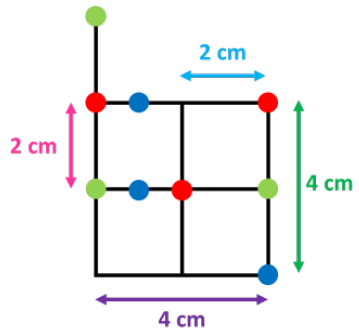
Solution
Q4. Is the given triangle isosceles, scalene, or equilateral?
Information 1: The given triangle is similar to a right-angled triangle
Information 2: The given triangle is not a scalene triangle
To answer the given question, which of the given information is/are sufficient?
Solution
Q5. At least how many folds are required to convert the given paper sheet into an equilateral triangle?
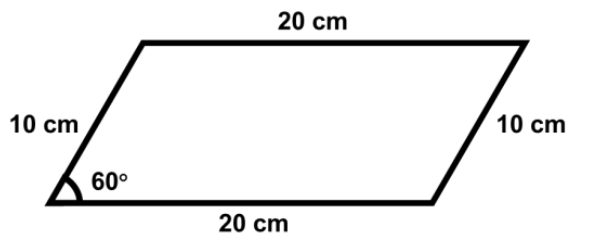
Solution
Q6. Each option contains exactly two types of triangles from the following: a right-angled triangle, an equilateral triangle, and a scalene triangle. Which option contains both a right-angled triangle and an equilateral triangle?
Note: Consider only those triangles whose all three sides are clearly visible

Solution
Q7. An isosceles triangle has a perimeter of 23 cm and all its side lengths are whole numbers.
The two equal sides are multiples of 3. How many different possible lengths can the third side have?
Solution
Q8. Two triangles, triangle X and triangle Y, are given. Only partial information about their corresponding sides and angles is provided below.
Question: Are triangles X and Y similar?
Information 1: Two pairs of corresponding sides of triangle X and triangle Y are proportional, but no information is given about the third pair of corresponding sides.
Information 2: Two pairs of corresponding angles of triangle X and triangle Y are equal, but no information is given about the third pair of corresponding angles.
To answer the given question, which of the given information is/are sufficient?
Solution
Q9. An equilateral triangle is given. Inside it, two straight lines are drawn in any direction. If the triangle is cut along these two lines, what is the maximum number of right-angled triangles that can be formed?
Note: You cannot form a triangle by joining two or more pieces.
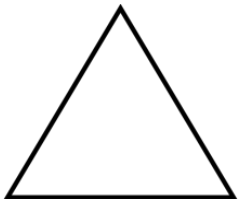
Solution
Q10. How many right-angled triangles are there in the given figure?
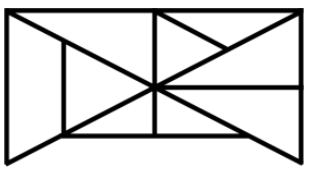
Solution
The Thinking Spot
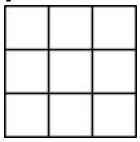
A 3 x 3 grid is shown below.
You need to place some circles in the cells without making three in a row, column, and diagonal. How many circles at maximum can you place in the grid?
Solution
Additional Practice Questions with Solutions
Choose an answer, use a hint if needed, then open the worked solution to check your reasoning.
Solved 0 of 10 · Checked 0 of 10
Your practice progress lasts until you reset or reload this page.
Apply · classify
Practice Q1. A triangle has angles 45°,45° and 90°. Which description is correct?
Show hint
Equal angles face equal sides.
Show worked solution
Option (b) Isosceles and right-angled.
Two equal angles give two equal sides, so the triangle is isosceles. Its 90° angle makes it right-angled.
Common mistake: Side and angle classifications can both apply.
Apply · inequality
Practice Q2. Which set of lengths can form a triangle?
Show hint
The sum of the two smaller lengths must exceed the largest.
Show worked solution
Option (c) 4 cm,5 cm,8 cm.
4 + 5 = 9 > 8, so 4,5,8 form a triangle. The other sets fail the strict inequality.
Common mistake: Equality is not enough.
Apply · area
Practice Q3. A triangle has base 8 cm and perpendicular height 5 cm. What is its area?
Show hint
Use half the product of base and height.
Show worked solution
Option (a) 20 cm².
Area = ½ × 8 × 5 = 20 cm².
Common mistake: Use square units for area.
Apply · similar
Practice Q4. Two triangles each have angles 35° and 65°. What can you conclude?
Show hint
The third angle in each triangle is 80°.
Show worked solution
Option (d) They are similar.
Both triangles have the same three angles, so they are similar by the AA test. Their sizes may differ.
Common mistake: Similar does not necessarily mean equal in size.
Apply · inequality
Practice Q5. An isosceles triangle has perimeter 22 cm. Its equal sides are whole-number multiples of 3. How many possible lengths can its third side have?
Show hint
Try equal sides 3,6 and 9, then check the remaining side.
Show worked solution
Option (b) 2.
The candidates are(3,3,16),(6,6,10),(9,9,4). The first fails the triangle inequality; the other two work. The third side can be 10 cm or 4 cm.
Common mistake: Check both the perimeter and triangle inequality.
Apply · classify
Practice Q6. A triangle is right-angled and is not scalene. What must its other two angles be?
Show hint
The triangle must be isosceles, and its remaining angles total 90°.
Show worked solution
Option (c) 45° and 45°.
The two remaining angles are equal and sum to 90°, so each is 45°.
Common mistake: A right triangle cannot be equilateral.
Apply · area
Practice Q7. An equilateral triangle and a square both have side 6 cm. Which has greater area?
Show hint
The triangle’s perpendicular height is less than 6 cm.
Show worked solution
Option (a) The square.
The square has area 36 cm². The triangle’s area is less than ½ × 6 × 6 = 18 cm², so the square has greater area.
Common mistake: Rotating a shape does not change its area.
Apply · count
Practice Q8. A square is cut once along a diagonal. How many right-angled triangular pieces result?
Show hint
The diagonal joins two opposite corners.
Show worked solution
Option (d) 2.
It divides the square into two triangles. Each contains one of the square’s unchanged right-angle corners.
Common mistake: Count the pieces created by the cut.
Apply · bounds
Practice Q9. In a 3 × 3 grid, circles may not fill an entire row. There are no other restrictions. What is the maximum number of circles?
Show hint
Each row can contain at most two circles.
Show worked solution
Option (b) 6.
Three rows allow at most 3 × 2 = 6 circles. Place two in every row to reach the bound.
Common mistake: Apply the restriction to every row.
Apply · similar
Practice Q10. Two triangles have two corresponding side pairs in the ratio 2: 1. No angle or third-side information is given. Is similarity guaranteed?
Show hint
The angle between the known sides can vary.
Show worked solution
Option (c) No, similarity cannot yet be determined.
Two side ratios alone do not fix the shape. An equal included angle or a matching third-side ratio would supply enough further information.
Common mistake: Insufficient information does not mean similarity is impossible.