
CLASS 7 · Computational Thinking
Class 7 CT and AI: Number Play Solutions
Work with binary light states, logical implications, digit grids and number patterns.
Jump to a question or activity
Key ideas
Represent OFF by 0 or O and ON by 1 or U. A clue filters the possible states; it does not necessarily determine a single state. In particular, “if A then B” does not say that A is true.
Short Concept Lessons
Learn a method, follow the example, then use it in the additional practice.
Count independent ON/OFF states
Each independent light has two states. Multiply by two for each additional light.
Four independent lights have 2 × 2 × 2 × 2 = 16 possible states.
Remember: A clue may reduce the count by fixing some positions.
Practise this method →Apply every clue as a filter
List possible states, then remove every state that breaks a clue. Use U for ON and O for OFF.
For RGB, Red ON and Blue OFF leave UOO and UUO.
Remember: A wildcard X is an unspecified position, not a third light state.
Practise this method →Read “if” carefully
If A then B rules out A being true while B is false. It does not assert that A is true.
If Red ON implies Blue ON, then both-OFF is still allowed by that clue alone.
Remember: Do not reverse an implication or assume its starting condition.
Practise this method →Use digit place values
Write a two-digit number as 10a + b. Its reversal is 10b + a, so their difference is 9(a − b).
72 − 27 = 45, a multiple of 9.
Remember: Distinct digits give a nonzero difference.
Practise this method →Track even and odd totals
Even plus even is even; odd plus odd is even; odd plus even is odd. Adding an odd number changes parity.
A row increasing by 3 alternates odd, even, odd or even, odd, even.
Remember: Parity can rule out answers without calculating every value.
Practise this method →List cases and prove a minimum
Use an organised list to avoid missing possibilities. For a minimum, show both a lower bound and a way to reach it.
If each action reaches at most two of six objects, at least three actions are needed; a valid three-action arrangement proves the minimum.
Remember: A lower bound alone does not prove an arrangement is possible.
Practise this method →Questions and Solutions
Activity: Logical puzzle punch cards. In this activity, you will use punched cards to solve logical puzzles. By stacking, aligning, and filtering the cards, we will see how complex reasoning can be built from simple decisions – True or False, mirroring how binary logic works inside a computer.
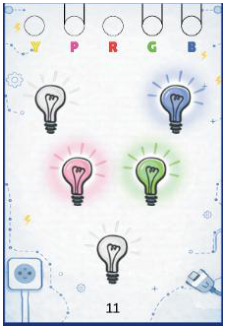
The scenario is that you have the following lights in the room: Yellow Y, Pink P, Red R, Green G, and Blue B. By following the clues given in the Case Cards, you have to figure out which lights are ON in the given Puzzle. To solve these puzzles, we have a deck of cards representing all possible combinations of these lights being ON or OFF.
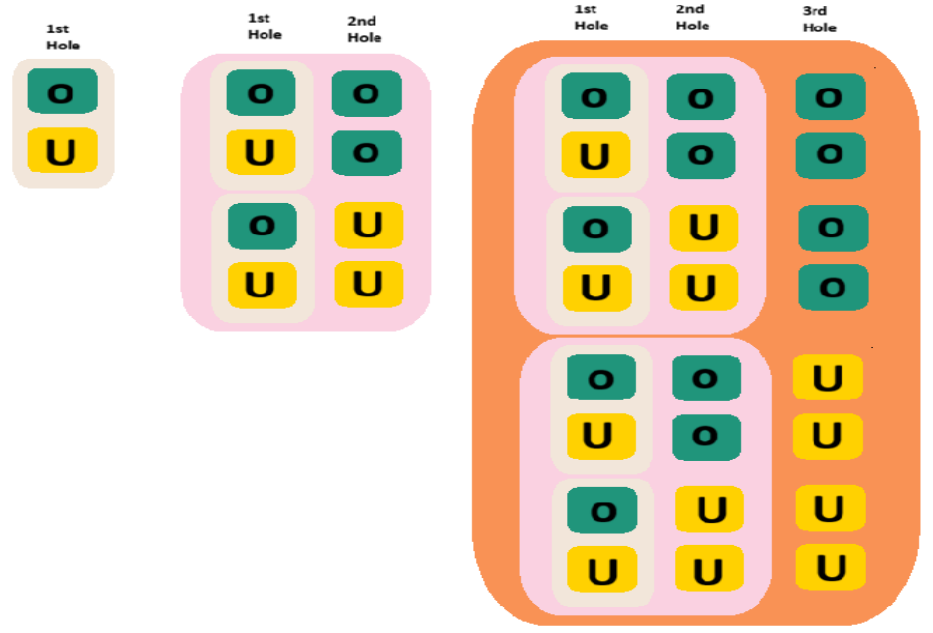
Each card has five positions for holes on the top, and each position corresponds to a coloured light mentioned above in the given order.
Each position has two possible hole types: U-shaped or O-shaped. Each card represents one possible combination. If a light is ON in a card, then the hole corresponding to it is U-shaped. If a light is OFF in a card, then the hole corresponding to it is O-shaped.
Solution
Use five positions in the order Y, P, R, G, B. Each has two states, so there are 2⁵ = 32 cards. For an ON requirement, retain U-slot cards at that position; for an OFF requirement, retain closed O-hole cards. Keep only states satisfying every clue. A stick lifts closed O holes, while open U slots slip off. Record surviving states after each clue so the reasoning can be checked.
Activity Q1. Can you identify which bulbs are ‘OFF’ based on the card?
Solution
Activity Q2. Can you identify which bulb is OFF based on this pattern: RGB = U U O?
Solution
Case 1: Focusing on RGB cards only (with 8 cards only)
Statements
I. The Red light is ON
II. The Blue light is OFF
III. ON light only has OFF Neighbour
In RGB order, U means ON, O means OFF, and X means the position is not fixed. Statement I removes RGB = O X X cards. Statement II keeps cards with Blue OFF. Statement III rules out neighbouring ON lights.
Activity Q3. After performing an action using Statement I, how many cards are left in the pack?
Solution
Activity Q4. After performing the action using Statement II, among these, which card will not be discarded?
Solution
Activity Q5. What is the pattern of the last card (solution)?
Solution
Case 2: Focusing on RGB cards only (with 8 cards only)
Statements
I. The Red light is ON
II. The Lights are either all ON or all OFF
Activity Q6. Among these, what would be the pattern of the solution?
Solution
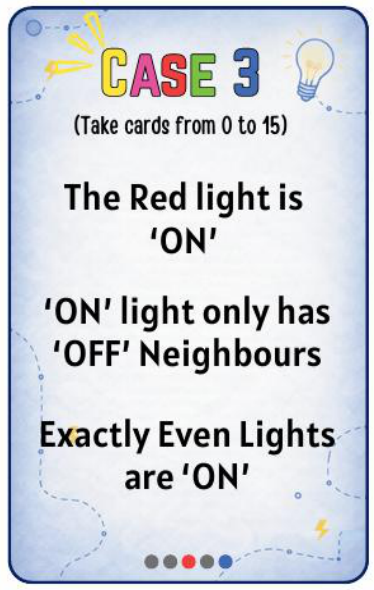
More Puzzles — Case 3. (Take cards from 0 to 15)
The Red light is ‘ON’
‘ON’ Light only has ‘OFF’ Neighbours
Exactly Even Lights are ‘ON’
Solution
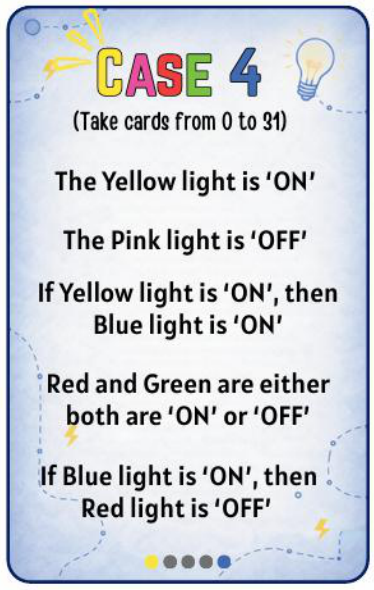
More Puzzles — Case 4. (Take cards from 0 to 31)
The Yellow light is ‘ON’
The Pink light is ‘OFF’
If Yellow light is ‘ON’, then Blue light is ‘ON’
Red and Green are either both are ‘ON’ or ‘OFF’
If Blue light is ‘ON’, then Red light is ‘OFF’
Solution
More Puzzles — Case 5. (Take cards from 0 to 31)
If Yellow light is ‘ON’, so is Pink light
Either Green light or Blue light, or both of them, is ‘ON’
If Yellow light is ‘ON’, then Blue light is ‘ON’
Red and Green are either both are ‘ON’ or ‘OFF’
If Blue light is ‘ON’, then Red light is ‘OFF’

Solution
It has five valid states, not one, under the printed clues. In YPRGB order they are OOOOU, OOUUO, OUOOU, OUUUO and UUOOU.
If B is ON, R must be OFF, so G is OFF as R and G match. With Y OFF, P can be OFF or ON; with Y ON, P must be ON. These give three states. If B is OFF, the “G or B” clue requires G ON, hence R ON. Y must be OFF because Y ⇒ B, but P remains free, giving two more states. The clues need an extra condition if a unique card is intended.
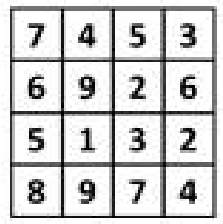
Q1. Form the largest four-digit odd number by selecting exactly one digit from each row and each column.
What is the sum of the digits?
Solution
Q2. In the given image, S, T, and N represent distinct single-digit numbers, where T > S.
What is the value of N + S?

Solution
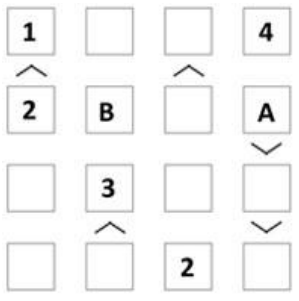
Q3. Each square of the given puzzle must be filled with a single-digit natural number such that:
– The sum of all four different digits in each row and each column is 10
– All the inequality signs (< and >) between the boxes must be followed
Find the correct values of A and B.
Solution
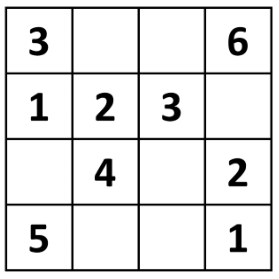
Q4. How many cells contain a digit equal to the sum of all the other digits in its corresponding row and column combined?
Solution
Q5. Using the digits 1, 2, 3, and 4, form the highest and the smallest three-digit numbers such that each number contains exactly two different digits.
What is the sum of the two numbers formed?
Solution
Q6. A 2-digit number is formed using two different digits, and the digits are reversed to create another 2-digit number.
The difference between these 2 numbers CANNOT be:
Solution
Q7. A four-digit number has the same number of even and odd digits.
Which of the following could possibly be the sum of the digits of this number?
Solution
Q8. The given grid is to be filled with distinct single-digit natural numbers such that:
● The sum of each row is the same and is an even number
● The larger number in each column is placed in the red block
What is the sum of the numbers in the white blocks?

Solution
Q9. A computer generates rectangles where the length and breadth (dimensions) follow a series. If the pattern continues, what will be the area of the next rectangle the computer should draw?
2 × 3, 3 × 5, 5 × 8, 8 × 13, 13 × 21, ?
Solution
Q10. Given below is a 3 × 3 grid to be filled by numbers from 1 to 9 such that:
● Every pair of adjacent digits in a row should have a difference of three
● Some of the numbers have already been placed
Based on the given conditions, choose the correct option.

Solution
The Thinking Spot
Given below are bulbs, each with a switch beneath it.
When you press a switch, it lights up ONLY the adjacent bulbs and not the bulb above the switch. What is the minimum number of switches you need to press to light up all the bulbs?

Solution
Additional Practice Questions with Solutions
Choose an answer, use a hint if needed, then open the worked solution to check your reasoning.
Solved 0 of 10 · Checked 0 of 10
Your practice progress lasts until you reset or reload this page.
Apply · binary
Practice Q1. How many ON/OFF states are possible for four independent lights?
Show hint
Multiply two choices four times.
Show worked solution
Option (c) 16.
2⁴ = 16 states.
Common mistake: Do not add the two choices for each light.
Apply · filter
Practice Q2. For RGB cards, Red must be ON and Blue must be OFF. Green is unrestricted. Which states remain?
Show hint
Fix the first position as U and the last as O.
Show worked solution
Option (a) UOO and UUO.
Green can be O or U, giving UOO and UUO.
Common mistake: An unrestricted light keeps both possibilities.
Apply · if
Practice Q3. The only clue says: “If Red is ON, Blue is ON.” Which state is forbidden?
Show hint
An implication fails when its condition holds but its required result does not.
Show worked solution
Option (b) Red ON, Blue OFF.
Red ON requires Blue ON, so Red ON with Blue OFF is forbidden.
Common mistake: The clue does not require Red to be ON.
Apply · filter
Practice Q4. Three lights R, G and B are in a line. Red is ON, no neighbouring lights may both be ON, and exactly two lights are ON. What is RGB?
Show hint
Green is next to the ON Red light.
Show worked solution
Option (d) UOU.
Green must be OFF. Since exactly two lights are ON, Blue must be ON: UOU.
Common mistake: Check the count as well as the neighbour rule.
Apply · digits
Practice Q5. What is the positive difference between 83 and its digit reversal?
Show hint
The reversal of 83 is 38.
Show worked solution
Option (b) 45.
83 − 38 = 45. It is also 9 × (8 − 3).
Common mistake: Reversal changes the place values.
Apply · parity
Practice Q6. A four-digit number contains exactly two odd digits and two even digits. Its digit sum must be:
Show hint
Pair the two odd digits and the two even digits.
Show worked solution
Option (c) Even.
Odd + odd is even, and even + even is even. Adding these two even totals gives an even sum.
Common mistake: An even total need not be divisible by four.
Apply · systematic
Practice Q7. Using digits 2, 3 and 5, form the greatest and smallest three-digit numbers that each use exactly two different digits. What is their sum?
Show hint
One digit must repeat, but all three cannot be the same.
Show worked solution
Option (a) 776.
The greatest is 553 and the smallest is 223. Their sum is 776.
Common mistake: Exactly two different digits excludes 555 and 222.
Apply · digits
Practice Q8. In A5 + 2A = 69, A5 and 2A are two-digit numbers. Find A.
Show hint
Use A5 = 10A + 5 and 2A = 20 + A.
Show worked solution
Option (a) 4.
11A + 25 = 69, so 11A = 44 and A = 4. Check: 45 + 24 = 69.
Common mistake: Use place values, not products.
Apply · parity
Practice Q9. Three numbers in a row increase by 3 from left to right. If the first is even, what is their parity pattern?
Show hint
Adding 3 changes parity each time.
Show worked solution
Option (b) Even, odd, even.
Even + odd is odd; then odd + odd is even. For example, 2,5,8.
Common mistake: Apply the change at every step.
Apply · systematic
Practice Q10. Six bulbs stand in a line, all initially OFF. Pressing a switch lights only the neighbouring bulbs, not its own bulb. What is the minimum number of switches needed to light them all?
Show hint
The end bulbs require switches 2 and 5. Then check bulbs 2 and 5 themselves.
Show worked solution
Option (c) 4.
Switches 2 and 5 are required for bulbs 1 and 6. Those switches do not light bulbs 2 or5, and no single switch neighbours both 2 and 5. Two more switches are needed. Pressing 1,2,5,6 lights all six bulbs, so the minimum is 4.
Common mistake: A lower bound of three is not enough; check whether three can actually work.