
CLASS 7 · Computational Thinking
Class 7 CT and AI: Parallel and Intersecting Lines Solutions
Count shapes systematically and use parallel-line and angle relationships to justify answers.
Jump to a question or activity
Key ideas
Count objects, pairs and directions separately: three mutually parallel faces make three pairs. At an intersection, opposite angles are equal and adjacent angles on a straight line add to 180°.
Short Concept Lessons
Learn a method, follow the example, then use it in the additional practice.
Count shapes by size
Count each size separately and add the groups. Larger shapes can contain smaller ones.
A 2 × 2 square grid contains four small squares and one large square: five altogether.
Remember: Count complete boundaries, not just empty regions.
Practise this method →Separate directions, edges and pairs
Parallel lines lie in the same plane and never meet. A cuboid has four edges in each of three directions.
For one chosen cuboid edge, three other edges run parallel to it.
Remember: Do not count the chosen edge as an additional parallel edge.
Practise this method →Count pairs without repeating them
Every pair contains two different objects. For three parallel faces labelled A, B and C, the pairs are AB, AC and BC.
Four mutually parallel planes give 4 × 3 ÷ 2 = 6 pairs.
Remember: AB and BA are the same pair.
Practise this method →Use intersection angle rules
Vertically opposite angles are equal. Adjacent angles forming a straight line add to 180°.
If one angle is 65°, its opposite is 65° and each adjacent angle is 115°.
Remember: Decide whether the question refers to opposite or adjacent angles.
Practise this method →Measure turns on a clock face
There are twelve equal gaps around a clock. Each gap is 30°, so three gaps make a right angle.
The diameters through 12–6 and 3–9 are perpendicular.
Remember: Use the shown positions; do not confuse a drawn diameter with a real clock time.
Practise this method →Prove a quadrilateral is a parallelogram
Show that both pairs of opposite sides are parallel. Use the given relationships rather than the appearance of a sketch.
If AB ∥ CD and BC ∥ AD in quadrilateral ABCD, it is a parallelogram.
Remember: One parallel pair alone is not enough.
Practise this method →Questions and Solutions
Q1. Each side of a square is divided into three equal parts by marking points on it.
Using these points as endpoints, line segments are drawn inside the square, such that each line segment is parallel to at least one side of the square. What is the maximum number of squares that can be found in the resulting figure?
Solution
Q2. The following arrangement is formed using a cube and a cuboid.
How many edges are parallel to the edge highlighted by the red line?

Solution
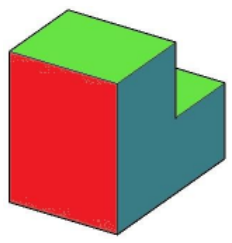
Q3. In the following solid, every edge has at least one other edge parallel to it.
How many different pairs of PARALLEL FACES are present in the solid?
Solution
Q4. In a clock, the hour hand and the minute hand are perpendicular to each other, where the minute hand is at 12.
How many different possible positions the hands of the clock can have at this time?
Solution
Q5. If each of the given terms follows the same theme, what will come in place of “?”

Solution
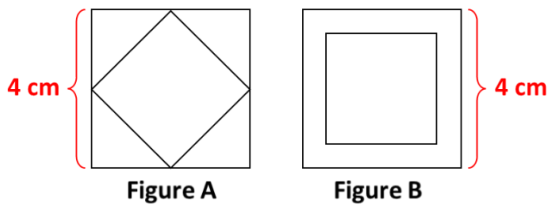
Q6. Figures A and B are formed using two transparent squares, each.
If figure A is placed on top of figure B (without rotation), such that it completely overlaps figure B, how many right-angled triangles can be seen in the resultant image?
Solution
Q7. In triangle ABC, BC is the base.
Point P lies on AB and point Q lies on BC such that PQ is parallel to AC.
Point R lies on AB and point S lies on AC such that RS is parallel to BC.
Lines PQ and RS intersect at a point O inside the triangle.
Which of the following quadrilaterals must be a parallelogram?
Solution
Q8. Two lines intersect at point K.
One angle is (ax − 10)° and its vertically opposite angle is (bx + 20)°.
Which of the following is DEFINITELY true?
Solution
Q9. A computer draws two intersecting lines.
One angle formed at the intersection is 70°, but originally, it was intended to be 40°. Which of the following options shows the respective ‘Expected and Resultant’ measures of one of the other angles?
Solution
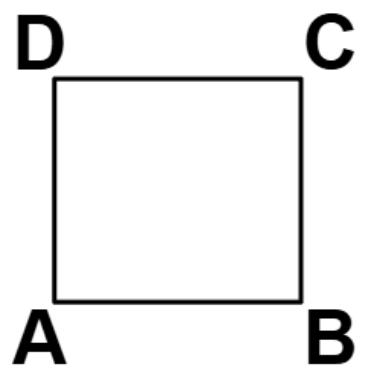
Q10. ABCD is a square of side length 4 m.
Raj starts from point A and walks North to reach point D. From point D, he further walks 4 m without taking any turns and reaches point P. At P, he turns 135° clockwise and walks a certain distance and stops only when he reaches a point on the square. Which of the following statements is INCORRECT with respect to the boundary of the square and the path taken?
Solution
The Thinking Spot
A, B, and C are all different numbers having any value among 1, 2, and 5.
What will come in place of C so that no two consecutive numbers are placed next to each other in any direction (vertically, horizontally, or diagonally)?

Solution
Additional Practice Questions with Solutions
Choose an answer, use a hint if needed, then open the worked solution to check your reasoning.
Solved 0 of 10 · Checked 0 of 10
Your practice progress lasts until you reset or reload this page.
Apply · count
Practice Q1. How many squares are present in a complete 4 × 4 grid of equal small squares?
Show hint
Count squares of side lengths 1, 2, 3 and 4 units.
Show worked solution
Option (c) 30.
16 + 9 + 4 + 1 = 30 squares.
Common mistake: Larger squares must also be counted.
Apply · parallel
Practice Q2. How many other edges of a cuboid are parallel to one selected edge?
Show hint
There are four edges in the selected direction, including the selected edge.
Show worked solution
Option (b) 3.
Four edges share that direction. Excluding the selected edge leaves three.
Common mistake: Do not count the reference edge itself.
Apply · pairs
Practice Q3. Four distinct planes are mutually parallel. How many different pairs of parallel planes can be chosen?
Show hint
List pairs or use 4 × 3 ÷ 2.
Show worked solution
Option (d) 6.
Each of four planes pairs with three others, but this counts each pair twice: 12 ÷ 2 = 6.
Common mistake: Reversing the order does not create a new pair.
Apply · clock
Practice Q4. A line across a clock face joins 1 and 7. Which diameter is perpendicular to it?
Show hint
Move each endpoint by three hour marks.
Show worked solution
Option (a) 4 and 10.
A quarter-turn takes 1 to 4 and 7 to 10. The diameter 4–10 is perpendicular.
Common mistake: Three hour gaps equal 90°.
Apply · angles
Practice Q5. Two lines intersect. One angle is 65°. What is an adjacent angle on the same straight line?
Show hint
The adjacent pair adds to 180°.
Show worked solution
Option (c) 115°.
180° − 65° = 115°.
Common mistake: Opposite angles are equal; this question asks for an adjacent angle.
Apply · angles
Practice Q6. Vertically opposite angles are (3x + 5)° and (5x − 15)°. Find x.
Show hint
Set the expressions equal.
Show worked solution
Option (b) 10.
3x + 5 = 5x − 15 gives 20 = 2x, so x = 10. Both angles are 35°.
Common mistake: Equate opposite angles rather than adding them to 180°.
Apply · clock
Practice Q7. With the minute hand at 12, which pair of times gives perpendicular clock hands?
Show hint
The hour hand must be three hour gaps from 12.
Show worked solution
Option (d) 3:00 and 9:00.
At 3:00 and 9:00, the smaller angle between the hands is 90°.
Common mistake: Perpendicular means a right angle.
Apply · proof
Practice Q8. In quadrilateral ABCD, AB ∥ CD and BC ∥ AD. What must ABCD be?
Show hint
Both pairs of opposite sides are parallel.
Show worked solution
Option (a) A parallelogram.
That is the defining parallel-side property of a parallelogram. Equal sides or right angles are not specified.
Common mistake: Do not infer extra properties.
Apply · angles
Practice Q9. An intended intersection angle of 50° is drawn as 80°. What are the expected and actual adjacent angles, in that order?
Show hint
Subtract each intersection angle from 180°.
Show worked solution
Option (b) 130°, 100°.
Expected: 180° − 50° = 130°. Actual: 180° − 80° = 100°.
Common mistake: Keep the requested order.
Apply · count
Practice Q10. A complete 2 × 3 rectangular grid contains equal unit squares. How many squares of all sizes does it contain?
Show hint
There are six unit squares; then count 2 × 2 squares.
Show worked solution
Option (c) 8.
There are 6 small squares and 2 squares of side 2 units: 6 + 2 = 8.
Common mistake: A 2 × 3 rectangle is not itself a square.