
CLASS 7 · Computational Thinking
Class 7 CT and AI: Expressions using Letter-Numbers Solutions
Translate symbols into relationships and solve the handbook’s algebraic and calendar puzzles.
Jump to a question or activity
Key ideas
Letters can represent numbers, but digit strings such as 5A mean 50 + A, not 5 × A. Write each verbal condition as an equation or inequality before substituting.
Short Concept Lessons
Learn a method, follow the example, then use it in the additional practice.
Translate a symbol key first
An unfamiliar symbol can stand for an ordinary comparison. Replace it with its stated meaning before reasoning.
If @ means greater than, p @ q means p > q.
Remember: Do not use the usual meaning of a symbol when the question defines a different one.
Practise this method →Simplify before substituting
Combine like terms while keeping subtraction signs attached to every term in the brackets.
(5a + 2b) − (3a + b) = 2a + b.
Remember: A minus before brackets changes the signs of all terms inside.
Practise this method →Balance incoming and outgoing quantities
At a junction with no leftovers, incoming units equal the local demand plus outgoing units.
A town receives 90 units, uses 30 and passes on 60: 90 = 30 + 60.
Remember: Include goods sent onwards, not just goods used locally.
Practise this method →Use bounds to find possible values
Combine all equations and inequalities, then check which allowed numbers fit. Whole numbers include zero.
If n is a whole number and 1 < n < 4, then n is 2 or 3.
Remember: Strict inequalities exclude equality.
Practise this method →Distinguish digits from multiplication
When a question defines 7A as a two-digit number, it means 70 + A. The letter is a digit from 0 to 9.
If A = 3, the two-digit number 7A is 73, while 7 × A is 21.
Remember: A leading digit cannot be zero in a two-digit number.
Practise this method →Track repeated changes
Write how much each quantity changes in one step. A total age increases once for every person; weekdays repeat every seven days.
Three people gain a total of 3 × 4 = 12 years over four years.
Remember: For calendar problems, remove complete groups of seven days.
Practise this method →Questions and Solutions
Q1. It is given that x means ‘greater than’, $ means ‘equal to’, < means ‘not less than’, A means ‘less than’ and + means ‘not greater than’. Which of the following options has the same meaning as the given expression?
a x b A c
Solution
Q2. A factory ‘S’ sends goods to four cities: A, B, C, and D through pipelines (represented by arrows), as shown below.
The demand of each city is mentioned above that city (for example, the demand at City A is 400 units). The demands are satisfied exactly, and no extra units are left in the pipelines. If 300 units are sent through the pipeline from A to B, how many units are sent from D to B?

Solution
Q3. Each letter in Set 1 corresponds to exactly one different number from Set 2 (in any order).
Set 1: A, B, C, P, Q, R
Set 2: 1, 2, 4, 5, 7, 9
The following conditions are given:
● A and C are consecutive numbers, with A > C
● P + Q = R, with P > Q
● B is greater than both A and C
Using this information, find the value of: (4P+3B) − (2P+3C) + (2A−3B)
Solution
Q4. The sum of the ages of four people A, B, C, and D is 35.
Each one of them is at least 8 years old. What is the MAXIMUM possible age of the oldest person?
Solution
Q5. 3 whole numbers A, B, and C, satisfy the given conditions. At maximum, how many different possible values can C have?
A > B > C and A + B = 10
Solution
Q6. If the sum of the ages of Shubham and Shivam is 36.
What would be the sum of their ages after 36 years?
Solution
Q7. A, B, and Z are natural numbers such that A + B = Z and:
● The value of B is twice the value of A
● The value of B is greater than 4
● The value of Z is less than 10
What could be the value of A?
Solution
Q8. In the given image, each number equals the sum of the two numbers immediately below it.
If P, Q, and R are unknown, what is the value of P × Q + R?

Solution
Q9. 5A, 5B, and C9 are 2-digit numbers, where A, B, and C represent one of the digits of the respective numbers, and A + B + C = 15. Find the MAXIMUM possible value of 3B + 4C + 8, if:
5A > 5B > C9
Solution
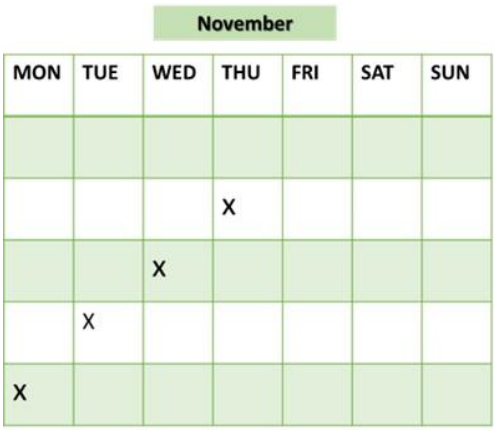
Q10. All the cells having ‘x’ in the given calendar represent dates that are consecutive multiples of a particular number.
The first ‘x’ represents the first Thursday of the month, as shown below. Which of the following is the last day of the month?
Solution
The Thinking Spot
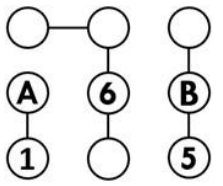
Numbers from 1-9 are to be placed in the grid such that no two consecutive numbers are placed adjacent to each other.
For example, the bottom-left circle has 1, so the circle above it and the circle on the immediate right cannot have the number 2.
Each group of circles which are inter-connected by lines must contain either only odd or only even numbers.
Find the values of A and B.
Solution
Additional Practice Questions with Solutions
Choose an answer, use a hint if needed, then open the worked solution to check your reasoning.
Solved 0 of 10 · Checked 0 of 10
Your practice progress lasts until you reset or reload this page.
Apply · symbols
Practice Q1. If @ means greater than and # means less than, what does a @ b # c tell us?
Show hint
Translate each symbol separately.
Show worked solution
Option (a) a > b and c > b.
a > b < c says that both a and c are greater than b. It does not compare a with c.
Common mistake: Do not infer an order between a and c.
Apply · expressions
Practice Q2. Simplify (5p + 2q) − (3p + q).
Show hint
Subtract both terms in the second bracket.
Show worked solution
Option (c) 2p + q.
5p + 2q − 3p − q = 2p + q.
Common mistake: The minus sign applies to both 3p and q.
Apply · balance
Practice Q3. A town uses 250 units of water and sends 400 units onwards. One pipe brings in 180 units. With no losses or leftovers, how many units must a second pipe bring?
Show hint
Total inflow must cover local use and onward flow.
Show worked solution
Option (c) 470.
Required inflow = 250 + 400 = 650. The second pipe supplies 650 − 180 = 470 units.
Common mistake: Do not omit the town’s own use.
Apply · bounds
Practice Q4. The ages of four children total 42 years. Each is at least 9 years old. What is the maximum possible age of the oldest?
Show hint
Give the other three children their minimum ages.
Show worked solution
Option (b) 15 years.
42 − 3 × 9 = 15 years. The ages 9,9,9,15 satisfy every condition.
Common mistake: Maximise one age by minimising the other three.
Apply · bounds
Practice Q5. Whole numbers A, B and C satisfy A + B = 12 and A > B > C. How many different values can C take?
Show hint
The largest possible B is 5.
Show worked solution
Option (c) 5.
A = 7, B = 5 allows C = 0,1,2,3,4: five values. B cannot reach 6 because then A would not exceed it.
Common mistake: Include zero, but exclude B itself.
Apply · patterns
Practice Q6. Three people have a combined age of 45 years. What will their combined age be after 5 years?
Show hint
Each of the three people becomes five years older.
Show worked solution
Option (c) 60 years.
45 + 3 × 5 = 60 years.
Common mistake: The total increases once per person.
Apply · digits
Practice Q7. If A = 4 and B = 2, what is the difference between the two-digit numbers 6A and B8?
Show hint
Write out the two numbers before subtracting.
Show worked solution
Option (a) 36.
6A = 64 and B8 = 28. Their difference is 64 − 28 = 36.
Common mistake: Digit notation is not multiplication.
Apply · expressions
Practice Q8. An addition pyramid has bottom row 2, P, 4 and top value 18. Each entry is the sum of the two below it. What is P?
Show hint
The middle entries are 2 + P and P + 4.
Show worked solution
Option (c) 6.
18 = (2 + P) + (P + 4) = 2P + 6. Thus 2P = 12 and P = 6.
Common mistake: The bottom middle value contributes twice to the top.
Apply · patterns
Practice Q9. A date falls on Tuesday. What weekday is 17 days later?
Show hint
Remove two full weeks from 17 days.
Show worked solution
Option (c) Friday.
17 = 14 + 3. Three days after Tuesday is Friday.
Common mistake: Count elapsed days, with Wednesday one day later.
Apply · bounds
Practice Q10. Natural numbers A and B satisfy B = 3A, B > 6 and A + B < 13. What is A?
Show hint
Combine 3A > 6 with 4A < 13.
Show worked solution
Option (c) 3.
A > 2 and A < 3.25. The only natural number is 3. Then B = 9 and A + B = 12.
Common mistake: Check both strict inequalities.