
The Pot Maker Questions and Answers | Class 9 Kaveri
Checked against NCERT Kaveri, first edition January 2026, pages 33–56; listening transcript 261. Personal, discussion and creative responses are samples: adapt them to your experience. This independent study guide is not an official NCERT answer key.
Chapter Overview
Set in a Naga village, this moving story by Temsula Ao follows young Sentila, who dreams of becoming a pot maker like her mother and grandmother. Her mother Arenla, worn out by the back-breaking, poorly paid craft, wants her to take up weaving instead. The story explores the tension between a parent’s practical worries and a child’s calling, the village’s belief that traditional skills belong to the whole community, and the continuation of a craft across generations. It celebrates passion, perseverance and the dignity of indigenous crafts.
About the Author – Temsula Ao
NCERT credits this abridged story to Temsula Ao. Her narrative brings together a young learner’s ambition, the difficulty of earning a living through skilled handwork, and the responsibility of passing knowledge to another generation.
Summary in English
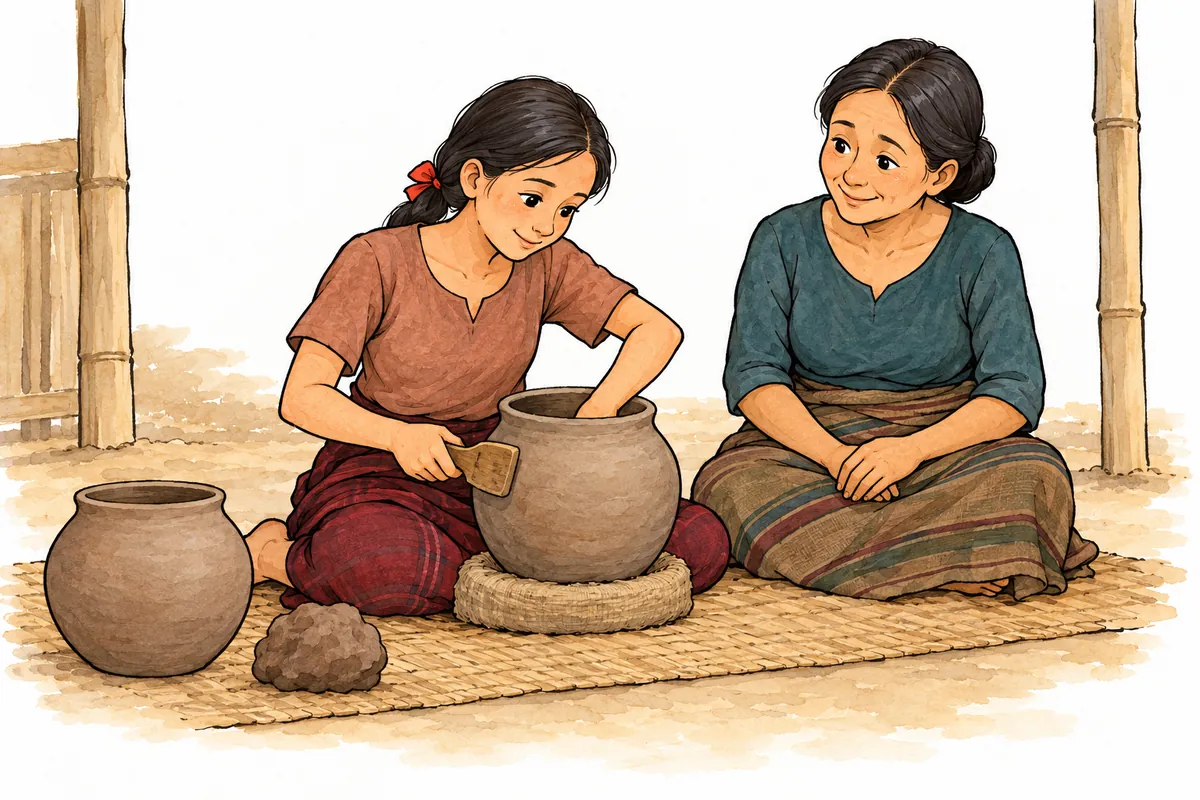
Ever since she was old enough to go to the fields, Sentila has dreamt of becoming a pot maker like her mother, Arenla, and her grandmother. But she keeps her passion secret, because one night she overheard Arenla telling her father, Mesoba, that pot making had brought her nothing but pain — clay had to be carried up from a riverbank sixteen kilometres away, pounding it in bamboo cylinders was exhausting, a batch of pots took months, and the reward was a pittance. Arenla wanted Sentila to learn weaving instead: cleaner, indoor work with handsome returns. Undeterred, Sentila secretly watches expert potters — how the clay is mixed, pounded and deftly shaped with a spatula, dried and fired in a kiln with great care. Her visits become village gossip, and the council summons Mesoba: traditional skills, the elders warn, do not belong to any individual; experts must pass them on.
The next year Arenla finally begins teaching her daughter — digging clay with a dao, soaking and pounding it — but for almost a year Sentila fails at shaping pots while her mother silently watches. When Sentila moves to the girls’ dormitory, the kind widow Onula notices her tense, clumsy efforts and teaches her to relax; Sentila makes a beautiful pot whose mouth is still imperfect, and Onula tells her to watch her mother closely while the pot’s mouth is shaped. During the next session Sentila does so. Then, on a bright sunny day, Arenla — complaining of a headache and backache — asks Sentila to carry on alone. Working with sudden ease and dexterity, Sentila makes pot after pot, finishing just one short of her mother’s tally. But inside the house she finds Arenla lying dead. As the body is carried out, Sentila cries that she never wished it to happen this way. Only Onula understands: in the work shed stand two identical rows of pots, impossible to tell apart. The mother’s art now lives on in the daughter — a new pot maker is born.
Summary in Hindi (सारांश हिंदी में)
नागालैंड के एक गाँव की सेंतिला बचपन से अपनी माँ अरेनला और दादी की तरह कुम्हारिन बनने का सपना देखती है, परंतु अपनी इच्छा छिपाए रखती है, क्योंकि उसने एक रात माँ को पिता मेसोबा से कहते सुना था कि मिट्टी के बर्तन बनाने से उसे केवल कष्ट मिला है — सोलह किलोमीटर दूर नदी-तट से मिट्टी ढोनी पड़ती है, बाँस की नलियों में मिट्टी कूटना थका देने वाला है, महीनों की मेहनत का फल केवल कुछ रुपये! माँ चाहती है कि बेटी बुनाई सीखे — साफ-सुथरा, घर के भीतर का काम और अच्छी कमाई। फिर भी सेंतिला चुपके-चुपके कुशल कुम्हारों को काम करते देखती रहती है। बात गाँव में फैल जाती है और पंचायत मेसोबा को बुलाकर चेतावनी देती है — परंपरागत कलाएँ किसी एक व्यक्ति की नहीं होतीं; उन्हें अगली पीढ़ी को सौंपना कर्तव्य है।
अगले वर्ष अरेनला बेटी को सिखाना शुरू करती है, पर लगभग एक वर्ष तक सेंतिला बर्तन का आकार ही नहीं बना पाती। छात्रावास में स्नेही विधवा ओनुला उसकी घबराहट पहचानकर उसे सहज होना सिखाती है — सेंतिला सुंदर बर्तन बनाती है, लेकिन उसका मुँह अभी ठीक नहीं बना है। ओनुला सलाह देती है कि बर्तन का मुँह बनाते समय माँ को ध्यान से देखना। फिर एक धूप भरे दिन अरेनला सिरदर्द-कमरदर्द का कहकर सेंतिला को अकेले काम सौंप देती है। सेंतिला अद्भुत गति और कुशलता से बर्तन पर बर्तन बनाती जाती है — माँ से केवल एक कम! परंतु घर में उसे माँ मृत मिलती है। अर्थी के पीछे दौड़ती सेंतिला कहती है — “माँ, मैंने ऐसा नहीं चाहा था!” केवल ओनुला समझती है। कार्यशाला में एक जैसे बर्तनों की दो पंक्तियाँ खड़ी हैं — पहचानना असंभव कि कौन-सी किसकी है। माँ की कला बेटी में जीवित हो उठी है — एक नई कुम्हारिन का जन्म हुआ है।
The ending places Sentila’s achievement beside Arenla’s death. It does not establish that her success caused the death or that their exact moments coincided. Her grief and plea for forgiveness do not make her responsible for it.
Word Meanings (शब्दार्थ)
| Word | English Meaning | हिंदी अर्थ |
|---|---|---|
| outgrow | to lose interest in something as one grows older | बड़े होकर रुचि खो देना |
| indifference | lack of interest in something | उदासीनता |
| pittance | a very small amount of money received as income | नाममात्र की कमाई |
| pounding | repeated beating | कूटना |
| tedious | tiring, boring | उबाऊ, थकाऊ |
| deftly | skilfully | कुशलता से |
| spatula | tool used by a potter to shape a pot | बर्तन गढ़ने का औज़ार |
| kiln | oven for baking pots | भट्ठी (आवाँ) |
| tend | take care of | देखभाल करना |
| followed suit | did the same thing as somebody else | अनुसरण किया |
| dao | an instrument used to dig | खोदने का औज़ार (दाओ) |
| malleable | able to be shaped without breaking or cracking | लचीला, गढ़ने योग्य |
| dormitories | large rooms containing many beds | शयनशालाएँ |
| resolved | (here) determined | दृढ़ निश्चय किया |
| wearily | tiredly | थकान से |
| slackened | relaxed, made slower | धीमा किया |
| momentum | driving force | गति, वेग |
| dexterity | skill | निपुणता |
| tally | a count (of pots) | गिनती |
| threshold | entrance of a room | दहलीज़ |
| intuitively | based on feelings | सहज बोध से |
| momentous | of great significance | अत्यंत महत्त्वपूर्ण |
| phenomenon | unusual incident | विलक्षण घटना |
| profound revelation | powerful moment of realisation | गहन रहस्योद्घाटन |
NCERT Exercise Solutions
Reflect and Respond
I. Identify the four vocations and give five more examples.
From left to right: basket weaving, pottery, weaving and carpentry. Five additional examples are blacksmithing, embroidery, shoemaking, stone carving and tailoring.
II.1. What do the pictures have in common?
II.2. Complete the word.
II.3. Compare handmade and machine-made products.
Handmade products often show individual variations and an artisan’s personal choices. Machine production can make large quantities with greater uniformity. Time, price and quality depend on materials, skills and methods; neither category is automatically better in every respect.
Check Your Understanding (after Part I)
I. Do you think pot making is easy? If yes, why? If no, why not?
No, pot making is not easy. The grey and red clay must be carried uphill from a riverbank sixteen kilometres away, down a sheer drop. Pounding the stubborn clay inside bamboo cylinders is tedious, shaping the rotating lump with a spatula demands great skill, and the pots must be carefully dried and fired in a kiln, where over-firing or under-firing can ruin the whole batch. A single batch takes months of labour — and earns only a pittance.
II. Would Sentila be able to fulfil her dream of becoming a pot maker? Explain.
Sample prediction: Sentila may fulfil her dream. Her passion is deep and steady — she secretly visits expert potters, watches every step of the craft with fascination and refuses to give up even though her mother wants her to learn weaving. Such quiet determination and keen observation are the marks of a true learner, so practice and helpful guidance could enable her to succeed. At this stage of reading, this is a prediction, not an established outcome.
III. Do you think Mesoba and Arenla would support Sentila? Give a reason.
Yes. Mesoba defends the family before the village council and even promises that Sentila will soon make the best pots in the village, which shows his faith in her. Arenla’s resistance comes from love — she only wants to spare her daughter the hardship and poverty of the craft — so once she sees Sentila’s genuine passion, she too is likely to teach her, as the elders have also reminded the family of this duty.
Check Your Understanding (after Part II)
I. Do you think Onula’s support helped Sentila? If yes, why? If no, why not?
Yes, Onula’s support was the turning point. She noticed that Sentila was too tense during the practice session she observed. Her kind words, “Don’t worry, little one,” gave Sentila confidence; her demonstration taught her the right method; and her advice to watch how Arenla shaped the mouth of the pot completed the learning. With Onula’s help, Sentila made a beautiful pot, although its mouth still needed improvement.
II. Sentila observes her mother making pots. What does this tell us about her?
It shows that Sentila is a keen observer and a sincere, patient learner. Instead of being discouraged by her failures, she follows Onula’s advice and studies every movement of her mother’s hands — how she held the spatula, slackened the rhythm at the mouth of the pot, and added a strip of dough for the rim. Her watchfulness reflects dedication, humility and a genuine hunger to master the craft.
III. Arrange the following events of the story in the correct sequence.
4 → 6 → 3 → 1 → 8 → 5 → 2 → 9 → 7
| Order | Event |
|---|---|
| 1. | (4) Sentila was passionate about pottery but did not share it with her mother. |
| 2. | (6) Sentila overheard her mother saying that pot making was a tiring job and that she earned very little from it. |
| 3. | (3) Sentila observed how other expert potters crafted beautiful pots. |
| 4. | (1) The village council called Mesoba to know about Arenla’s unwillingness to teach pottery to Sentila. |
| 5. | (8) Sentila learnt the art of pot making for a year from her mother, but was unsuccessful. |
| 6. | (5) Onula guided Sentila in the art of pot making. |
| 7. | (2) Arenla made a new batch of pots and asked Sentila to continue the work as she was unwell. |
| 8. | (9) Sentila was able to make pots quickly and skilfully, just one less than her mother’s. |
| 9. | (7) Onula observed two rows of pots inside the work shed, which she felt was the work of two people. |
Critical Reflection
I. Read the extracts given below and answer the questions that follow. (Extract 1: Arenla’s complaint about the hardships of pot making — textbook page 42)
(i) Choose the correct reason for the given assertion. (A): The effort in making pots is far greater than the returns.
A. The process of pot making is quite tiresome and long, and one hardly earns much.
(ii) Why does Arenla want Sentila to learn weaving?
Because weaving earns much more money and also provides enough cloth for the family. It is not messy like pot making, can be done indoors in all seasons, and a shawl takes far less time to make while giving a handsome return.
(iii) State one advantage that weaving has over pot making, as per the extract.
Weaving can be done indoors in all seasons (it is also cleaner, quicker and more profitable than pot making).
(iv) Choose the sentence that uses the word ‘handsome’ in the same way as in the extract.
B. They will make a handsome profit selling this property. (Here ‘handsome’ means large in amount, not good-looking.)
(v) ‘And the reward?’ What is the author’s purpose of using a question mark here?
The question mark makes the sentence rhetorical and ironic. Arenla pauses to make the listener expect a worthy reward — and then crushes that expectation with “a few rupees”. It emphasises her bitterness at how poorly the months of hard labour are paid.
(Extract 2: Onula watching Sentila’s clumsy efforts in the dormitory — textbook page 43)
(i) Complete the sentence with an appropriate reason. Onula feels Sentila’s effort at making a pot is clumsy because ______.
…Sentila was too tense, and as a result the clay seemed unable or unwilling to yield the right shape.
(ii) ‘Don’t worry, little one, I shall teach you how to make a perfect pot.’ This shows that Onula was _____________.
C. thoughtful and generous — she noticed the girl’s struggle on her own and freely offered her time and skill.
(iii) Which among the following is the effect of a cause?
A. “As a result, the clay seemed unable or unwilling to yield the right shape.” (The cause was Sentila’s tension.)
(iv) ‘Onula fashioned a beautiful pot.’ Here, the word ‘fashioned’ means ______. (created/styled)
created
(v) How might Sentila have felt when she saw ‘the misshapen lump fall flat on the ground’?
She may have felt frustrated or discouraged because her efforts had again failed. This is an inference about her feelings, supported by her repeated difficulty in shaping the clay.
II. Answer the following questions.
1. Describe the process of pot making followed by expert pot makers, as observed by Sentila.
The clay is first mixed with water and pounded. The potter then pushes the left hand into a lump of softened clay and deftly rotates it, shaping the rotating lump with a spatula held in the right hand — the regular tap-tap giving the pot its form. After two or three days the pots get a final touch-up to retain their shape and test their consistency. They are then dried in the sun, loaded on to a kiln in a uniform pattern on a bed of hay and dried bamboo, covered with another layer of the same materials, and fired — with the fire tended carefully, since over-firing or under-firing can ruin the entire batch.
2. What warning was given to Mesoba by the village council?
The elders cautioned Mesoba to remind Arenla that it was her duty to teach her daughter the skill handed down from generation to generation. They declared that skills like pot making, which served the people’s needs and symbolised their tradition and history, did not ‘belong’ to any individual — experts were obliged to pass them on, not only to their own children but to anyone who wished to learn.
3. How did Sentila feel when she failed at pot making even after a year of training with her mother?
She felt ashamed and frustrated — she would hang her head while her mother silently took over and turned the same lump into a beautiful pot. Yet her failures never killed her passion; she kept practising secretly in the dormitory, which shows that beneath the frustration her determination remained alive.
4. ‘Onula stood there for a long time as if trying to absorb a new phenomenon.’ Explain.
Inside the work shed Onula saw two neat rows of newly made pots so perfectly alike that nothing could tell one batch from the other — yet she knew they were made by two different hands, mother and daughter. She recognised that Sentila could now produce pots as skilfully as her mother. The sight suggests continuity through learning despite a devastating loss. A reader may sense a mysterious atmosphere, but the story does not prove a supernatural transfer of skill or a causal link between achievement and death.
5. ‘The tradition and history of the people did not belong to any individual.’ What does this symbolise?
Within the council’s view in the story, it symbolises traditional crafts as shared community heritage. This is a literary explanation of the elders’ belief, not a statement about legal ownership. An expert is only a trustee of the skill for one generation; she holds it on behalf of her people and is duty-bound to hand it on. The craft carries the community’s identity and history, which must never be allowed to die with one person.
6. What is the significance of the concluding line of the story, ‘A new pot maker was born’?
The line completes the story’s circle. As the village mourns its experienced potter, a successor emerges — the tradition does not break, it is reborn. It also marks Sentila’s transformation: the clumsy, tense learner has become a true artist whose pots cannot be told apart from her mother’s. Birth and death stand side by side in one sentence, giving the ending both sorrow and hope.
7. What is the role of perseverance in pursuing one’s dreams? Elaborate with reference to Sentila.
Perseverance sustains learning, especially when combined with instruction, feedback and opportunities to practise. Sentila dreams of pottery from childhood, secretly watches expert potters, endures her mother’s refusal, fails continuously for a whole year, and still does not give up. She accepts Onula’s guidance humbly, studies her mother’s hands carefully and keeps practising until, one sunny day, the skill finally flows through her own fingers. Without her quiet persistence, neither talent nor tradition could have made her a pot maker; her experience illustrates the value of persistence and supportive teaching, without guaranteeing that effort alone fulfils every dream.
Vocabulary and Structures in Context
I. Classify the words/phrases given in the box as shown in the table below.
| Tools/Implements | Raw Materials | Process |
|---|---|---|
| dao, spatula, cylinders, basket, kiln | dough, clay, bamboo, bed of hay (bamboo and hay are firing materials; they are not ingredients of the clay dough) | pounding, rotating, shaping |
II. Work in pairs and find the meanings of the following words related to economy. Now, frame sentences using each word.
| Word | Meaning | Sentence |
|---|---|---|
| bankrupt | unable to pay one’s debts | The firm went bankrupt after years of losses. |
| credit | money borrowed, or buying now to pay later | The shopkeeper sold goods on credit to trusted customers. |
| currency | the money system of a country | The rupee is the currency of India. |
| debt | money owed to someone | The farmer repaid his debt after a good harvest. |
| fiscal | related to government money matters | The new fiscal policy supports small artisans. |
| inflation | a general rise in prices | Inflation has made raw materials costlier for craftsmen. |
| investment | money put into something to earn profit | Buying a new loom was a wise investment for the weaver. |
| interest | extra money paid on borrowed money | A borrower may pay interest on a loan. |
III. Noun clauses, relative clauses and determiners
1. Complete the sentences (sample answers).
Grammar clarification: Although the exercise heading says “noun clauses”, only (i)–(iii) use noun/content clauses. In (iv), the clause beginning which comments on the preceding observation; in (v), where introduces a relative clause describing the kiln. These two are not noun clauses.
(i) The elders emphasised that traditional skills did not belong to any individual and had to be passed on.
(ii) Mesoba explained why Arenla had not yet taught Sentila pot making — they wanted her to grow stronger after her illness.
(iii) Onula’s promise was that she would teach Sentila how to make a perfect pot.
(iv) Sentila observed her mother carefully when she was shaping the mouth of the pot, which helped her master the most difficult step of the craft.
(v) The kiln, where the pots were fired on a bed of hay and dried bamboo, required careful attention to prevent over-or-under firing.
2. Underline the main clause and circle the subordinate clause.
(i) Main clause: Arenla took Sentila to the riverbank; subordinate (relative) clause: where the grey and red clay was found.
(ii) Main clause: She started on the next one; subordinate clause: who had suddenly found momentum (describing the sprinter).
(iii) Main clause, restored from the complete sentence: skills such as pot making did not belong to any individual; relative clause: which not only catered to the needs of the people but also symbolised the tradition and history of the people. The exercise prints a shortened fragment; use the full story sentence to identify the main clause.
3. Complete the following sentences with suitable relative clauses.
(i) Sentila, whose passion for pottery had never faded, practised the craft diligently.
(ii) The village council, where the elders met to settle important matters, sought an explanation for Arenla’s reluctance.
(iii) The potter’s hands, which moved with practised rhythm and skill, shaped the clay into beautiful creations.
(iv) Arenla, her mother, wanted her to learn weaving, which earned more money and provided cloth for the family.
(v) Mesoba went home and discussed the matter with Arenla, who finally agreed to teach their daughter the next year.
4(i). Find out some more determiners from the text.
Examples from the story include her mother, the riverbank, a few rupees, sixteen kilometres, two neat rows, every possible way and a new pot maker. A determiner accompanies a noun; a word such as “one” standing alone may function as a pronoun.
4(ii). Fill in the blanks with suitable determiners.
A. The florist arranged five bouquets for her clients, that were displayed in her elegant floral shop.
B. The carpenter crafted several unique tables, and one became the centrepiece in his furniture collection.
C. Each of the apprentices in the culinary class demonstrated their knife skills during the intense cooking session.
D. Some of the sculptures were displayed at the art exhibition, showcasing our diverse artistic skills. (A sample completion spoken by the artists; other contextually suitable possessives are possible.)
Listen and Respond
I. Complete the three gaps using the transcript on page 261.
- visually interesting three-dimensional
- sculptures
- fascinating and mesmerising
II. Select six statements that best match the process.
The best matches among the printed options are 1, 3, 5, 6, 8 and 9. This is a selection of statements, not their chronological order. Option 3 loosely represents choosing stone according to the intended statue’s weight and dimensions; the recording does not describe measuring a finished statue. Option 5 paraphrases refinement, but final finishing occurs after detachment.
Actual sequence: choose suitable stone → remove large unwanted portions → develop the imagined shape with tools and references → detach the creation → give it a finishing touch. Setting up tools, soaking the statue overnight and beginning at the centre are not stated steps.
Speaking Activity
Role-play between Sentila and Onula
Imagined dialogue, not quotations from the story.
Sentila: I want to make pots, but the clay keeps losing its shape.
Onula: Let your hands relax. Watch while I demonstrate, then try again.
Sentila: This pot is better, but its mouth still looks wrong.
Onula: Watch your mother closely when she shapes the mouth. Notice how she changes the rhythm and forms the rim.
Sentila: I shall observe carefully and keep practising. Thank you for helping me.
Writing Task – Reflective Writing
I. Follow the steps given below to create a write-up about your skills and passions.
My Skills and My Passion (imagined student example; replace achievements with your own)
Introduction: Ever since I painted my first poster in Class 4, art has been the activity in which I lose all sense of time. Sketching and painting are meaningful to me because they let me say things that words cannot.
Describing skills: I nurture this skill through a weekend art class, by maintaining a daily sketchbook, and by taking part in school exhibitions and online drawing challenges. Recently I have begun learning digital illustration on a tablet.
Passion into profession: I believe illustration and design have real career potential — books, advertising, animation and apps all need artists. My patience with detail and my habit of observing people, like Sentila observing the potters, are my biggest advantages.
Examples and reflection: Last year my poster on water conservation won the district competition, and our teacher used my diagrams in class. These moments showed me that my art can inform and inspire others, and they have shaped my ambition to study design after school.
Conclusion: This reflection has taught me that my passion and my skills feed each other: the more I practise, the deeper my love for art grows. With steady effort, I hope to turn this passion into my profession.
Learning Beyond the Text
I. Match the pottery photographs on page 51.
Suggested matches using the textbook’s six supplied labels, read across each row:
| Position | Textbook label | Visible feature |
|---|---|---|
| Top left | Khurja pottery — Uttar Pradesh | Colourful glazed vessels |
| Top middle | Blue pottery — Jaipur | Blue-and-white patterned ware |
| Top right | Terracotta — West Bengal | Reddish-brown figures |
| Bottom left | Andretta pottery — Himachal Pradesh | Decorated plates and bowls |
| Bottom middle | Karigari pottery — Tamil Nadu | Plain reddish-brown pots |
| Bottom right | Longpi Black pottery — Manipur | Dark vessels, including cane-wrapped handles |
These are matches within this textbook activity. A photograph alone cannot reliably authenticate an object’s place of manufacture. For the local-research part, ask an artisan about materials, tools, firing and market challenges; record only information you actually collect.
II. Review “Quality” and prepare a presentation.
Sample review: John Galsworthy’s “Quality” presents Mr Gessler, a German bootmaker in London whose carefully made boots fit well and last. He treats his work as an art and offers to repair a defective pair or remove its charge. Large firms attract customers through advertising, while his slow, exacting work and shrinking trade make survival difficult. His elder brother dies; the text does not give the cause. Later, the narrator learns that Mr Gessler has died of “slow starvation”, according to the shop’s new occupant, who reports the doctor’s explanation. Gessler spends his resources on rent and leather and neglects food while working. The story makes us question how a market rewards quality and what conditions artisans need to survive. It does not prove that every machine-made product is poor.
Both this story and “The Pot Maker” connect craft with demanding labour and livelihood. However, “The Pot Maker” does not identify industrial competition as the cause of Arenla’s low earnings, so that cause should not be transferred from one story to the other.
- Slide 1: Introduce Gessler and his commitment to fitted, durable boots.
- Slide 2: Explain advertising, competition, delay and declining orders using story evidence.
- Slide 3: Discuss the human cost: isolation, inadequate food and loss of skilled makers.
- Slide 4: Compare Arenla’s labour and earnings; identify the differences between the stories.
- Slide 5: Suggest fair prices, apprenticeships and access to markets as discussion ideas, not outcomes reported in the stories.
Extra Questions with Answers
Q1. Why did Sentila keep her passion for pot making a secret? (30–40 words)
She had overheard her mother telling her father that pot making brought only exhaustion and a pittance, and that she would never teach it to Sentila. Fearing refusal, Sentila hid her fascination and learnt by secretly watching expert potters.
Q2. Who was Onula? How did she help Sentila? (30–40 words)
Onula was the kind, middle-aged widow who supervised the girls’ dormitory. Noticing that tension made Sentila’s hands clumsy, she taught her to relax, showed her how to fashion a pot, and advised her to watch her mother shape the pot’s mouth.
Q3. What did Onula see in the work shed after Arenla’s death? (30–40 words)
She saw two neat rows of newly made, still-moist pots standing in perfect symmetry — so alike that nothing could tell one batch from the other. She recognised Sentila’s achievement and the survival of a skill her mother had taught her.
Q4. Compare Arenla’s attitude and the village elders’ attitude towards traditional skills. (100–120 words)
Arenla sees pot making through the lens of her own suffering: the sixteen-kilometre trudge for clay, the aching back, the tedious pounding and the pitiful earnings. To her, the craft is a burden she loves her daughter too much to pass on, and weaving is the sensible, profitable alternative. The elders see the same craft from the community’s side: pot making serves the people’s needs and embodies their tradition and history, so it “belongs” to no individual. An expert is duty-bound to transmit it to the next generation and to anyone who wishes to learn. The story honours both views — a mother’s protective love and a community’s claim on its heritage — and resolves them through Sentila, who inherits the art willingly.
Q5. The ending of ‘The Pot Maker’ is both tragic and hopeful. Discuss. (100–120 words)
The ending is tragic because Arenla dies on the very day her daughter finally masters the craft — mother and daughter never share the joy of that success, and Sentila is left crying for forgiveness behind the funeral procession, overwhelmed by grief. The narrative does not establish that her success caused her mother’s death. Yet the ending is equally hopeful: in the work shed stand two identical rows of pots, proof that the art has not died but has been reborn in younger hands. The village that feared losing its expert potter has quietly received a new one. The final line — “A new pot maker was born” — places birth beside death, turning grief into continuity and loss into legacy.
Additional MCQs
1. Sentila’s mother was named — (a) Onula (b) Arenla (c) Krishtakka (d) Temsula
2. Arenla wanted Sentila to learn — (a) farming (b) pottery (c) weaving (d) cooking
3. The clay for pots was found — (a) in the village pond (b) at a riverbank sixteen kilometres away (c) in the forest (d) behind the work shed
4. The clay was softened by pounding it inside — (a) stone jars (b) wooden barrels (c) bamboo cylinders (d) metal drums
5. Mesoba was summoned by — (a) the school (b) the village council (c) the king (d) the potters’ guild
6. The girls’ dormitory was supervised by — (a) Arenla (b) an old potter (c) Onula (d) the headman’s wife
7. Onula told Sentila to watch her mother while she shaped — (a) the base of the pot (b) the mouth of the pot (c) the handle (d) the lid
8. On the final day, Sentila’s tally of pots was — (a) equal to her mother’s (b) double her mother’s (c) one short of her mother’s (d) half her mother’s
9. The story ends with the line — (a) “She made good pots.” (b) “A new pot maker was born.” (c) “The kiln burned bright.” (d) “Onula smiled at last.”
10. ‘The Pot Maker’ is written by — (a) Sudha Murty (b) Mitra Phukan (c) Temsula Ao (d) Asha Nehemiah
Answer key: 1-b, 2-c, 3-b, 4-c, 5-b, 6-c, 7-b, 8-c, 9-b, 10-c
Assertion–Reason Questions
Options for each: (a) Both A and R are true and R explains A. (b) Both A and R are true but R does not explain A. (c) A is true, R is false. (d) A is false, R is true.
1. A: Sentila did not reveal her passion for pottery at home. R: She had overheard her mother vowing not to teach her the craft. — (a)
2. A: The village council summoned Mesoba. R: Traditional skills were considered the property of individual families. — (c)
3. A: Sentila struggled to shape the clay in the session Onula observed. R: She was too tense, so the clay would not yield the right shape. — (a)
4. A: Onula stood in the work shed for a long time. R: The two rows of pots were so alike that she sensed something momentous had happened. — (a)
5. A: Arenla preferred weaving for her daughter. R: Weaving was messier and slower than pot making. — (c)
FAQs
Who wrote The Pot Maker?
NCERT Kaveri credits this abridged story to Temsula Ao.
How does Onula help Sentila?
Onula reassures her, demonstrates shaping a pot and advises her to observe how Arenla forms its mouth.
Does Sentila’s success cause Arenla’s death?
The story does not establish this. It places a daughter’s achievement beside her loss to explore grief and the continuity of traditional skill.
Also read: Chapter 1 – How I Taught My Grandmother to Read · Kaveri – All Chapters · NCERT Solutions Home. Official textbook catalogue: ncert.nic.in