
Gifts of Grace: Honouring Our Vocations Questions and Answers | Class 9 Kaveri
Checked against NCERT Kaveri, first edition January 2026, pages 57–68; listening transcript 262. Personal, discussion and creative responses are samples: adapt them to your experience. This independent study guide is not an official NCERT answer key.
Poem Overview & Central Idea
Gifts of Grace: Honouring Our Vocations, credited to Anonymous in NCERT Kaveri, celebrates skilled workers and the dignity of labour. Its speaker hears Bharat’s varied occupations as a shared celebration. Craft, music, carpentry, electrical work, fishing, shoemaking, cooking, design and masonry contribute to this picture of a community. Work is presented as an important expression of identity, not the only source of a person’s worth.
About the Poem
The poem is written in free verse: it has no fixed rhyme scheme. A catalogue of workers and repeated sentence patterns create movement and unity. NCERT credits it to Anonymous; it does not name a poet or identify it as an adaptation. The paired prose, The Pot Maker, also explores skilled work, but includes the economic hardship behind a craft.
Explanation of the Poem
The speaker declares that they can hear the whole of Bharat celebrating through its varied vocations. Craftspersons celebrate crafts “woven with colours and myriad hues”; artisans with lutes fill the streets with music that carries every shade of emotion and dream. Work itself becomes a festival.
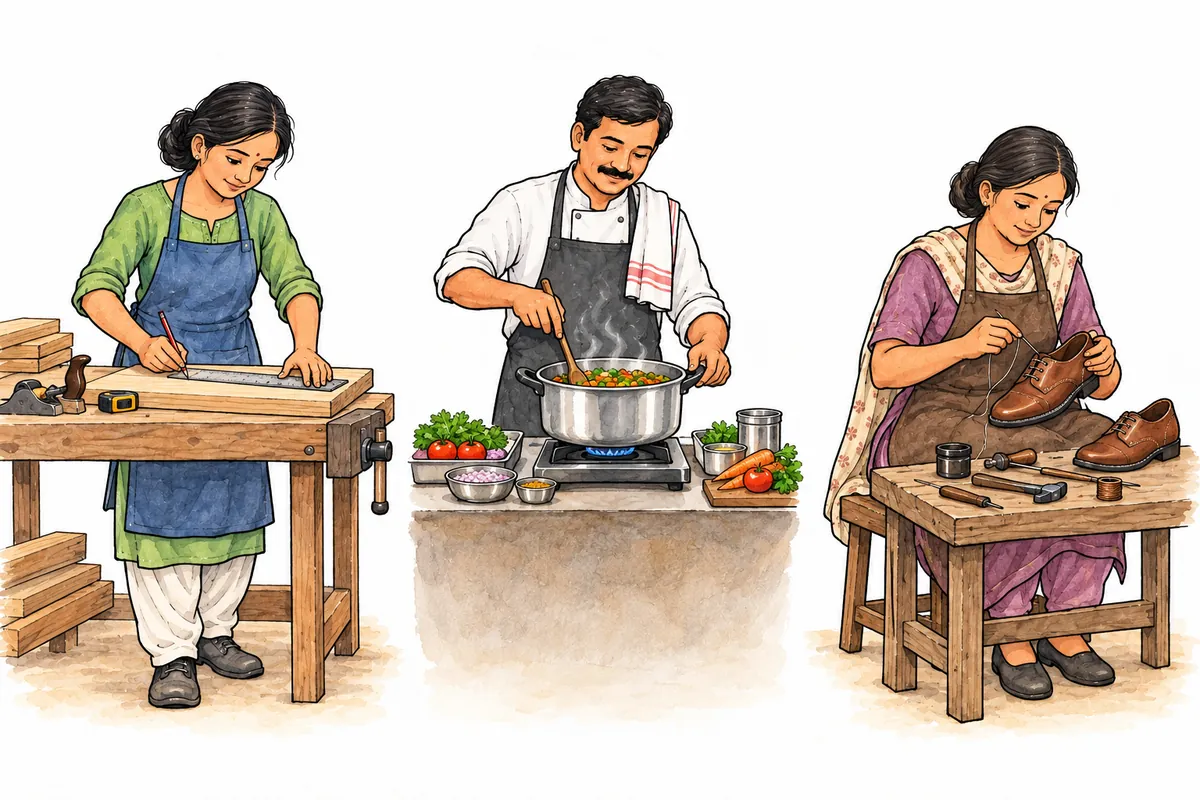
The catalogue widens: carpenters create anything from wood with mathematical precision; electricians hum cheerfully as they ready their cables and wires to brighten our lives; boatmen gather their nets, sail out singing and return with tales of the sea; shoemakers proudly affirm the quality of boots made for feet that walk, dance, run, jump and return home safely.
The cook’s “delicious singing”, the rhythm of the designer and the mason — each celebrates what belongs to them and to none else. The poem closes on its key line: the voice of their vocation is the voice of their identity. The opening idea returns with a change from “vocations” to “voices”, sealing the poem in one continuous song of national celebration.
Summary in English
The poet hears the whole nation of Bharat celebrating through the songs of its workers. Craftspersons celebrate their colourful crafts; artisans play lutes in the streets; carpenters shape wood with mathematical precision; electricians hum as they prepare to brighten our lives with cables and wires; boatmen sing as they sail and return with stories of the sea; shoemakers proudly stand by the quality of shoes made for feet that walk, dance, run and return home; cooks, designers and masons each rejoice in work that is theirs alone. Through this catalogue of voices, the poet shows that work is presented here as a celebration, that every vocation deserves honour, and that a person’s work can express an important part of their identity. Together, these varied voices are the song of India itself.
Summary in Hindi (सारांश हिंदी में)
कवि कहता है कि उसे पूरा भारत अपने विविध व्यवसायों के माध्यम से उत्सव मनाता सुनाई देता है। शिल्पकार रंग-बिरंगे शिल्पों का उत्सव मनाते हैं; गलियों में वीणा-जैसे वाद्य लिए कलाकार भावनाओं और सपनों के गीत गाते हैं; बढ़ई गणितीय सटीकता से लकड़ी से कुछ भी गढ़ देते हैं; बिजली मिस्त्री गुनगुनाते हुए तारों से हमारे जीवन को रोशन करने की तैयारी करते हैं; नाविक जाल समेटते, गाते हुए समुद्र की कथाएँ लेकर लौटते हैं; मोची गर्व से अपने जूतों की गुणवत्ता की घोषणा करते हैं — उन पैरों के लिए जो चलते, नाचते, दौड़ते, कूदते और सुरक्षित घर लौटते हैं; रसोइए का ‘स्वादिष्ट गायन’, डिज़ाइनर और राजमिस्त्री की लय — हर कोई उस काम का उत्सव मनाता है जो केवल उसका अपना है। कवि का संदेश है — श्रम ही गौरव है; हमारा व्यवसाय ही हमारी पहचान की आवाज़ है। ये विविध स्वर मिलकर भारत का संगीत बनते हैं।
Poetic Devices in the Poem
| Device | Explanation / Example from the poem |
|---|---|
| Free verse | The poem has no strict rhyme scheme; its lines vary in length like natural speech and song. |
| Repetition (refrain) | The opening is echoed at the end: “varied vocations” becomes “varied voices”. The near-repetition frames the poem. |
| Imagery (visual) | Crafts “woven with colours and myriad hues”; boatmen gathering nets from the shore. |
| Imagery (auditory) | Artisans with lutes, the electricians humming, the singing of the boatmen and the cook. |
| Metaphor | The “delicious singing” of the cook — the song is as enjoyable as tasty food. |
| Personification | “The voice of their vocation is the voice of their identity” — vocation is given a human voice. |
| Alliteration | “varied vocations”; “sailing, and singing”. |
| Symbolism | Each vocation symbolises identity, dignity and one’s unique contribution to society. |
| Catalogue (listing) | The poem lists different workers, giving each a place in a collective celebration. |
Word Meanings (शब्दार्थ)
| Word | English Meaning | हिंदी अर्थ |
|---|---|---|
| vocation | one’s occupation or calling | व्यवसाय, वृत्ति |
| myriad | countless, innumerable | असंख्य |
| hues | shades, colours | रंग, आभा |
| artisan | a skilled craftsperson | शिल्पकार, दस्तकार |
| lute | a stringed musical instrument | वीणा जैसा वाद्य |
| hailing | greeting, expressing | अभिवादन करते हुए |
| echoing | resounding | गूँजते हुए |
| precision | exactness, accuracy | सटीकता |
| humming | singing softly with closed lips | गुनगुनाना |
| affirming | declaring with confidence | दृढ़ता से कहना |
| mason | a builder who works with brick/stone | राजमिस्त्री |
| rhythm | a regular pattern of movement or sound | लय |
| identity | who a person is | पहचान |
| grace | blessing, divine favour | कृपा, अनुग्रह |
NCERT Exercise Solutions
Reflect and Respond
I. Given below are four riddles. Read and identify who these people are.
1. (sows secrets in furrows and watches them grow) — a farmer
2. (from wheel to kiln, an art takes form) — a potter
3. (lays foundations brick by brick) — a mason
4. (works with pots, pans and spice) — a cook
II. What is the role and relevance of the people you identified in the riddles? How do they contribute to the society?
These workers form the backbone of our daily life. The farmer grows the food that feeds the whole nation; the potter shapes vessels we cook, store and serve in; the mason builds the homes, schools and hospitals we live and work in; and the cook turns raw grain into nourishing meals. Without their skill and labour, society simply could not function — which is why every such vocation deserves equal respect and gratitude.
Check Your Understanding
I. Based on your understanding of the poem, state whether the following statements are true or false. Also, rectify the false statements.
| Statement | True/False |
|---|---|
| 1. The poem highlights the skilled work of craftspersons. | True |
| 2. The poet shares that musicians express emotions through their instruments. | True — the artisans with lutes hail varied emotions and celebrate dreams. |
| 3. The carpenters in the poem are admired for their logical work. | True — they create anything out of wood with mathematical precision. |
| 4. The electricians in the poem are recognised for their crucial role in lighting up lives. | True |
| 5. The poem pays homage to shoemakers who manufacture quality footwear. | True |
| 6. The poem celebrates the patriotism of the people of Bharat. | False — Rectified: the poem celebrates the varied vocations of the people of Bharat and the dignity and identity found in honest work. |
| 7. The poet feels that each vocation deserves to be respected. | True |
II. Let us appreciate the poem.
1. Rhyme Scheme and Lineation
(i) The poem does not adhere to a strict rhyme scheme — it is written in free verse.
(ii) The varying length of lines gives the poem a natural, flowing, speech-like rhythm. Long lines roll on like a worker’s song, while shorter lines create pauses — together they mirror the variety of the vocations themselves.
(iii) Most lines follow the same pattern: they begin by naming a group of workers (the carpenters, the electricians, the boatmen, the shoemakers) and then describe how those workers celebrate their craft.
2. Speaker
(i) The speaker is an appreciative listener and observer who presents workers’ sounds as Bharat celebrating. The poem does not identify the speaker’s gender, prove that this is the poet’s personal experience, or describe a literal journey through the nation.
3. Tone and Mood
A. The tone is reverential and celebratory, depicting a sense of admiration and respect for the artisans and craftspersons.
B. There is a joyful mood throughout the poem, capturing the vibrancy and richness of cultural traditions and skills.
4. Imagery
(i) Visual images: crafts “woven with colours and myriad hues”; the boatmen “gathering their nets from the shore”. (The carpenters shaping wood with mathematical precision is a third example.)
(ii) The poem includes auditory imagery through mentions of artisans with lutes, the electricians humming, and the boatmen (and the cook) singing, emphasising the sounds associated with each vocation.
5. Metaphor
(i) True — ‘delicious singing’ equates the pleasure of the cook’s song with the pleasure of tasting delicious food.
6. Personification
(i) “The voice of their vocation is the voice of their identity.” — the vocation is given the human quality of a voice.
7. Repetition
(i) By echoing the opening at the end, the poet frames the whole poem as a shared celebration. The final wording is “the varied voices I hear”, whereas the opening says “the varied vocations I hear”. The exercise describes these as the same line, but they are not verbatim identical. The return of the line works like the refrain of a song: it reminds us of the central idea, creates a circular unity, and suggests that Bharat’s celebration of its vocations never stops — it goes on echoing after the poem ends.
8. Alliteration
(i) Two examples: “varied vocations” (also “the voice of their vocation”) and “sailing, and singing”.
9. Symbolism
(i) Each vocation symbolises far more than a means of earning: it stands for the worker’s identity, dignity, self-respect and unique contribution to society. Together the vocations symbolise the unity-in-diversity of the nation itself.
Critical Reflection
I. Read the extract given below and answer the questions that follow. (The lines on the shoemakers and the cook — textbook page 62)
1. The poet says that the shoemakers ‘affirm’ the quality of their work. What does ‘affirm’ refer to here?
(ii) to declare with confidence
2. What do quality shoes help with, according to the poet?
They support every movement of daily life — they help feet walk, dance, run and jump, and carry people safely back home.
3. What does ‘return home’ symbolise besides the literal act of returning?
It can suggest belonging, comfort and completion of a day’s journey. This is a symbolic interpretation, not a guarantee that footwear ensures a safe return.
4. Identify the phrase that tells us that every worker’s contribution is distinct.
“each celebrating what belongs to them and to none else”
5. Complete the following with suitable words.
“…for the feet that walk, dance, run, jump, return home” refers to people from every walk of life, in all their daily activities, whom the shoemaker’s work serves and protects.
II. Answer the following questions.
1. Why does the poet say, ‘I hear Bharat celebrating, the varied vocations I hear’?
Because the speaker hears working people singing at their crafts — artisans, carpenters, electricians, boatmen, shoemakers, cooks and masons. To the speaker, these work-songs are not separate sounds but one grand chorus: the nation itself celebrating through the joyful labour of its people.
2. What does the electrician ‘humming’ while getting ready for work suggest?
It suggests contentment and pride. The humming creates an impression of cheerful engagement in this poem. It suggests satisfaction; it does not prove that every worker is always happy or that work has no difficulties.
3. Explain the significance of the line, ‘The voice of their vocation is the voice of their identity.’
The line carries the heart of the poem: a person’s work is the truest expression of who they are. The carpenter is known by his precision, the cook by her flavours, the boatman by his tales of the sea. The poem connects skill and pride with identity. This should not be read as a claim that employment determines someone’s full identity or human value.
4. Do you think the role of all the people belonging to different vocations is important in our daily lives? Support your answer with a reason.
Yes, absolutely. Our daily life is a web of their labours: the farmer feeds us, the mason shelters us, the electrician lights our homes, the cobbler protects our feet and the cook nourishes us. If any one vocation stopped, the whole web would tear — which is why every honest occupation, however humble it appears, is equally indispensable.
5. Why is the poet celebrating all the vocations in the poem? Explain by giving examples from your context.
The poet celebrates them because each contributes something unique that no one else can give, and each worker finds identity and joy in that contribution. Sample personal response: I see similar contributions in my neighbourhood: the tailor who remembers every customer’s measurements, the milkman who arrives before sunrise in every season, the local potter whose diyas light our Diwali, and the community health worker who supports local families. Their skills, like those in the poem, keep our community alive and deserve celebration.
6. How does the poet use sensory imagery to bring out the beauty of everyday work?
The poem appeals constantly to the ear and the eye. We hear lutes in the streets, the electrician’s humming, the boatmen’s singing and the cook’s ‘delicious’ song; we see crafts woven in myriad hues, wood shaped with precision and nets gathered on the shore. By letting us hear and see the workers at their tasks, the poet transforms ordinary labour into music and art.
Vocabulary in Context
I. Match the vocations given in the box below with the descriptions that follow.
1. A person who studies or grows garden plants: horticulturist
2. A trained female community health worker: ASHA worker
3. A producer of raw silk: sericulturist
4. A person whose job is making or selling sweets and chocolates: confectioner
5. A metalworker who specialises in working with precious metals: goldsmith
6. A person who fuses materials together: welder
II. Identify the word from Column 2 that is not the synonym of the words given in Column 1.
1. myriad — countable 2. hues — drawing 3. precision — calculation 4. varied — uniform 5. delicious — inedible
Listen and Respond
I. You will listen to two friends, a boy and a girl discussing the occupations of their parents. As you listen, answer the following question in two to three words only.
What does the boy use to understand the details of the tools?
Toy cars (he uses toy cars with his father’s tool kit to discuss details and usage).
II. Answer the questions by selecting the correct option.
1. The girl is (i) happy about taking food for her mother at the factory.
2. The boy thinks that the job of the girl’s mother carries a lot of (iii) responsibility.
3. The girl (iii) realises why the boy is good at science exhibitions.
4. The girl shares her (ii) wish about joining the weekend discussion on tools.
Speaking Activity
In groups of five, each student represents one vocation from the poem and speaks for 1–2 minutes about it.
Good morning, friends. I am a carpenter. With saw, chisel and plane, I turn plain wood into doors, desks and cradles — anything you can imagine, measured with mathematical precision. My workshop smells of fresh shavings, and every grain of timber tells me how it wishes to be shaped. My joys are many: a chair that lasts a generation, a child’s smile at a new study table. My problems are real too — machine-made furniture undercuts my prices, and good seasoned wood grows costly. Yet I sing while I work, for my craft is my identity. My message to you: respect every maker, and when you buy, remember the hands behind the thing. (Prepare similar speeches for the boatman, cook, electrician and shoemaker.)
Writing Task
I. Complete the Career Mela poster.
Sample entries for the textbook’s blanks: Sunrise School; CAREER; School Hall; Green Park; and guidance; career queries; sessions; Entry; Career Club; Sunrise. These names and arrangements are fictional. The full printed template plus entries exceeds 50 words, so the shorter version below follows the stated limit.
CAREER MELA
Explore career options!
25 February | 9 a.m.–6 p.m.
School Hall, Green Park
Career information and guidance
Counsellors for every stream
Interactive sessions with professionals
CHART YOUR FUTURE!
Entry: FREE
Organiser: Career Club, Sunrise School
Use varied lettering and spacing for emphasis while keeping the poster readable. This is a model event, not a real announcement.
Learning Beyond the Text
I. Read “The Lamplighter” by R. L. Stevenson.
The child speaker admires Leerie, who lights street lamps with a lantern and ladder, and hopes to join him when older. Tom wants to be a driver and Maria wants to go to sea; the banker is the speaker’s father, not another child’s ambition. The poem values the fascination and reassurance created by everyday work.
II. Research one vocation and prepare a presentation.
Sample plan: electrician. Begin at the textbook’s suggested Ministry of Skill Development and Entrepreneurship website. Record the exact course or programme page and access date. Check eligibility, duration, training and assessment from that official source before adding them; do not assume demand, pay or guaranteed employment.
- Reason for choosing: I am interested in how electrical systems work.
- Contribution to society: Trained electricians install and maintain electrical systems used in buildings.
- Value to the learner: The vocation develops technical understanding, problem solving and careful working habits.
- Evidence: Add only verified programme details and cite the official page. Ask a trained professional about real working conditions.
This is a research outline, not a claim that a particular course or job opportunity has been verified. Electrical work requires appropriate training; the classroom task does not require working on live equipment.
III. Write an original haiku.
Classroom 5–7–5 example:
Clay spins on the wheel
Patient hands of the potter
Shape the morning sun
Syllables: Clay(1) spins(1) on(1) the(1) wheel(1) = 5; Patient(2) hands(1) of(1) the(1) potter(2) = 7; Shape(1) the(1) morning(2) sun(1) = 5. The textbook uses this common English classroom model; traditional Japanese haiku counts sound units that do not correspond exactly to English syllables.
Extra Questions with Answers
Q1. How does the poem use a catalogue of workers?
Q2. How are the boatmen described in the poem? (30–40 words)
The boatmen gather their nets from the shore, sail out singing as they work, and return to tell the tales of life at sea — workers whose labour is woven with song, adventure and storytelling.
Q3. What does the title ‘Gifts of Grace: Honouring Our Vocations’ mean? (30–40 words)
It suggests that our skills and occupations are blessings — gifts of grace — given to us. The poem honours these gifts by celebrating every vocation as a source of dignity, identity and service to society.
Q4. “The poem turns ordinary work into a national celebration.” Discuss. (100–120 words)
The poem’s genius lies in hearing music where others hear routine. A carpenter measuring wood, an electrician checking wires, a boatman hauling nets, a cook at her stove — these everyday scenes are presented as performances in one nationwide festival. Each worker sings, hums or keeps rhythm, and each song expresses pride in a craft that belongs to that worker alone. By framing the catalogue between closely related opening and closing statements, the poet makes the celebration continuous and collective: individual work-songs merge into the chorus of Bharat itself. The poem thus elevates ordinary labour to the level of art and worship, teaching us that a nation’s true music is made by its working people.
Additional MCQs
1. The poem ‘Gifts of Grace’ is written by — (a) Subramania Bharati (b) Temsula Ao (c) an anonymous poet (d) R.L. Stevenson
2. The carpenters work with — (a) musical rhythm (b) mathematical precision (c) great speed (d) borrowed tools
3. The electricians are described as — (a) shouting (b) sleeping (c) humming (d) marching
4. The boatmen return to tell — (a) tales of life at sea (b) the day’s earnings (c) weather reports (d) fishing secrets
5. ‘Myriad hues’ means — (a) a few colours (b) countless shades (c) dull tones (d) bright lights
6. The cook’s singing is called — (a) melodious (b) delicious (c) graceful (d) divine
7. The poem is written in — (a) sonnet form (b) rhymed couplets (c) free verse (d) haiku form
8. According to the poem, the voice of one’s vocation is the voice of one’s — (a) family (b) village (c) identity (d) nation
Answer key: 1-c, 2-b, 3-c, 4-a, 5-b, 6-b, 7-c, 8-c
Assertion–Reason Questions
Options for each: (a) Both A and R are true and R explains A. (b) Both A and R are true but R does not explain A. (c) A is true, R is false. (d) A is false, R is true.
1. A: The ending echoes the opening, with “voices” replacing “vocations”. R: The repetition frames the poem as one continuous, unending celebration. — (a)
2. A: The cook’s ‘delicious singing’ is a metaphor. R: A song cannot literally be tasted, so the word transfers the pleasure of food to the pleasure of music. — (a)
3. A: The poem follows a strict ABAB rhyme scheme. R: Free verse has no fixed rhyme scheme, although it may still use rhythm and occasional rhyme. — (d)
4. A: The shoemakers ‘affirm’ the quality of their work. R: They are uncertain whether their boots will last. — (c)
FAQs
Who wrote Gifts of Grace: Honouring Our Vocations?
NCERT Kaveri credits the poem to Anonymous.
What is its central idea?
The poem celebrates the dignity of skilled work and presents different occupations as voices contributing to a shared community.
Is the first line repeated exactly at the end?
No. The ending echoes the opening but changes “varied vocations” to “varied voices”. This near-repetition creates unity.
Also read: Poem 1 – Bharat Our Land · Kaveri – All Chapters · NCERT Solutions Home. Official textbook catalogue: ncert.nic.in