
Canvas of Soil Questions and Answers | Class 9 Kaveri
Checked against NCERT Kaveri, first edition January 2026, pages 86–96; listening transcript 264–265. Personal, discussion and creative responses are samples: adapt them to your experience. This independent study guide is not an official NCERT answer key.
Poem Overview & Central Idea
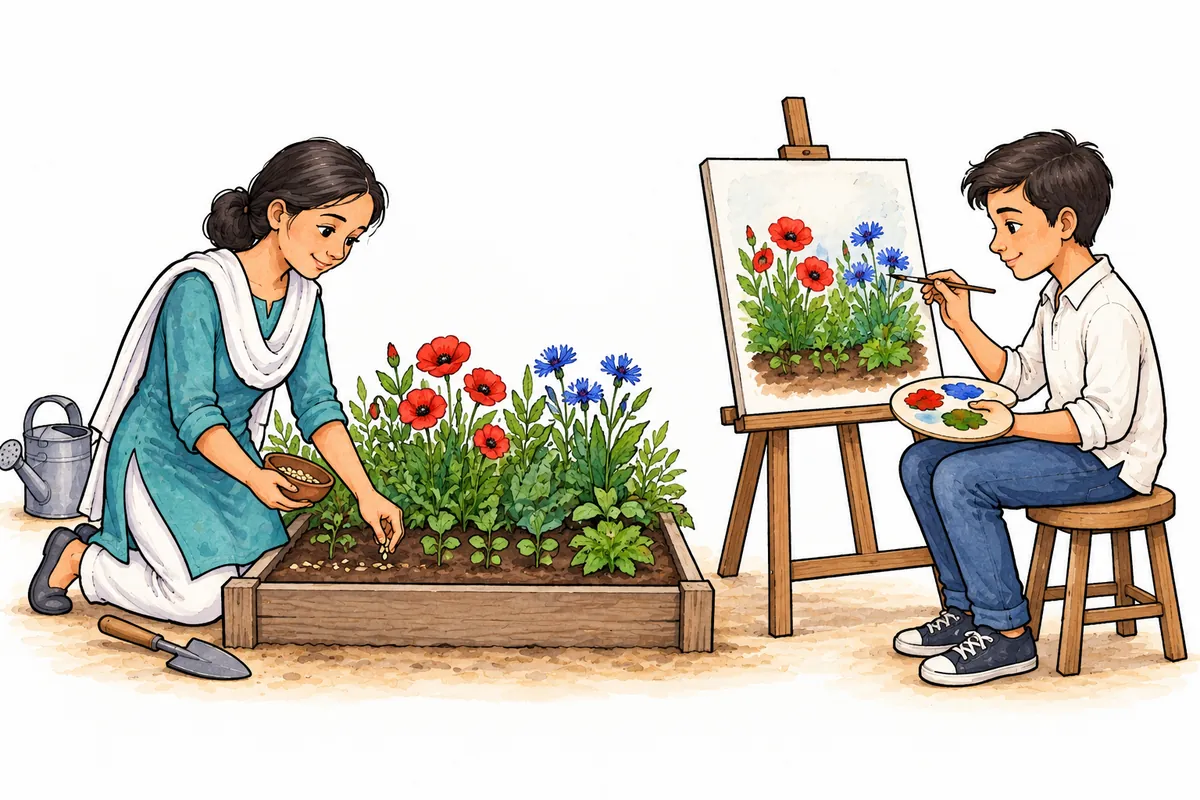
Canvas of Soil by Maya Anthony is a short, richly visual poem built on one extended metaphor: the garden is a painting and the gardener is its artist. The earth is the artist’s palette, seeds are brushstrokes planted with care, and spring’s blossoms are the finished picture glowing in the morning light. The central idea is that gardening is itself an art form — in every plot of soil, “art and life coincide”, and through the patient hands of those who till, gardens become living paintings. The poem can also be read as an allegory of life’s growth and the beauty of diversity in harmony.
About the Poem & Poet
The poem is the work of poet Maya Anthony, acknowledged by NCERT for this piece in the Kaveri textbook. In just twelve lines of rhyming couplets, the poet matches the unit’s prose chapter Winds of Change: where the article showed craft as culture, the poem shows gardening as art, training students to see creativity in everyday work with the soil.
Stanza-wise Explanation
The poet calls the earth a rich, deep palette — the board on which a painter mixes colours. Into this living palette seep the dreams of gardeners. The seeds they plant carefully and faithfully are like a painter’s brushstrokes, quietly waiting for spring to bring out their vibrant shades.
Spring arrives and the brushstrokes bloom: flowers open like a painted scene, dancing in the morning light. Shades of green, red and blue spread across the garden — nature’s own artwork, which is renewed again and again, season after season, and is therefore “ever new”.
Every garden plot is a wide canvas where art and life meet and merge. In the hands of those who till the soil, gardens turn into paintings — living still-life art. The gardener stands revealed as a true artist whose medium is the soil itself.
Summary in English
The poem presents gardening as painting. The earth is the artist’s palette, rich and deep, holding the dreams of gardeners. Seeds, sown carefully and faithfully, are the brushstrokes of this living artwork, waiting for spring to supply its vibrant hues. When the season turns, blossoms bloom into a painted sight that dances in the morning light, spreading shades of green, red and blue — nature’s artwork that renews itself endlessly. Each plot of land is a wide canvas on which art and life coincide, and in the hands of those who till, gardens become paintings. The poet’s message is that creativity is not confined to studios: the gardener who works the soil with love and patience is as much an artist as any painter.
Summary in Hindi (सारांश हिंदी में)
कविता बाग़बानी को चित्रकला के रूप में प्रस्तुत करती है। धरती चित्रकार की समृद्ध और गहरी रंग-पट्टिका (palette) है, जिसमें बाग़बानों के सपने रचे-बसे हैं। सच्चे मन से बोए गए बीज इस जीवित चित्र की तूलिका के स्पर्श (brushstrokes) हैं, जो वसंत के जीवंत रंगों की प्रतीक्षा करते हैं। ऋतु बदलते ही फूल खिल उठते हैं — मानो कोई चित्र सुबह की रोशनी में नाच रहा हो। हरे, लाल और नीले रंगों की छटाएँ फैल जाती हैं — यह प्रकृति की अपनी कलाकृति है, जो हर ऋतु में नई हो जाती है। हर क्यारी एक चौड़ा कैनवास है जहाँ कला और जीवन एक हो जाते हैं, और मिट्टी जोतने वालों के हाथों में बाग़ चित्र बन जाते हैं। कवयित्री का संदेश है — रचनात्मकता केवल कला-शालाओं तक सीमित नहीं; धैर्य और प्रेम से मिट्टी सँवारने वाला माली भी उतना ही बड़ा कलाकार है जितना कोई चित्रकार।
Poetic Devices in the Poem
| Device | Explanation / Example from the poem |
|---|---|
| Extended metaphor | The whole poem compares garden to painting: earth = palette, seeds = brushstrokes, plot = canvas. |
| Rhyme scheme | AABB within each four-line stanza — rhyming couplets. If the same letters are retained for recurring sounds across all twelve lines, the pattern is AABBCCBBDDEE: deep/seep, true/hue, sight/light, blue/new, wide/coincide, till/still. |
| Imagery | Vivid mind-pictures: colours, brushstrokes, blossoms, shades of green, morning light. |
| Alliteration | “Blossoms bloom” (repetition of the ‘b’ sound). |
| Personification | Blossoms are described as “dancing”, giving them a human action. Dreams “seeping” is metaphorical imagery, not a clear example of personification. |
| Tone | Appreciative — the poet admires the gardener’s art. |
| Mood | Joyful — the reader feels the freshness and colour of the garden. |
| Allegory | On a deeper level the garden stands for life’s journey and growth, and the mingling colours for harmony in diversity. |
Word Meanings (शब्दार्थ)
| Word | English Meaning | हिंदी अर्थ |
|---|---|---|
| palette | board on which a painter mixes colours | रंग-पट्टिका |
| canvas | (here) a painting; the cloth a painter paints on | चित्रफलक, कैनवास |
| hue | shade of a colour | रंगत, आभा |
| seep | to soak slowly into | रिसना, समा जाना |
| brushstrokes | marks made by a painter’s brush | तूलिका के स्पर्श |
| vibrant | bright and full of life | जीवंत |
| blossoms | flowers | पुष्प, बौर |
| plot | a small piece of garden land | क्यारी, भूखंड |
| coincide | to come together, meet | एक हो जाना |
| till | to prepare and work the soil | जोतना |
| still (paintings still) | suggests a lasting or picture-like impression; the wording permits more than one interpretation | स्थिर चित्र; फिर भी |
NCERT Exercise Solutions
Reflect and Respond
I. Work in pairs. Discuss what all you see in a garden. Think of the colours you see and where you see them.
In a garden we see flowers of many colours — red roses, yellow marigolds, white jasmines and pink dahlias in the beds; green in the grass, hedges and leaves; brown in the soil, tree trunks and pots; blue in the sky above and in flowers like morning glory; and orange-gold in butterflies and the evening light on the leaves.
II. Look at the picture of a garden and a painting. Speak about any similarities between the garden and the painting.
Just as a garden is full of colours arranged beautifully, similarly, a painting arranges colours to please the eye. A garden and a painting both are created patiently, stroke by stroke and plant by plant. Beauty of colour and design is common to both a garden and a painting. Like a garden, a painting too expresses the dreams and feelings of its maker.
III. Look at the painting given above and identify palette, canvas, and select a hue.
In the picture on page 86, the palette is the paint-colour tray at the far left beside the brushes. The canvas, in the exercise’s sense of a painting, is represented by the painted landscape next to it. A hue could be the green of the landscape or the yellow of the sun in the garden drawing. No painter is shown holding a palette.
Check Your Understanding
I. Read the poem again and complete the summary of each stanza by filling in the blanks.
1. The earth (soil) is portrayed as a rich palette where gardeners’ dreams flourish in the form of seeds, awaiting spring.
2. The garden flowers bloom into a beautiful display of different blossoms, resembling a painting (artwork) by Mother Nature, in the light of morning.
3. Each garden is likened to a wide canvas, integrating art and life. Through the efforts of gardeners, gardens transform into still-life paintings.
II. Select the appropriate title for each stanza. There are two extra titles.
Stanza 1 — 4. Earth and Possibilities | Stanza 2 — 1. Nature’s Work of Art | Stanza 3 — 3. Gardens as Living Canvases
Extra titles: 2 (Sweet-smelling Blossoms) and 5 (The Painter’s Canvas).
III. Match the poetic devices in Column 1 to the examples in Column 2.
| Poetic Device | Example |
|---|---|
| 1. Imagery (mind pictures) | (iv) colours, brushstrokes, blossoms, shades of green |
| 2. Metaphor (comparison without ‘like’ or ‘as’) | (vi) garden as a painting, plot as canvas, seeds as brushstrokes |
| 3. Rhyme Scheme | (ii) AABB |
| 4. Tone (what the poet feels) | (i) appreciative |
| 5. Mood (what the reader feels) | (vii) joyful |
| 6. Speaker | (v) a gardener — the intended match among the supplied options; the poem itself does not explicitly identify the speaker’s occupation |
| 7. Alliteration (same consonant sound) | (iii) ‘Blossoms bloom’ |
Critical Reflection
I. Read the given extracts from the poem and answer the questions that follow. (Extract 1: the couplet on seeds as brushstrokes awaiting spring — textbook page 89)
(i) Which option uses a metaphor?
B. She has a heart of gold. (The heart is directly equated with gold, without ‘like’ or ‘as’.)
(ii) The phrase ‘planted true’ is significant because it implies __________.
…that the seeds are sown with care, precision and faith — the gardener’s honest, devoted effort, like an artist’s sure and deliberate brushstroke.
(iii) Why has the poet used the word ‘hue’ instead of ‘colours’ in the extract?
‘Hue’ suggests the fine, delicate shades of colour rather than plain colours, which suits the painting metaphor; it is also more poetic and rhymes perfectly with ‘true’.
(iv) Complete the analogy: Summer : hot :: Spring : _________
vibrant
(v) (A): Gardeners wait for Spring. (R): Gardens are worth painting in Spring.
B. Both (A) and (R) are true but (R) is not the correct explanation of (A) — gardeners wait for spring because that is when their seeds bloom into vibrant colour, not in order to have the garden painted.
(Extract 2: the couplet on each plot as a wide canvas — textbook page 90)
(i) What does ‘Each plot’ refer to in this extract?
Each small piece or bed of garden land that a gardener cultivates.
(ii) Select the option that imitates the rhyme scheme of the extract.
A. beautiful and clear / laughter and cheer (a rhyming couplet, like wide/coincide).
(iii) Select the line that conveys that gardening blends aesthetic beauty with natural growth.
“Where art and life coincide.”
(iv) The plot is likened to a canvas suggesting that __________.
…the soil is a blank space awaiting creation, on which the gardener, like a painter, composes a picture with seeds and blossoms.
(v) Why has the poet most likely used the word ‘wide’ instead of ‘long’ in ‘canvas wide’?
‘Wide’ conveys openness and breadth — a vast field of possibilities spreading in every direction before the gardener-artist — and it also rhymes with ‘coincide’, preserving the couplet.
II. Give reasons for the comparisons made by the poet in the poem.
1. A painter is compared to a gardener because both create works of beauty with patience and skill — one with paints on canvas, the other with plants on soil.
2. A palette is like earth as the earth holds and blends all the raw materials of the garden’s colours, just as a palette holds and mixes a painter’s paints.
3. The brushstrokes are like seeds because every seed sown is a small, deliberate touch that slowly builds up the complete picture of the garden.
4. A canvas is similar to a garden plot as both provide a space for arranging an artistic composition — paint on the canvas and plants in the garden plot.
III. Answer the following questions.
1. How does the metaphor ‘Brushstrokes of seeds’ enhance the understanding of gardening as an art form?
It transforms sowing from routine labour into deliberate artistry. A painter places each brushstroke thoughtfully to build a picture; likewise the gardener places each seed with care, imagining the shapes and colours the plants may bring as they grow. The metaphor makes us see that a garden does not happen by chance — it is composed, stroke by stroke, like a painting.
2. What can you infer about the poet’s perspective on the relationship between nature and creativity from ‘Each plot, a canvas wide,/Where art and life coincide’?
The poet believes nature and creativity are not separate worlds but partners. The garden plot is at once a living, growing thing (life) and a composed work of beauty (art). Human planning works with natural growth; the comparison presents them as partners rather than suggesting that nature is incomplete without people.
3. Do you think the imagery in the poem successfully paints a vivid picture in the reader’s mind? If yes, why?
Yes. The poem appeals to the eye at every step — the rich, deep palette of earth, seeds laid like brushstrokes, blossoms opening like a painted sight, dancing in morning light, and shades of green, red and blue. Because every image is drawn from the single, familiar world of painting, the pictures combine into one clear, glowing scene rather than scattering the reader’s attention.
4. Support the view that the poet’s mention of the colour yellow, besides red, blue and green, would have lent effectively to the imagery.
Possible addition, not a colour named in the poem: Yellow can recall sunlight, marigolds and sunflowers — among the most common and cheerful sights in an Indian garden. Since the blossoms are described dancing “in the morning light”, a touch of yellow would have linked the flowers to the sunshine itself, completing the palette and making the painted garden warmer and brighter.
5. Considering the line ‘Gardens become paintings still’, what can you interpret about the poet’s view on the timelessness of nature’s beauty?
One possible reading of ‘still’ works in two ways. As ‘still-life’, it turns the garden into a finished artwork — a moment of beauty held and preserved. As ‘even now’, it suggests this miracle keeps happening in every season and every age. The repeated renewal of the garden suggests lasting beauty through change. A living garden is not literally motionless, and this is an interpretation rather than a claim that it remains unchanged forever.
6. Justify the title of the poem, ‘Canvas of Soil’.
The title compresses the poem’s entire metaphor into three words. The soil is the canvas on which the gardener-artist works; seeds are the brushstrokes, the earth is the palette, and the blossoming garden is the finished painting. Every stanza unfolds from this single idea — earth as the ground of art — so no title could fit the poem more exactly.
Vocabulary in Context
Sample associations for all eighteen shades. Actual objects vary in colour; these are examples to discuss, not exact colour standards.
| Shade | Two possible associations |
|---|---|
| Navy blue | A dark-blue blazer; a navy-painted door |
| Indigo | Indigo-dyed cloth; a deep blue-purple notebook cover |
| Cobalt blue | A cobalt-blue ceramic cup; a vivid blue painted tile |
| Denim | Blue jeans; a denim jacket |
| Sky blue | A clear daytime sky; a sky-blue kite |
| Ice blue | A very pale blue scarf; pale blue glass |
| Pine green | Pine needles; a dark-green painted gate |
| India green | The green band of the Indian flag; a matching green ribbon |
| Apple green | A green apple; an apple-green pencil case |
| Jade | A green jade bead; a jade-green bowl |
| Olive | Green olives; an olive-coloured jacket |
| Pistachio | A pistachio kernel; a pale green sweet |
| Rusty red | A rust-coloured metal surface; a rusty-red clay pot |
| Salmon | A salmon-pink shirt; a peach-pink cloud at sunset |
| Scarlet | A bright scarlet ribbon; a scarlet painted sign |
| Crimson | A deep crimson rose; a crimson shawl |
| Blood red | A blood-red paint swatch; a matching dark-red ribbon |
| Vermilion | Vermilion pigment; an orange-red painted border |
II. Discuss what the underlined painting-related words might mean (easel, framing, tonal range, portrait, underpainting, mural).
I think easel means the stand that holds a painting because the passage says the painters approached it to work on their canvases. I think framing means fixing/mounting the canvas because each painter prepared a canvas to work on. I think tonal range means the spread of light and dark shades because the teacher asks them to play with shades and hues. I think portrait means a picture of someone’s face because the passage talks about capturing a friend’s features. I think underpainting means the first base layer of paint because the student paints it before filling the final colours. I think mural means a painting made on a wall because the student paints a Spring Day on the classroom wall.
Listen and Respond
I. Which picture is not mentioned in the recording?
Picture 2: the garden hose and tap. The speaker mentions the painted bench near the entrance (picture 1) and butterflies around flowers (picture 3), but does not mention the hose or tap. This is checked against the complete transcript on pages 264–265.
II. Choose the correct options.
- pink — first-row flowers
- rose — second-row flowers
- left corners — useful potted plants
- 20 — potted evergreen plants
- white and red — border bricks
- banyan — central tree
- dustbins — the listed option made from waste materials; the recording also names small scarecrows and pinwheels
Speaking Activity
I–II. Advantages of flower and vegetable gardens; state your preference with reasons.
Advantages — flower garden: beautifies the home, gives fragrance, attracts butterflies and bees, refreshes the mind. Advantages — vegetable garden: fresh produce and control over growing methods, may reduce some food purchases, teaches responsibility, uses kitchen waste as compost.
Preference: I prefer a vegetable garden to a flower garden because it feeds the family as well as the eyes. If I had a choice I’d rather have a kitchen garden than a rose bed, as plucking my own tomatoes and spinach gives me both joy and healthy food — though I would happily border it with a few marigolds for colour!
Writing Task
I. Write a descriptive piece of two to three paragraphs describing the details and colours in the garden you have visited.
A Morning in My Grandmother’s Garden
Last winter I visited my grandmother’s garden just after sunrise, when the light was soft and golden. The first thing I noticed was the conversation of greens: the deep, waxy green of the mango leaves, the pale, feathery green of the curry-leaf bush, and the fresh spring-green of new grass still silvered with dew. Against this living background, the reds blazed — scarlet hibiscus trumpets near the gate, crimson roses by the path, and the rusty red of geraniums in clay pots, their petals soft as velvet against the rough terracotta.
Blue arrived more quietly. Morning glories climbed the fence in trumpets of sky blue, and beside the water tap a cluster of cobalt-blue butterfly peas seemed to hold a piece of the sky. As the sun rose higher, the light changed everything: the dew burned away, the reds turned brighter, the leaves glittered, and the shadows under the banyan tree went from grey-blue to cool green. Standing there, I understood what our poem means — the garden truly was a painting, and my grandmother, with her watering can and pruning scissors, its patient artist.
Learning Beyond the Text
I. Mini-project: choose one task from 1/2 and one from 3/4.
- Research five gardens: Make a table with name, location, history, design features and cultural significance. Begin with textbook examples such as Amrit Udyan and Brindavan Gardens, and select three more. Verify facts from each garden’s official or government source; record links and dates.
- Respond to garden-inspired art: Choose a named painting or sculpture, identify its artist and source, describe how it represents plants, colours and space, then make your own visual or written response.
- Design a garden: Draw a labelled plan showing paths, planting areas and practical access. Explain colour choices and how the poem or artwork informed them. This is your design, not the exact layout of the listening garden.
- Interview a gardener: Ask about plant selection, soil preparation, watering, seasonal changes and difficult tasks. Record consent, notes and what you learnt; do not invent an interview or quotations.
Example valid pairing: tasks 2 and 3. Submit the artwork response and your own garden plan, explaining the connection.
II. Read Toru Dutt’s “A Sea of Foliage Girds Our Garden Round”.
The speaker contrasts shades of foliage: lighter tamarinds, darker mango trees, grey palms and red seemul flowers. Moonlight makes the white lotus resemble a silver cup. The comparison between startling red and a trumpet’s sound connects sight and hearing. Like “Canvas of Soil”, the poem invites attention to colour and natural beauty, but uses its own imagery and sonnet form. This is a reading-for-enjoyment activity.
Extra Questions with Answers
Q1. What ‘awaits spring’ in the poem, and why? (30–40 words)
The seeds — the gardener’s brushstrokes — wait for spring, because spring brings the vibrant hues that turn them into blossoms. The waiting suggests both nature’s patience and the artist’s anticipation of the finished picture.
Q2. What is the rhyme scheme of the poem? Give an example. (30–40 words)
Each stanza follows the AABB couplet pattern — for example ‘deep/seep’ and ‘true/hue’ in the first stanza, and ‘wide/coincide’ in the last.
Q3. In what sense is the poem an allegory? (100–120 words)
An allegory carries a deeper meaning beneath its surface story, and this poem invites such a reading. On the surface it describes gardening as painting; beneath, the garden becomes a picture of life itself. The seeds sown “true” are our honest efforts and dreams, which lie hidden until their season comes; spring stands for the time of growth and reward; the changing blossoms, “ever new”, mirror the cycles of life. The mingling shades of green, red and blue suggest the beauty of diversity living in harmony. Read this way, the poem teaches that a garden can symbolise growth, care and cooperation. This is a possible allegorical reading, not a claim that every life outcome depends solely on individual effort.
Additional MCQs
1. ‘Canvas of Soil’ is written by — (a) Toru Dutt (b) Maya Anthony (c) Subramania Bharati (d) Temsula Ao
2. The earth is described as a rich — (a) canvas (b) palette (c) brush (d) frame
3. The seeds are compared to — (a) dreams (b) jewels (c) brushstrokes (d) raindrops
4. The blossoms dance in the — (a) evening breeze (b) morning light (c) spring rain (d) moonlight
5. The shades named in the poem are — (a) green, red and blue (b) yellow, pink and white (c) green, gold and grey (d) red, orange and violet
6. The rhyme scheme of the poem is — (a) ABAB (b) AABB (c) ABCB (d) free verse
7. ‘Where art and life coincide’ refers to — (a) the painter’s studio (b) the garden plot (c) the spring sky (d) the morning light
8. ‘Blossoms bloom’ is an example of — (a) metaphor (b) simile (c) alliteration (d) refrain
Answer key: 1-b, 2-b, 3-c, 4-b, 5-a, 6-b, 7-b, 8-c
Assertion–Reason Questions
Options for each: (a) Both A and R are true and R explains A. (b) Both A and R are true but R does not explain A. (c) A is true, R is false. (d) A is false, R is true.
1. A: The poem is built on an extended metaphor. R: The garden is compared to a painting throughout — palette, brushstrokes and canvas. — (a)
2. A: The poem is written in free verse. R: It follows the AABB rhyming couplet pattern. — (d)
3. A: The gardener is presented as an artist. R: In the hands of those who till, gardens become paintings. — (a)
4. A: Nature’s artwork is called ‘ever new’. R: The garden renews its colours season after season. — (a)
FAQs
Who wrote the poem Canvas of Soil?
Maya Anthony, credited by NCERT in Kaveri, first edition January 2026.
What is the central idea of Canvas of Soil?
Gardening is an art: the soil is a canvas, seeds are brushstrokes, and in the gardener’s patient hands a garden becomes a living painting where art and life coincide.
What is the rhyme scheme of Canvas of Soil?
Each stanza has an AABB pattern of rhyming couplets. Across all twelve lines, retaining the same letter for recurring sounds gives AABBCCBBDDEE.
Also read: Poem 2 – Gifts of Grace · Kaveri – All Chapters · NCERT Solutions Home. Official textbook catalogue: ncert.nic.in