
Carrier of Words Questions and Answers | Class 9 Kaveri
Checked against NCERT Kaveri, first edition January 2026, pages 203–219; listening transcript 272. Personal, discussion and creative responses are samples: adapt them to your experience. This independent study guide is not an official NCERT answer key.
Chapter Overview
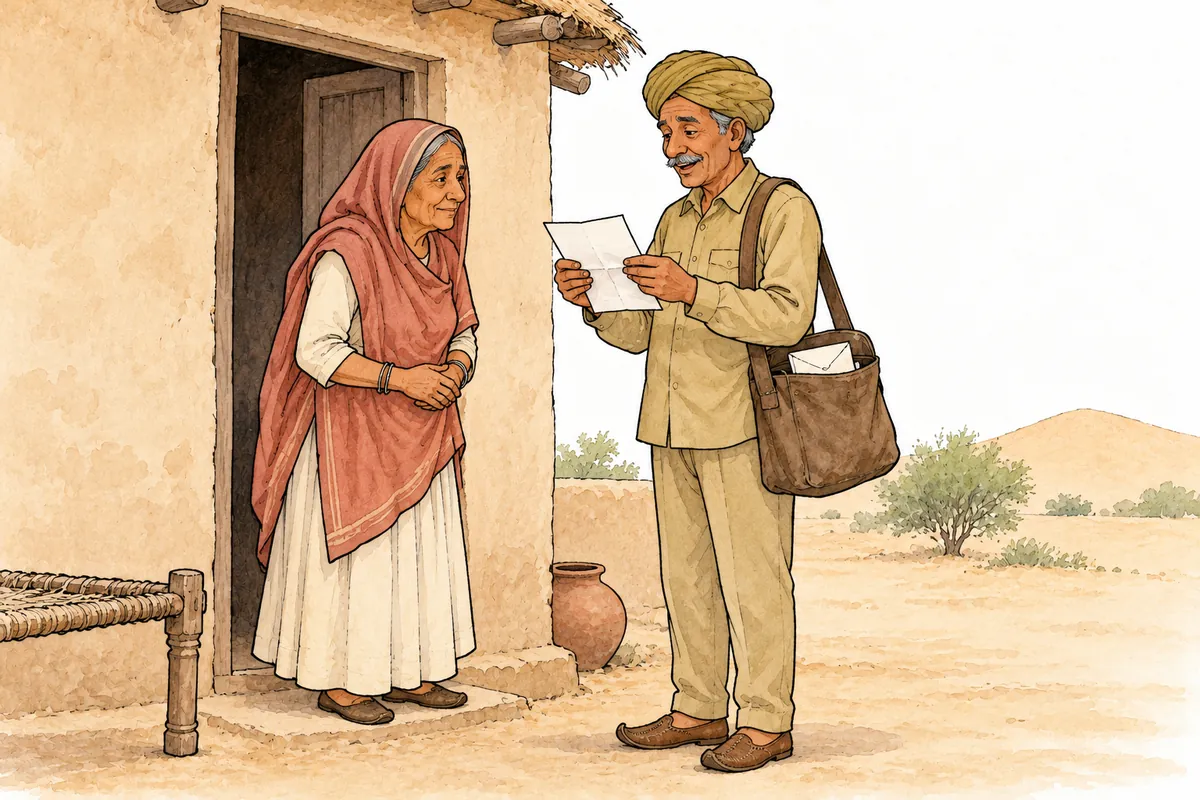
Carrier of Words profiles Khetaram, the sole postman of Somarad Branch Post Office in Rajasthan’s Thar desert. His work connects isolated hamlets with distant relatives through letters and money orders. The article explores difficult working conditions, villagers’ trust and the dignity of everyday service.
Reading context: distances, workforce figures, working conditions and proposed phone services below belong to the article’s reported setting. They are not a current survey or a statement of today’s postal rules. The article’s claim about recording 50°C as 49.9°C is treated as a textual statement, not independently verified government policy.
About the Text
This feature article combines a worker’s personal experiences with postal history. It contrasts company mail between British administrative centres with the wider reach sought after independence. Its figures—about 25,000 post offices in 1947 and more than 150,000 at the time described—must be read in that historical context. It also refers to Mulk Raj Anand’s Story of the Indian Post Office.
Summary in English
In the article, Khetaram has served desert hamlets for fifteen years. Mail travels from Jodhpur by train, bus and finally on foot to the border region within twenty-four hours. He does not walk the entire 330 km from Jodhpur. A twenty-kilometre delivery walk can be exhausting, and he sometimes waits until after sundown. The stated 28 kg limit is a maximum load, not the weight he always carries. His khaki clothes and turban offer limited protection against heat and blowing sand.
The postal job supplements farming: a single bajra crop in a good year cannot adequately support his family of five. Villagers depend on money orders and trust him to read letters and write replies. BSF personnel offer lifts and tea; families share jaggery when he brings joyful news. A torn envelope corner signals a death in the custom described. He reads such a letter outside twice, then tears it up according to his belief about inauspicious news. This is a reported local practice, not an instruction for handling other people’s mail. He looks forward to possibly carrying a mobile phone alongside the post. The ending honours workers whose personal service holds communities together.
Summary in Hindi (सारांश हिंदी में)
पाठ में खेताराम राजस्थान के थार क्षेत्र में सोमराड शाखा डाकघर के अकेले डाकिए हैं। जोधपुर से डाक रेल, बस और अंत में उनके पैदल चलने से सीमावर्ती गाँवों तक पहुँचती है; वे पूरे 330 किलोमीटर पैदल नहीं चलते। 28 किलो डाक-भार की अधिकतम सीमा है, हर दिन का निश्चित वजन नहीं। तेज गर्मी में वे कभी-कभी सूर्यास्त के बाद डाक पहुँचाते हैं। बाजरे की एक फसल से पाँच सदस्यों के परिवार का पर्याप्त निर्वाह नहीं होता, इसलिए डाक की नौकरी उनकी खेती की आय में सहायता करती है।
गाँव वाले उन पर विश्वास करते हैं और उनसे पत्र पढ़वाते तथा उत्तर लिखवाते हैं। बीएसएफ के लोग उन्हें लिफ्ट और चाय देते हैं; अच्छी खबर पर गाँव वाले गुड़ देते हैं। पाठ में वर्णित स्थानीय परंपरा में लिफाफे का फटा दायाँ कोना मृत्यु-संदेश का संकेत है। वे ऐसा पत्र बाहर दो बार पढ़कर फाड़ देते हैं। इसे वर्तमान डाक-नियम या अनुकरण योग्य निर्देश न मानें। भविष्य में फोन सेवा आने की आशा उन्हें उत्साहित करती है। लेख ऐसे कर्मियों की कठिन मेहनत और सामाजिक योगदान का सम्मान करता है।
Word Meanings (शब्दार्थ)
| Word | English Meaning | हिंदी अर्थ |
|---|---|---|
| sole | only | एकमात्र |
| slumped | bent, drooping | झुका हुआ |
| defying | challenging, resisting | चुनौती देते हुए |
| hamlets (dhaanis) | small settlements | ढाणियाँ, छोटी बस्तियाँ |
| ply | move, travel (regularly) | चलना |
| hefted | lifted (something heavy) | उठाया |
| stipulate | specify (as a rule) | निर्धारित करना |
| mojri | traditional footwear of Rajasthan | मोजड़ी |
| devoid of | completely lacking | रहित |
| riverine | situated on a river bank | नदी-तटीय |
| inaccessible | unreachable | दुर्गम |
| ambit | range, scope | दायरा |
| remitted | sent (money) | भेजा गया (धन) |
| scrap | remove, abolish | समाप्त करना |
| dwell | to stay on for some time | ठहरना |
| threshold | entrance to a home | दहलीज़ |
| dreads | fears | डरता है |
| missive | letter | पत्र |
| desolate | empty, lonely (place) | वीरान |
| entail | involve | शामिल होना |
| striding | walking with long steps | लंबे डग भरते हुए |
| part and parcel | an essential part | अभिन्न अंग |
NCERT Exercise Solutions
Reflect and Respond
I. Look at the pictures of persons engaged in the same profession. 1. Which profession do they belong to? 2. Do they face any difficulties while doing their duty? 3. How does their profession affect the people they meet?
1. They belong to the postal profession — they are postmen (mail carriers).
2. Yes. They walk or cycle long distances in scorching heat, rain and cold, carry heavy mailbags, cross difficult terrain like deserts, hills and rivers, and try to maintain delivery despite difficult conditions.
3. They touch people’s lives deeply — bringing letters from loved ones, money orders, exam results and official documents. For remote villages they can provide a vital link with the outside world, and the joy or comfort they deliver makes them trusted and beloved figures.
II. Discuss in groups. 1. How can ‘words’ be ‘carried’? 2. Who could be a carrier of words? 3. What are the means for people to stay connected?
1. Words can be carried in written form — letters, postcards and parcels of books (historically, telegrams also carried written messages) — and in spoken form, as messages passed from person to person.
2. A postman, a messenger, a courier — and in older times, pigeons and royal runners; today, even satellites and cables ‘carry’ our words.
3. Letters and the postal system, telephone and mobile calls, SMS, e-mail, video calls and social media.
III. Place the words in their appropriate context in the passage.
1. signals 2. dunes 3. hamlets 4. defying 5. slumped 6. devoid
Check Your Understanding (after Part I)
I. Information sheet for Khetaram’s identity card
| Field | Text-based answer |
|---|---|
| Name | Khetaram |
| Position | Gramin Dak Sewak; sole postman of the branch |
| Employer | India Post / Department of Posts |
| Official address | Somarad Branch Post Office, Barmer district, Rajasthan |
| Transport | On foot on his desert delivery route |
| Responsibilities | Deliver letters; deliver money orders; read letters aloud when requested; draft replies for villagers. |
Do not invent an identity number or postal code. The 24-hour journey begins with dispatch from Jodhpur and includes train and bus transport before his final walk.
II.1. Why might he have taken this challenging job?
II.2. How might he feel about the daily challenge?
Check Your Understanding (after Part II)
I. Situations and reasons
| Situation | Reason in the article |
|---|---|
| The article says temperatures of 50°C are recorded as 49.9°C. | It says that recording 50°C or above would require a state holiday. This is the article’s assertion, not a verified statement of current policy. |
| Khetaram can pause at any threshold. | Villagers welcome and trust him, asking him to read letters and draft replies. |
| BSF personnel offer him lifts. | He also delivers their mail; they show kindness and offer tea. |
II. Why offer jaggery for news of a birth or wedding?
III. How could phone lines help him?
Critical Reflection
I. Read the extracts given below and answer the questions. (Extract 1: famine as a way of life)
(i) One crop of bajra makes a little difference for people like Khetaram because ______.
…it is far too little to feed a family of five for the whole year — without another income they would starve.
(ii) Why did Khetaram term famine as ‘a way of life’?
Because in the Thar’s arid land famine and scarcity are recurring hardships in his experience. The passage does not give an exact annual frequency.
(iii) Give one reason why Khetaram had to take up a job to help his family survive.
Farming alone could never sustain them — even in a good year his single crop of bajra could not feed five people, so the GDS job’s assured income was a necessity.
(iv) Complete the analogy: Other families : Money orders :: Khetaram : ______
(this) job — as other families survive on money orders, Khetaram’s family survives on his GDS job.
(v) What would ‘a good year’ signify?
A year with enough rainfall for the desert land to yield at least one crop of bajra.
(Extract 2: the letter with the torn corner)
(i) Who could have torn the right corner of the envelope?
B. Sender of the letter — the torn corner is the sender’s customary signal that the letter carries news of death.
(ii) The most likely reason for Khetaram reading the letter twice is because ______.
A likely inference is that repeating the message helps the family understand it before the letter is destroyed under the custom described. The narrator does not explicitly state his reason for reading it twice.
(iii) What was Khetaram’s philosophy regarding bad news, and how did he act upon it?
His philosophy was that “bad news must be destroyed” — inauspicious words should not linger in a home. Accordingly, he stands outside the threshold, reads the letter aloud twice, and then tears it to bits.
(iv) True or False: Khetaram’s action of tearing the letter differed from his beliefs.
False — his action followed his belief exactly.
(v) Mention one aspect of Khetaram’s temperament revealed through this extract.
His compassion and sensitivity — he respects the villagers’ customs and feelings, handling the cruellest news with gentleness and philosophical calm.
II. Answer the following questions.
1. Justify the Postmaster-General’s statement that the role of GDS is ‘invaluable’.
The article describes GDS reaching difficult, remote settlements and carrying letters, money and news to people who depend on them. It cites regions such as Ladakh, Lakshadweep and the northeast as well as the Thar. This does not mean that every place in those regions is accessible only on foot. Their practical service and the trust they earn make their role invaluable.
2. How was the purpose of India Post different from that of the British postal system?
The British system was set up to relay company dak between administrative centres — it served the rulers. After independence, India Post’s mandate was to bring the entire population within the mailing ambit — to serve every citizen. The growth from 25,000 post offices in 1947 to more than a lakh and a half at the time described shows that change of purpose.
3. People trusted Gramin Dak Sewaks. Support this with two instances from the text.
First, villagers welcome Khetaram on any threshold and freely ask him to read their private letters and draft their replies — an intimacy granted only to the most trusted. Second, rural depositors entrust their monthly savings to the post office, and when a scheme proposed transferring the GDS’s job to patwaris, it was summarily rejected — “We knew they would not be able to do the job,” said the village elder.
4. Infer the most likely reason that Khetaram was grateful to continue as GDS even after the age of 60.
With farming income too limited to support his family adequately, the job’s assured income remains his family’s lifeline even in old age. Equally, the work gives him respect, purpose and the joy of serving his people — so the rule allowing GDS to serve till 65 feels to him like a blessing.
5. Explain why the author pays tribute to people like Khetaram.
Because they are the invisible threads of our social fabric: for modest pay they defy deserts, storms and 50-degree heat to keep the nation’s remotest homes connected — carrying not just letters but savings, celebrations, condolences and trust. Such selfless, uncelebrated service deserves the salute the author offers.
Vocabulary and Structures in Context
I. Match the phrases with their meanings; use them in sentences.
1. crumbles into sand — (iii) disappears in the desert | 2. give a new lease of life — (i) get a chance to continue living | 3. turn into a trickle before drying out — (iv) lessen gradually and then finally stop | 4. bearing words across this desolate geography — (ii) carrying letters to less populated areas
Sentences: Beyond the village, the road crumbles into sand. • The new well gave a new lease of life to the parched hamlet. • In summer the stream turns into a trickle before drying out. • For decades the old postman kept bearing words across this desolate geography.
II. Identify examples of alliteration and metaphor in the extract.
Alliteration: “scorching summer winds and swirling sandstorms” (repetition of the ‘s’ sound).
Metaphor: Khetaram turned into “a walking sandman“.
III. Match the words to what they suggest in the context of the chapter; use them in sentences.
1. arid — (iii) farmland without much yield | 2. concessional — (i) interest rate for the farmers | 3. gaunt — (v) farmer waiting for the rains | 4. remote — (ii) corner of the world | 5. desolate — (iv) desert stretching far and wide
Sentences: Little grows on this arid land. • The bank offered farmers a concessional loan. • The gaunt farmer scanned the sky for clouds. • He serves a remote corner near the border. • The desolate dunes stretch to the horizon.
IV. Fill in the blanks using the present perfect form of the verbs.
1. I have just got a collection of postage stamps from my grandfather. He 2. has collected these stamps over a period of 20 years. I 3. have studied most of the stamps in his collection and loved all of them. I 4. have begun my own collection of postage stamps. Grandfather 5. has truly inspired me.
V. Complete the paragraph of Khetaram’s advice in passive voice.
To begin with, a lot of stamina will be needed for this job. Next, reading clearly A. should be practised, as you B. will be expected to read out the letters by some of the villagers. Words C. should be written neatly as you D. will be asked to draft replies by some villagers. Full-sleeved shirts and trousers E. should be worn to protect yourself from the heat.
Grammar note: present perfect uses has/have + past participle. It can express recent actions, experience, change, repetition and a past action with present relevance. “I have studied in this school for six years” can describe study continuing into the present; it does not necessarily mean the student has left.
Listen and Respond
I. You will listen to a girl talking about an event. Fill in the blank with the suitable word.
The speaker concluded her talk with a request (“I request all the students to actively participate and make this event a grand success”).
II. Choose the correct option for the following questions.
1. The occasion — (iii) Indian Postal Day (10 October in the listening transcript; answer according to that recording).
2. India Post has the most extensive network — (ii) in the world.
3. Letter writing is being revived as the art form has been — (iii) forgotten.
4. Part of the letter writing carnival — (i) calligraphy and graphology.
5. The postal department will add — (i) interactive demonstrations.
Speaking Activity
I. Four speakers compare the postal forms — original model
Postcard: It seems to me that I am useful for short, inexpensive messages. My limitation is that anyone handling me can see what is written.
Inland letter: I would like to point out that I provide more writing space and can be folded and sealed for greater privacy.
Envelope: That is one way to look at it, but I can also hold separate sheets, photographs or documents. The contents and weight affect the cost.
Money order form: I agree that words matter, but my purpose is to help send money. For a family waiting for financial support, that service can be especially important.
Conclusion: The best choice depends on the purpose, privacy, space and enclosures. Check current India Post availability and rates rather than treating this historical comparison as a tariff guide.
Writing Task
I. On behalf of your parents, draft an imaginary condolence message for your aunt on the recent passing away of her father.
12 June 20XX
Dear Sunita Didi,
We are deeply saddened to hear about the passing away of respected Uncle. Please accept our heartfelt condolences. He was a kind and noble soul whose warmth touched everyone in the family, and his memories will always remain with us. We extend our deepest sympathy to you and your family in this hour of grief. May God grant eternal peace to the departed soul and give all of you the courage to bear this irreparable loss.
With love and prayers,
Yours sincerely,
Suresh and Meena
Learning Beyond the Text
I. Daakroom carnival — research note
A Ministry of Culture release dated 4 December 2022 describes Daakroom at Gandhi Darshan, Rajghat, New Delhi. Letter-writing activities, competitions and workshops encouraged audiences to reconnect with handwritten communication. Use the release as a dated example, not an announcement of an upcoming event.
II.1. What do the five stamps depict?
From left to right in the textbook:
| Stamp | Identification | Category |
|---|---|---|
| 1 | Sarojini Naidu, poet and national leader | Personality |
| 2 | Kishore Kumar, singer and actor | Personality |
| 3 | Teej festival | Celebration |
| 4 | Painted stork | Nature |
| 5 | Sun Temple, Konark | Heritage |
Look closely at names, portraits and motifs rather than guessing from colour alone. The Konark issue is listed in the India Post stamp catalogue.
II.2. Class board: Philately—Upholding Our Heritage
Philately is the study of postage stamps and postal history. Make five sections: personalities, celebrations, centenaries, nature and heritage. For each chosen stamp, record the subject, issue date, source and significance. For a centenary, identify the hundredth anniversary being marked; an old portrait stamp is not automatically a centenary issue. Use the five pictured stamps as examples where suitable, then research a verified centenary issue. A stamp’s face value is not necessarily its present collector value.
III. Historical telegram activity
Telegrams were priced by word count, so messages were concise. Treat the pictured form as a historical exercise. Sample greeting: Congratulations on your success. Best wishes—Asha. Sample condolence: Deeply saddened by your loss. Our heartfelt sympathy—Ravi. Fill recipient and sender fields using fictional classroom details, not private contact information.
Extra Questions with Answers
1. Describe Khetaram’s delivery area.
2. Does he always carry 28 kg and never postpone delivery?
3. What changed in 2001 according to the article?
4. Why does the postal income matter?
5. Character sketch — model
6. Explain the title.
Additional MCQs
1. Khetaram is the sole postman of — (a) Barmer Head Post Office (b) Somarad Branch Post Office (c) Chohtan Post Office (d) Jodhpur GPO
2. His mailbag load cannot exceed — (a) 20 kilos (b) 25 kilos (c) 28 kilos (d) 30 kilos
3. Mail must be delivered at the border within — (a) 12 hours (b) 24 hours (c) 48 hours (d) a week
4. According to the article, a temperature of 50°C is recorded as 49.9°C because 50°C would mean — (a) school closure (b) a state holiday (c) extra pay (d) night delivery
5. Delivery agents were renamed Gramin Dak Sewaks in — (a) 1991 (b) 1997 (c) 2001 (d) 2011
6. The number of post offices in India in 1947 was about — (a) 10,000 (b) 25,000 (c) 50,000 (d) one lakh
7. ‘Story of the Indian Post Office’ was written by — (a) R.K. Narayan (b) Mulk Raj Anand (c) Khushwant Singh (d) Ruskin Bond
8. An envelope with its right corner torn off signifies — (a) urgent mail (b) news of death (c) a money order (d) official mail
9. The scheme to transfer the GDS’s job to patwaris was — (a) accepted (b) postponed (c) summarily rejected (d) partially implemented
10. With phone lines arriving, Khetaram may become a — (a) Postmaster (b) Gramin Sanchar Sewak (c) telegraph operator (d) BSF guide
Answer key: 1-b, 2-c, 3-b, 4-b, 5-c, 6-b, 7-b, 8-b, 9-c, 10-b
Assertion–Reason Questions
Options for each: (a) Both A and R are true and R explains A. (b) Both A and R are true but R does not explain A. (c) A is true, R is false. (d) A is false, R is true.
1. A: Khetaram delivers mail on foot. R: Beyond the Barmer–Chohtan road the sand is so soft that even bicycles cannot ply. — (a)
2. A: GDS applicants must have access to another means of livelihood. R: The article says GDS need another livelihood alongside a five-hour workday. — (a)
3. A: Khetaram reads the death-letter outside the house. R: According to custom, ‘ashubh samachar’ cannot be carried into the house. — (a)
4. A: The villagers wanted patwaris to take over mail delivery. R: They had complete confidence in the Gramin Dak Sewaks. — (d)
5. A: India Post reaches rural depositors through the GDS. R: Villagers entrust their monthly savings to their area post office. — (a)
Revision: distinguish the reported maximum load from a fixed daily weight, the whole mail route from Khetaram’s walk, and the article’s setting from current postal rules. Practise the present perfect and passive forms, supporting interpretations with textual evidence.
FAQs
Who is Khetaram in Carrier of Words?
He is the Gramin Dak Sewak serving Somarad Branch Post Office in the article’s account of Rajasthan’s Thar desert.
What does the torn envelope corner mean?
In the local custom described, a torn right corner signals news of death. Khetaram reads the letter outside and tears it up; this is a reported practice, not official postal advice.
What is the central idea?
The article honours the labour, trust and human connections created by postal workers serving remote communities.
Also read: Chapter 6 – Twin Melodies · Kaveri – All Chapters · NCERT Solutions Home. Official textbook PDF: ncert.nic.in