
A Friend Found in Music Questions and Answers | Class 9 Kaveri
Checked against NCERT Kaveri, first edition January 2026, pages 194–202; listening transcript 270–271. Personal, discussion and creative responses are samples: adapt them to your experience. This independent study guide is not an official NCERT answer key.
Poem Overview & Central Idea
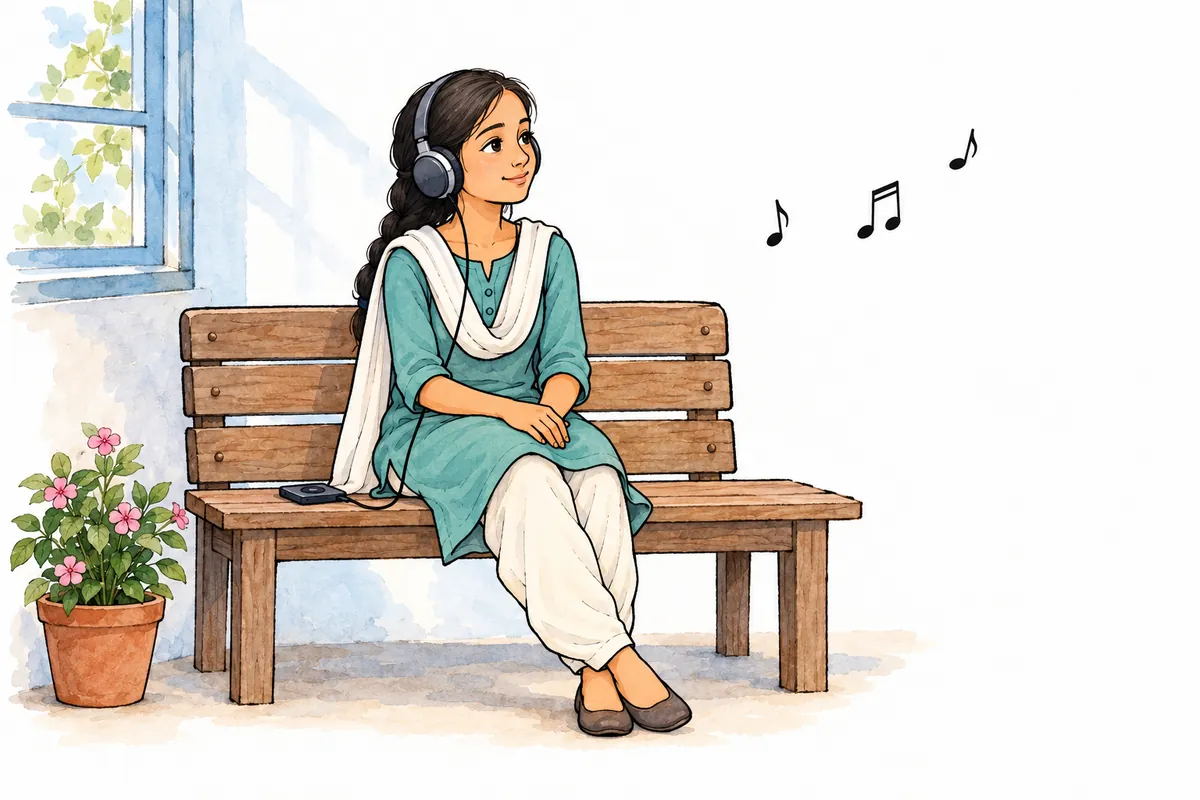
In A Friend Found in Music, Bryanna T. Perkins presents music as a deeply valued companion. The speaker compares it to an ocean, rhythm, therapy and a needed friend. These images express emotional attraction, comfort and gratitude. The poem describes a personal experience; its healing language is figurative rather than a promise of medical recovery for every listener.
About the Poet
Bryanna T. Perkins is credited by NCERT as the writer. The poem’s first-person voice, recurring references to music and regular end rhymes create an intimate reflection. The text does not establish claims about readership size or the author’s wider biography.
Explanation of the Poem
Lines 1–4: attraction and emotional depth
Lines 5–8: comfort during sadness
Lines 9–12: companionship
Summary in English
The speaker reflects on music’s importance through four comparisons. It draws them like an ocean, affects them through rhythm, brings comfort in sadness and feels like a dependable friend. Repetition gives music a central place in the poem, while rhymes create a gentle musical pattern. The ending expresses gratitude for companionship in both cheerful and lonely moments.
Summary in Hindi (सारांश हिंदी में)
कविता का वक्ता संगीत के प्रति अपने लगाव को सागर, लय, उपचार और मित्र के रूपकों से व्यक्त करता है। संगीत उसे आकर्षित करता है, अंतरतम भावनाओं को छूता है और उदासी में सांत्वना देता है। प्रसन्न क्षणों में भी संगीत का साथ रहता है। जब लगता है कि कोई ध्यान नहीं दे रहा, तब संगीत एक आवश्यक मित्र जैसा अनुभव होता है। यहाँ उपचार की भाषा भावनात्मक सहारे का रूपक है, किसी बीमारी के निश्चित इलाज का दावा नहीं। कविता की पुनरावृत्ति और तुकांत शब्द उसकी संगीतात्मकता बढ़ाते हैं।
Poetic Devices in the Poem
| Device | Evidence and effect |
|---|---|
| Metaphor | Music is called an ocean, rhythm, therapy and a needed friend without using “like” or “as”. |
| Alliteration | “moves me” repeats the initial /m/ sound. This answers the short phrase-based exercise. |
| Personification | Music behaves like a caring friend; “lifts my spirits” also contributes to the impression of a helpful presence. |
| Repetition | “Music” repeatedly begins lines, keeping it at the centre of the reflection. |
| Rhyme | ABCB in each four-line group: shore/core; blue/through; there/care. With new letters across all 12 lines: ABCB DEFE GHIH. |
| Imagery and idiom | Ocean and shore provide an image; “feel blue” expresses sadness figuratively. |
| Tone and mood | An affectionate, grateful tone and thoughtful mood. |
Word Meanings (शब्दार्थ)
| Word/Phrase | English Meaning | हिंदी अर्थ |
|---|---|---|
| shore | the land along the edge of a sea | तट, किनारा |
| rhythm | a regular pattern of beats | लय |
| to the core | to one’s deepest self | अंतरतम तक |
| therapy | healing treatment | चिकित्सा, उपचार |
| feel blue | (idiom) feel sad or low | उदास होना |
| lifts my spirits | makes me cheerful | मन प्रसन्न कर देता है |
| pull through | (phrasal verb) succeed in surviving something difficult | कठिनाई से पार पाना |
| cheerful | happy, joyous | प्रसन्न |
| needed friend | the friend one truly requires | ज़रूरी मित्र |
NCERT Exercise Solutions
Reflect and Respond
I. 1. What kind of music do you prefer — vocal or instrumental? 2. Name your favourite musician(s). 3. Give reasons for your choice.
I prefer instrumental music, especially the flute and the santoor. My favourite musicians are Pandit Hariprasad Chaurasia and Pandit Shivkumar Sharma. I choose instrumental music because, without words, it leaves room for my own feelings — when I am studying it calms me, and when I am sad it comforts me exactly as the poem describes, like a friend who understands without speaking.
Check Your Understanding
I. Complete the diary with words from the poem.
1. shore; 2. rhythm; 3. core; 4. therapy; 5. spirits; 6. cheerful; 7. needed; 8. care.
II.1. Device in “moves me”
II.2. Metaphors rewritten as similes — samples
- Ocean: music is as compelling as an ocean.
- Rhythm: music is like a rhythm that stirs my feelings.
- Therapy: music is like therapy for the speaker’s sadness.
- Needed friend: music is as comforting as a dependable friend.
II.3. Rhyme scheme and effect
II.4. Why repeat “music”?
II.5. Message
II.6. Mood
II.7. Evidence for a personal voice
Critical Reflection
I. Read the extract given below and answer the questions that follow. (Stanza 2 — music as therapy)
(i) The phrase ‘feel blue’ indicates ___________.
…feeling sad or low. The idiom alone does not establish clinical depression.
(ii) Identify the line which shows music makes the poet happy.
“Music lifts my spirits”.
(iii) What does the last line of the extract signify?
“To make sure I pull through” signifies that music gives the poet the strength to survive and come safely out of her difficult times — the line expresses her confidence that music helps her cope; it does not establish a medical recovery.
(iv) True or False: Music plays a vital role in the poet’s life.
True
(v) Select the central idea of the extract.
A. Music brings comfort during sadness.
II. Answer the following questions.
1. How is music able to move the poet ‘to the core’?
The phrase suggests that music’s rhythm deeply affects the speaker — her deepest emotions and memories. A beat or melody resonates with feelings she cannot express, so she is stirred not on the surface but at the very centre of her being.
2. Why does the poet compare music to a ‘needed friend’?
The speaker experiences music as comforting company in sadness and joy. Calling it a friend conveys closeness and trust, especially when the speaker feels alone. It is a comparison, not a claim that music can replace every human relationship.
3. Explain the poet’s attitude towards music.
Her attitude is one of deep gratitude, love and dependence. She credits music with her recoveries from sadness and her happiest hours, elevating it from a pastime to a therapist and a best friend. The whole poem reads like a thank-you letter to music.
4. Support the opinion that this poem has a universal appeal.
The poem can appeal to many readers because it connects music with familiar feelings of sadness, joy and companionship. Its simple language and rhymes make these connections easy to follow. “Universal appeal” means broad relevance here, not that every person experiences music in exactly the same way.
5. Compare your experience of music with the feelings expressed in the poem.
(Model answer) My experience matches the poet’s closely. Before exams, soft instrumental music calms my nerves; when I lost a school competition, my favourite songs slowly lifted my spirits, just as the poem says; and my happiest memories — birthdays, festivals, school functions — all have music in them. Like the poet, I have found in music a friend who never refuses to listen.
Vocabulary in Context
I. Classify the words as positive and negative emotions; then fill in the blanks.
Positive emotions (happiness): lifts my spirits, most cheerful. Negative emotions (sadness): feel blue.
1. The familiar tune stimulated a rush of nostalgia… 2. The soulful ballad expressed the singer’s anguish… 3. …creating an ambience of melancholy. 4. The festive symphony filled the air with jubilant tones…
III. Choose the correct meaning for the underlined phrasal verbs.
Meaning and textbook option
| Verb | Meaning | Option |
|---|---|---|
| move out | leave the home where one has been living | (v) |
| move in | begin living in a new home | (ii) |
| move on | start a new activity or stage | (i) |
| move over | shift sideways to make room | (vi), also similar to (iv) |
| move along | continue onwards; stop remaining in one place | (iv) appears intended by elimination, but is imprecise |
| move off | start moving away | (iii) |
Box problem: options (iv) and (vi) overlap strongly as definitions of “move over”. “Move along” means continue onwards, as when police ask a crowd not to linger. Do not learn “make room” as its only meaning. Also, “moves me” in the poem is an ordinary verb plus object, not a phrasal verb: it means affects me emotionally.
IV. Create phrasal verbs from ‘put’, ‘get’, ‘look’, ‘break’; find meanings and make sentences.
| Phrasal verb | Meaning | Sentence |
|---|---|---|
| put off | postpone | The concert was put off due to rain. |
| put up with | tolerate | I cannot put up with loud cacophony. |
| get over | recover from | Music helped her get over her sadness. |
| get along | have a friendly relationship | The four musicians get along very well. |
| look after | take care of | She looks after her old veena lovingly. |
| look forward to | await eagerly | We look forward to the World Music Day recital. |
| break down | stop working; lose control of emotions | The speaker broke down while singing her mother’s song. |
| break into | suddenly begin | The audience broke into applause. |
Listen and Respond
I–II. Guess the responses; then listen to the conversation and check your answers.
1. The two speakers are connected as — (i) parent-child (Jaspreet and his mother).
2. The conversation takes place at the — (i) music centre (about to close for the day).
3. The instrument causing the problem is the — (ii) santoor.
4. The problem discussed is — (ii) irregularity of the music class (the santoor teacher comes only twice a week).
5. The unsuccessful solution was — (iii) watching videos about playing the instrument.
6. The best option is (iii) purchase the musical instrument. More precisely, his mother will first ask a friend to lend a santoor until they buy their own, allowing home practice.
Speaking Activity
I. Four-role conversation — original model
Teacher: Would you like to try a music class? We can discuss the practice time before you decide.
Student 1: I am interested, but I worry that lessons might leave too little time for homework.
Student 2: I learn music. A short practice session fits into my timetable, although I change the schedule during busy weeks.
Parent: I share that concern. How much practice would a beginner need?
Teacher: We can agree on a manageable routine and review it together. Enjoyment and steady learning matter more than rushing.
Student 1: Could I try a few lessons and check whether the routine works?
Parent: Yes. After this discussion, I am happy to support a trial that leaves time for study and rest.
Student 2: I can show you how I plan my week, and you can adapt it.
Writing Task
I. Draft an invitation letter requesting your grandparents to attend your Sitar recital at the school’s musical evening on 21 June, World Music Day.
14, Shanti Niketan Colony
Jaipur
12 June 2026
Dear Dadu and Dadi,
I hope both of you are keeping well and that Dadu’s morning walks are going strong. We all miss you very much.
I have some happy news to share. My school is organising a musical evening on 21 June, World Music Day, at 6 p.m. in the school auditorium — and I will be presenting a sitar recital at the event! I have been practising every evening, and my teacher says my raga has really taken shape. You both first put the love of music in my heart with all those old records, so this performance truly belongs to you.
Please do come and bless me — it would mean the world to see you in the front row. Papa will pick you up at 5 p.m.
Yours affectionately,
Mira
Learning Beyond the Text
I. Music and well-being — short research response
Music therapy is a structured practice involving a trained therapist and individual goals; it is different from simply listening to a favourite song. Research suggests some music-based interventions may help with stress, anxiety or other symptoms in particular settings, but findings vary. Music should not be presented as a guaranteed cure or a substitute for indicated care. The poem uses “therapy” to express comfort. NCCIH: Music and Health provides an evidence-based starting point for the activity.
II. Seven swaras — prepare for your teacher discussion
The familiar names are Sa, Re (Ri), Ga, Ma, Pa, Dha and Ni: Shadja, Rishabha, Gandhara, Madhyama, Panchama, Dhaivata and Nishada. Ask your teacher to demonstrate them and explain traditional accounts of their origins. Stories connecting notes with animal calls should be identified as traditional associations, not established acoustic proof of a single historical origin. Record the source and tradition your teacher uses.
III. Make a collection of poems or songs about music.
Create a table with title, writer/composer, language, source and one sentence explaining the role of music. Possible starting texts already in this book are A Friend Found in Music, Walter de la Mare’s Music and the play Twin Melodies for comparison. Add a song in a language you know and credit its creator. Write your own short response rather than copying entire lyrics.
IV. Read Walter de la Mare’s “Music” — comparison
De la Mare imagines familiar nature becoming enchanted when music sounds: trees, flowers and mythological water nymphs form a dreamlike world. Perkins focuses more directly on personal comfort and companionship. Both present music as transformative, but one emphasises imaginative vision while the other expresses intimate emotional support. A naiad is a water nymph in mythology, not a real animal described by the poem.
Extra Questions with Answers
Q1. Why is the poem titled ‘A Friend Found in Music’? (30–40 words)
Because the poem’s final discovery is that music behaves like a true friend — comforting the poet in sadness, sharing her cheerful moments and standing by her when no one else seems to care.
Q2. Which two idiomatic expressions of emotion does the poet use? (30–40 words)
She uses ‘feel blue’, meaning to feel sad or low, and ‘pull through’, meaning to come safely out of a difficult time — both showing music’s role in her emotional life.
Q3. What role does music play in the poet’s happy moments? (30–40 words)
The poet notes that in her most cheerful times, “it’s clear, music was there” — music is associated with both comfort during sadness and cheerful experiences; the poem does not establish it as the sole cause of happiness.
Q4. “The poem presents music as ocean, medicine and friend.” Explain how the three metaphors build the poem’s meaning. (100–120 words)
Each metaphor adds a layer to music’s portrait. The ocean conveys music’s vastness and irresistible pull — the poet is drawn to it as the tide draws a swimmer to shore, and its rhythm moves her to the core. The therapy metaphor shifts from power to healing: when she feels blue, music treats her sadness, lifts her spirits and ensures she pulls through, as a metaphor for emotional support, not a guaranteed cure. Finally, the friend metaphor makes music personal and faithful — present in her cheerful hours and loyal when no one seems to care. Together the images move from nature’s grandeur to a doctor’s care to a friend’s intimacy, bringing music steadily closer to the heart.
Additional MCQs
1. ‘A Friend Found in Music’ is written by — (a) David Roth (b) Bryanna T. Perkins (c) Walter de la Mare (d) Maya Anthony
2. Music is called an ocean that pulls the poet to the — (a) depths (b) waves (c) shore (d) sky
3. When the poet feels blue, music is her — (a) teacher (b) therapy (c) memory (d) prize
4. ‘Feel blue’ means to feel — (a) cold (b) sad (c) sleepy (d) angry
5. Music lifts the poet’s — (a) voice (b) hopes (c) spirits (d) dreams
6. The rhyme scheme of each stanza is — (a) aabb (b) abab (c) abcb (d) free verse
7. Music is the needed friend when — (a) exams approach (b) no one seems to care (c) friends visit (d) the night falls
8. ‘Pull through’ means to — (a) drag something (b) succeed in surviving a difficulty (c) pull a rope (d) push ahead in a race
Answer key: 1-b, 2-c, 3-b, 4-b, 5-c, 6-c, 7-b, 8-b
Assertion–Reason Questions
Options for each: (a) Both A and R are true and R explains A. (b) Both A and R are true but R does not explain A. (c) A is true, R is false. (d) A is false, R is true.
1. A: The poet calls music a therapy. R: The speaker presents music as a source of comfort that helps her through difficult times. — (a)
2. A: The poem uses metaphors throughout. R: Music is directly equated with an ocean, a therapy and a friend, without using ‘like’ or ‘as’. — (a)
3. A: The poem is written in the third person. R: The poet uses ‘I’, ‘me’ and ‘my’ in every stanza. — (d)
4. A: Music is present only in the poet’s sad moments. R: She says music was clearly there in her most cheerful times. — (d)
Revision: learn the diary sequence, distinguish alliteration from personification, explain the rhyme pairs and check the overlapping phrasal-verb options. Support answers with relevant language from the poem.
FAQs
Who wrote A Friend Found in Music?
Bryanna T. Perkins, a contemporary poet, acknowledged by NCERT for this piece in the Class 9 Kaveri textbook (2026-27).
What is the central idea of the poem?
Music is a healer and a faithful friend — it comforts us when we feel blue, strengthens us through difficulties, shares our happiest moments and stays with us when no one else seems to care.
What is the rhyme scheme of A Friend Found in Music?
abcb — in each four-line stanza the second and fourth lines rhyme (shore/core, blue/through, there/care).
Also read: Poem 5 – Nine Gold Medals · Kaveri – All Chapters · NCERT Solutions Home. Official textbook PDF: ncert.nic.in