
Follow That Dream Questions and Answers | Class 9 Kaveri
Checked against NCERT Kaveri, first edition January 2026, pages 231–244; listening transcript 275. Personal, discussion and creative responses are samples: adapt them to your experience. This independent study guide is not an official NCERT answer key.
Chapter Overview
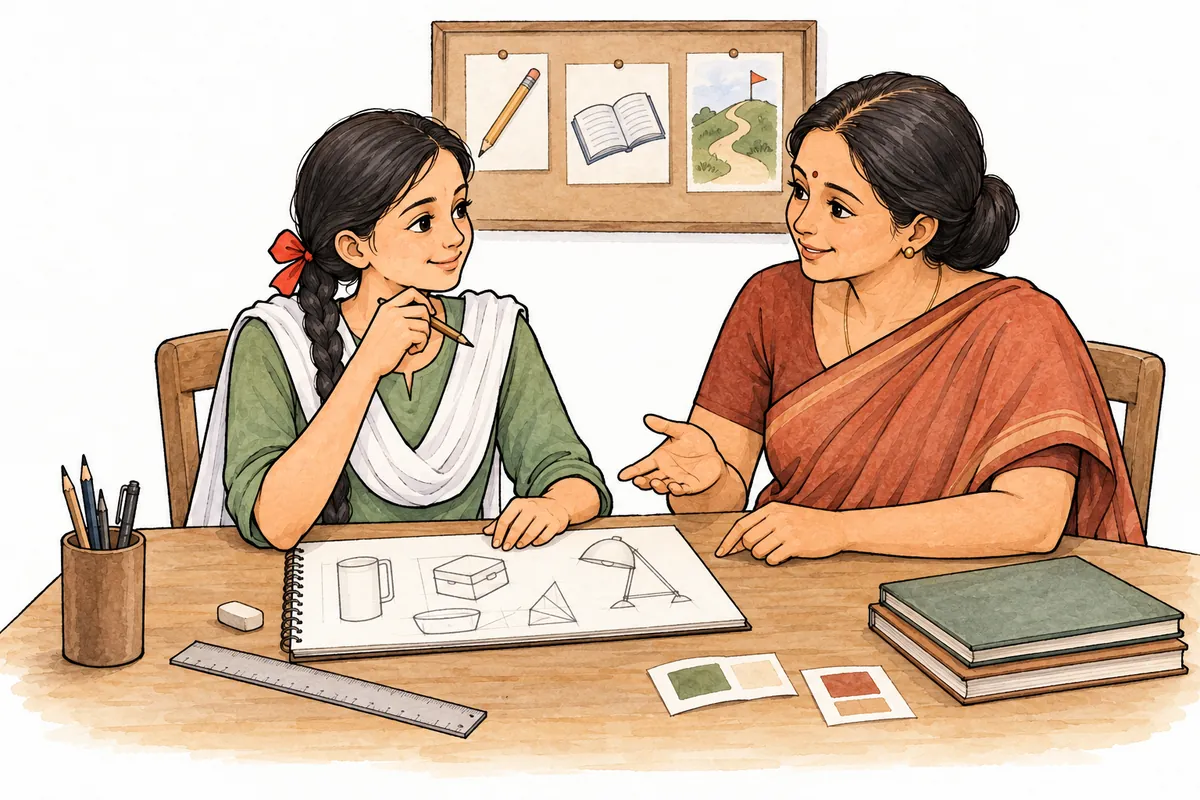
Follow That Dream is an excerpt from Irene Chua’s My Daughter, My Friend. In a letter dated 19 June 1995, a mother encourages her teenage daughter Ming to pursue her ambition thoughtfully. She discusses effort, cost, sacrifice, support and changing circumstances. Her advice combines encouragement with realistic preparation.
The mother’s reference to at least ten years expresses the letter’s emphasis on sustained effort. It is not a universal scientific rule, a guaranteed timetable or a requirement that every learner must meet. The letter also recognises that war, family responsibilities and other circumstances can alter dreams.
About the Author & the Text
NCERT introduces the excerpt as a letter from Irene Chua’s collection My Daughter, My Friend. The personal-letter form includes a date, salutation, direct advice, examples and the affectionate closing “Love, Mum”. Ming’s earlier letter is not reproduced, so its exact contents and her chosen ambition are unknown.
Summary in English
The mother urges Ming to follow her dream after considering what it requires. Passion must be supported by commitment, effort and an honest assessment of time, money and sacrifice. Enjoyment of meaningful work and hope of success can sustain motivation. Her Academy Awards example highlights the people who support an achiever.
She also recognises that dreams may remain unrealised for different reasons. Some people do not move beyond wishing; others choose security or face circumstances beyond their control. War disrupted some people’s plans to attend Raffles College, while family duties forced others to work instead of finishing school. These examples should not be reduced to a lack of determination.
The mother explains that dreams can change without losing their value. Publishing her book became a later ambition that she had pursued for ten years. She encourages Ming to consider obstacles, make a practical commitment and remain open to evolving hopes.
Summary in Hindi (सारांश हिंदी में)
माँ अपनी बेटी मिंग को सोच-समझकर अपने सपने का अनुसरण करने के लिए प्रेरित करती है। रुचि के साथ संकल्प, प्रयास और समय, धन तथा त्याग का वास्तविक आकलन भी आवश्यक है। अपने प्रिय और सार्थक काम से मिलने वाला आनंद तथा समर्थकों का सहयोग आगे बढ़ने में सहायता कर सकते हैं। दस वर्ष की साधना का उल्लेख पत्र में निरंतर प्रयास पर बल देता है; यह हर क्षेत्र के लिए निश्चित वैज्ञानिक नियम नहीं है।
माँ मानती है कि कुछ लोग केवल इच्छा करने तक सीमित रहते हैं, पर कुछ के सपने युद्ध या पारिवारिक दायित्वों के कारण बदल जाते हैं। इसलिए अधूरे सपनों का कारण हमेशा कम मेहनत नहीं होता। जीवन के साथ नए सपने बन सकते हैं और वे पुराने सपनों से कम महत्त्वपूर्ण नहीं होते। अपनी पुस्तक प्रकाशित करना माँ का ऐसा ही बाद का सपना है। संदेश है—योजना और सहयोग के साथ प्रयास करें तथा बदलती परिस्थितियों को समझें।
Word Meanings (शब्दार्थ)
| Word/Phrase | English Meaning | हिंदी अर्थ |
|---|---|---|
| insight | clear and deep understanding | अंतर्दृष्टि |
| by all means | certainly, definitely | अवश्य, बेझिझक |
| singularly | exclusively | एकनिष्ठ होकर |
| imperative | necessary | अनिवार्य |
| conviction | firm belief | दृढ़ विश्वास |
| burning in your blood | felt as a passionate desire | रगों में धधकना |
| plunge | throw oneself into the activity | कूद पड़ना |
| uphill | difficult, requiring constant effort | कठिन, चढ़ाई भरा |
| buoyed up | kept afloat, kept in good spirits | सहारा पाए हुए |
| prospect | the possibility (of something happening) | संभावना |
| a host of | a large number of | अनेक |
| wistfully | longingly | ललक के साथ |
| wishful thinking | hopeful belief unlikely to come true | हवाई ख़याल |
| put a wet blanket on | discourage, dampen enthusiasm | उत्साह ठंडा करना |
| coursing through your veins | flowing through your body (strongly felt) | रगों में बहना |
| negotiate | find a way through | पार करना |
| maze of hurdles | a confusing series of obstacles | बाधाओं की भूलभुलैया |
| dreamscape | a world of dreams | स्वप्न-लोक |
| aspirations | hopes, ambitions | आकांक्षाएँ |
NCERT Exercise Solutions
Reflect and Respond
I. 1. What is your dream? 2. Who inspires you to dream? 3. What qualities should you have to fulfil your dream? 4. Abdul Kalam said, “Dream is not that you see in sleep, dream is something that does not let you sleep.” Discuss.
1. My dream is to become a doctor and serve in rural India where hospitals are far away.
2. My grandmother, who could not study herself but educated all her children, inspires me; so do achievers like Dr. A.P.J. Abdul Kalam and Dr. Deepa Malik.
3. Passion, determination, discipline, patience, readiness to sacrifice, and the resilience to rise after failures.
4. The saying attributed to A. P. J. Abdul Kalam in the exercise contrasts a sleeping dream with an ambition that motivates action. “Does not let you sleep” is figurative emphasis, not advice to give up sleep or rest. A strong purpose can guide steady work within a balanced routine.
II. What role can parents and community play to help children achieve their dreams?
Parents can encourage rather than dictate, offer honest counsel (like Ming’s mother — supporting the dream while helping count its cost), provide resources and emotional support, and stand by the child through failures. The community can supply mentors, libraries, coaching, scholarships and platforms — for, as the letter says, behind every winner stands a host of people who supported them.
III. Complete the web chart: Why is it important to follow a dream?
• It gives life direction and purpose • It motivates hard work and discipline • It can help develop our talents • Progress can bring satisfaction • Achieved dreams inspire others • It can encourage learning and contribution • It helps us move from wishing to practical steps.
Check Your Understanding
Answer these statements according to the letter. The first answer reflects the mother’s claim, not a universal rule about expertise.
I. State whether the following sentences are true or false.
| 1. Reaching the peak of skill in a field typically demands focused and intense dedication for about a decade. | True |
| 2. The mother believes that significant effort and personal sacrifices are essential for turning aspirations into reality. | True |
| 3. The path to achieving the deepest desires has very little difficulty or a few obstacles. | False — the road is uphill most of the way, through a maze of hurdles. |
| 4. The mother is of the opinion that a person’s life goals and hopes can evolve over time. | True |
| 5. Having a strong network of individuals can be a hurdle in pursuing one’s ambition. | False — for every winner there is a group of people who stood by him/her. |
| 6. The mother feels that pursuing a major life goal will not involve any financial expense or sacrifice. | False — she asks Ming to count the cost in effort, financial investment and sacrifice. |
| 7. For many individuals, their aspirations remain just wishes because they don’t move beyond mere daydreaming. | True |
Critical Reflection
I. Extract 1: passion and commitment
- conviction
- B. an early abandonment of the dream. Assessing costs helps one prepare realistically.
- complete involvement: “plunge” means commit fully here.
- The motivation comes from enjoyment of the work and the feeling that it is meaningful, rather than only from external rewards.
- A possible answer is encouragement from family, friends or mentors. Love of the work is another valid answer.
I. Extract 2: changing dreams
- evolving or dynamic; both offered words express change.
- Later aspirations can be as valuable as youthful ones; change does not make a dream inferior.
- “negotiate a path through a maze of hurdles”
- A longer, changing journey can involve more relatives, colleagues, mentors and supporters. This is an interpretation of the mother’s observation.
- C. optimistic and encouraging.
II.1. What might Ming have written?
II.2. Two ways to develop an international level of skill
II.3. Mere dreaming and achievement
II.4. How do questions and examples persuade Ming?
II.5. Encouragement and caution
II.6. Is the advice relevant today? — sample
II.7. Costs I would accept or refuse — sample
Vocabulary and Structures in Context
I. ‘-scape’ words: fill in the blanks in the dialogue.
(i) seascape (the Goa pictures) (ii) cityscape (iii) landscape (iv) mindscape
Meanings: mindscape — the inner world of one’s thoughts; seascape — a view of the sea; landscape — a view of an area of land; cityscape — a view of a city.
II. Choose the best meaning for the underlined expressions; use each in a sentence.
1. burn in her blood — (ii) have a passionate desire: The wish to fly fighter jets burns in her blood.
2. an uphill task — (i) a tough challenge: Clearing the entrance exam without coaching was an uphill task.
3. buoyed up — (iv) lifted in spirit: Buoyed up by the audience’s cheers, she sang even better.
4. wishful thinking — (iii) a hopeful belief but unlikely to be true: Expecting top marks without revision is wishful thinking.
5. a wet blanket — (i) spoil-sport: Don’t be a wet blanket; join the celebration!
6. coursing through her veins — (ii) flowing through her body: Determination was coursing through his veins as the race began.
III. Complete the first-conditional sentences using imperatives.
1. If the idea excites you, pursue it wholeheartedly.
2. If you hear strange noises, inform an elder at once.
3. If this seems too hard, break it into smaller steps.
4. If you care about the issue, speak up and act.
5. If you finish early, revise your answers carefully.
IV. Analyse the usage of ‘could’ and match the sentences with their functions.
1. “It could be in any field…” — possibility
2. “I wish I could be this or the other” — unreal or hypothetical situation
3. “They could have preferred to trade their dream for security.” — past possibility or speculation
4. “…so that they could support their siblings through school.” — past ability or purpose
V. Complete the sentences using ‘could’ with the given functions.
1. I wish I could travel the world without worrying about money. (unreal/hypothetical)
2. They could have taken the shorter route, but they didn’t know about it. (past possibility)
3. When I was younger, I could run for hours without stopping. (past ability)
4. She could be at the library right now — she had mentioned it. (possibility)
5. Could you repeat the question? I didn’t hear it clearly. (polite request)
VI. Fill in the blanks with suitable grammatical forms.
1. helps 2. learned / learnt (used to learn also fits) 3. work 4. apply 5. conducts (may conduct is also possible) 6. analyses 7. must reflect 8. helps 9. is 10. will incorporate
Grammar: in the experiential-learning paragraph, present simple describes general practices, the past form contrasts traditional learning, must reflect expresses necessity and will incorporate expresses the passage’s future prediction. In the idiom question, “lifted in spirit” is the broadest definition of buoyed up; several other options describe its effect in that particular victory context.
Listen and Respond
I. Exact-word answers from the announcement
| Item | Answer | Evidence or qualification |
|---|---|---|
| 1. Course starting month | Not explicitly stated | April is mentioned for registration, not expressly for the first class. |
| 2. Objective | practical skills | These support higher education and careers. |
| 3. Course after Graphic Design | Basic Coding | These two exact words occur in the list. |
| 4. Instructors | trained professionals | The stated course leaders. |
| 5. Forms available at | school office | The stated collection location. |
| 6. Priority applicants | early | Seats are allotted to early applicants. |
Item 1 mismatch: the recording says courses begin “from this academic year”. Forms are available from 4 April with an 8 April deadline. April may be the intended classroom answer, but the start month cannot be confirmed from those registration dates alone. No year is stated for these sample dates.
Speaking Activity
I. Four-role conversation — original model
Dreamer: I know this is challenging, but I hope to become a trekking guide. I enjoy learning about routes and helping a group work together.
Parent: I respect your interest. I am concerned about training costs, safety and how you would earn a steady income.
Mentor: Dreams need planning. Let us research recognised training, entry requirements, costs and realistic work opportunities before deciding. Your education can continue while you explore the field.
Friend: I can help compare information. What would your backup plan be if the first route did not work?
Dreamer: I will start with supervised learning, speak to experienced guides and prepare a budget. Then we can review whether this path suits me.
Parent: That gives us a concrete plan to discuss. I will help you gather reliable information.
Writing Task
I. Formal enquiry email — fictional classroom model
From: mira@example.com
To: director@example.org
Date: 15 May 20XX
Subject: Enquiry about the Summer Design Workshop
Dear Sir or Madam,
I am Mira, a Class IX student interested in studying design in the future. I read about your summer workshop and would like to know whether students of my age may apply.
Please share the dates, daily timings, duration, topics, venue or online arrangements, fees and available concessions. I would also appreciate details of the application process, deadline and any portfolio or materials required.
I would be grateful for permission to participate if I meet the eligibility requirements. Thank you for your guidance. I look forward to your reply.
Yours sincerely,
Mira
Class IX student
Contact: mira@example.com
The names, date and reserved example email addresses are placeholders, not real institute contacts. Cc and Bcc can be omitted when unnecessary.
Learning Beyond the Text
I. Vision board — adaptable example
| Section | Sample content | First practical step |
|---|---|---|
| My Dreams | Explore product design | Sketch one everyday object and identify a useful improvement. |
| I Want to Try | Join a school art or making activity | Ask the teacher about a suitable session. |
| Goals | Complete four thoughtful sketches this month | Set aside two short practice periods each week. |
| Places I Will Go | A local museum or design exhibition | Check access and plan a visit with a trusted adult. |
| Inspiration | A supportive family member, teacher or designer | Write what I can learn from that person. |
Use drawings or credited images, then add actions and review dates. A vision board is a planning aid; pictures alone do not cause a goal to come true.
II. Parental influence in the textbook
Extra Questions with Answers
1. What does the ten-year reference mean?
2. Why mention award winners?
3. Which circumstances altered people’s plans?
4. What was the mother’s later dream?
5. Explain the metaphor of a “green signal and a map”.
6. What can students learn?
Additional MCQs
1. ‘Follow That Dream’ is a — (a) speech (b) diary entry (c) letter (d) interview
2. The letter is taken from the collection — (a) My Mother, My Guide (b) My Daughter, My Friend (c) Letters to Ming (d) Dreams and Destiny
3. Its author is — (a) Mitra Phukan (b) Asha Nehemiah (c) Irene Chua (d) Temsula Ao
4. The letter is addressed to — (a) Mei (b) Ming (c) Min (d) Mai
5. According to the mother, world-class standard requires intensive pursuit for at least — (a) five years (b) ten years (c) fifteen years (d) twenty years
6. The dream chase starts with — (a) money (b) luck (c) a passion for a particular interest (d) a degree
7. In the mother’s example, award winners thank — (a) their critics (b) a host of supporters (c) the media (d) their rivals
8. The dreams of Raffles College aspirants were destroyed by — (a) poverty (b) floods (c) the Japanese invasion in World War II (d) illness
9. ‘To put a wet blanket on’ means to — (a) protect (b) discourage (c) delay (d) hide
10. The mother’s own ten-year dream was — (a) visiting Singapore (b) becoming a teacher (c) publishing her book (d) opening a school
Answer key: 1-c, 2-b, 3-c, 4-b, 5-b, 6-c, 7-b, 8-c, 9-b, 10-c
Assertion–Reason Questions
Options for each: (a) Both A and R are true and R explains A. (b) Both A and R are true but R does not explain A. (c) A is true, R is false. (d) A is false, R is true.
1. A: The mother asks Ming to ‘count the cost’ before plunging. R: A realistic assessment helps prepare for difficulties and can reduce early abandonment. — (a)
2. A: For many people, dreams remain dreams. R: Some never move beyond wishful thinking; others choose security or face external obstacles. — (a)
3. A: The mother asks Ming to consider the years needed to chase her dream. R: She does not want to put a wet blanket on Ming’s dreams. — (b)
4. A: Dreams formed later in life deserve pursuit. R: Life itself may change a person’s dreams without making them less worthy. — (a)
5. A: The letter values support networks. R: Its award-winner example highlights people who stood by an achiever. — (a)
Revision: connect passion with planning and support, explain how circumstances change dreams, and practise conditional imperatives and the functions of “could”. Distinguish the recording’s registration dates from an unstated course start date.
FAQs
Who wrote Follow That Dream?
It is an excerpt from a letter by Irene Chua in My Daughter, My Friend, addressed to Ming and dated 19 June 1995.
Is ten years a guaranteed rule for success?
No. The mother uses the period to emphasise sustained effort. The letter does not establish a universal timetable or guarantee of achievement.
What is the main message?
Pursue a meaningful dream with effort, realistic planning and support, while recognising obstacles and allowing aspirations to evolve.
Also read: Chapter 7 – Carrier of Words · Kaveri – All Chapters · NCERT Solutions Home. Official textbook PDF: ncert.nic.in