
A Bottle of Dew — Class 6 English Poorvi Questions and Answers
A Bottle of Dew questions and answers: review the story in Class 6 English Poorvi Unit 1 with a summary, word meanings, comprehension answers, homophones, listening order and sample speaking and writing activities.
Source: NCERT Poorvi, Grade 6, Unit 1, printed pages 1–12; listening transcript on page 36; supplied reprint 2026–27. Open-ended and personal responses are examples to adapt. These explanations are study support, not an official NCERT answer key.
About the chapter
In Sudha Murty’s story, Rama Natha neglects his inherited land while searching for a potion that will turn objects into gold. Sage Mahipati sets him the task of growing banana plants and collecting five litres of dew. Farming and Madhumati’s sales create wealth; the dew does not turn the copper vessel into gold. The sage does not set a six-year deadline: six years is the time Rama Natha actually takes to collect the dew.
About the author
NCERT credits this story to Sudha Murty. The textbook acknowledgements identify her collection The Magic Drum and Other Favourite Stories, published by Penguin Random House India, as its source. Read the author’s storytelling through the characters’ actions and the final explanation of the coins.
Summary
Rama Natha was the son of a rich landlord who left him large tracts of land. Instead of looking after his fields, Rama Natha wasted all his time chasing a strange belief: that there existed a magic potion which could turn any object into gold. People often cheated him by promising to reveal the secret, and he kept spending money on them. His wife, Madhumati, grew tired and worried, fearing they would soon be ruined.
One day a famous sage called Mahipati visited their town. Rama Natha became his follower and begged him about the potion. To his surprise, the sage agreed to help. He told Rama Natha to plant banana plants, water them with his own hands, and collect the morning dew from their leaves in winter. When he had gathered five litres of dew, the sage would chant magic words to turn it into the potion. Rama Natha worried that this would take years, but the sage insisted he must do everything himself.
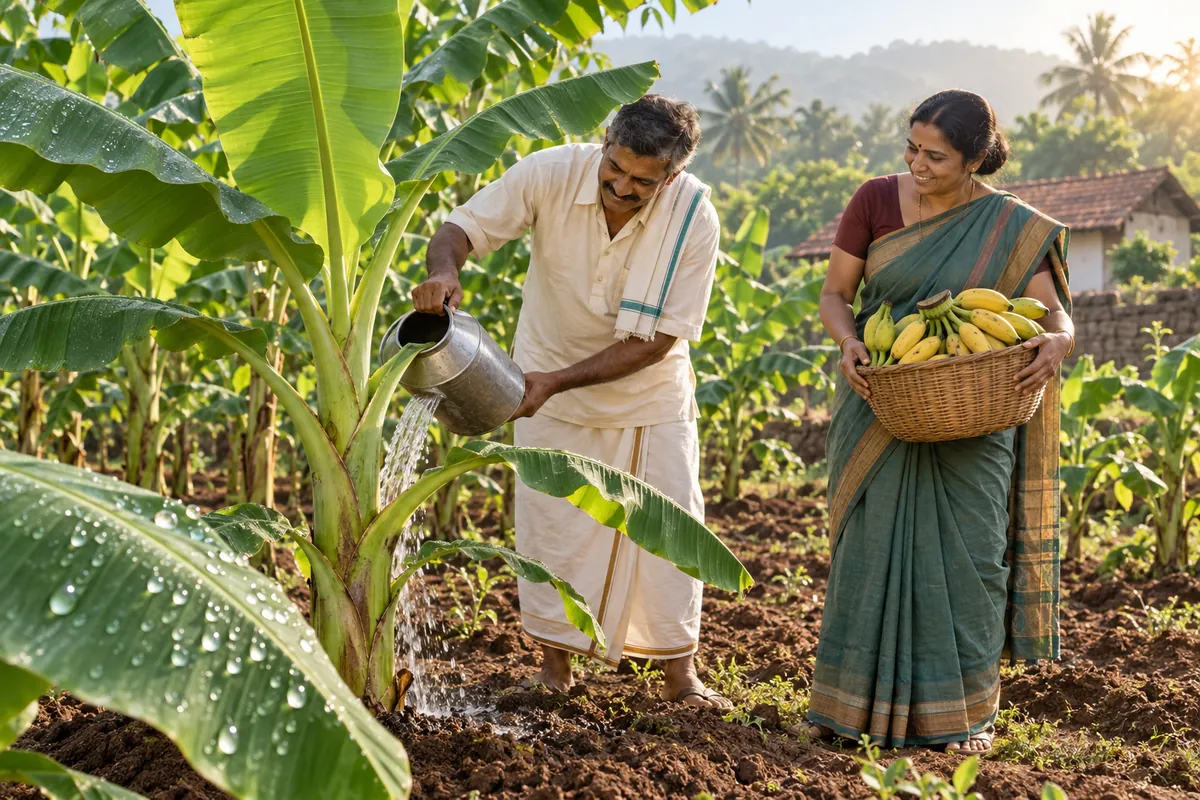
Rama Natha went home and, with his wife’s help, cleaned his long-empty fields and planted rows of banana plants. He tended them carefully and collected dew each winter, while Madhumati sold the banana crop at the market for a good price. Over six years their plantation grew huge, and at last he collected five litres of dew. He proudly took it to the sage, who muttered over it and told him to try it. But when Rama Natha sprinkled it on a copper vessel, nothing turned to gold. Angry, he accused the sage of cheating. The sage then called Madhumati, who opened a box full of gold coins. He explained that there is no magic potion – the real wealth had come from Rama Natha’s hard work on the land and his wife’s sales at the market. Rama Natha understood the wisdom behind the trick and worked even harder from that day on.
Theme & message
The story contrasts the search for a magical shortcut with patient, productive work. Rama Natha grows and tends the banana plants; Madhumati harvests and sells the crop. Both contribute to the wealth shown at the end. The sage’s plan helps Rama Natha learn through experience.
The message is to use one’s resources responsibly, work steadily and value practical effort. In this story, the coins are earnings from the banana crop, not evidence of magic.
Word meanings
| Word | English meaning | Hindi meaning |
|---|---|---|
| landlord | a person who owns land or property | जमींदार / भूस्वामी |
| large tracts of land | large areas of land | भूमि के बड़े हिस्से |
| potion | a liquid with magical properties | जादुई औषधि / मंत्रित द्रव |
| give up | to stop trying | हार मान लेना / छोड़ देना |
| sage | a wise and holy person | आचार्य / साधु / ज्ञानी पुरुष |
| follower | a person who admires and obeys another | अनुयायी / शिष्य |
| dew | small drops of water on leaves that form during the night | ओस |
| chant | to repeat or sing a word or phrase | मंत्र पढ़ना / जपना |
| plantation | a large area where one type of plant is grown | बागान / रोपण-क्षेत्र |
| tended | looked after | देखभाल की / संभाला |
| vessel | a container such as a pot or bowl | बर्तन / पात्र |
| muttered | spoke in a low voice | बुदबुदाना / धीमे से बोलना |
| sprinkled | scattered small drops over something | छिड़काव / छिड़काव |
| precious | valuable | बहुमूल्य / कीमती |
| wisdom | deep understanding | ज्ञान / समझ |
| wealth | a large amount of money or riches | धन / संपदा |
| worried | feeling anxious or troubled | चिंतित |
| surprise | a feeling caused by something unexpected | आश्चर्य |
| crop | plants grown and harvested for food | फसल |
Before we read — activities
I. Match the word to the textbook picture
Use the original pictures on printed page 1. The new plantation image below illustrates the story; it is not a replacement for those picture choices.
| Word | Correct picture in that row | What to notice |
|---|---|---|
| Worried | Left | The girl has an anxious expression. |
| Plantation | Left | Many plants are grown together, rather than a single tree. |
| Sage | Left | The seated wise man, rather than the vegetable seller. |
| Surprise | Right | The boy’s open mouth and raised eyebrows suggest surprise. |
II. A time I worked hard
Let us discuss
Let us discuss (Part I)
1. What did Rama Natha believe?
2. How did the sage help Rama Natha?
3. Do you think Rama Natha will be able to collect the dew? Give a reason.
Let us discuss (Part II)
1. Why was Rama Natha angry?
2. How did Rama Natha and Madhumati create wealth?
Let us think and reflect
I. Read the lines and answer
1. Extract – “He spent all his time to learn about the magic potion. People cheated him often, promising to tell him about it, but he did not give up. His wife, Madhumati, was tired of this and also worried because she saw how much money Rama Natha was spending. She was sure that soon they would be without money.”
| What Happened | Outcome |
|---|---|
| A. People promised to tell Rama Natha about the magic potion. | They cheated him and took his money, but never told him any real secret. |
| B. Rama Natha was spending a lot of money. | His wife Madhumati became worried and was sure they would soon be left without any money. |
2. Extract – “Carefully, he took the bottle to the sage. The sage smiled and muttered something over the water. Then he returned the bottle and said, ‘Try it out.’ Rama Natha sprinkled a few drops on a copper vessel and waited for it to turn to gold. To his surprise nothing happened!”
A. The sage smiled. B. Rama Natha gave the bottle to the sage. C. Rama Natha dropped a few drops of water on a copper vessel. D. He said something in a low voice over the water. E. Rama Natha waited to see if the magic worked.
Correct option: (b) b, a, d, c, e (ii) Fill in the blank with the correct word from the lines above:
Seeing that the plant had dried up, the gardener sprinkled some water on it. (iii) How might Rama Natha have felt when nothing happened to the copper vessel? Rama Natha must have felt shocked, disappointed and angry. After six years of hard work he expected gold, so when nothing happened he felt cheated and thought he had wasted precious years of his life for nothing.
II. Answer the following questions
| What he did before meeting the sage | What he did after meeting the sage |
|---|---|
| (i) He wasted all his time searching for a magic potion and never looked after his land. | (i) He cleaned his empty fields and planted rows of banana plants, tending them carefully himself. |
| (ii) He spent his money on people who cheated him, leaving the family close to ruin. | (ii) He collected dew each winter and, with Madhumati selling the crop, the family earned real wealth. |
Let us learn
1. Complete the paragraph
In blank order: huge, luck, difficult, promised, cheated, remember. The unused words are spending and market. This vocabulary paragraph is about a coconut farmer; Rama Natha’s story is about banana plants.
2. Homophones — meanings in Column B
| Column A | Column B | Meaning of Column B |
|---|---|---|
| I | eye | The body part used for seeing |
| your | you’re | Short form of ‘you are’ |
| dew | due | Expected or scheduled at a particular time |
| son | sun | The star that gives Earth light and heat |
| one | won | Past tense of ‘win’ |
| ate | eight | The number 8 |
| see | sea | A large body of salt water |
Homophones sound alike but have different meanings and spellings.
3. Four sentences using both homophones — samples
- My son sat in the warm sun.
- The team that won the match scored one goal.
- If you’re ready, please pick up your bag.
- I could see a small boat on the sea.
4. Join the phrases using connecting words
- The children submitted their work before the deadline.
- He did not want to try rock climbing because of his fear of heights.
- The children ran towards the gate as soon as the bell rang.
- Nitin was late to school today as there was a traffic jam.
‘Before’ and ‘as soon as’ show time; ‘because’ and ‘as’ give reasons in these sentences.
5. Tongue-twister activity
Practise the two printed sentences slowly before increasing speed. Original sample: ‘Bina brings big baskets of bananas.’ Create your own sentence with a repeated sound and share it with the class.
Let us listen
Number the events in the textbook’s row order
The transcript on printed page 36 confirms the following. Write the order number beside each printed event, rather than copying its event number.
| Printed event | Order number to write |
|---|---|
| 1. Gives two bananas to a hungry boy | 6 |
| 2. Meets Kalawati in the market | 3 |
| 3. Visits her mother and gives two dozen bananas | 1 |
| 4. Chooses to go home with only some bananas left | 5 |
| 5. Visits her neighbour and gifts a bunch of bananas | 7 |
| 6. Gives twelve bananas to her friend | 4 |
| 7. Goes to the market to sell bananas | 2 |
Chronological event sequence: 3 → 7 → 2 → 6 → 4 → 1 → 5. A dozen is 12; two dozen is 24. Listen to the narration before checking the key.
Let us speak
I. The sounds /s/ and /z/
| Word | Sound of the letter ‘s’ |
|---|---|
| sage, promising, sand, sea | /s/ |
| wisdom, trees, beds, clothes, was, keys, bags, nose | /z/ |
| surprise | First ‘s’: /s/; second ‘s’: /z/ |
Read the words aloud with your teacher; look at the sound, not just the spelling.
II. Partner discussion — samples
- Meaning: Hard work means making a steady, thoughtful effort to complete a task well.
- Three reasons: Firstly, it helps me improve my skills. Secondly, it develops patience. Lastly, it helps me make progress towards a goal.
- Three suggestions: Begin with a manageable plan. Next, practise regularly and ask for help when needed. Finally, take suitable breaks and learn from mistakes.
Use your own ideas and the speaking hints from the textbook.
Let us write
1. Describe a banana — a sample
| Feature | Possible description |
|---|---|
| Taste | Sweet and soft when ripe |
| Colour | Often a yellow ripe peel and cream-white flesh; an unripe peel is often green |
| Touch | Smooth peel and soft ripe flesh |
| Smell | A pleasant fruity smell when ripe |
| When I eat it | After school |
| Why I choose it | It provides energy and is a convenient snack |
Banana varieties differ; describe the fruit you observe. The following are eight sample sentences:
- A banana is usually long and curved.
- Many ripe bananas have yellow peels.
- An unripe banana often has a green peel.
- The flesh of many bananas is cream-white.
- The peel feels smooth.
- A ripe banana tastes sweet and feels soft.
- A ripe banana has a fruity smell.
- I like to eat a banana after school because it gives me energy.
2. A short script — original sample, not textbook dialogue
Narrator: Rama Natha is still searching for a potion.
Madhumati: ‘Our fields need care. We cannot keep spending our money on promises.’
Rama Natha: ‘Sage Mahipati, can you help me?’
Mahipati: ‘Grow banana plants, care for them yourself and collect five litres of dew.’
Narrator: Rama Natha tends the plants. Madhumati sells their crop. Six years later, the dew has no effect on the copper vessel.
Rama Natha: ‘It has not turned into gold!’
Madhumati: ‘Look at the coins we earned by selling bananas.’
Mahipati: ‘The money came from your work together, not from a magic potion.’
Adapt this script and use expressions, simple props and pauses to perform it.
Let us explore
Investigate banana varieties grown or sold in your region. The National Horticulture Board’s variety guide describes, for example, Robusta, Rasthali, Poovan, Nendran and Red Banana. Nendran is associated with Kerala; Red Banana is grown in parts of Tamil Nadu and other states. These are examples, not a complete or exclusive regional list. National Horticulture Board — banana varieties.
Record the variety name, region, appearance and source. Compare this information with a local grower or fruit seller, with an adult’s help. The textbook’s Blue Java note is supplementary reading; your project need not be limited to that variety.
Additional ClearStudy questions
This practice is separate from the printed textbook exercises.
Short answer (30–40 words)
1. What did Rama Natha’s father leave him, and how did Rama Natha treat it?
2. Why was Madhumati worried about her husband?
3. What was the sage’s real purpose behind the dew-collecting task?
4. How long did it take Rama Natha to collect five litres of dew, and why so long?
5. What lesson did Rama Natha learn at the end of the story?
Long answer (100–120 words)
6. Describe how the sage Mahipati cleverly changed Rama Natha’s life.
7. How does ‘A Bottle of Dew’ teach the value of hard work over shortcuts?
MCQs & Assertion–Reason
1. Who was Rama Natha?
(a) a sage (b) the son of a rich landlord (c) a banana seller (d) a poor farmer
2. What did Rama Natha believe the magic potion could do?
(a) cure illness (b) bring rain (c) turn any object into gold (d) make plants grow
3. What was the name of the sage in the story?
(a) Mahipati (b) Madhumati (c) Mahanta (d) Kalawati
4. What did the sage ask Rama Natha to collect?
(a) rainwater (b) morning dew (c) flower petals (d) river water
5. How many litres of dew did Rama Natha have to collect?
(a) two litres (b) five litres (c) ten litres (d) one litre
6. From which plant’s leaves did Rama Natha collect the dew?
(a) mango (b) coconut (c) banana (d) neem
7. How many years did it take to collect the five litres of dew?
(a) three years (b) four years (c) six years (d) ten years
8. Who sold the bananas at the market?
(a) Rama Natha (b) the sage (c) Madhumati (d) Kalawati
9. What did the box that Madhumati opened contain?
(a) bananas (b) gold coins (c) dew (d) seeds
10. What real lesson did the sage teach Rama Natha?
(a) magic is powerful (b) luck brings wealth (c) hard work creates wealth (d) gold is everywhere
Assertion–Reason – choose: (a) A and R true, R explains A; (b) A and R true, R does not explain A; (c) A true, R false; (d) A false, R true.
1. Assertion (A): Madhumati was worried about her husband.
Reason (R): Rama Natha was spending a lot of money trying to find the magic potion.
2. Assertion (A): The sage asked Rama Natha to do all the work with his own hands.
Reason (R): The sage secretly wanted Rama Natha to learn the value of hard work.
3. Assertion (A): The copper vessel turned into gold when Rama Natha sprinkled the dew on it.
Reason (R): The sage muttered some words over the water before returning the bottle.
4. Assertion (A): After learning how the wealth was earned, Rama Natha worked even harder on his plantation.
Reason (R): He understood the wisdom that real wealth comes from hard work, not magic.
5. Assertion (A): Rama Natha became angry with the sage and called it cheating.
Reason (R): After six years of effort, the dew failed to turn the copper vessel into gold.
Exam tips & common mistakes
Exam tips
• Remember the key sequence: belief in potion → meeting the sage → planting bananas → collecting dew for six years → no gold → box of gold coins → lesson learnt.
• Always name the author (Sudha Murty), the main characters (Rama Natha, Madhumati, sage Mahipati) in long answers.
• In theme questions, clearly state the message: hard work, not magic, creates wealth.
• For value-based questions, mention honesty, patience and the dignity of labour.
Common mistakes
• Do not write that the potion actually worked – nothing happened to the copper vessel.
• The dew was collected from banana plants, not coconut or mango plants.
• It took six years, not a few months, to gather five litres of dew.
• The gold came from selling bananas at the market, not from any magic spell – do not confuse the trick with real magic.
FAQs
Who wrote A Bottle of Dew, and which unit contains it?
Sudha Murty wrote the story. It appears in Unit 1, Fables and Folk Tales, in the NCERT Grade 6 English textbook Poorvi.
What does A Bottle of Dew teach?
In the story, farming and Madhumati’s sales create wealth, while the supposed potion does nothing. The tale values patient work and responsible use of resources.
Did the copper vessel turn into gold?
No. Rama Natha sprinkled the liquid on the copper vessel, but nothing happened. The coins came from selling the banana crop.
How much dew was collected, and how long did it take?
Rama Natha collected five litres over six years. Five litres was the sage’s requirement; six years was the time the task took, not a fixed deadline.