
The Raven and the Fox — Class 6 English Poorvi Questions and Answers
The Raven and the Fox questions and answers: study the Class 6 Poorvi Unit 1 poem with its central idea, stanza explanations, picture-order key, rhyme pairs, alliteration, listening answers and sample activities.
Source: NCERT Poorvi, Grade 6, Unit 1, printed pages 13–19; listening transcript on page 37; supplied reprint 2026–27. Open-ended and personal responses are examples to adapt. These explanations are study support, not an official NCERT answer key.
- Poem Overview
- About the Poet
- Central Idea & Stanza Summary
- Word Meanings
- Poetic Devices
- NCERT textbook exercises
- Extra Questions
- MCQs & Answer Key
- Assertion–Reason Questions
- FAQs
Poem Overview
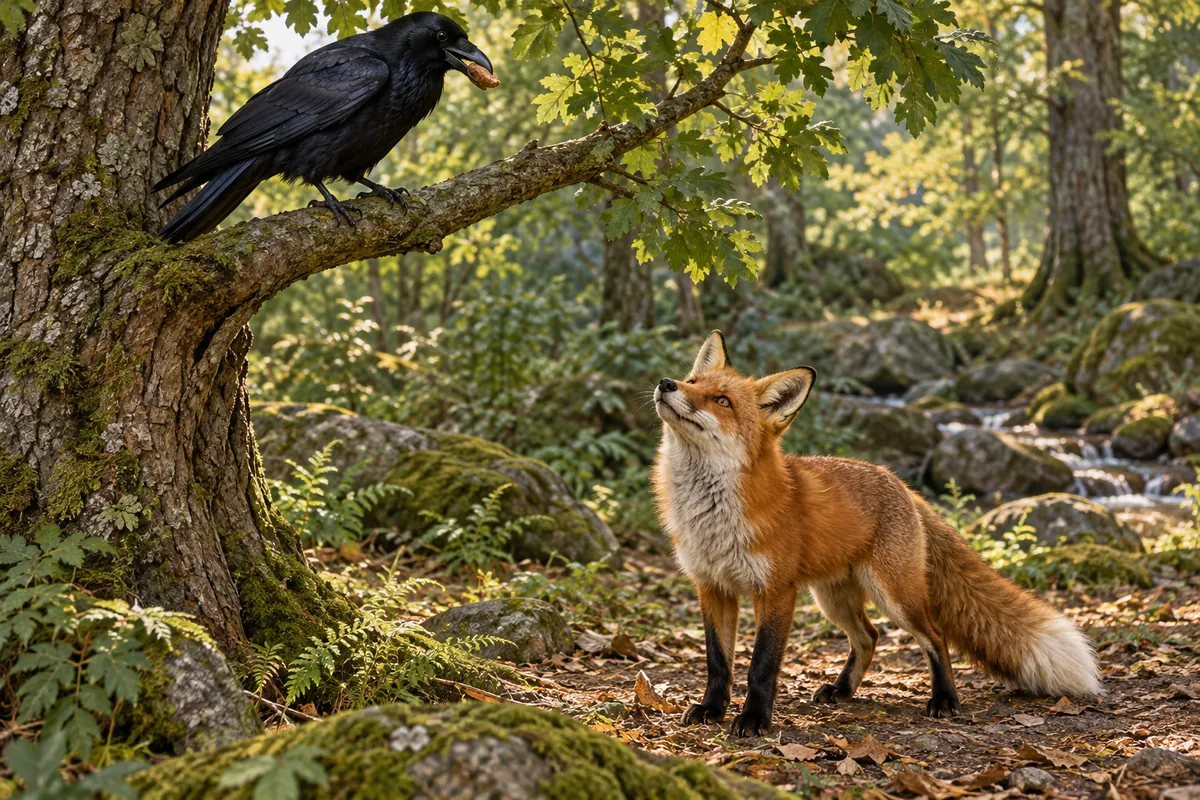
The NCERT poem tells an animal fable in verse. Mr Raven holds a morsel of food on a branch. Reynard the Fox praises his looks and suggests that singing would make the other birds call him King. The Raven opens his beak in foolish pride, dropping the food. The Fox laughs and gives a lesson about flattering words and pride.
The poem says only ‘a morsel’, meaning a small piece of food. It does not name the food as cheese. The animals’ dialogue and emotions belong to the fable, rather than a description of ordinary wildlife behaviour.
About the Poet – Jean de La Fontaine
NCERT credits the poem to Jean de La Fontaine, associated with animal fables. Study the text as printed in Poorvi: its four stanzas use the Fox’s speech and the Raven’s reaction to convey a lesson.
Central Idea & Stanza Summary
Central idea: exaggerated, self-serving praise can distract someone from good judgement. The Raven loses the morsel when foolish pride leads him to open his beak. The lesson concerns false flattery; sincere appreciation and healthy confidence are different.
- Stanza 1: the Fox sees the Raven perched on a branch with food in his beak.
- Stanza 2: the Fox praises the Raven’s appearance and tempts him to sing.
- Stanza 3: the Raven forgets the warning sign in the Fox’s words, opens his beak and drops the food.
- Stanza 4: the Fox laughs and explains how flattering words and foolish pride caused the loss.
Word Meanings (शब्दार्थ)
| Word | English Meaning | हिंदी अर्थ |
|---|---|---|
| raven | a large black bird similar to a crow | एक बड़ा काला पक्षी (कौवे जैसा) |
| perched | sat on a branch or edge | डाली पर बैठा हुआ |
| limb | a branch of a tree | पेड़ की डाली/शाखा |
| morsel | a small piece of food | भोजन का छोटा टुकड़ा, ग्रास |
| beak | the hard pointed mouth of a bird | चोंच |
| seek | to look for something | खोजना, ढूँढना |
| admiring | showing praise and approval | प्रशंसा भरा |
| handsome | good-looking, attractive | सुंदर, आकर्षक |
| feathers | the soft light parts covering a bird | पंख |
| woods | a small forest with similar trees | छोटा जंगल, वन |
| croak | a deep, rough sound (as of a frog or raven) | काँव-काँव/कर्कश आवाज़ |
| foolish | silly; lacking good sense | मूर्खतापूर्ण |
| pride | too high an opinion of oneself | घमंड, अभिमान |
| eyed | looked at with interest | ललचाई नज़र से देखा |
| ignore | to take no notice of something | अनदेखा करना |
| glow | to shine; to feel a warm pleasure | दमकना; गर्व से फूलना |
| unwise | not sensible; foolish | नासमझ, बुद्धिहीन |
| teaching | a lesson or moral | शिक्षा, सीख |
Poetic Devices in the Poem
| Device | Example and explanation |
|---|---|
| Rhyme | Each stanza has two rhyming pairs: AABB within that stanza. Examples include limb–him and beak–seek. |
| Alliteration | big beak repeats /b/; woods would repeats /w/. These are repeated beginning consonant sounds, not a rhyme at word endings. |
| Personification | The Fox speaks, flatters and laughs; the Raven shows foolish pride. The animals have human-like motives and emotions. |
| Dialogue | The Fox’s direct speech reveals how he tempts and then mocks the Raven. |
| Irony | The promise of admiration causes a loss: opening the beak to gain praise makes the Raven drop what he already has. |
| Fable and moral | This animal tale ends with an explicit warning against flattering words and foolish pride. |
NCERT textbook exercises
Before we read
I. The textbook points out that ravens can croak. In this poem, the Raven’s voice is described as ‘just a croak’; the Fox’s praise is intended to make him open his beak.
II. Choose 2. fox. Foxes are often portrayed as cunning in fables; this is a storytelling convention.
Let us discuss — I. Fill in the blanks
| Stanza | (i) | (ii) | (iii) |
|---|---|---|---|
| 1 | bird | Reynard | a piece of food |
| 2 | good-looking | sing | woods |
| 3 | forgot | sing | food |
| 4 | laughed | wise | lesson |
Let us discuss — II. Word-meaning matching
Using the printed Column B numbers: 1 → iv, 2 → i, 3 → v, 4 → iii, 5 → ii, 6 → vii, 7 → vi.
| Word | Meaning |
|---|---|
| perched | sat on a branch |
| morsel | a small piece of food |
| seek | look for something |
| pride | here, feeling that one is better than others |
| eyed | looked at with interest |
| limb | a tree branch |
| woods | an area of forest |
Let us think and reflect — I. Picture sequence
For the four original pictures on printed page 15, write:
| Picture position | Number | What the picture shows |
|---|---|---|
| Top left | 3 | The Raven opens his beak and the morsel falls. |
| Top right | 4 | The Fox leaves with the food; the Raven’s beak is empty. |
| Bottom left | 1 | The Raven has a morsel before the tree scene. |
| Bottom right | 2 | The Fox looks up at the Raven holding food on the branch. |
The reading order is 3, 4 / 1, 2 across the printed grid. Use those textbook pictures for this answer; the new illustration on this page is not part of that grid.
Let us think and reflect — II. Lines and questions
1(i) Option A — shiny and beautiful, as suggested by the Fox’s admiring praise.
1(ii) According to the Fox’s flattering claim, the Raven’s fine appearance plus singing would make other birds call him King. It is a tempting promise, not a fact that the birds have already agreed to do so.
1(iii) ‘Sir’ shows pretended respect. The Fox wants the Raven to feel important and respond to his invitation to sing.
2(i) The Raven opens his beak to sing, persuaded by the praise and his foolish pride.
2(ii) foolish — the word describing the Raven contrasts with ‘clever’ for the Fox.
Let us think and reflect — III–VII
III. The praise and promise of being called King distract the Raven. In his pride, he forgets that his voice in the poem is a croak.
IV. Reynard praises the Raven’s feathers, calls him handsome and suggests that singing would earn him the title of King.
V. The Raven’s foolish pride makes him careless: he opens his beak and loses his food.
VI. He expects admiration, but instead experiences a loss and a lesson about flattery. That reversal surprises him.
VII. Sample personal response: I would thank the person politely and consider whether the praise is sincere. I would stay thoughtful instead of making a careless decision just to receive more praise. Adapt this to your own view.
Let us learn — I. Rhyming pairs
| Stanza | Pair 1 | Pair 2 |
|---|---|---|
| 1 | limb–him | beak–seek |
| 2 | word–bird | sing–King |
| 3 | joke–croak | pride–eyed |
| 4 | know–glow | unwise–surprise |
Let us learn — II. Alliteration
A clear example from Stanza 2 is ‘woods would’, repeating /w/. On page 17, ‘big beak’ illustrates /b/. The teaching example ‘song of sweet birds’ illustrates /s/; it is not an extra line to add to the four-stanza poem.
Let us learn — III. Opposites and sentences
From the given word box: perched–flew, forgot–remembered, foolish–wise, pride–humility, laughed–cried, ignore–notice, glow–dim. The unused words are happy and silly. ‘Perched’ and ‘flew’ describe contrasting bird actions in this exercise.
Four sample sentences: The bird flew to another tree. I remembered my promise. It is wise to check before deciding. The lamp grew dim.
Let us listen — transcript on page 37
The answers are 1. True; 2. False; 3. True. The crow feels sad after being cheated; he thinks he is smart even without beautiful feathers; he wants other animals to be careful with words and pride. The listening material uses ‘crow’, while the poem calls its character Mr Raven. Follow the transcript for the listening task.
Let us speak — a different ending
Let us write — conversation based on that new ending
Reynard: ‘Good morning, Mr Raven! What fine feathers you have!’
The Raven nods, keeping the food in his beak.
Reynard: ‘If you would sing, every bird would admire you!’
The Raven looks at the Fox, then flies to another branch and eats his morsel.
Reynard: ‘My flattering words have not worked today.’
Write only actions for the Raven while he holds the food, as the textbook asks. Adapt the sample with your own alternative ending.
Let us explore — puppets and performance
Make raven and fox figures from folded or drawn paper and attach them to sticks. Origami uses paper folding; a drawn-and-cut puppet is another craft method. Add a paper morsel and act out the poem’s sequence. Use black for the raven and suitable natural colours for the fox. Take an adult’s help for cutting tools and present with your classmates.
Additional ClearStudy questions
This practice is separate from the printed textbook exercises.
Short Answer Questions (30–40 words)
The raven was perched (sitting) on the branch, or “limb”, of a tree. He was holding a tasty morsel — a small piece of food — in his great big beak, which the hungry fox wanted very much. Q2. What is the name of the fox in the poem?
The fox in the poem is named Reynard. He is clever and cunning, and he tricks the raven into dropping his food by using flattering, admiring words. Q3. What did the fox want and how did he try to get it?
The fox wanted the food in the raven’s beak. Instead of fighting, he flattered the raven, praising his feathers and asking him to sing, so that the raven would open his beak and drop the food. Q4. What happened when the raven opened his beak?
When the proud raven opened his beak to sing, the morsel of food he was holding fell straight down to the ground. The waiting fox quickly grabbed it and laughed. Q5. What lesson does the fox teach the raven?
The fox teaches the raven to ignore sweet, flattering words that make him feel proud. He says that pride is unwise, because being too proud can make a person foolish and easy to trick.
Long Answer Questions (100–120 words)
The fox was clever and wanted the food in the raven’s beak. He knew he could not snatch it, so he used flattery instead. Looking up, he praised the raven in admiring tones, calling him a handsome bird with wonderful feathers, and said that if only he would sing, all the birds of the woods would call him King. The raven did not see the joke. Filled with foolish pride, he forgot that his voice was only a croak and forgot the food in his beak. He opened his beak to sing, and the morsel fell down. The fox grabbed it, laughed, and taught the raven that pride is unwise. Q2. What is the moral of ‘The Raven and the Fox’ and why is it useful today?
The moral of the poem is that we should not be fooled by flattery, and that pride is unwise. The raven loses his food because sweet, false praise makes him proud and careless. This lesson is very useful even today. In daily life, people sometimes praise us too much because they want something from us, or to make us proud and careless. If we, like the raven, believe such flattery and act on it, we may end up losing something important. The poem teaches us to stay humble, think clearly, and judge praise carefully instead of letting it go to our heads. Q3. Compare the characters of the raven and the fox.
The raven and the fox are very different. The raven is proud, foolish and easily flattered. He believes the fox’s false praise, forgets that his voice is only a croak, and loses his food because of his vanity. The fox, on the other hand, is clever, cunning and patient. He understands the raven’s weakness — his pride — and uses smooth, admiring words to get what he wants. He does not act in a hurry or by force; he wins by being smart. Through these two contrasting characters, the poet shows that cleverness can defeat foolish pride, and warns readers against being vain and gullible.
ClearStudy MCQ practice
1. Who wrote the poem ‘The Raven and the Fox’?
(a) Sudha Murty (b) Jean de La Fontaine (c) Ruskin Bond (d) Aesop
2. What is the name of the fox in the poem?
(a) Rama (b) Reynard (c) Mahipati (d) Mr Raven
3. Where was the raven perched?
(a) on a rock (b) on the ground (c) upon a limb (branch) (d) on a wall
4. What was the raven holding in his beak?
(a) a leaf (b) a twig (c) a morsel of food (d) a worm only
5. The word ‘morsel’ means —
(a) a large meal (b) a small piece of food (c) a branch (d) a song
6. How did the fox try to get the food?
(a) by force (b) by flattery and sweet words (c) by climbing the tree (d) by asking politely
7. The fox said the birds would call the raven —
(a) King (b) Sir (c) singer (d) friend
8. What is the raven’s voice actually like?
(a) sweet (b) musical (c) just a croak (d) silent
9. Why did the food fall down?
(a) the wind blew it (b) the raven opened his beak to sing (c) the fox jumped (d) it slipped on its own
10. What lesson does the poem teach?
(a) to be greedy (b) to fly high (c) to ignore flattery and not be proud (d) to sing loudly
ClearStudy assertion–reason practice
For each, choose: (a) Both A and R are true and R is the correct explanation of A. (b) Both A and R are true but R is NOT the correct explanation of A. (c) A is true but R is false. (d) A is false but R is true.
1. Assertion (A): The fox praised the raven’s feathers and asked him to sing.
Reason (R): The fox wanted to flatter the raven so that he would open his beak and drop the food.
Answer: (a) — R correctly explains why the fox flattered the raven.
2. Assertion (A): The raven lost his food.
Reason (R): The raven opened his beak in foolish pride to sing.
Answer: (a) — R correctly explains how the raven lost his food.
3. Assertion (A): The raven has a sweet, musical singing voice.
Reason (R): The poem says his voice was “just a croak”.
Answer: (d) — A is false (his voice is only a croak); R is true.
4. Assertion (A): The fox is shown as a clever animal.
Reason (R): He uses smart, flattering words instead of force to get the food.
Answer: (a) — R correctly explains the fox’s cleverness.
5. Assertion (A): The poem teaches that pride is unwise.
Reason (R): The fox lives in the woods with the raven.
Answer: (b) — Both statements are true, but R does not explain the moral of the poem.
📌 Exam Tips
• Remember the two characters clearly: the raven is proud and foolish; the fox (Reynard) is clever and cunning.
• Learn the moral in one line: “Ignore flattery; pride is unwise.” It answers many questions.
• For rhyme questions, memorise the couplet pairs (limb–him, beak–seek, word–bird, sing–King, joke–croak, pride–eyed, know–glow, unwise–surprise).
• Quote short phrases — “just a croak”, “in his foolish pride”, “handsome bird” — to support your answers.
• For device questions, name the device and give a one-line reason.
⚠ Common Mistakes to Avoid
• Do not write that the raven sang beautifully — his voice is only a croak.
• Do not confuse the names: the fox is Reynard; “Mr Raven” is the bird.
• The fox did not take the food by force or climb the tree — he used flattery.
• ‘Morsel’ is a small piece of food, not a branch or a leaf.
• Do not call “Sir Raven, you are a handsome bird” a true compliment — it is flattery (false praise).
• Spell the names correctly: Reynard, raven, and the poet Jean de La Fontaine.
Frequently Asked Questions (FAQs)
Who is credited with The Raven and the Fox in Poorvi?
NCERT credits the poem to Jean de La Fontaine. It appears in Unit 1, Fables and Folk Tales, in Class 6 English Poorvi.
What is the poem’s lesson?
The Raven loses his morsel when false flattery and foolish pride distract him from good judgement. The lesson is to judge flattering words carefully, not to reject sincere appreciation.
What is the correct picture order on page 15?
Write 3 and 4 across the top row, and 1 and 2 across the bottom row of the four original textbook pictures.
What is an example of alliteration in Stanza 2?
‘Woods would’ repeats the /w/ sound at the beginning of the words. This differs from rhyme, which concerns matching ending sounds.