
Rama to the Rescue — Class 6 English Poorvi Questions and Answers
Rama to the Rescue questions and answers: study the Class 6 Poorvi comic with its summary, corrected comprehension answers, contractions, present progressive tense, adverbs, listening key and maze route.
Source: NCERT Poorvi, Grade 6, Unit 1, printed pages 20–35; listening transcript on page 38; supplied reprint 2026–27. Open-ended and personal responses are examples to adapt. These explanations are study support, not an official NCERT answer key.
About the chapter
‘Rama to the Rescue’ is a folktale from Tamil Nadu presented as a comic in Poorvi Unit 1. A husband and wife hear a thief entering their village house at night. The husband proposes a plan, and both act as though they are discussing the name of a future child. Calling ‘Rama’ loudly brings the village kotwal, who catches the thief.
Rama here is the village policeman. He is not Rama Natha from ‘A Bottle of Dew’, and the story is not an episode from the Ramayana.
About the piece
The textbook credits the comic to Amar Chitra Katha. Its opening panel identifies Luis M. Fernandes for the script and Ram Waeerkar for the illustrations. Read the speech bubbles, expressions and action panels together to understand the sequence.
Summary
One night, a tired husband and wife are preparing to sleep. The wife hears a noise and asks her husband to listen. They realise that a thief has dug into their house. The man tells his wife that he has a plan. They begin a pretend conversation about naming a future child Rama.
The wife says she would call the child softly in the house, more loudly in the yard and very loudly in the street. The hidden thief hopes to hear about their money or to see them fall asleep. Instead, the couple call ‘Rama’ loudly enough for the village kotwal to hear. Rama runs to the house, sees the hole, enters and arrests the thief. Their teamwork and timely police help prevent the robbery.
- Notice: the wife hears the intruder and alerts her husband.
- Plan: the husband proposes a pretend conversation about a child named Rama.
- Signal: the couple call the name so the kotwal can hear.
- Rescue: Rama arrives and arrests the thief.
Theme & message
The story values observation, presence of mind, cooperation and seeking appropriate help. Both spouses contribute: the wife notices the noise, the husband proposes the plan, and they carry it out together. Rama provides the police assistance that completes the rescue.
For a real emergency, seek a trusted adult and appropriate emergency help; the comic’s trick is a fictional plot, not a general safety procedure.
Word meanings
| Word | English meaning | Hindi meaning |
|---|---|---|
| rescue | to save someone from danger | बचाना / उद्धार करना |
| kotwal | a village policeman or guard | कोतवाल / गाँव का सिपाही |
| thief | a person who steals | चोर |
| robber | one who robs or steals by force | लुटेरा / डाकू |
| wonder | a feeling of surprise | आश्चर्य |
| yard | an area outside a building | आंगन / बाड़ा |
| chatter | to talk for a long time about unimportant things | बक-बक करना |
| instead | in place of someone or something | बजाय / के स्थान पर |
| closely | carefully and attentively | ध्यान से / गौर से |
| perhaps | maybe; possibly | शायद / संभवतः |
| suspicious | making one feel that something is wrong | संदेहास्पद |
| dug | made a hole by removing earth (past of dig) | खोदा (गठ्ठा खोदना) |
| plan | a clever way to do something | योजना / तरकीब |
| alert | watchful and ready | सतर्क / चौकन्ना |
| emergency | a sudden dangerous situation needing quick action | आपातकाल |
Before we read — activities
I. People who help us
In the original page-20 pictures, from left to right: police officer, doctor, firefighter. Police help with safety and crime; doctors treat illness and injury; firefighters respond to fires and rescue situations.
II. Meaning of rescue
Choose 2. save someone.
III. Who needs rescue?
Tick 1, 3 and 4: the man in a burning building, the dog with an injured leg and the tree threatened by cutting. The woman shopping in the given situation is not shown in danger. Discuss appropriate rescue or conservation help with your teacher.
IV. Policeman in my language
Sample: in Hindi I can say ‘पुलिसकर्मी’ or ‘सिपाही’. Write the word used in your own language; ‘kotwal’ is the term in this story.
V. A problem when I am alone
Sample: I would assess the problem calmly and contact a trusted adult if I needed help. For question 2, choose (iii) think quickly about ways to solve the problem. A manageable problem and an immediate danger need different responses; I would not confront an intruder.
Let us discuss
While reading — circle the odd one
1. Children. There are no children present; the couple only pretend to discuss a future child.
2. Guest. The robber and the kotwal enter the house in the story. A guest does not. The task concerns who appears/enters, rather than who would normally be welcome.
While reading — True or False
1. True. The man says that he will tell his wife the plan.
2. False. The thief’s thoughts mention money, not jewels. Keep that distinction when answering the printed statement.
Calling ‘Rama’ and predicting
1. Practise calling the name softly, loudly and very loudly as a classroom voice activity.
2. Sample prediction: the village kotwal may hear his name, come to the house and catch the thief. State your prediction before reading the ending.
I. Word-meaning matching
1 → vi, 2 → iii, 3 → iv, 4 → i, 5 → ii, 6 → v. Wonder means a feeling of surprise; yard is an area outside a building; chatter means extended talk about unimportant matters; instead means in place of; closely means carefully; perhaps means maybe.
II. Story map
| Element | Answer |
|---|---|
| Main characters | The husband and wife |
| Other characters | The thief and Rama, the village kotwal |
| Setting | A village house at night |
| Problem | A thief has dug his way in and hopes to steal their money. |
| Solution | The couple’s pretend conversation and loud calls bring Rama, who arrests the thief. |
Let us think and reflect
I.1. The couple hear a noise
(i) The wife looks alert and is listening to a sound, prompting the man to ask what is the matter.
(ii) Choose D — be silent.
(iii) She notices that the noise has stopped and concludes that the person has got in. Her attention to the change in sound shows careful listening.
I.2. Rama arrives
(i) kotwal. This is the word from the lines completing the sentence.
(ii) Choose A — surprise.
(iii) Rama responds promptly to the call, recognises the hole made by the thief and acts to catch him.
II. Why could the couple not fall asleep?
They hear someone entering their house and realise it is a thief. They remain alert to deal with the danger.
III. What did the thief wish for?
He wants the couple to talk about their money, or at least stop talking and fall asleep. That does not happen: their conversation summons Rama and the thief is arrested.
IV. How did they get the kotwal’s help?
They pretend to discuss naming a child Rama and how they would call him at different distances. Their loud calls of the same name as the village kotwal bring the real Rama to the house.
V. Can cleverness help solve problems?
Sample: yes, thoughtful planning can help. The couple use what they know and work together to seek help. Cleverness is useful alongside safety and appropriate assistance; it does not mean facing every danger alone.
Let us learn
I. Expand the forms with missing letters
I’m → I am; it’s → it is; they’re → they are. The apostrophe marks omitted letters: ‘a’ in I’m, ‘i’ in it’s, and ‘a’ in they’re.
II. Expansions and sample sentences
| Contraction | Expansion in this context | Original sample sentence |
|---|---|---|
| what’s | what is | What’s your favourite story? |
| I’ll | I will | I’ll read the comic tonight. |
| I’d | I had / I would, depending on context | I’d better listen carefully. (‘I had better’) |
| we’ll | we will | We’ll practise together. |
| that’s | that is | That’s a clever idea. |
| we’re | we are | We’re learning contractions. |
| don’t | do not | Don’t leave the task unfinished. |
| you’ll | you will | You’ll find the answer in the panel. |
| must’ve | must have | She must’ve heard the sound. |
In the story, ‘I’d better listen closely’ means ‘I had better listen closely’, not ‘I would better’. In ‘I’d like to help’, I’d means ‘I would’. Must’ve expands to ‘must have’, not ‘must of’.
III. Present progressive tense
Choose ‘are going on at the time of speaking’. The pattern is am/is/are + verb-ing.
IV. Complete the sentences
- I am studying in Grade 6.
- My friend is reading a story book.
- We are playing a board game.
- I am learning a new language.
- The teachers are sitting in the staff room.
- My mother is cooking food in the kitchen.
V. Verbs for the actual page-29 picture
- Govind and Anu are playing football.
- Pema is plucking flowers.
- Anil is holding the score card.
- The mother is reading a book.
- The dog is jumping to catch the ball.
- The birds are flying in the sky.
These answers refer to the printed illustration, rather than an imagined playground picture. Suitable alternatives must describe what is actually visible.
VI. Adverbs
A. closely; B. softly; C. loudly. They answer ‘How?’ ‘Very’ increases the degree of ‘loudly’ in the phrase ‘very loudly’.
VII. Suitable adverbs — one natural set
In blank order: quickly, smoothly, beautifully, gracefully, hurriedly. Unused: warmly, funnily. Discuss another choice if it fits both the action and the sentence’s meaning.
VIII. Adverbs in the forest paragraph
In blank order: peacefully, slowly, tirelessly, honestly, sweetly. Unused: brightly, angrily. These complete the imagined paragraph; it is a language exercise.
IX. Feelings and questions
(i) tiredness; (ii) relief; (iii) questions.
X. Punctuation and sentence type
- Wow, what an intelligent man he is! — Exclamatory
- Oh, how big the hole is! — Exclamatory
- Do you like to read comic books? — Interrogative
- What is your favourite story? — Interrogative
Let us listen
Listening — printed transcript on page 38
In blank order: robbery; adults; safety; 100. Keep 100 for this textbook listening answer because that is the number in the transcript.
Let us speak
I. Pronounce the contractions
Practise: I’ll, it’s, don’t, I’m, I’d, he’s, that’s, we’ll, they’re, you’re, we’re, what’s; then can’t, won’t, I’ve, wouldn’t, shouldn’t and didn’t. Say each with your teacher and expand it to check its meaning. Contractions are common in speech and informal writing; expanded forms are often preferred for formal writing.
II. Discuss safety
Core choices: (i) avoid injury; (ii) protect family and pets; (iii) prevent accidents; (v) prevent robbery. Choice (vii), saving money, can also be supported by explaining that avoiding theft or accidents prevents losses. Visiting a doctor regularly and paying an electricity bill are not direct answers to this safety question.
Three sample suggestions: secure doors and windows with an adult’s help; report an unusual concern to a trusted adult; learn whom to contact for urgent help. Put these into full sentences using the textbook’s speaking hints.
Let us write
Original model — the man tells a neighbour: My wife and I were about to go to sleep last night when we heard someone trying to enter our village house. My wife noticed the noise and asked me to listen. We realised that a thief had got in. I suggested a plan, and we pretended to discuss naming a child Rama. We called the name softly and then loudly. The village kotwal, also called Rama, heard us, came to the house and caught the thief. Our plan helped us get the right assistance before anything was stolen.
This covers when, where, what, how and why. Retell it in your own words rather than copying the model.
Let us explore
1. Whom could I call?
For a genuine emergency in India, 112 connects police, fire/rescue and health assistance. Government of India — Emergency Response Support System. This practical information is separate from the listening transcript’s answer, 100.
| Situation | Appropriate help |
|---|---|
| Fire | Alert a trusted adult and seek fire/rescue help through 112 for an emergency. |
| Someone hurt | Tell an adult; seek medical/emergency help if the injury is serious. |
| Wounded animal | Tell an adult and contact a veterinarian or appropriate local animal-rescue service. |
| Suspicious activity | Inform a trusted adult; contact police/emergency services for immediate danger. Do not confront the person. |
| A lost child | Inform police or responsible staff with an adult’s help. |
| I get lost | Stay in a safe, visible place and ask identified responsible staff/police to help contact my parent or guardian. |
2. The page-35 maze
Start at the opening beside the kotwal on the upper left. Follow the route through the passages to the lower-right opening beside the thief. The diagram below redraws the maze and shows a connected route that does not cross its walls.
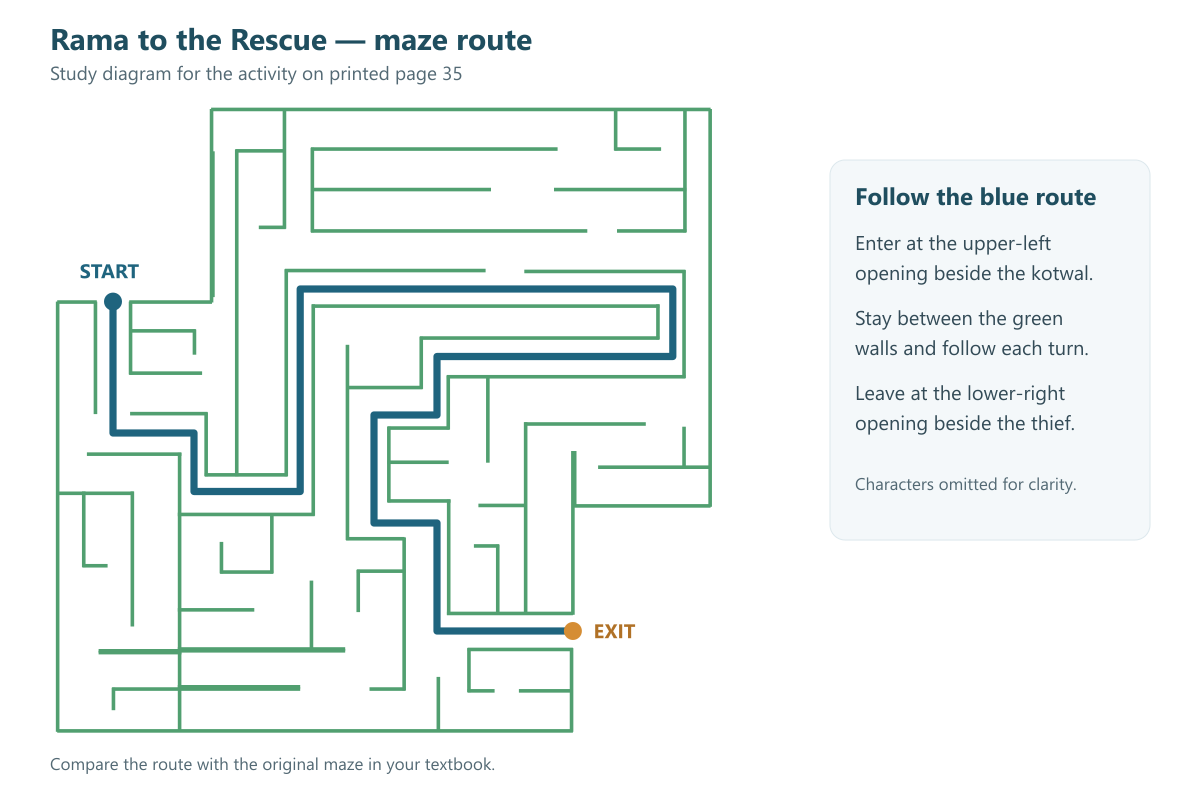
Open the maze route at full size to inspect the turns, then trace it on your textbook copy.
Additional ClearStudy questions
This practice is separate from the printed textbook exercises.
Additional comprehension practice
1. What problem did the couple face?
A thief dug into their house at night while they were preparing to sleep.
2. Who was Rama?
He was the village kotwal, or policeman. His name matched the name used in the couple’s pretend conversation.
3. Who proposed the plan?
The husband proposed it, and his wife cooperated. She had first alerted him to the noise.
4. Why did Rama come to the house?
He heard his name being called loudly and responded to the call. On arrival, he recognised that a thief had dug into the house.
5. What does the story value?
Observation, thoughtful planning, teamwork and seeking appropriate help.
Longer responses
6. Explain the couple’s teamwork.
The wife notices a sound and asks the husband to listen. They realise that a thief has entered. The husband proposes a pretend discussion about naming a future child Rama. His wife joins the conversation about calling the child softly or loudly depending on where he is. Their loud calls of ‘Rama’ bring the village kotwal, whose name is the same. He catches the thief. The rescue depends on both spouses’ contributions and the kotwal’s timely action; it is inaccurate to give only one spouse all the credit.
7. How does the pretend conversation work?
The thief expects talk about money and hopes the couple will fall asleep. Their conversation seems to concern a child’s name, but the loud calls are intended to reach the village kotwal. The thief does not understand their purpose, while Rama responds to his name. This difference between what the thief thinks and what the couple intend makes the comic entertaining and completes its clever plot.
ClearStudy MCQs and assertion–reason practice
1. The word ‘rescue’ means to ____.
(a) make fun of someone (b) save someone (c) ask someone for help (d) run away
2. Who was Rama in the story?
(a) the thief (b) the husband (c) the village kotwal (d) a neighbour
3. At what time of day does the story take place?
(a) early morning (b) noon (c) evening (d) night
4. How did the thief get into the house?
(a) through the front door (b) by digging his way in (c) over the roof (d) through a window
5. What did the thief want to find out?
(a) the family’s names (b) where they kept their money (c) the way out (d) the kotwal’s name
6. Who first noticed the noise of the thief?
(a) the husband (b) the wife (c) the kotwal (d) a neighbour
7. How did the wife call the kotwal for help?
(a) she ran outside (b) she rang a bell (c) she called out the name ‘Rama’ loudly (d) she telephoned him
8. The words “Oh, Oh!” said by the kotwal show ____.
(a) anger (b) pain (c) surprise (d) happiness
9. What quality of the wife helped save the family?
(a) her great strength (b) her presence of mind (c) her loud voice only (d) her wealth
10. From which comic-book series is ‘Rama to the Rescue’ taken?
(a) Tinkle (b) Amar Chitra Katha (c) Chacha Chaudhary (d) Panchatantra Comics
Assertion–Reason – choose: (a) A and R true, R explains A; (b) A and R true, R does not explain A; (c) A true, R false; (d) A false, R true.
1. Assertion (A): The wife called out the name ‘Rama’ loudly.
Reason (R): ‘Rama’ was the name of the village kotwal, whom she wanted to bring to the house for help.
2. Assertion (A): The thief listened closely to the couple’s talk.
Reason (R): He hoped to learn where the family kept their money.
3. Assertion (A): The kotwal ran to the house at once.
Reason (R): He heard his own name being called out loudly from inside.
4. Assertion (A): The husband made the clever plan to catch the thief.
Reason (R): The wife alone proposed the plan to call the kotwal.
5. Assertion (A): The couple were able to fall asleep peacefully early in the night.
Reason (R): They heard a thief digging into their house and were frightened and alert.
Exam tips & common mistakes
Study points
- The wife notices the noise; the husband proposes the plan; both cooperate.
- The odd-one-out answers are children and guest.
- The printed True/False answers are True, False.
- The thief mentions money, not jewels.
- Rama is the village kotwal; the child exists only in the pretend conversation.
- Check contractions in context and use am/is/are correctly with verb-ing.
FAQs
Who is Rama in Rama to the Rescue?
Rama is the village kotwal, or policeman. He hears his name being called, comes to the house and arrests the thief.
Who made the plan?
The husband proposes the plan and his wife helps carry it out. She first notices the noise and alerts him. The story credits their cooperation.
What are the odd-one-out and True/False answers?
The odd words are children and guest. The True/False answers are True and False: the man tells his wife the plan, and the thief refers to money rather than jewels.
Does I’d always mean I would?
No. It can mean I had or I would. In ‘I’d better listen closely’, it means ‘I had better listen closely’.
Is the listening answer 100 or 112?
Write 100 for the textbook listening task because it is in the page-38 transcript. The current Government of India emergency-response service uses 112 for police, fire/rescue and health emergencies.