
The Unlikely Best Friends — Class 6 English Poorvi Questions and Answers
The Unlikely Best Friends questions and answers: explore Gajaraj and Buntee’s friendship with a story summary, textbook comprehension, the solved opposites crossword, past tenses and listening activities.
Source: NCERT Poorvi, Grade 6, Unit 2, printed pages 39–51; listening transcript 71; supplied reprint 2026–27. Open-ended and personal responses are examples to adapt. These explanations are study support, not an official NCERT answer key.
- About the chapter
- About the author
- Summary
- Theme & message
- Word meanings
- Let us do these activities before we read
- Let us discuss
- Let us think and reflect
- Let us learn (grammar & vocabulary)
- Let us listen / speak / write / explore
- Extra questions
- MCQs & Assertion–Reason
- Exam tips & common mistakes
- FAQs
About the chapter
“The Unlikely Best Friends” is a warm-hearted story from Unit 2, ‘Friendship’. It tells of Gajaraj, a royal elephant who lives in great comfort but feels lonely because he has no friend. One evening a tired, hungry stray dog named Buntee wanders into the stable, and the kind elephant shares his food. The two quickly become inseparable companions – bathing, playing and travelling together. The title is ‘unlikely’ because an elephant and a dog are so different in size and nature, yet they form the truest of friendships. The story shows that real friendship can grow between the most different creatures, and that no comfort can replace the joy of a true friend.
About the author
The textbook credits Subba Rao and kathakids.com. Its exploration task connects this tale with the Jataka story ‘The Elephant and the Dog’. The Jataka tales are ancient Buddhist stories that explore life values and wisdom.
Summary
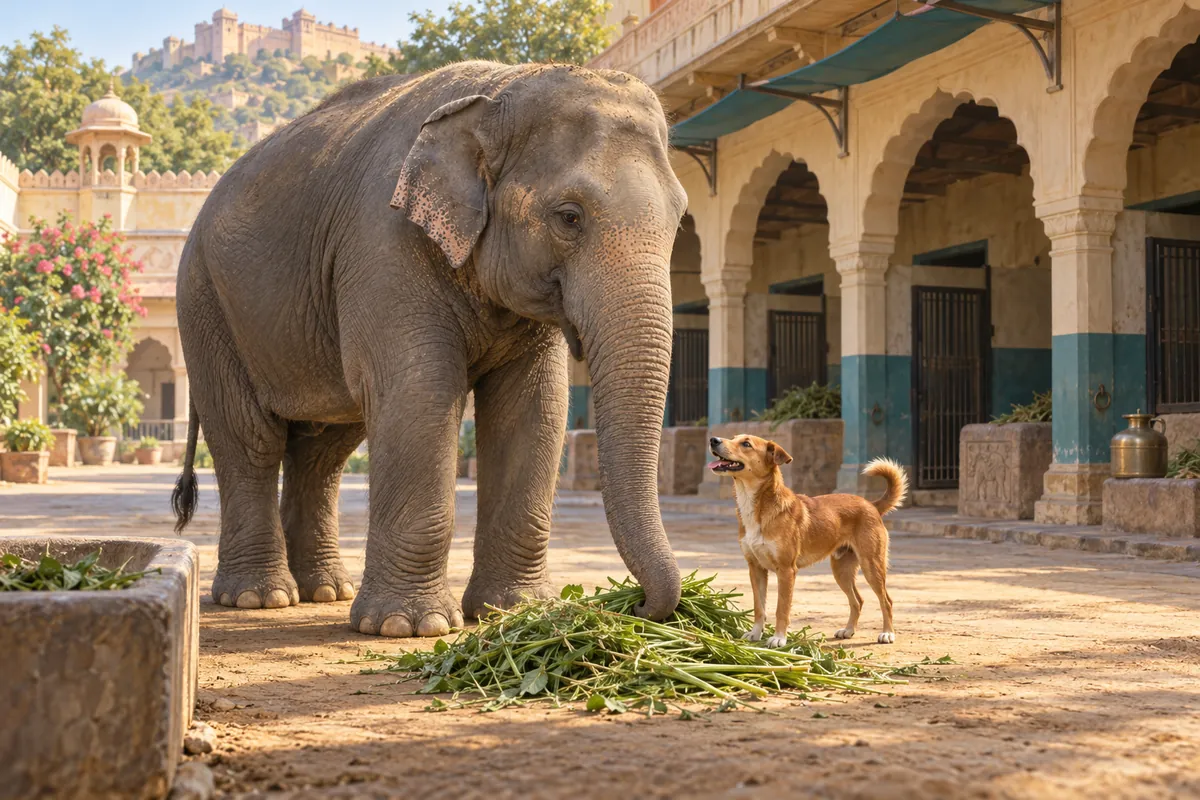
Gajaraj, the king’s favourite elephant, lived in the best booth of the royal stables and was very well looked after. Yet he was sad, for he had no friend – only the kind mahout (elephant trainer) who fed him and bathed him daily. The mahout cared for Gajaraj’s daily needs, but at this point in the story Gajaraj lacked a companion to play with. Caregiving and friendship are not incompatible. One late evening, a tired and hungry stray dog wandered into the stable. Gajaraj kindly pushed some of his food towards the dog, who ate it gratefully and fell asleep.
The next morning the mahout did not mind the dog; seeing that Gajaraj enjoyed his company, he fed the dog too. The elephant and the dog became fast friends. They went to the pond together, where Gajaraj playfully splashed water on the yelping dog, and on the way home he lovingly carried the dog on his back with his trunk. A passing farmer recognised the dog as his own, called him “Buntee,” and took him home with a rope around his neck.
Separated from his friend, Buntee refused to eat at the farmer’s house, and Gajaraj too stopped eating his favourite food, worrying the mahout. The kind farmer, realising how much Buntee missed his friend, removed the rope and let him go. Buntee raced back to the stable, where the joyful elephant swung him in the air with his trunk, and both friends ate happily again. The farmer, who had followed, watched with the mahout. In the end the mahout hugged the farmer, saying that not only had Gajaraj found a friend – he had found one too.
Theme & message
The central theme is the power and beauty of true friendship, especially between two very different beings. The story shows that wealth and comfort cannot fill the emptiness of loneliness – only a true friend can. It also highlights kindness, sharing and empathy: Gajaraj shares his food with a stranger, the farmer sacrifices his own wish so that his dog can be happy, and the mahout shows understanding. The message is that real friendship knows no boundaries of size, kind or status, and that genuine love means caring about another’s happiness as much as our own.
Word meanings
| Word | English meaning | Hindi meaning |
|---|---|---|
| booth | a rectangular enclosed space | बाड़ा / छोटा छत वाला स्थान |
| stables | living spaces for animals | अस्तबल / पशुशाला |
| interacted with | communicated with | बातचीत / मेल-जोल करना |
| strayed | came by mistake; wandered in | भटकते हुए आ गया |
| munching | chewing | चबा-चबाकर खाना |
| wagged | moved from side to side | (पूंछ) हिलाना |
| convey | to communicate | व्यक्त करना |
| crumbs | small pieces of food | खाने के छोटे टुकड़े |
| accompanied | went with someone | साथ गया / साथ दिया |
| plunging | jumping into | छलाँग लगाना |
| trunk | the long nose of an elephant | सूँड |
| splashed | threw water | पानी उछालना |
| yelped | cried out (as a dog) | कुंयाया |
| delighted | very happy | बहुत खुश |
| disappeared | was not seen; went missing | गायब हो गया |
| winced | shrank back in pain or distress | दर्द या दुख से सिहर उठना |
| chores | daily duties | रोज़मर्रा के काम |
| indigestion | an upset stomach | अपच / भोजन न पचना |
| sprang | jumped up suddenly | उछल पड़ा |
| relieved | thankful; freed from worry | राहत महसूस / निश्चिंत |
| satisfaction | a feeling of happiness or contentment | संतोष / तृप्ति |
Let us do these activities before we read
I. Friends are an important part of our lives. Why do you think so? Share your ideas with your friend. What do you do when you are with your friends and how do you feel? Now, complete the following sentences by writing in the shapes given below. One has been done for you. (“With my friend I ___” / “With my friend I feel ___”)
II. The title of the chapter is ‘The Unlikely Best Friends’.
1. What can be the meaning of ‘unlikely’? Discuss in groups, and then discuss with your teacher.
2. Can you think of some unlikely friends? Share your answer with your teacher.
Let us discuss
Part I
1. Talk about the things that Gajaraj and Buntee did together. Now, write in the shapes given below. One has been done for you. (Example: played)
2. Why did the farmer hug Buntee?
3. Do you think Buntee will leave Gajaraj and go home with the farmer?
Part II
1. Why did Gajaraj not eat his food?
2. Who were friends at the end of the story?
Let us think and reflect
I.1. Read the lines: “In spite of royal comforts, Gajaraj was sad because he had no friends. The mahout, or elephant trainer, was the only one he ever interacted with. The mahout was a kind man who served Gajaraj food, and gave him a bath in the elephant pond daily. He was a good caretaker, but not a friend.”
I.2. Read the lines: “Are you missing your friend?” asked the farmer remembering the happy look on Buntee’s face while sitting on the elephant’s back. “I cannot see you go hungry,” said the farmer, “If you miss your friend so much, go to him.” The farmer removed the rope with which he had tied the dog.
II. Give two examples to show that Gajaraj was very happy to have a friend.
III. How did the mahout come to know that Gajaraj was sad?
IV. Why do you think Buntee licked the farmer’s hand?
V. What was ‘unlikely’ about the friendship of Gajaraj and Buntee?
Let us learn
1. Opposites crossword — printed page 47
These answers fit the actual printed letters and slot lengths, rather than offering interchangeable synonyms.
Down: 1 FINISHED; 2 DISAPPEARED; 4 DELIGHTED; 5 TOUCHED; 6 LIKE.
For example, Down 4 has nine letters and starts with D, so delighted fits; ‘happy’ does not. Down 6 is like, not ‘love’. ‘Yelped/laughed’ is the contextual contrast supplied by this puzzle, rather than a strict dictionary antonym.
2. Missing-pencil paragraph
The blanks in order are missing, worried, asleep, disappeared, laughed, relieved, found. The last word is FOUND; the second-to-last is RELIEVED, drawn from the Across-9 clue rather than its answer ‘worried’.
3. Past tenses
| Simple past | Past progressive | Past perfect |
|---|---|---|
| looked, gave, hated, noticed, went, served, told, asked, felt, touched, joined, arrived, threw | was looking, was missing, was munching | had ordered, had followed, had remained, had tied |
Simple past states a past action; not every verb adds -ed (give → gave). Past progressive describes an action in progress at a past time: was/were + verb-ing. Past perfect uses had + past participle to place an action before another past event.
Passage answers: noticed, had tied, asked, felt, was missing. ‘Had tied’ places the tying on the previous day, before the farmer’s return.
4. Neither…nor and either…or
Neither Shikha nor Anuj likes to tell stories means that Shikha does not like it and Anuj does not either. Either Bhavesh or Abha made the painting means that one of those two made it; the speaker does not identify which one.
Practice samples: Neither the farmer nor the mahout initially noticed the friends’ tears. We may read either a story or a poem. Discuss your own examples with the teacher.
Let us listen / speak / write / explore
Let us listen — pages 49–50, transcript 71
Exact words for the four blanks: wild; night; beside; The villagers. The printed blank is after ‘sit’, so insert beside to make ‘sit beside the cow’; ‘quietly’ follows ‘cow’ in the transcript.
Number the sentences in their printed row order: 4, 1, 3, 2.
- The cow took care of the cub as a mother.
- The leopard grew up and left the village.
- It returned at night to meet the cow.
- It stopped coming regularly.
The given ‘1’ belongs to the cow-care sentence, not the ‘stopped coming’ sentence. The transcript presents the cub-care account as ‘Some people say’; use it to complete the listening exercise, without treating the anecdote as a general guide to approaching wild animals.
Let us speak — personal response
Interview your friend and record two likes each, two shared likes and one difference. Sample: I am Aarav. I like reading and cricket. My friend Riya likes drawing and dancing. Both of us like ice-cream and cartoons. I like to read, but my friend likes to dance. Our interests differ, and we still enjoy each other’s company.
Let us write — six-sentence model
- My friend Riya and I study in the same class.
- Both of us like cartoons and ice-cream.
- I like reading, but she likes dancing.
- Unlike me, she enjoys drawing portraits.
- Neither of us likes quarrelling.
- We either play together or share a story after school.
Adapt this sample to the facts collected in your interview; no particular friend or hobby is compulsory.
Let us explore — suggested approaches
- Read another Jataka story from a library, record its title and explain its value using an incident. A possible choice is ‘The Monkey and the Crocodile’, which invites discussion of presence of mind.
- Discuss elephants’ cultural roles alongside habitat loss and human–elephant conflict. Respect for animals includes protecting habitats and their welfare, rather than copying the story’s handling of a dog or elephant.
- Read the textbook’s historical report about Tarra and Bella. It describes Tarra waiting while injured Bella was inside a building for three weeks. Compare this reported bond with Gajaraj and Buntee’s fictional separation; do not present the report as a current status update.
Additional ClearStudy questions
This practice is separate from the printed textbook exercises.
Short answer (30–40 words)
1. Where did Gajaraj live, and how was he treated?
2. How did the friendship between Gajaraj and the dog begin?
3. What did Gajaraj do on the way home from the bath?
4. Why did Buntee refuse to eat at the farmer’s house?
5. How did the story end happily?
Long answer (100–120 words)
6. Describe how Gajaraj and Buntee became best friends and what their friendship teaches us.
7. How do the mahout and the farmer show kindness in the story?
ClearStudy MCQs and assertion–reason practice
1. Where did Gajaraj the elephant live?
(a) in a forest (b) in the best booth of the royal stables (c) in a temple (d) at the farmer’s house
2. Why was Gajaraj sad in spite of his royal comforts?
(a) he was hungry (b) he was ill (c) he had no friend (d) he wanted to leave
3. Who was the only person Gajaraj interacted with at first?
(a) the king (b) the mahout (c) the farmer (d) a soldier
4. What did Gajaraj do when the tired, hungry dog came into the stable?
(a) chased it away (b) ignored it (c) pushed some of his food towards it (d) called the mahout
5. What did Gajaraj do to the dog at the pond?
(a) splashed water on him playfully (b) pushed him into deep water (c) ignored him (d) gave him food
6. What was the dog’s name?
(a) Tarra (b) Bella (c) Buntee (d) Gajaraj
7. Why did the farmer hug the dog?
(a) it was a stray dog (b) it was his lost dog he had been searching for (c) the mahout asked him to (d) it was hungry
8. Why did Buntee not touch his food at the farmer’s house?
(a) he was ill (b) the food was bad (c) he was missing his friend Gajaraj (d) he was not hungry
9. What did the farmer finally do for Buntee?
(a) tied him tighter (b) gave him more food (c) removed the rope and set him free (d) sold him
10. What did the mahout say at the end of the story?
(a) that he had found a friend too (b) that the dog should go away (c) that the king was angry (d) that Gajaraj was ill
Assertion–Reason – choose: (a) A and R true, R explains A; (b) A and R true, R does not explain A; (c) A true, R false; (d) A false, R true.
1. Assertion (A): Gajaraj was sad even though he lived in royal comfort.
Reason (R): He had no friend to play with and felt lonely.
2. Assertion (A): Gajaraj shared his food with the stray dog.
Reason (R): Gajaraj could see that the visitor was tired and hungry.
3. Assertion (A): The mahout became worried about Gajaraj.
Reason (R): Gajaraj had stopped eating his food at successive meals.
4. Assertion (A): The farmer kept Buntee tied with a rope at his house forever.
Reason (R): The farmer removed the rope and set Buntee free to go to his friend.
5. Assertion (A): The friendship of Gajaraj and Buntee was called ‘unlikely’.
Reason (R): An elephant and a dog are very different animals and are not expected to be best friends.
Exam tips & common mistakes
Study reminders
- The mahout cares for the elephant; the farmer is Buntee’s owner.
- The dog dislikes the splashing, although Gajaraj intends it playfully.
- The farmer frees Buntee after noticing that he misses Gajaraj.
- At the end there are two pairs of friends: Gajaraj/Buntee and mahout/farmer.
- Use DELIGHTED and LIKE in the crossword; check the printed grid.
- The listening row numbers are 4, 1, 3, 2.
FAQs
Who wrote ‘The Unlikely Best Friends’ and where is it from?
It was retold by Subba Rao and is adapted from kathakids.com. The tale is based on the ancient Jataka story ‘The Elephant and the Dog’.
Why is the friendship of Gajaraj and Buntee called ‘unlikely’?
Because Gajaraj is a huge elephant and Buntee is a small dog – two very different animals that we would not normally expect to become best friends.
Why did both Gajaraj and Buntee stop eating?
They stopped eating because they were separated and missed each other very much. Their sadness showed how deep and true their friendship had become.
What is the main message of the story?
The story teaches that true friendship can grow between very different beings, and that love, kindness and companionship matter more than wealth or comfort.
Textbook-based exercises and additional ClearStudy practice are identified separately. Use your textbook alongside these explanations.