
The Kites — Class 6 English Poorvi Questions and Answers
The Kites questions and answers: explore Daphne Lister’s poem in Class 6 Poorvi with similes, rhyme pairs, a labelled kite-parts diagram and the festival listening key.
Source: NCERT Poorvi, Grade 6, Unit 5, printed pages 141–150; listening transcript 163; supplied reprint 2026–27. Open-ended and personal responses are examples to adapt. These explanations are study support, not an official NCERT answer key.
- Poem Overview
- About the Poet
- Central Idea & Stanza Summary
- Word Meanings
- Poetic Devices
- NCERT textbook exercises
- Extra Questions
- MCQs & Answer Key
- Assertion–Reason Questions
- FAQs
Poem Overview
“The Kites” is a light, joyful poem in which a child watches colourful kites flying high in the breezy sky and begins to daydream. The kites look like coloured birds, and the child wishes to become small and “light as air” so that they could climb onto a kite and sail away with it. In this imagination, the child drifts on the kite’s “paper wings”, listens to the songs of the wild wind, and looks down happily at the park and the rooftops of the town far below. The child even imagines the people on the ground staring up and wishing they could be the lucky one flying so high. The poem captures the wonder, freedom and innocent fancy of childhood, and the simple, timeless delight of kite-flying — an activity deeply linked to India’s culture and festivals such as Makar Sankranti and Uttarayan.
About the Poet – Daphne Lister
Daphne Lister is credited as the poet on printed page 142. The five four-line stanzas follow a child’s imagined wish to ride a kite, using comparisons, rhyme and lively wind imagery.
Central Idea & Stanza Summary
Central idea: The poem expresses a child’s wonder and imagination on seeing kites fly. It celebrates the freedom, joy and fancy of childhood through the simple wish to become light enough to ride a kite and float high above the town, looking down on the world while everyone below watches and envies the flight.
Stanza 1: The child looks up at the sky and sees the kites flying high. The colourful kites look just like “coloured birds” moving in the wind-whipped (breezy) sky. This opening picture sets the cheerful, airy mood of the poem.
Stanza 2: The child makes a wish — to become small and as “light as air”. If that were possible, the child would climb onto a kite and sail up into the sky along with it. Here the daydream begins.
Stanza 3: In imagination, the child drifts gently on the kite’s “paper wings” high above. Floating there, the child can hear the lovely “songs that the wild wind sings”, enjoying the music and freedom of the open sky.
Stanza 4: The child thinks how much fun it would be to look “right down” from above — over the park and the rooftops of the town. From this height the whole town would look tiny and beautiful.
Stanza 5: Finally, the child imagines the people below standing and staring up in surprise, wishing that they were the one flying so “high, high in the air”. The poem ends on a happy note of pride and wonder at being up in the sky.
Word Meanings (शब्दार्थ)
| Word | English Meaning | हिंदी अर्थ |
|---|---|---|
| kite | a light frame covered with paper/cloth, flown in the wind on a string | पतंग |
| coloured birds | brightly coloured birds (here, the kites compared to birds) | रंग-बिरंगे पक्षी |
| wind-whipped | blown and tossed about by strong wind | हवा से लहराता हुआ |
| light as air | extremely light in weight | हवा जैसा हल्का |
| climb | to go up onto something | चढ़ना |
| sail | to move smoothly through the air | तैरते हुए जाना |
| drift | to float or move slowly and gently | धीरे-धीरे बहना/तैरना |
| paper wings | the paper sides of the kite, imagined as wings | कागज़ के पंख |
| wild wind | strong, free-blowing wind | तेज़, स्वच्छंद हवा |
| fun | enjoyment, pleasure | मज़ा, आनंद |
| look right down | to look straight downwards | सीधे नीचे देखना |
| rooftops | the top surfaces of houses/buildings | छतें |
| stare | to look fixedly for a long time | टकटकी लगाकर देखना |
| high in the air | far up in the sky | हवा में बहुत ऊँचाई पर |
Poetic Devices in the Poem
| Device | Explanation / Example from the poem |
|---|---|
| Simile | The kites are compared to birds using like: “Like coloured birds / In the wind-whipped sky”; and the child wishes to be “light as air”. |
| Personification | The wind is given a human quality of singing: “the songs / That the wild wind sings”. |
| Imagery | Vivid pictures of “coloured birds”, “wind-whipped sky”, “paper wings” and looking “over the park / And the rooftops of town”. |
| Repetition | “High, high in the air” — repeating “high” stresses just how far up the kite is flying. |
| Alliteration | Repeated consonant sounds: “wind-whipped” (w), “wild wind” (w). |
| Rhyme | The poem uses end rhyme in each stanza (fly–sky, air–there, wings–sings, down–town, stare–air) to give it a musical sing-song flow. |
NCERT textbook exercises
Before we read — page 141
I. Personal model: I saw a diamond-shaped red-and-yellow kite in a park on a windy afternoon. It had a ribbon tail and seemed to float among the birds. Use your own experience or observations.
II. Video discussion: with your teacher, watch a suitable kite-festival video. Describe the shapes, colours and activities actually shown. Explain whether you would participate and which kite you would choose; do not invent details about an unwatched video.
III. Picture-word completions: 1 kite, birds, sky; 2 windy; 3 flying; 4 looking; 5 has ribbons.
IV. Imaginative samples: I might add clouds and a tree. As the child I would watch the kite carefully; as the kite I would float over the park. These are personal choices.
Let us discuss
I. Read the poem silently. As you read, mark the given statements as True or False.
| Statement | T / F |
|---|---|
| 1. The child is looking at the kites. | True |
| 2. The kites look like birds of different colours. | True |
| 3. It was a rainy day. | False (it was a windy day) |
| 4. The child wants to be like a kite. | True if ‘like a kite’ means sharing its flight; the child imagines riding it, not literally becoming one |
| 5. The child wishes to climb on a kite. | True |
| 6. The kite is made of cloth and plastic. | False (the poem speaks of “paper wings”) |
| 7. The child wants to ride the kite. | True |
| 8. The child knows they would have fun. | True |
| 9. The child wants to look at the kite from a rooftop. | False (the child wants to look down at the rooftops from the sky) |
| 10. The child would like to look at people down below. | True |
| 11. The child knows that the people would stare. | True |
II. Complete the following sentences. 1. The poet says that the kites are like coloured birds – “See the kites fly / Like coloured birds in the sky.” The kites have been compared to b_ _ _ _ because they ______________. 2. The child wishes to be like air – “I wish I were small / And as light as air.” The child wishes to be as l_ _ _t as _ _ _. The child wishes this to be able to c_ _ m_ on a kite and fly.
II (extended). Do you think that the use of simile in this poem helps us imagine better when we read the poem? Share your thoughts with your teacher and classmates.
III. Find a set of words from the poem that begin with the same consonant sound. Stanza 1 — Which consonant sound do both words begin with? Stanza 3 — Which consonant sound do both words begin with? This is called alliteration. For example, big bright blue bag, funny fan, etc. Create 4 other sets of words using alliteration.
IV. In the last stanza, the two words that the poet repeats are __________, __________ to tell us that the kite is flying __ __ __y high.
V. Study each stanza and underline the rhyming words from the end of each line. Also, circle the end words in the stanzas that do not rhyme.
| Stanza | Rhyming end words | Non-rhyming end words |
|---|---|---|
| 1 | fly – sky | air, birds |
| 2 | air – there | small, kite |
| 3 | wings – sings | upon, songs |
| 4 | down – town | be, park |
| 5 | stare – air | below, me |
Let us think and reflect
I. Read the given lines from the poem and answer the following questions. “What fun it would be / To look right down, / Over the park / And the rooftops of town.”
1. Circle the word that does not share the same feeling as ‘fun’: joy, excitement, care, happiness.
2. Which line tells us that the poet was somewhere above?
3. Choose the scene the child saw. (i) (ii) (iii) (iv)
II. Answer the following questions.
In the first two lines the poet describes the kites flying up in the air and compares them to “coloured birds” in the “wind-whipped sky”. This shows the kites as bright, lively and free, moving about in the breeze just like real birds. 2. Why does the child say that they have to climb a tree first to get onto the kite?
The child does not actually climb a tree; the child says they wish to be “small / And light as air” so that they could “climb on a kite”. Because a kite floats high in the sky, the child imagines that only by becoming tiny and weightless could they climb up onto it and sail away — it is a daydream, not a real action. 3. What are the songs that the child hears when flying atop the kite?
The “songs” are the sounds of the “wild wind” blowing in the sky. As the child imagines drifting on the kite’s paper wings, the whistling, rushing music of the strong wind seems like songs being sung to them high up in the air. 4. Why did the people look up at the child and stare? If you looked up and saw that, what feelings would you have?
The people looked up and stared because it was a surprising and amazing sight to see a child sailing through the sky on a kite. They wished they could be in the child’s place, flying high. If I looked up and saw that, I would feel astonished, thrilled and a little jealous — and I would wish I could fly so freely too. 5. If you were the kite carrying the child high up in the air, what would you tell them?
If I were the kite, I would say: “Hold on tight and do not be afraid! Look down at the tiny park and rooftops below — enjoy the view and the cool wind. Trust me, I will carry you gently and bring you safely back to the ground.” (This is an imaginative question — your own kind, encouraging words are welcome.)
Question II.2 on page 145 mentions climbing a tree, but the poem itself says climbing on a kite and never mentions climbing a tree. If interpreted as an imaginative question, a tree could be imagined as a high starting point; it is not an event to add to the poem’s summary or an instruction to attempt the flight.
Let us learn
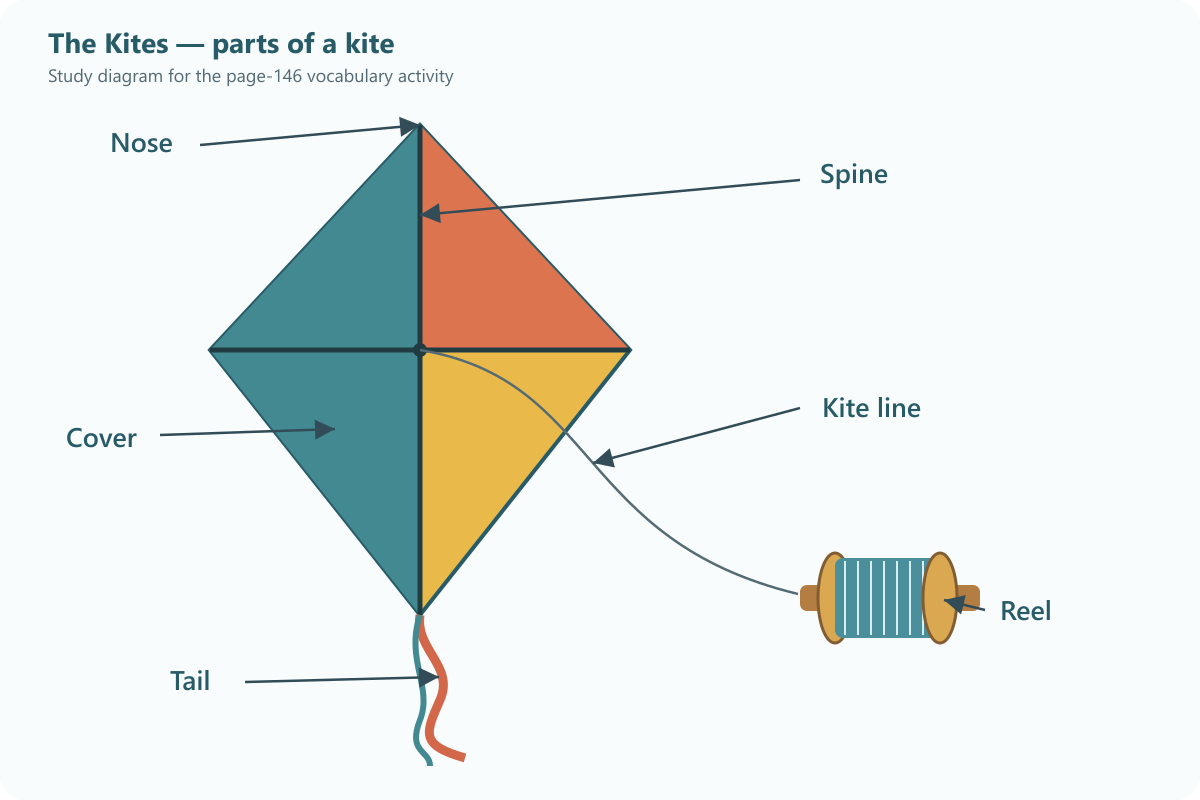
Open the kite diagram at full size to inspect its labels.
I. Look at the picture of the kite and read what some of its parts are named (Nose, Spine, Cover, Kite line, Tail, Reel). Now, complete the given conversation by filling the blanks with some ‘parts of a kite’ from above.
II. Let us create a poem using words in a kite! (A cinquain: line 1 – one noun; line 2 – two describing words; line 3 – three action words; line 4 – two words describing the action; line 5 – one synonym of the subject.) Now, create a cinquain poem yourself on anything you like.
III. The poet uses the word ‘fly’ and ‘drift’ to tell us about the kite’s movement. 1. Circle the words that match with the ‘drift’ movement (you can choose more than one): slow, fast, quick, round and round, float, downward, upward. 2. Study some other words about the kite’s movement and share what type of movement they show: glide, dive, soar, swoop, circle.
| Word | Type of movement |
|---|---|
| glide | smooth, easy movement through the air (like drift) |
| dive | sudden downward movement, very fast |
| soar | to rise and fly high upward |
| swoop | a quick downward and then upward sweep |
| circle | moving round and round |
IV. The poet has used expressions like — up in the air; look right down; stay up there; stand and stare. 1. Read how these expressions are used in the poem. 2. In pairs, make sentences using these expressions. Discuss with your teacher and then write in your notebooks.
The pre-reading activities (“Let us do these activities before we read”), and the Let us listen (Kite Festival), Let us speak (sharing a kite-flying experience), Let us write (“I am a Kite” paragraph) and Let us explore (types of kites, making your own kite) tasks are oral, listening or project activities to be done in class with your teacher. Guided notes for the listening task are given below; the reading-comprehension and language exercises above are the assessable written exercises for the poem.
Let us listen (guided notes)
Listen about the Kite Festival in India. As you listen, circle the words that are not correct. Then, listen again and write the correct words.
| Sentence | Wrong word | Correct word |
|---|---|---|
| 1. Kite Festival is celebrated during the month of June. | June | January (during Makar Sankranti) |
| 2. The International Kite Festival is named Uttarayan in Eastern India. | Eastern | Western |
| 3. Uttarayan is mainly celebrated in Gujarat, but also in Maharashtra and Telangana. | Maharashtra | Rajasthan |
| 4. During the Kite Festival, we can see kites of different shapes, sizes and colours. | (correct) | — correct — |
| 5. In Karnataka, the Tourism Department organises the Kite Festival every year. | (correct) | — correct — |
| 6. The Punjab region celebrates Basant Panchami and Baisakhi by flying kites. | (correct) | — correct — |
| 7. People of India also enjoy flying kites on Earth Day. | Earth Day | Independence Day |
Let us speak — personal model
‘I watched kites in our park last winter. A neighbour held the reel while the breeze lifted a bright diamond-shaped kite. I enjoyed seeing its ribbon tail move. I stayed in the open space with my family.’ Give where, when, why and how from your own experience.
Let us write — I Am a Kite (sample, about 100 words)
I am a bright diamond-shaped kite with a long ribbon tail. A child made my paper cover yellow and blue. My wooden frame helps me keep my shape, and a line joins me to a reel below. On a breezy afternoon, I rise above an open park. Clouds seem close, while people look small beneath me. Other kites are my colourful companions. I dip and drift with the wind, but my flyer keeps control of the line. I would tell people to choose a safe open space, protect birds and avoid dangerous strings. My flight belongs to imagination and play.
Let us explore — types and making
The book shows diamond, delta, rokkaku, box and parafoil kites. Identify which you have actually seen; a diamond-shaped kite is one common example, not the only valid local answer.
Simple classroom craft: with teacher help, cross two light sticks into a frame, tie them securely, fit a light paper cover, attach a balanced bridle and ordinary cotton line, and add a paper tail if needed. Decorate it with a short message. A display model need not be flown. Fly only in a suitable open area away from roads and power lines; never try to ride a kite or use cutting line.
The exploration note traces the word gudi and paper kaagad to Namadeva’s poetry. Report this as the textbook’s literary-history note, rather than claiming it proves a single origin for all kite flying.
Additional ClearStudy questions
This practice is separate from the printed textbook exercises.
Short Answer Questions (30–40 words)
The kites look like “coloured birds” to the child. Because they are brightly coloured and fly high, moving freely about in the windy sky, they remind the child of colourful birds in flight. Q2. What does the child wish for in the poem?
The child wishes to become small and “light as air” so that they could climb onto a kite and sail up into the sky, drifting freely on its paper wings high above the town. Q3. What does the child hear while imagining flying on the kite?
While imagining drifting on the kite’s paper wings, the child hears “the songs that the wild wind sings” — that is, the whistling, rushing music made by the strong wind high in the sky. Q4. What would the child see while looking down from the kite?
Looking “right down” from the kite, the child would see the park and the rooftops of the town far below, all looking tiny and beautiful from up in the air. Q5. How do the people below react in the child’s imagination?
In the child’s daydream, the people below stand and stare up in surprise, wishing that they themselves could be the lucky one flying so “high, high in the air”.
Long Answer Questions (100–120 words)
The poem begins with a real scene — a child watching colourful kites fly in a windy sky. But it quickly turns into a beautiful daydream. The child imagines becoming small and “light as air”, climbing onto a kite, and sailing up into the sky. In this fancy, the child drifts on the kite’s “paper wings”, hears the songs of the wild wind, and looks down on the tiny park and rooftops. The child even pictures people staring up enviously. In this way the poet shows how a child’s imagination can turn an ordinary sight into a magical adventure, giving the freedom to fly and see the world from above — something only a creative young mind can dream up. Q2. Describe the feelings of joy and freedom expressed in ‘The Kites’.
From start to finish, the poem is filled with joy and a sense of freedom. The kites fly happily like coloured birds in the open sky, and the child longs to join them by becoming light enough to ride a kite. Floating on the “paper wings”, the child feels free as the wind and delights in its songs. Looking down at the park and rooftops, the child thinks “what fun it would be”, and feels proud as the people below stare and wish to be in their place. The light rhythm, the bright images and the repeated “high, high” all add to this feeling of carefree happiness, capturing the simple joy of childhood and of kite-flying itself. Q3. How is the poem ‘The Kites’ connected to Indian culture and tradition?
The poem appears in the unit “Culture and Tradition” because kite-flying is a much-loved part of Indian life. Across India, kites fill the sky during festivals such as Makar Sankranti and Uttarayan, celebrated grandly in states like Gujarat and Rajasthan, and during Basant Panchami and Baisakhi in Punjab. People also fly kites to celebrate Independence Day. Though written from a child’s simple point of view, the poem captures the same wonder, colour and shared happiness that these festivals bring. It reminds us how a small joy like flying a kite connects families, neighbours and whole communities, making kite-flying a cheerful, living tradition that passes from one generation to the next.
ClearStudy MCQ practice
1. Who is the poet of ‘The Kites’?
(a) Sarojini Naidu (b) Daphne Lister (c) Ruskin Bond (d) Jean de La Fontaine
2. The kites in the poem are compared to —
(a) clouds (b) aeroplanes (c) coloured birds (d) balloons
3. The child wishes to be small and —
(a) strong (b) light as air (c) brave (d) quick
4. The sky in the first stanza is described as —
(a) clear (b) dark (c) wind-whipped (d) starry
5. The child imagines drifting on the kite’s —
(a) paper wings (b) iron bars (c) cloth tail (d) glass frame
6. What does the child hear while flying on the kite?
(a) bells ringing (b) songs of the wild wind (c) people shouting (d) birds chirping
7. From the kite the child would look down over the park and the —
(a) rivers (b) mountains (c) rooftops of town (d) gardens
8. In the last stanza, the people below would —
(a) run away (b) stand and stare (c) clap and sing (d) fly kites
9. “Like coloured birds” is an example of —
(a) metaphor (b) simile (c) personification (d) hyperbole
10. The repeated word in the last stanza is —
(a) air (b) fly (c) high (d) down
ClearStudy assertion–reason practice
For each, choose: (a) Both A and R are true and R is the correct explanation of A. (b) Both A and R are true but R is NOT the correct explanation of A. (c) A is true but R is false. (d) A is false but R is true.
1. Assertion (A): The kites are compared to coloured birds.
Reason (R): The kites are bright and fly freely high in the sky, just like birds.
Answer: (a) — R correctly explains why the kites look like coloured birds.
2. Assertion (A): The child wishes to be light as air.
Reason (R): Being light would let the child climb on a kite and sail up into the sky.
Answer: (a) — R correctly explains the child’s wish.
3. Assertion (A): The child actually flies on a kite in the poem.
Reason (R): The whole flight is only the child’s imagination and daydream.
Answer: (d) — A is false (the child only imagines flying); R is true.
4. Assertion (A): “The songs that the wild wind sings” is an example of personification.
Reason (R): The wind is given the human ability to sing songs.
Answer: (a) — R correctly explains the device.
5. Assertion (A): The people below wish they were the child flying high.
Reason (R): It looks like great fun to sail high in the air and look down on the town.
Answer: (a) — R correctly explains why the people envy the child.
📌 Exam Tips
• Remember the two key similes: kites are “like coloured birds” and the child wishes to be “light as air” — both use ‘like’/’as’.
• “The songs that the wild wind sings” is personification (the wind sings).
• The repeated word “high, high” stresses how far up the kite flies — a common one-mark question.
• Note the rhyme scheme: in every stanza the 2nd and 4th lines rhyme.
• Quote short phrases — “wind-whipped sky”, “paper wings”, “rooftops of town” — to support your answers.
⚠ Common Mistakes to Avoid
• The child does not become a kite or actually fly — it is all a daydream/imagination.
• “Like coloured birds” is a simile, not a metaphor (it uses the word ‘like’).
• The kite has “paper wings” — do not write that it is made of cloth and plastic.
• The day in the poem is windy, not rainy.
• Do not confuse the poet: it is Daphne Lister, not Sarojini Naidu or Jean de La Fontaine.
• Spell key words correctly: wind-whipped, drift, rooftops, stare.
Frequently Asked Questions (FAQs)
Who wrote The Kites?
NCERT Poorvi credits Daphne Lister on printed page 142.
Does the child actually ride a kite?
No. The child wishes to become small and light enough to ride it. The flight is imagined.
What are the kite-parts blanks?
Tail, cover, spine, line, reel and nose, in conversation order.
Which scene should be chosen on page 145?
Option (ii), the elevated view of the town’s rooftops, best matches the child’s imagined view.
What are the festival-listening corrections?
June becomes January; Eastern becomes Western; Maharashtra becomes Rajasthan; Earth Day becomes Independence Day. Rows 4, 5 and 6 already match the transcript.