
Class 6 Maths Chapter 4 Solutions – Data Handling and Presentation
These Class 6 Maths Ganita Prakash Chapter 4 solutions cover Data Handling and Presentation from the new NCF-2023 textbook (Reprint 2026–27). Worked Figure it Out answers, original charts and guided activities explain collecting and organising data, tally marks and frequency tables, reading and drawing pictographs and bar graphs — so you can master the chapter and revise it quickly.
- Chapter overview
- Key concepts & definitions
- Important ideas & methods
- Figure it Out (Collecting & Organising Data)
- Math Talk & in-text examples (answered)
- Figure it Out (Pictographs)
- Figure it Out (Bar Graphs)
- Figure it Out (Artistic & Aesthetic)
- Common mistakes to avoid
- Practice MCQs & Assertion–Reason
- Quick revision summary
- FAQs
Chapter 4 Overview
Chapter 4 of Ganita Prakash, Data Handling and Presentation, shows how to turn an untidy list of observations into clear, readable information. It begins with Navya and Naresh collecting their classmates’ favourite games, then moves to organising data in tables using tally marks and reading off frequencies. Next it builds pictographs, where one picture stands for one or many units and a scale or key is chosen to fit the data, and then bar graphs, where bars of equal width and uniform spacing represent frequencies on a chosen scale. The chapter closes with the artistic and aesthetic side of presenting data — choosing vertical or horizontal bars, columns and infographics — and a warning that “fancy” pictures can sometimes mislead. The Class 6 Maths Ganita Prakash Chapter 4 solutions below combine worked examples, visual explanations and methods for collecting your own data.
Key Concepts & Definitions
Data: any collection of facts, numbers, measures, observations or other descriptions of things that conveys information about those things.
Organising data: arranging raw data (for example in ascending order or in a table) so that questions can be answered easily.
Tally marks: short strokes ‘|’ used to count items one by one; the fifth stroke is drawn across the previous four (| | | |) to make groups of five easy to count.
Frequency: the count of how many times a particular value, measure or observation occurs (for example, jalebi has a frequency of 6).
Pictograph: a way of representing data through pictures or symbols of objects; a scale/key tells what each symbol stands for (e.g. one symbol = 1 student, or = 10 children).
Bar graph: a representation of data using bars of uniform width and equal spacing, where the length or height of each bar shows the frequency on a chosen scale; vertical bar graphs are also called column graphs.
Infographic: a data visualisation beautified with artistic imagery; useful for engaging an audience, but it can mislead if the picture distorts the actual values.
Important Ideas & Methods (Chapter 4)
Reading a frequency: a tally group | | | | = 5; count the groups of five, then add the leftover single strokes (e.g. | | | | ||| = 5 + 3 = 8).
Pictograph value: number represented = (number of full symbols × scale) + (fraction of a symbol × scale). Example: with 1 symbol = 10 children, 2½ symbols = 20 + 5 = 25.
Choosing a key/scale: pick a scale that divides the data neatly so the figure fits the page (e.g. use 1 symbol = 5 or 10 units when frequencies are large; a common factor of the frequencies often makes a convenient key).
Height of a bar: bar height (in units) = frequency ÷ scale. Example: with 1 unit length = ₹200, the “House rent” bar of ₹3000 is 3000 ÷ 200 = 15 units.
Reading a bar graph: the longest bar shows the maximum value and the shortest bar shows the minimum value; compare lengths to compare categories at a glance.
Two different totals: add frequencies to count observations (such as 30 matches). For a total of numerical values, add value × frequency (such as 90 wickets). For categories such as sweets, add their frequencies to count students.
Figure it Out — Collecting & Organising Data (Page 75, 76, 77)
Page 75 — Figure it Out (favourite games)
1. What would you do to find the most popular game among Naresh’s and Navya’s classmates?
2. What is the most popular game in their class?
3. Try to find out the most popular game among your classmates.
4. Pari wants to respond to the questions given below. Put a tick (✓) for the questions where she needs to carry out data collection and put a cross (✗) for the questions where she doesn’t need to collect data. Discuss your answers in the classroom. a. What is the most popular TV show among her classmates? b. When did India get independence? c. How much water is getting wasted in her locality? d. What is the capital of India?
Page 76 — Figure it Out (Shri Nilesh’s sweets)
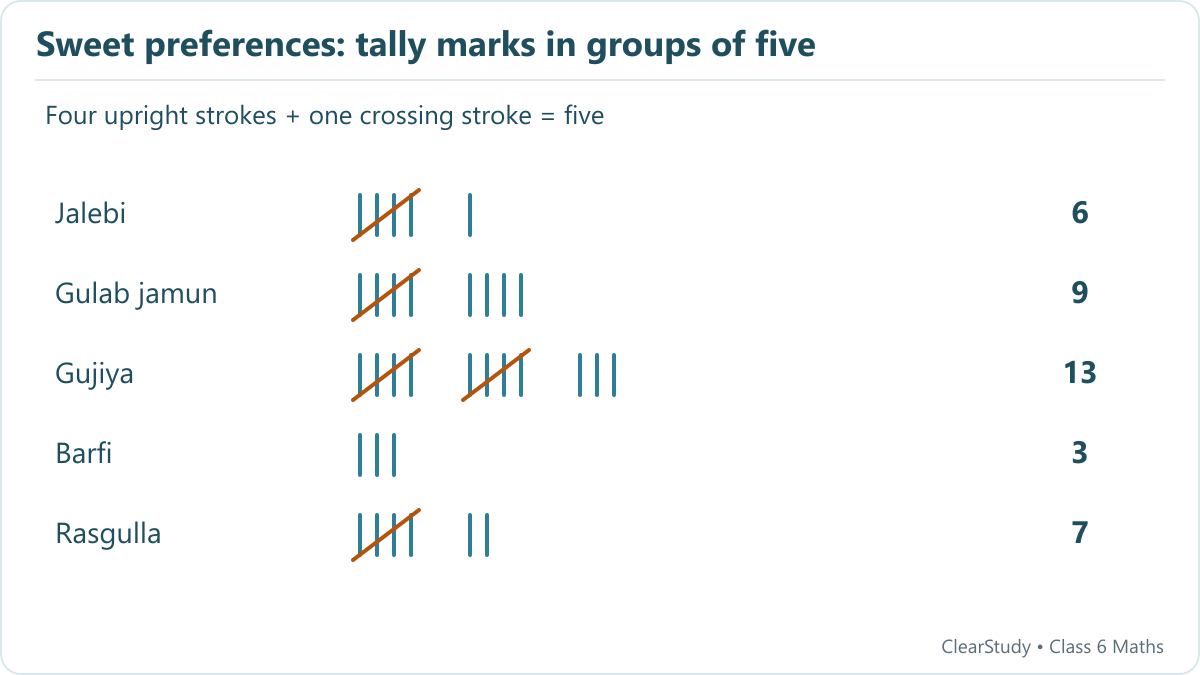
The tally table given in the book is completed below. A group | | | | stands for 5.
| Sweets | Tally Marks | No. of Students |
|---|---|---|
| Jalebi | | | | | | | 6 |
| Gulab jamun | | | | | | | | | | 9 |
| Gujiya | | | | | | | | | ||| | 13 |
| Barfi | ||| | 3 |
| Rasgulla | | | | | || | 7 |
1. Complete the table to help Shri Nilesh to purchase the correct numbers of sweets: a. How many students chose jalebi? b. Barfi was chosen by ____ students? c. How many students chose gujiya? d. Rasgulla was chosen by ____ students? e. How many students chose gulab jamun?
2. Is the above table sufficient to distribute each type of sweet to the correct student? Explain. If it is not sufficient, what is the alternative?
Page 77 — Figure it Out (shoe sizes)
The shoe sizes, arranged in ascending order, are: 3, 3, 3, 4, 4, 4, 4, 4, 4, 4, 4, 4, 5, 5, 5, 5, 5, 5, 5, 5, 5, 5, 6, 6, 6, 6, 7.
1. Help her to figure out the following: a. The largest shoe size in the class is _________. b. The smallest shoe size in the class is _________. c. There are _________ students who wear shoe size 5. d. There are _________ students who wear shoe sizes larger than 4.
2. How did arranging the data in ascending order help to answer these questions? (Math Talk)
3. Are there other ways to arrange the data?
Data collection activities (pages 78–79)
Trees: choose a route and record each tree once, using a tally for its type. Add the tallies, then identify the greatest, smallest and equal frequencies. Results depend on your route.
Letters in a news item: choose one passage, treat uppercase and lowercase as the same letter, and tally c, e, i, r and x. Check the count with a second pass. Sort by frequency, keeping ties together. A new passage may give a different order; letter frequencies are tendencies, not a fixed rule for every text.
Math Talk & In-text Examples — Answered
These are the worked examples and reflective tasks within the chapter; the determinate ones are answered and the open ones are guided.
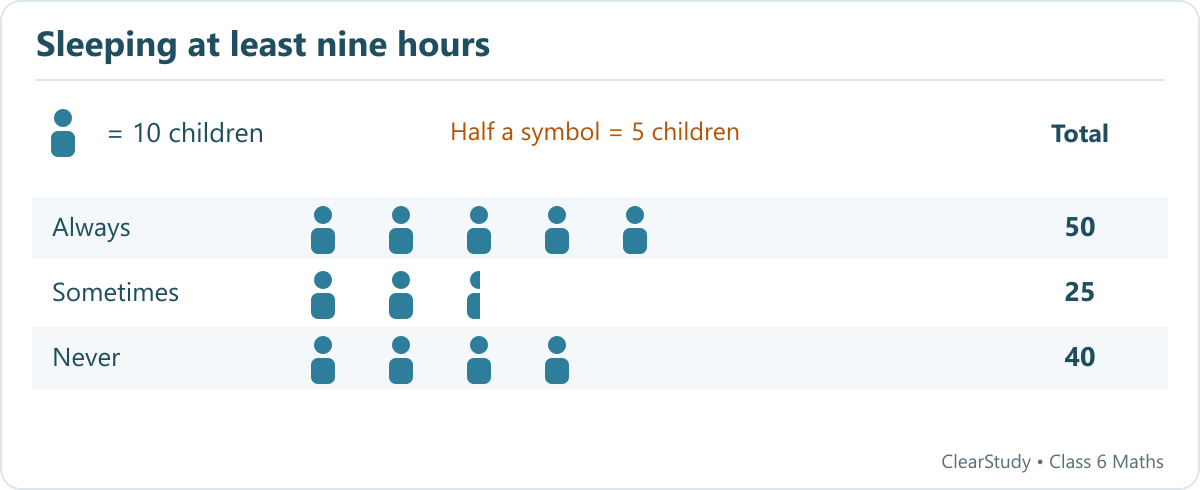
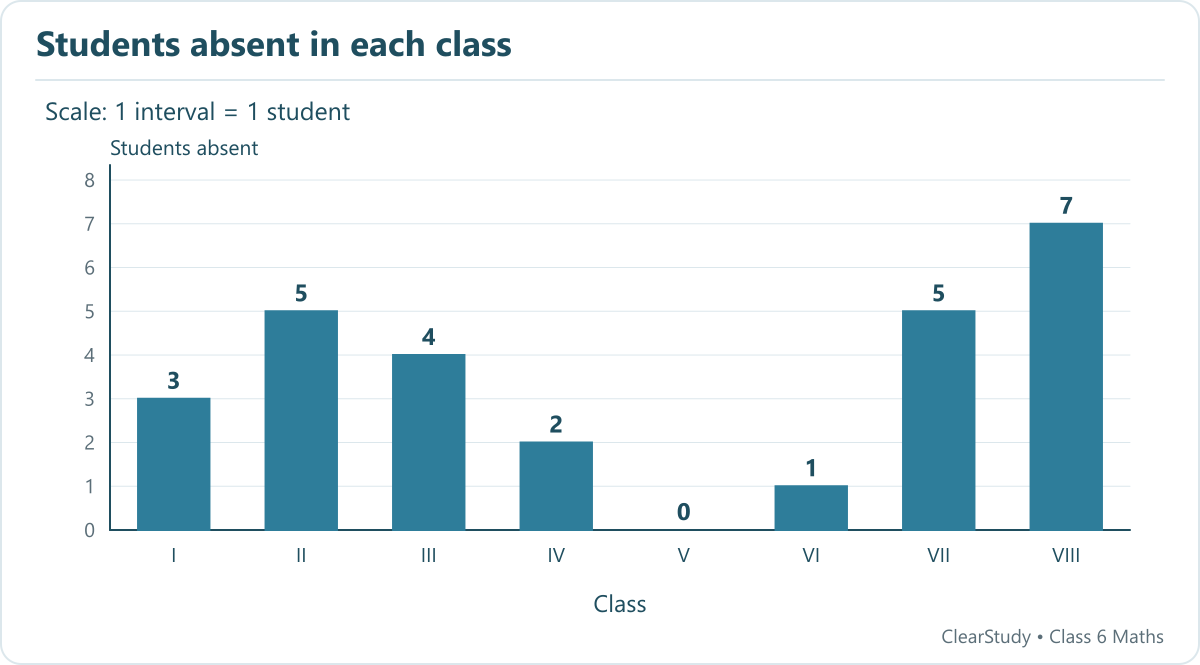
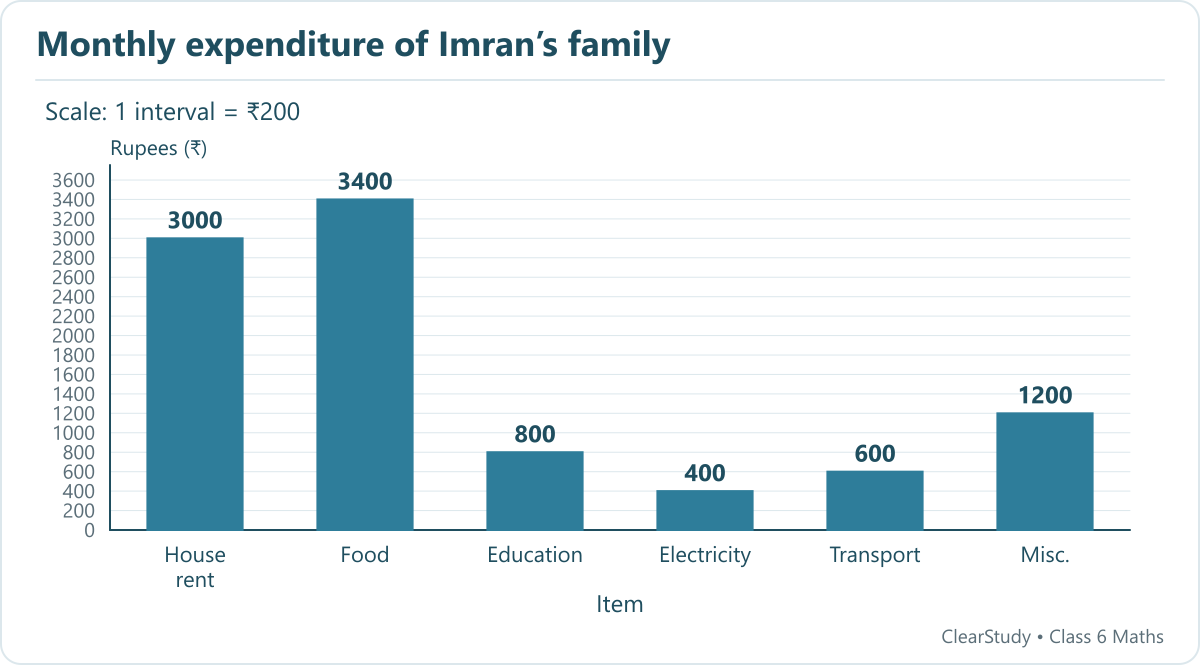
Figure it Out — Pictographs (Page 83–84)
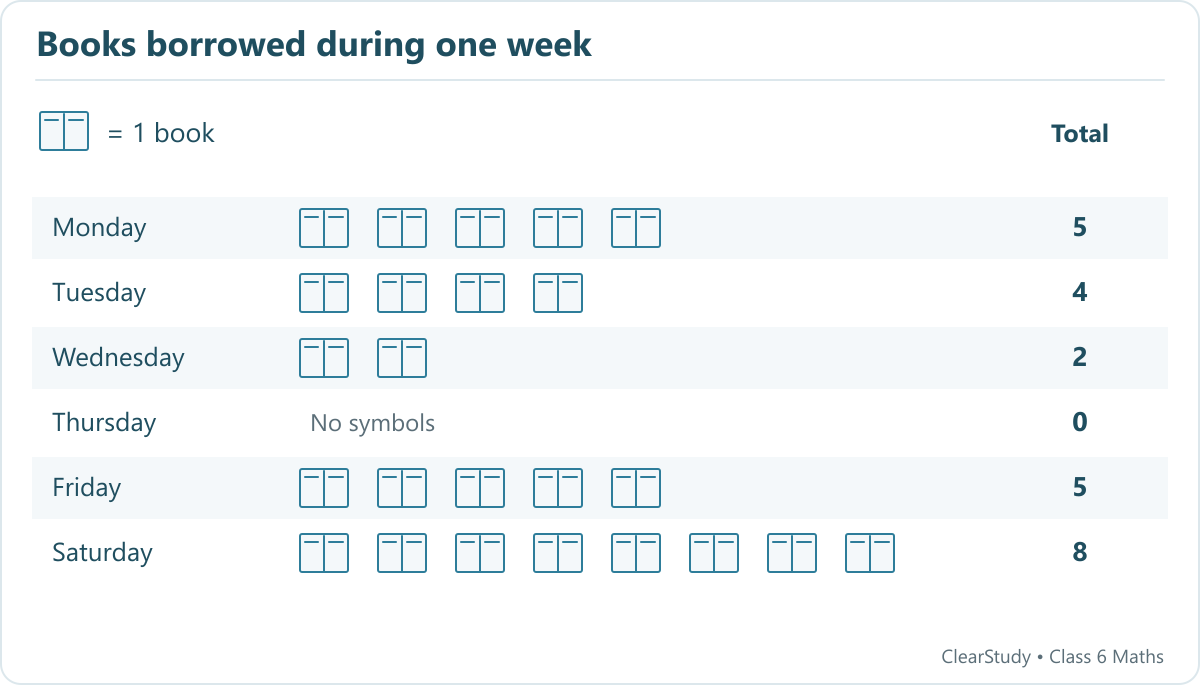
1. The following pictograph shows the number of books borrowed by students, in a week, from the library of Middle School, Ginnori (one symbol = 1 book; Monday 5, Tuesday 4, Wednesday 2, Thursday 0, Friday 5, Saturday 8): a. On which day were the minimum number of books borrowed? b. What was the total number of books borrowed during the week? c. On which day were the maximum number of books borrowed? What may be the possible reason?
2. Magan Bhai sells kites at Jamnagar. Six shopkeepers from nearby villages come to purchase kites from him. The number of kites he sold (Chaman 250, Rani 300, Rukhsana 100, Jasmeet 450, Jetha Lal 250, Poonam Ben 700). Prepare a pictograph using a symbol to represent 100 kites. Answer the following questions: a. How many symbols represent the kites that Rani purchased? b. Who purchased the maximum number of kites? c. Who purchased more kites, Jasmeet or Chaman? d. Rukhsana says Poonam Ben purchased more than double the number of kites that Rani purchased. Is she correct? Why?
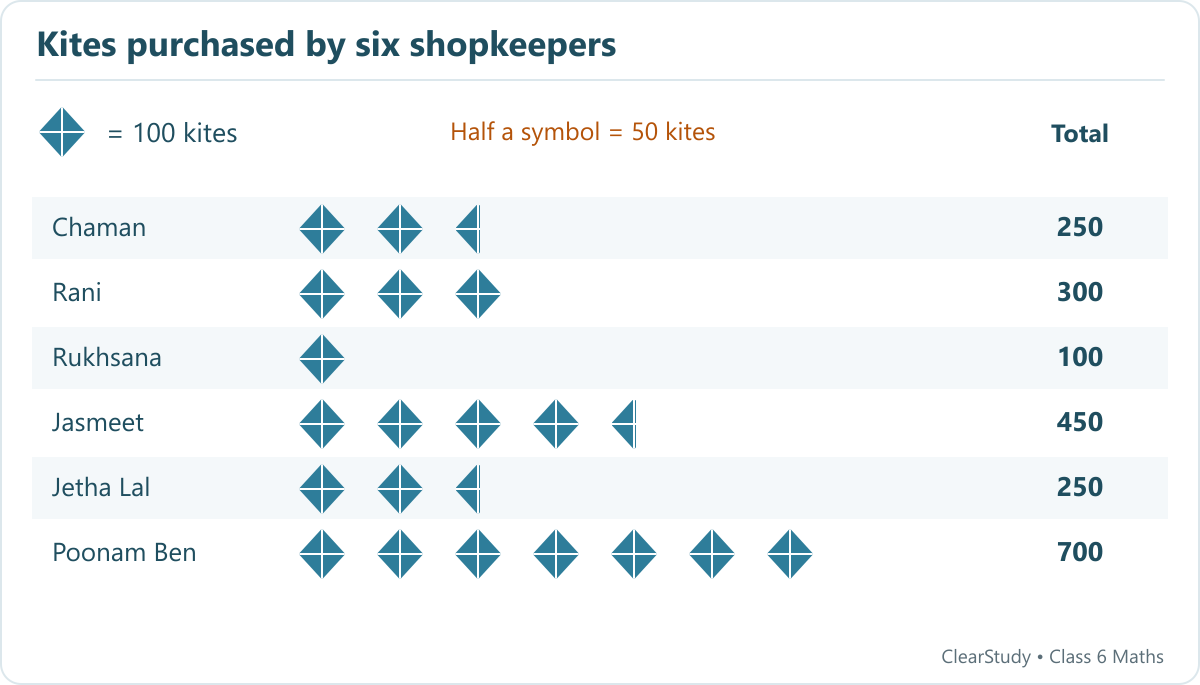
| Shopkeeper | Number of Kites Sold | Symbols (1 symbol = 100 kites) |
|---|---|---|
| Chaman | 250 | 2½ symbols |
| Rani | 300 | 3 symbols |
| Rukhsana | 100 | 1 symbol |
| Jasmeet | 450 | 4½ symbols |
| Jetha Lal | 250 | 2½ symbols |
| Poonam Ben | 700 | 7 symbols |
Figure it Out — Bar Graphs (Page 88, 93–99)
Page 88 — Figure it Out (traffic bar graph)
1. How many total cars passed through the crossing between 6 a.m. and noon?
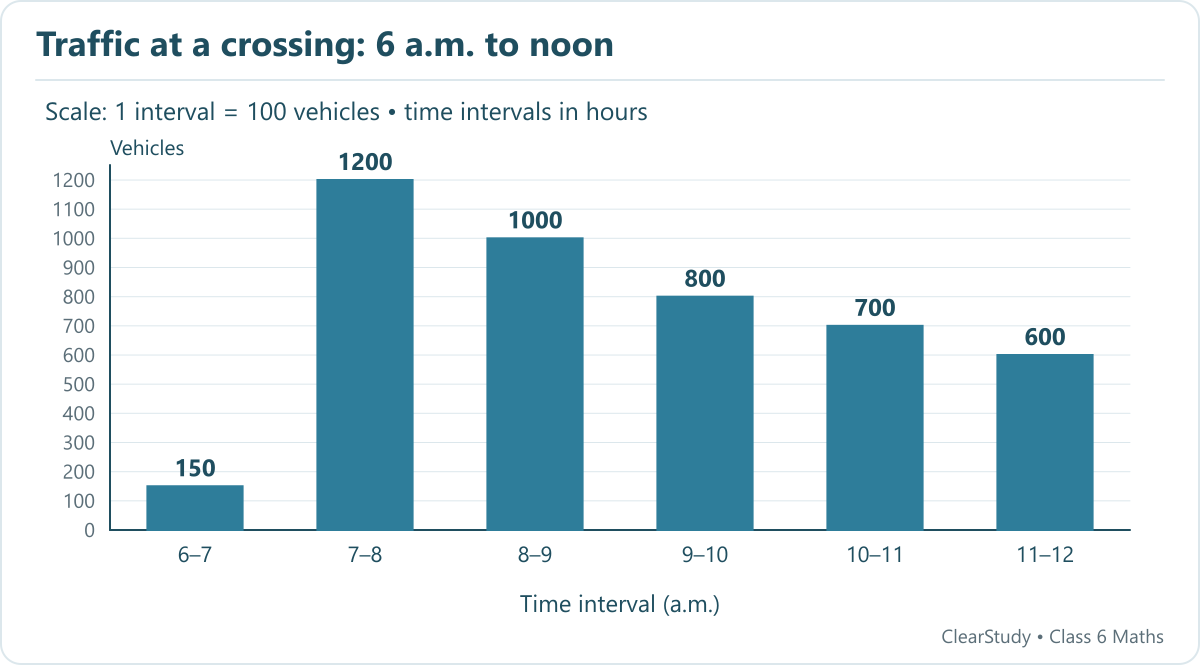
2. Why do you think so little traffic occurred during the hour of 6–7 a.m., as compared to the other hours from 7 a.m.–noon?
3. Why do you think the traffic was the heaviest between 7–8 a.m.?
4. Why do you think the traffic was lesser and lesser each hour after 8 a.m. all the way until noon?
Page 93–99 — Figure it Out (bar graphs & tables)
1. Samantha visited a tea garden, and collected data of the insects and critters she saw there (Mites 6, Caterpillars 10, Beetles 5, Butterflies 3, Grasshoppers 2). Help her prepare a bar graph representing this data.
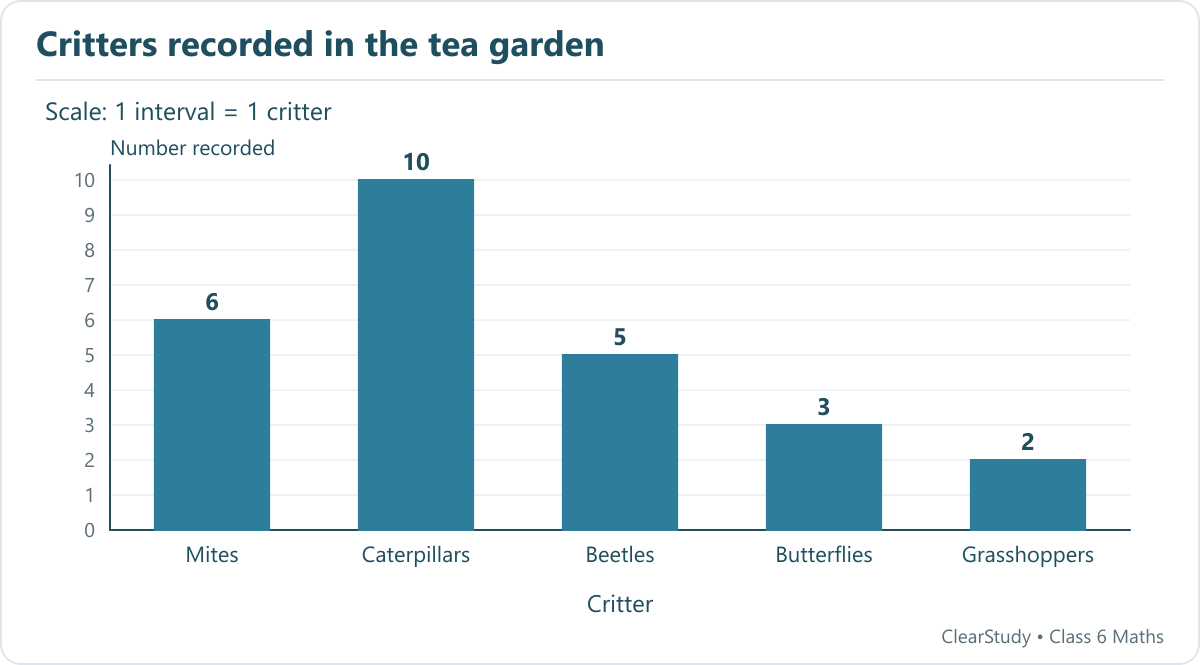
| Critter | Number | Bar height (1 unit = 1 critter) |
|---|---|---|
| Mites | 6 | 6 units |
| Caterpillars | 10 | 10 units |
| Beetles | 5 | 5 units |
| Butterflies | 3 | 3 units |
| Grasshoppers | 2 | 2 units |
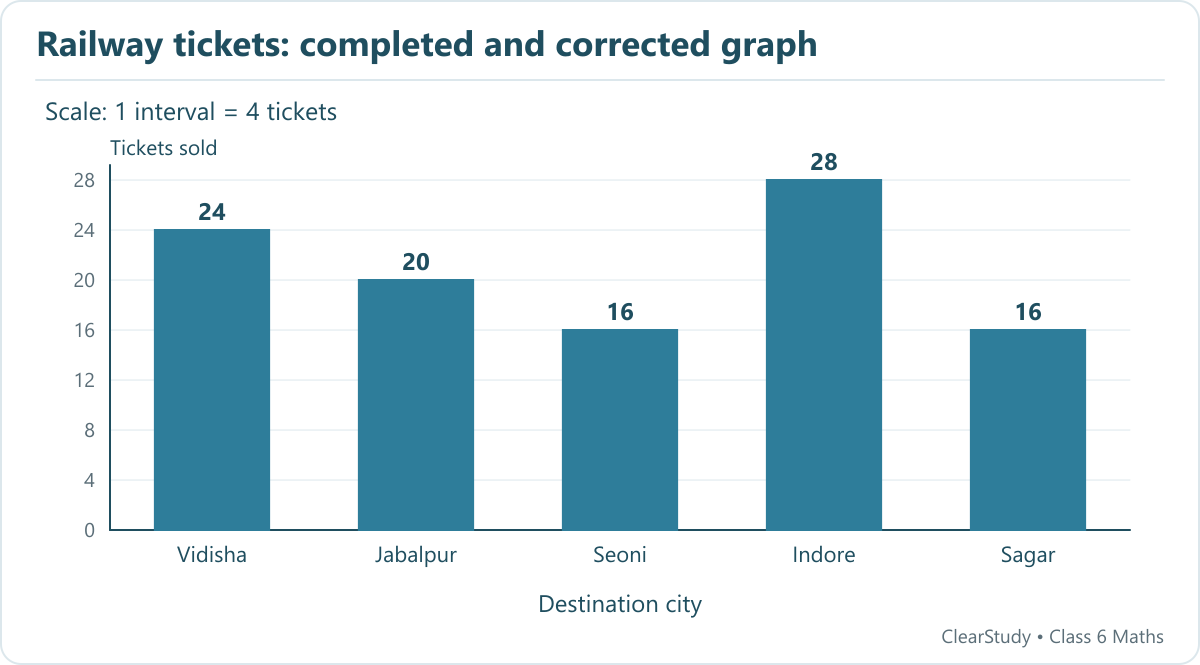
2. Pooja collected data on the number of tickets sold at the Bhopal railway station for a few different cities (Vidisha 24, Jabalpur 20, Seoni 16, Indore 28, Sagar 16). She prepared a bar graph, but someone erased a portion of the graph. a. Write the number of tickets sold for Vidisha above the bar. b. Write the number of tickets sold for Jabalpur above the bar. c. The bar for Vidisha is 6 unit lengths and the bar for Jabalpur is 5 unit lengths. What is the scale for this graph? d. Draw the correct bar for Sagar. e. Add the scale of the bar graph by placing the correct numbers on the vertical axis. f. Are the bars for Seoni and Indore correct in this graph? If not, draw the correct bar(s).
3. Chinu listed the various means of transport that passed across the road in front of his house from 9 a.m. to 10 a.m. a. Prepare a frequency distribution table for the data. b. Which means of transport was used the most? c. If you were there to collect this data, how could you do it? Write the steps or process.
| Means of Transport | Tally Marks | Number |
|---|---|---|
| Bike | | | | | | | | | ||| | 13 |
| Car | | | | | | | 6 |
| Bicycle | | | | | ||| | 8 |
| Auto Rickshaw | | | | | ||| | 8 |
| Scooter | | | | | | | | | | 9 |
| Bus | | | | | | 4 |
| Bullock Cart | || | 2 |
4. Roll a die 30 times and record the number you obtain each time. Prepare a frequency distribution table using tally marks. Find the number that appeared: a. The minimum number of times. b. The maximum number of times. c. Find numbers that appeared an equal number of times.
5. Faiz prepared a frequency distribution table of data on the number of wickets taken by Jaspreet Bumrah in his last 30 matches (Wickets 0–7 taken in 2, 4, 6, 8, 3, 5, 1, 1 matches respectively). a. What information is this table giving? b. What may be the title of this table? c. What caught your attention in this table? d. In how many matches has Bumrah taken 4 wickets? e. Mayank says, “If we want to know the total number of wickets… we have to add the numbers 0, 1, 2, 3 …, up to 7.” Can Mayank get the total number of wickets taken in this way? Why? f. How would you correctly figure out the total number of wickets taken by Bumrah in his last 30 matches, using this table?
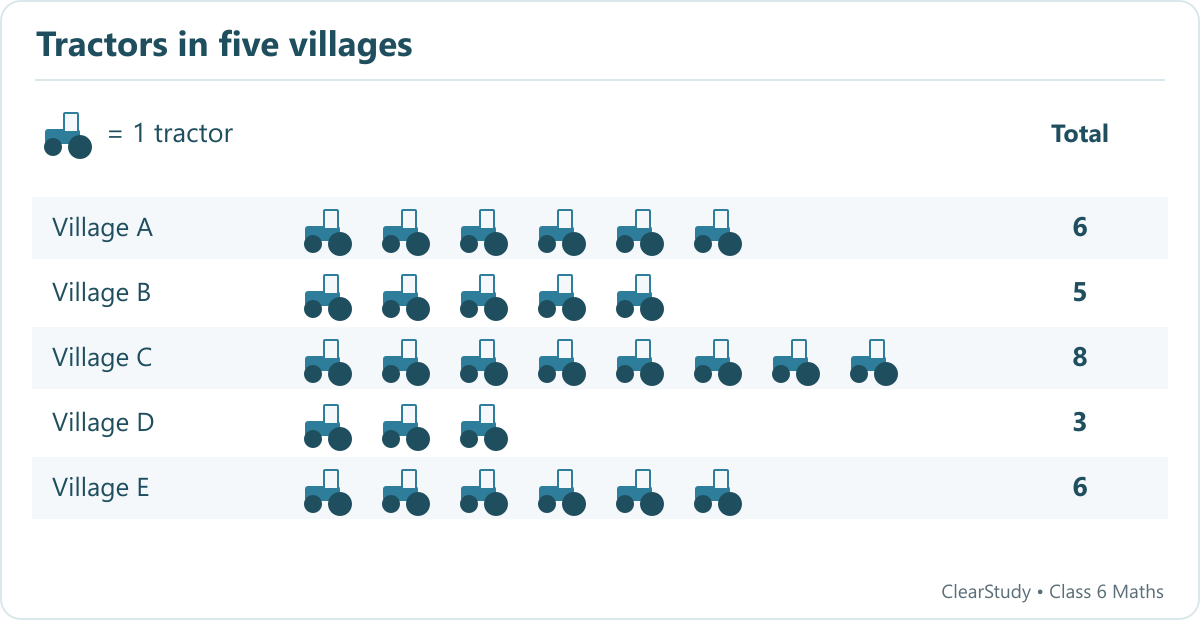
6. The following pictograph shows the number of tractors in five different villages (one symbol = 1 tractor; Village A 6, B 5, C 8, D 3, E 6). a. Which village has the smallest number of tractors? b. Which village has the most tractors? c. How many more tractors does Village C have than Village B? d. Komal says, “Village D has half the number of tractors as Village E.” Is she right?
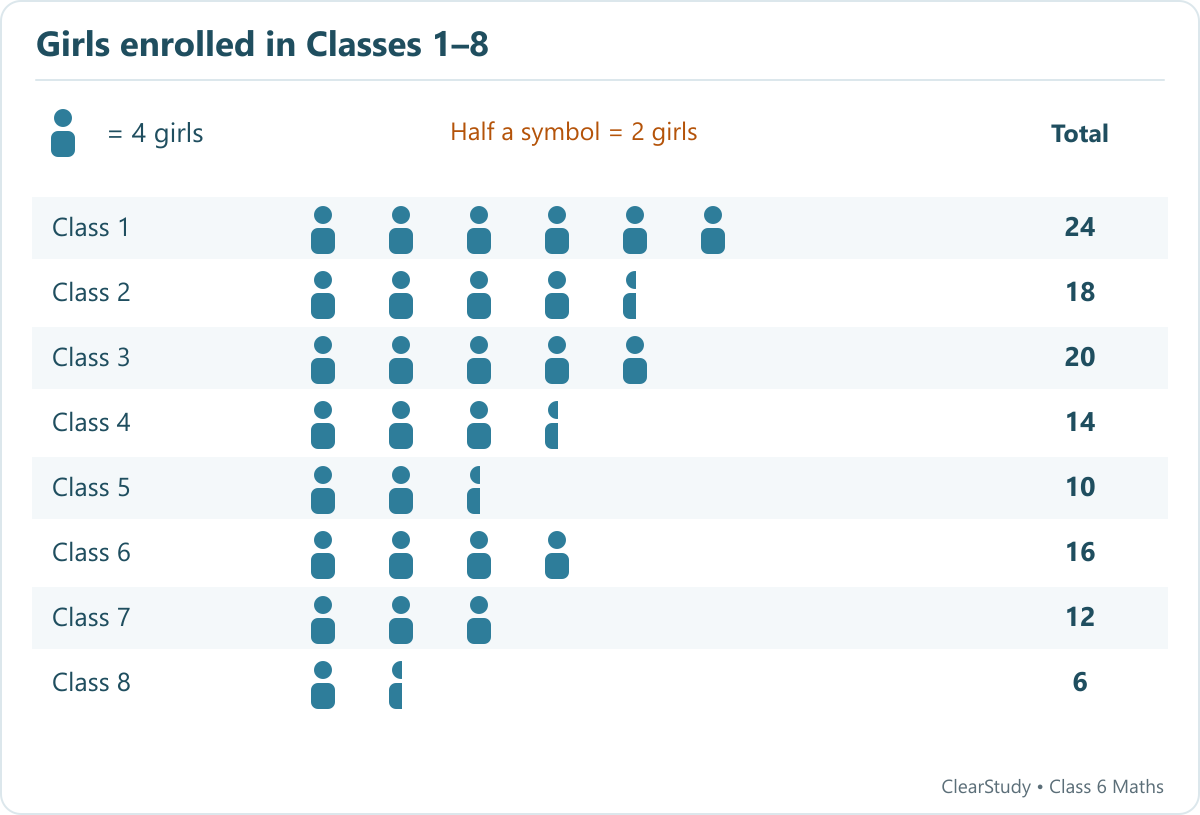
7. The number of girl students in each class of a school is depicted by the pictograph (one symbol = 4 girls; Classes 1–8 = 24, 18, 20, 14, 10, 16, 12, 6). a. Which class has the least number of girl students? b. What is the difference between the number of girls in Classes 5 and 6? c. If two more girls were admitted in Class 2, how would the graph change? d. How many girls are there in Class 7?
8. The number of Mudhol dogs in six villages of Karnataka are: Village A 18, Village B 36, Village C 12, Village D 48, Village E 18, Village F 24. Prepare a pictograph and answer the following questions: a. What will be a useful scale or key to draw this pictograph? b. How many symbols will you use to represent the dogs in Village B? c. Kamini said that the number of these dogs in Village B and Village D together will be more than the number of these dogs in the other 4 villages. Is she right? Give reasons for your response.
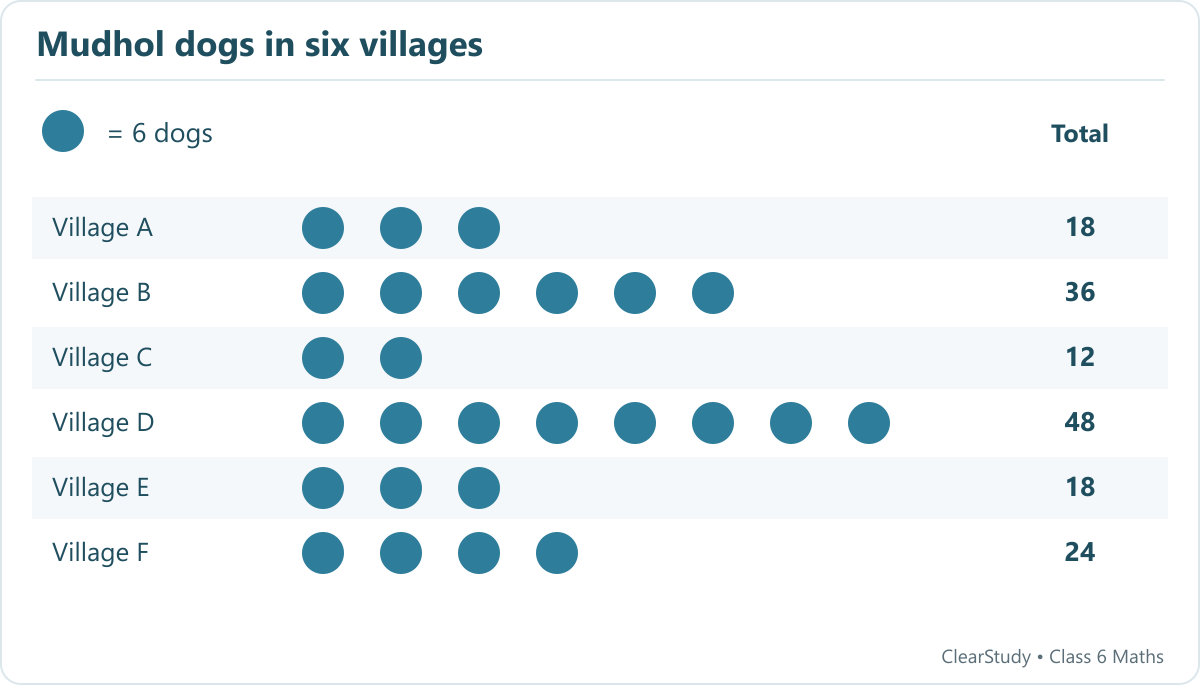
| Village | Number of Dogs | Symbols (1 symbol = 6 dogs) |
|---|---|---|
| Village A | 18 | 3 symbols |
| Village B | 36 | 6 symbols |
| Village C | 12 | 2 symbols |
| Village D | 48 | 8 symbols |
| Village E | 18 | 3 symbols |
| Village F | 24 | 4 symbols |
9. A survey of 120 school students found which activity they preferred in free time (Playing 45, Reading story books 30, Watching TV 20, Listening to music 10, Painting 15). Draw a bar graph taking the scale of 1 unit length = 5 students. Which activity is preferred by most students other than playing?
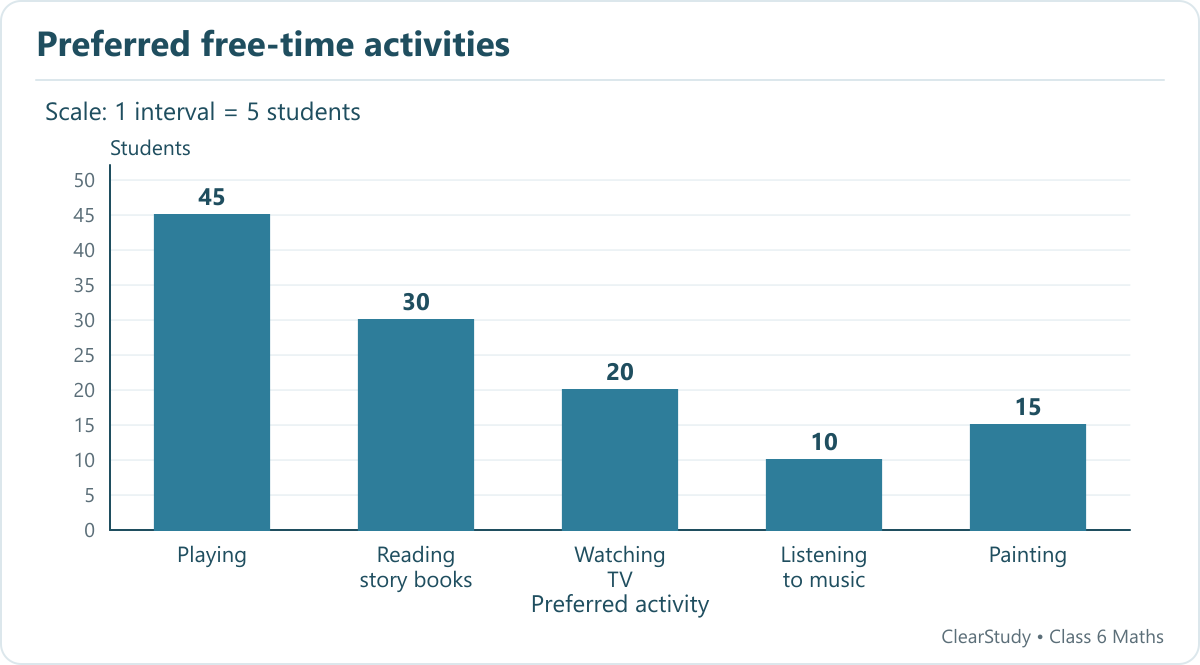
| Preferred Activity | Number of Students | Bar height (1 unit = 5 students) |
|---|---|---|
| Playing | 45 | 9 units |
| Reading story books | 30 | 6 units |
| Watching TV | 20 | 4 units |
| Listening to music | 10 | 2 units |
| Painting | 15 | 3 units |
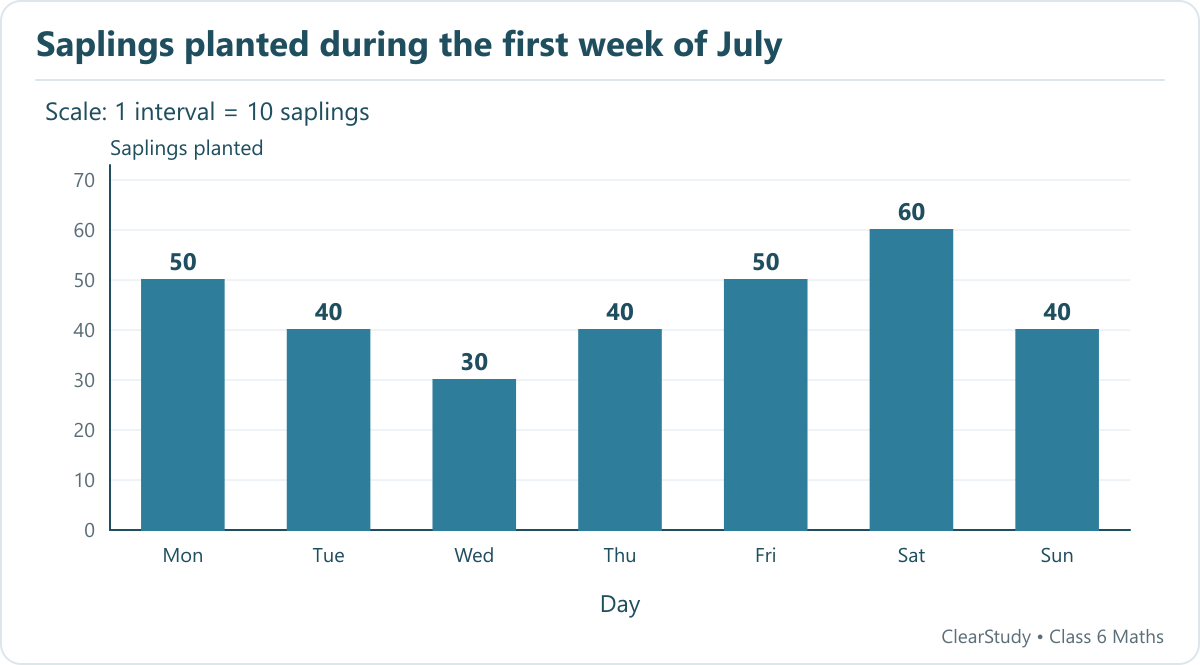
10. Students and teachers planted tree saplings during the first week of July. From the bar graph: Monday 50, Tuesday 40, Wednesday 30, Thursday 40, Friday 50, Saturday 60, Sunday 40. a. The total number of saplings planted on Wednesday and Thursday is ____. b. The total number of saplings planted during the whole week is ____. c. The greatest number of saplings were planted on ____ and the least number of saplings were planted on ____. Why do you think that is the case?
11. Shagufta and Divya looked up the number of tigers in India between 2006 and 2022 in four-year intervals (2006 = 1400, 2010 = 1700, 2014 = 2200, 2018 = 3000, 2022 = 3700). They made a bar graph, but there are a few mistakes in it. Can you find those mistakes and fix them?
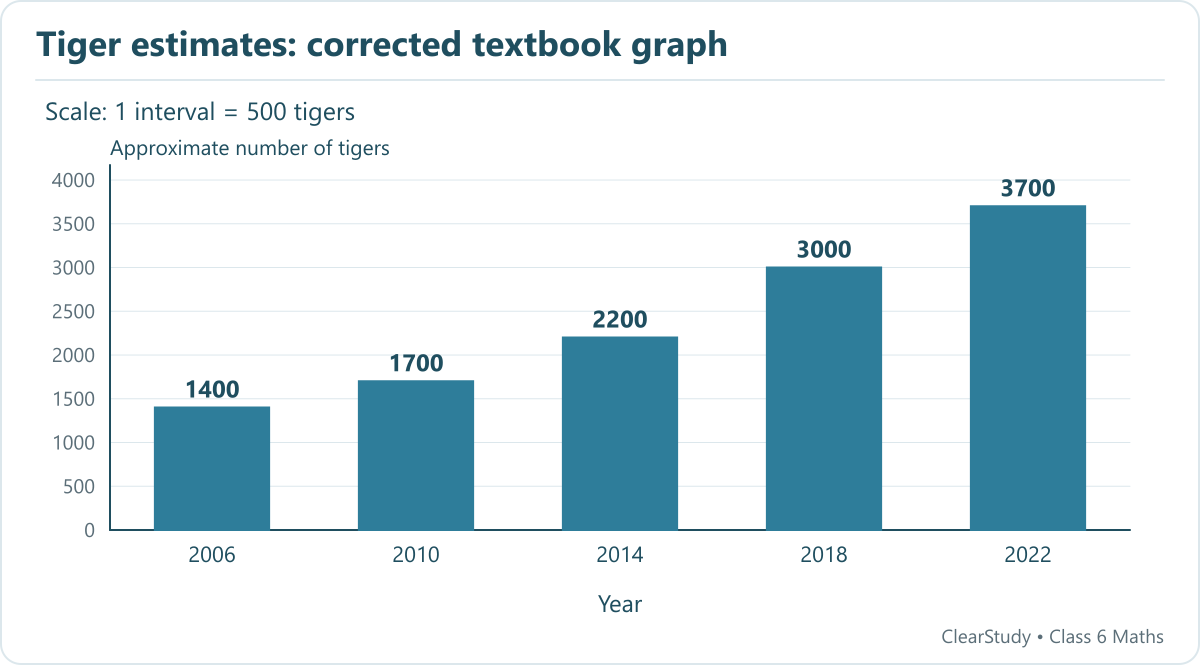
Figure it Out — Artistic & Aesthetic Considerations (Page 103)
1. If you wanted to visually represent the data of the heights of the tallest persons in each class in your school, would you use a graph with vertical bars or horizontal bars? Why?
2. If you were making a table of the longest rivers on each continent and their lengths, would you prefer to use a bar graph with vertical bars or with horizontal bars? Why? Try finding out this information, and then make the corresponding table and bar graph! Which continents have the longest rivers?
Common Mistakes to Avoid
Watch out for these
- Miscounting tally marks — remember a crossed group | | | | is exactly 5; count the groups of five first, then add the leftover strokes.
- Thinking a frequency table tells you which individual chose what — it only gives the count for each category, not the names.
- Forgetting to state the scale/key on a pictograph or bar graph — without it, the figure cannot be read correctly.
- For a frequency table, adding the values instead of (value × frequency) — the true total is the sum of value × how many times it occurs (Bumrah’s total = 90, not 0+1+…+7).
- Drawing bars of different widths or unequal gaps, or starting the scale away from zero — bars must be equal width, equally spaced and measured from 0.
- Trusting a “fancy” infographic blindly — if taller shapes are also wider (or much taller than the real ratio), the picture can mislead even when the data is correct.
Practice MCQs & Assertion–Reason
1. A crossed group of tally marks | | | | stands for:
(a) 4 (b) 5 (c) 6 (d) 10
2. The count of how many times a particular value occurs in data is called its:
(a) scale (b) frequency (c) tally (d) average
3. In the sweets table, the tally | | | | | | | | ||| represents:
(a) 11 (b) 12 (c) 13 (d) 15
4. In a pictograph where one symbol = 10 children, 2½ symbols represent:
(a) 20 (b) 25 (c) 30 (d) 12
5. Magan Bhai’s pictograph uses 1 symbol = 100 kites. Rani bought 300 kites, so she needs:
(a) 2 symbols (b) 3 symbols (c) 4 symbols (d) 30 symbols
6. In a bar graph with 1 unit length = ₹200, a House-rent of ₹3000 is drawn as a bar of:
(a) 10 units (b) 12 units (c) 15 units (d) 30 units
7. In Pooja’s ticket bar graph, Vidisha (24 tickets) is 6 units long. The scale is:
(a) 1 unit = 2 tickets (b) 1 unit = 4 tickets (c) 1 unit = 6 tickets (d) 1 unit = 24 tickets
8. Using the wickets table (matches: 2, 4, 6, 8, 3, 5, 1, 1 for 0–7 wickets), the total wickets in 30 matches is:
(a) 28 (b) 90 (c) 30 (d) 60
9. The most popular game in Navya and Naresh’s class is:
(a) Cricket (b) Kabaddi (c) Hockey (d) Football
10. A vertical bar graph is also called a:
(a) pictograph (b) column graph (c) tally chart (d) line graph
For each Assertion–Reason question, choose: (A) Both Assertion and Reason are true and the Reason is the correct explanation of the Assertion; (B) Both are true but the Reason is not the correct explanation; (C) Assertion is true but Reason is false; (D) Assertion is false but Reason is true.
A-R 1. Assertion: A frequency table of the sweet choices is not enough to give each sweet to the correct student.
Reason: A frequency table records only how many students chose each sweet, not which student chose which sweet.
A-R 2. Assertion: Arranging shoe-size data in ascending order makes it easy to count how many students wear each size.
Reason: In ordered data, equal values stand together so each value’s frequency is easy to read off.
A-R 3. Assertion: With 1 symbol = 10 students and only whole or half symbols allowed, 27 students cannot be shown exactly.
Reason: Whole and half symbols with this key represent multiples of 5, and 27 is not a multiple of 5.
A-R 4. Assertion: The total number of wickets Bumrah took cannot be found by adding 0 + 1 + 2 + … + 7.
Reason: The total must be the sum of (wickets × number of matches), because each wicket-count occurred in several matches.
A-R 5. Assertion: Heights of people are best shown with a vertical bar graph.
Reason: Heights are measured upward from the ground, so vertical bars represent them more intuitively.
Quick Revision Summary
- Data is any collection of facts, numbers, measures or observations that conveys information.
- Data can be organised in a table using tally marks; a crossed group | | | | = 5 makes counting easy.
- Frequency is the number of times a value occurs; the most popular item has the highest frequency.
- A pictograph represents data with pictures; a scale/key tells what each symbol stands for (1 or more units).
- A bar graph uses bars of equal width and equal spacing; bar height = frequency ÷ scale, measured from 0.
- Total observations = sum of frequencies. Total numerical value = sum of (value × frequency).
- Choose vertical bars (columns) for heights and horizontal bars for lengths; fancy infographics can mislead.
How to score full marks in this chapter
Always write a clear title, scale/key and axis labels on every pictograph and bar graph — these make the representation clear and checkable. Read tally marks in groups of five, and when finding a numerical total such as wickets, multiply each value by its frequency before adding; to count observations such as matches, add the frequencies. Keep bars of equal width with uniform gaps starting from zero, and double-check each bar’s height = number ÷ scale. Show one neat working line per step so each part earns its mark.
Frequently Asked Questions
What is Class 6 Maths Ganita Prakash Chapter 4 about?
Chapter 4, Data Handling and Presentation, covers collecting and organising data, tally marks and frequency tables, and how to read and draw pictographs and bar graphs (including choosing a suitable scale or key), along with the artistic side of presenting data and how infographics can sometimes mislead.
How many Figure it Out exercises are there in Chapter 4?
There are several “Figure it Out” sets — on collecting and organising data (pages 75, 76, 77), pictographs (pages 83–84), bar graphs (pages 88 and 93–99) and artistic considerations (page 103) — plus Math Talk tasks and worked examples, with worked solutions and activity guidance below.
What is the difference between a pictograph and a bar graph?
A pictograph shows data using pictures or symbols, where each symbol stands for a fixed number of units (its key). A bar graph shows data using bars of equal width and equal spacing, where the length or height of each bar gives the frequency on a chosen scale. Both need a clearly stated scale to be read correctly.
Are these Class 6 Maths Ganita Prakash Chapter 4 solutions free?
Yes. These free NCERT Ganita Prakash solutions include worked answers, original charts and guidance for collecting your own data.
Textbook reference: NCERT Ganita Prakash, Chapter 4 (official PDF). ClearStudy diagrams and worked explanations are original teaching aids.