These Class 6 Maths Ganita Prakash Chapter 3 solutions cover Number Play from the new NCF-2023 textbook (Reprint 2026–27). Worked Figure it Out solutions, original diagrams and guided activities explain supercells, number-line placement, digit sums, palindromes, the Kaprekar constant, the Collatz conjecture, estimation and winning game strategies — so you can master the chapter and revise it quickly.
Class: 6Subject: MathematicsBook: Ganita PrakashChapter: 3Exercises: Figure it Out (Sections 3.1–3.12)Session: 2026–27
Chapter 3 of Ganita Prakash, Number Play, shows how numbers do far more than count — they convey information (the “taller-neighbour” game), reveal patterns (supercells, palindromes, digit sums), and power puzzles and games. The chapter places numbers on the number line, counts how many 1-, 2-, 3-, 4- and 5-digit numbers exist, explores the Kaprekar constant 6174, the famous Collatz conjecture, simple estimation, and winning strategies for number games. The Class 6 Maths Ganita Prakash Chapter 3 solutions below explain the methods, check numerical examples and guide open-ended activities.
Key Concepts & Definitions
Supercell: a cell whose number is greater than all the numbers in its adjacent (neighbouring) cells. In a single row the neighbours are the left and right cells; in a grid they are the left, right, top and bottom cells.
Digit sum: the number obtained by adding all the digits of a number, e.g. the digit sum of 68 is 6 + 8 = 14.
Palindrome (palindromic number): a number that reads the same from left to right and from right to left, e.g. 66, 848, 1111.
Kaprekar constant: the number 6174. Take any 4-digit number with at least two different digits, make the largest number A and smallest number B from its digits, find C = A − B, and repeat — you always reach 6174.
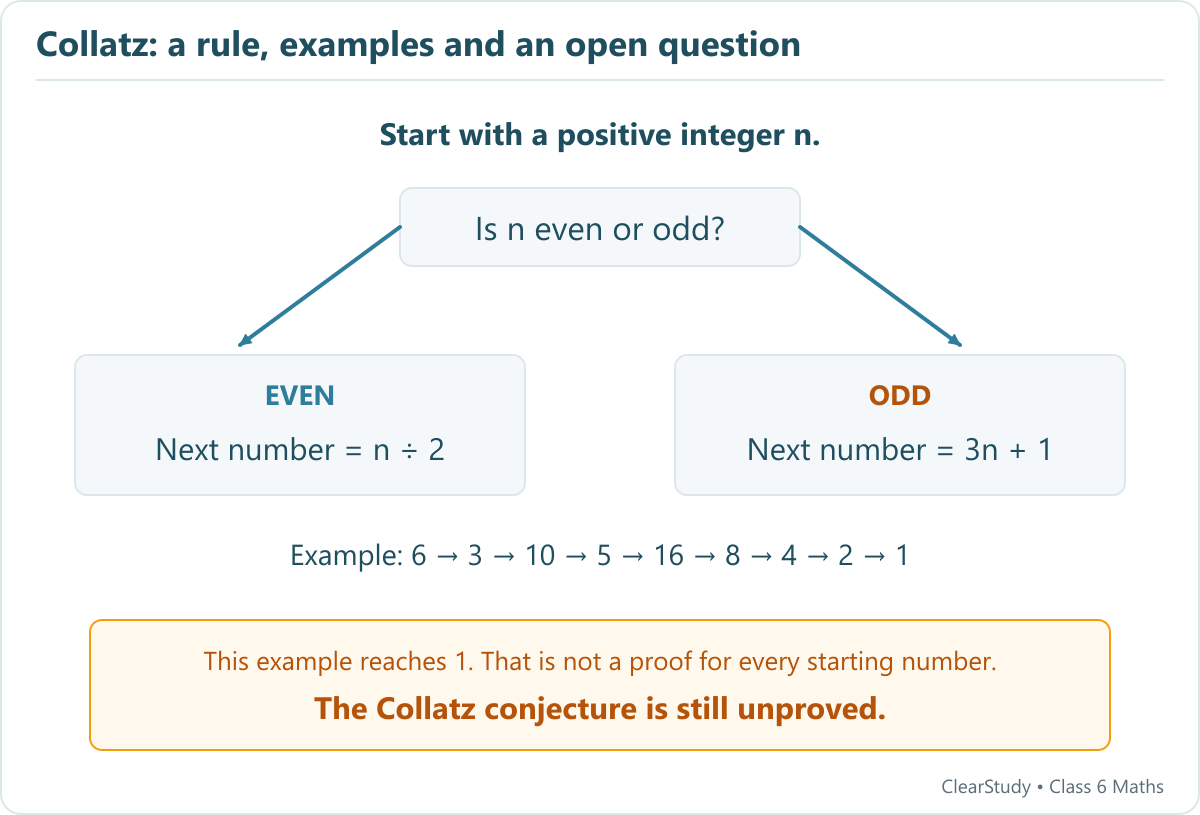
Collatz rule: start with any positive integer; if it is even take half of it, if it is odd multiply by 3 and add 1; repeat. The Collatz conjecture says every such sequence eventually reaches 1 (still unproved).
Estimation: a sensible approximate value, used when an exact count is not needed.
Important Ideas & Patterns (Chapter 3)
Count of positive n-digit numbers: there are 9 one-digit, 90 two-digit, 900 three-digit, 9000 four-digit and 90000 five-digit numbers.
Maximum supercells: for c cells in a row, the maximum number of supercells is c ÷ 2 (even c) or (c + 1) ÷ 2 (odd c) — fill the first cell as a supercell, then alternate.
Largest / smallest number from given digits: put digits in descending order for the largest. For the smallest number with the same number of digits, put the smallest non-zero digit first, then the remaining digits in ascending order. An ordinary multi-digit number cannot start with 0.
Kaprekar convention: keep four digit positions, including leading zeros. Subtract the digits in ascending order from those in descending order. Thus 5085 gives 8550 − 0558 = 7992. This fixed-width operation differs from finding the smallest ordinary four-digit number.
Calendar repeat: two years have the same calendar when 1 January falls on the same weekday and both are common years or both are leap years.
Numbers can Tell us Things (Section 3.1)
Math Talk — Situations where numbers are usedThink about various situations where we use numbers. List five different situations in which numbers are used. See what your classmates have listed, share, and discuss.Answer. Five different situations in which numbers are used: (1) telling the time, (2) reading a calendar (dates), (3) counting objects or marks, (4) measuring height and weight, (5) handling money. There could be many more.
Q. What do you think these numbers mean?
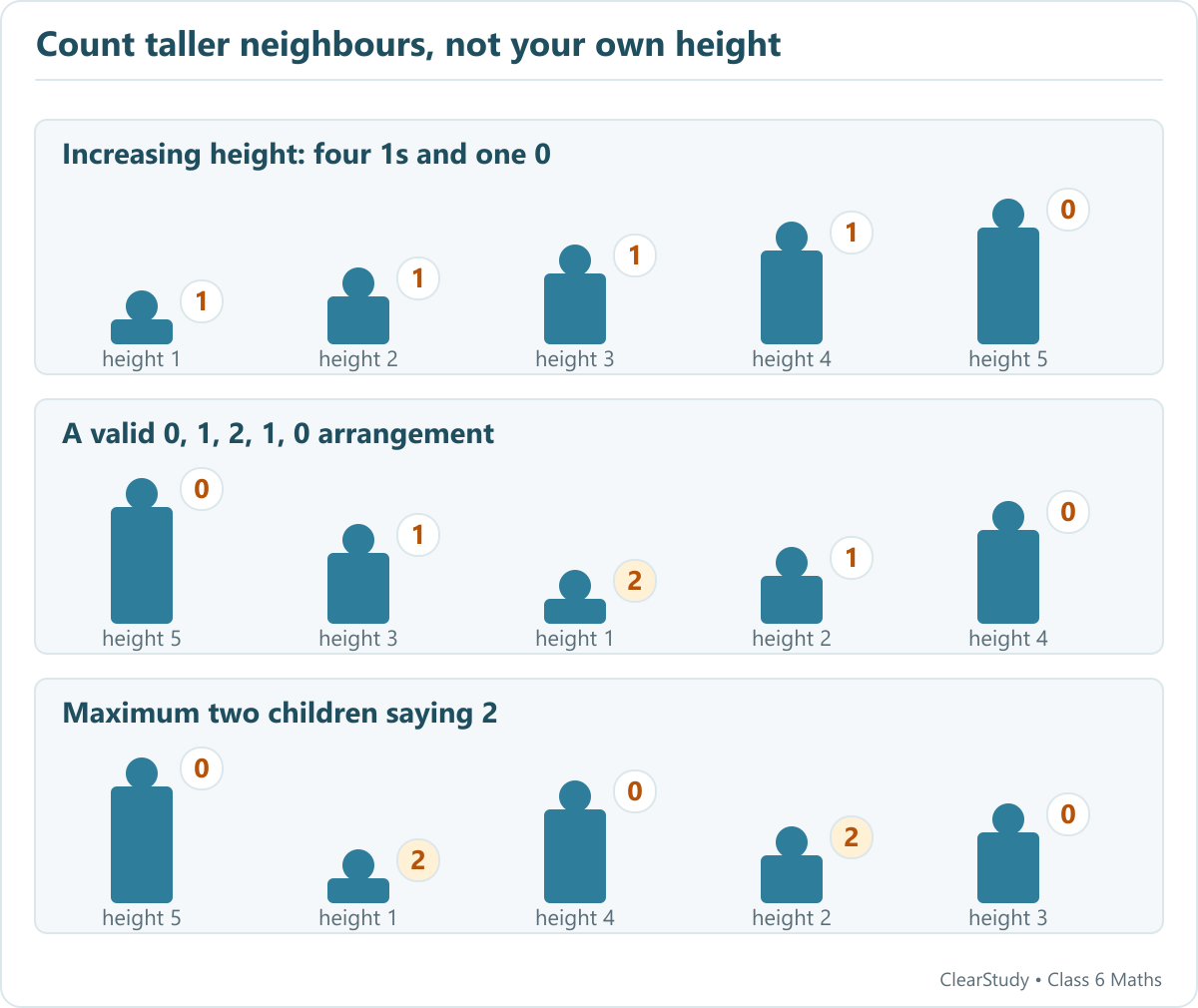
SOLUTIONEach child looks at the children standing next to them and says how many of their neighbours are taller than themselves.A child says ‘1’ if exactly one neighbour is taller, ‘2’ if both neighbours are taller, and ‘0’ if neither neighbour is taller. So the numbers count the taller neighbours of each child.
1. Can the children rearrange themselves so that the children standing at the ends say ‘2’?
SOLUTIONNo. A child at an end has only one neighbour, so the most that child can ever say is ‘1’. There is no one on the outer side of an end child, so it can never have two taller neighbours.
2. Can we arrange the children in a line so that all would say only 0s?
SOLUTIONNo, for the pictured group of different heights. If every child said 0, neither child in any neighbouring pair could be taller, so every adjacent pair would have equal heights. That would require all children to have the same height; rearranging them cannot make this happen.A different group consisting entirely of equal-height children would all say 0.
3. Can two children standing next to each other say the same number?
SOLUTIONYes. In the height order 1, 2, 3, 4, 5, the spoken numbers are 1, 1, 1, 1, 0, so neighbouring children can both say 1. Two neighbours of unequal heights cannot both say 0: the shorter one sees a taller neighbour.
4. There are 5 children in a group, all of different heights. Can they stand such that four of them say ‘1’ and the last one says ‘0’? Why or why not?
SOLUTIONYes, they can. If the 5 children stand in ascending order of height (shortest to tallest), the shortest child (at one end) has its only neighbour taller, so it says ‘1’; each middle child has one shorter and one taller neighbour, so it says ‘1’; the tallest child (at the other end) has its only neighbour shorter, so it says ‘0’. That gives four 1s and one 0.
5. For this group of 5 children, is the sequence 1, 1, 1, 1, 1 possible?
SOLUTIONNo. Wherever the tallest child stands, it has no taller neighbour and must say 0. Therefore all five children cannot say 1.
6. Is the sequence 0, 1, 2, 1, 0 possible? Why or why not?
SOLUTIONYes, it is possible. Arrange heights so that the children at the two ends are the tallest (each says 0), the middle child is the shortest (both neighbours taller, says 2), and the two children on either side of the middle have exactly one taller neighbour (each says 1). For example heights in the order 5, 3, 1, 2, 4 give the sequence 0, 1, 2, 1, 0.
7. How would you rearrange the five children so that the maximum number of children say ‘2’?
SOLUTIONAt most two children can say 2. End children have only one neighbour, and two adjacent children cannot both be shorter than each other.Use height order 5, 1, 4, 2, 3. The counts are 0, 2, 0, 2, 0. Positions 2 and 4 each have two taller neighbours.
Bars show relative heights; bubbles count taller immediate neighbours. An end child has only one neighbour.
Supercells (Section 3.2)
A cell is a supercell if its number is greater than all of its adjacent cells.
Figure it Out (Page 57)
1. Colour or mark the supercells in the table below.
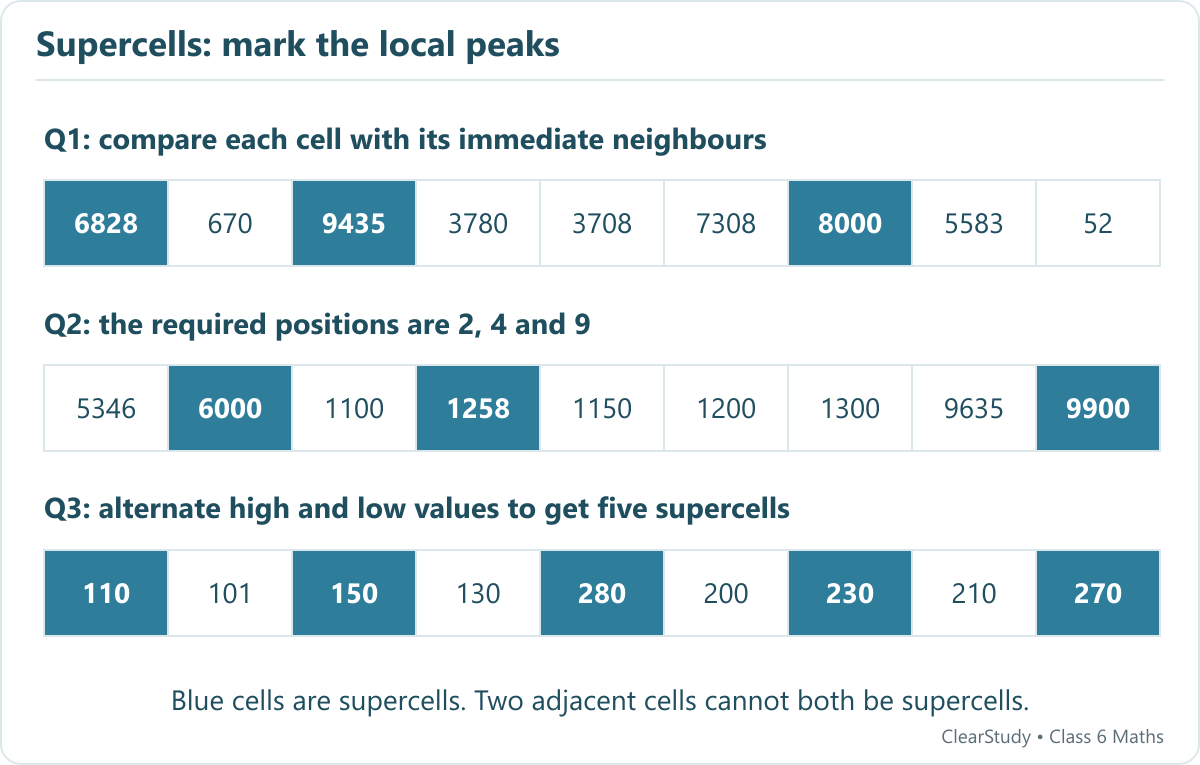
6828 670 9435 3780 3708 7308 8000 5583 52
SOLUTIONCompare each cell with its left and right neighbours and mark the ones larger than both:6828 > 670 (left end, one neighbour) → supercell. 670 < 6828 → no. 9435 > 670 and 3780 → supercell. 3780 < 9435 → no. 3708 < 7308 → no. 7308 > 3708 and 8000? 7308 < 8000 → no. 8000 > 7308 and 5583 → supercell. 5583 > 52 but < 8000 → no. 52 < 5583 → no (52 is an end cell but smaller than its only neighbour).∴ The supercells are 6828, 9435 and 8000.
2. Fill the table below with only 4-digit numbers such that the supercells are exactly the coloured cells.
5346 ___ ___ 1258 ___ ___ ___ 9635 ___
SOLUTIONThe coloured positions in the textbook are 2, 4 and 9. One valid filling is 5346, 6000, 1100, 1258, 1150, 1200, 1300, 9635, 9900.6000 exceeds 5346 and 1100; 1258 exceeds 1100 and 1150; 9900 exceeds its only neighbour 9635. Every other cell has a larger neighbour, so these are exactly the three supercells.
3. Fill the table below such that we get as many supercells as possible. Use numbers between 100 and 1000 without repetitions.
SOLUTIONTo get the maximum number of supercells, make every alternate cell (1st, 3rd, 5th, 7th, 9th) larger than its neighbours. One arrangement is:110 101 150 130 280 200 230 210 270 — here cells 110, 150, 280, 230 and 270 are each greater than their neighbours, giving 5 supercells.
In Q2, the given 5346 and 9635 are not coloured. The blue cells match the textbook’s required positions exactly.
4. Out of the 9 numbers, how many supercells are there in the table above? ___________
SOLUTIONIn a row of 9 cells the maximum number of supercells is the alternate cells 1st, 3rd, 5th, 7th and 9th.∴ there are 5 supercells.
5. Find out how many supercells are possible for different numbers of cells. Do you notice any pattern? What is the method to fill a given table to get the maximum number of supercells? Explore and share your strategy.
SOLUTIONFor an even number of cells (2, 4, 6, …) the maximum number of supercells is 2÷2 = 1, 4÷2 = 2, 6÷2 = 3, …For an odd number of cells (1, 3, 5, 7, …) it is (1+1)÷2 = 1, (3+1)÷2 = 2, (5+1)÷2 = 3, (7+1)÷2 = 4, …Method: to get the maximum number of supercells, fill the first cell as a supercell and then fill the cells alternately (every second cell is a supercell, with smaller numbers in between).
Try This (Page 58)
6. Can you fill a supercell table without repeating numbers such that there are no supercells? Why or why not?
SOLUTIONNo. The cell holding the greatest number among the chosen numbers will always be larger than its neighbours, so it becomes a supercell no matter where it is placed. Hence there must be at least one supercell.
7. Will the cell having the largest number in a table always be a supercell? Can the cell having the smallest number in a table be a supercell? Why or why not?
SOLUTIONIf the table has distinct numbers, its largest number is greater than every neighbour and is always a supercell. The smallest number cannot be a supercell when it has a neighbour.If repetitions are allowed, a largest entry beside an equal largest entry is not strictly greater and is not a supercell. For example, neither cell of [5, 5] is a supercell.
8. Fill a table such that the cell having the second largest number is not a supercell.
SOLUTIONPlace the second largest number right next to the largest number, so its larger neighbour stops it from being a supercell. One way is:1 2 3 4 5 6 7 9 8 — here 8 (the second largest) sits next to 9, so 8 is not a supercell.
9. Fill a table such that the cell having the second largest number is not a supercell but the second smallest number is a supercell. Is it possible?
SOLUTIONYes, it is possible. One way is:2 1 3 4 5 6 7 9 8 — here the second smallest number 2 is at the left end and is greater than its only neighbour 1, so 2 is a supercell; the second largest number 8 sits next to 9, so 8 is not a supercell.
10. Make other variations of this puzzle and challenge your classmates.
SOLUTIONSome variations you can pose: “Can you fill a table of 9 cells such that there are more than 5 supercells?” (the answer is no — 5 is the maximum), and “Can you fill a table of 9 cells such that there are exactly 4 supercells?” (yes — arrange the numbers so one of the alternate peaks is missed). (Open-ended.)
Table 2 (Page 58)
Q. Complete Table 2 with 5-digit numbers whose digits are ‘1’, ‘0’, ‘6’, ‘3’, and ‘9’ in some order. Only a coloured cell should have a number greater than all its neighbours.
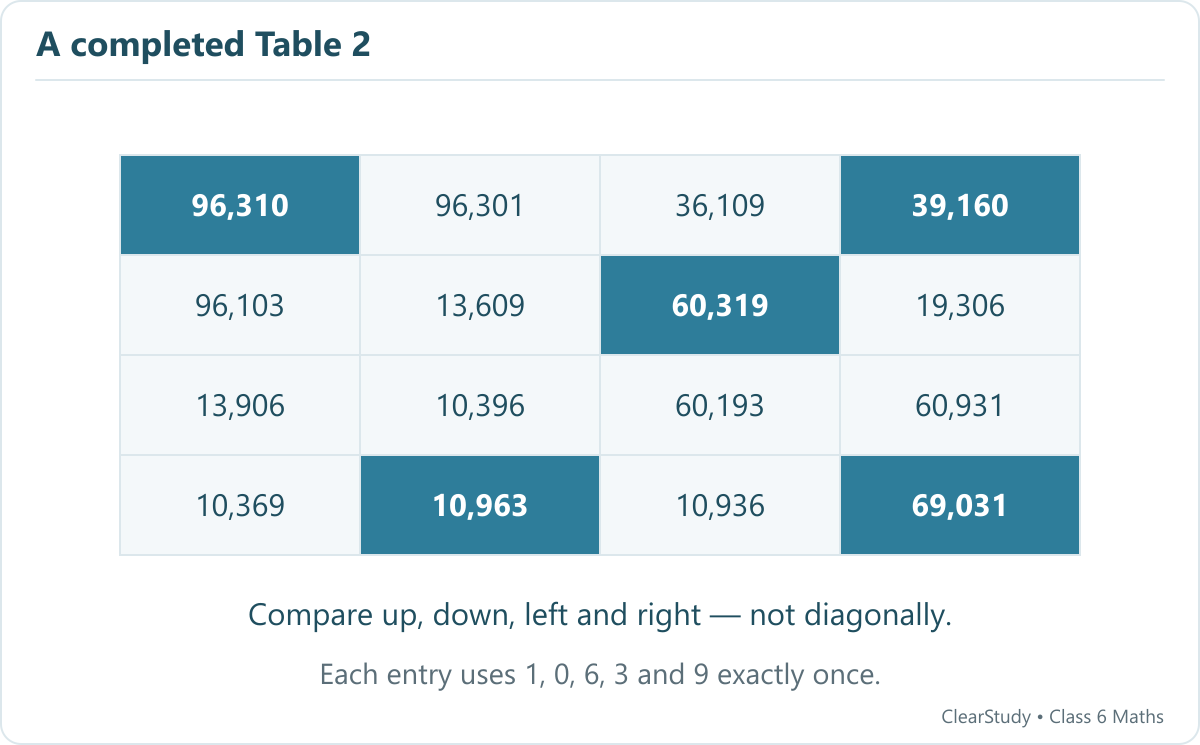
SOLUTIONOne valid filling of the 4 × 4 grid (each number uses the digits 1, 0, 6, 3, 9 once):Row 1: 96,310 96,301 36,109 39,160Row 2: 96,103 13,609 60,319 19,306Row 3: 13,906 10,396 60,193 60,931Row 4: 10,369 10,963 10,936 69,031
This is one valid filling. The answers below refer to this particular completed table.
Q. The biggest number in the table is ____________.
SOLUTIONThe largest 5-digit number formed from 1, 0, 6, 3, 9 is got by writing the digits in descending order: 96,310.
Q. The smallest even number in the table is ____________.
SOLUTIONThe smallest even number (it must end in an even digit such as 0 or 6) in this table is 10,396.
Q. The smallest number greater than 50,000 in the table is ____________.
SOLUTIONAmong the entries in the completed table above, the smallest number exceeding 50,000 is 60,193. This answer refers to this particular filling; it is not the smallest possible arrangement of those digits above 50,000 (which would be 60,139).
Patterns of Numbers on the Number Line (Section 3.3)
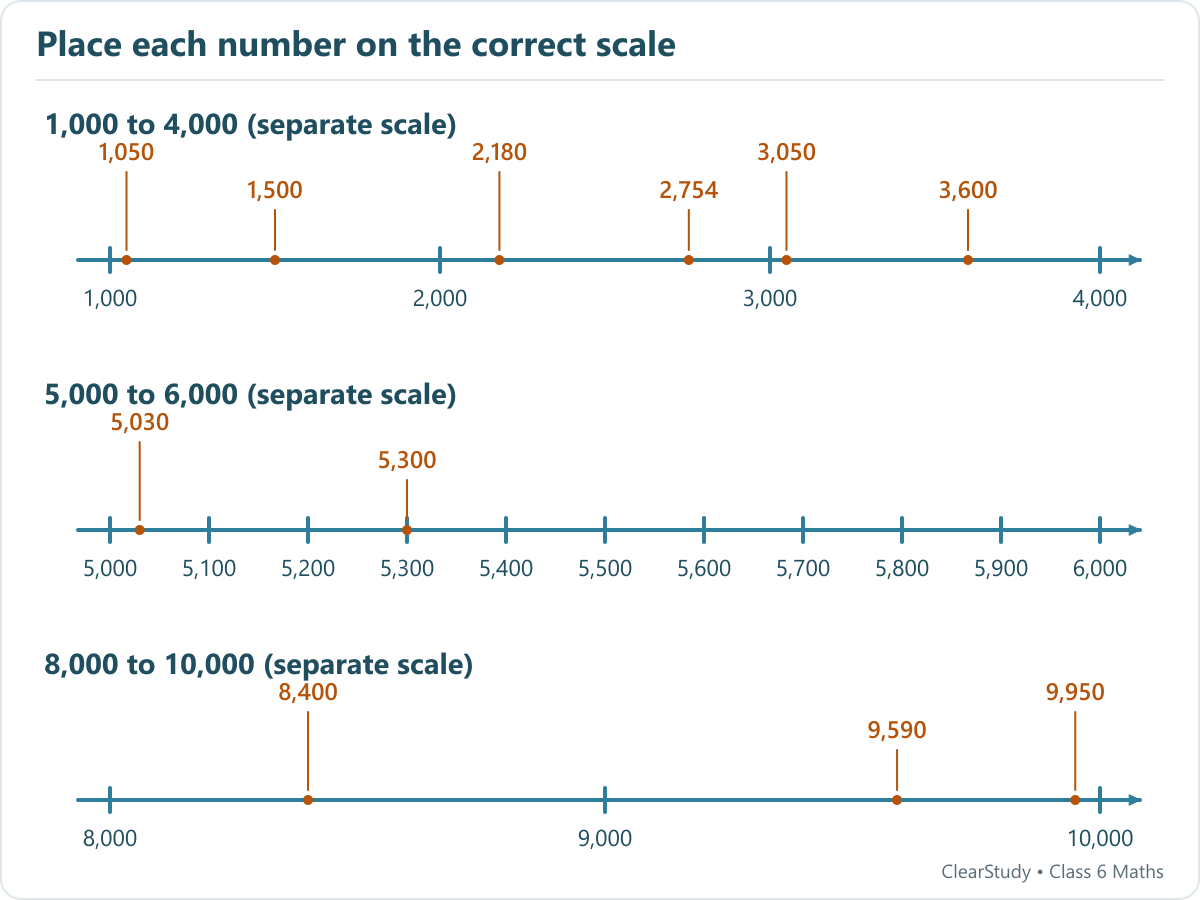
Q. We are quite familiar with number lines now. Let’s see if we can place some numbers in their appropriate positions on the number line. Here are the numbers: 2180, 2754, 1500, 3600, 9950, 9590, 1050, 3050, 5030, 5300 and 8400.
SOLUTIONOrder the numbers and place each between the right pair of thousands marks (1000, 2000, …, 10000):1050 (just after 1000), 1500 (mid 1000–2000), 2180 and 2754 (between 2000–3000), 3050 (just after 3000), 3600 (six-tenths of the way from 3000 to 4000), 5030 and 5300 (just after 5000), 8400 (between 8000–9000), 9590 and 9950 (between 9000–10000).
Each panel has its own labelled scale. For example, 3,600 is six-tenths of the way from 3,000 to 4,000.
Figure it Out (Page 59)
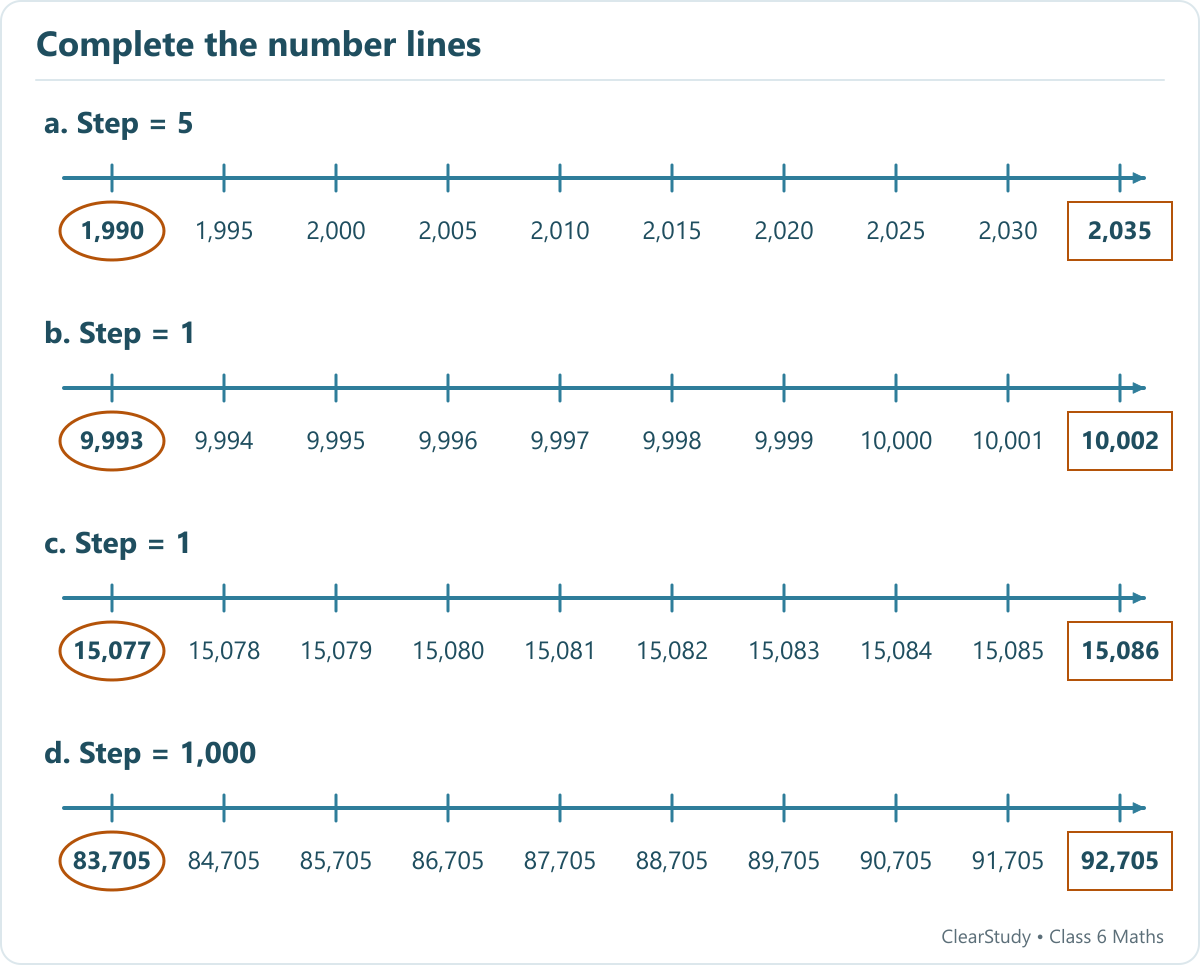
Q. Identify the numbers marked on the number lines below, and label the remaining positions. Put a circle around the smallest number and a box around the largest number in each of the sequences above.
a. (marks shown at 2010 and 2020)
SOLUTIONThe marks 2010 and 2020 are 10 apart and lie 2 steps apart, so each step is 5. Labelling all positions:1990, 1995, 2000, 2005, 2010, 2015, 2020, 2025, 2030, 2035. Smallest = 1990 (circle), largest = 2035 (box).
b. (marks shown at 9996 and 9997)
SOLUTIONConsecutive marks differ by 1, so:9993, 9994, 9995, 9996, 9997, 9998, 9999, 10000, 10001, 10002. Smallest = 9993 (circle), largest = 10002 (box).
SOLUTIONThe marks 86,705 and 87,705 are 1000 apart and 1 step apart, so each step is 1000:83,705, 84,705, 85,705, 86,705, 87,705, 88,705, 89,705, 90,705, 91,705, 92,705. Smallest = 83,705 (circle), largest = 92,705 (box).
Count equal gaps to find the step. The smallest labelled number is circled and the largest is boxed.
Playing with Digits (Section 3.4)
Q. Find out how many numbers have two digits, three digits, four digits, and five digits.
SOLUTION
1-digit
2-digit
3-digit
4-digit
5-digit
9
90
900
9,000
90,000
Counting positive integers, 1–9 gives 9 one-digit numbers (0 is also one digit, but is excluded from this positive-number count); from 10–99 there are 90; from 100–999 there are 900; from 1000–9999 there are 9,000; from 10000–99999 there are 90,000.
Figure it Out (Page 60)
1. Digit sum 14
a. Write other numbers whose digits add up to 14.b. What is the smallest number whose digit sum is 14?c. What is the largest 5-digit number whose digit sum is 14?d. How big a number can you form having the digit sum of 14? Can you make an even bigger number?
SOLUTIONa. Some numbers whose digits add to 14: 248 (2+4+8), 653 (6+5+3), 356, 815, 833, 12335, 23351.b. To make the smallest number with digit sum 14, use as few digits as possible and put the smaller digit first: 59 (5 + 9 = 14).c. For the largest 5-digit number, push the big digits to the front: 95000 (9 + 5 = 14).d. We can make the number as big as we like by adding zeros (which do not change the digit sum): 95, 9005, 900005, 90000005, … Yes, we can always make an even bigger number by inserting more zeros.
2. Find out the digit sums of all the numbers from 40 to 70. Share your observations with the class.
SOLUTIONAdding the digits of each number from 40 to 70:40→4, 41→5, 42→6, 43→7, 44→8, 45→9, 46→10, 47→11, 48→12, 49→13; 50→5, 51→6, 52→7, 53→8, 54→9, 55→10, 56→11, 57→12, 58→13, 59→14; 60→6, 61→7, 62→8, 63→9, 64→10, 65→11, 66→12, 67→13, 68→14, 69→15; 70→7.Observation: within each ten (40s, 50s, 60s) the digit sum increases by 1 as the units digit increases, then drops when the tens digit changes (because the units digit resets to 0).
3. Calculate the digit sums of 3-digit numbers whose digits are consecutive (for example, 345). Do you see a pattern? Will this pattern continue?
SOLUTION123 → 1+2+3 = 6; 234 → 2+3+4 = 9; 345 → 3+4+5 = 12; 456 → 4+5+6 = 15; 567 → 5+6+7 = 18; 678 → 6+7+8 = 21; 789 → 7+8+9 = 24.Yes, there is a pattern — all the digit sums are multiples of 3, and each is 3 more than the one before.No, it cannot continue beyond 789, because there is no 3-digit number with consecutive digits after 789 (the next digit would be 10).
Digit Detectives (Page 61)
Q. Among the numbers 1–100, how many times will the digit ‘7’ occur? Among the numbers 1–1000, how many times will the digit ‘7’ occur?
SOLUTIONFrom 1 to 100, the digit 7 appears in the units place (7, 17, 27, …, 97 = 10 times) and in the tens place (70–79 = 10 times), giving 20 times.From 1 to 1000, by a similar count the digit 7 appears 300 times (100 in each of the units, tens and hundreds places).
Q. Write all possible 3-digit palindromes using these digits (1, 2, 3).
SOLUTIONA 3-digit palindrome has the form aba (first and last digits equal). Using digits 1, 2, 3:111, 121, 131; 212, 222, 232; 313, 323, 333 — nine palindromes in all.
The odd units digit must be 1 because four times it must still be a single digit.
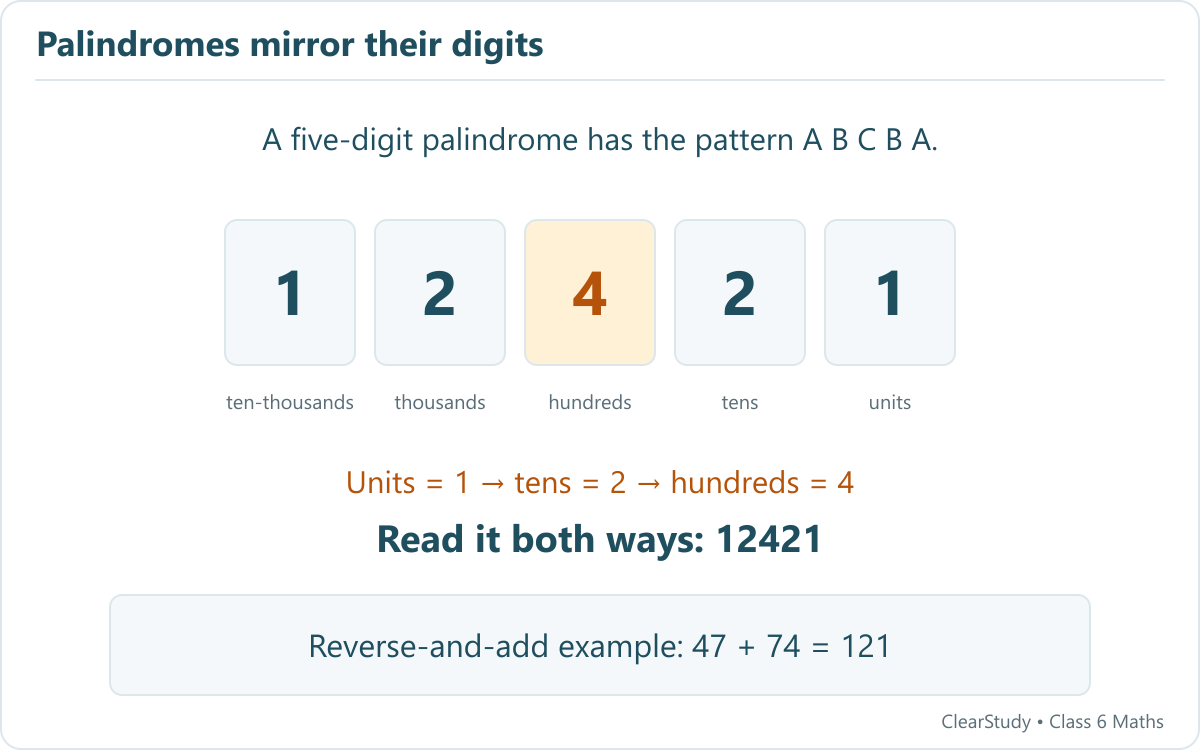
Math Talk (Explore) — Reverse-and-add palindromesWill reversing and adding numbers repeatedly, starting with a 2-digit number, always give a palindrome? Explore and find out.Answer. For 2-digit starting numbers, repeatedly reversing and adding always reaches a palindrome. Examples: 12 + 21 = 33 (a palindrome in one step); 47 + 74 = 121 (a palindrome in one step). (For some 3-digit numbers, e.g. 196, it is suspected no palindrome is ever reached — an unsolved question.)
Puzzle time — The 5-digit palindromeI am a 5-digit palindrome. I am an odd number. My ‘t’ digit is double of my ‘u’ digit. My ‘h’ digit is double of my ‘t’ digit. Who am I? Write the number in words.Answer. Place values are ten-thousands (tth), thousands (th), hundreds (h), tens (t), units (u). For a palindrome tth = u and th = t. The number is odd, so u is odd. Let u = 1, then t = 2u = 2 and h = 2t = 4. So the digits are tth = 1, th = 2, h = 4, t = 2, u = 1, giving 12,421 — “Twelve thousand four hundred twenty-one.”
The Magic Number of Kaprekar (Page 63)
Q. Carry out these same steps with a few 3-digit numbers. What number will start repeating?
SOLUTIONTake a 3-digit number with at least two different digits, say 321. Keep three positions, allowing leading zeros after rearranging. Repeatedly make the largest number minus the smallest number from the digits:321 → 321 − 123 = 198; 981 − 189 = 792; 972 − 279 = 693; 963 − 369 = 594; 954 − 459 = 495; 954 − 459 = 495 …The number 495 starts repeating. Repeated-digit numbers are excluded: for example, 111 − 111 = 000.
Clock and Calendar Numbers & Mental Math (Sections 3.7–3.8)
Q. Try and find out all possible times on a 12-hour clock of each of these types (like 4:44, 10:10, 12:21).
SOLUTIONAll displayed digits identical: 1:11, 2:22, 3:33, 4:44, 5:55 and 11:11, using an hour display without a leading zero.Repeated two-digit blocks (HH:MM): 01:01, 02:02, 03:03, 04:04, 05:05, 06:06, 07:07, 08:08, 09:09, 10:10, 11:11 and 12:12.Palindromes in HH:MM form: 01:10, 02:20, 03:30, 04:40, 05:50, 10:01, 11:11 and 12:21. Ignore the colon when reversing. Whether a leading zero is displayed matters; state the format you use.
Q. Manish has his birthday on 20/12/2012 where the digits ‘2’, ‘0’, ‘1’, ‘2’ repeat in that order. Find some other dates of this form from the past.
SOLUTIONDates where the day/month digits repeat in the year, such as 20/04/2004 and 20/06/2006. (Try to find more for yourself.)
Q. His sister, Meghana, has her birthday on 11/02/2011 which reads the same from left to right and right to left. Find all possible dates of this form from the past.
SOLUTIONWrite a date as DDMMYYYY and reverse its eight digits. It is palindromic only if they stay the same and the date is valid.For the bounded period 2000–2026, the examples are 10/02/2001, 20/02/2002, 01/02/2010, 11/02/2011, 21/02/2012, 02/02/2020, 12/02/2021 and 22/02/2022. For example, 11022011 reads the same both ways.To search any earlier range, reverse each four-digit year to obtain DDMM, then check the day and month. These eight dates are not a list of every historical palindromic date.
Try This — Reusing a calendarWill any year’s calendar repeat again after some years? Will all dates and days in a year match exactly with that of another year?Answer.Yes. Two years match exactly when 1 January has the same weekday and both years have the same leap-year status. An ordinary year moves the next 1 January forward by one weekday; a leap year moves it by two. For example, 2025 and 2031 are common years starting on Wednesday; 2024 and 2052 are leap years starting on Monday. There is no single 5-year or 6-year rule that works for every year.
Figure it Out (Page 64)
1. Pratibha uses the digits ‘4’, ‘7’, ‘3’ and ‘2’, and makes the smallest and largest 4-digit numbers with them: 2347 and 7432. The difference is 7432 − 2347 = 5085. The sum is 9779. Choose 4 digits to make:
a. the difference between the largest and smallest numbers greater than 5085.b. the difference between the largest and smallest numbers less than 5085.c. the sum of the largest and smallest numbers greater than 9779.d. the sum of the largest and smallest numbers less than 9779.
3. The time now is 10:01. How many minutes until the clock shows the next palindromic time? What about the one after that?
SOLUTIONAfter 10:01 the next palindromic time is 11:11, which is 1 hour 10 minutes = 70 minutes later.The one after that is 12:21, which is 2 hours 20 minutes = 140 minutes after 10:01.
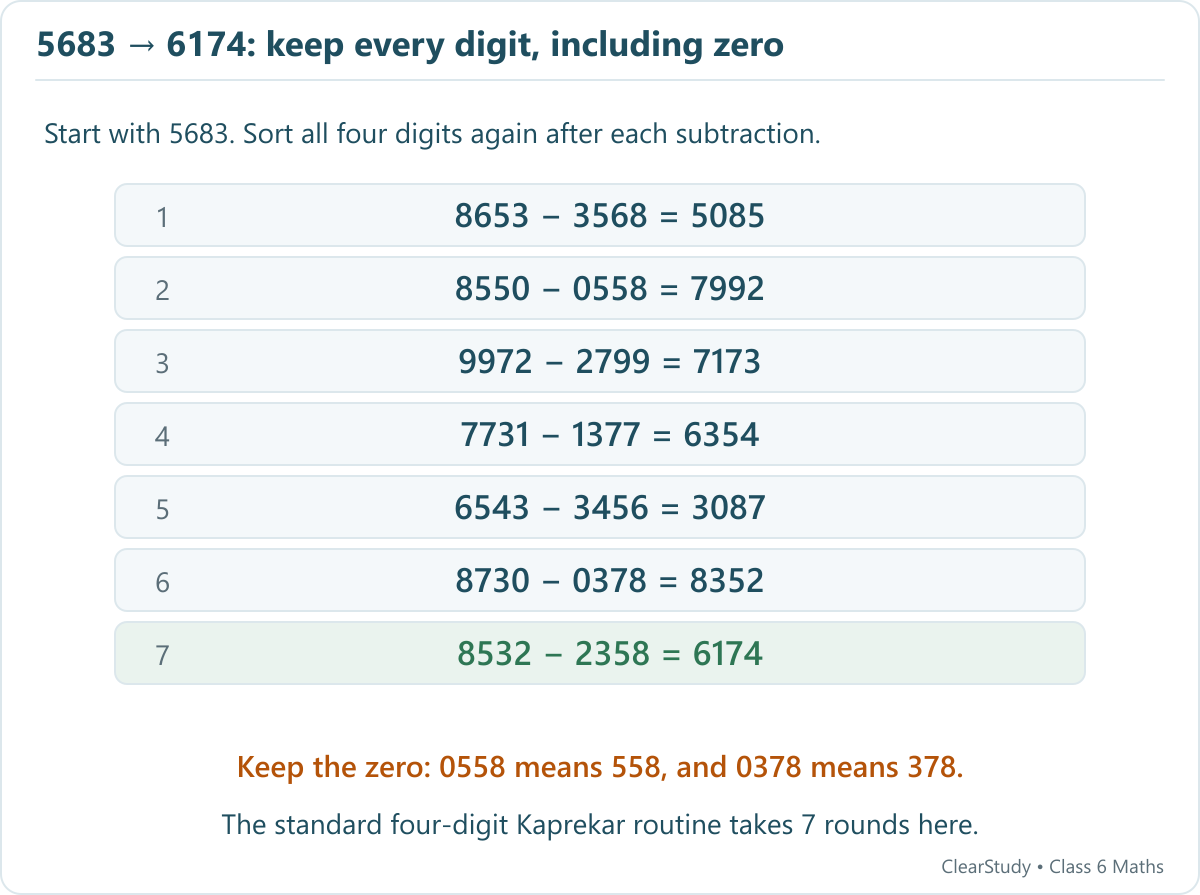
4. How many rounds does the number 5683 take to reach the Kaprekar constant?
SOLUTIONKeep four positions, including leading zeros in the ascending arrangement. The seven rounds are:1. 8653 − 3568 = 5085 2. 8550 − 0558 = 7992 3. 9972 − 2799 = 7173 4. 7731 − 1377 = 6354 5. 6543 − 3456 = 3087 6. 8730 − 0378 = 8352 7. 8532 − 2358 = 6174.Therefore 5683 takes 7 rounds. At 6174, 7641 − 1467 = 6174, so it repeats.
Write four digit positions at every step. Replacing 0558 by 5058 changes the procedure and gives the wrong standard round count.
Mental Math (Page 66)
Q. Can we make 1,000 using the numbers in the middle? Why not? What about 14,000, 15,000 and 16,000? Yes, it is possible. Explore how. What thousands cannot be made?
SOLUTIONNo, we cannot make 1,000. The only middle number smaller than 1000 is 400, and 1000 is not a multiple of 400.14,000 = 1500 × 8 + 400 × 5 = 12,000 + 2,000 = 14,000.15,000 = 13,000 + 400 × 5 = 13,000 + 2,000 = 15,000.16,000 = 1500 × 8 + 400 × 10 = 12,000 + 4,000 = 16,000.Only 1,000 cannot be made among the positive multiples of 1000. We can make 2000 = 5 × 400 and 3000 = 2 × 1500. Every even number of thousands is a multiple of 2000; every odd number of thousands from 3000 onward is 3000 plus a multiple of 2000.
Figure it Out (Page 66)
1. Write an example for each of the below scenarios whenever possible. Could you find examples for all the cases? If not, think and discuss what could be the reason.
SOLUTION5-digit + 5-digit > 90,250: 45,000 + 45,400 = 90,400 (> 90,250). ✓5-digit + 3-digit = 6-digit sum: 99,999 + 999 = 1,00,998. ✓4-digit + 4-digit = 6-digit sum: Not possible, because even 9999 + 9999 = 19,998 is only a 5-digit number.5-digit + 5-digit = 6-digit sum: 60,000 + 40,000 = 1,00,000. ✓5-digit + 5-digit = 18,500: Not possible — the smallest 5-digit number is 10,000, and 10,000 + 10,000 = 20,000 already exceeds 18,500.5-digit − 5-digit < 56,503: 80,000 − 50,000 = 30,000 (< 56,503). ✓5-digit − 3-digit = 4-digit difference: 10,000 − 999 = 9001. ✓5-digit − 4-digit = 4-digit difference: 12,000 − 2,500 = 9,500. ✓5-digit − 5-digit = 3-digit difference: 50,999 − 50,000 = 999. ✓5-digit − 5-digit = 91,500: Not possible — the greatest difference between two 5-digit numbers is 99,999 − 10,000 = 89,999, which is less than 91,500.
2. Always, Sometimes, Never?
a. 5-digit number + 5-digit number gives a 5-digit numberb. 4-digit number + 2-digit number gives a 4-digit numberc. 4-digit number + 2-digit number gives a 6-digit numberd. 5-digit number − 5-digit number gives a 5-digit numbere. 5-digit number − 2-digit number gives a 3-digit number
SOLUTIONa. Only sometimes true. 20,000 + 80,000 = 1,00,000 is a 6-digit number, not 5-digit.b. Only sometimes true. 9,999 + 99 = 10,098 is a 5-digit number, not 4-digit.c. Never true. The largest 4-digit + largest 2-digit = 9,999 + 99 = 10,098, only a 5-digit number, so a 6-digit sum is impossible.d. Only sometimes true. 12,000 − 10,000 = 2,000 is a 4-digit number, not 5-digit.e. Never true. Even the smallest 5-digit number minus the largest 2-digit number, 10,000 − 99 = 9,901, is a 4-digit number, never just 3 digits.
Number Patterns (Section 3.9)
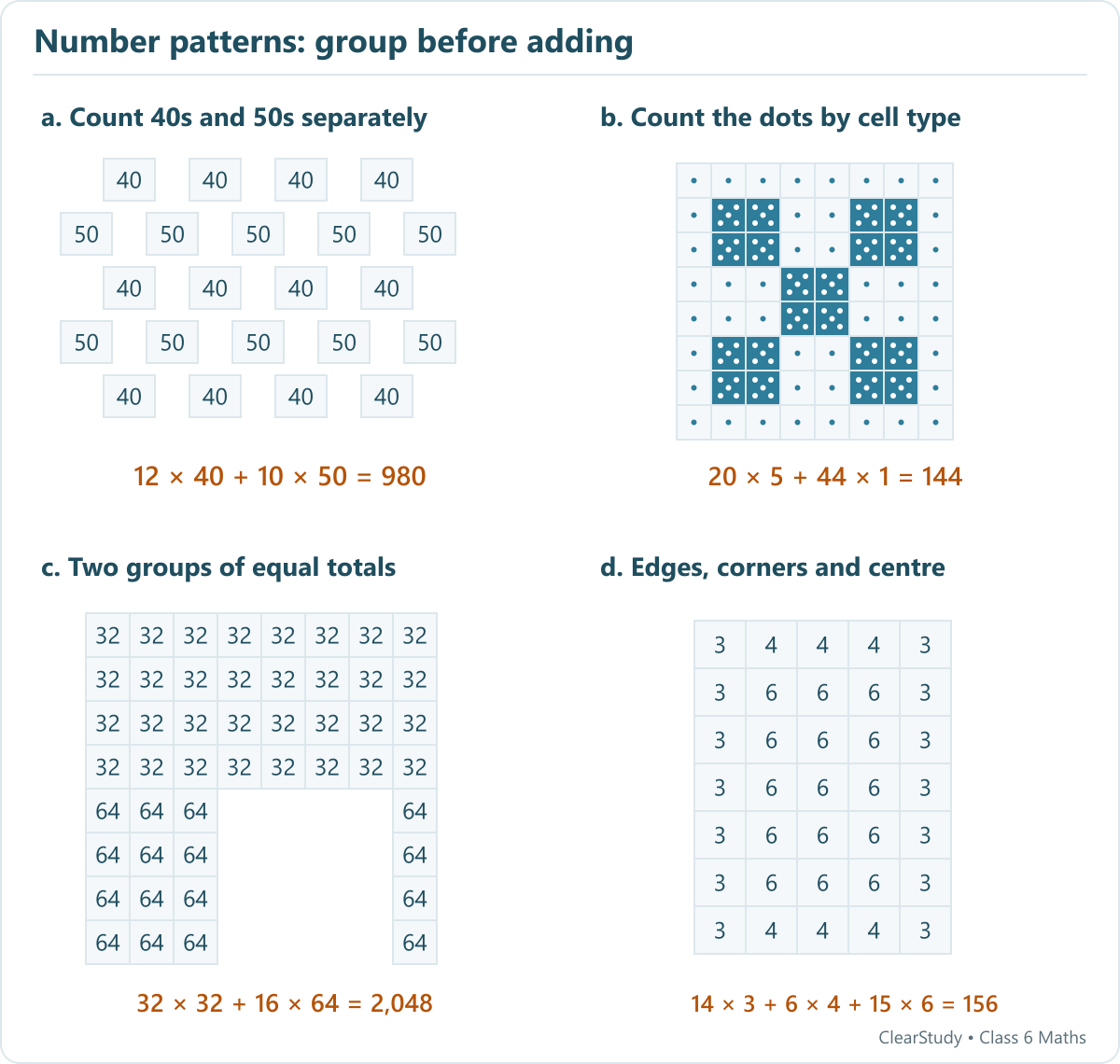
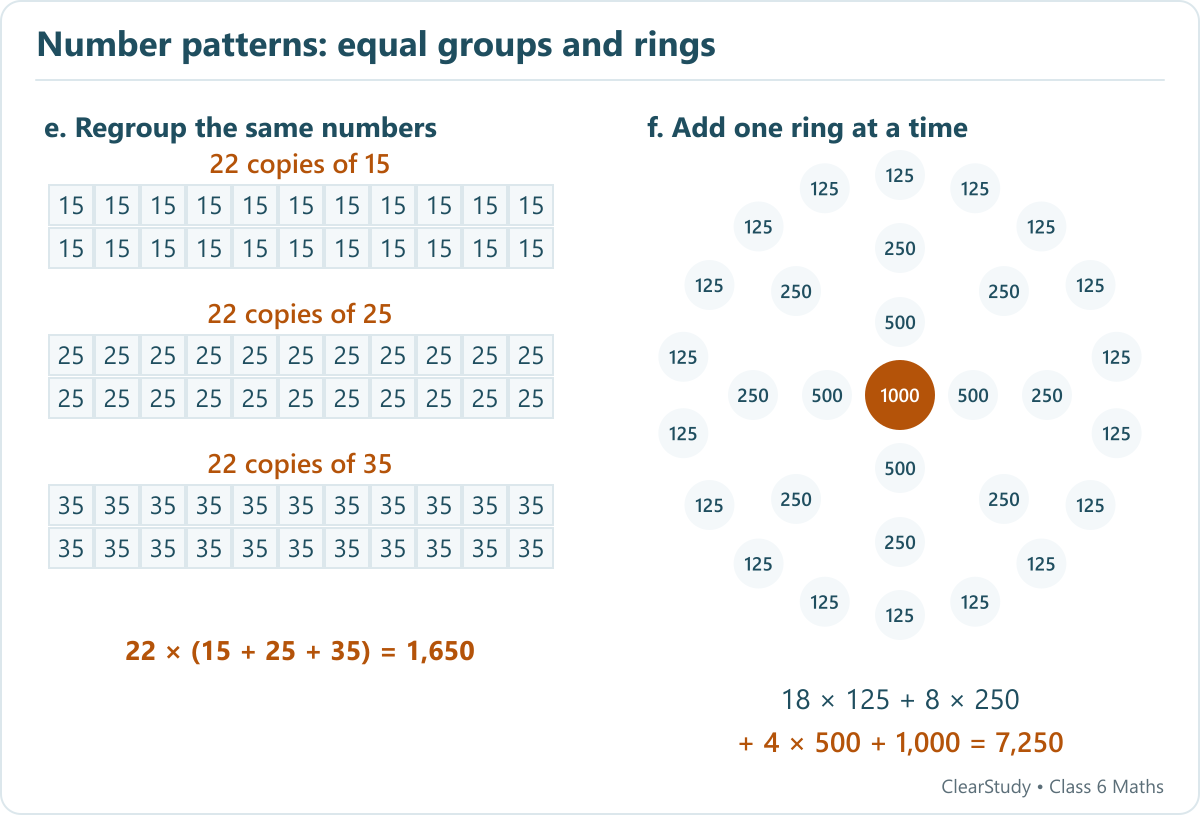
Count equal groups before adding. The diagrams below show how to organise the textbook patterns on pages 67–68; the final two regroup the same numbers to make their totals easy to check.
SOLUTION(a) 12 × 40 + 10 × 50 = 480 + 500 = 980.(b) The 8 × 8 pattern has 20 five-dot cells and 44 one-dot cells: 20 × 5 + 44 = 144 dots.(c) 32 × 32 + 16 × 64 = 1024 + 1024 = 2048.(d) There are fourteen 3s, six 4s and fifteen 6s: 14 × 3 + 6 × 4 + 15 × 6 = 156.
The totals are 980, 144, 2,048 and 156. In (d), numerals stand for the dots in each textbook cell.
SOLUTION(e) There are 22 of each of 15, 25 and 35. Group one of each: 22 × (15 + 25 + 35) = 22 × 75 = 1650.(f) There are eighteen 125s, eight 250s, four 500s and one 1000: 18 × 125 + 8 × 250 + 4 × 500 + 1000 = 2250 + 2000 + 2000 + 1000 = 7250.
The left-hand arrangement regroups the values from the textbook’s hexagon. The ring diagram makes repeated values easy to count.
Collatz, Estimation & Games (Sections 3.10–3.12)
Section 3.10 — Make your own Collatz sequencesMake some more Collatz sequences like those above, starting with your favourite positive integers. Do you always reach 1? Do you believe the conjecture of Collatz that all such sequences will eventually reach 1? Why or why not?Answer. Start with positive integers. For example, 28 → 14 → 7 → 22 → 11 → 34 → 17 → 52 → 26 → 13 → 40 → 20 → 10 → 5 → 16 → 8 → 4 → 2 → 1. Starting with 19 gives 19 → 58 → 29 → 88 → 44 → 22 and then the same path from 22. Both examples reach 1, but this does not prove the claim for every positive integer. Odd steps can increase a number (3 → 10), so halving even terms does not by itself prove eventual descent. The general Collatz conjecture remains unproved.
Some steps increase the number: 3 becomes 10. Eventual decrease for every positive starting number has not been proved.
Simple Estimation (Section 3.11)
3. Name some objects around you that are:
a. a few thousand in numberb. more than ten thousand in number
SOLUTIONa. A few thousand: books in a large school library, or seats in a small sports stadium.b. More than ten thousand: grains of rice in a large bag, or leaves on several large trees.These are estimates of counts. A PIN or registration number is an identifier, not a count of objects. Actual counts depend on the example you choose.
3. Roshan wants to buy milk and 3 types of fruit to make fruit custard for 5 people. He estimates the cost to be ₹100. Do you agree with him? Why or why not?
SOLUTIONIt depends on the quantities and local prices. List the amount of milk and each fruit needed, estimate each cost and add them.For a classroom example, assume the four costs are ₹30, ₹20, ₹25 and ₹15. Their total is ₹90, which fits ₹100. If the same quantities cost ₹40, ₹30, ₹25 and ₹20, the total is ₹115, which exceeds it. These are illustrative assumptions, not current market prices.
4. Estimate the distance between Gandhinagar (in Gujarat) to Kohima (in Nagaland). Hint: Look at the map of India to locate these cities.
SOLUTIONLocate both cities on a map and use its scale. A rough map estimate is about 2,500 km. For example, if 1 cm represents 500 km and the separation is approximately 5 cm, estimate 5 × 500 = 2500 km.This is an approximate straight-line map distance, not a measured road journey. Different map measurements give somewhat different estimates; a road route can be longer.
5. Sheetal is in Grade 6 and says she has spent around 13,000 hours in school till date. Do you agree with her? Why or why not?
SOLUTIONState assumptions before deciding. Assuming 6 hours per day, 200 school days per year and 8 years (including two pre-primary years), the estimate is 6 × 200 × 8 = 9600 hours.Under these assumptions, 13,000 hours is high. A different number of school days, longer school days or more pre-primary years changes the estimate, so we cannot reject her claim without knowing her schooling pattern.
7. Make some estimation questions and challenge your classmates!
SOLUTIONSome examples: “How many students are there in your school?” and “On average, how many hours does a person sleep in a lifetime?” (Many more such questions can be framed.)
Figure it Out (Page 72)
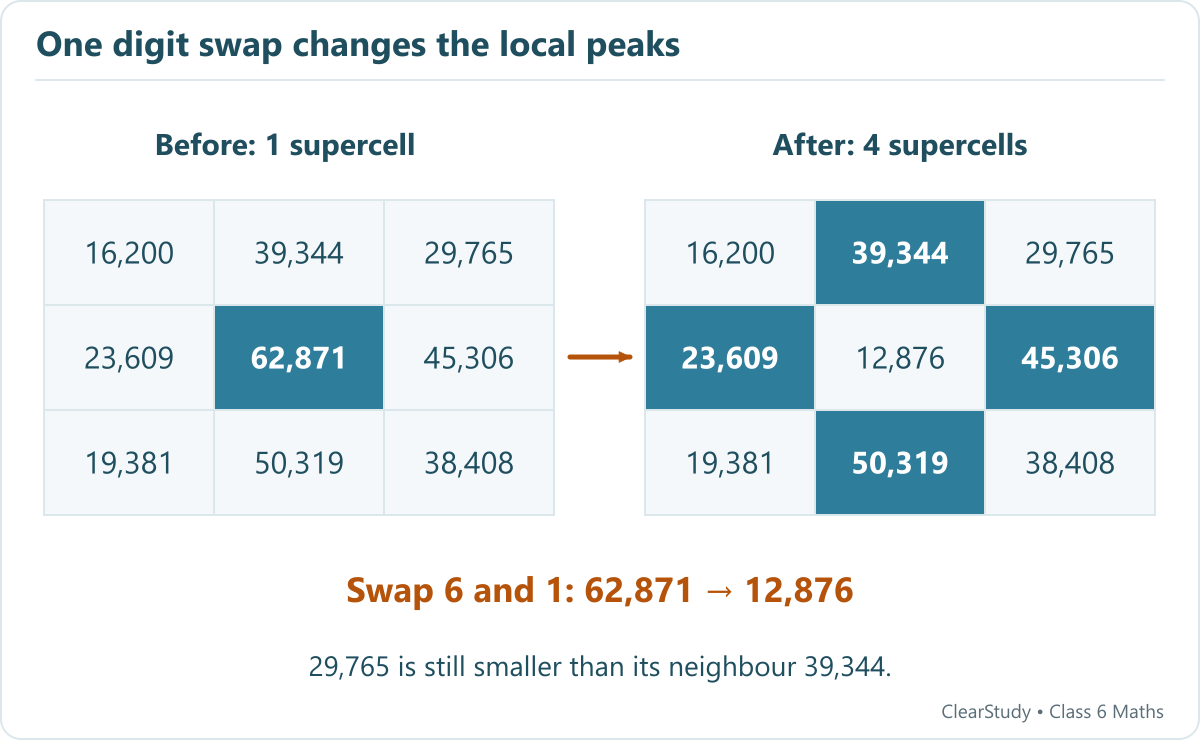
1. There is only one supercell (number greater than all its neighbours) in this grid. If you exchange two digits of one of the numbers, there will be 4 supercells. Figure out which digits to swap.
16,200 39,344 29,765 / 23,609 62,871 45,306 / 19,381 50,319 38,408
SOLUTIONSwap the digits 6 and 1 in 62,871 to make 12,876. Compare only neighbours above, below, left and right.The four supercells are 39,344, 23,609, 45,306 and 50,319. Each now exceeds every adjacent number. In particular, 29,765 is not a supercell because 39,344 is its larger left neighbour.
The new supercells form a cross around the centre. Diagonal cells are not neighbours.
2. How many rounds does your year of birth take to reach the Kaprekar constant?
SOLUTIONExample: keep all four positions for the year 1980.1. 9810 − 0189 = 9621 2. 9621 − 1269 = 8352 3. 8532 − 2358 = 6174.Thus 1980 takes 3 rounds. Apply the same ascending/descending digit rule to your own birth year.
3. We are the group of 5-digit numbers between 35,000 and 75,000 such that all of our digits are odd. Who is the largest number in our group? Who is the smallest number in our group? Who among us is the closest to 50,000?
SOLUTIONDigits may repeat, but each digit must belong to 1, 3, 5, 7, 9.Largest: 73,999. Starting with 75 would exceed the upper limit once the remaining odd digits are included.Smallest: 35,111, using the smallest possible odd digits after 35.Closest to 50,000: 51,111, at a distance of 1111. The largest eligible number below 50,000 is 39,999, at a distance of 10,001, so 51,111 is closer.
6. Write one 5-digit number and two 3-digit numbers such that their sum is 18,670.
SOLUTIONChoose a 5-digit number and two 3-digit numbers that add to 18,670: 18,000 + 300 + 370 = 18,670. (Many other combinations work.)
7. Choose a number between 210 and 390. Create a number pattern similar to those shown in Section 3.9 that will sum up to this number.
SOLUTIONNumber chosen: 250. One pattern: a row of 50, 50, 50 with a row of 25, 25 above and below it — 50 × 3 + 25 × 4 = 150 + 100 = 250. Another: a 5 × 5 grid of 10s gives 25 × 10 = 250.
8. Recall the sequence of Powers of 2 from Chapter 1, Table 1. Why is the Collatz conjecture correct for all the starting numbers in this sequence?
SOLUTIONA power of 2 such as 28 = 2×2×2×2×2×2×2×2 is even, so it is halved to 27, then 26, and so on.Each halving removes one factor of 2, so we keep getting smaller powers of 2 until we reach 2, and 2 ÷ 2 = 1. Hence every power of 2 reaches 1 directly.
9. Check if the Collatz Conjecture holds for the starting number 100.
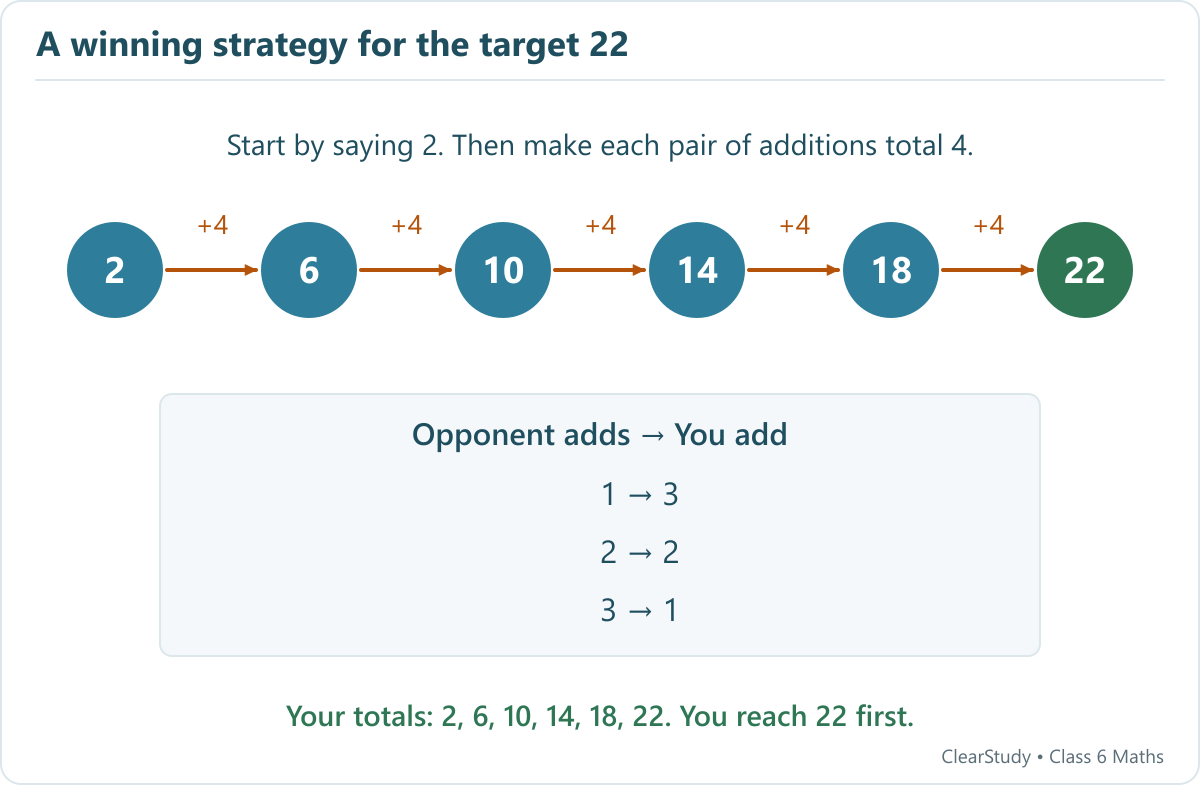
10. Starting with 0, players alternate adding numbers between 1 and 3. The first person to reach 22 wins. What is the winning strategy now?
SOLUTIONThe winning strategy is to be the first player and aim for the “safe” totals 2, 6, 10, 14, 18 (and finally 22), keeping a gap of 4 each time. The first player says 2, then after the opponent adds 1–3, brings the total back to the next safe number, and so reaches 22 first.
After your first move, reply with 4 minus your opponent’s addition. This preserves the winning totals.
Common Mistakes to Avoid
Watch out for these
Calling an end cell a supercell only by looking at one side — an end cell has only one neighbour, so compare with that one cell.
Forgetting that an end child in the taller-neighbour game can never say ‘2’ (it has only one neighbour).
In the Kaprekar process, not rearranging the digits each round — always remake the largest and smallest numbers from the new digits.
Counting the gap between number-line marks wrongly — find the step by dividing the difference of two marks by the number of steps between them.
Thinking 4-digit + 4-digit can give a 6-digit sum — the maximum is 9999 + 9999 = 19,998, only 5 digits.
Mixing up the Kaprekar constants: 6174 for 4-digit numbers and 495 for 3-digit numbers.
Practice MCQs & Assertion–Reason
1. A cell is a supercell when its number is:
(a) smaller than all neighbours (b) greater than all neighbours (c) equal to a neighbour (d) at an end
2. The Kaprekar constant for 4-digit numbers is:
(a) 495 (b) 1729 (c) 6174 (d) 9999
3. How many 3-digit numbers are there in all?
(a) 99 (b) 900 (c) 999 (d) 90
4. The smallest number whose digit sum is 14 is:
(a) 95 (b) 59 (c) 77 (d) 149
5. Which of these is a palindrome?
(a) 1231 (b) 848 (c) 1230 (d) 357
6. In the Collatz rule, an even number is:
(a) multiplied by 3 (b) halved (c) increased by 1 (d) squared
7. From 1 to 100, the digit 7 occurs:
(a) 10 times (b) 11 times (c) 19 times (d) 20 times
8. The maximum number of supercells in a row of 9 cells is:
(a) 4 (b) 5 (c) 6 (d) 9
9. The difference between the largest and smallest 5-digit palindrome is:
(a) 1,10,000 (b) 89,998 (c) 90,000 (d) 99,999
10. Two years have exactly the same calendar when they have:
(a) the same last digit (b) leap-year status only (c) the same weekday on 1 January and the same leap-year status (d) 31 days in January
For each Assertion–Reason question, choose: (A) Both Assertion and Reason are true and the Reason is the correct explanation of the Assertion; (B) Both are true but the Reason is not the correct explanation; (C) Assertion is true but Reason is false; (D) Assertion is false but Reason is true.
A-R 1. Assertion: In a table of distinct numbers, the largest number is always a supercell.
Reason: The largest number is greater than every other number, so it is greater than all its neighbours.
A-R 2. Assertion: A child standing at the end of the line can say ‘2’.
Reason: A child at the end of the line has only one neighbour.
A-R 3. Assertion: The number 5683 reaches the Kaprekar constant in 7 rounds.
Reason: The Kaprekar constant for 4-digit numbers is 6174.
A-R 4. Assertion: There are 900 three-digit numbers.
Reason: The three-digit numbers run from 100 to 999.
A-R 5. Assertion: A 4-digit number added to a 4-digit number can give a 6-digit sum.
Reason: The greatest 4-digit sum is 9999 + 9999 = 19,998, which has only 5 digits.
Answer key: 1-(A), 2-(D), 3-(B), 4-(A), 5-(D).
Quick Revision Summary
Numbers convey information, reveal patterns, and power puzzles and games.
A supercell is greater than all its neighbours; in a table of distinct numbers with at least two cells, the largest is always a supercell and the smallest never is. A row of c cells has at most c÷2 (or (c+1)÷2) supercells.
Among positive integers, there are 9 one-digit, 90 two-digit, 900 three-digit, 9000 four-digit and 90000 five-digit numbers.
Palindromes read the same both ways; the smallest/largest 5-digit palindromes are 10001 and 99999.
The Kaprekar constant is 6174 for 4-digit numbers and 495 for 3-digit numbers.
The Collatz conjecture says every positive-integer starting value eventually reaches 1; it remains unproved.
Estimation gives a sensible approximate value when exact counts are not needed.
How to score full marks in this chapter
Show your reasoning, not just the answer — for supercell and number-line questions explain which neighbours you compared and how you found the step size. For Kaprekar and Collatz questions, write each round of working in order so every step earns its mark, and remember the two Kaprekar constants (6174 and 495). For estimation questions, state the rough figures you assumed (like 6 school hours a day, 200 days a year) before you calculate.
Frequently Asked Questions
What is Class 6 Maths Ganita Prakash Chapter 3 about?
Chapter 3, Number Play, shows how numbers convey information, reveal patterns and power puzzles and games. It covers supercells, placing numbers on the number line, counting n-digit numbers, digit sums, palindromes, the Kaprekar constant 6174, the Collatz conjecture, simple estimation and winning game strategies.
What is the Kaprekar constant?
The four-digit Kaprekar constant is 6174. Use at least two different digits, keep four positions including leading zeros, subtract the ascending arrangement from the descending arrangement, and repeat. The analogous three-digit process reaches 495 when the starting digits are not all equal.
What is a supercell in this chapter?
A supercell is strictly greater than every adjacent cell: left and right in a row; left, right, above and below in a grid. With distinct entries, the largest entry is a supercell. Equal neighbouring largest entries need not be supercells.
Are these Class 6 Maths Ganita Prakash Chapter 3 solutions free?
Yes. These free solutions explain the NCERT Ganita Prakash exercises with worked examples and original diagrams. Open-ended activities can have more than one valid answer.