Class 6 Maths Chapter 2 Solutions – Lines and Angles
These Class 6 Maths Ganita Prakash Chapter 2 solutions cover Lines and Angles from the new NCF-2023 textbook (Reprint 2026–27). The Figure it Out solutions and guided activities explain points, line segments, rays, angles, comparing angles, special angles and measuring angles with a protractor — so you can master the chapter and revise it quickly.
Class: 6Subject: MathematicsBook: Ganita PrakashChapter: 2Exercises: Figure it Out (p. 15–19, 21–23, 29–31, 35, 40–42, 45, 49, 52–53)Session: 2026–27
Chapter 2 of Ganita Prakash, Lines and Angles, introduces the building blocks of plane geometry. It starts with a point (a precise location with no size), then a line segment (the shortest path between two points), a line (a segment extended endlessly in both directions) and a ray (which starts at one point and goes on forever in one direction). It then builds the idea of an angle as the amount of rotation between two rays sharing a common vertex, shows how to compare angles by superimposition and using a circle, names the special angles (straight, right, acute, obtuse, reflex), and explains how to measure and draw angles in degrees using a protractor. The Class 6 Maths Ganita Prakash Chapter 2 solutions below combine worked answers, labelled diagrams and guidance for practical activities.
Key Concepts & Definitions
Point: a precise location with no length, breadth or height. It is denoted by a capital letter, e.g. point Z.
Line segment: the shortest path between two end points A and B; written as AB or BA.
Line: a line segment extended endlessly in both directions; written as AB (with arrows) or a small letter like l or m. Any two points determine exactly one line.
Ray: a portion of a line that starts at one point (the starting/initial point) and goes on endlessly in one direction; the ray from A through P is written AP.
Angle: formed by two rays with a common starting point. The common point is the vertex; the two rays are the arms. ∠DBE has vertex B (the middle letter).
Size of an angle: the amount of rotation or turn about the vertex needed to move the first arm onto the second. It does not depend on the length of the arms.
Angle bisector: a ray from the vertex that divides an angle into two equal angles (it bisects the angle).
Degree: a full turn is divided into 360 equal parts; each part is 1 degree (1°). The measure of an angle is the number of 1° parts inside it, read with a protractor.
Important Facts & Angle Types (Chapter 2)
Full turn = 360° • Straight angle = 180° (half turn) • Right angle = 90° (quarter turn).
Acute angle: more than 0° and less than 90° (less than a right angle).
Obtuse angle: more than 90° and less than 180° (more than a right angle, less than a straight angle).
Reflex angle: more than 180° and less than 360° (more than a straight angle, less than a full turn).
Naming an angle: the vertex is always the middle letter, e.g. ∠DBE = ∠EBD.
Two angles round a straight line: a ray drawn from a point on a straight line splits the straight angle into two angles that add to 180°.
Clock fact: the 12 numbers split a full turn equally, so adjacent numbers are 360° ÷ 12 = 30° apart.
Figure it Out — Points, Lines and Rays (Page 15–17)
1. Rihan marked a point on a piece of paper. How many lines can he draw that pass through the point? Sheetal marked two points on a piece of paper. How many different lines can she draw that pass through both of the points? Can you help Rihan and Sheetal find their answers?
SOLUTIONThrough a single point you can draw a line in any direction, so Rihan can draw countless (infinitely many) lines through his one point.Through two fixed points only one straight path is possible, so Sheetal can draw exactly one line through both points.
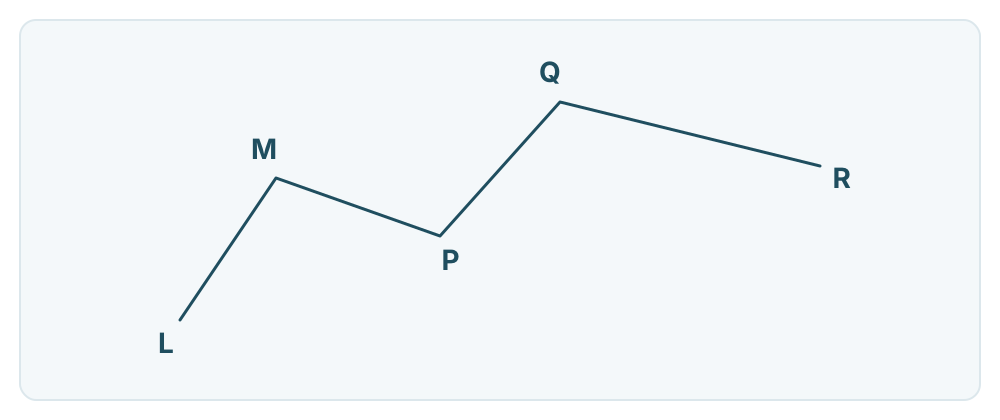
2. Name the line segments in Fig. 2.4. Which of the five marked points are on exactly one of the line segments? Which are on two of the line segments?
Fig. 2.4
SOLUTIONThe line segments are LM, MP, PQ and QR.Points L and R are end points and lie on exactly one line segment each.Points M, P and Q are shared corners and lie on two line segments each.
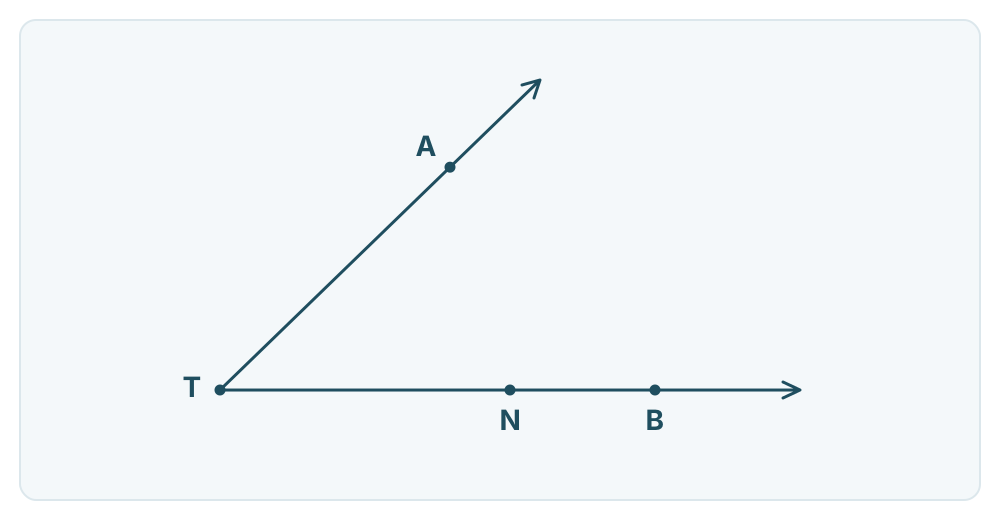
3. Name the rays shown in Fig. 2.5. Is T the starting point of each of these rays?
Fig. 2.5
SOLUTIONFour ray names are TA, TB, TN and NB. Notice that TB and TN name the same ray because N and B lie in the same direction from T.No. T is the starting point of TA, TB and TN, but the ray NB starts at N, not at T.
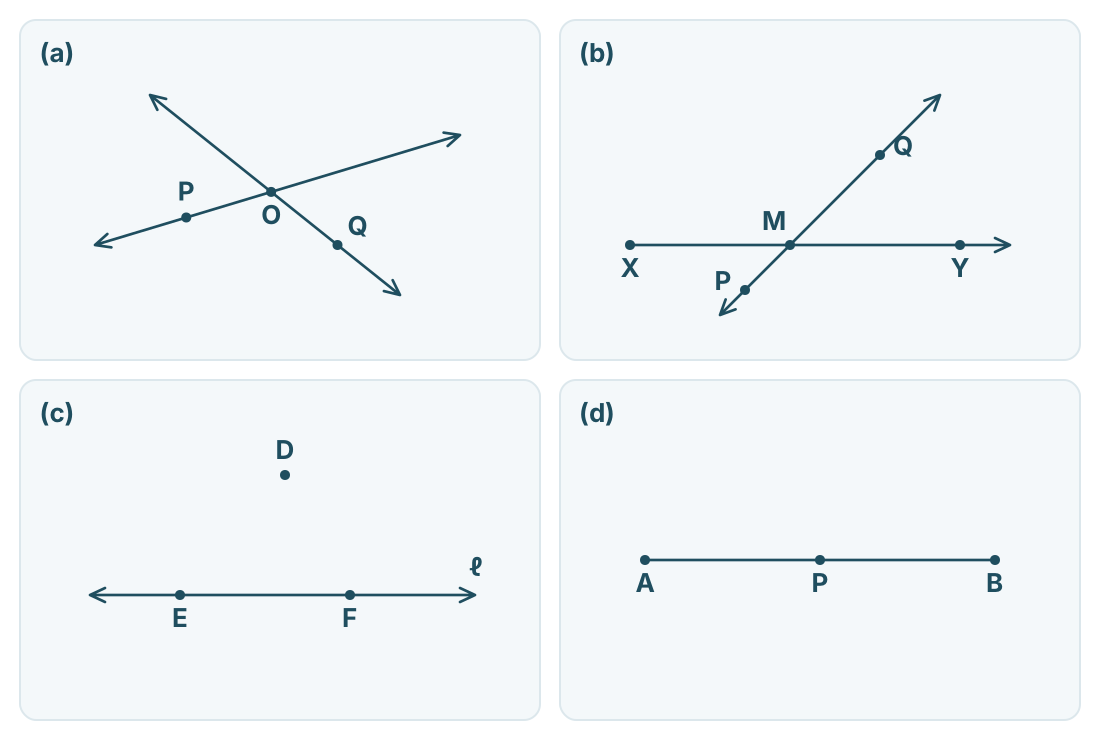
4. Draw a rough figure and write labels appropriately to illustrate each of the following:
a. Lines OP and OQ meet at O.b. Ray XY and line PQ intersect at point M.c. Line l contains points E and F but not point D.d. Point P lies on AB.
SOLUTIONa. Draw two lines, OP and OQ, crossing at O. Put arrowheads at both ends of each line; O is their intersection, not an endpoint.b. Draw the ray XY, starting at X and continuing through Y, and the line PQ, extending both ways. Let them cross at M.c. Draw a straight line, label it l, mark two points E and F on it, and mark a separate point D away from the line so that D is not on l.d. Draw a line segment AB and mark a point P somewhere on it, so P lies on AB.
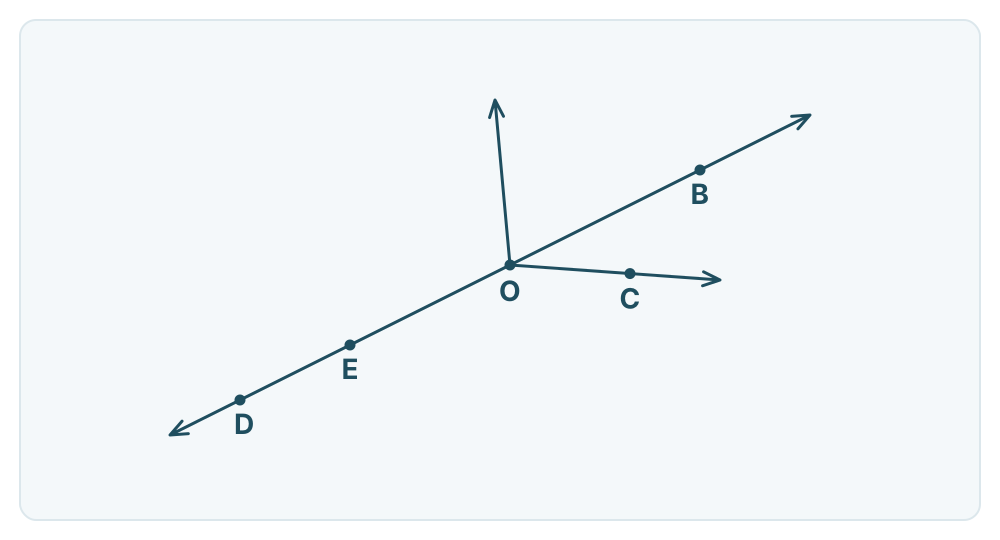
5. In Fig. 2.6, name:
a. Five points b. A line c. Four rays d. Five line segments
Fig. 2.6
SOLUTIONa. Five points: D, E, O, B and C.b. A line: DE (the line through D, E, O, B may also be named DO, DB, EO, EB or OB).c. Four distinct examples are OC, OB, DE and ED. The textbook answer also lists OC, OB, OE and OD; in that list, OE and OD are two names for the same leftward ray from O.d. Five line segments: DE, DO, DB, EO and EB (OB and OC are also acceptable).
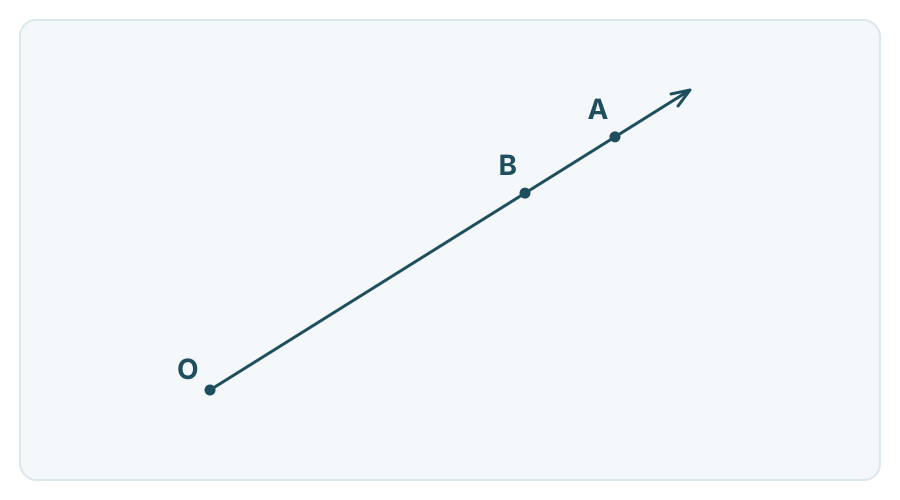
6. Here is a ray OA (Fig. 2.7). It starts at O and passes through the point A. It also passes through the point B.
a. Can you also name it as OB? Why?b. Can we write OA as AO? Why or why not?
Fig. 2.7
SOLUTIONa. Yes. The ray starts at O and goes endlessly through B and then A, so B also lies on it. The same ray can be named OB because it has the same starting point O and B is a point on its path.b. No. The ray OA starts at O and travels towards A, while AO would mean a ray starting at A and travelling towards O. They start at different points and point in opposite directions, so OA and AO are not the same ray.
Figure it Out — Angles (Page 19–21)
1. Can you find the angles in the given pictures? Draw the rays forming any one of the angles and name the vertex of the angle.
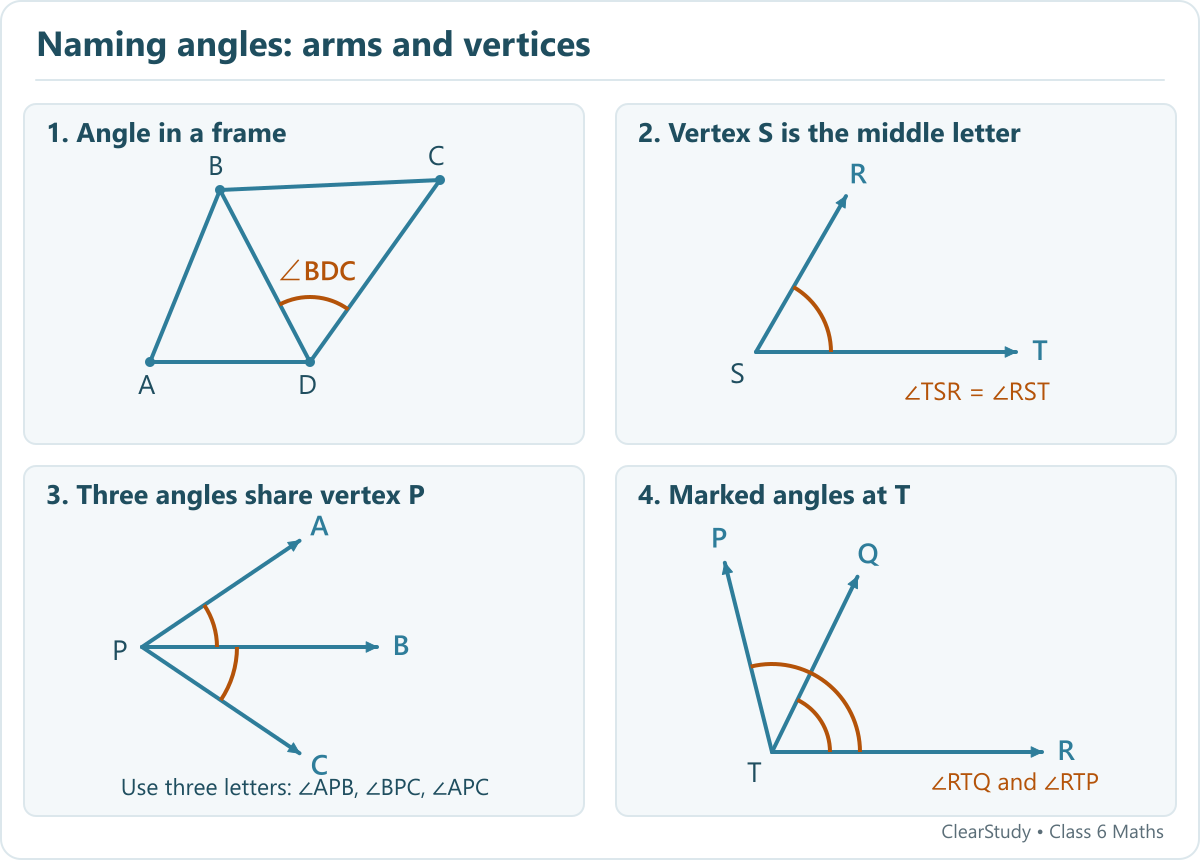
SOLUTIONYes. Wherever two edges meet at a corner, an angle is formed. For the figure shown, one angle is ∠BDC: its vertex is D, and its two arms are the rays DB and DC. Try identifying the corner angles in the other pictures the same way.
2. Draw and label an angle with arms ST and SR.
SOLUTIONMark a point S as the vertex. From S, draw one ray to T and another ray to R. The angle formed is ∠TSR (= ∠RST), with vertex S and arms ST and SR. (Rough labelled figure — drawn in your notebook.)
3. Explain why ∠APB cannot be labelled as ∠P.
SOLUTIONAt the vertex P there is more than one angle (for example ∠APB, ∠APC and ∠BPC all share the vertex P in the figure). Writing just ∠P would not tell us which pair of arms is meant. So we name it using a point on each arm together with the vertex — ∠APB — with the vertex P written in the middle.
4. Name the angles marked in the given figure.
SOLUTIONThe two marked angles are ∠RTQ and ∠RTP (the vertex T is written in the middle in each).
A labelled point on each arm identifies the angle. Always put the vertex in the middle of its name.
5. Mark any three points on your paper that are not on one line. Label them A, B, C. Draw all possible lines going through pairs of these points. How many lines do you get? Name them. How many angles can you name using A, B, C? Write them down, and mark each of them with a curve as in Fig. 2.9.
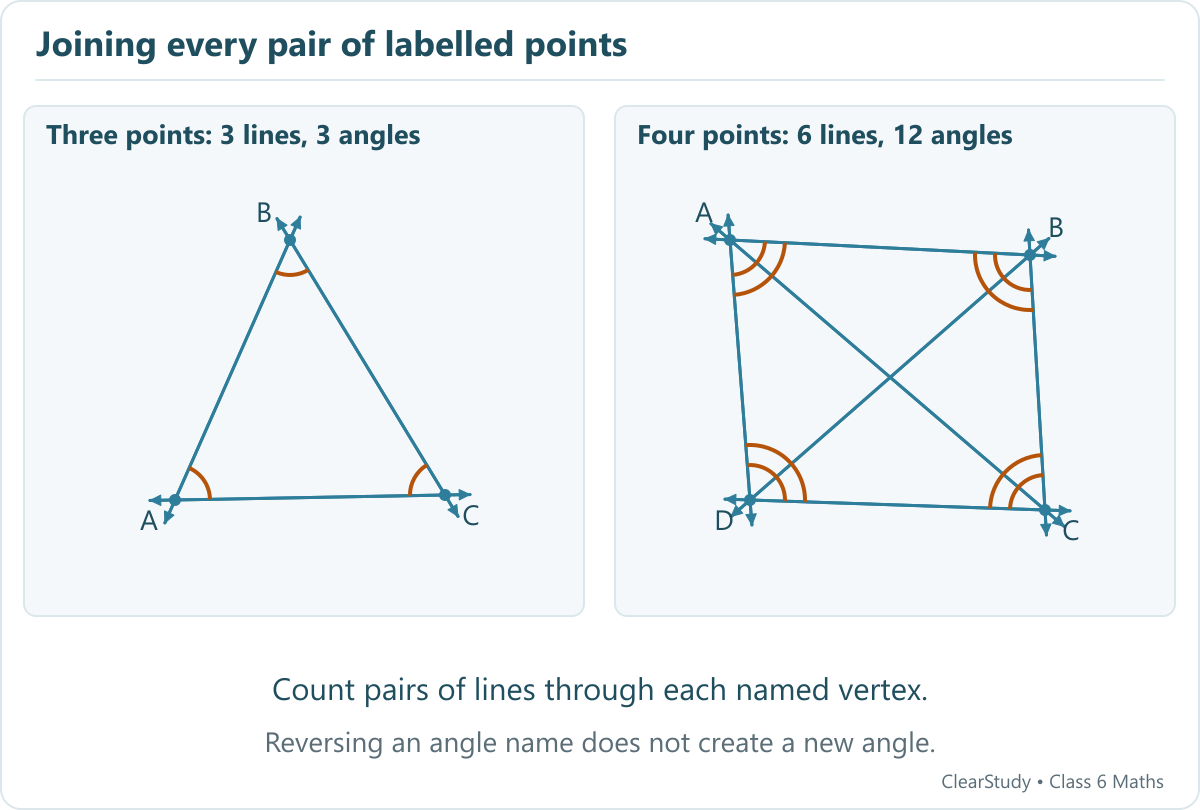
SOLUTIONJoining the three points in pairs gives 3 lines: AB, BC and CA.Using A, B and C we can name 3 angles: ∠ABC (= ∠CBA), ∠BCA (= ∠ACB) and ∠CAB (= ∠BAC). Mark each with a small curve at its vertex.
6. Now mark any four points on your paper so that no three of them are on one line. Label them A, B, C, D. Draw all possible lines going through pairs of these points. How many lines do you get? Name them. How many angles can you name using A, B, C, D? Write them all down, and mark each of them with a curve as in Fig. 2.9.
SOLUTIONJoining four points (no three in a line) in pairs gives 6 lines: AB, BC, CD, DA, AC and BD.The angles that can be named using A, B, C, D are 12: ∠BAC, ∠CAD, ∠BAD, ∠ADB, ∠BDC, ∠ADC, ∠DCA, ∠ACB, ∠DCB, ∠CBD, ∠DBA and ∠CBA. Mark each with a curve at its vertex.
At each of the four vertices there are three possible pairs of rays, so 4 × 3 = 12 angles can be named.
1. Fold a rectangular sheet of paper, then draw a line along the fold created. Name and compare the angles formed between the fold and the sides of the paper. Make different angles by folding a rectangular sheet of paper and compare the angles. Which is the largest and smallest angle you made?
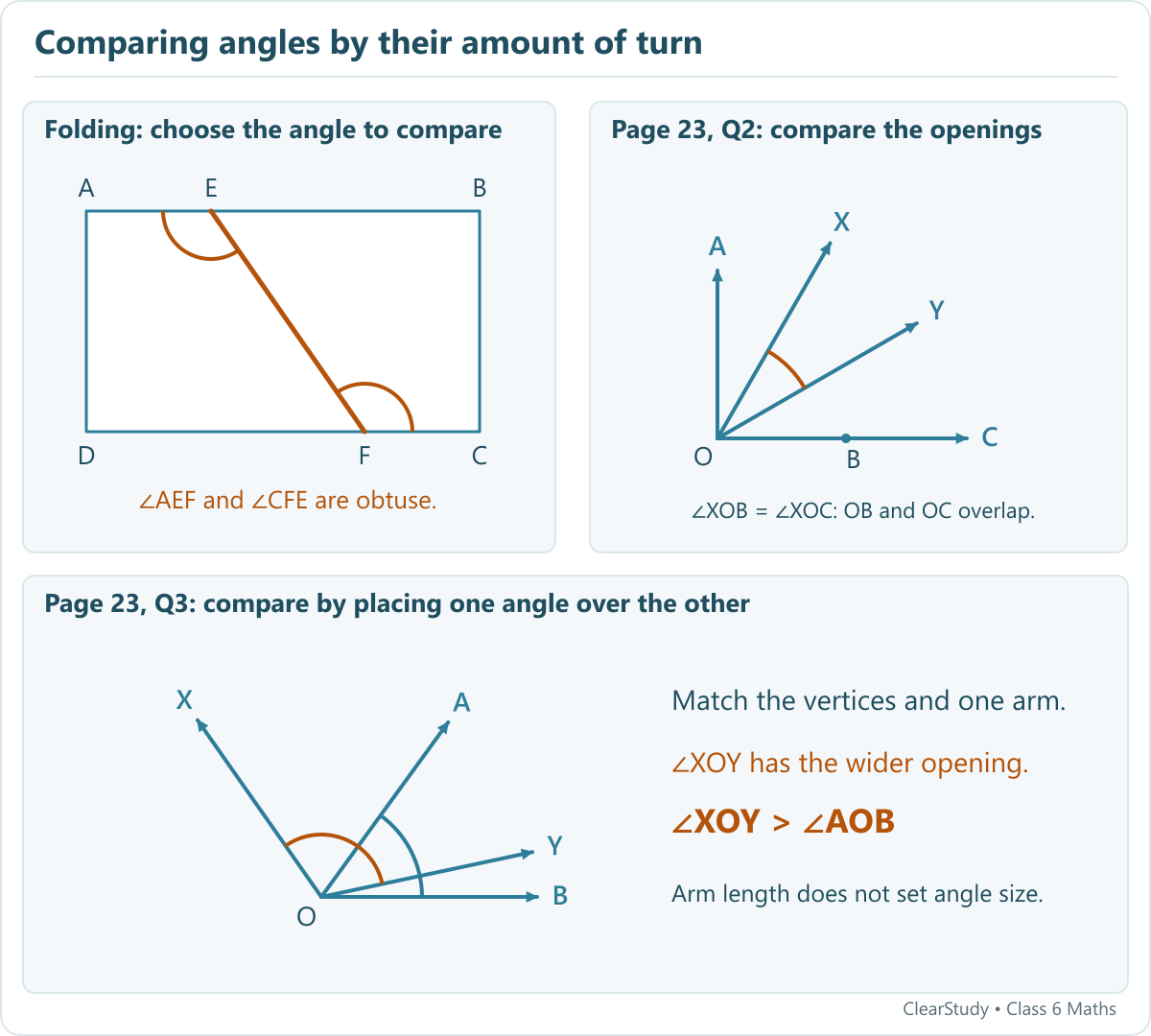
SOLUTIONIn the illustrated example, the crease EF meets sides AB and DC. The angles are ∠AEF, ∠BEF, ∠DFE and ∠CFE. ∠AEF and ∠CFE are obtuse; ∠BEF and ∠DFE are acute, so the obtuse pair is larger.At either meeting point, the two adjacent angles add to 180°. As one gets larger, the other gets smaller. Compare the same named angle when you change the fold; “a steeper fold makes a larger angle” is not true for both adjacent angles.Try several folds and record your own largest and smallest angles. Your answers depend on your folds.
2. In each case, determine which angle is greater and why.
a. ∠AOB or ∠XOYb. ∠AOB or ∠XOBc. ∠XOB or ∠XOCDiscuss with your friends on how you decided which one is greater.
SOLUTIONa. ∠AOB is greater. Here ∠XOY is a small angle inside ∠AOB, and ∠AOB = ∠AOX + ∠XOY + ∠YOB, so it must be larger than ∠XOY.b. ∠AOB is greater, because ∠XOB is a part of ∠AOB (it lies inside it).c. Neither — they are equal. ∠XOB = ∠XOC, since the arm passes through the same positions; they overlap exactly on superimposition.
3. Which angle is greater: ∠XOY or ∠AOB? Give reasons.
SOLUTIONIn the displayed figure, ∠XOY is greater than ∠AOB. To check, trace the two angles, place their vertices together and align one arm. The remaining arm of ∠XOY lies farther from the common arm.Do not compare arm lengths. Superimposition or a protractor gives a reliable comparison; the larger opening represents the larger turn.
The drawings preserve the labelled relationships. For Q3, superimposition confirms that ∠XOY is larger than ∠AOB.
Figure it Out — Right Angles & Classifying Angles (Page 29–31)
1. How many right angles do the windows of your classroom contain? Do you see other right angles in your classroom?
SOLUTIONEach rectangular window pane has four right angles (one at every corner). You can also see right angles at the corners of the blackboard, the door, tables, books, floor tiles and the wall corners. (Observation activity — count the windows in your own classroom.)
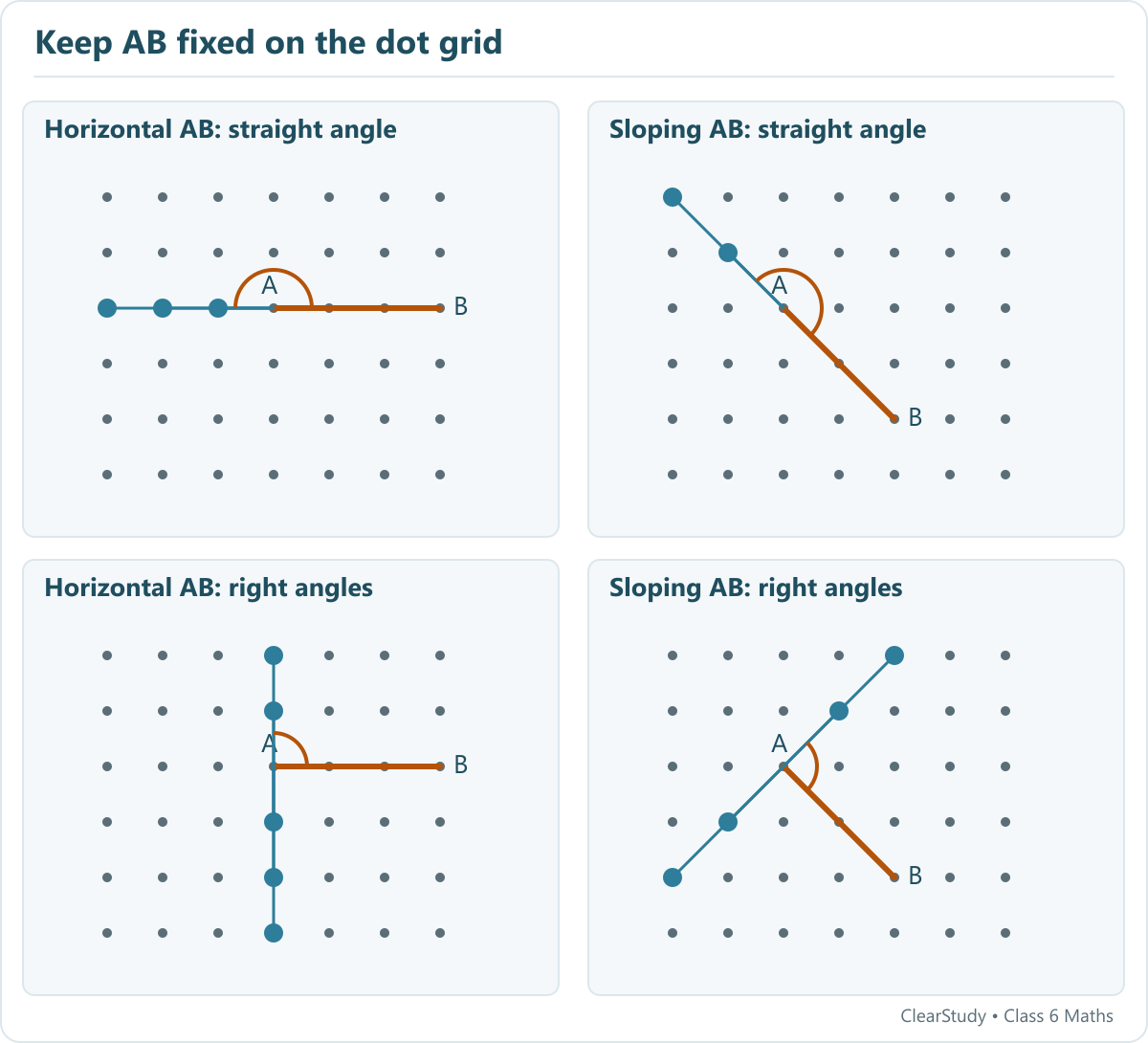
2. Join A to other grid points in the figure by a straight line to get a straight angle. What are all the different ways of doing it?
SOLUTIONKeep the given arm AB fixed. The new arm AC must point exactly opposite AB, giving ∠CAB = 180°.Left grid: choose any of the three points to the left of A in its row. Right grid: choose either of the two points diagonally up-left from A. These choices make the required straight angle; choosing an unrelated horizontal or vertical pair would change the given arm.
3. Now join A to other grid points in the figure by a straight line to get a right angle. What are all the different ways of doing it? Hint: Extend the line further. To get a right angle at A, draw a line through A that divides the straight angle CAB into two equal parts.
SOLUTIONKeep AB fixed and choose a new arm perpendicular to it. Then ∠CAB = 90°.Left grid: choose any point in A’s column other than A: two above and three below, giving five endpoint choices. Right grid: choose either of the two points diagonally up-right or either of the two diagonally down-left, giving four endpoint choices.Several endpoint choices can lie on the same ray and therefore produce the same angle.
Blue dots are the possible endpoints. Keep the orange arm AB fixed; choose the opposite direction for 180° or a perpendicular direction for 90°.
4. Get a slanting crease on the paper. Now, try to get another crease that is perpendicular to the slanting crease.
a. How many right angles do you have now? Justify why the angles are exact right angles.b. Describe how you folded the paper so that any other person who doesn’t know the process can simply follow your description to get the right angle.
SOLUTIONa. Four right angles. The two creases cross and divide the full turn (360°) into four equal angles, so each angle is ¼ of 360° = 90° — an exact right angle.b. Make the first slanting crease. Then fold the paper again so that the first crease folds exactly onto itself (one part of the crease lies on top of the other). Press flat; the new crease meets the first at a right angle. (Hands-on folding activity.)
5. Identify acute, right, obtuse and straight angles in the previous figures.
SOLUTIONLook at each earlier figure and use the rule of turn: an acute angle is smaller than a corner of a square (less than a quarter turn), a right angle is exactly the square corner shaped like an ‘L’, an obtuse angle is wider than a right angle but not a straight line, and a straight angle is when the two arms form one straight line. Classify each marked angle accordingly. (Identification activity using the figures in the chapter.)
6. Make a few acute angles and a few obtuse angles. Draw them in different orientations.
SOLUTIONFor acute angles, draw two arms with a small opening (e.g. 30°, 45°, 60°) pointing in different directions. For obtuse angles, draw two arms with a wide opening (e.g. 110°, 130°, 150°). Turn the page so the same angles point up, down or sideways — the size stays the same even when the orientation changes. (Drawing activity.)
7. Do you know what the words acute and obtuse mean? Acute means sharp and obtuse means blunt. Why do you think these words have been chosen?
SOLUTIONAn acute angle has a small opening, so its arms close up to a sharp point — like a sharp tip. An obtuse angle has a large opening, so it looks wide and blunt rather than pointed. That is why ‘sharp’ (acute) and ‘blunt’ (obtuse) suit them.
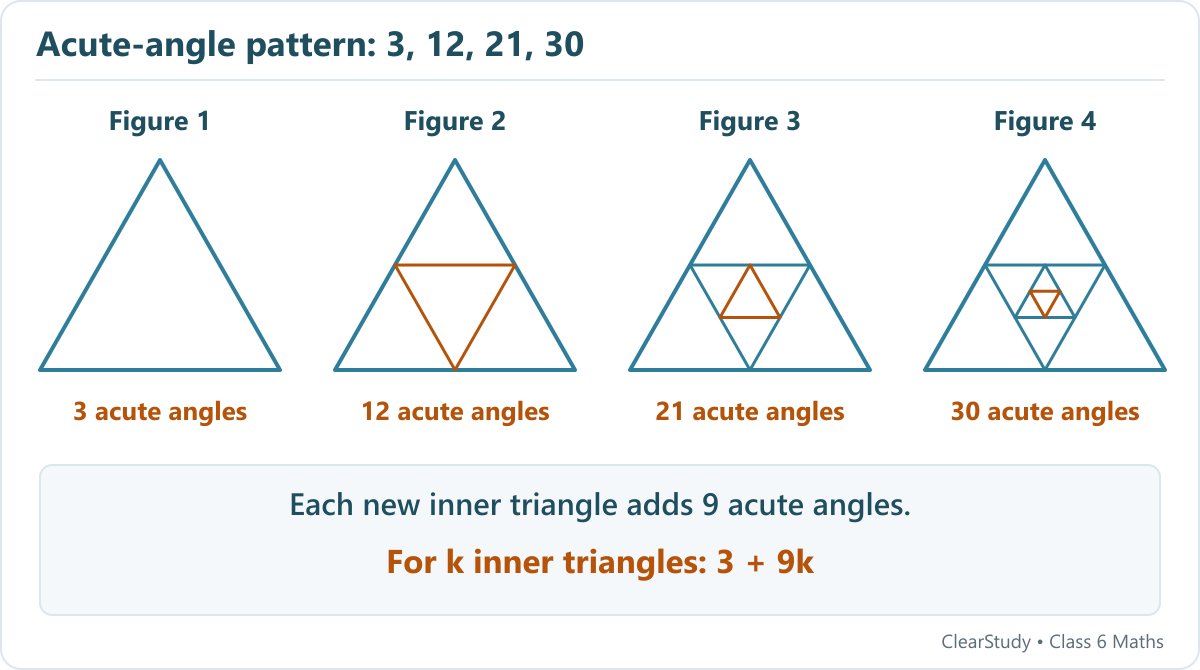
8. Find out the number of acute angles in each of the figures below. What will be the next figure and how many acute angles will it have? Do you notice any pattern in the numbers?
SOLUTIONThe first three figures have 3, 12 and 21 acute angles. The next figure is formed by joining the midpoints of the innermost triangle and has 30 acute angles.Each new inner triangle introduces three new midpoint vertices. At each, three 60° angles are formed, so the count increases by 3 × 3 = 9.With k inner triangles, the count is 3 + 9k: 3, 12, 21, 30, … for k = 0, 1, 2, 3, … .
At each new midpoint, three 60° angles are created. Three new midpoints therefore add 9 acute angles.
Figure it Out — Measuring Angles with a Protractor (Page 35–42, 45)
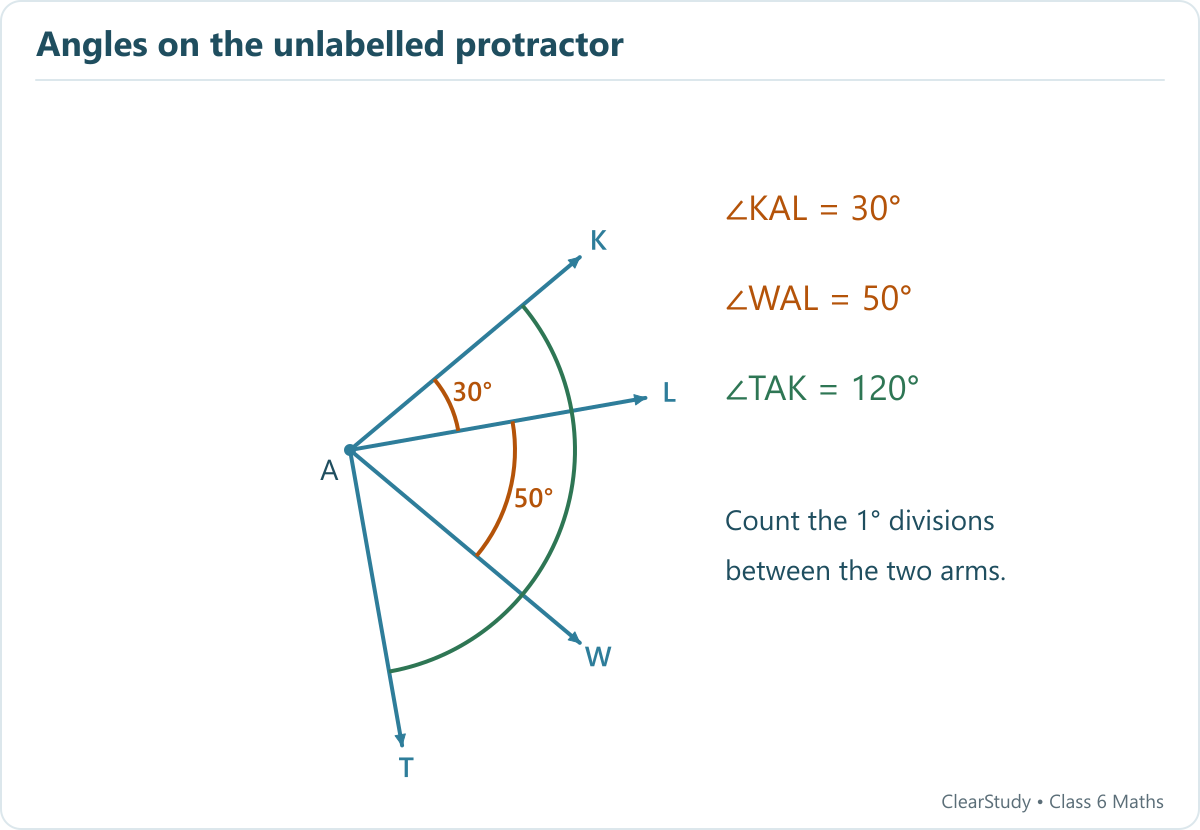
1. (Page 35) Write the measures of the following angles:
a. ∠KAL b. ∠WAL c. ∠TAK
SOLUTIONPlace the centre of the protractor on the vertex A and read the number of 1° units between the arms.a. ∠KAL = 30° (yes, the medium and long marks let you count in 5s and 10s).b. ∠WAL = 50°.c. ∠TAK = 120°.
The larger green arc spans AT to AK. An angle is the difference between the directions of its two arms.
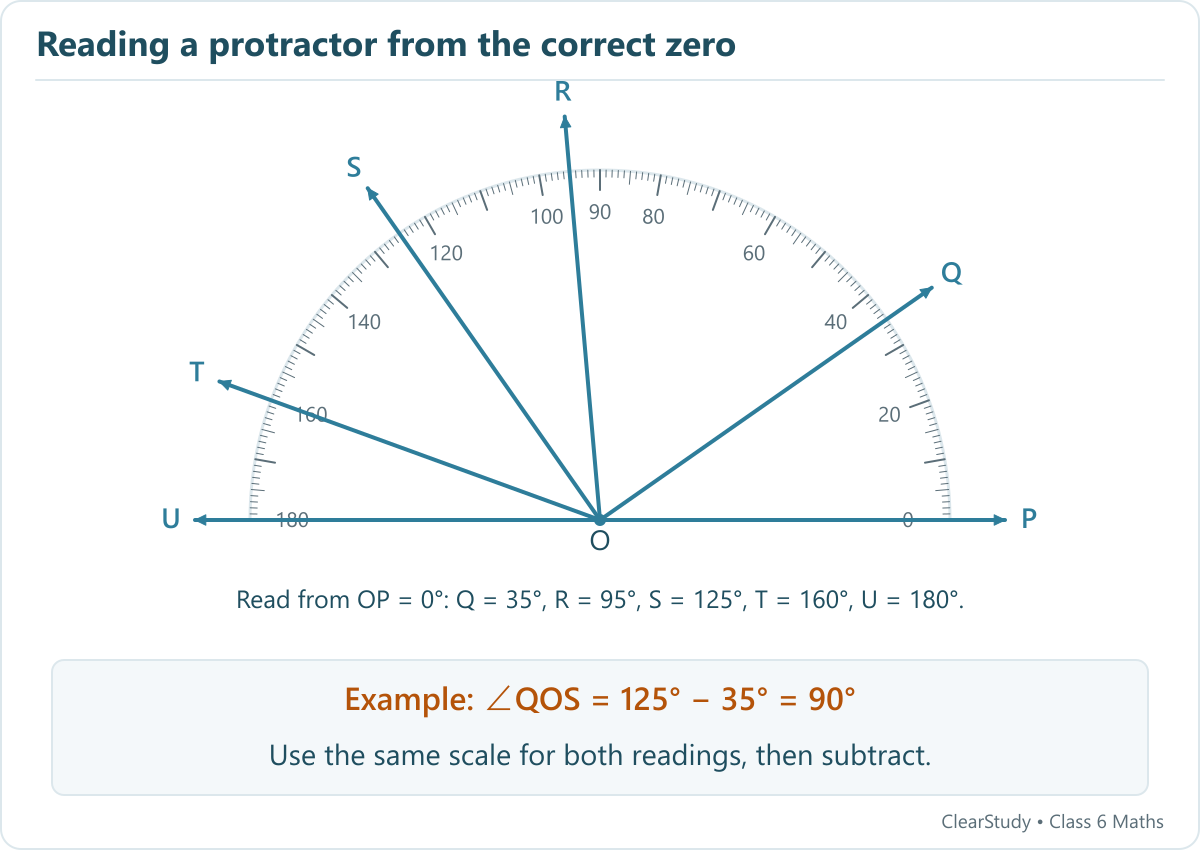
2. (Page 36) Name the different angles in the figure and write their measures.
SOLUTIONReading the protractor (using subtraction of the two scale values for each pair of arms) gives:
Angle
Measure
Angle
Measure
∠POQ
35°
∠QOT
125°
∠POR
95°
∠QOU
145°
∠POS
125°
∠ROS
30°
∠POT
160°
∠ROT
65°
∠QOR
60°
∠ROU
85°
∠QOS
90°
∠SOT
35°
∠SOU
55°
∠TOU
20°
∠POU
180°
Straight angle
There are 15 pairs of the six rays, including the straight angle ∠POU = 180°. Subtract readings from the same scale.
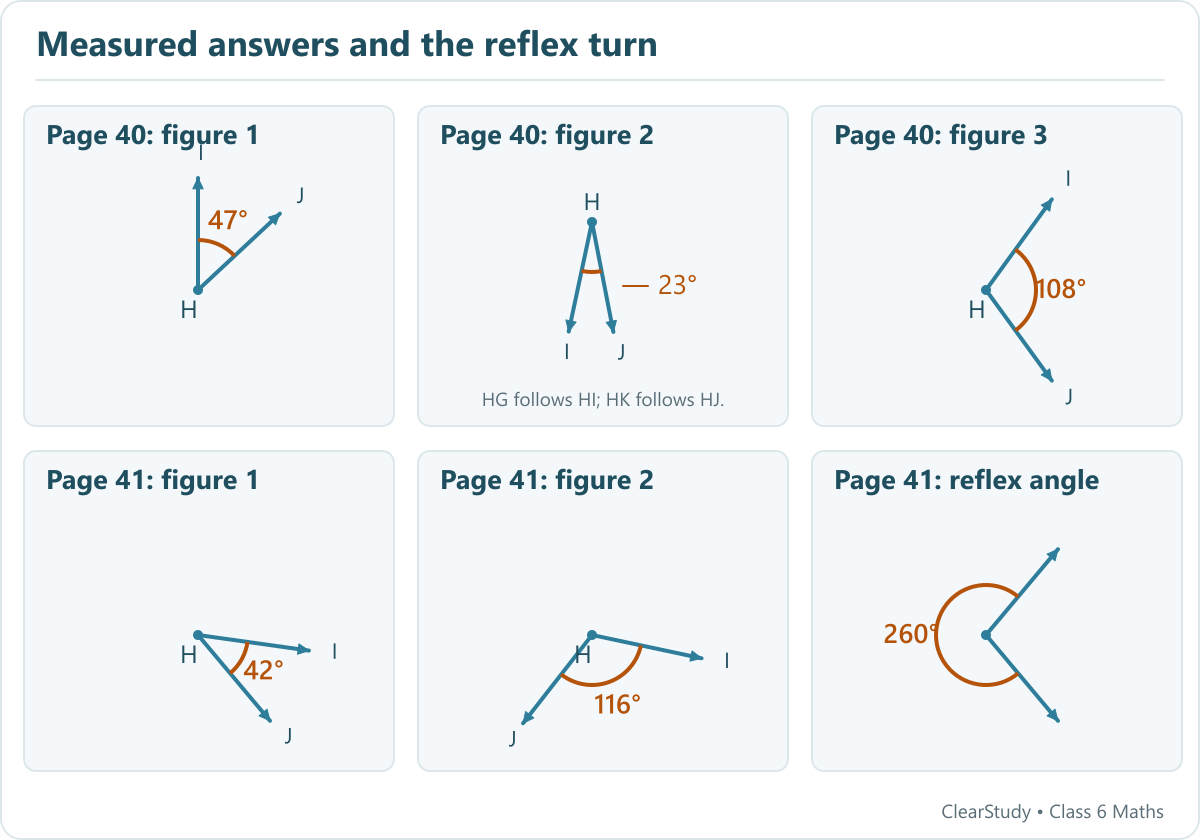
3. (Page 40) Find the degree measures of the following angles using your protractor.
SOLUTIONApproximate measurements of the three printed figures are: ∠IHJ = 47°, ∠GHK = 23°, ∠IHJ = 108° (for the three figures shown).
4. (Page 41) Find the degree measures for the angles given below. Check if your paper protractor can be used here!
SOLUTIONThe approximate readings are ∠IHJ ≈ 42° and ∠IHJ ≈ 116°. Small differences may occur when measuring thick printed lines.No, the hand-made paper protractor cannot read these accurately, because it only has the special folded marks (like 22.5°, 45°, 90°) and not every degree.
5. (Page 41) How can you find the degree measure of the angle given below using a protractor?
SOLUTIONThe marked angle is a reflex angle, so measure the smaller (unmarked) angle first and subtract from a full turn:Measure of marked angle = 360° − measure of unmarked angle = 360° − 100° = 260°.
These are reconstructed answer diagrams. For a reflex angle, measure the smaller opening and calculate 360° minus that reading.
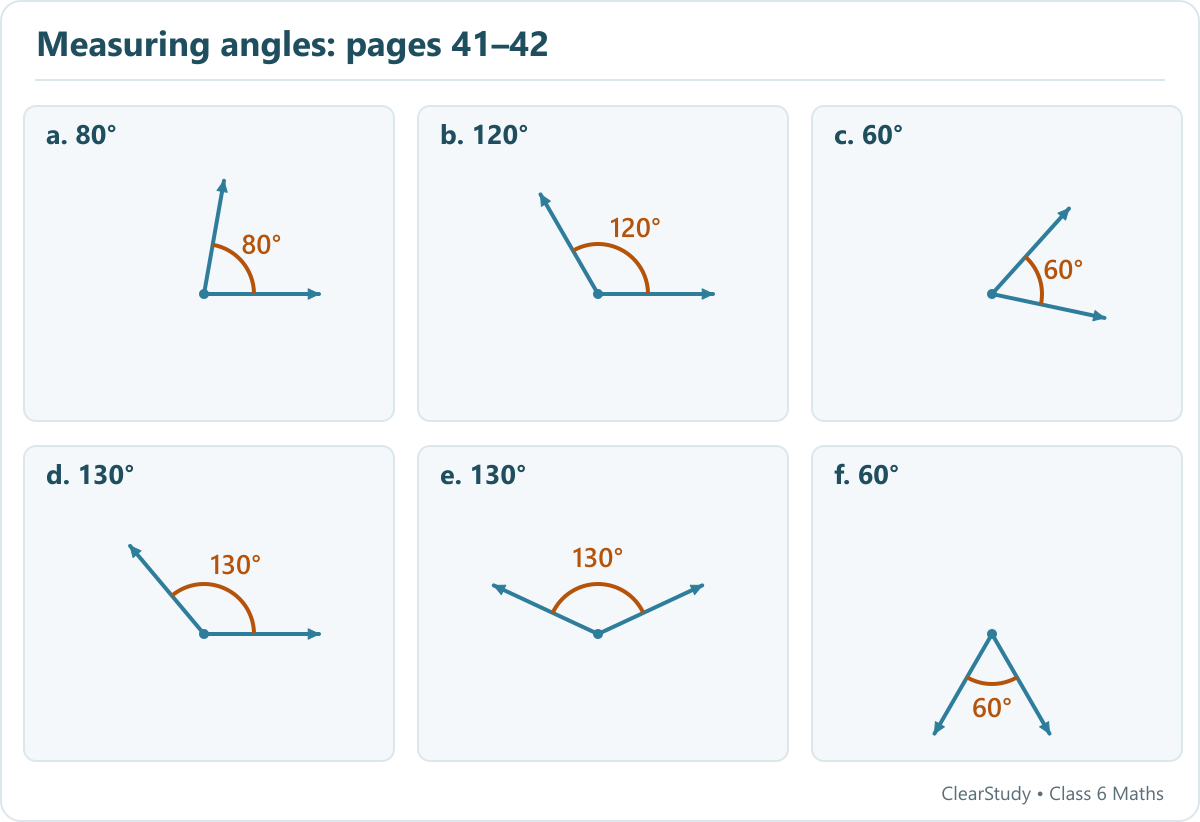
6. (Page 41) Measure and write the degree measures for each of the following angles.
SOLUTIONa. 80° b. 120° c. 60° d. 130° e. 130° f. 60°.
Reconstructed answer diagrams for (a)–(f). Use a protractor on the textbook figures; small differences can occur when measuring printed lines.
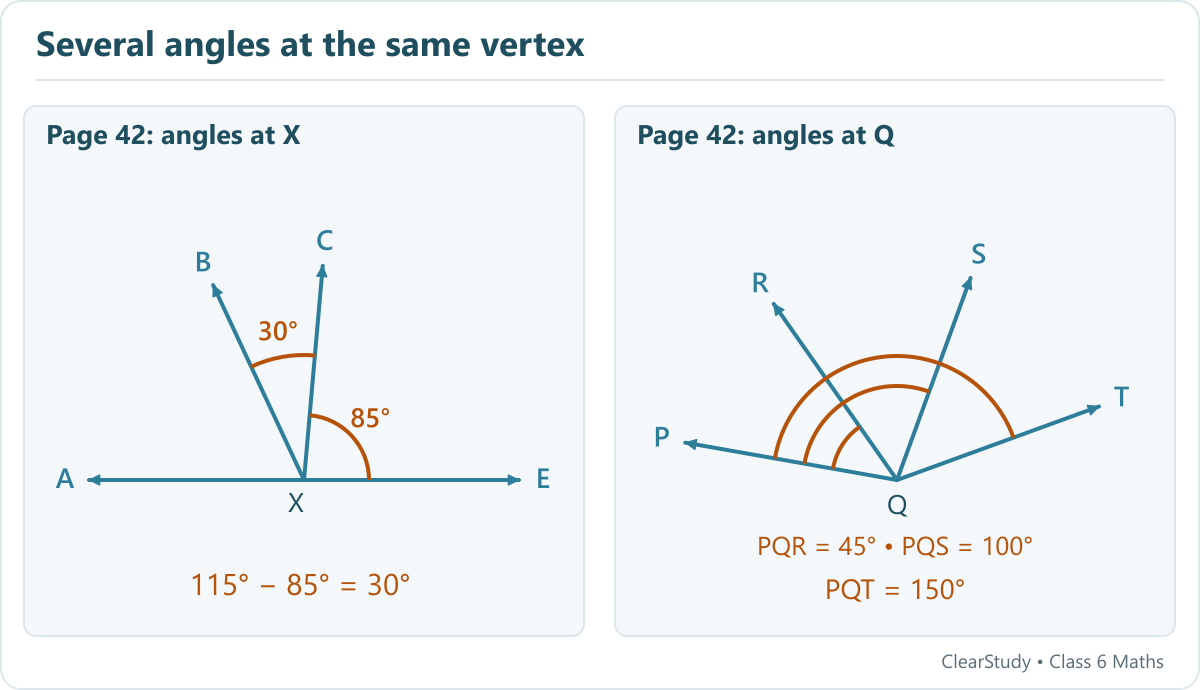
7. (Page 42) Find the degree measures of ∠BXE, ∠CXE, ∠AXB and ∠BXC.
8. (Page 42) Find the degree measures of ∠PQR, ∠PQS and ∠PQT.
SOLUTION∠PQR = 45°, ∠PQS = 100°, ∠PQT = 150°.
Mark the intended arc first. Several different angles can share the same vertex.
9. (Page 43) Measure all three angles of the triangle in Fig. 2.21 (a), (b) and (c), add them up, and make a conjecture.
SOLUTIONWhen you measure the three angles of each triangle and add them, the total comes to about 180° every time.Conjecture: the three angles of any triangle always add up to 180° (a straight angle). (The reason is studied in a later class.)
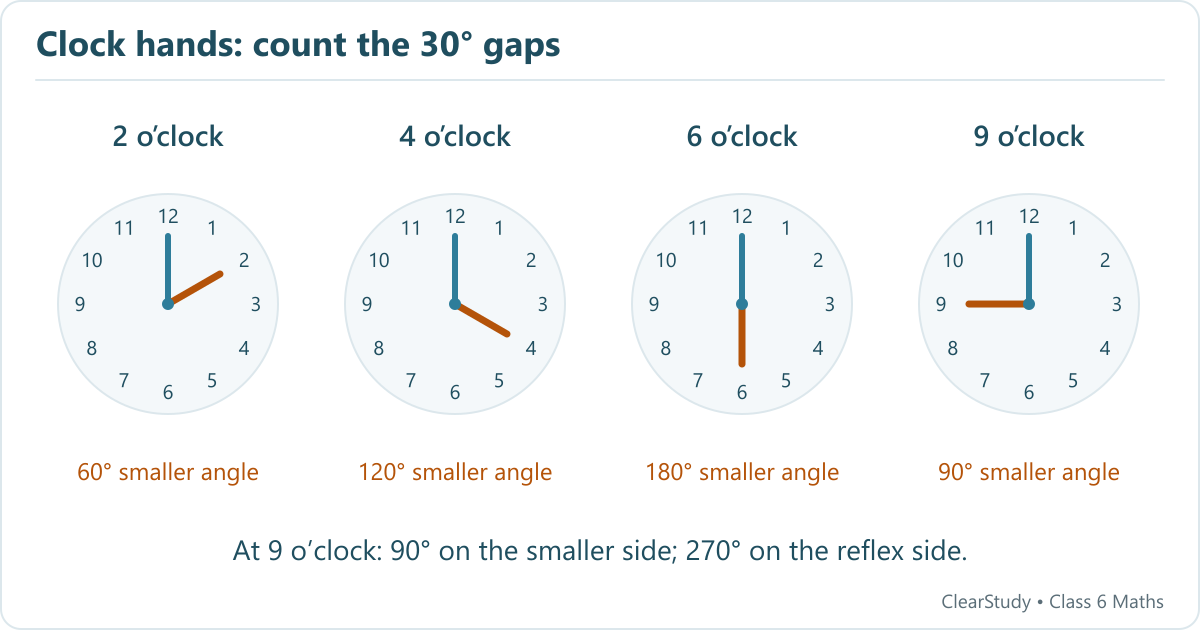
10. (Page 45) Angles in a clock.
a. At 1 o’clock the angle between the hands is 30°. Why?b. What will be the angle at 2 o’clock? At 4 o’clock? At 6 o’clock?c. Explore other angles made by the hands of a clock.
SOLUTIONa. The full turn round a clock face is 360°, shared equally by the 12 numbers, so the angle between two successive numbers = 360° ÷ 12 = 30°. At 1 o’clock the hands are one gap apart, so the angle is 30°.b. At 2 o’clock = 2 × 30° = 60°; at 4 o’clock = 4 × 30° = 120°; at 6 o’clock = 6 × 30° = 180° (a straight angle).c. At both 3 o’clock and 9 o’clock, the smaller angle is 90° and the reflex angle is 270°. Say which turn is intended. Each whole-hour gap is 30°.
Twelve equal gaps make a full turn: 360° ÷ 12 = 30°. Always say whether you mean the smaller angle or the reflex angle.
11. (Page 45) The angle of a door: Is it possible to express the amount by which a door is opened using an angle? What will be the vertex and the arms of the angle?
SOLUTIONYes. The vertex is the hinge — the point where the door meets the wall. The two arms are the edge of the open door and the line of the wall (door frame). The wider the door is opened, the larger the angle.
12. (Page 45) Vidya is on a swing — the greater the starting angle, the greater her speed. But where is the angle?
SOLUTIONThe angle is at the top of the swing (the pivot). One arm is the rope/chain in its rest (vertical) position; the other arm is the rope in the raised starting position. The bigger the turn between these two positions, the larger the angle and the faster the swing.
13. (Page 46) A toy has slanting slabs; the greater the slope, the faster the balls roll. Can angles describe the slopes? What are the arms? Which arm is visible and which is not?
SOLUTIONYes — the slope of each slab is an angle: a larger angle means a steeper slope and faster-rolling balls. For each slab, one arm is the slanting edge of the slab (visible) and the other arm is the horizontal base line at the bottom (often not drawn, so not visible). The vertex is where the slab meets the base.
Figure it Out — Drawing & Types of Angles (Page 49–53)
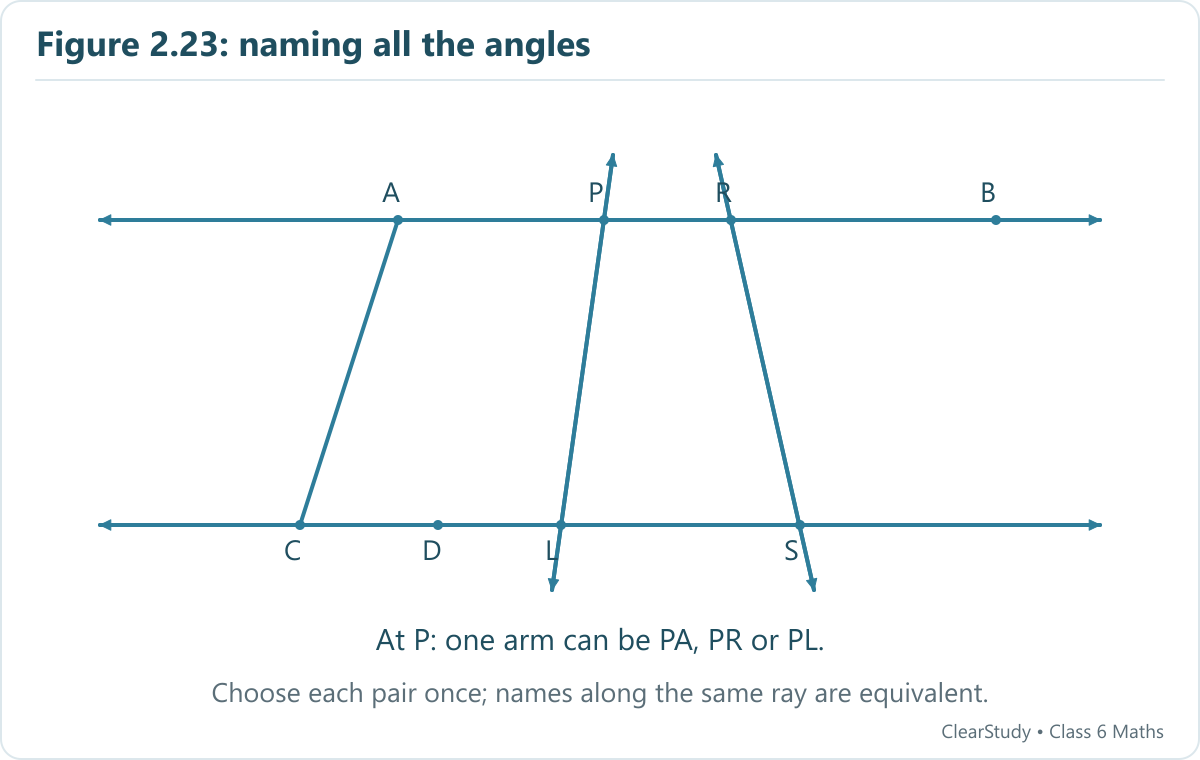
1. (Page 49) In Fig. 2.23, list all the angles possible. Now guess the measures of all the angles, then measure them with a protractor and record your numbers in a table.
SOLUTIONUsing the labelled points and counting equivalent names only once, the nine non-straight angles are ∠CAP, ∠ACD, ∠APL, ∠RPL, ∠DLP, ∠SLP, ∠PRS, ∠LSR and ∠BRS. For example, ∠CLP and ∠DLP name the same angle because LC and LD are the same ray.There are also four straight angles: ∠APR, ∠PRB, ∠CLS and ∠CDL. Each measures 180°. Thus there are 13 distinct angles using the labelled points, including straight angles.Make a table with columns angle, your estimate, measured value. Measure the textbook figure, not a stretched screen image. In the schematic below, representative readings are about 108° at A, 72° at C, 84° for ∠APL and 96° for ∠RPL. Your estimate column should contain your own first guesses.
A schematic redraw of the labelled connections in Fig. 2.23. Measure the original textbook figure for its printed angle sizes.
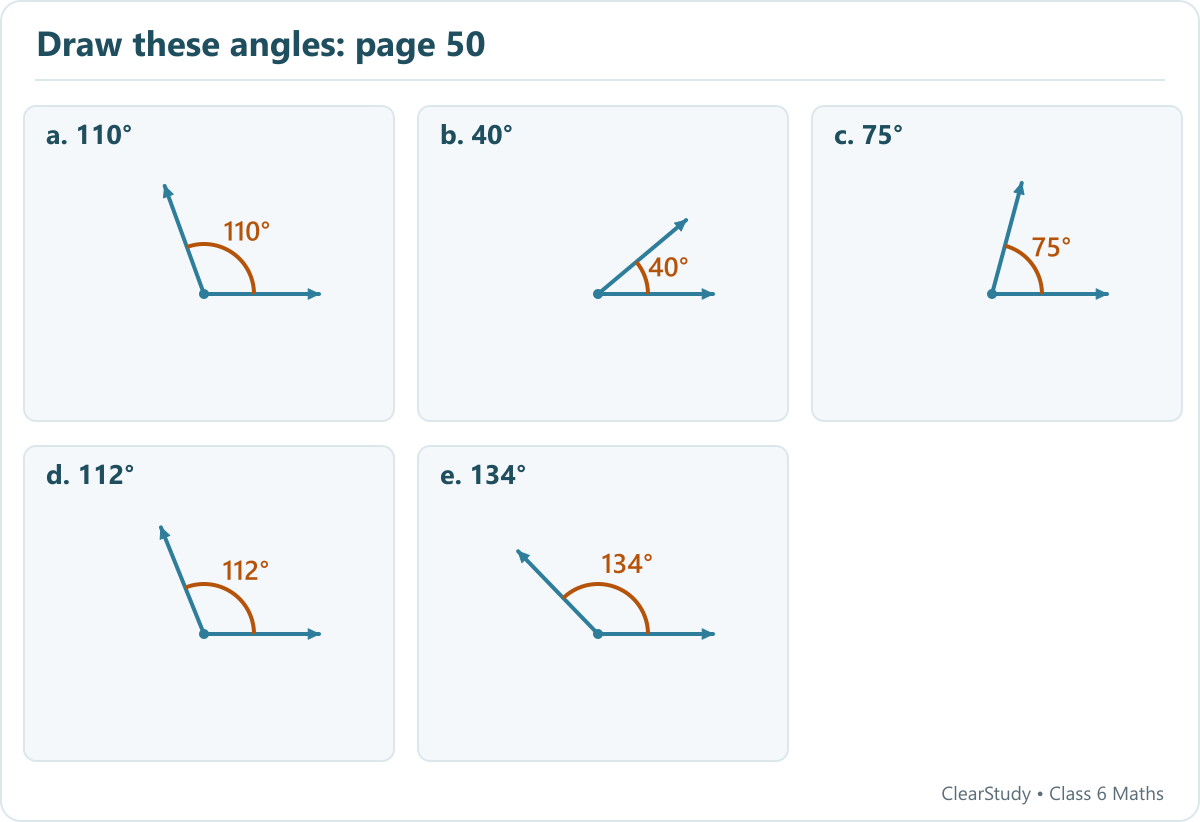
2. (Page 50) Use a protractor to draw angles having the following degree measures:
a. 110° b. 40° c. 75° d. 112° e. 134°
SOLUTIONFor each angle: draw a base ray, place the protractor’s centre on the starting point with the base along the 0° line, count up to the required measure (110°, 40°, 75°, 112° or 134°), mark a point there, and join it to the starting point with a ruler. (Construction activity — draw each angle in your notebook.)
Draw a base ray, align the protractor centre and zero, mark the required reading, then draw the second ray.
3. (Page 50) Draw an angle whose degree measure is the same as the angle given below. Also write the steps you followed.
SOLUTIONStep 1: Measure the given angle with a protractor (say it reads X°). Step 2: Draw a base ray. Step 3: Place the protractor’s centre on the starting point and the base on the 0° line. Step 4: Count up to X°, mark the point and join it to the starting point. The new angle equals the given angle. (Construction activity; X is the measure you read from the given figure.)
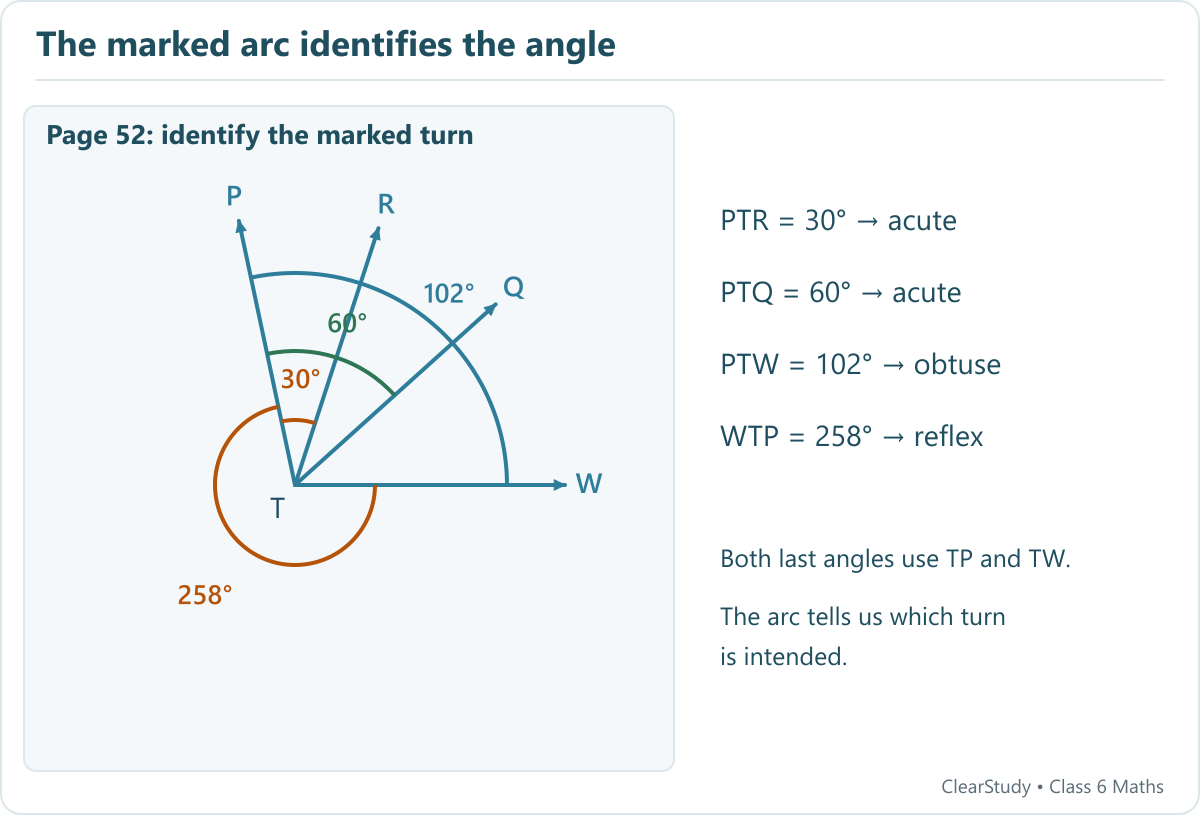
4. (Page 52) Use a protractor to find the measure of each angle. Then classify each as acute, obtuse, right or reflex.
a. ∠PTR b. ∠PTQ c. ∠PTW d. ∠WTP
The same pair of arms has a smaller and a larger turn. ∠PTW and ∠WTP here follow the particular arcs marked in the question.
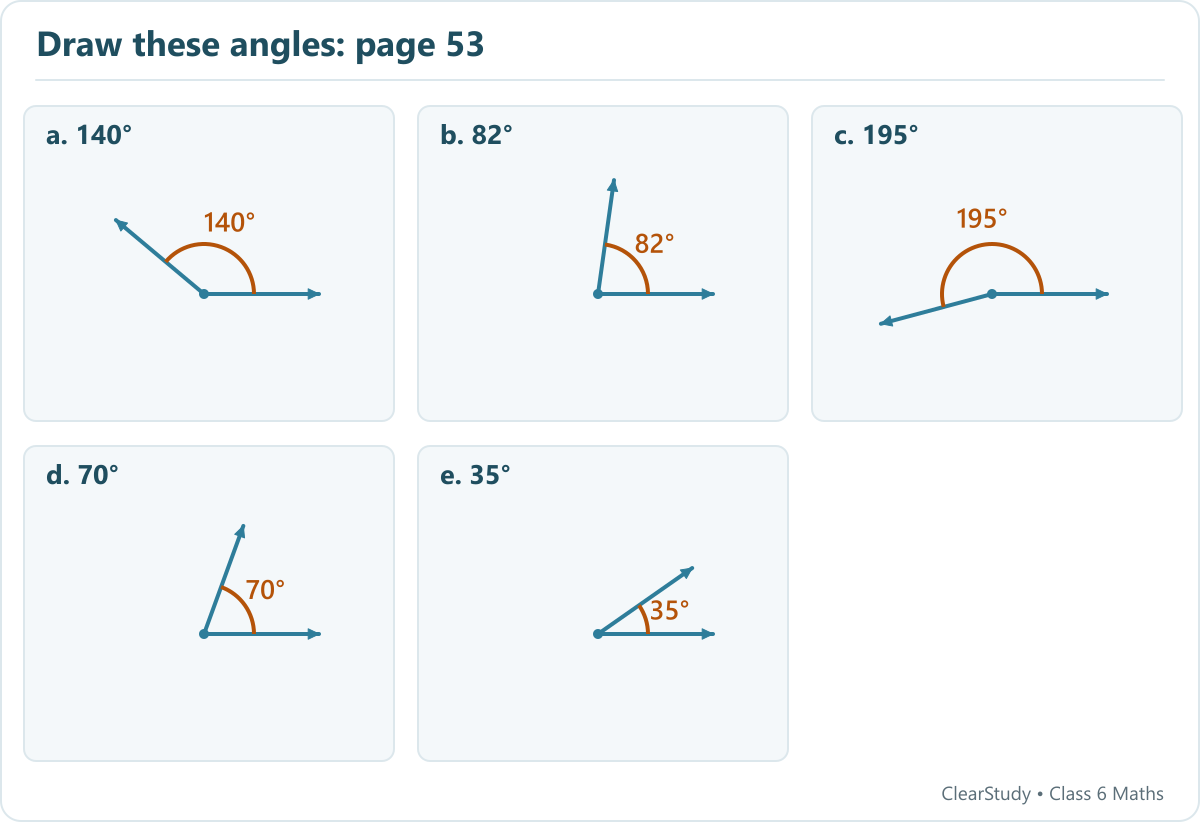
5. (Page 53) Draw angles with the following degree measures:
a. 140° b. 82° c. 195° d. 70° e. 35°
SOLUTIONUse the protractor method (base ray → centre on the vertex → count up → mark and join). For 195°, which is more than 180°, mark its smaller partner 360° − 195° = 165° on the other side, so the reflex side is 195°. (Construction activity.)
For the reflex angle 195°, draw a smaller opening of 165° and mark the larger arc: 360° − 165° = 195°.
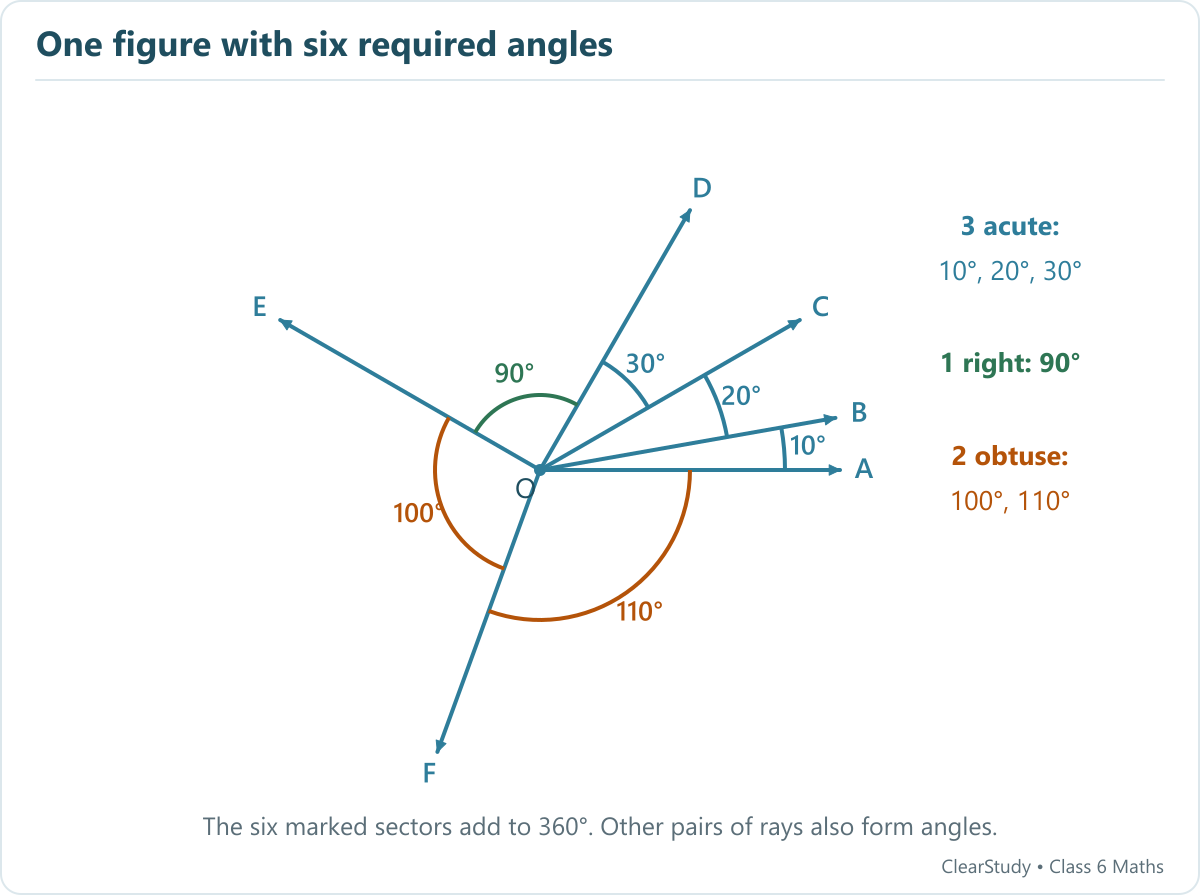
6. (Page 53) Make any figure with three acute angles, one right angle and two obtuse angles.
SOLUTIONDraw six rays from O so that the six successive marked sectors are 10°, 20°, 30°, 90°, 100° and 110°.The first three are acute, 90° is a right angle, and 100° and 110° are obtuse. Their sum is 360°, so they fit exactly around O. The question asks for a figure with these marked angles; it does not require a hexagon.Why a convex hexagon would not work: its interior angles total 720°. Three acute, one right and two obtuse interior angles would total strictly less than 720°. Use the ray construction instead.
This construction satisfies the question using six marked sectors around a point. It does not require a closed six-sided shape.
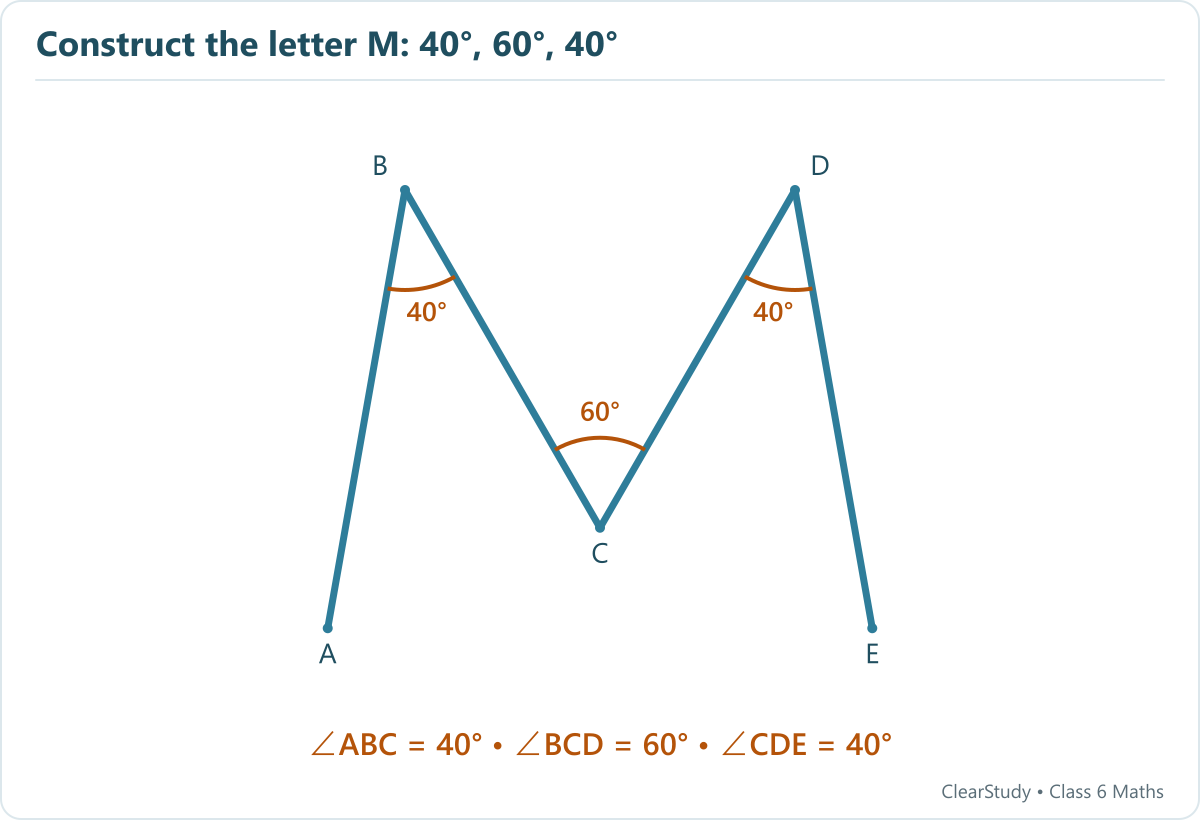
7. (Page 53) Draw the letter ‘M’ such that the angles on the sides are 40° each and the angle in the middle is 60°.
SOLUTIONFirst draw the central V, BCD, with ∠BCD = 60°. At B, draw the outer stroke BA so that ∠ABC = 40°. At D, draw DE so that ∠CDE = 40°.Choose A and E below the two top corners so that A–B–C–D–E forms an M. Check the three marked angles with a protractor.
Draw the central V with a 60° angle, then make each outer stroke form 40° with its adjacent inner stroke.
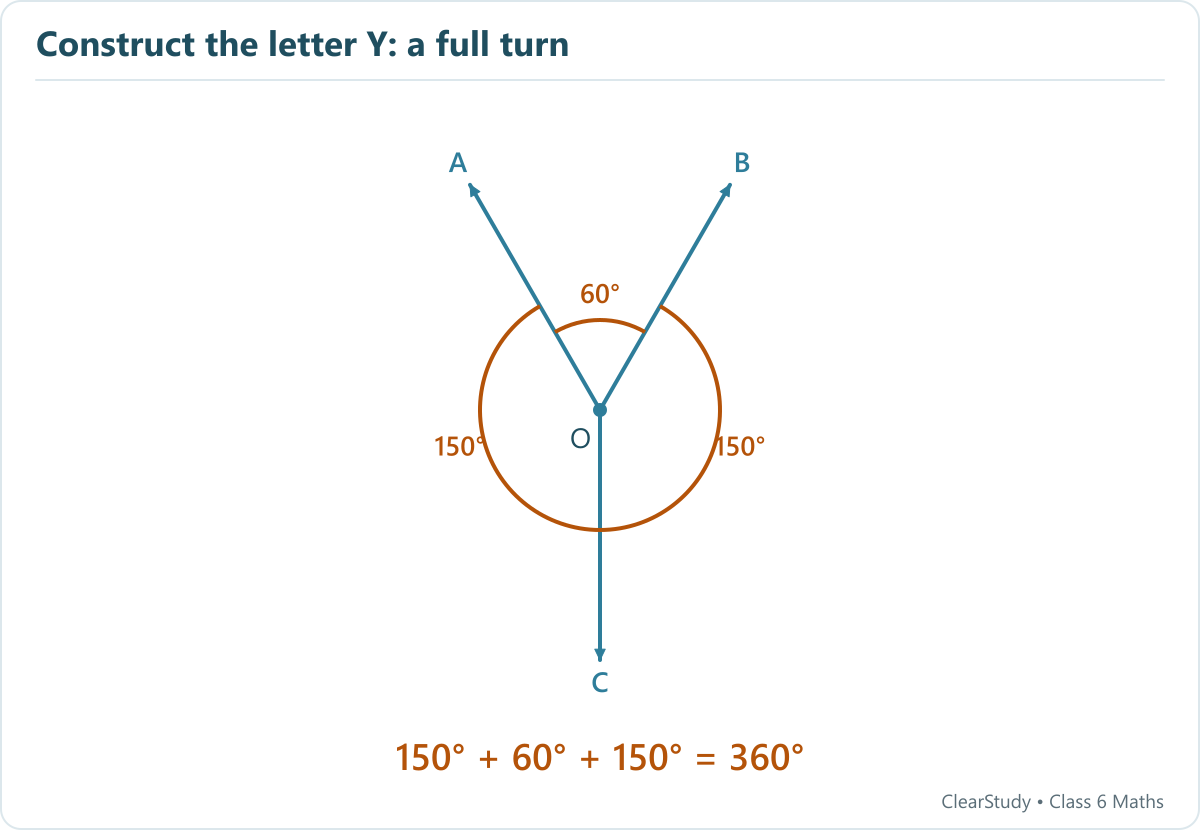
8. (Page 53) Draw the letter ‘Y’ such that the three angles formed are 150°, 60° and 150°.
SOLUTIONAt O, draw two upper rays OA and OB making ∠AOB = 60°. Draw the third ray OC downward so that ∠AOC = 150° and ∠BOC = 150°.Each 150° angle lies between the downward stem and one upper arm. Check: 150° + 60° + 150° = 360°.
Each 150° angle is between the downward stem and one upper arm. The three angles together make a full turn.
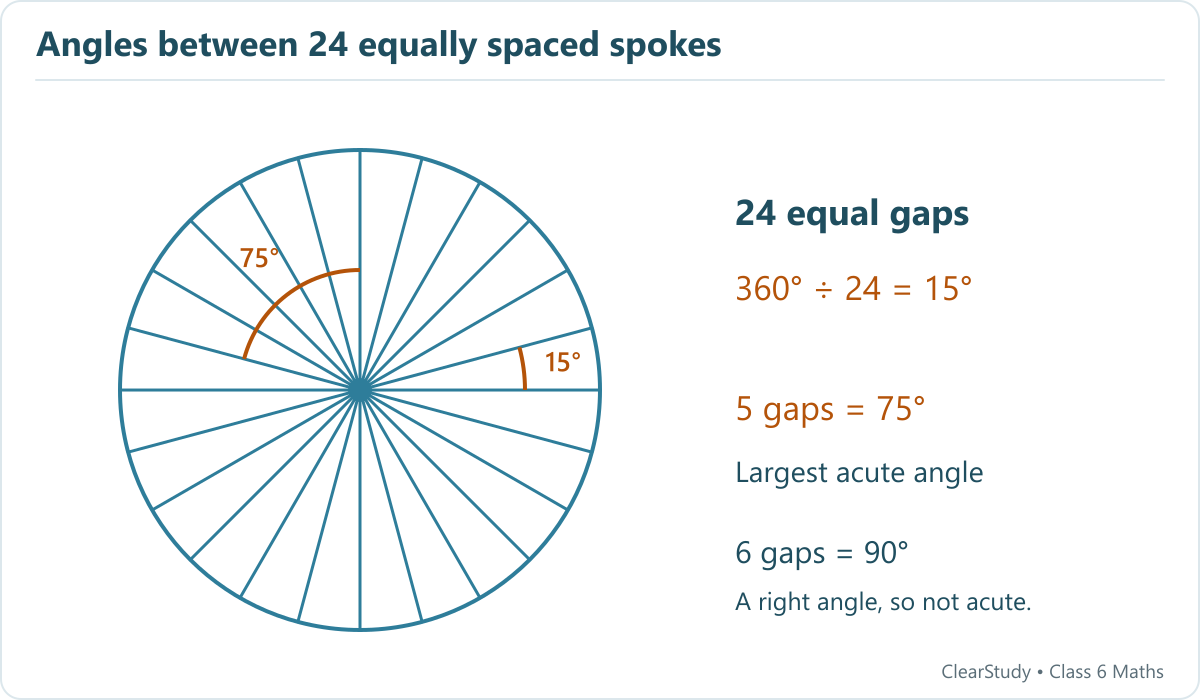
9. (Page 53) The Ashoka Chakra has 24 spokes. What is the degree measure of the angle between two spokes next to each other? What is the largest acute angle formed between two spokes?
SOLUTIONThe 24 spokes share a full turn equally, so the angle between two adjacent spokes = 360° ÷ 24 = 15°.Angles between spokes are multiples of 15°: 15°, 30°, 45°, 60°, 75°, 90°, … The largest of these that is still acute (less than 90°) is 75° (= five gaps between spokes).
Count the gaps between spokes: five gaps give 75°, while six gaps give 90°. This is a mathematical spoke diagram.
10. (Page 53) Puzzle: I am an acute angle. Doubling, tripling and quadrupling my measure each still gives an acute angle, but multiplying by 5 gives an obtuse angle. What are the possibilities for my measure?
SOLUTIONLet the angle be x. We need 0° < 4x < 90° (so x, 2x, 3x, 4x are all acute) and 90° < 5x < 180° (so 5x is obtuse).From 4x < 90°: x < 22.5°. From 5x > 90°: x > 18°.So 18° < x < 22.5°, giving the whole-degree possibilities 19°, 20°, 21° and 22°.
Additional grid activity — pages 51–52
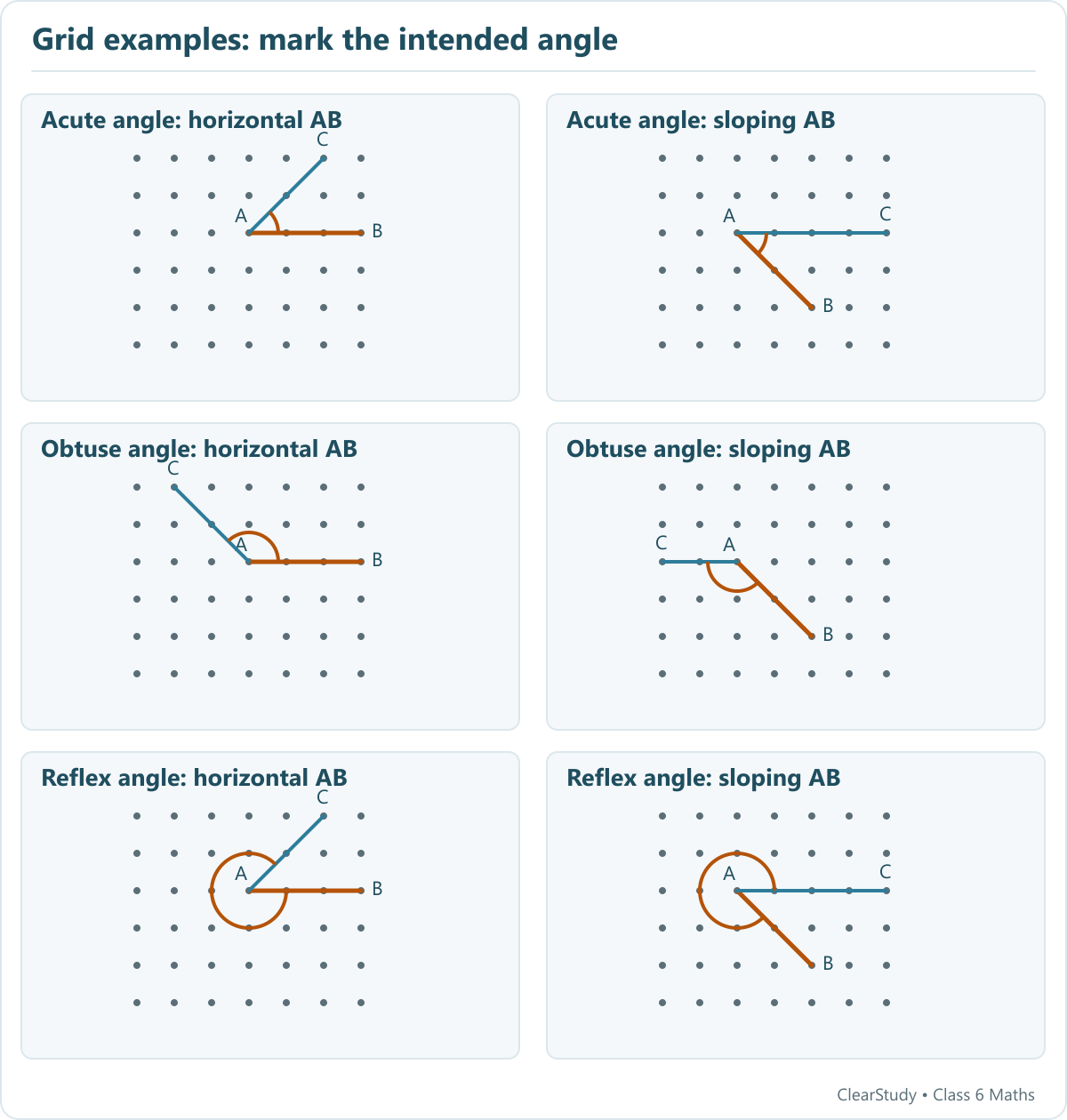
Keep the given arm AB fixed. Add a second arm AC to make an acute angle, an obtuse angle and a reflex angle, and mark the intended turn.
SOLUTIONThe examples below work in both orientations. For horizontal AB, choose C diagonally up-right for an acute angle and diagonally up-left for an obtuse angle. The same up-right ray also gives a reflex angle when you mark the longer turn.For sloping AB, a ray from A to the right gives an acute angle; a ray to the left gives an obtuse angle. Mark the long turn to the rightward ray to obtain a reflex angle. Other choices are possible.
These are sample choices. Many other grid points work. For a reflex angle, mark the longer turn around A.
Math Talk & Let’s Explore — Answered
These are the in-text reflective and exploratory tasks in the chapter; the determinate ones are answered, the open ones are guided.
Page 21 — Is it always easy to compare two angles?Math Talk: Is it always easy to compare two angles?Answer.No. When two angles are very close in size — for example 89° and 91° — we cannot tell which is larger just by looking. We must superimpose them or measure them. For clearly different angles, comparison by eye is easy.
Page 23 — Where else do we use superimposition?Math Talk: Where else do we use superimposition to compare?Answer. We use superimposition to compare other shapes too — for example to check whether two line segments are equal in length, or whether two squares or two circles are the same size, by placing one exactly over the other.
Page 28 — Dividing a straight angle equallyLet’s Explore: Is it possible to draw OC such that the two angles ∠AOC and ∠COB are equal in size?Answer.Yes. Fold the paper so that OB falls exactly on OA; the crease OC then divides the straight angle ∠AOB into two equal angles. Because OA and OB overlap on folding, ∠AOC = ∠COB — each is a right angle (90°).
Page 29 — A right angle as part of a full turnIf a straight angle is formed by half of a full turn, how much of a full turn forms a right angle?Answer. A right angle is half of a straight angle, and a straight angle is half a full turn. So a right angle is ¼ (one quarter) of a full turn.
Page 40 — Why are all the folded creases equal?Think! In Fig. 2.19, ∠AOB = ∠BOC = ∠COD = ∠DOE = ∠EOF = ∠FOG = ∠GOH = ∠HOI = ___. Why?Answer. Each angle = 22.5°. The straight angle of 180° was folded into eight equal parts, so every part = 180° ÷ 8 = 22.5°.
Page 36 — Reading a labelled protractorMath Talk: Why does a protractor include two sets of numbers (inner and outer)? Can subtraction be used to find an angle?Answer. The two scales let you start counting from either side — use the scale whose arm sits on 0°. When neither arm is on 0°, read the number under each arm and subtract. For example, if OT and OS pass through 20 and 55 on the same scale, ∠TOS = 55° − 20° = 35°.
Page 53 — Angles on a straight lineLet’s Explore: In the figure, ∠TER = 80°. What is the measure of ∠BET? What is the measure of ∠SET?Answer. ∠REB is a straight angle (180°) and ∠TER = 80° lies on it, so ∠BET = 180° − 80° = 100°. Since ∠SER is a right angle (90°) made of ∠TER (80°) and ∠SET, ∠SET = 90° − 80° = 10°.
Common Mistakes to Avoid
Watch out for these
Thinking that longer arms make a bigger angle — the size of an angle depends only on the amount of turn, not on the length of the arms.
Writing the vertex in the wrong place when naming an angle — the vertex is always the middle letter (∠DBE, not ∠BDE, when B is the vertex).
Confusing a ray with a line segment or a line — a ray has one starting point and no end; a segment has two end points; a line has no end on either side.
Reading the wrong scale on the protractor — start from the side where an arm sits on 0°, and use the same (inner or outer) scale throughout.
For a reflex angle, measuring the smaller side by mistake — measure the inner angle and subtract from 360°.
Forgetting that a straight angle is 180° and a right angle is 90°, so two angles on a straight line add up to 180°.
Practice MCQs & Assertion–Reason
1. The shortest path between two points A and B is called a:
(a) ray (b) line (c) line segment (d) angle
2. How many lines can pass through a single given point?
(a) one (b) two (c) only three (d) countless (infinitely many)
3. The common starting point of the two arms of an angle is called its:
For each Assertion–Reason question, choose: (A) Both Assertion and Reason are true and the Reason is the correct explanation of the Assertion; (B) Both are true but the Reason is not the correct explanation; (C) Assertion is true but Reason is false; (D) Assertion is false but Reason is true.
A-R 1. Assertion: Through two given points only one straight line can be drawn.
Reason: Any two points determine a unique line passing through both of them.
A-R 2. Assertion: The ray OA can also be named OB if B lies on it beyond A.
Reason: A ray is named by its starting point and any other point on its path.
A-R 3. Assertion: Increasing the length of the arms of an angle increases the size of the angle.
Reason: The size of an angle is the amount of rotation about the vertex.
A-R 4. Assertion: A right angle is one quarter of a full turn.
Reason: A full turn is 360° and a right angle measures 90°.
A-R 5. Assertion: An angle of 200° is a reflex angle.
Reason: A reflex angle is greater than 180° and less than 360°.
Answer key: 1-(A), 2-(A), 3-(D), 4-(A), 5-(A).
Quick Revision Summary
A point marks a location; a line segment is the shortest path between two points; a line extends endlessly both ways; a ray starts at one point and goes on forever in one direction.
An angle is formed by two rays (arms) sharing a common vertex; its size is the amount of turn, not the length of the arms.
Name an angle with the vertex in the middle, e.g. ∠DBE.
Angles are compared by superimposition or by measuring with a protractor.
A full turn = 360°, a straight angle = 180°, a right angle = 90°.
The ray from the vertex that splits an angle into two equal parts is its angle bisector; the three angles of a triangle add up to 180°.
How to score full marks in this chapter
Always name angles with the vertex as the middle letter, and remember that arm length never changes an angle’s size. When measuring, line the protractor’s centre on the vertex and one arm on the 0° mark, then read the same (inner or outer) scale. For reflex angles, measure the inner angle and subtract from 360°. Keep the key values 90°, 180° and 360° ready, and use “angles on a straight line add to 180°” and “equal spacing” (clock = 30°, Chakra = 15°) to answer quickly.
Frequently Asked Questions
What is Class 6 Maths Ganita Prakash Chapter 2 about?
Chapter 2, Lines and Angles, covers the basic ideas of geometry — points, line segments, lines, rays and angles — together with comparing angles, the special angles (straight, right, acute, obtuse, reflex), and measuring and drawing angles in degrees with a protractor.
What are the five types of angles in this chapter?
An acute angle is more than 0° and less than 90°, a right angle is exactly 90°, an obtuse angle is more than 90° and less than 180°, a straight angle is 180°, and a reflex angle is more than 180° and less than 360°.
Does the length of the arms change the size of an angle?
No. The size of an angle is the amount of rotation about the vertex needed to turn one arm onto the other. Making the arms longer or shorter does not change the angle.
Are these Class 6 Maths Ganita Prakash Chapter 2 solutions free?
Yes. These solutions are free and follow the NCERT Ganita Prakash chapter. The worked explanations and diagrams help you check answers and complete the practical activities.
Textbook reference: NCERT Ganita Prakash, Chapter 2: Lines and Angles. ClearStudy’s explanatory diagrams are original redrawings. Use the printed textbook for measurement activities; on-screen scaling and line thickness can affect readings.