
Class 6 Maths Chapter 1 Solutions – Patterns in Mathematics
These Class 6 Maths Ganita Prakash Chapter 1 solutions cover Patterns in Mathematics from the new NCF-2023 textbook (Reprint 2026–27). Every Figure it Out, Math Talk and Try This question is solved step by step, with the number sequences, shape sequences and the surprising relations between them explained in full, so you can master the chapter and revise it quickly.
- Chapter overview
- Key concepts & definitions
- Important sequences & patterns
- Figure it Out (Sections 1.1 & 1.2)
- Figure it Out (Section 1.3 — Visualising)
- Figure it Out (Section 1.4 — Relations)
- Figure it Out (Sections 1.5 & 1.6 — Shapes)
- Math Talk & in-text tasks (answered)
- Common mistakes to avoid
- Practice MCQs & Assertion–Reason
- Quick revision summary
- FAQs
Chapter 1 Overview
Chapter 1 of Ganita Prakash, Patterns in Mathematics, introduces mathematics as the search for patterns and the explanations for why they exist. It begins with number sequences — counting numbers, odd and even numbers, triangular numbers, square numbers, cube numbers, Virahāṅka numbers and powers of 2 and 3 (Table 1). It then shows how these sequences can be visualised with pictures (Table 2) and how they relate to each other in beautiful ways — for example, adding consecutive odd numbers gives square numbers. Finally it explores shape sequences (Table 3) such as regular polygons, complete graphs, stacked squares and triangles and the Koch snowflake, and links them back to number sequences. The Class 6 Maths Ganita Prakash Chapter 1 solutions below work through every Figure it Out, Math Talk and Try This task step by step.
Key Concepts & Definitions
Pattern: a regularity in numbers or shapes that follows a rule, so we can predict what comes next and explain why.
Number theory: the branch of mathematics that studies patterns in whole numbers (0, 1, 2, 3, …).
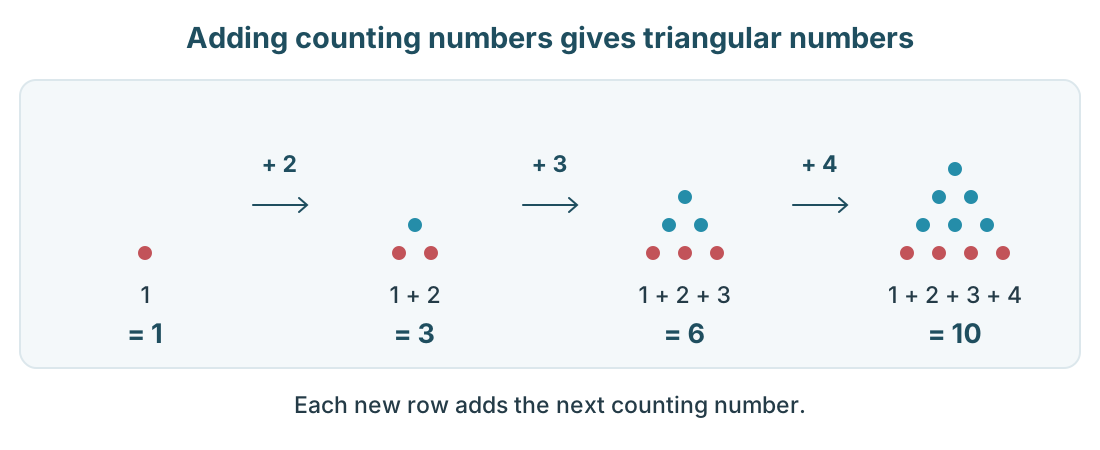
Triangular numbers (1, 3, 6, 10, 15, …): numbers of dots that can be arranged in an equilateral triangle; each is the sum of counting numbers 1 + 2 + 3 + …
Square numbers (1, 4, 9, 16, 25, …): dots that fill a square grid; the n-th square number is n × n.
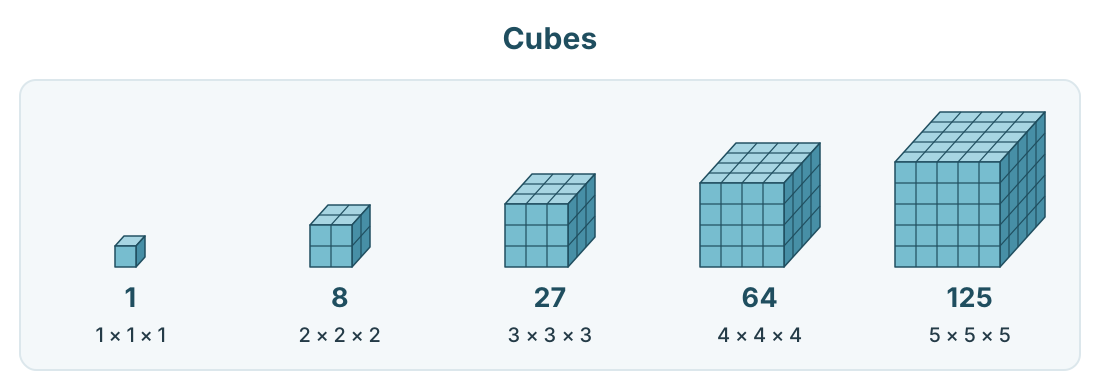
Cube numbers (1, 8, 27, 64, 125, …): dots that fill a cube; the n-th cube number is n × n × n.
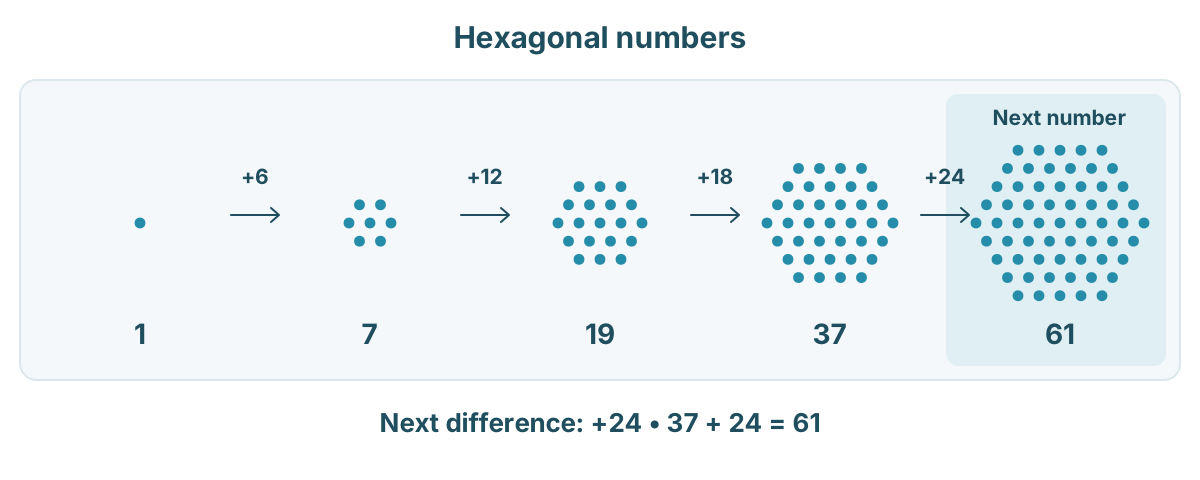
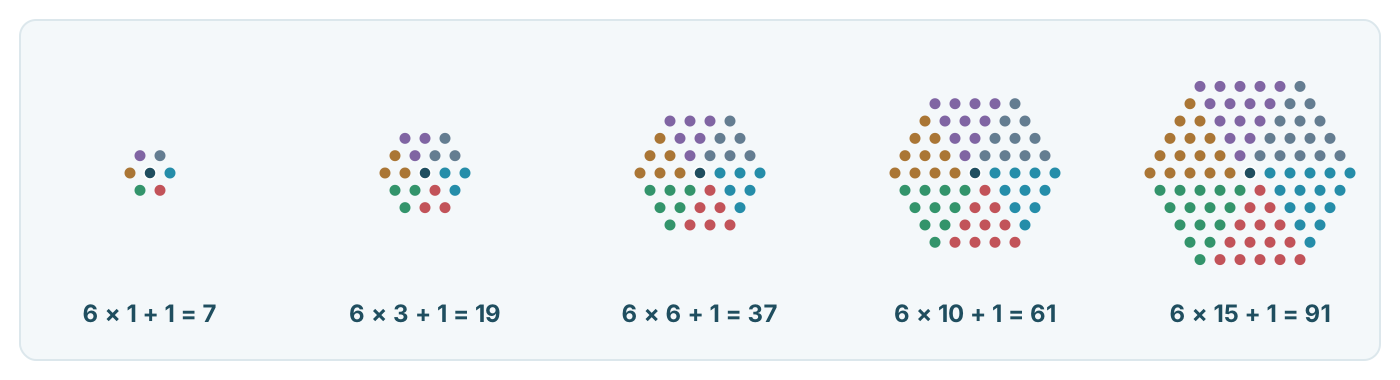
Hexagonal numbers (1, 7, 19, 37, …): dots arranged in growing hexagons.
Virahāṅka (Fibonacci) numbers (1, 2, 3, 5, 8, 13, 21, …): each number is the sum of the previous two.
Geometry: the branch of mathematics that studies patterns in shapes (in 1D, 2D, 3D or more).
Regular polygon: a closed shape with all sides equal and all angles equal — triangle, square, pentagon, hexagon, and so on.
Important Sequences & Patterns (Chapter 1)
Counting numbers: 1, 2, 3, 4, 5, … (add 1 each time).
Odd numbers: 1, 3, 5, 7, 9, … • Even numbers: 2, 4, 6, 8, 10, … (add 2 each time).
Triangular numbers: 1, 3, 6, 10, 15, … (add 2, then 3, then 4, …).
Squares: 1, 4, 9, 16, 25, … = 1×1, 2×2, 3×3, … • Cubes: 1, 8, 27, 64, 125, … = 1×1×1, 2×2×2, …
Powers of 2: 1, 2, 4, 8, 16, … (double each time) • Powers of 3: 1, 3, 9, 27, 81, … (triple each time).
Virahāṅka numbers: 1, 2, 3, 5, 8, 13, 21, … (each = sum of previous two).
Key relation: 1 + 3 + 5 + … + (2n − 1) = n2 (the sum of consecutive odd numbers starting at 1 is always a square).
Figure it Out — Sections 1.1 & 1.2
Figure it Out (page 2)
1. Can you think of other examples where mathematics helps us in our everyday lives?
2. How has mathematics helped propel humanity forward? (You might think of examples involving: carrying out scientific experiments; running our economy and democracy; building bridges, houses or other complex structures; making TVs, mobile phones, computers, bicycles, trains, cars, planes, calendars, clocks, etc.)
Figure it Out (page 3)
1. Can you recognise the pattern in each of the sequences in Table 1?
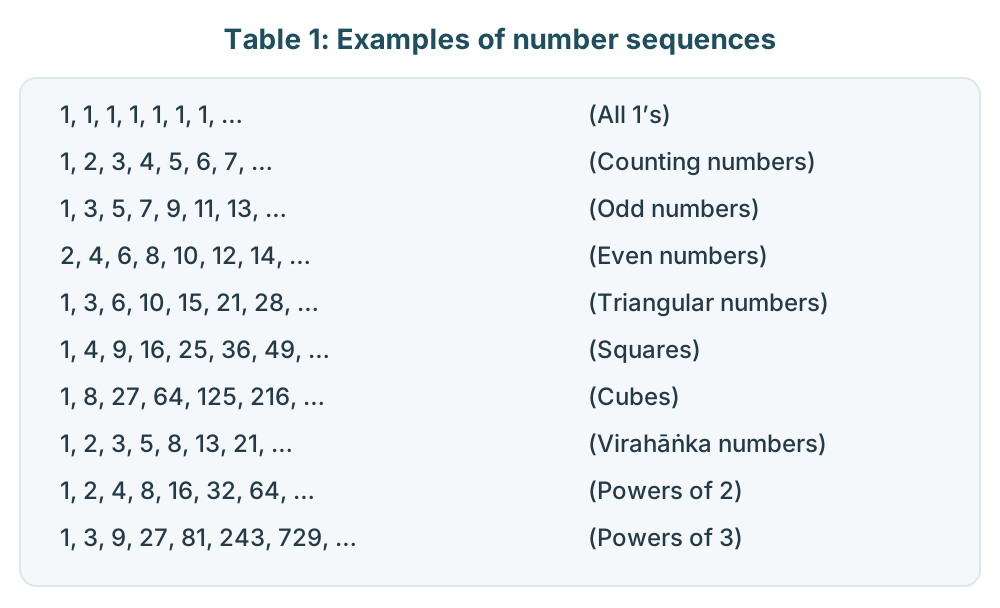
2. Rewrite each sequence of Table 1 in your notebook, along with the next three numbers in each sequence! After each sequence, write in your own words what is the rule for forming the numbers in the sequence.
| Sequence | Next three numbers | Rule |
|---|---|---|
| All 1’s: 1, 1, 1, … | 1, 1, 1 | Every term is 1. |
| Counting: 1, 2, 3, 4, 5, 6, 7, … | 8, 9, 10 | Add 1 each time. |
| Odd: 1, 3, 5, 7, 9, 11, 13, … | 15, 17, 19 | Start at 1, add 2 each time. |
| Even: 2, 4, 6, 8, 10, 12, 14, … | 16, 18, 20 | Start at 2, add 2 each time. |
| Triangular: 1, 3, 6, 10, 15, 21, 28, … | 36, 45, 55 | Add 2, then 3, then 4, … (add the next counting number). |
| Squares: 1, 4, 9, 16, 25, 36, 49, … | 64, 81, 100 | The n-th term is n × n. |
| Cubes: 1, 8, 27, 64, 125, 216, … | 343, 512, 729 | The n-th term is n × n × n. |
| Virahāṅka: 1, 2, 3, 5, 8, 13, 21, … | 34, 55, 89 | Each number is the sum of the previous two. |
| Powers of 2: 1, 2, 4, 8, 16, 32, 64, … | 128, 256, 512 | Double each time. |
| Powers of 3: 1, 3, 9, 27, 81, 243, 729, … | 2187, 6561, 19683 | Triple each time. |
Figure it Out — Section 1.3 (Visualising Number Sequences, page 5)
1. Copy the pictorial representations of the number sequences in Table 2 in your notebook, and draw the next picture for each sequence!
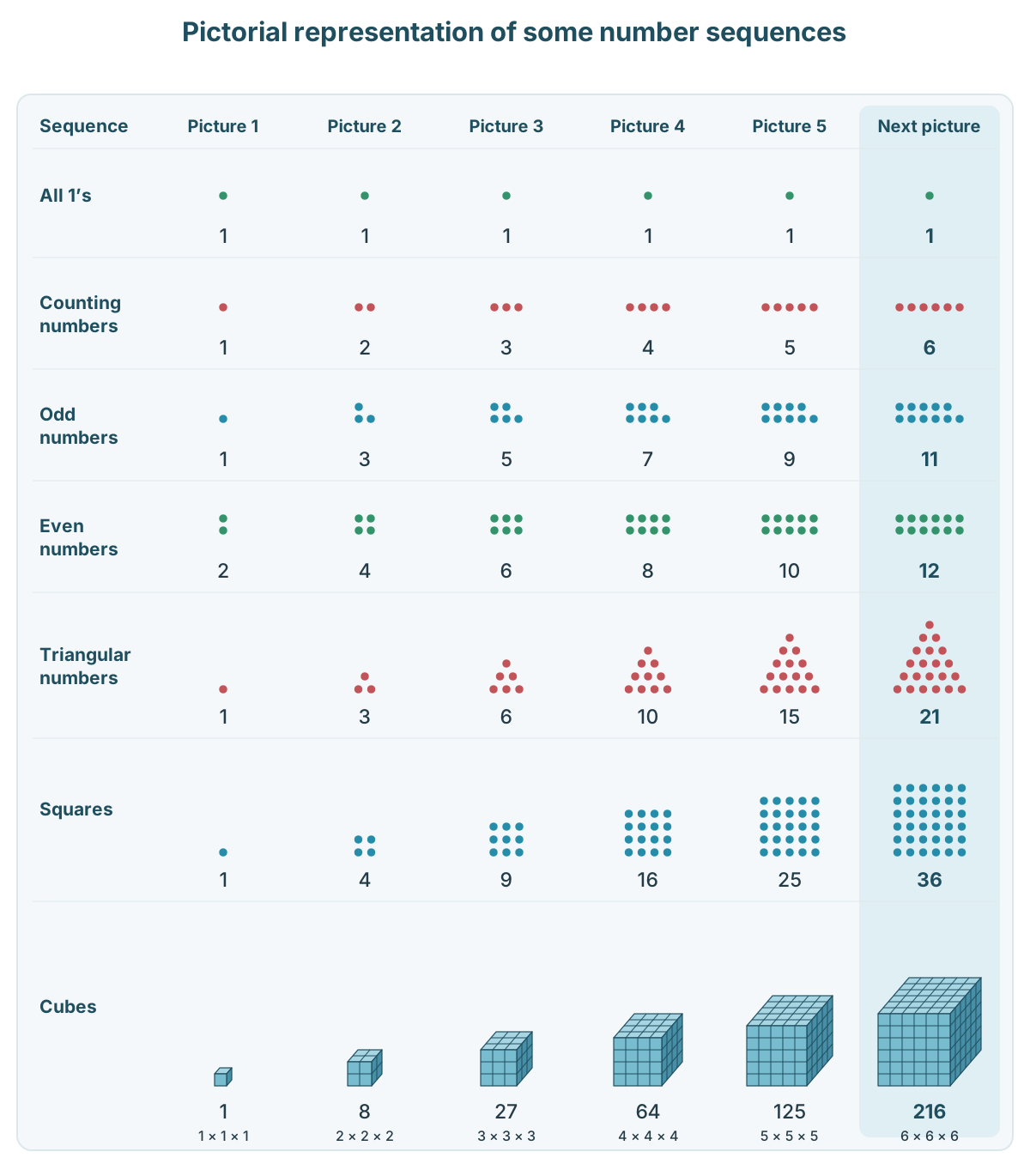
2. Why are 1, 3, 6, 10, 15, … called triangular numbers? Why are 1, 4, 9, 16, 25, … called square numbers or squares? Why are 1, 8, 27, 64, 125, … called cubes?
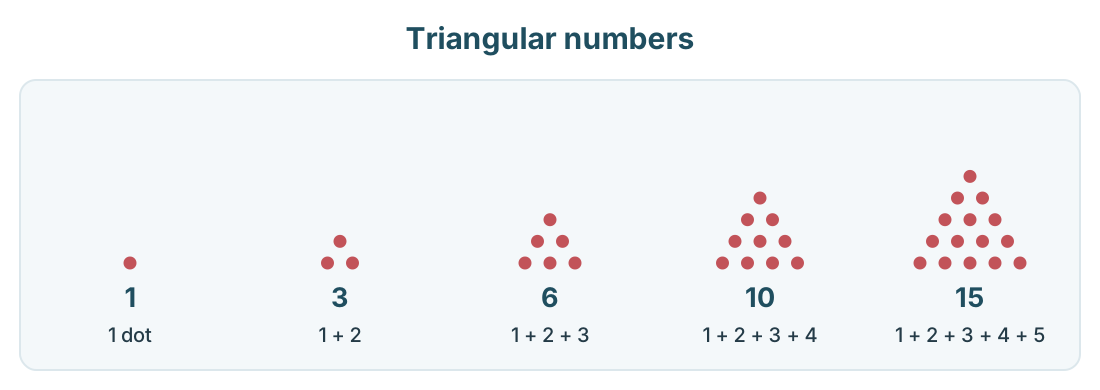
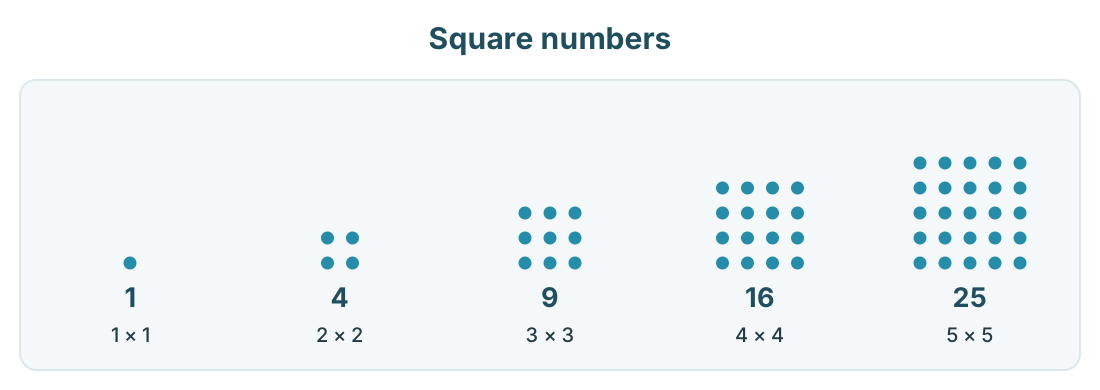
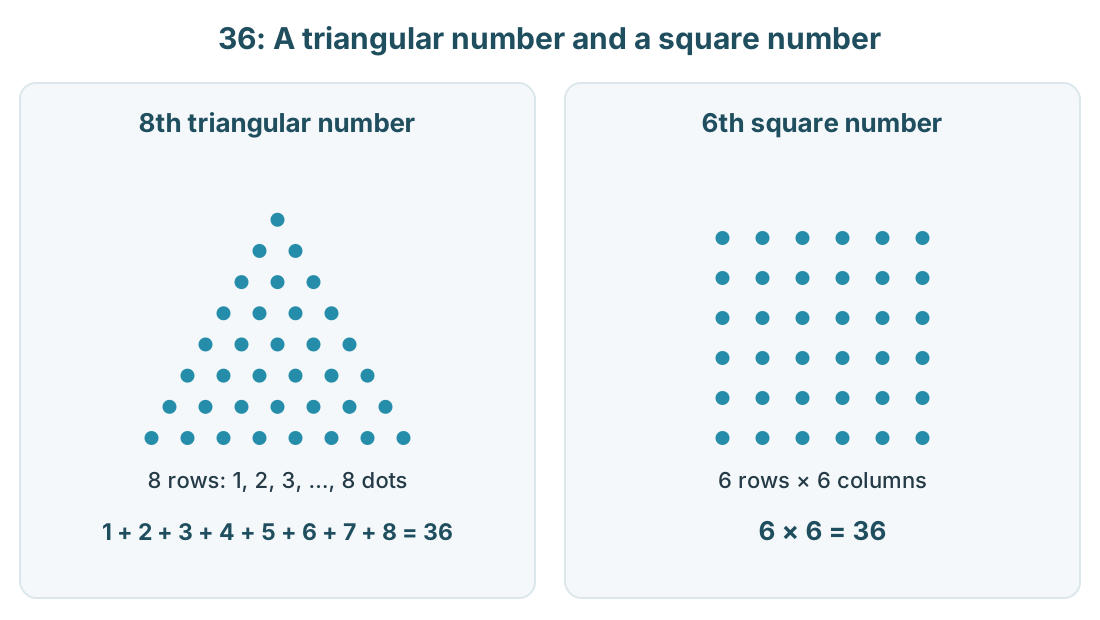
3. You will have noticed that 36 is both a triangular number and a square number! That is, 36 dots can be arranged perfectly both in a triangle and in a square. Make pictures in your notebook illustrating this!
4. What would you call the following sequence of numbers? 1, 7, 19, 37, … That’s right, they are called hexagonal numbers! Draw these in your notebook. What is the next number in the sequence?
5. Can you think of pictorial ways to visualise the sequence of Powers of 2? Powers of 3?
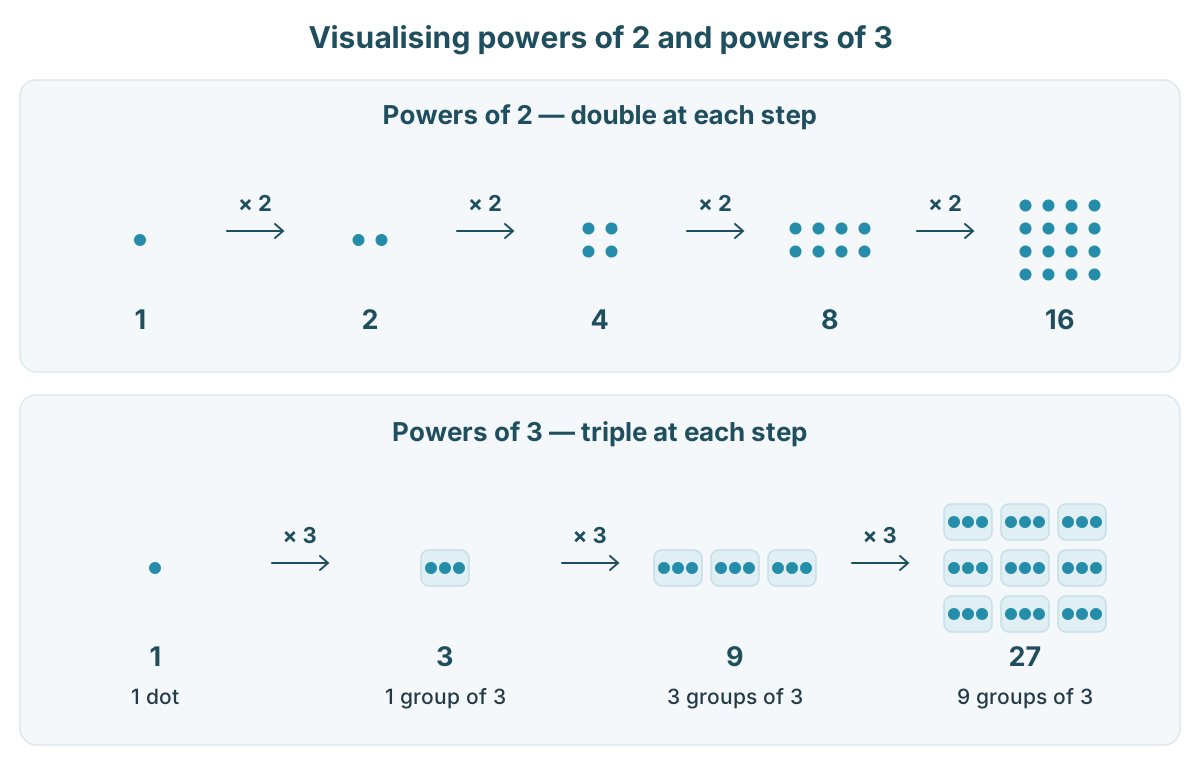
Figure it Out — Section 1.4 (Relations among Sequences, pages 8–9)
1. Can you find a similar pictorial explanation for why adding counting numbers up and down, i.e., 1, 1 + 2 + 1, 1 + 2 + 3 + 2 + 1, …, gives square numbers?
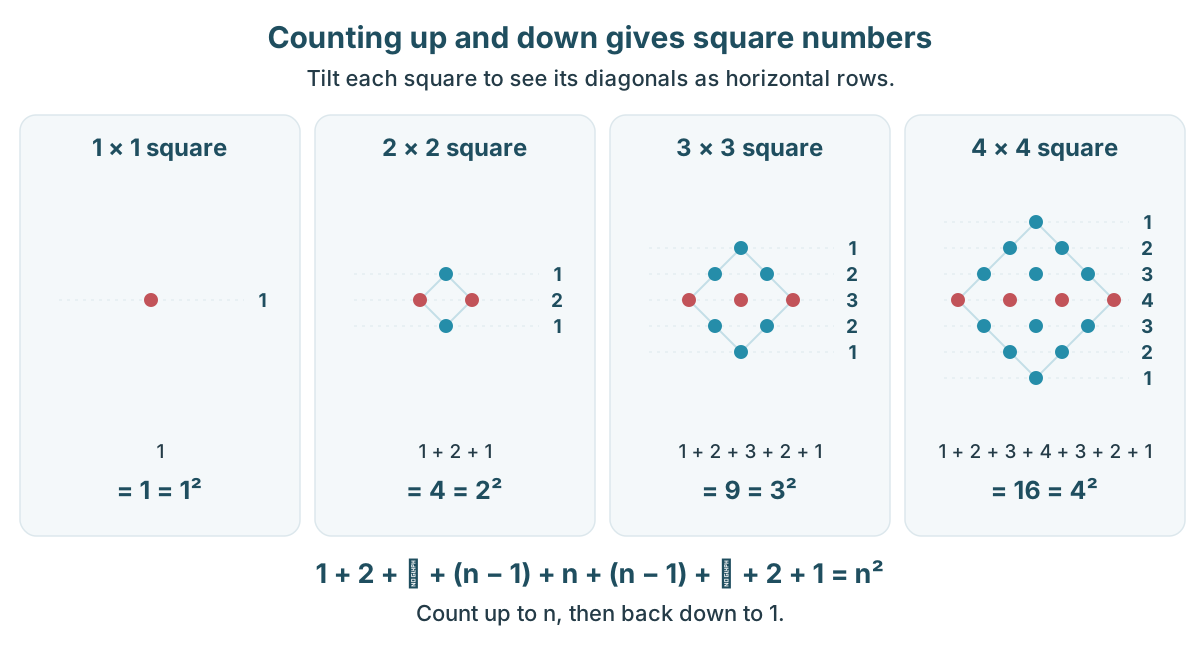
2. By imagining a large version of your picture, or drawing it partially, as needed, can you see what will be the value of 1 + 2 + 3 + … + 99 + 100 + 99 + … + 3 + 2 + 1?
3. Which sequence do you get when you start to add the All 1’s sequence up? What sequence do you get when you add the All 1’s sequence up and down?
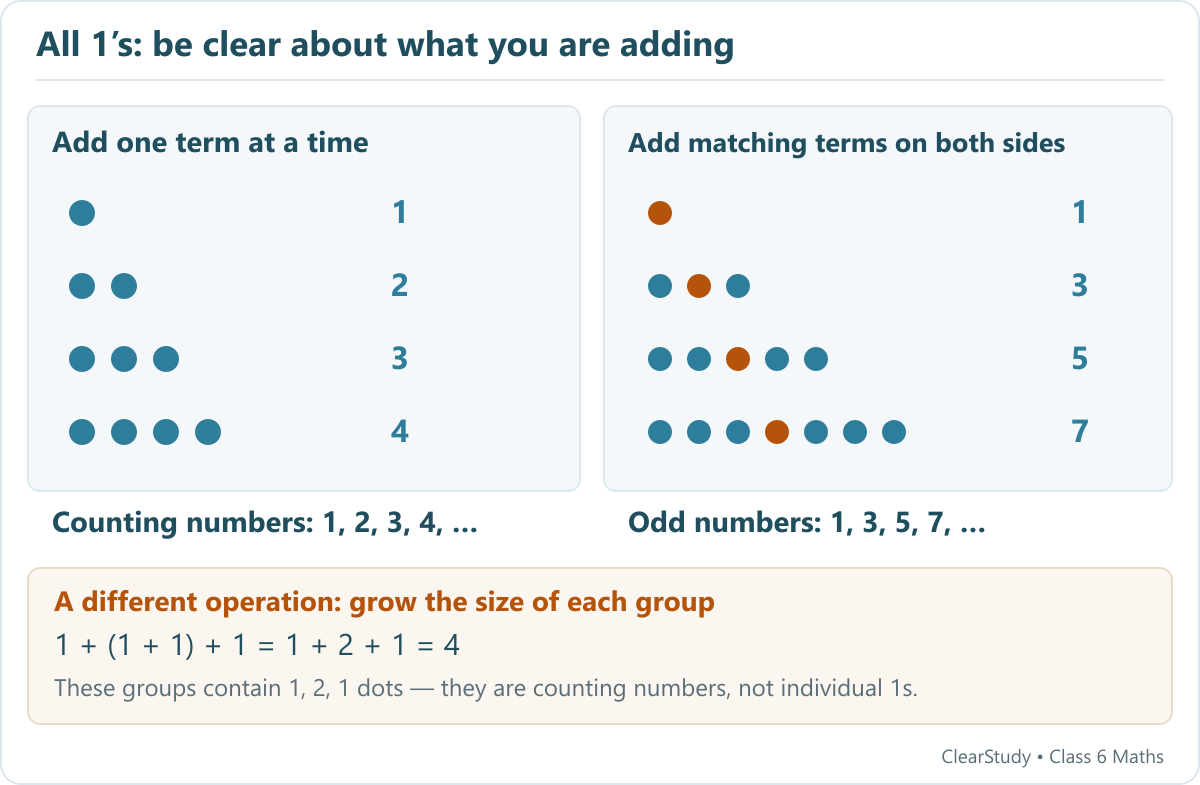
4. Which sequence do you get when you start to add the counting numbers up? Can you give a smaller pictorial explanation?
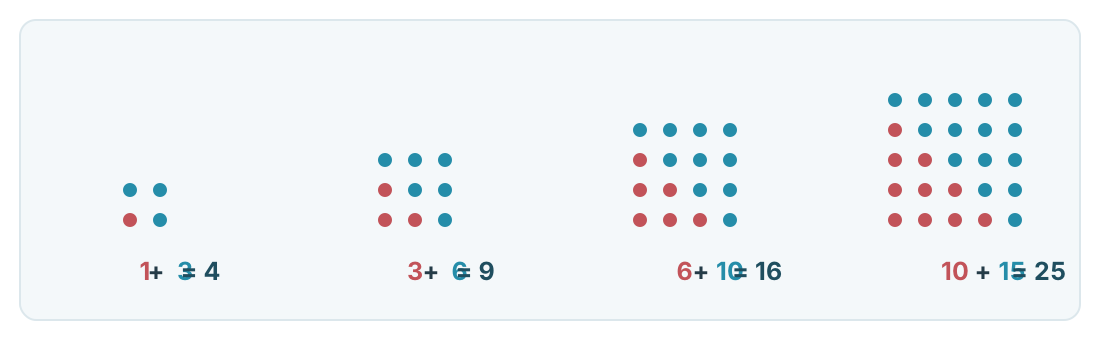
5. What happens when you add up pairs of consecutive triangular numbers? That is, take 1 + 3, 3 + 6, 6 + 10, 10 + 15, … Which sequence do you get? Why? Can you explain it with a picture?
6. What happens when you start to add up powers of 2 starting with 1, i.e., take 1, 1 + 2, 1 + 2 + 4, 1 + 2 + 4 + 8, … ? Now add 1 to each of these numbers — what numbers do you get? Why does this happen?
7. What happens when you multiply the triangular numbers by 6 and add 1? Which sequence do you get? Can you explain it with a picture?
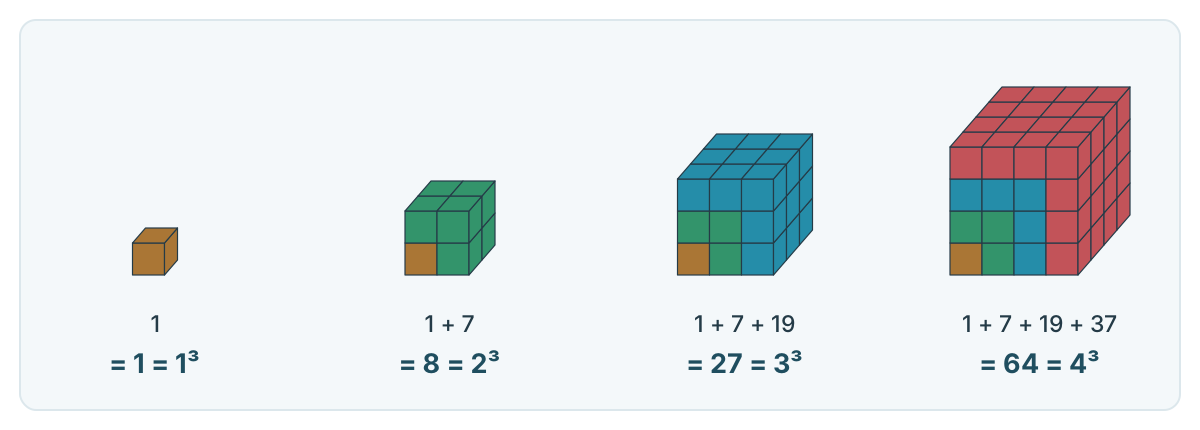
8. What happens when you start to add up hexagonal numbers, i.e., take 1, 1 + 7, 1 + 7 + 19, 1 + 7 + 19 + 37, … ? Which sequence do you get? Can you explain it using a picture of a cube?
9. Find your own patterns or relations in and among the sequences in Table 1. Can you explain why they happen with a picture or otherwise?
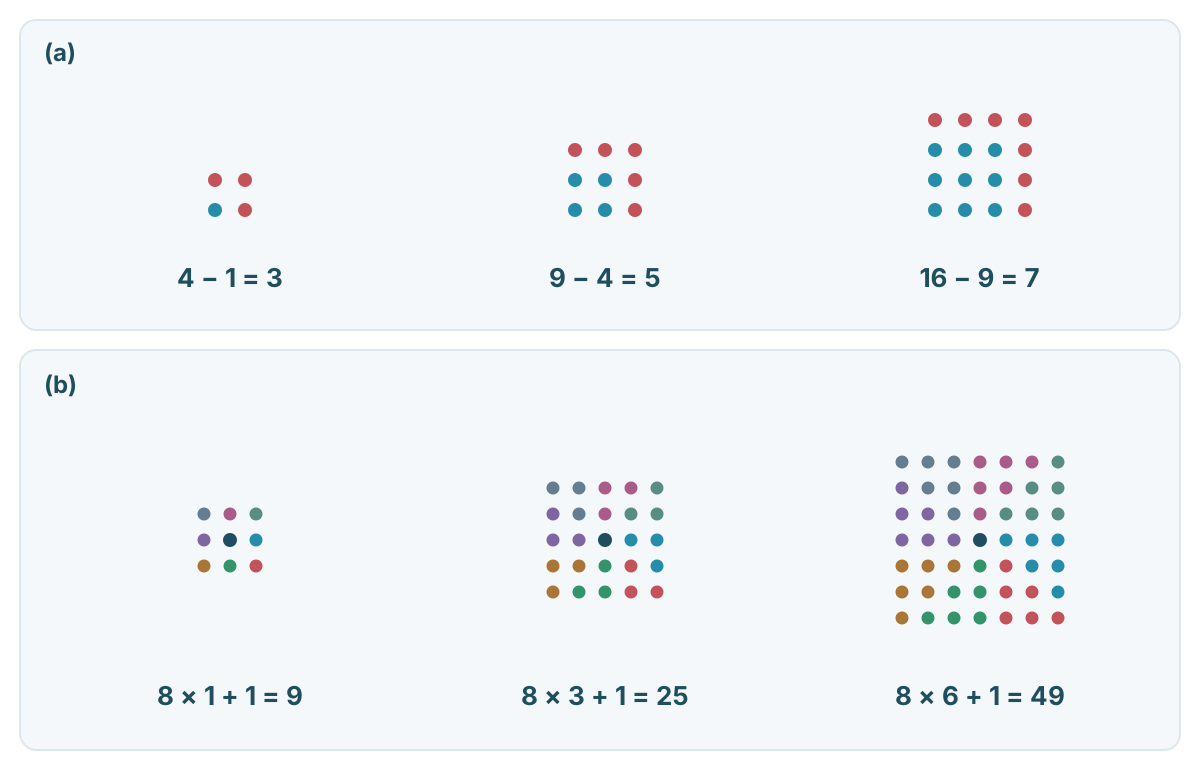
Figure it Out — Sections 1.5 & 1.6 (Patterns in Shapes, pages 11–12)
Figure it Out (page 11)
1. Can you recognise the pattern in each of the sequences in Table 3?
2. Try and redraw each sequence in Table 3 in your notebook. Can you draw the next shape in each sequence? Why or why not? After each sequence, describe in your own words what is the rule or pattern for forming the shapes in the sequence.
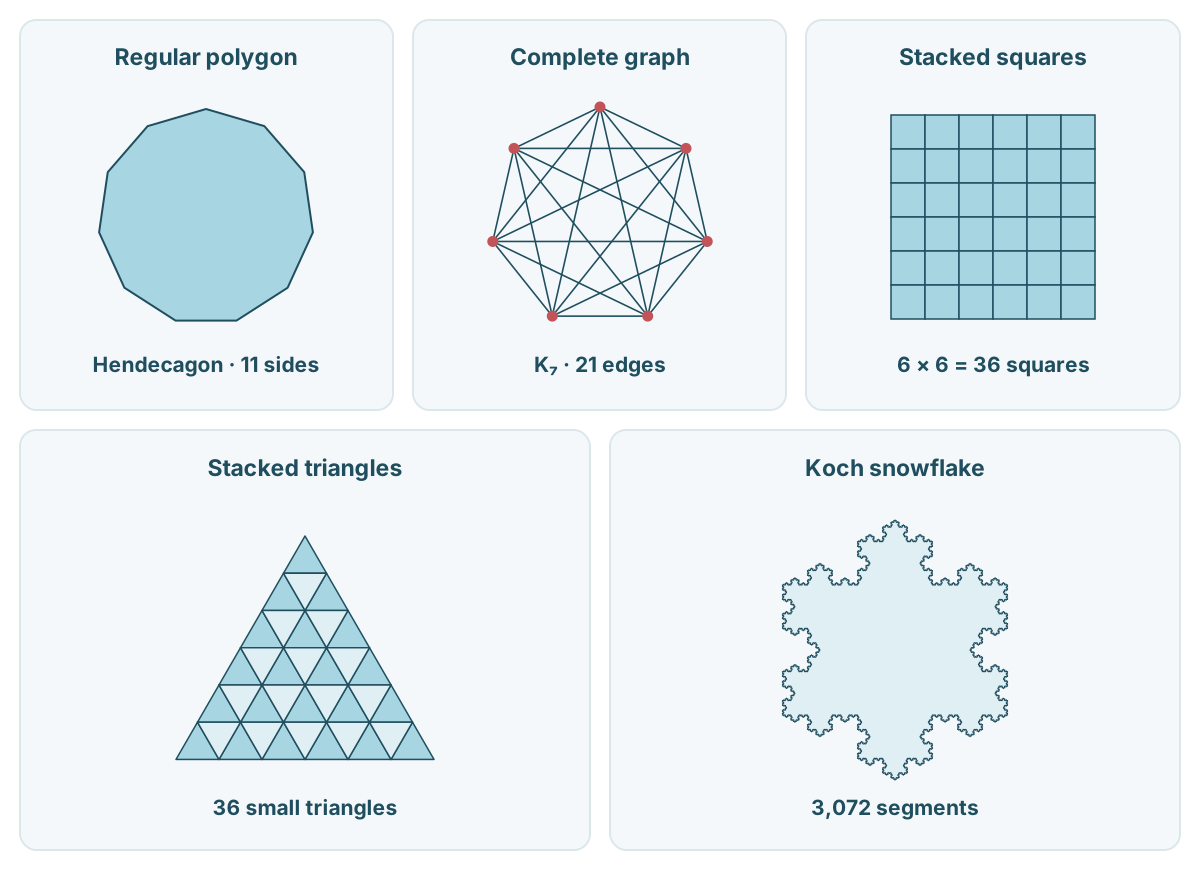
Figure it Out (page 11–12)
1. Count the number of sides in each shape in the sequence of Regular Polygons. Which number sequence do you get? What about the number of corners in each shape in the sequence of Regular Polygons? Do you get the same number sequence? Can you explain why this happens?
2. Count the number of lines in each shape in the sequence of Complete Graphs. Which number sequence do you get? Can you explain why?
3. How many little squares are there in each shape of the sequence of Stacked Squares? Which number sequence does this give? Can you explain why?
4. How many little triangles are there in each shape of the sequence of Stacked Triangles? Which number sequence does this give? Can you explain why? (Hint: In each shape in the sequence, how many triangles are there in each row?)
5. To get from one shape to the next shape in the Koch Snowflake sequence, one replaces each line segment ‘—’ by a ‘speed bump’. As one does this more and more times, the changes become tinier and tinier with very very small line segments. How many total line segments are there in each shape of the Koch Snowflake? What is the corresponding number sequence? (The answer is 3, 12, 48, …, i.e., 3 times Powers of 4; this sequence is not shown in Table 1.)
Math Talk & In-text Tasks — Answered
Common Mistakes to Avoid
Watch out for these
- Confusing the triangular numbers (1, 3, 6, 10, …, add the next counting number) with the odd numbers (1, 3, 5, 7, …, add 2) — check the differences.
- Forgetting that the sum of consecutive odd numbers starting at 1 is a perfect square (n2), not a triangular number.
- In the “up and down” sum 1 + 2 + … + n + … + 2 + 1, the answer is n2 — the peak value n is counted only once, not twice.
- Writing the next power of 2 by adding 2 instead of doubling (and the next power of 3 by tripling, not adding 3).
- Mixing up sides and lines: in regular polygons sides = corners (counting numbers from 3), but in complete graphs the lines follow the triangular numbers.
- For the Koch snowflake, multiplying the count by 3 instead of 4 — each segment becomes 4 segments, so it is 3 × powers of 4.
Practice MCQs & Assertion–Reason
1. The branch of mathematics that studies patterns in whole numbers is called:
(a) geometry (b) algebra (c) number theory (d) statistics
2. The next number in the triangular-number sequence 1, 3, 6, 10, 15, … is:
(a) 18 (b) 20 (c) 21 (d) 25
3. The sum of the first 10 odd numbers is:
(a) 55 (b) 90 (c) 100 (d) 110
4. In the Virahāṅka (Fibonacci) sequence 1, 2, 3, 5, 8, 13, …, the next number is:
(a) 18 (b) 21 (c) 24 (d) 26
5. Adding pairs of consecutive triangular numbers (1 + 3, 3 + 6, 6 + 10, …) gives the:
(a) cube numbers (b) square numbers (c) even numbers (d) powers of 2
6. The next number in the hexagonal sequence 1, 7, 19, 37, … is:
(a) 55 (b) 58 (c) 61 (d) 64
7. The number of lines in the sequence of Complete Graphs (K2, K3, K4, …) follows the:
(a) square numbers (b) triangular numbers (c) cube numbers (d) odd numbers
8. The value of 1 + 2 + 3 + … + 99 + 100 + 99 + … + 2 + 1 is:
(a) 5050 (b) 9900 (c) 10000 (d) 10100
9. Adding up hexagonal numbers (1, 1 + 7, 1 + 7 + 19, …) gives the:
(a) square numbers (b) triangular numbers (c) cube numbers (d) powers of 3
10. The number of line segments in the Koch Snowflake follows the sequence 3, 12, 48, …, which is 3 times the:
(a) powers of 2 (b) powers of 3 (c) powers of 4 (d) square numbers
For each Assertion–Reason question, choose: (A) Both Assertion and Reason are true and the Reason is the correct explanation of the Assertion; (B) Both are true but the Reason is not the correct explanation; (C) Assertion is true but Reason is false; (D) Assertion is false but Reason is true.
A-R 1. Assertion: Adding consecutive odd numbers starting from 1 always gives a square number.
Reason: To grow an n × n square into the next square you add an L-shape of (2n + 1) dots, which is the next odd number.
A-R 2. Assertion: 36 is both a triangular number and a square number.
Reason: 36 = 1 + 2 + 3 + 4 + 5 + 6 + 7 + 8 and 36 = 6 × 6.
A-R 3. Assertion: In a complete graph the number of lines follows the powers of 2.
Reason: With n points, each new point is joined to all earlier points, adding 1, 2, 3, … lines.
A-R 4. Assertion: In any regular polygon the number of sides equals the number of corners.
Reason: In a closed figure every side ends at a corner and every corner joins two sides.
A-R 5. Assertion: Multiplying the triangular numbers by 6 and adding 1 gives the hexagonal numbers 7, 19, 37, …
Reason: A hexagon can be split into a central dot plus six identical triangular arrangements.
Quick Revision Summary
- Mathematics is the search for patterns and the explanations for why those patterns exist.
- Key number sequences: counting, odd, even, triangular (1, 3, 6, 10, …), squares (1, 4, 9, …), cubes (1, 8, 27, …), Virahāṅka (1, 2, 3, 5, 8, …), powers of 2 and powers of 3.
- Adding the first n odd numbers gives n2; adding counting numbers 1 + 2 + 3 + … gives the triangular numbers.
- Adding two consecutive triangular numbers gives a square; adding hexagonal numbers gives cubes; 6 × (triangular) + 1 gives hexagonal numbers.
- Adding powers of 2 (1, 1+2, 1+2+4, …) gives one less than the next power of 2.
- Shape sequences: regular polygons (sides = corners = 3, 4, 5, …), complete graphs (lines = triangular numbers), stacked squares/triangles (square numbers), Koch snowflake (3 × powers of 4).
- Visualising sequences with dot pictures helps explain why these relationships are true.
How to score full marks in this chapter
Always identify the rule of a sequence first (what is added or multiplied each step), then continue it — double for powers of 2, triple for powers of 3, add the next counting number for triangular numbers. When a question asks “why”, give the dot-picture reason (e.g. an L-shape of odd dots builds the next square). State the resulting sequence by name (square, triangular, cube) and show one or two numerical checks so each step earns its mark.
Frequently Asked Questions
What is Class 6 Maths Ganita Prakash Chapter 1 about?
Chapter 1, Patterns in Mathematics, introduces number sequences (counting, odd, even, triangular, square, cube, Virahāṅka and powers of 2 and 3), shows how to visualise them with dot pictures, and explores the surprising relations between number sequences and shape sequences such as regular polygons, complete graphs and the Koch snowflake.
What sequence do you get by adding consecutive odd numbers?
You get the square numbers. 1 = 1, 1 + 3 = 4, 1 + 3 + 5 = 9, 1 + 3 + 5 + 7 = 16, and so on — the sum of the first n odd numbers is always n2, because each new odd number adds an L-shape of dots that grows one square into the next.
Why is 36 both a triangular number and a square number?
36 is the 8th triangular number (1 + 2 + 3 + … + 8 = 36), so 36 dots form a triangle; it is also the 6th square number (6 × 6 = 36), so the same 36 dots fill a square grid. A number can play different roles depending on how its dots are arranged.
Are these Class 6 Maths Ganita Prakash Chapter 1 solutions free?
Yes. All solutions are free and follow the official NCERT Ganita Prakash textbook for the 2026–27 session, with every Figure it Out, Math Talk and Try This task solved and verified.
Textbook reference: NCERT Ganita Prakash, Chapter 1: Patterns in Mathematics. The explanatory dot diagram above was created by ClearStudy.