
Class 6 Maths Chapter 5 Solutions – Prime Time
These Class 6 Maths Ganita Prakash Chapter 5 solutions cover Prime Time from the new NCF textbook (Reprint 2026–27). Worked Figure it Out answers, original diagrams and guided activities explain common multiples, common factors, prime and composite numbers, prime factorisation, co-prime numbers and divisibility tests — so you can master the chapter and revise it quickly.
- Chapter overview
- Key concepts & definitions
- Important rules & tests
- Figure it Out 5.1 (Common Multiples & Factors)
- Figure it Out 5.2 (Prime Numbers)
- Figure it Out 5.4 (Prime Factorisation)
- Figure it Out 5.5 (Divisibility Tests)
- Math Talk & Try This (answered)
- Common mistakes to avoid
- Practice MCQs & Assertion–Reason
- Quick revision summary
- FAQs
Chapter 5 Overview
Chapter 5 of Ganita Prakash, Prime Time, uses playful games — the Idli-Vada game and Grumpy and Jumpy’s treasure hunt — to introduce common multiples and common factors. It then builds the ideas of prime and composite numbers (with the Sieve of Eratosthenes), co-prime numbers, prime factorisation and how it is used to test co-primeness and divisibility, and the quick divisibility tests for 10, 5, 2, 4 and 8. The Class 6 Maths Ganita Prakash Chapter 5 solutions below show the reasoning behind the exercises and guide the practical activities.
Key Concepts & Definitions
Multiple: the result of multiplying a number by 1, 2, 3, … (e.g. multiples of 3 are 3, 6, 9, 12, …). A common multiple of two numbers is a multiple of both (e.g. 15 is a common multiple of 3 and 5).
Factor (divisor): a number that divides another exactly with no remainder (e.g. the factors of 24 are 1, 2, 3, 4, 6, 8, 12, 24). A common factor divides both numbers (e.g. 1 and 2 are the common factors of 14 and 36).
Prime number: a positive integer greater than 1 that has exactly two positive factors — 1 and itself (e.g. 2, 3, 5, 7, 11, …). 2 is the only even prime.
Composite number: a positive integer greater than 1 with more than two positive factors (e.g. 4, 6, 8, 9, …). The number 1 is neither prime nor composite.
Co-prime numbers: two numbers that have no common factor other than 1 (e.g. 4 and 9). They need not be prime themselves.
Prime factorisation: writing a number as a product of prime numbers only (e.g. 56 = 2 × 2 × 2 × 7). Every number greater than 1 has exactly one prime factorisation, apart from the order of factors.
Perfect number: a number whose factors (including itself) add up to twice the number (e.g. 6 and 28).
Important Rules & Tests (Chapter 5)
Co-prime test: two numbers are co-prime when their prime factorisations share no common prime factor.
Divisibility test (using prime factorisation): a number is divisible by another when the prime factorisation of the second is fully included in that of the first.
Divisible by 10: the number ends in 0.
Divisible by 5: the number ends in 0 or 5.
Divisible by 2: the number ends in 0, 2, 4, 6 or 8 (it is even).
Divisible by 4: the number formed by the last two digits is divisible by 4.
Divisible by 8: the number formed by the last three digits is divisible by 8.
Figure it Out — 5.1 Common Multiples and Common Factors (Page 108 & 110–111)
Figure it Out (Page 108)
1. At what number is ‘idli-vada’ said for the 10th time?
2. If the game is played for the numbers 1 to 90, find out: a. How many times would the children say ‘idli’ (including the times they say ‘idli-vada’)? b. How many times would the children say ‘vada’ (including the times they say ‘idli-vada’)? c. How many times would the children say ‘idli-vada’?
3. What if the game was played till 900? How would your answers change?
4. Is this figure somehow related to the ‘idli-vada’ game? Hint: Imagine playing the game till 30. Draw the figure if the game is played till 60.
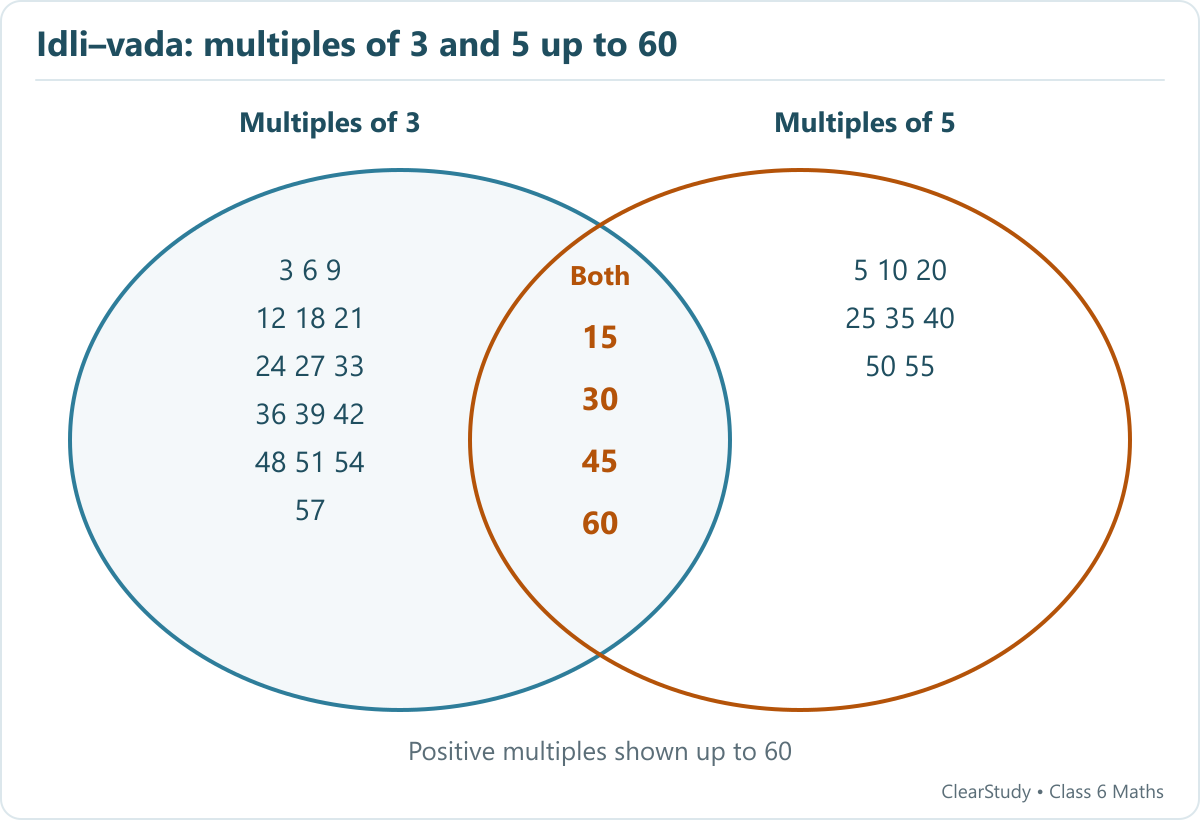
Figure it Out (Page 110–111)
1. Find all multiples of 40 that lie between 310 and 410.
2. Who am I? a. I am a number less than 40. One of my factors is 7. The sum of my digits is 8. b. I am a number less than 100. Two of my factors are 3 and 5. One of my digits is 1 more than the other.
3. A number for which the sum of all its factors is equal to twice the number is called a perfect number. The number 28 is a perfect number. Its factors are 1, 2, 4, 7, 14 and 28. Their sum is 56 which is twice 28. Find a perfect number between 1 and 10.
4. Find the common factors of: a. 20 and 28 b. 35 and 50 c. 4, 8 and 12 d. 5, 15 and 25
5. Find any three numbers that are multiples of 25 but not multiples of 50.
6. Anshu and his friends play the ‘idli-vada’ game with two numbers, which are both smaller than 10. The first time anybody says ‘idli-vada’ is after the number 50. What could the two numbers be which are assigned ‘idli’ and ‘vada’?
7. In the treasure hunting game, Grumpy has kept treasures on 28 and 70. What jump sizes will land on both the numbers?
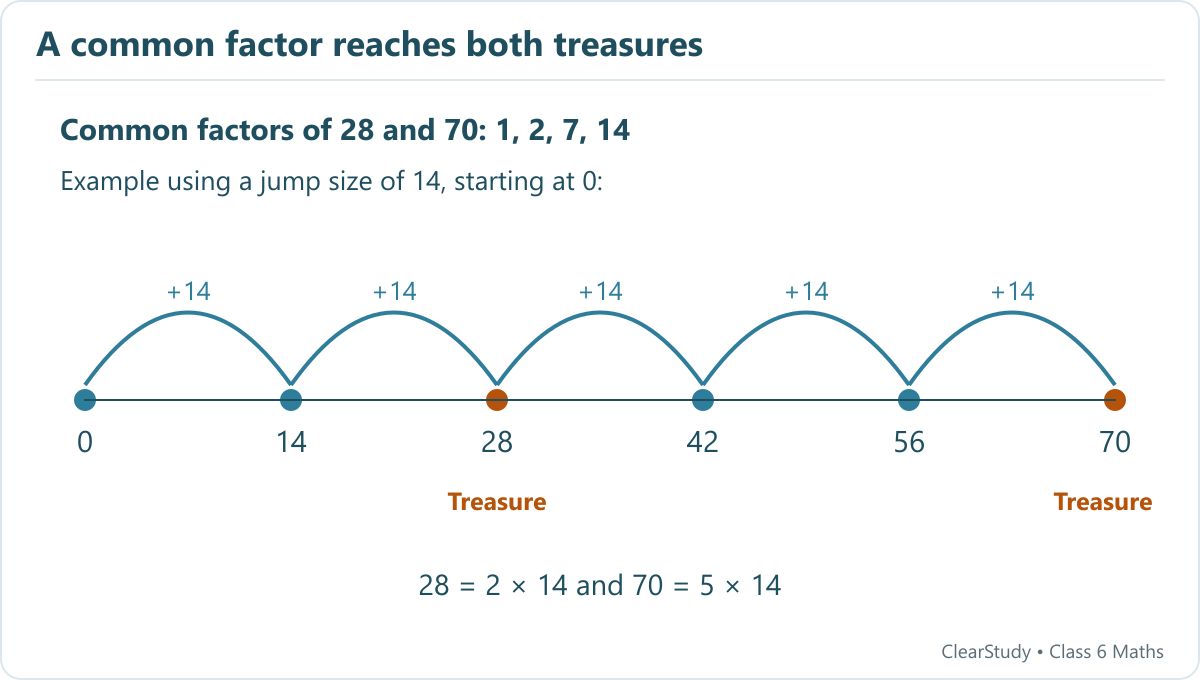
8. In the diagram below, Guna has erased all the numbers except the common multiples. Find out what those numbers could be and fill in the missing numbers in the empty regions. (Common multiples shown: 24, 48, 72.)
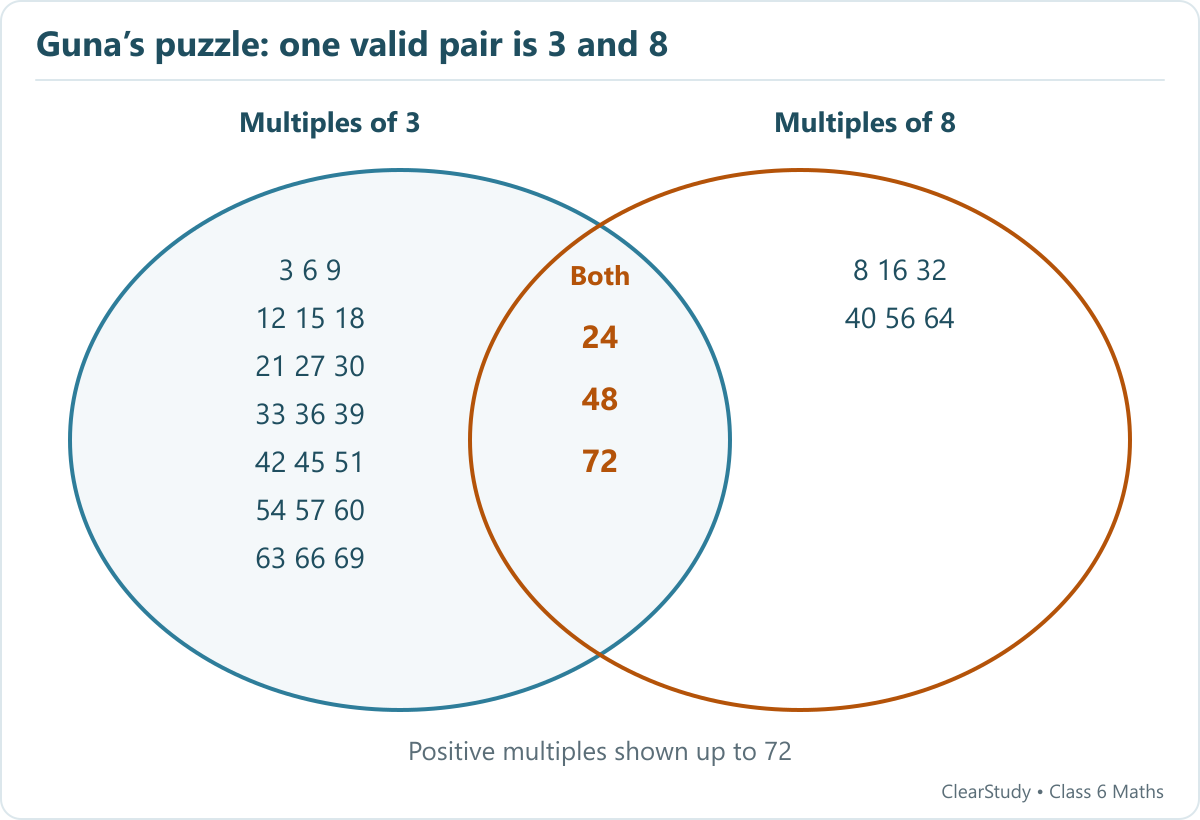
9. Find the smallest number that is a multiple of all the numbers from 1 to 10, except for 7.
10. Find the smallest number that is a multiple of all the numbers from 1 to 10.
Why rectangular arrays reveal factors
Ignoring rotations, 12 can form rectangles of 1 × 12, 2 × 6 or 3 × 4. Seven can form only 1 × 7. This is why 12 is composite and 7 is prime.
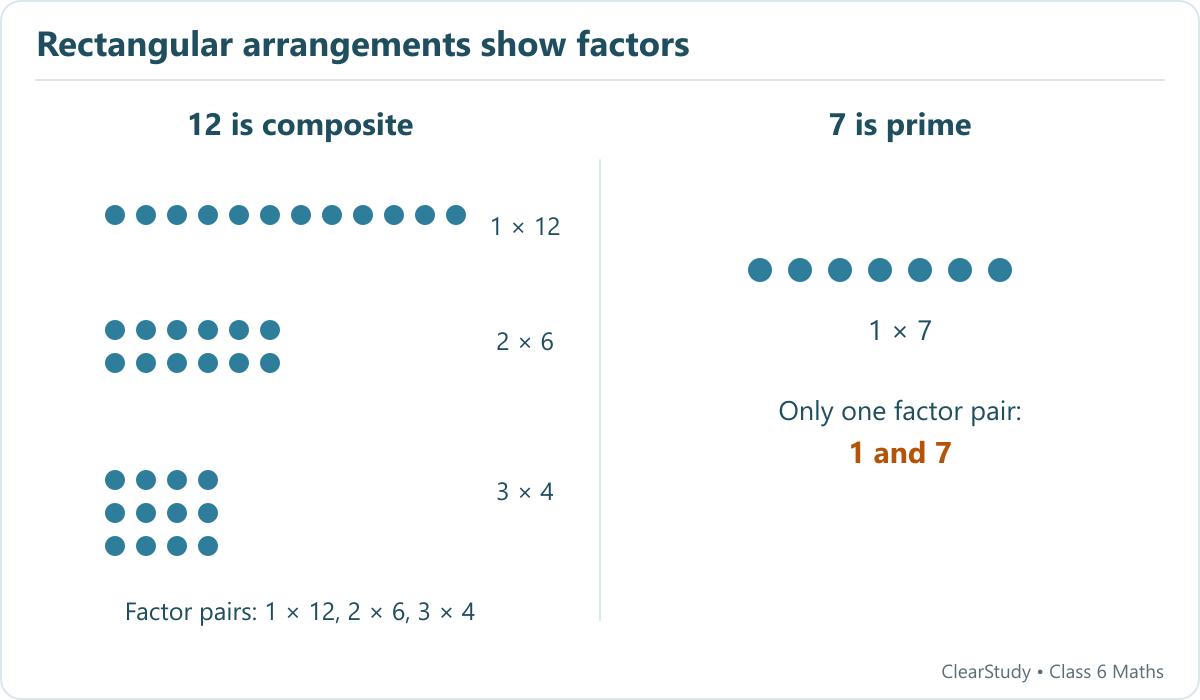
Figure it Out — 5.2 Prime Numbers (Page 114)
1. We see that 2 is a prime and also an even number. Is there any other even prime?
2. Look at the list of primes till 100. What is the smallest difference between two successive primes? What is the largest difference?
3. Are there an equal number of primes occurring in every row in the table on the previous page? Which decades have the least number of primes? Which have the most number of primes?
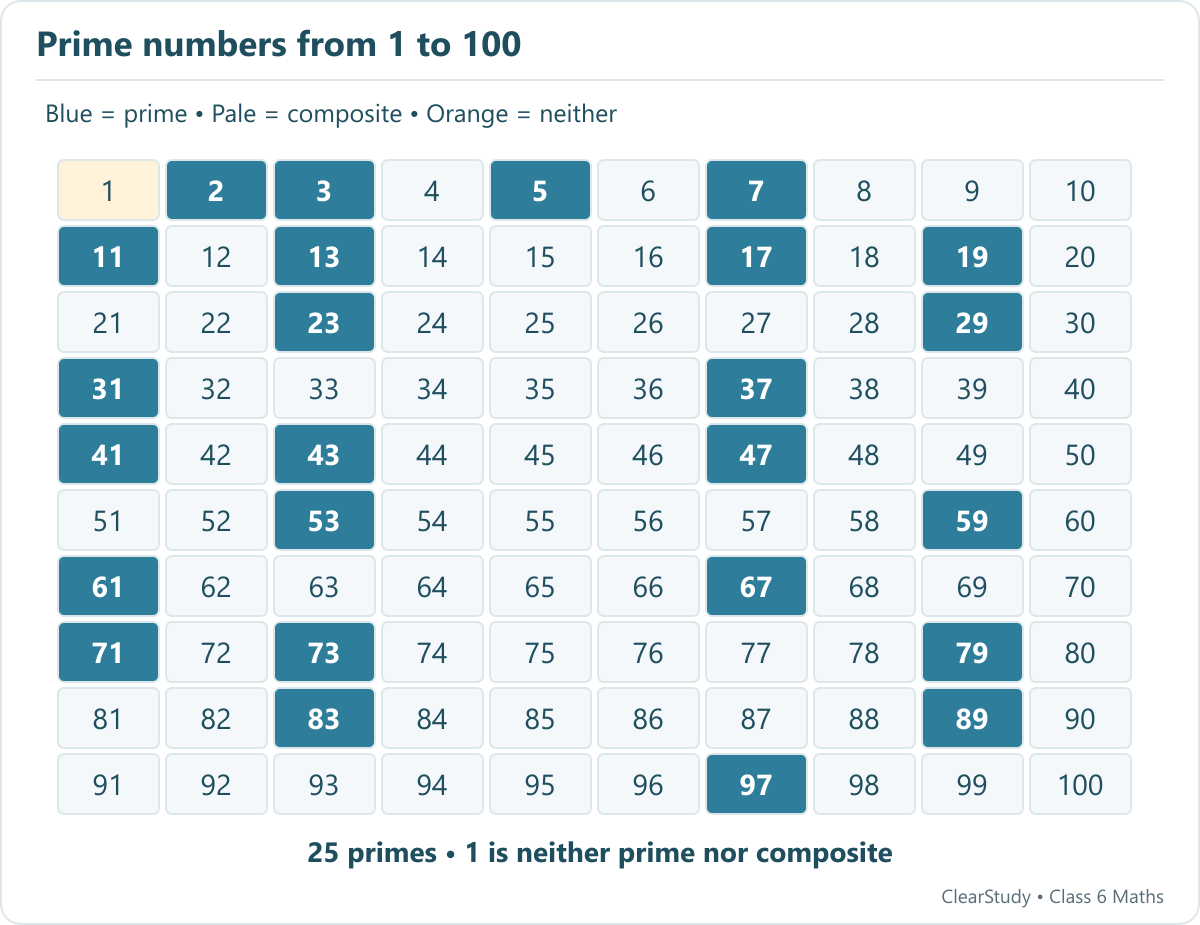
4. Which of the following numbers are prime: 23, 51, 37, 26?
5. Write three pairs of prime numbers less than 20 whose sum is a multiple of 5.
6. The numbers 13 and 31 are prime numbers. Both these numbers have same digits 1 and 3. Find such pairs of prime numbers up to 100.
7. Find seven consecutive composite numbers between 1 and 100.
8. Twin primes are pairs of primes having a difference of 2. For example, 3 and 5 are twin primes. So are 17 and 19. Find the other twin primes between 1 and 100.
9. Identify whether each statement is true or false. Explain. a. There is no prime number whose units digit is 4. b. A product of primes can also be prime. c. Prime numbers do not have any factors. d. All even numbers are composite numbers. e. 2 is a prime and so is the next number, 3. For every other prime, the next number is composite.
10. Which of the following numbers is the product of exactly three distinct prime numbers: 45, 60, 91, 105, 330?
11. How many three-digit prime numbers can you make using each of 2, 4 and 5 once?
12. Observe that 3 is a prime number, and 2 × 3 + 1 = 7 is also a prime. Are there other primes for which doubling and adding 1 gives another prime? Find at least five such examples.
Worked factor-tree example: 56 and 63
Keep splitting composite factors until every leaf is prime. The trees give 56 = 2 × 2 × 2 × 7 and 63 = 3 × 3 × 7. The shared prime 7 proves they are not co-prime.
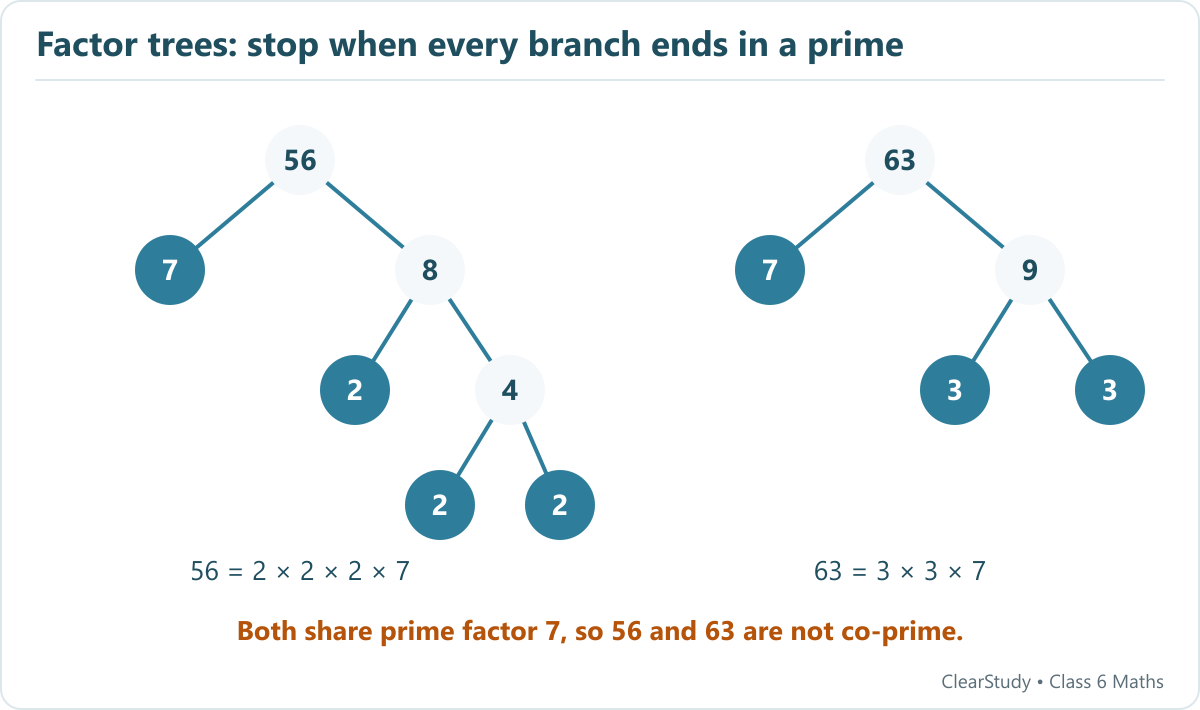
Figure it Out — 5.4 Prime Factorisation (Page 120 & 122)
Figure it Out (Page 120)
1. Find the prime factorisations of the following numbers: 64, 104, 105, 243, 320, 141, 1728, 729, 1024, 1331, 1000.
2. The prime factorisation of a number has one 2, two 3s, and one 11. What is the number?
3. Find three prime numbers, all less than 30, whose product is 1955.
4. Find the prime factorisation of these numbers without multiplying first. a. 56 × 25 b. 108 × 75 c. 1000 × 81
5. What is the smallest number whose prime factorisation has: a. three different prime numbers? b. four different prime numbers?
Figure it Out (Page 122)
1. Are the following pairs of numbers co-prime? Guess first and then use prime factorisation to verify your answer. a. 30 and 45 b. 57 and 85 c. 121 and 1331 d. 343 and 216
2. Is the first number divisible by the second? Use prime factorisation. a. 225 and 27 b. 96 and 24 c. 343 and 17 d. 999 and 99
3. The first number has prime factorisation 2 × 3 × 7 and the second number has prime factorisation 3 × 7 × 11. Are they co-prime? Does one of them divide the other?
4. Guna says, “Any two prime numbers are co-prime”. Is he right?
Figure it Out — 5.5 Divisibility Tests (Page 125)
1. 2024 is a leap year (as February has 29 days). Leap years occur in the years that are multiples of 4, except for those years that are evenly divisible by 100 but not 400. a. From the year you were born till now, which years were leap years? b. From the year 2024 till 2099, how many leap years are there?
2. Find the largest and smallest 4-digit numbers that are divisible by 4 and are also palindromes.
3. Explore and find out if each statement is always true, sometimes true or never true. You can give examples to support your reasoning. a. Sum of two even numbers gives a multiple of 4. b. Sum of two odd numbers gives a multiple of 4.
4. Find the remainders obtained when each of the following numbers are divided by (a) 10, (b) 5, (c) 2. 78, 99, 173, 572, 980, 1111, 2345
| Number | ÷ 10 | ÷ 5 | ÷ 2 |
|---|---|---|---|
| 78 | 8 | 3 | 0 |
| 99 | 9 | 4 | 1 |
| 173 | 3 | 3 | 1 |
| 572 | 2 | 2 | 0 |
| 980 | 0 | 0 | 0 |
| 1111 | 1 | 1 | 1 |
| 2345 | 5 | 0 | 1 |
5. The teacher asked if 14560 is divisible by all of 2, 4, 5, 8 and 10. Guna checked for divisibility of 14560 by only two of these numbers and then declared that it was also divisible by all of them. What could those two numbers be?
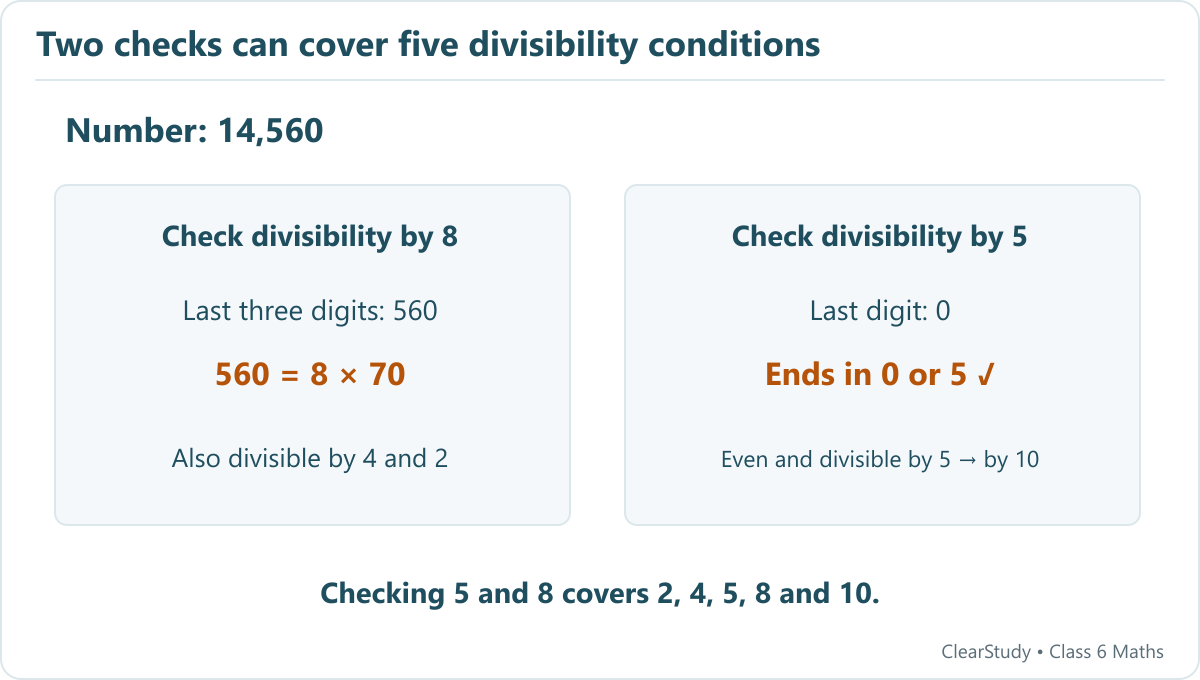
6. Which of the following numbers are divisible by all of 2, 4, 5, 8 and 10: 572, 2352, 5600, 6000, 77622160.
7. Write two numbers whose product is 10000. The two numbers should not have 0 as the units digit.
Math Talk & Try This — Answered
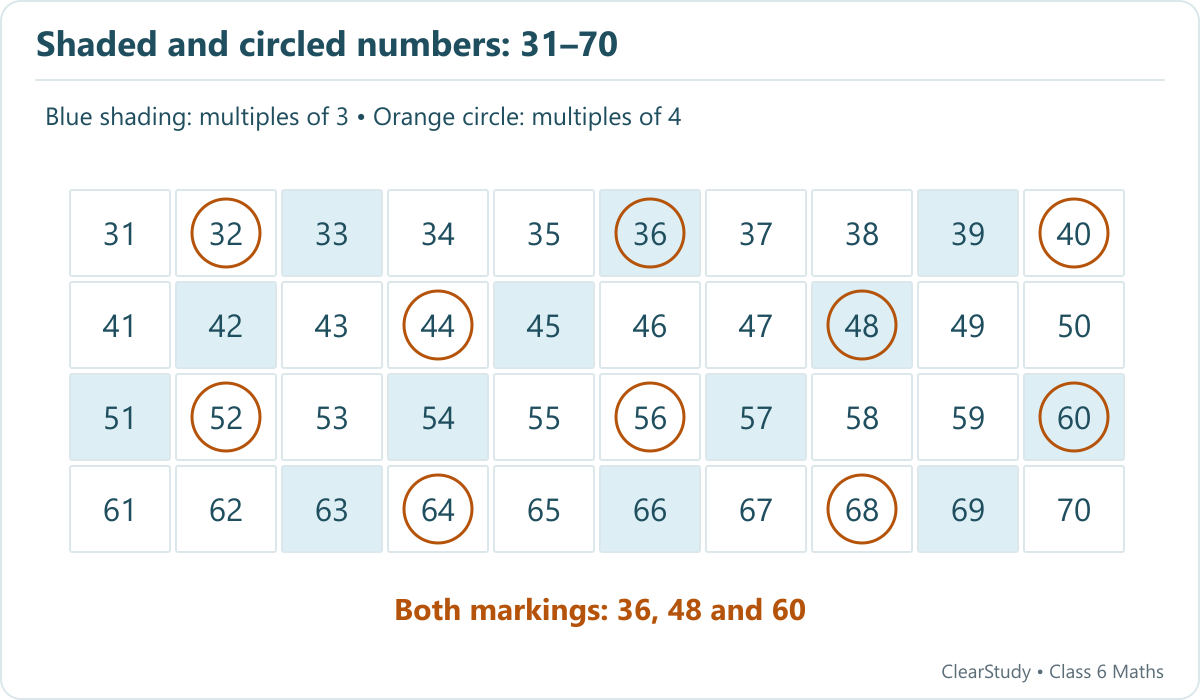
These are the in-text reflective and short tasks in the chapter; the determinate ones are answered, the open ones are guided.
Common Mistakes to Avoid
Watch out for these
- Calling 1 a prime — the number 1 is neither prime nor composite (it has only one factor).
- Thinking co-prime numbers must themselves be prime — e.g. 4 and 9 are co-prime but neither is prime.
- Mixing up factors and multiples: a jump size that reaches a treasure is a factor; the idli-vada numbers are common multiples.
- Concluding two numbers are co-prime from one factorisation like 56 = 14 × 4 — always use the full prime factorisation.
- Testing divisibility by 4 with the last one digit — use the last two digits for 4 and the last three digits for 8.
- Forgetting that the only even prime is 2 — every other even number is composite.
Practice MCQs & Assertion–Reason
1. The smallest prime number is:
(a) 0 (b) 1 (c) 2 (d) 3
2. Which number is neither prime nor composite?
(a) 1 (b) 2 (c) 3 (d) 4
3. The common factors of 20 and 28 are:
(a) 1, 2 (b) 1, 2, 4 (c) 2, 4, 5 (d) 1, 4, 7
4. Which of these pairs is co-prime?
(a) 12 and 18 (b) 15 and 39 (c) 4 and 15 (d) 20 and 55
5. The prime factorisation of 105 is:
(a) 3 × 5 × 7 (b) 5 × 21 (c) 3 × 35 (d) 5 × 5 × 3
6. The smallest number that is a multiple of all numbers from 1 to 10 is:
(a) 360 (b) 840 (c) 1260 (d) 2520
7. For numbers with at least three digits, what is the fewest final digits sufficient to decide divisibility by 8?
(a) one digit (b) two digits (c) three digits (d) four digits
8. Which of the following is the product of exactly three distinct primes?
(a) 45 (b) 60 (c) 91 (d) 105
9. A perfect number between 1 and 10 is:
(a) 4 (b) 6 (c) 8 (d) 9
10. Which pair is a set of twin primes?
(a) 7 and 11 (b) 13 and 17 (c) 17 and 19 (d) 23 and 29
For each Assertion–Reason question, choose: (A) Both Assertion and Reason are true and the Reason is the correct explanation of the Assertion; (B) Both are true but the Reason is not the correct explanation; (C) Assertion is true but Reason is false; (D) Assertion is false but Reason is true.
A-R 1. Assertion: 2 is the only even prime number.
Reason: Every even number greater than 2 is divisible by 2, so it has more than two factors.
A-R 2. Assertion: The numbers 4 and 9 are co-prime.
Reason: Two numbers are co-prime only when both of them are prime numbers.
A-R 3. Assertion: 1 is a prime number.
Reason: A prime number has exactly two factors, 1 and itself.
A-R 4. Assertion: 105 = 3 × 5 × 7 is the prime factorisation of 105.
Reason: Every number greater than 1 has exactly one prime factorisation, apart from the order of factors.
A-R 5. Assertion: 5600 is divisible by 8.
Reason: The number formed by its last three digits, 600, is divisible by 8.
Quick Revision Summary
- A common multiple of two numbers is a multiple of both; a common factor divides both.
- A prime number has exactly two factors; a composite number has more than two; 1 is neither.
- 2 is the only even prime; the Sieve of Eratosthenes lists primes up to 100.
- Two numbers are co-prime if their only common factor is 1 (they need not be prime).
- Prime factorisation writes a number as a product of primes, and it is unique apart from order.
- Use prime factorisation to test co-primeness (no shared prime) and divisibility (second’s primes contained in the first’s).
- Divisibility: ends in 0 (by 10); ends in 0/5 (by 5); even (by 2); last two digits (by 4); last three digits (by 8).
How to score full marks in this chapter
Always write the full prime factorisation before deciding if two numbers are co-prime or whether one divides the other — never judge from a single split like 56 = 14 × 4. For divisibility, quote the exact rule you are using (“last two digits for 4”, “last three for 8”). For ‘smallest number’ questions take the highest power of each prime (LCM). Keep factor lists and multiple lists clearly separated so you do not confuse jump sizes (factors) with idli-vada numbers (common multiples).
Frequently Asked Questions
What is Class 6 Maths Ganita Prakash Chapter 5 about?
Chapter 5, Prime Time, covers common multiples and common factors (through the Idli-Vada and treasure-hunt games), prime and composite numbers, the Sieve of Eratosthenes, co-prime numbers, prime factorisation and its uses, and the divisibility tests for 10, 5, 2, 4 and 8.
How many Figure it Out exercises are there in Chapter 5?
There are four main “Figure it Out” sets — in Section 5.1 (Common Multiples and Common Factors), 5.2 (Prime Numbers), 5.4 (Prime Factorisation) and 5.5 (Divisibility Tests) — plus several Math Talk and Try This tasks, with worked solutions and guided activities below.
Why is 1 neither a prime nor a composite number?
A prime has exactly two factors and a composite has more than two. The number 1 has only one factor (itself), so it fits neither definition — that is why 1 is classed as neither prime nor composite.
Are these Class 6 Maths Ganita Prakash Chapter 5 solutions free?
Yes. These free NCERT Ganita Prakash solutions include worked explanations, original diagrams and guided activities.
Textbook reference: NCERT Ganita Prakash, Chapter 5 (official PDF). ClearStudy diagrams and worked explanations are original teaching aids.