Class 6 Maths Chapter 6 Solutions – Perimeter and Area
These Class 6 Maths Ganita Prakash Chapter 6 solutions explain Perimeter and Area with labelled diagrams and step-by-step calculations. Work through running tracks, grid figures, split-and-rejoin puzzles, tangrams, house plans and area mazes. Compare each explanation with the linked official NCERT chapter, then try the practice questions.
Class: 6Subject: MathematicsBook: Ganita PrakashChapter: 6Exercises: Figure it Out (p. 132, 133, 138, 144, 149) & Area MazeSession: 2026–27
Chapter 6 of Ganita Prakash, Perimeter and Area, revisits two measurements of flat shapes. The perimeter is the total distance once around the boundary of a closed figure, while the area is the amount of region the figure encloses. The chapter recalls perimeter formulas for rectangles, squares and triangles, extends them to regular polygons, then explores running-track distances, “straight and diagonal” perimeters, and split-and-rejoin puzzles. In the second half it recalls area of rectangles and squares from grid paper, derives the area of a triangle as half a rectangle, and tackles area-maze puzzles and house-plan problems where the same area can hide very different perimeters. The worked solutions below include textbook exercises and guided exploratory activities.
Key Concepts & Definitions
Perimeter: the distance covered along the boundary of a closed plane figure when you go around it once. For a polygon it is the sum of the lengths of all its sides.
Area: the amount of region enclosed by a closed figure, measured in square units (sq cm, sq m, …).
Regular polygon: a closed figure with all sides equal and all angles equal — e.g. the equilateral triangle, square and regular pentagon.
Triangle from a rectangle: a diagonal of a rectangle (or square) splits it into two equal triangles, so each triangle is exactly half the rectangle’s area.
Same area, different perimeter: two figures can enclose the same area yet have different perimeters (and vice-versa); a long thin rectangle has a larger perimeter than a square of equal area.
Estimating area on a grid: count each full square as 1 and each exact half-square as ½. For an approximate estimate of curved or irregular pieces, round a piece covering more than half a square to 1 and less than half to 0. Keep exact half-squares as ½.
Important Formulas (Chapter 6)
Perimeter of a rectangle = 2 × (length + breadth).
Perimeter of a square = 4 × side.
Perimeter of a triangle = sum of its three sides; for an equilateral triangle = 3 × side.
Perimeter of a regular polygon = number of sides × length of one side.
Area of a rectangle = length × breadth (width).
Area of a square = side × side.
Area of a triangle = ½ × base × perpendicular height; equivalently, half a rectangle with that same base and height.
Figure it Out — Perimeter (Page 132)
1. Find the missing terms:
a. Perimeter of a rectangle = 14 cm; breadth = 2 cm; length = ?.b. Perimeter of a square = 20 cm; side of a length = ?.c. Perimeter of a rectangle = 12 m; length = 3 m; breadth = ?.
SOLUTIONa. Perimeter = 2 × (length + breadth), so 14 = 2 × (length + 2) → length + 2 = 7 → length = 5 cm.b. Perimeter of a square = 4 × side, so 20 = 4 × side → side = 5 cm.c. 12 = 2 × (3 + breadth) → 3 + breadth = 6 → breadth = 3 m.
2. A rectangle having sidelengths 5 cm and 3 cm is made using a piece of wire. If the wire is straightened and then bent to form a square, what will be the length of a side of the square?
SOLUTIONLength of wire = perimeter of the rectangle = 2 × (5 + 3) = 2 × 8 = 16 cm.The same 16 cm forms a square, so 4 × side = 16 → side = 4 cm.
3. Find the length of the third side of a triangle having a perimeter of 55 cm and having two sides of length 20 cm and 14 cm, respectively.
SOLUTIONPerimeter = sum of all three sides, so third side = 55 − (20 + 14) = 55 − 34 = 21 cm.
4. What would be the cost of fencing a rectangular park whose length is 150 m and breadth is 120 m, if the fence costs ₹40 per metre?
5. A piece of string is 36 cm long. What will be the length of each side, if it is used to form:
a. A square,b. A triangle with all sides of equal length, andc. A hexagon (a six sided closed figure) with sides of equal length?
SOLUTIONa. Square has 4 equal sides: 36 ÷ 4 = 9 cm each.b. Equilateral triangle has 3 equal sides: 36 ÷ 3 = 12 cm each.c. A hexagon with 6 equal sides: 36 ÷ 6 = 6 cm each.
6. A farmer has a rectangular field having length 230 m and breadth 160 m. He wants to fence it with 3 rounds of rope. What is the total length of rope needed?
SOLUTIONPerimeter of the field = 2 × (230 + 160) = 2 × 390 = 780 m.For 3 rounds: 3 × 780 = 2340 m of rope.
Figure it Out — Matha Pachchi! Running Tracks (Page 133)
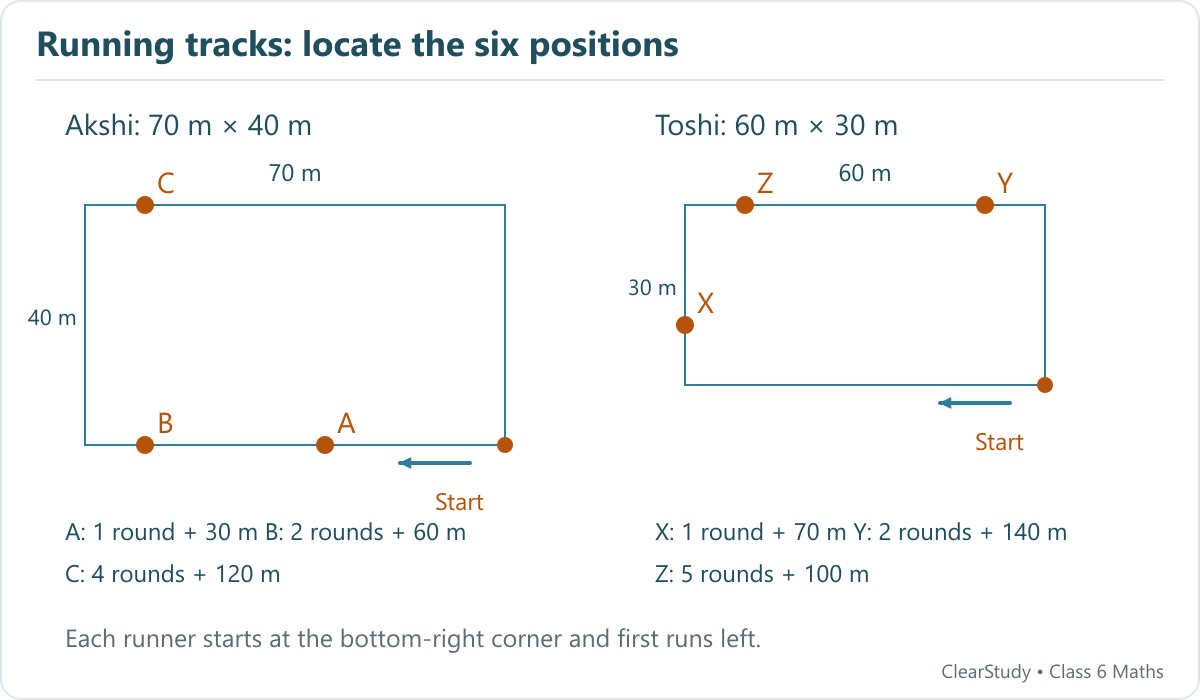
Akshi runs the outer track (length 70 m, breadth 40 m); Toshi runs the inner track (length 60 m, breadth 30 m).
1. Find out the total distance Akshi has covered in 5 rounds.
SOLUTIONPerimeter of the outer track = 2 × (70 + 40) = 220 m (one round).In 5 rounds: 5 × 220 = 1100 m.
2. Find out the total distance Toshi has covered in 7 rounds. Who ran a longer distance?
SOLUTIONPerimeter of the inner track = 2 × (60 + 30) = 180 m (one round).In 7 rounds: 7 × 180 = 1260 m.Since 1260 m > 1100 m, Toshi ran the longer distance.
3. Think and mark the positions as directed—
a. Mark ‘A’ at the point where Akshi will be after she ran 250 m.b. Mark ‘B’ at the point where Akshi will be after she ran 500 m.c. Now, Akshi ran 1000 m. How many full rounds has she finished running around her track? Mark her position as ‘C’.d. Mark ‘X’ at the point where Toshi will be after she ran 250 m.e. Mark ‘Y’ at the point where Toshi will be after she ran 500 m.f. Now, Toshi ran 1000 m. How many full rounds has she finished running around her track? Mark her position as ‘Z’.
SOLUTIONStart at the bottom-right corner of each track and move left along its bottom edge, as in the diagram. One Akshi lap is 220 m; one Toshi lap is 180 m.A: 250 = 220 + 30, so 1 full lap and then 30 m left along the bottom. B: 500 = 2 × 220 + 60, so 2 full laps and 60 m left along the bottom. C: 1000 = 4 × 220 + 120: after the bottom 70 m and left side 40 m, move 10 m right along the top.X: 250 = 180 + 70: after the bottom 60 m, go 10 m up the left side. Y: 500 = 2 × 180 + 140: after 60 + 30 m, go 50 m right along the top. Z: 1000 = 5 × 180 + 100: after 60 + 30 m, go 10 m right along the top.
Divide the total distance by one lap, then trace only the remainder in the running direction.
Deep Dive, Perimeter Puzzles & Math Talk — Answered
These are the in-text exploratory and reflective tasks; the determinate ones are solved, the open ones are guided with worked examples.
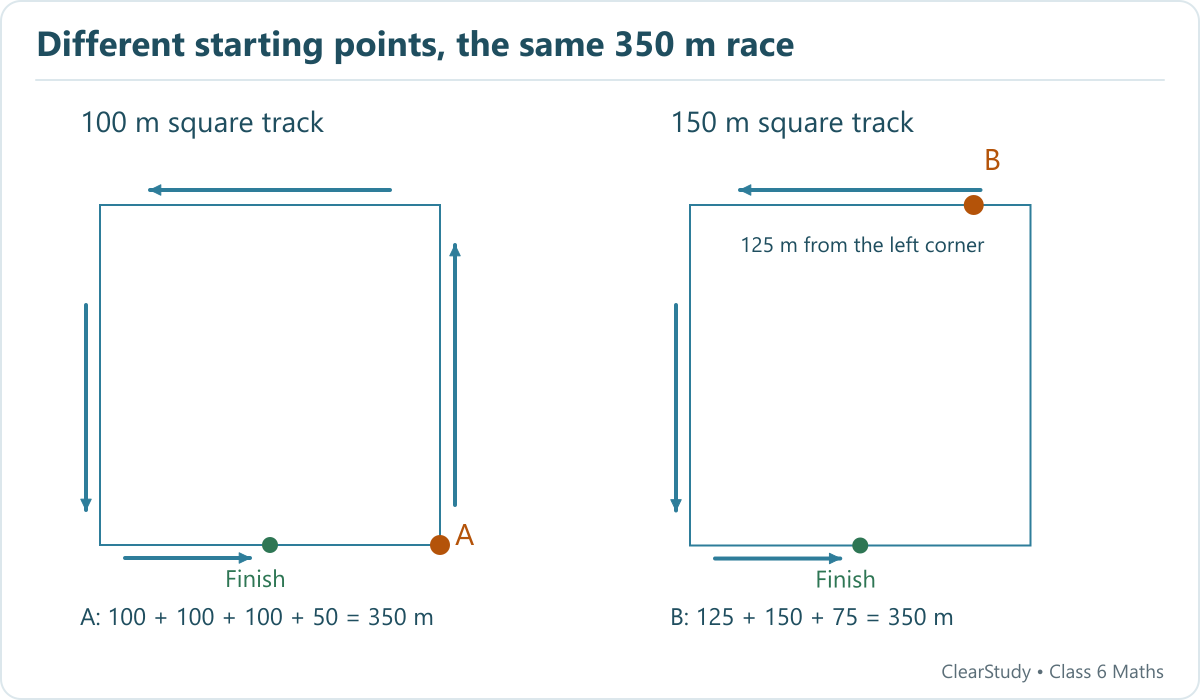
Deep Dive — Common finishing line (Page 134)Two square tracks: inner of side 100 m, outer of side 150 m, with a common finishing line at the centre of one side. For a 350 m race, where should the two runners start so each covers 350 m to the flag? Mark the inner-track start as ‘A’ and the outer-track start as ‘B’.Answer. Use the running direction shown below, with the finish at the midpoint of the bottom side. A is the bottom-right corner of the inner square. From A, run up 100 m, left 100 m, down 100 m and then right 50 m to the flag: 350 m. B lies on the top side of the outer square, 25 m from its top-right corner (125 m from the left corner). From B, run left 125 m, down 150 m and right 75 m to finish: 350 m. Equal race distances do not guarantee equal finishing times; that also depends on running speed.
Follow the arrows from each starting point to its finish flag. The two square tracks are shown separately for clarity.
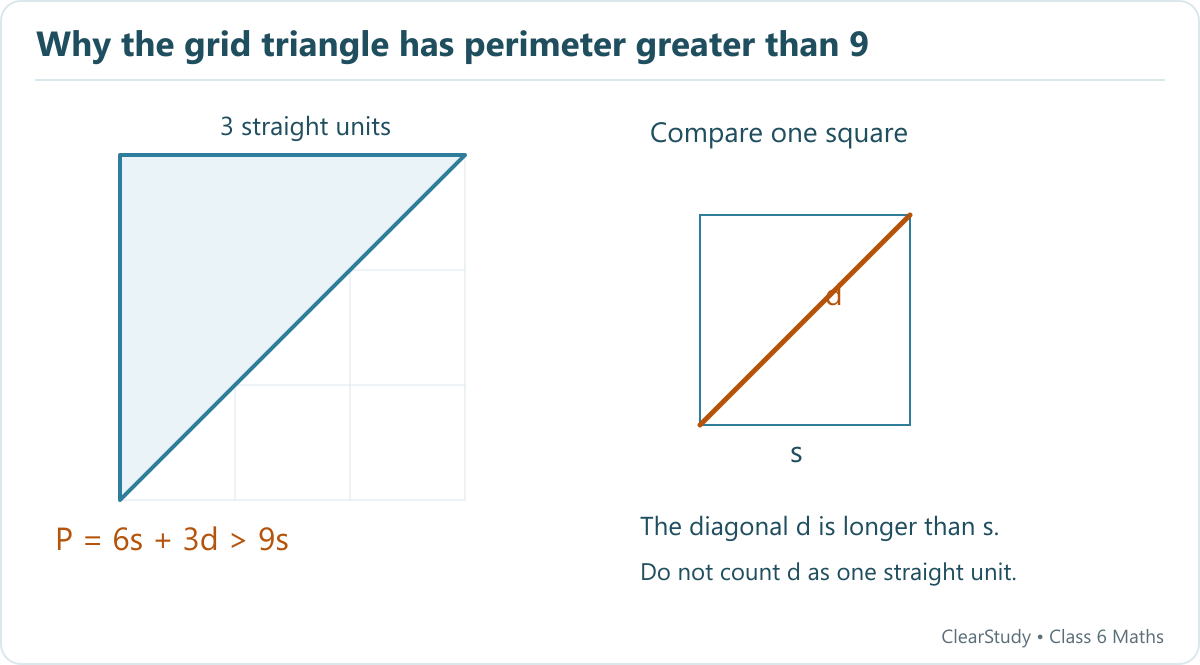
Estimate and Verify — The 9-unit triangle (Page 134)Akshi says the perimeter of this triangle shape is 9 units. Toshi says it can’t be 9 units and the perimeter will be more than 9 units. What do you think?Answer.Toshi is right — the perimeter is more than 9 units. The triangle is drawn on a grid using both straight (horizontal/vertical) and diagonal segments. A diagonal of a unit square is always longer than a side of the square, so counting a diagonal as 1 straight unit undercounts. The true perimeter is therefore greater than 9 units.
The perimeter is 6 straight units plus 3 diagonal units, so it is greater than 9 straight units.
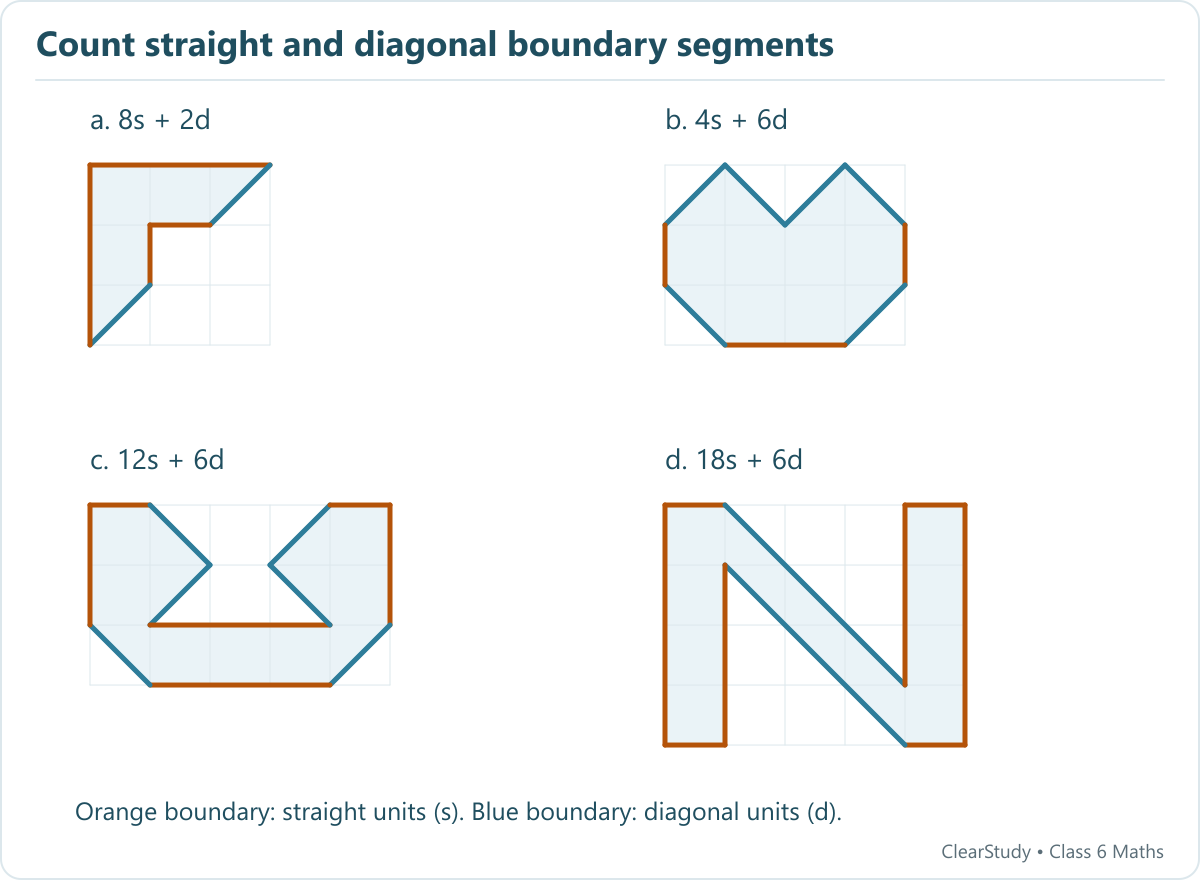
Straight & diagonal units (Page 135)Write the perimeters of the figures below in terms of straight and diagonal units (s = straight unit, d = diagonal unit).Answer. The four figures have perimeters 8s + 2d, 4s + 6d, 12s + 6d and 18s + 6d — counting the red (straight) and blue (diagonal) segments separately, since the two unit lengths are different.
Each small grid square is one square unit. The outlines follow the textbook exercises.
Regular polygons (Page 135)Find objects around you with regular shapes and find their perimeters. Generalise your understanding for the perimeter of other regular polygons.Answer. Because every side of a regular polygon is the same length, the perimeter is simply repeated addition: Perimeter of a regular polygon = number of sides × length of one side. For example, a regular pentagon of side 6 cm has perimeter 5 × 6 = 30 cm.
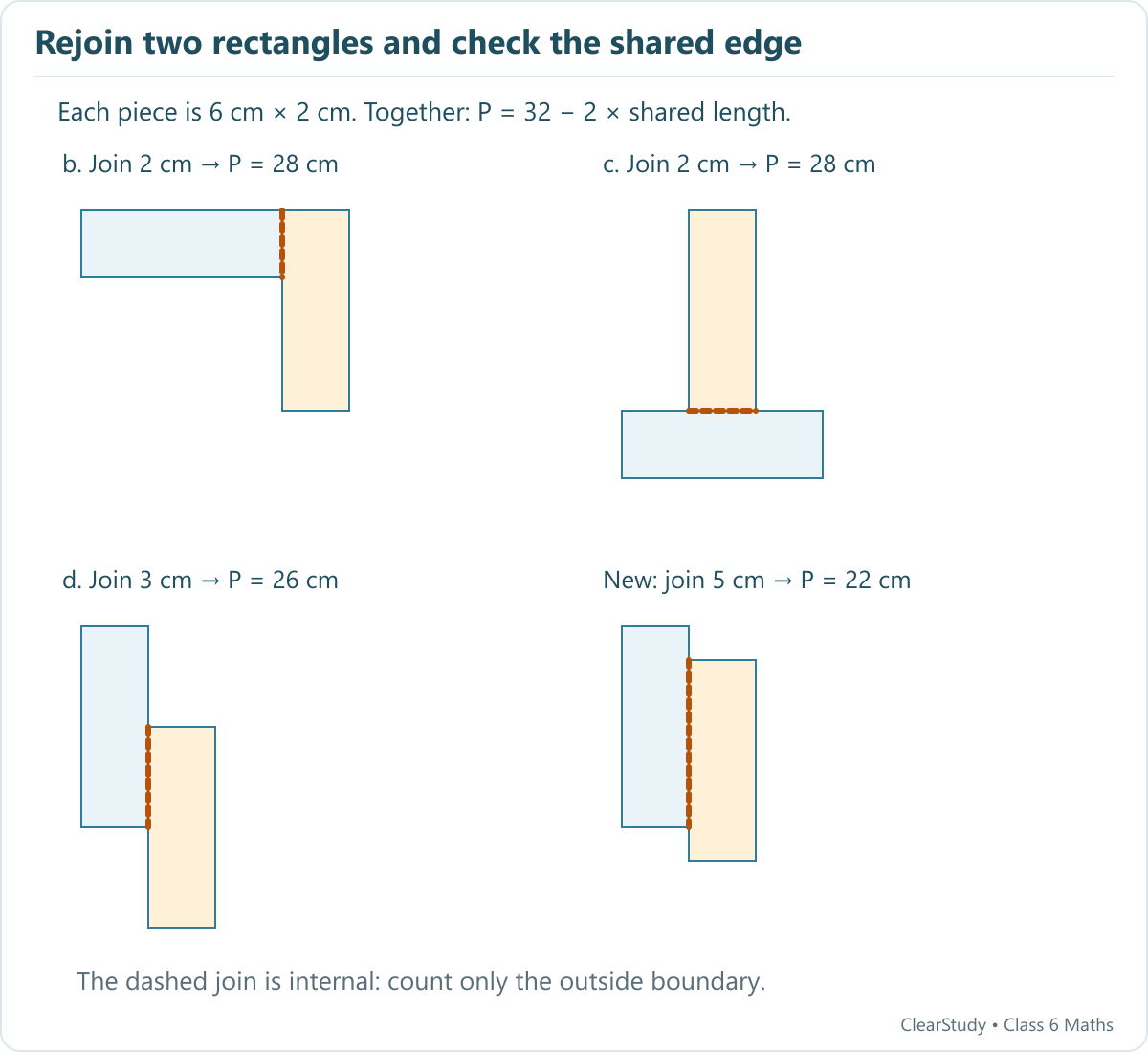
Split and rejoin (Page 136)A 6 cm × 4 cm rectangular chit is cut into two equal pieces, then joined in different ways. Arrangement a. has a perimeter of 28 cm. Find the perimeter of the other arrangements (b, c, d), then arrange the two pieces to form a figure with a perimeter of 22 cm.Answer. Each 6 cm × 2 cm piece has perimeter 16 cm, so their separate perimeters total 32 cm. Joining along a shared length removes that length from both boundaries: new perimeter = 32 − 2 × shared length. In a, b and c the join is 2 cm, giving 28 cm each. In d the join is 3 cm, giving 26 cm. To obtain 22 cm, join the long sides over 5 cm, leaving one piece shifted by 1 cm. Joining the full 6 cm sides restores the 6 cm × 4 cm rectangle with perimeter 20 cm.
The area remains 24 square centimetres in every arrangement. An internal shared edge removes twice its length from the total perimeter.
Let’s Explore! — Rectangles of area 24 sq units / Math Talk (Page 141)Make every whole-number rectangle of area 24 square units. a. Which has the greatest perimeter? b. Which has the least perimeter? c. Repeat for area 32 sq cm. Given an area, can you predict the rectangle with the greatest and least perimeter?Answer. Rectangles of area 24: 1×24, 2×12, 3×8, 4×6, with perimeters 50, 28, 22 and 20 units. (a) greatest perimeter is the long thin 1 × 24 (perimeter 50). (b) least perimeter is the nearest-to-square 4 × 6 (perimeter 20). (c) For area 32: 1×32, 2×16, 4×8, with perimeters 66, 36, 24; greatest is 1 × 32, least is 4 × 8. Prediction for positive whole-number side lengths: the factor pair 1 and the area gives the greatest perimeter; the factor pair closest together gives the least. If arbitrary positive side lengths are allowed, there is no greatest perimeter for a fixed area; the square gives the least.
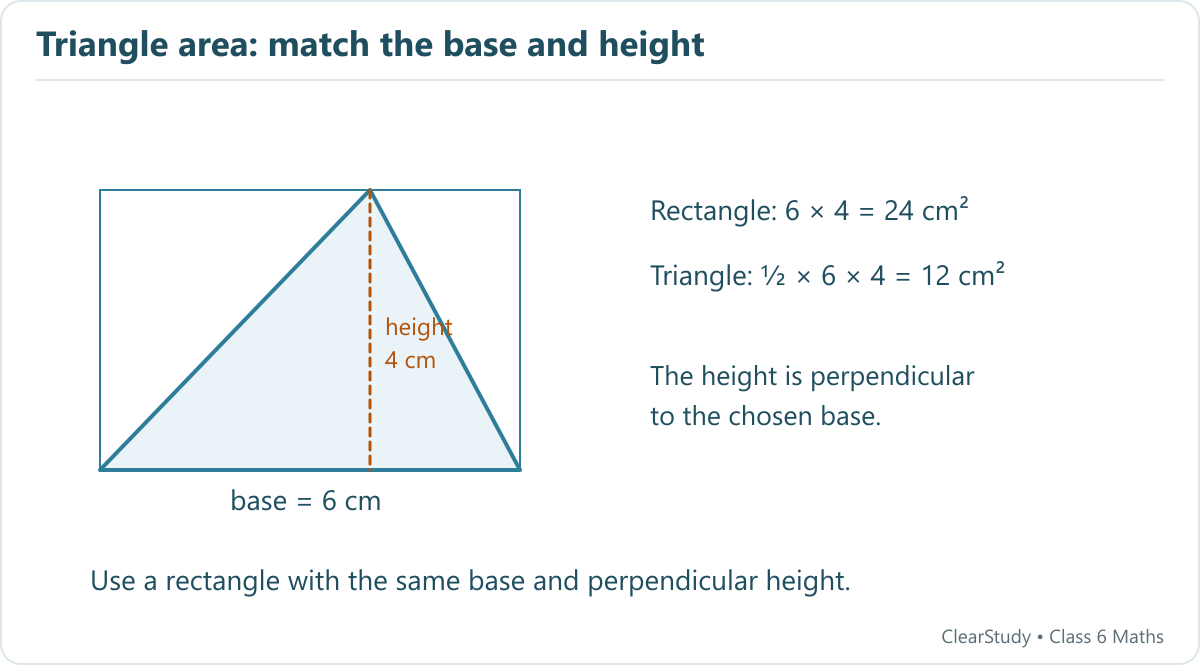
Area of a triangle — inference (Page 142–143)Cut a rectangle along a diagonal into two triangles. Do they have the same area? What is the relationship between a triangle and the rectangle that contains it?Answer. A rectangle cut along a diagonal gives two congruent triangles. Each has half the rectangle’s area. More generally, a triangle with base b and perpendicular height h has area ½ × b × h, even when its vertex is shifted sideways. Compare it with a rectangle having the same base and perpendicular height. An arbitrary enclosing rectangle does not satisfy this rule.
The rule depends on the same base and perpendicular height; an arbitrary larger enclosing rectangle does not give the triangle’s area.
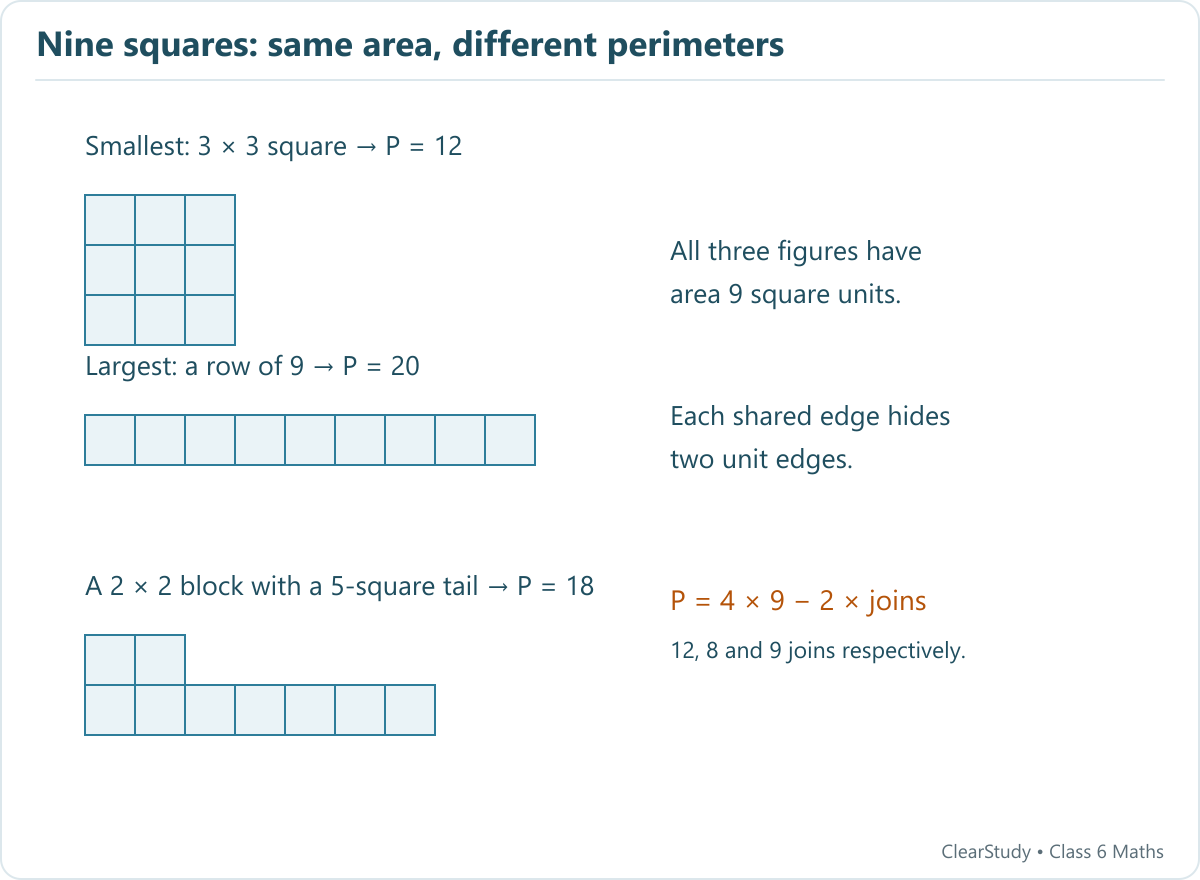
Making it ‘More’ or ‘Less’ — 9 unit squares (Page 145)Using 9 unit squares (area 9 sq units), solve: 1. smallest perimeter possible? 2. largest perimeter possible? 3. make a figure of perimeter 18 units. 4. Can you make other shapes for each perimeter, or is there only one?Answer. Arrange all nine squares as one figure, connected along full edges, without holes. 1. The 3 × 3 square gives the least perimeter, 12 units. 2. A 1 × 9 row gives the greatest, 20 units. 3. A 2 × 2 block with a straight five-square tail has nine shared edges, so P = 4 × 9 − 2 × 9 = 18 units. 4. Several arrangements give 18 or 20 units; the 3 × 3 square is the only shape with perimeter 12, apart from moving or turning it. When adding a new square, sharing k full edges changes the perimeter by 4 − 2k: one shared edge adds 2, two leave it unchanged, and three reduce it by 2.
These examples form one edge-connected shape without holes. Count exposed edges only.
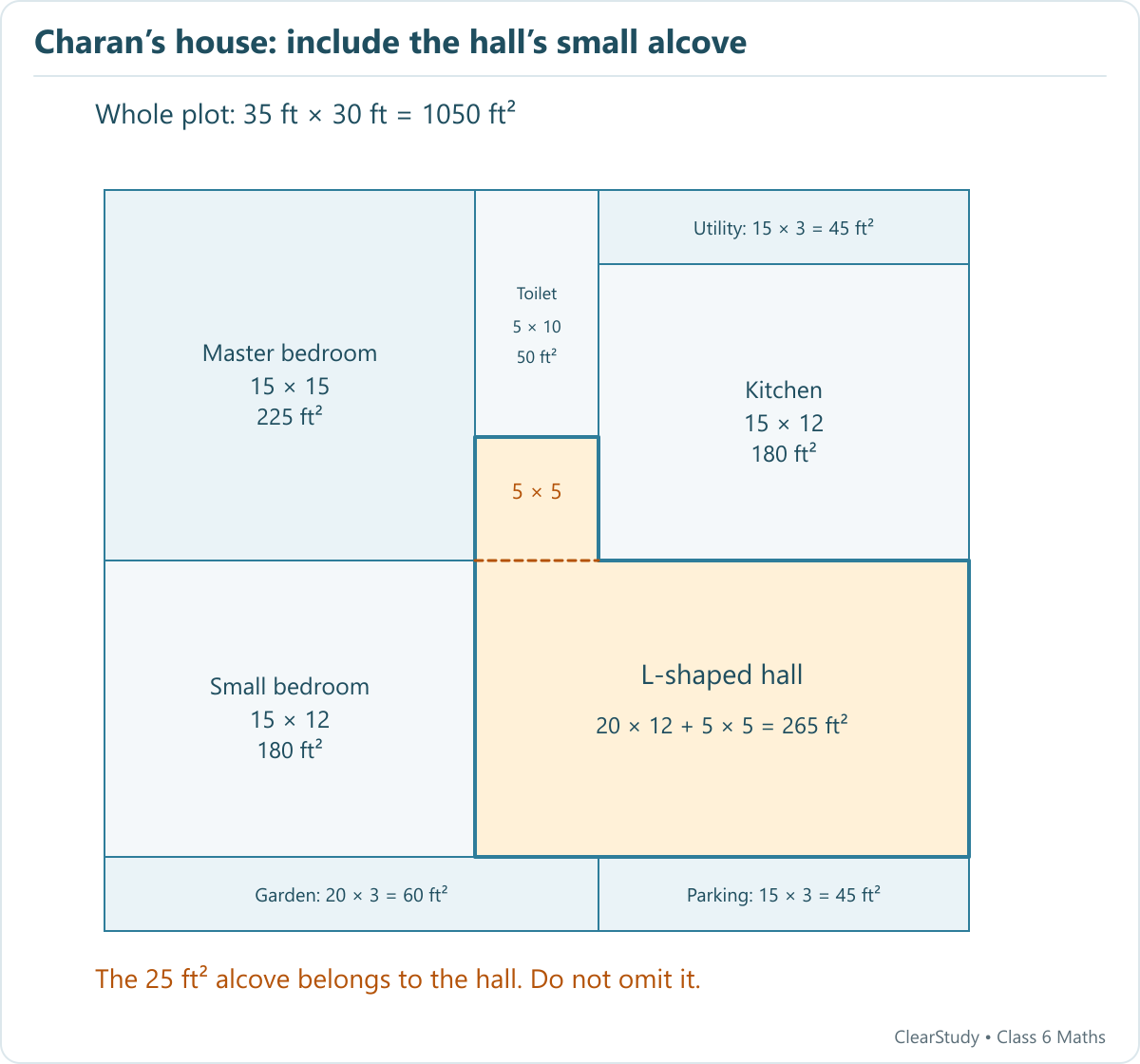
Charan’s house plan (Page 146)Find Charan’s missing room measurements and the total area of his house (rectangular plot, some dimensions given; the plot is 30 ft on one side).Answer. The plot is 35 ft × 30 ft, so its area is 1050 sq ft. The regions are: master bedroom 15 × 15 = 225; small bedroom 15 × 12 = 180; toilet 5 × 10 = 50; kitchen 15 × 12 = 180; utility 15 × 3 = 45; garden 20 × 3 = 60; parking 15 × 3 = 45 (all areas in sq ft). The hall is L-shaped: its 20 ft × 12 ft main rectangle plus a 5 ft × 5 ft alcove gives 240 + 25 = 265 sq ft. Check: 225 + 180 + 50 + 180 + 45 + 60 + 45 + 265 = 1050.
The seven other regions total 785 square feet. Adding the hall’s 265 square feet gives the plot area of 1050 square feet.
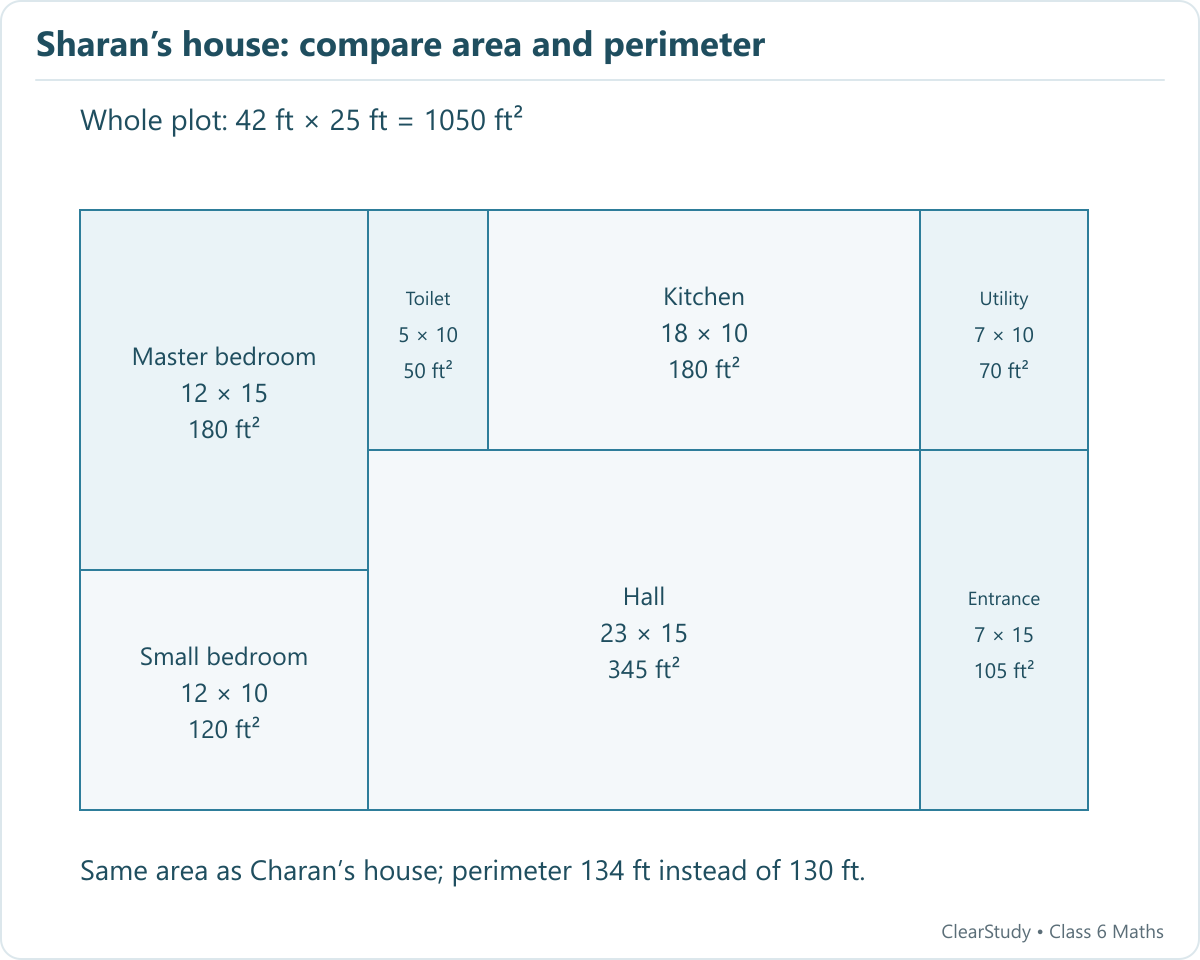
Sharan’s house plan (Page 147)Find Sharan’s missing dimensions and area, and compare the areas and perimeters of Sharan’s and Charan’s houses.Answer. Master bedroom 12 × 15 = 180; small bedroom 12 × 10 = 120; toilet 5 × 10 = 50; kitchen 18 × 10 = 180; utility 7 × 10 = 70; hall 23 × 15 = 345; entrance 7 × 15 = 105 (all areas in sq ft). Their sum is 1050 sq ft, matching 42 × 25. Charan’s perimeter is 2 × (35 + 30) = 130 ft; Sharan’s is 2 × (42 + 25) = 134 ft. Equal areas can have different perimeters.
Both houses cover 1050 square feet, but their outer boundaries have different lengths.
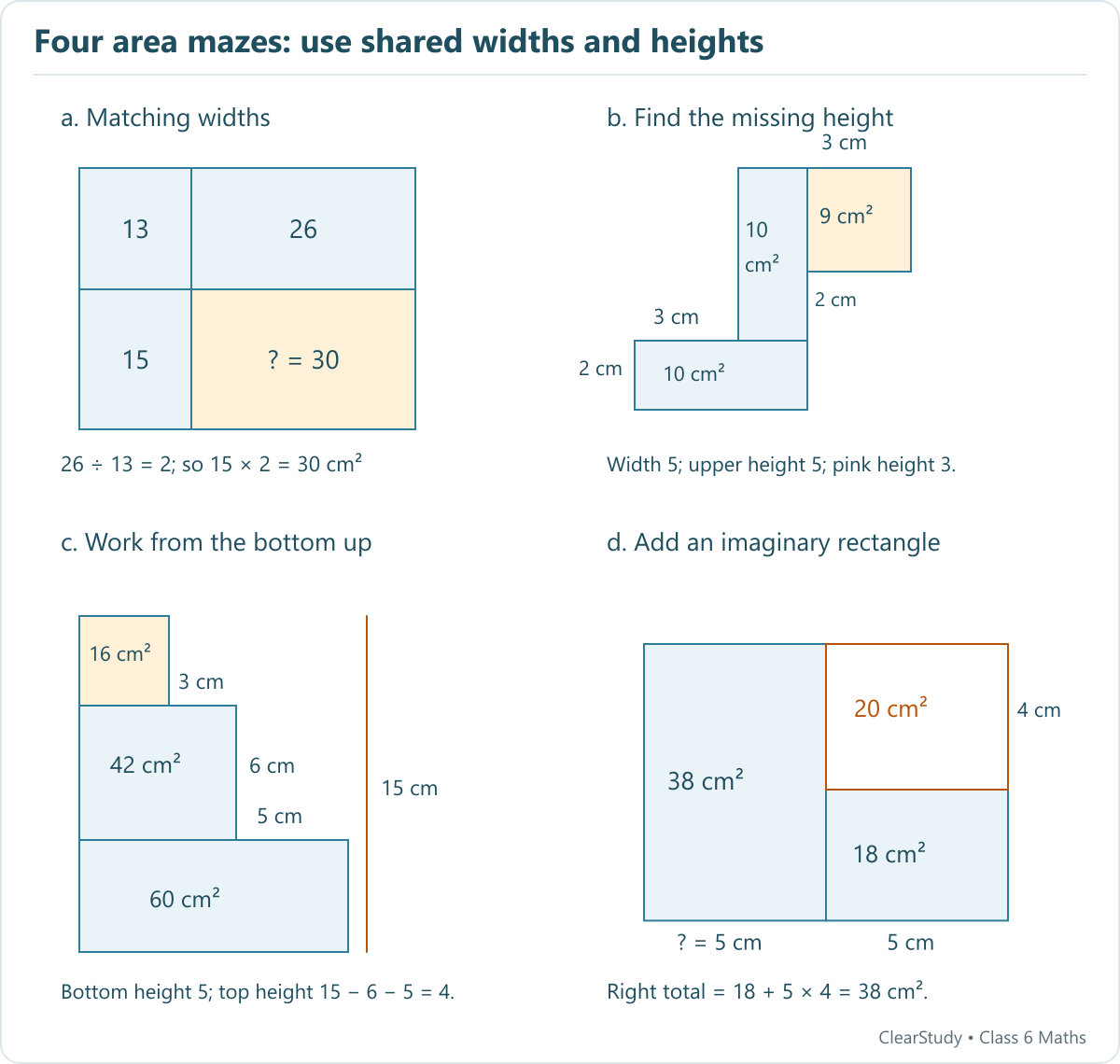
Area Maze Puzzles (Page 148)In each figure (a, b, c, d), find the missing value of either the length of a side or the area of a region.Answer.(a) The upper rectangles have the same height, so their widths are in the ratio 13:26 = 1:2. The lower rectangles share another height, so the unknown area is 15 × 2 = 30 sq cm. (b) Bottom width = 10 ÷ 2 = 5 cm. The narrow upright rectangle is 5 − 3 = 2 cm wide, so its height is 10 ÷ 2 = 5 cm. The shaded height is 5 − 2 = 3 cm; its area is 3 × 3 = 9 sq cm. (c) Middle width = 42 ÷ 6 = 7 cm. Bottom width = 7 + 5 = 12 cm, so its height is 60 ÷ 12 = 5 cm. Top height = 15 − 6 − 5 = 4 cm and width = 7 − 3 = 4 cm; area = 16 sq cm. (d) Imagine extending the right rectangle upwards by 4 cm. The added area is 5 × 4 = 20 sq cm, making 18 + 20 = 38 sq cm, equal to the left rectangle. They now have the same height and area, so their widths are equal: 5 cm.
Diagrams are teaching reconstructions. Use the labelled measurements; the dashed extension in d explains the equal-width argument.
Figure it Out — Area (Page 138)
1. The area of a rectangular garden 25 m long is 300 sq m. What is the width of the garden?
SOLUTIONArea = length × width, so width = area ÷ length = 300 ÷ 25 = 12 m.
2. What is the cost of tiling a rectangular plot of land 500 m long and 200 m wide at the rate of ₹8 per hundred sq m?
3. A rectangular coconut grove is 100 m long and 50 m wide. If each coconut tree requires 25 sq m, what is the maximum number of trees that can be planted in this grove?
SOLUTIONArea of grove = 100 × 50 = 5000 sq m.Number of trees = 5000 ÷ 25 = 200.
4. By splitting the following figures into rectangles, find their areas (all measures are given in metres).
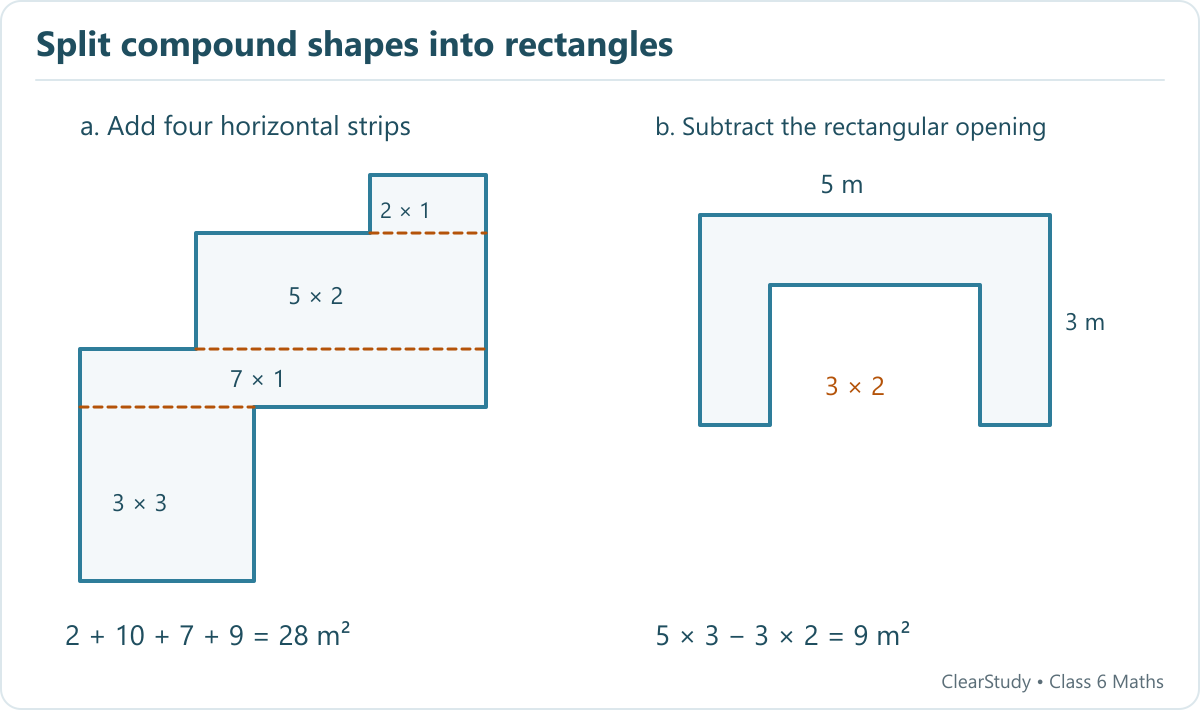
SOLUTION(a) Divide the stepped shape into four horizontal strips. Their widths and heights are 2 × 1, 5 × 2, 7 × 1 and 3 × 3 metres. Area = 2 + 10 + 7 + 9 = 28 sq m.(b) Take the 5 m × 3 m outer rectangle and remove the 3 m × 2 m opening: 15 − 6 = 9 sq m. Equivalently, add a 5 × 1 top strip and two 1 × 2 legs.
All lengths are in metres. Dashed lines divide the first shape into rectangles whose areas add to 28 square metres.
Tangram area comparisons (Page 139)
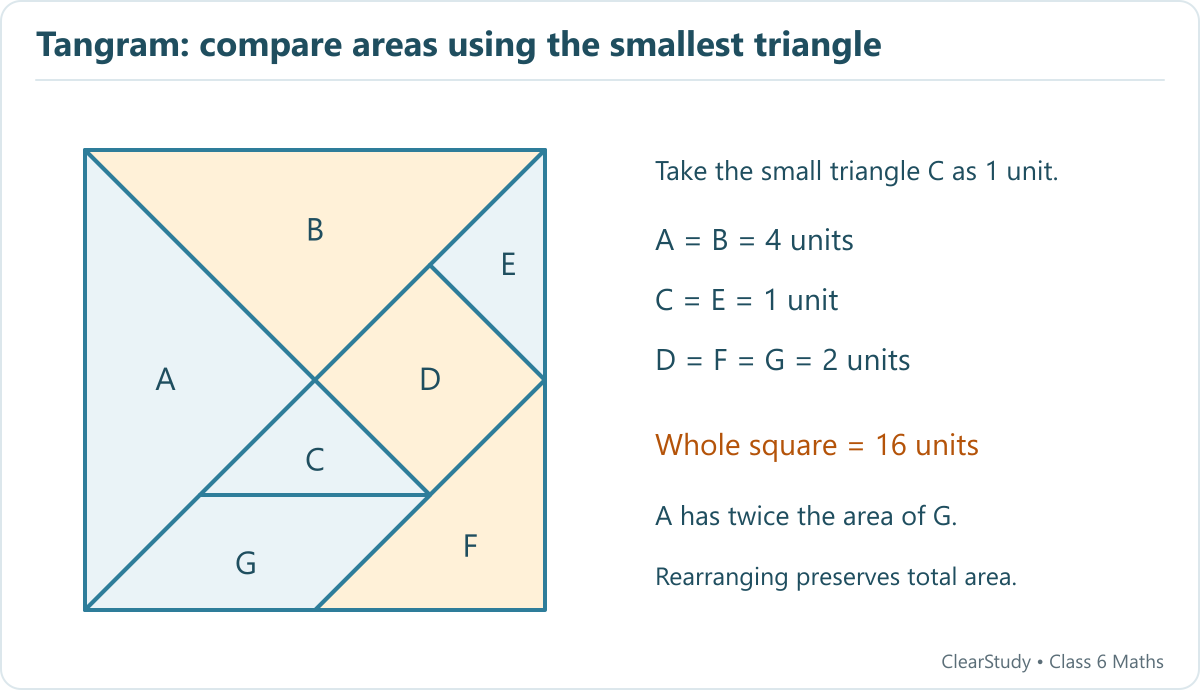
SOLUTIONTake small triangle C as one area unit. C and E each have area 1; D, F and G each have area 2; A and B each have area 4. Therefore A and B have equal areas, A has twice G’s area, and the whole square has 4 + 4 + 1 + 2 + 1 + 2 + 2 = 16 units.If you form a rectangle using all seven pieces without overlap or gaps, its area remains 16 of these units. Rearranging preserves area, but a non-square rectangle has a greater perimeter than the original square.
Compare equal areas, then rearrange the same pieces without overlaps or gaps. The area remains 16 small-triangle units.
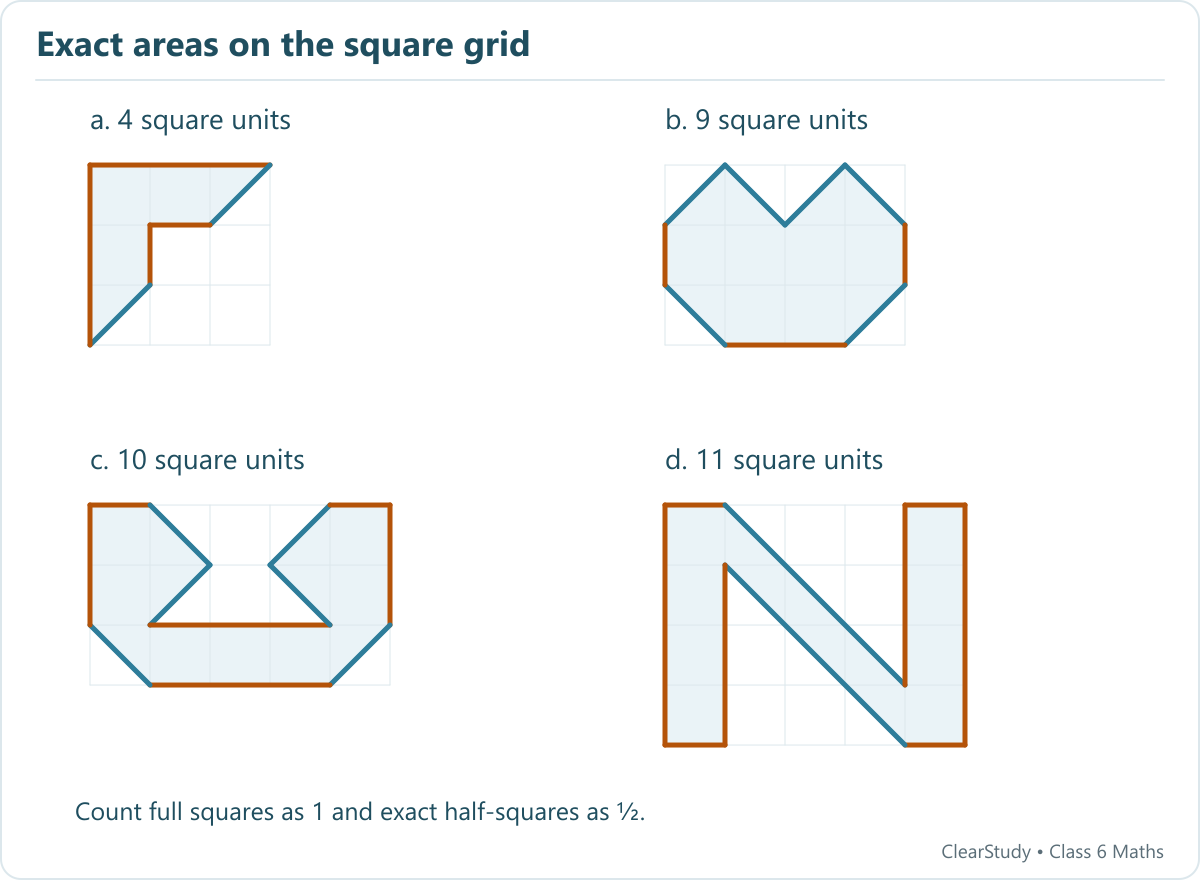
Find the area of the following figures (squared-paper estimation, Page 140).
SOLUTIONCount a full square as 1 square unit and two exact half-squares as 1 square unit. The four outlined shapes give exact areas 4, 9, 10 and 11 square units, respectively. These straight-edged grid figures do not require rounding partial squares up or down.
Each small grid square is one square unit. The outlines follow the textbook exercises.
Figure it Out — Area of Triangles (Page 144)
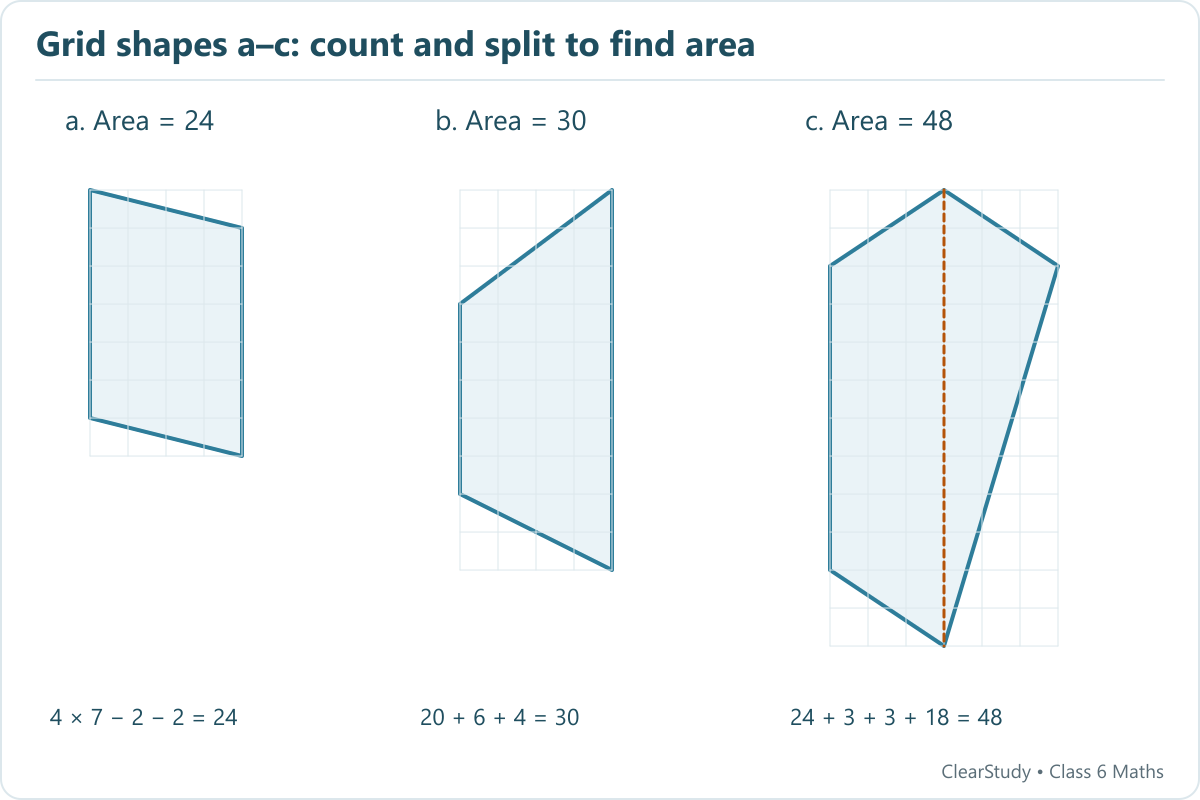
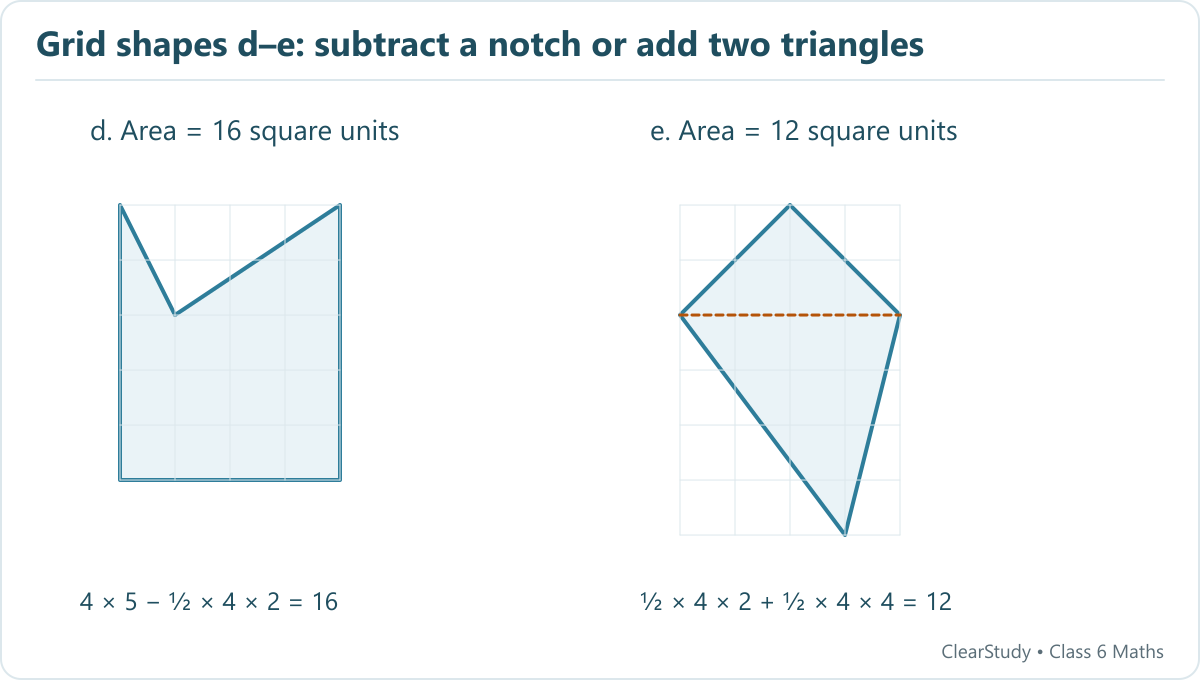
1. Find the areas of the figures below by dividing them into rectangles and triangles.
SOLUTION(a) A 4 × 7 bounding rectangle minus two triangles of area 2 each gives 28 − 2 − 2 = 24.(b) A 4 × 5 central rectangle plus triangles of areas ½ × 4 × 3 = 6 and ½ × 4 × 2 = 4 gives 30.(c) Split vertically through the top and bottom vertices. On the left, a 3 × 8 rectangle plus two triangles of area 3 each gives 30; the right triangle has area ½ × 12 × 3 = 18. Total 48.(d) Subtract the triangular notch from a 4 × 5 rectangle: 20 − ½ × 4 × 2 = 16.(e) Add the two triangles on a shared base of 4: ½ × 4 × 2 + ½ × 4 × 4 = 12. All five answers are in square units.
Each grid square has area 1. Use rectangles and half-rectangles; the worked additions are shown beneath the shapes.Dashed lines mark a useful split. Half-squares count as one-half, not as whole squares.
Figure it Out — Area & Perimeter (Page 149)
1. Give the dimensions of a rectangle whose area is the sum of the areas of these two rectangles having measurements: 5 m × 10 m and 2 m × 7 m.
SOLUTIONSum of areas = (5 × 10) + (2 × 7) = 50 + 14 = 64 sq m.Any rectangle of area 64 sq m works, e.g. 16 m × 4 m, or 32 m × 2 m, or 8 m × 8 m.
2. The area of a rectangular garden that is 50 m long is 1000 sq m. Find the width of the garden.
SOLUTIONWidth = area ÷ length = 1000 ÷ 50 = 20 m.
3. The floor of a room is 5 m long and 4 m wide. A square carpet whose sides are 3 m in length is laid on the floor. Find the area that is not carpeted.
SOLUTIONArea of floor = 5 × 4 = 20 sq m; area of carpet = 3 × 3 = 9 sq m.Area not carpeted = 20 − 9 = 11 sq m.
4. Four flower beds having sides 2 m long and 1 m wide are dug at the four corners of a garden that is 15 m long and 12 m wide. How much area is now available for laying down a lawn?
SOLUTIONArea of garden = 15 × 12 = 180 sq m.Area of one flower bed = 2 × 1 = 2 sq m; four beds = 4 × 2 = 8 sq m.Area available for lawn = 180 − 8 = 172 sq m.
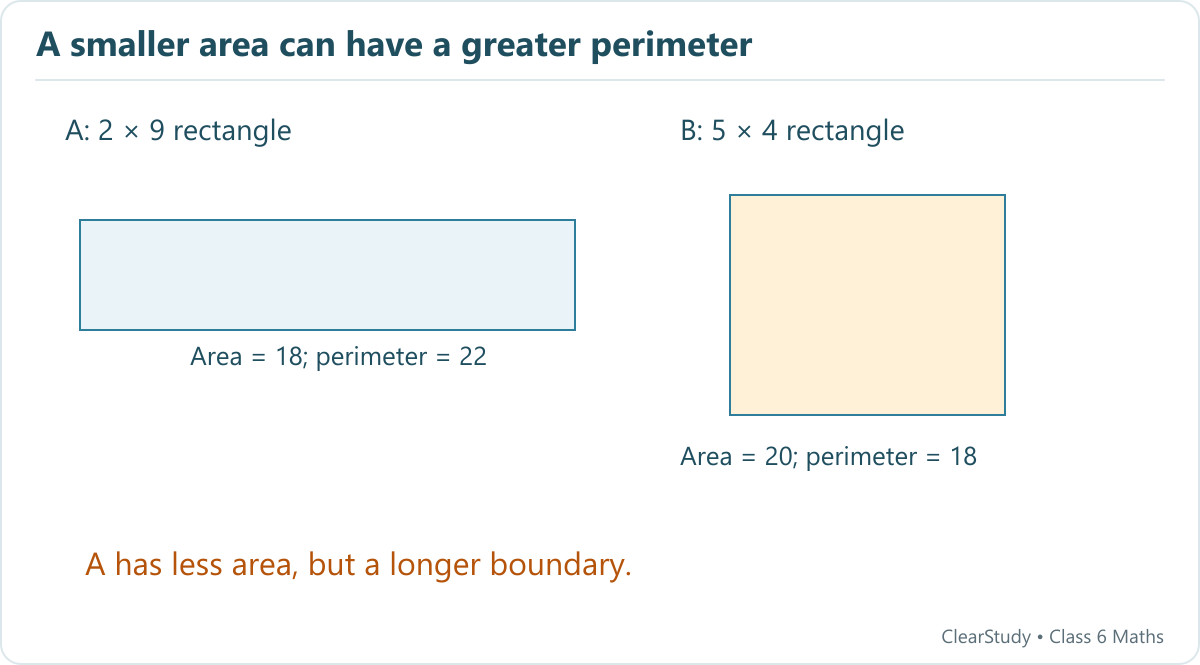
5. Shape A has an area of 18 square units and Shape B has an area of 20 square units. Shape A has a longer perimeter than Shape B. Draw two such shapes satisfying the given conditions.
SOLUTIONShape A (area 18) could be a 2 × 9 rectangle: perimeter = 2 × (2 + 9) = 22 units, or 1 × 18: perimeter 38 units.Shape B (area 20) could be a 5 × 4 rectangle: perimeter = 2 × (5 + 4) = 18 units.Choosing A = 2 × 9 (perimeter 22) and B = 5 × 4 (perimeter 18) gives perimeter(A) > perimeter(B) while the areas stay 18 and 20. (Draw any such pair on grid paper.)
Length is measured in units; area is measured in square units.
6. On a page in your book, draw a rectangular border that is 1 cm from the top and bottom and 1.5 cm from the left and right sides. What is the perimeter of the border?
SOLUTIONFirst measure your own page. For an example only, suppose it is 18 cm wide and 24 cm tall. Leaving 1.5 cm on each side gives a border width of 18 − 2 × 1.5 = 15 cm; leaving 1 cm at top and bottom gives a border height of 24 − 2 × 1 = 22 cm.Perimeter of the border = 2 × (15 + 22) = 74 cm for that page. (Measure your own page first, then apply Perimeter = 2 × (width − 3) + 2 × (height − 2) in cm.)
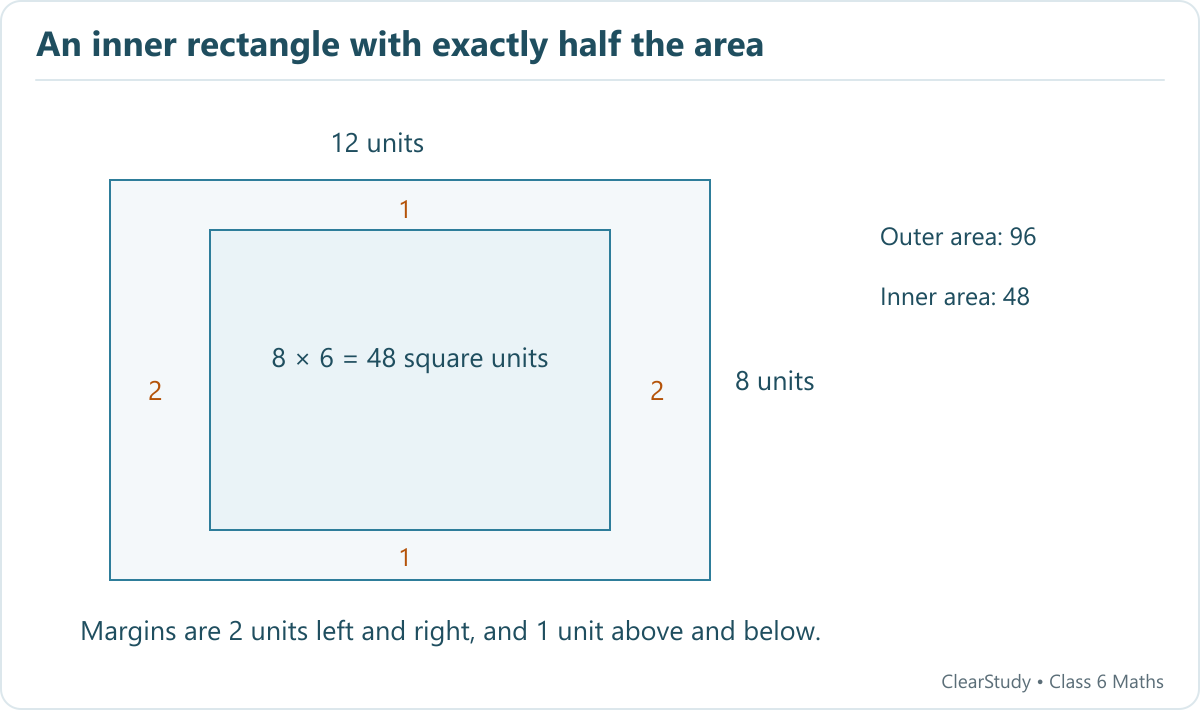
7. Draw a rectangle of size 12 units × 8 units. Draw another rectangle inside it, without touching the outer rectangle that occupies exactly half the area.
SOLUTIONArea of outer rectangle = 12 × 8 = 96 sq units; half of this = 48 sq units.Draw any inner rectangle of area 48 sq units that does not touch the outer one, e.g. an 8 units × 6 units rectangle centred inside (8 × 6 = 48). The horizontal margins are (12 − 8) ÷ 2 = 2 units each; the vertical margins are (8 − 6) ÷ 2 = 1 unit each. Thus no edge touches the outer rectangle.
Every margin is positive, so the inner rectangle does not touch the outer boundary.
8. A square piece of paper is folded in half. The square is then cut into two rectangles along the fold. Regardless of the size of the square, one of the following statements is always true. Which statement is true here?
a. The area of each rectangle is larger than the area of the square.b. The perimeter of the square is greater than the perimeters of both the rectangles added together.c. The perimeters of both the rectangles added together is always 1½ times the perimeter of the square.d. The area of the square is always three times as large as the areas of both rectangles added together.
SOLUTIONLet the square have side s, so perimeter = 4s and area = s2. Each half-rectangle is s × s/2.Each rectangle’s perimeter = 2 × (s + s/2) = 3s, so both together = 6s = 1½ × 4s = 1½ × (perimeter of square).Each rectangle’s area = s2/2 (smaller, so a is false); the two areas add to s2 = the square (so d is false); 4s < 6s (so b is false).∴ the always-true statement is (c).
Common Mistakes to Avoid
Watch out for these
Confusing perimeter with area — perimeter is a length (cm, m) around the boundary; area is the region inside (sq cm, sq m).
Forgetting to double in a rectangle: perimeter is 2 × (length + breadth), not length + breadth.
In running-track and rope problems, multiply one round’s perimeter by the number of rounds.
Counting a diagonal grid segment as one straight unit — a diagonal is longer, so a grid triangle’s perimeter is more than the count of segments.
Assuming equal areas mean equal perimeters — the same area can have many different perimeters (a long thin rectangle has a far bigger perimeter than a square of the same area).
Counting an exact half-square as a whole square. Use two exact halves to make one square unit; round only when making an estimate.
Practice MCQs & Assertion–Reason
1. The perimeter of a rectangle of length 12 cm and breadth 8 cm is:
(a) 20 cm (b) 40 cm (c) 96 cm (d) 48 cm
2. The perimeter of a square is 20 cm. The length of each side is:
(a) 4 cm (b) 5 cm (c) 10 cm (d) 80 cm
3. A wire bent into a 5 cm × 3 cm rectangle is re-bent into a square. The side of the square is:
(a) 3 cm (b) 4 cm (c) 8 cm (d) 16 cm
4. The third side of a triangle of perimeter 55 cm with two sides 20 cm and 14 cm is:
(a) 19 cm (b) 21 cm (c) 34 cm (d) 41 cm
5. The perimeter of a regular hexagon made from a 36 cm string has each side equal to:
(a) 4 cm (b) 6 cm (c) 9 cm (d) 12 cm
6. A rectangular garden 25 m long has an area of 300 sq m. Its width is:
(a) 10 m (b) 12 m (c) 15 m (d) 275 m
7. The area of a triangle that is exactly half of a 12 cm × 8 cm rectangle is:
(a) 48 sq cm (b) 96 sq cm (c) 20 sq cm (d) 40 sq cm
8. Among rectangles with positive whole-number side lengths and area 24 sq units, the one with the least perimeter is:
(a) 1 × 24 (b) 2 × 12 (c) 3 × 8 (d) 4 × 6
9. The cost of fencing a 150 m × 120 m park at ₹40 per metre is:
(a) ₹10,800 (b) ₹21,600 (c) ₹43,200 (d) ₹7,20,000
10. Two closed figures with the same area:
(a) must have the same perimeter (b) can have different perimeters (c) must be congruent (d) cannot both be rectangles
For each Assertion–Reason question, choose: (A) Both Assertion and Reason are true and the Reason is the correct explanation of the Assertion; (B) Both are true but the Reason is not the correct explanation; (C) Assertion is true but Reason is false; (D) Assertion is false but Reason is true.
A-R 1. Assertion: The perimeter of a square of side 5 cm is 20 cm.
Reason: The perimeter of a square equals 4 times the length of one side.
A-R 2. Assertion: A diagonal of a rectangle divides it into two triangles of equal area.
Reason: The two triangles overlap each other exactly, so each is half the rectangle.
A-R 3. Assertion: Two figures with the same area always have the same perimeter.
Reason: A long thin rectangle and a square of equal area can have very different perimeters.
A-R 4. Assertion: Toshi ran a longer distance than Akshi on the Matha Pachchi tracks.
Reason: Toshi covered 7 × 180 = 1260 m while Akshi covered 5 × 220 = 1100 m.
A-R 5. Assertion: The illustrated grid triangle with two 3-unit legs has perimeter exactly 9 straight units.
Reason: A diagonal of a unit square is longer than its side.
Answer key: 1-(A), 2-(A), 3-(D), 4-(A), 5-(D).
Quick Revision Summary
Perimeter = total distance around the boundary; for a polygon it is the sum of all side lengths.
Perimeter of a rectangle = 2 × (length + breadth); of a square = 4 × side; of a regular polygon = number of sides × side.
Area = region enclosed, measured in square units; area of a rectangle = length × breadth, of a square = side × side.
A diagonal splits a rectangle into two congruent triangles. In general, triangle area = ½ × base × perpendicular height.
For exact grid areas, count full squares as 1 and exact half-squares as ½. Round other partial squares only for an estimate.
Two figures can have the same area with different perimeters (and the same perimeter with different areas).
For a fixed whole-number area and positive whole-number side lengths, the factor pair 1 and the area gives the greatest perimeter, while the closest factor pair gives the least.
How to score full marks in this chapter
Write the correct formula first and substitute carefully — remember the “2 ×” for a rectangle’s perimeter and the “square units” for area. In rope or running-track problems, find one round’s perimeter, then multiply by the number of rounds. For composite shapes, split into rectangles and triangles, find each piece, and add. Always check units (cm vs m, length vs square units) and label your answer, so each step earns its mark.
Frequently Asked Questions
What is Class 6 Maths Ganita Prakash Chapter 6 about?
Chapter 6, Perimeter and Area, covers the perimeter of rectangles, squares, triangles and regular polygons, the area of rectangles, squares and triangles, estimating area on squared paper, and exploring how the same area can have different perimeters through running-track, split-and-rejoin and house-plan problems.
What is the difference between perimeter and area?
Perimeter is the distance once around the boundary of a closed figure and is measured in units of length (cm, m). Area is the amount of region the figure encloses and is measured in square units (sq cm, sq m).
How do you find the area of a triangle in Chapter 6?
A triangle has half the area of a rectangle with the same base and perpendicular height: area = one-half × base × height. A rectangle’s diagonal is one example: it divides the rectangle into two congruent triangles.
Are these Class 6 Maths Ganita Prakash Chapter 6 solutions free?
Yes. These solutions and original teaching diagrams are free. The official NCERT chapter is linked below for reference.