Class 6 Maths Chapter 7 Solutions – Fractions

These Class 6 Maths Ganita Prakash Chapter 7 solutions explain Fractions through equal shares, labelled number lines, a fraction wall and worked calculations. Learn to convert mixed numbers, find equivalent fractions, compare shares, and add or subtract using a common denominator. The original diagrams below support the exercises in the linked official NCERT chapter.

Class: 6 Subject: Mathematics Book: Ganita Prakash Chapter: 7 Sections: 7.1–7.9 Session: 2026–27

Chapter 7 Overview

Chapter 7 of Ganita Prakash, Fractions, begins with sharing rotis and chikki equally to build the idea of a fraction as an equal share. It introduces fractional units (unit fractions such as ½, ⅓, ¼), shows how fractions are measured by collecting fractional units, and marks them on the number line. The chapter then develops mixed fractions, equivalent fractions and the lowest-terms (simplest) form, explains how to compare fractions using a common denominator, and finally presents Brahmagupta’s method for adding and subtracting fractions, ending with a pinch of Indian history of fractions. The solutions below combine worked exercises with diagrams and guided explorations.

Key Concepts & Definitions

Fraction: what each share is when a whole number of equal things is shared equally, written as numerator over denominator, e.g. ½, ¾.

Fractional unit (unit fraction): one whole divided into equal parts gives parts each of size ½, ⅓, ¼, … For the same whole, the more equal parts, the smaller each part — so ½ > ¼ and 1/100 > 1/200.

Numerator and denominator: in 5/6, 5 is the numerator (how many fractional units) and 6 is the denominator (the number of equal parts in one whole); it identifies the fractional unit as 1/6.

Mixed fraction (mixed number): a whole-number part plus a proper fraction, e.g. 8/3 = 2⅔.

Equivalent fractions: fractions that represent the same share or length, e.g. ½ = 2/4 = 4/8 and 2/5 = 4/10.

Lowest terms (simplest form): a fraction whose numerator and denominator have no common factor except 1, e.g. 16/20 = 4/5.

A pinch of history: a fraction was called bhinna (‘broken’) in Sanskrit; the way we write fractions today originated in India, and general rules for fraction arithmetic were codified by Brahmagupta in 628 CE.

Important Rules & Methods (Chapter 7)

Reading a fraction: 3/4 = 3 times ¼ — the denominator gives the fractional unit, the numerator gives how many.

Greater than 1: a fraction is greater than 1 when its numerator is larger than its denominator (e.g. 7/2).

Mixed ↔ improper: improper fraction = (whole × denominator + numerator)/denominator; e.g. 3¼ = (3×4 + 1)/4 = 13/4.

Equivalent fractions: multiply (or divide) numerator and denominator by the same non-zero number.

Lowest terms: divide numerator and denominator by their highest common factor.

Compare: write fractions with the same denominator (a common multiple), then compare numerators.

Brahmagupta’s method: make the denominators equal, then add (or subtract) the numerators and keep the same denominator; reduce to lowest terms if needed.

Figure it Out — Fractional Units & Equal Shares (Sections 7.1–7.3)

Figure it Out (Page 152–153) — fill in the blanks

1. Three guavas together weigh 1 kg. If they are roughly of the same size, each guava will roughly weigh ____ kg.

SOLUTION 1 kg shared equally among 3 guavas → each = 1 ÷ 3. ∴ each guava weighs 1/3 kg.

2. A wholesale merchant packed 1 kg of rice in four packets of equal weight. The weight of each packet is ___ kg.

SOLUTION 1 kg shared equally into 4 packets → each = 1 ÷ 4. ∴ each packet weighs 1/4 kg.

3. Four friends ordered 3 glasses of sugarcane juice and shared it equally among themselves. Each one drank ____ glass of sugarcane juice.

SOLUTION 3 glasses shared equally among 4 friends → each = 3 ÷ 4. ∴ each one drank 3/4 glass.

4. The big fish weighs ½ kg. The small one weighs ¼ kg. Together they weigh ____ kg.

SOLUTION ½ = 2/4, so ½ + ¼ = 2/4 + 1/4 = 3/4. ∴ together they weigh 3/4 kg.

5. Arrange these fraction words in order of size from the smallest to the biggest: One and a half, three quarters, one and a quarter, half, quarter, two and a half.

SOLUTION Write each as a fraction: half = ½, quarter = ¼, three quarters = ¾, one and a quarter = 1¼, one and a half = 1½, two and a half = 2½. Smallest to biggest: ¼, ½, ¾, 1¼, 1½, 2½ (i.e. quarter, half, three quarters, one and a quarter, one and a half, two and a half).

Figure it Out (Page 155) — fractional unit of each chikki piece

The figures below show different fractional units of a whole chikki. How much of a whole chikki is each piece? (parts a–h)
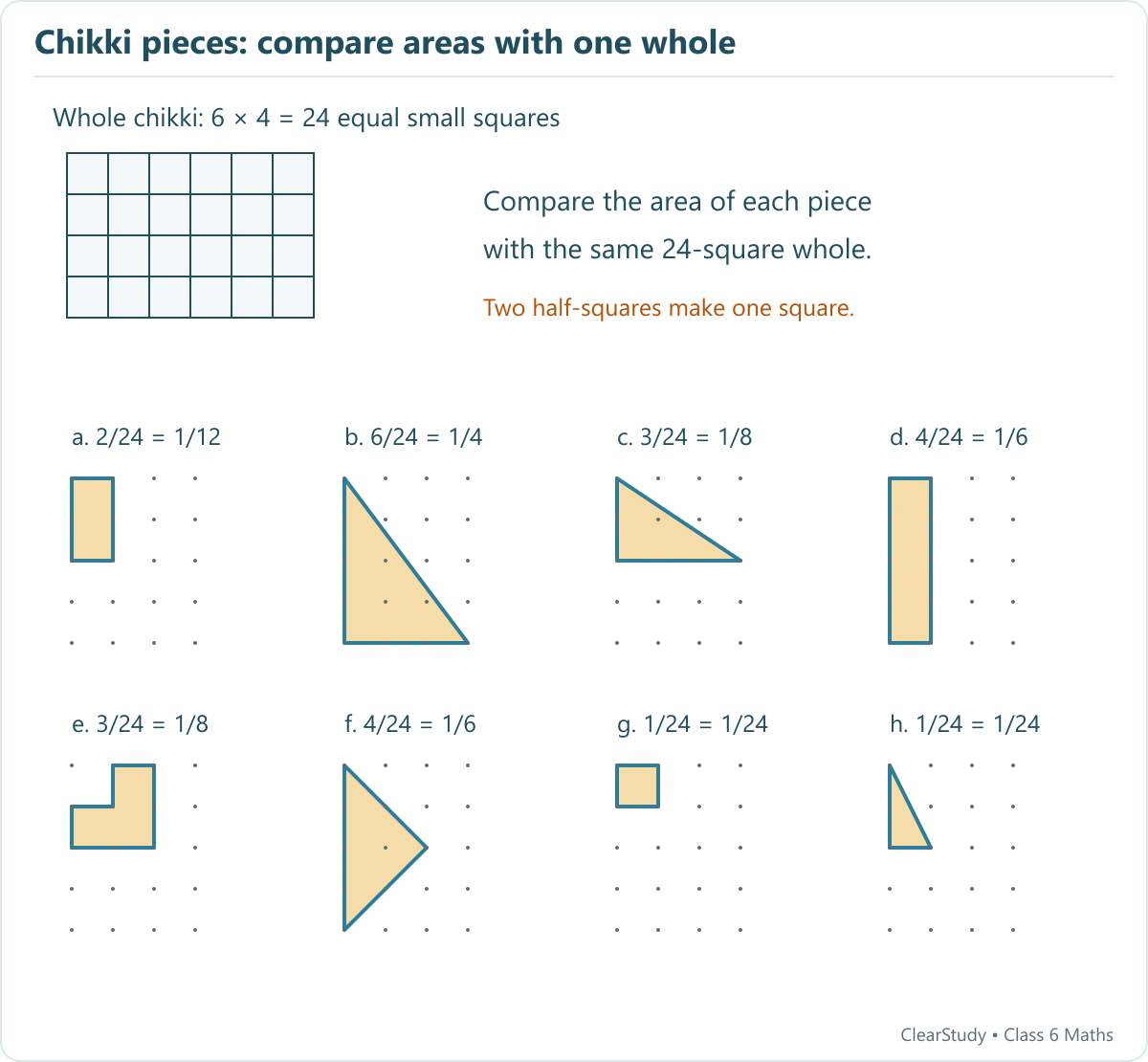
SOLUTIONUse the 6 × 4 whole chikki as 24 equal small squares. Compare each piece with that same whole; two half-squares count as one small square.a. 2/24 = 1/12; b. 6/24 = 1/4; c. 3/24 = 1/8; d. 4/24 = 1/6.e. 3/24 = 1/8; f. 4/24 = 1/6; g. 1/24 = 1/24; h. 1/24 = 1/24.For example, b is half a 3-by-4 rectangle, so it covers 6 small squares. The L-shaped e covers 3 squares; h is half a 1-by-2 rectangle, so it covers 1 square.
A whole chikki is a 6 by 4 grid. Eight rectangular, triangular and L-shaped pieces have areas 2, 6, 3, 4, 3, 4, 1 and 1 small squares, giving 1/12, 1/4, 1/8, 1/6, 1/8, 1/6, 1/24 and 1/24 of the whole.
All pieces use the same small-square scale. Count half-squares when a diagonal cuts through a square.

Figure it Out (Page 158)

1. Continue this table of ½ for 2 more steps.

SOLUTION The table adds one more ½ each step. The two further steps are: ½ + ½ + ½ + ½ + ½ + ½ = 6 times ½ = 6/2 = 3. ½ + ½ + ½ + ½ + ½ + ½ + ½ = 7 times ½ = 7/2 = 3½.

2. Can you create a similar table for ¼?

SOLUTION Yes — collecting ¼ one step at a time: ¼ = 1 time quarter = 1/4. ¼ + ¼ = 2 times quarter = 2/4 = ½. ¼ + ¼ + ¼ = 3 times quarter = 3/4. ¼ + ¼ + ¼ + ¼ = 4 times quarter = 4/4 = 1, and so on.

3. Make ⅓ using a paper strip. Can you use this to also make ⅙?
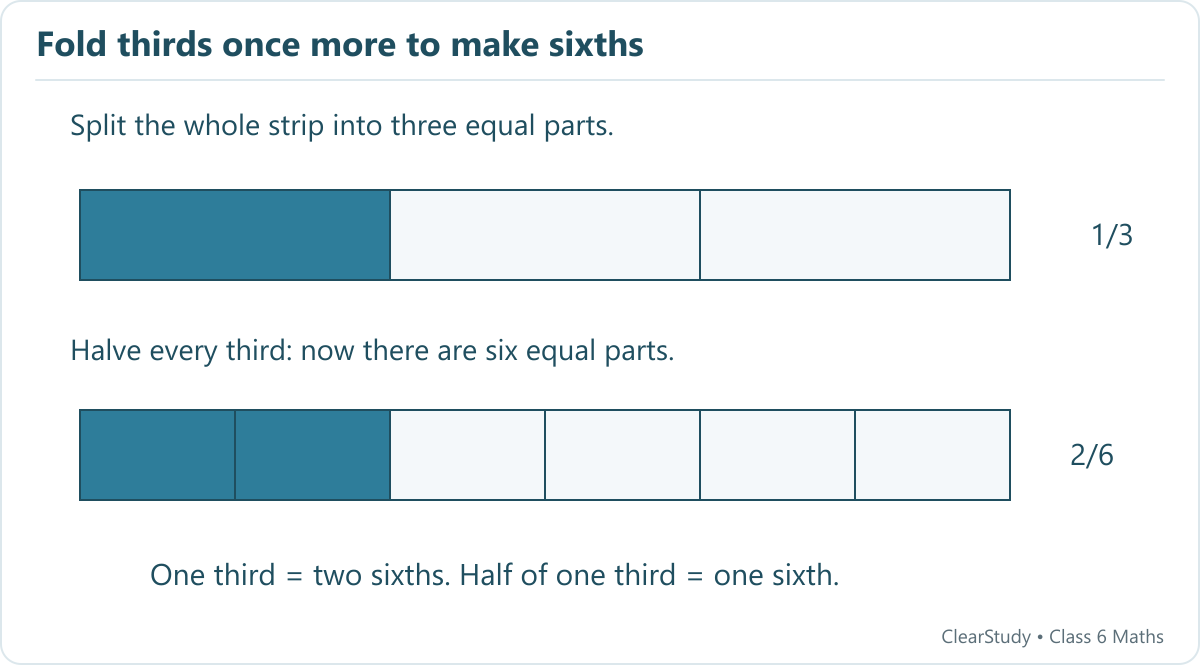
SOLUTION Fold the strip into 3 equal parts to get ⅓. Now fold each of those parts in half: the strip is divided into 6 equal parts. So yes — half of a ⅓ piece is a ⅙ piece (since 2 × ⅙ = ⅓).
Two equal-length paper strips show one of three parts shaded above and two of six parts shaded below. The shaded lengths are equal: 1/3 equals 2/6.
The whole strip stays the same length. Folding changes the size and number of the parts.

4. Draw a picture and write an addition statement to show: a. 5 times ¼ of a roti   b. 9 times ¼ of a roti
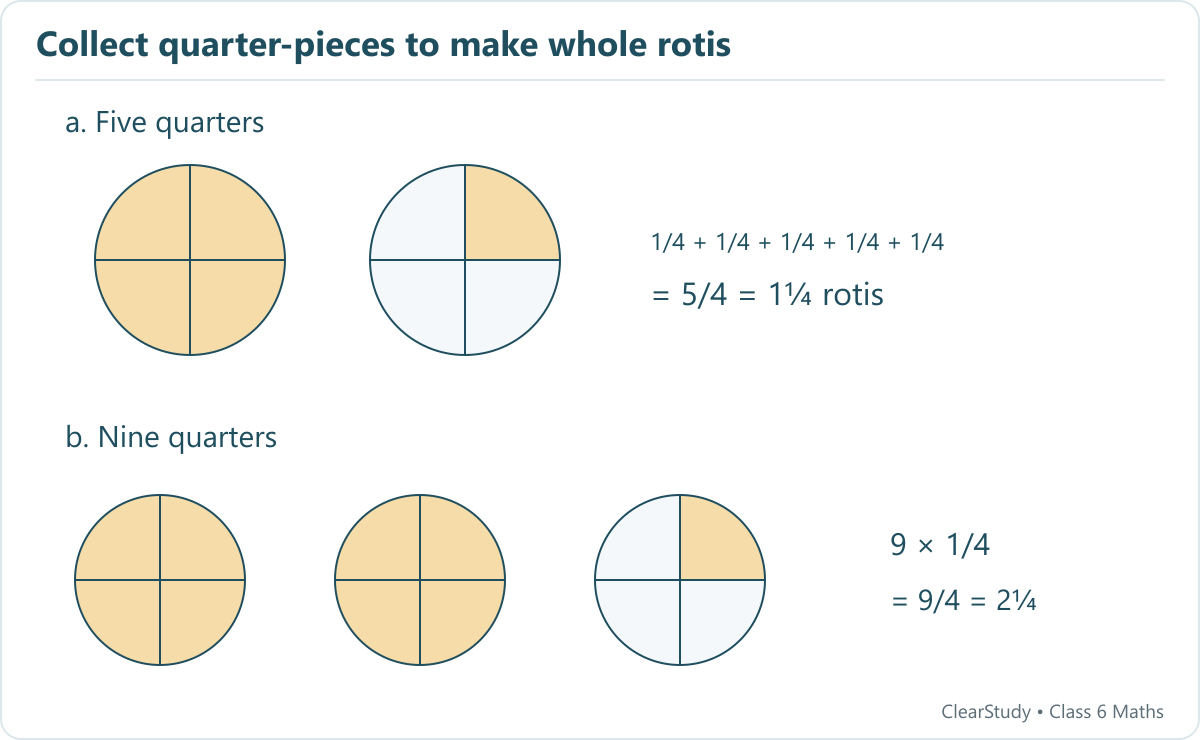
SOLUTION a. 5 times ¼ = ¼ + ¼ + ¼ + ¼ + ¼ = 5/4 = 1¼ rotis. b. 9 times ¼ = ¼ + ¼ + ¼ + ¼ + ¼ + ¼ + ¼ + ¼ + ¼ = 9/4 = 2¼ rotis. (Draw each as that many shaded quarter-strips of a roti.)
The top row has one whole roti and one quarter, representing five quarters. The bottom has two whole rotis and one quarter, representing nine quarters.
All rotis have equal area. Four quarter-pieces make one whole roti.

5. Match each fractional unit with the correct picture: ⅓, ⅕, ⅛, ⅙.
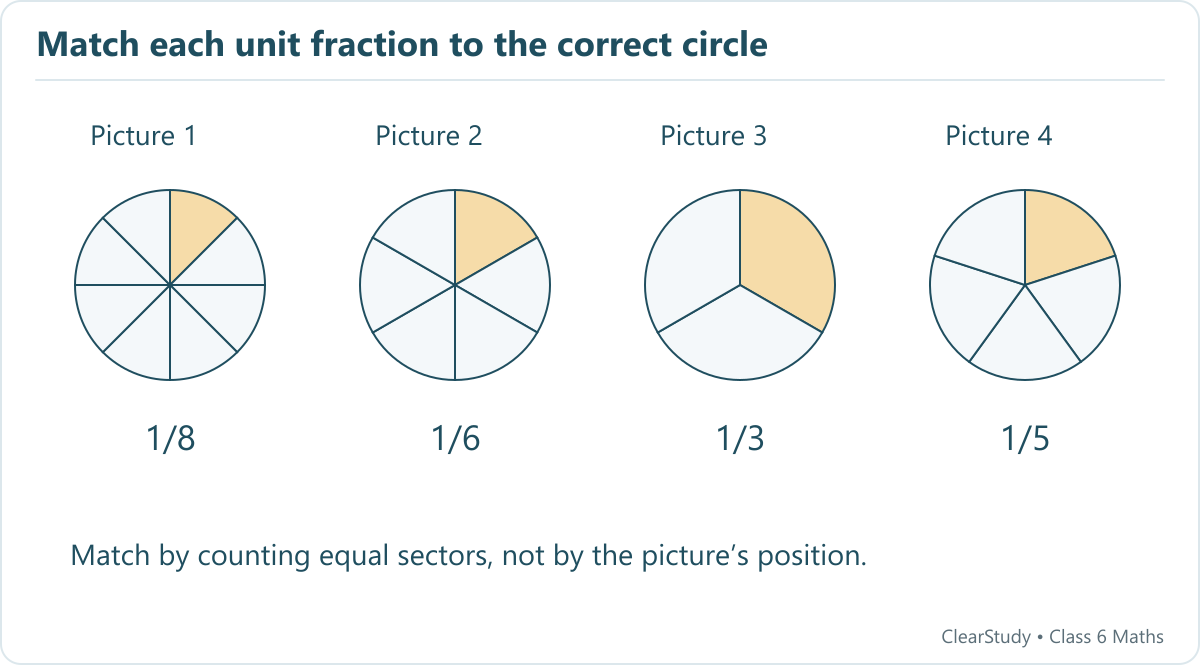
SOLUTIONNumber the four circles from left to right. They contain 8, 6, 3 and 5 equal sectors, respectively. Thus 1/3 → picture 3; 1/5 → picture 4; 1/8 → picture 1; 1/6 → picture 2. Each shaded part is one sector.
Four circles in textbook order are divided into 8, 6, 3 and 5 equal sectors, with one sector shaded in each. Their unit fractions are 1/8, 1/6, 1/3 and 1/5.
The circles are labelled from left to right so each fraction has an unambiguous match.

Figure it Out — Number Line & Mixed Fractions (Sections 7.4–7.5)

Number-line fill-ins (Page 159)

1. A length of 1 unit is divided into three equal parts. Write the fraction giving the length of the blue line.

SOLUTION Each part is ⅓ unit; the blue line covers 2 such parts. ∴ length = 2/3.

2. A unit is divided into 5 equal parts. Write the fractions giving the lengths of the blue lines.

SOLUTION Each part is ⅕; the marked blue lines cover 2 and 4 parts. ∴ lengths are 2/5 and 4/5.

3. A unit is divided into 8 equal parts. Write the appropriate fractions.
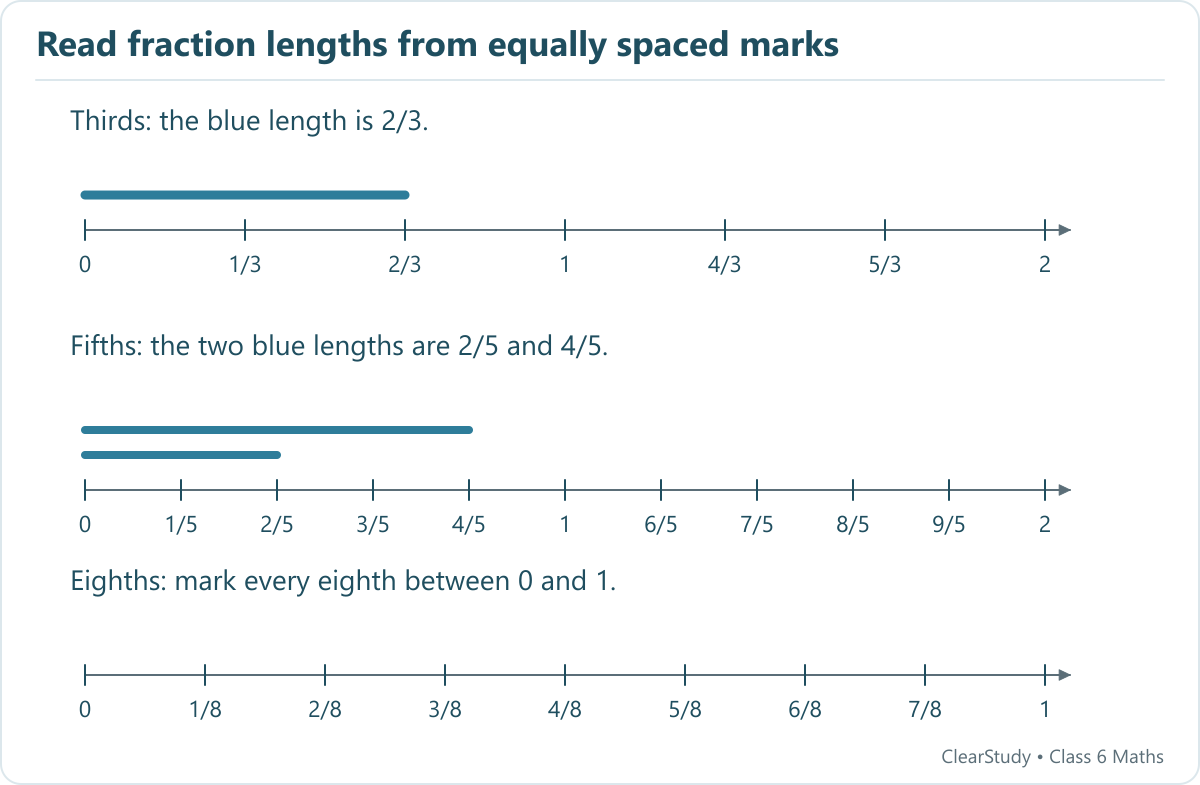
SOLUTION Each part is ⅛, so the marks are 1/8, 2/8, 3/8, … (up to 8/8 = 1).
Number lines show a length of 2/3, two lengths of 2/5 and 4/5, and all eighth marks from zero to one.
Count intervals from zero. The denominator tells how many equal intervals form one whole unit.

Figure it Out (Page 160)

1. On a number line, draw lines of lengths 1/10, 3/10, and 4/5.

SOLUTION Divide 0 to 1 into 10 equal parts (each = 1/10). Mark 1/10 at the 1st mark and 3/10 at the 3rd mark. 4/5 = 8/10, so mark it at the 8th mark (between 0 and 1, closer to 1).

2. Choose five more fractions and mark them on the number line.
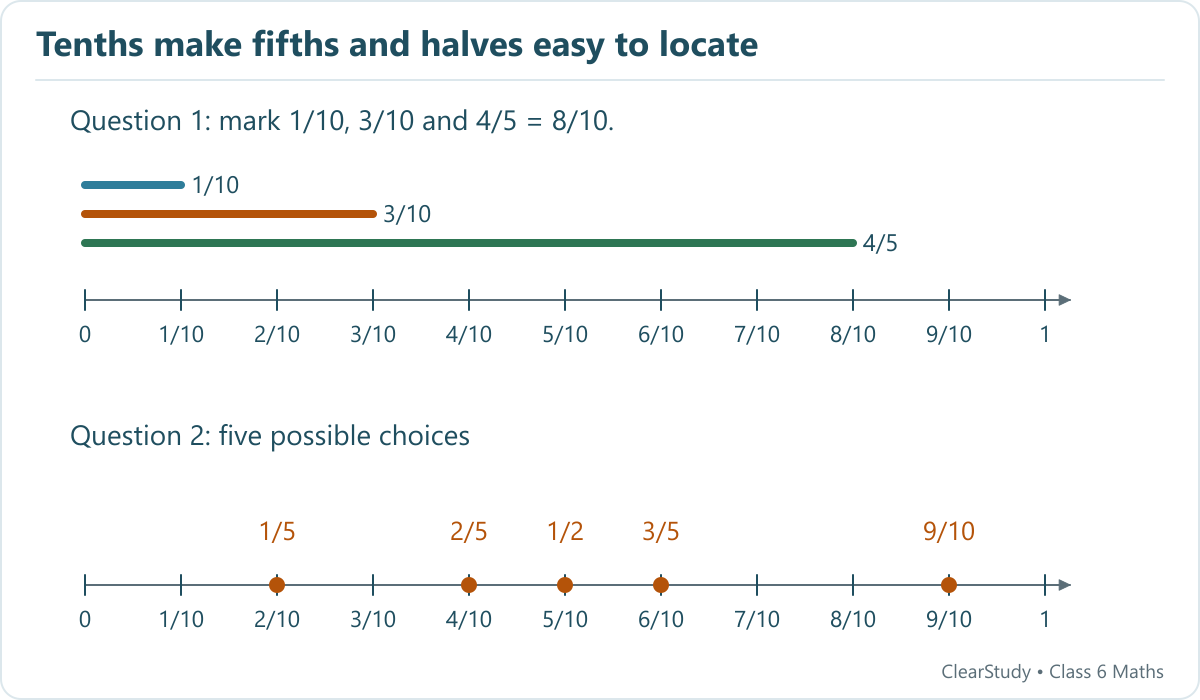
SOLUTIONOne possible set is 1/5, 2/5, 1/2, 3/5 and 9/10. On a tenths number line, these are 2/10, 4/10, 5/10, 6/10 and 9/10: the second, fourth, fifth, sixth and ninth marks after zero. Other correctly placed fractions also work.
A tenths number line marks 1/10, 3/10 and 4/5. A second marks five example fractions: 1/5, 2/5, 1/2, 3/5 and 9/10.
Equivalent fractions occupy the same point: for example, 4/5 equals 8/10.

3. How many fractions lie between 0 and 1? Think, discuss with your classmates, and write your answer.

SOLUTIONThere are infinitely many fractions between 0 and 1. For a concrete construction, mark 1/2, then half of that (1/4), then 1/8, 1/16, and keep halving. Each is a new fraction still strictly between 0 and 1. More generally, the average of any two distinct fractions lies between them.

4. The distance between 0 and 1 is divided into two equal parts; the blue line is ½ unit long. Write the fraction giving the length of the black line.

SOLUTION Each part is ½ unit. The black line reaches the third ½-mark, i.e. 3 halves. ∴ black line = 3/2 (= 1½) units.

5. Write the fractions giving the lengths of the black lines (unit split into fifths).
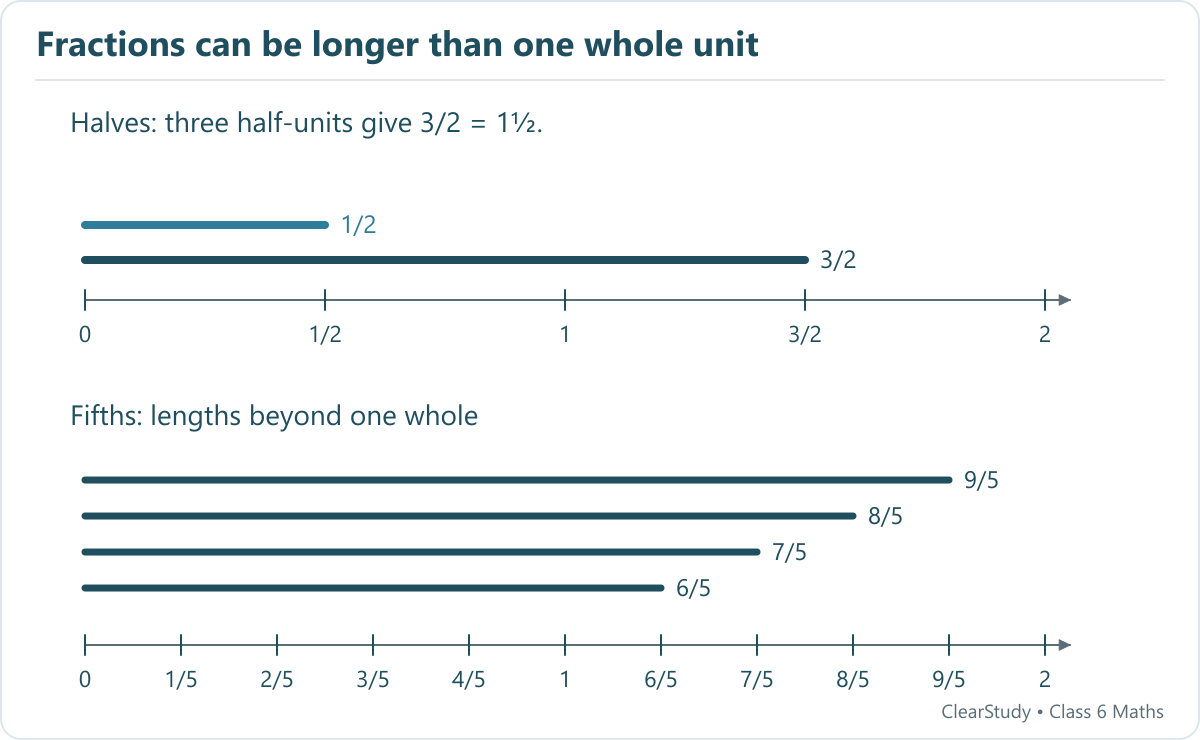
SOLUTION Each part is ⅕; the black lines reach beyond 1, at the 6th, 7th, 8th and 9th fifth-marks. ∴ lengths are 6/5, 7/5, 8/5 and 9/5.
The first number line has a blue half-unit and a black length of 3/2. The second shows black lengths of 6/5, 7/5, 8/5 and 9/5 extending beyond 1.
The size of one unit stays fixed when the fraction goes beyond one.

Figure it Out (Page 162) — whole units in a fraction

1. How many whole units are there in 7/2?

SOLUTION 7/2 = 3½, since 6/2 = 3 and there is ½ left over. ∴ there are 3 whole units in 7/2.

2. How many whole units are there in 4/3 and in 7/3?

SOLUTION 4/3 = 1⅓ → 1 whole unit; 7/3 = 2⅓ (since 6/3 = 2) → 2 whole units.

Figure it Out (Page 162) — whole units and mixed numbers

1. Figure out the number of whole units in each fraction: a. 8/3   b. 11/5   c. 9/4
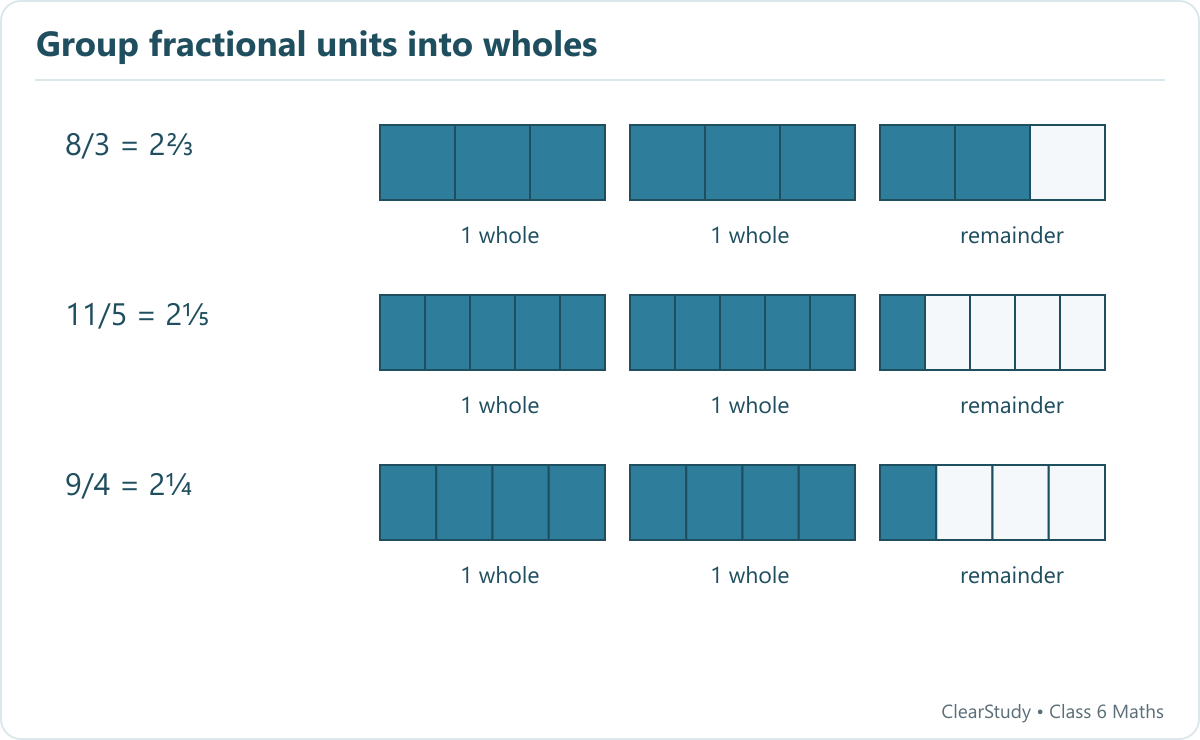
SOLUTION a. 8/3 = 2⅔ → 2 whole units. b. 11/5 = 2⅕ → 2 whole units. c. 9/4 = 2¼ → 2 whole units.
Three rows of equal bars show 8/3 as two wholes and two thirds, 11/5 as two wholes and one fifth, and 9/4 as two wholes and one quarter.
Divide the numerator by the denominator: the quotient counts wholes and the remainder counts leftover fractional units.

2. Can all fractions greater than 1 be written as such mixed numbers?

SOLUTIONDivide the numerator by the denominator. Every fraction greater than 1 is a whole-number part plus a remainder fraction; for example 8/3 = 2 + 2/3. If the division is exact, the remainder is 0: 8/4 = 2 + 0/4 = 2. We normally write this as a whole number, not as a mixed number with a non-zero fractional part.

3. Write the following fractions as mixed fractions (e.g. 9/2 = 4½): a. 9/2   b. 9/5   c. 21/19   d. 47/9   e. 12/11   f. 19/6

SOLUTION a. 9/2 = 4½ (8/2 = 4, remainder ½). b. 9/5 = 1 4/5 (5/5 = 1, remainder 4/5). c. 21/19 = 1 2/19 (19/19 = 1, remainder 2/19). d. 47/9 = 5 2/9 (45/9 = 5, remainder 2/9). e. 12/11 = 1 1/11 (11/11 = 1, remainder 1/11). f. 19/6 = 3 1/6 (18/6 = 3, remainder 1/6).

Figure it Out (Page 163) — mixed numbers as fractions

Write the following mixed numbers as fractions: a. 3¼   b. 7⅔   c. 9 4/9   d. 3⅙   e. 2 3/11   f. 3 9/10

SOLUTION Use (whole × denominator + numerator)/denominator: a. 3¼ = (3×4 + 1)/4 = 13/4. b. 7⅔ = (7×3 + 2)/3 = 23/3. c. 9 4/9 = (9×9 + 4)/9 = 85/9. d. 3⅙ = (3×6 + 1)/6 = 19/6. e. 2 3/11 = (2×11 + 3)/11 = 25/11. f. 3 9/10 = (3×10 + 9)/10 = 39/10.

Figure it Out — Equivalent Fractions & Lowest Terms (Section 7.6)

Fraction-wall questions (Page 164)
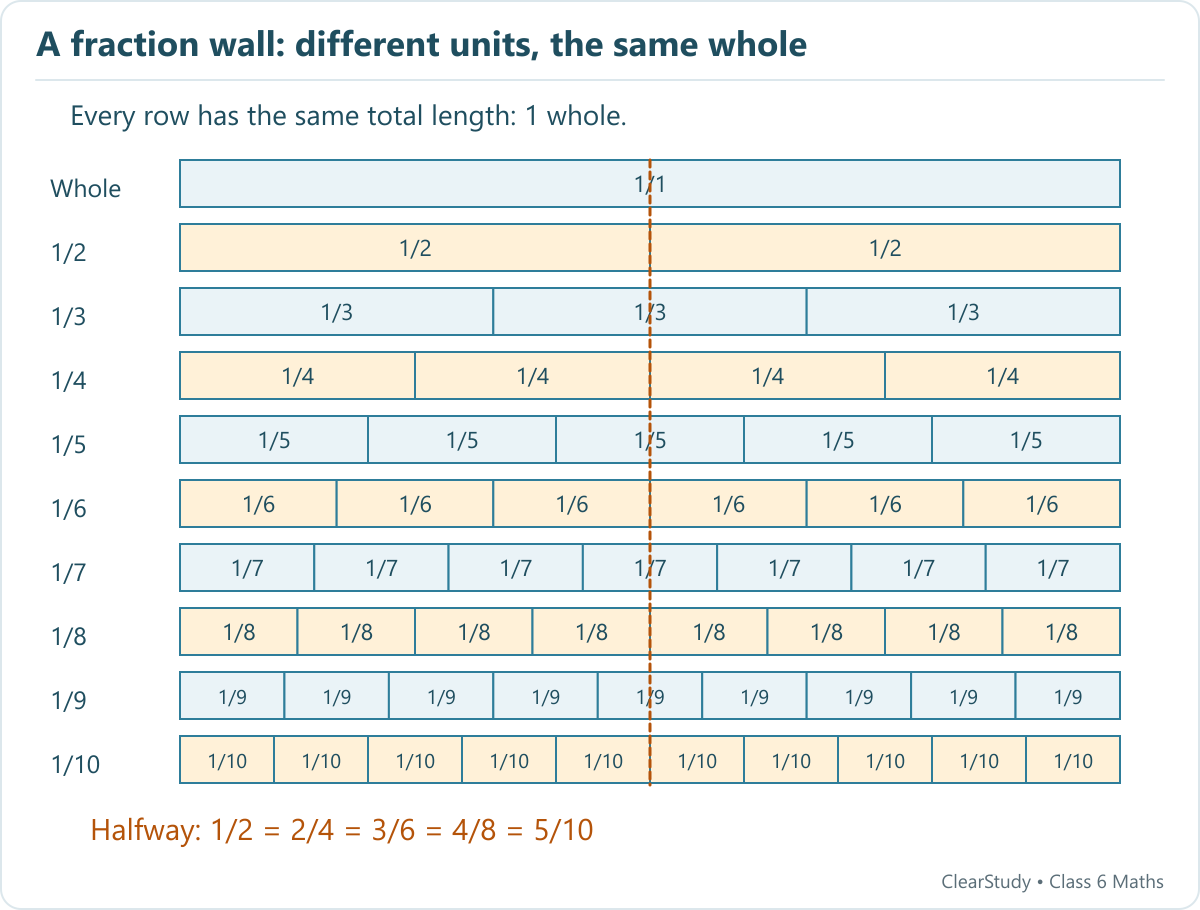
Ten equal-length rows divide one whole into halves through tenths. A halfway guide aligns 1/2, 2/4, 3/6, 4/8 and 5/10.
Equal fractions line up at the same distance from the left edge. Thirds and sixths also show that 1/3 equals 2/6.

1. Are the lengths ½ and 3/6 equal?

SOLUTIONYes — 3/6 = ½ (divide top and bottom by 3), so they are the same length.

2. Are 2/3 and 4/6 equivalent fractions? Why?

SOLUTIONYes. 4/6 = 2/3 (divide by 2); on the fraction wall their lengths are equal.

3. How many pieces of length 1/6 will make a length of ½?

SOLUTION½ = 3/6, so 3 pieces of 1/6.

4. How many pieces of length 1/6 will make a length of ⅓?

SOLUTION⅓ = 2/6, so 2 pieces of 1/6.

Figure it Out (Page 165)

1. Are 3/6, 4/8, 5/10 equivalent fractions? Why?

SOLUTION Each reduces to ½: 3/6 = ½, 4/8 = ½, 5/10 = ½. ∴ yes, they are equivalent — their lengths on the fraction wall are equal.

2. Write two equivalent fractions for 2/6.

SOLUTIONDivide both numerator and denominator by 2: 2/6 = 1/3. Multiply both by 2: 2/6 = 4/12. These are two possible answers. To obtain 3/9, first simplify to 1/3 and then multiply its numerator and denominator by 3. Multiplying 2/6 directly by 3/3 gives 6/18, not 3/9.

3. 4/6 = ___ = ___ = ___ = ___ (write as many as you can)

SOLUTION4/6 = 2/3 = 6/9 = 8/12 = 10/15 = … (keep multiplying 2/3 by the same number top and bottom).

Figure it Out (Page 166) — equal shares (division/addition/multiplication facts)

1. Three rotis are shared equally by four children. Write the fraction each child gets and the division, addition and multiplication facts.

SOLUTION Each child gets 3/4 roti. Division fact: 3 ÷ 4 = 3/4. Addition fact: 3 = 3/4 + 3/4 + 3/4 + 3/4. Multiplication fact: 3 = 4 × 3/4.

2. Draw a picture to show how much each child gets when 2 rotis are shared equally by 4 children, and write the division, addition and multiplication facts.
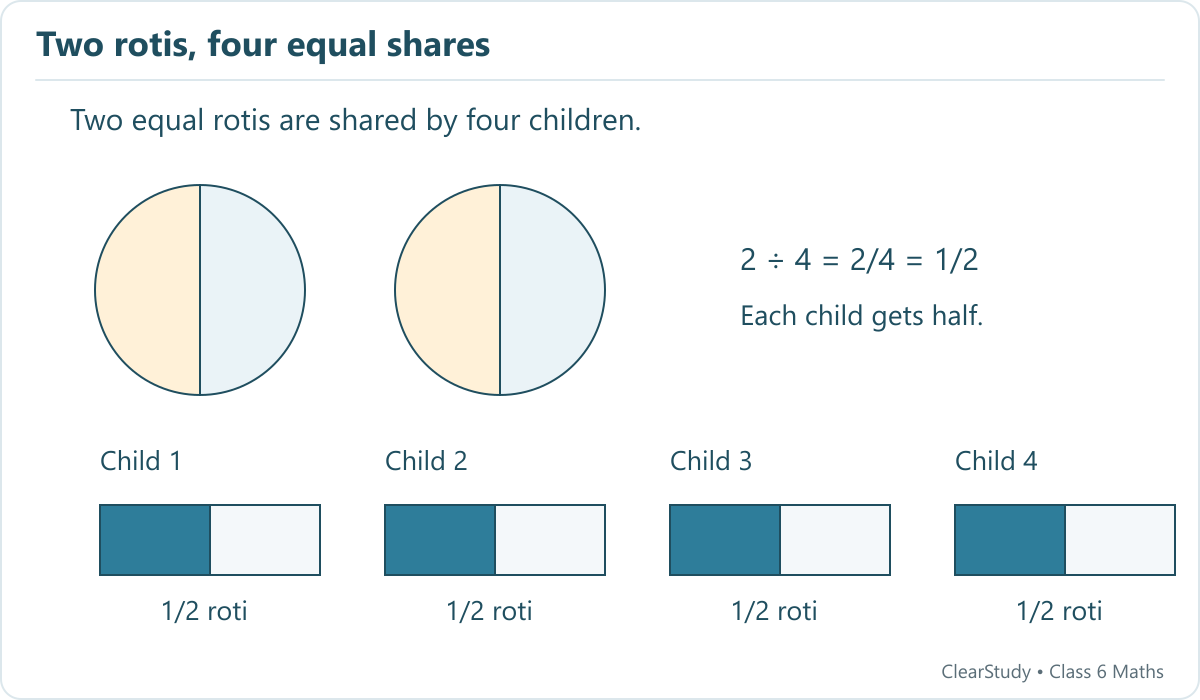
SOLUTION Each child gets 2/4 = ½ roti. Division fact: 2 ÷ 4 = 2/4 = ½. Addition fact: 2 = ½ + ½ + ½ + ½. Multiplication fact: 2 = 4 × ½.
Two whole rotis are cut into four half-pieces. Four equal bars below each show one half roti for one child.
Division: 2 ÷ 4 = 1/2. Addition: four halves total 2. Multiplication: 4 × 1/2 = 2.

3. Anil was in a group where 2 cakes were divided equally among 5 children. How much cake would Anil get?

SOLUTION2 cakes ÷ 5 children = 2/5 cake each.

Figure it Out (Page 168) — find the missing numbers

a. 5 glasses of juice shared equally among 4 friends is the same as ____ glasses shared equally among 8 friends. So, 5/4 = ___/8.

SOLUTION5/4 = 10/8 (multiply by 2/2), so the missing number is 10.

b. 4 kg of potatoes divided equally in 3 bags is the same as 12 kg divided equally in ___ bags. So, 4/3 = 12/___.

SOLUTION4/3 = 12/9 (multiply by 3/3), so the missing number is 9.

c. 7 rotis divided among 5 children is the same as ____ rotis divided among _____ children. So, 7/5 = ___/___.

SOLUTION7/5 = 14/10 (multiply by 2/2), so one answer is 14 rotis among 10 children (21/15, 28/20, … also work).

Find equivalent fractions with the same fractional unit (Page 172)

Find equivalent fractions for each pair so that the fractional units (denominators) are the same: a. 7/2 and 3/5   b. 8/3 and 5/6   c. 3/4 and 3/5   d. 6/7 and 8/5 e. 9/4 and 5/2   f. 1/10 and 2/9   g. 8/3 and 11/4   h. 13/6 and 1/9

SOLUTION a. common denominator 10: 7/2 = 35/10, 3/5 = 6/10. b. common denominator 6: 8/3 = 16/6, 5/6 = 5/6. c. common denominator 20: 3/4 = 15/20, 3/5 = 12/20. d. common denominator 35: 6/7 = 30/35, 8/5 = 56/35. e. common denominator 4: 9/4 = 9/4, 5/2 = 10/4. f. common denominator 90: 1/10 = 9/90, 2/9 = 20/90. g. common denominator 12: 8/3 = 32/12, 11/4 = 33/12. h. common denominator 18: 13/6 = 39/18, 1/9 = 2/18.

Figure it Out (Page 173) — lowest terms

As a visual example, 16/20 and 4/5 shade the same amount below. Grouping each four small parts makes one fifth.
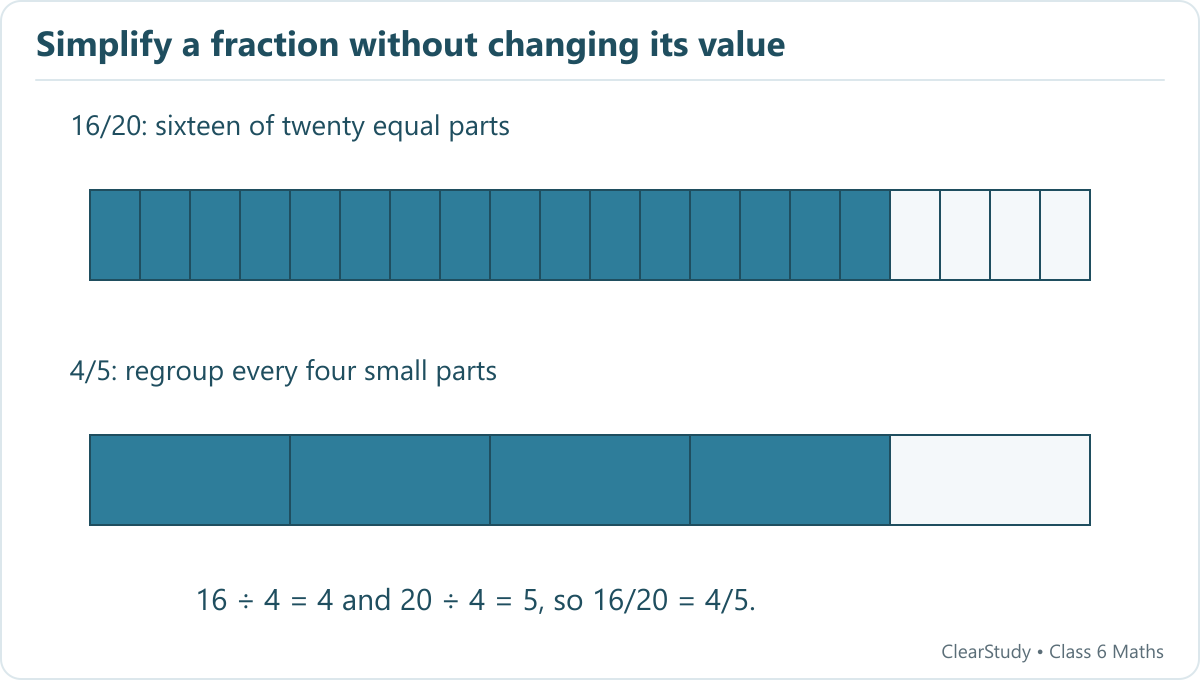
Equal-length bars shade sixteen twentieths and four fifths. Grouping four small parts creates each fifth, preserving the shaded length.
Divide numerator and denominator by the same common factor. Dividing by their highest common factor gives lowest terms.

Express the following fractions in lowest terms: a. 17/51   b. 64/144   c. 126/147   d. 525/112

SOLUTION a. 17/51: HCF 17 → (17÷17)/(51÷17) = 1/3. b. 64/144: HCF 16 → (64÷16)/(144÷16) = 4/9. c. 126/147: HCF 21 → (126÷21)/(147÷21) = 6/7. d. 525/112: HCF 7 → (525÷7)/(112÷7) = 75/16.

Figure it Out — Comparing Fractions (Section 7.7)

Figure it Out (Page 174)

1. Compare the following fractions and justify your answers: a. 8/3, 5/2   b. 4/9, 3/7   c. 7/10, 9/14   d. 12/5, 8/5   e. 9/4, 5/2

SOLUTION a. Common denominator 6: 8/3 = 16/6, 5/2 = 15/6 → 8/3 > 5/2. b. Common denominator 63: 4/9 = 28/63, 3/7 = 27/63 → 4/9 > 3/7. c. Common denominator 70: 7/10 = 49/70, 9/14 = 45/70 → 7/10 > 9/14. d. Same denominator: 12 > 8 → 12/5 > 8/5. e. Common denominator 4: 9/4 = 9/4, 5/2 = 10/4 → 9/4 < 5/2.

2. Write the following fractions in ascending order: a. 7/10, 11/15, 2/5   b. 19/24, 5/6, 7/12

SOLUTION a. Common denominator 30: 7/10 = 21/30, 11/15 = 22/30, 2/5 = 12/30 → 2/5 < 7/10 < 11/15. b. Common denominator 24: 19/24 = 19/24, 5/6 = 20/24, 7/12 = 14/24 → 7/12 < 19/24 < 5/6.

3. Write the following fractions in descending order: a. 25/16, 7/8, 13/4, 17/32   b. 3/4, 12/5, 7/12, 5/4

SOLUTION a. Common denominator 32: 25/16 = 50/32, 7/8 = 28/32, 13/4 = 104/32, 17/32 = 17/32 → 13/4 > 25/16 > 7/8 > 17/32. b. Common denominator 60: 3/4 = 45/60, 12/5 = 144/60, 7/12 = 35/60, 5/4 = 75/60 → 12/5 > 5/4 > 3/4 > 7/12.

Figure it Out — Addition & Subtraction (Section 7.8)

Figure it Out (Page 179) — addition by Brahmagupta’s method

1. Add the following fractions: a. 2/7 + 5/7 + 6/7   b. 3/4 + 1/3   c. 2/3 + 5/6   d. 2/3 + 2/7   e. 3/4 + 1/3 + 1/5 f. 2/3 + 4/5   g. 4/5 + 2/3   h. 3/5 + 5/8   i. 9/2 + 5/4   j. 8/3 + 2/7 k. 3/4 + 1/3 + 1/5   l. 2/3 + 4/5 + 3/7   m. 9/2 + 5/4 + 7/6

SOLUTION a. same unit: (2 + 5 + 6)/7 = 13/7. b. LCM 12: 9/12 + 4/12 = 13/12. c. LCM 6: 4/6 + 5/6 = 9/6 = 3/2. d. LCM 21: 14/21 + 6/21 = 20/21. e. LCM 60: 45/60 + 20/60 + 12/60 = 77/60. f. LCM 15: 10/15 + 12/15 = 22/15. g. LCM 15: 12/15 + 10/15 = 22/15. h. LCM 40: 24/40 + 25/40 = 49/40. i. LCM 4: 18/4 + 5/4 = 23/4. j. LCM 21: 56/21 + 6/21 = 62/21. k. LCM 60: 45/60 + 20/60 + 12/60 = 77/60. l. LCM 105: 70/105 + 84/105 + 45/105 = 199/105. m. LCM 12: 54/12 + 15/12 + 14/12 = 83/12.

2. Rahim mixes 2/3 litres of yellow paint with 3/4 litres of blue paint to make green paint. What is the volume of green paint he has made?
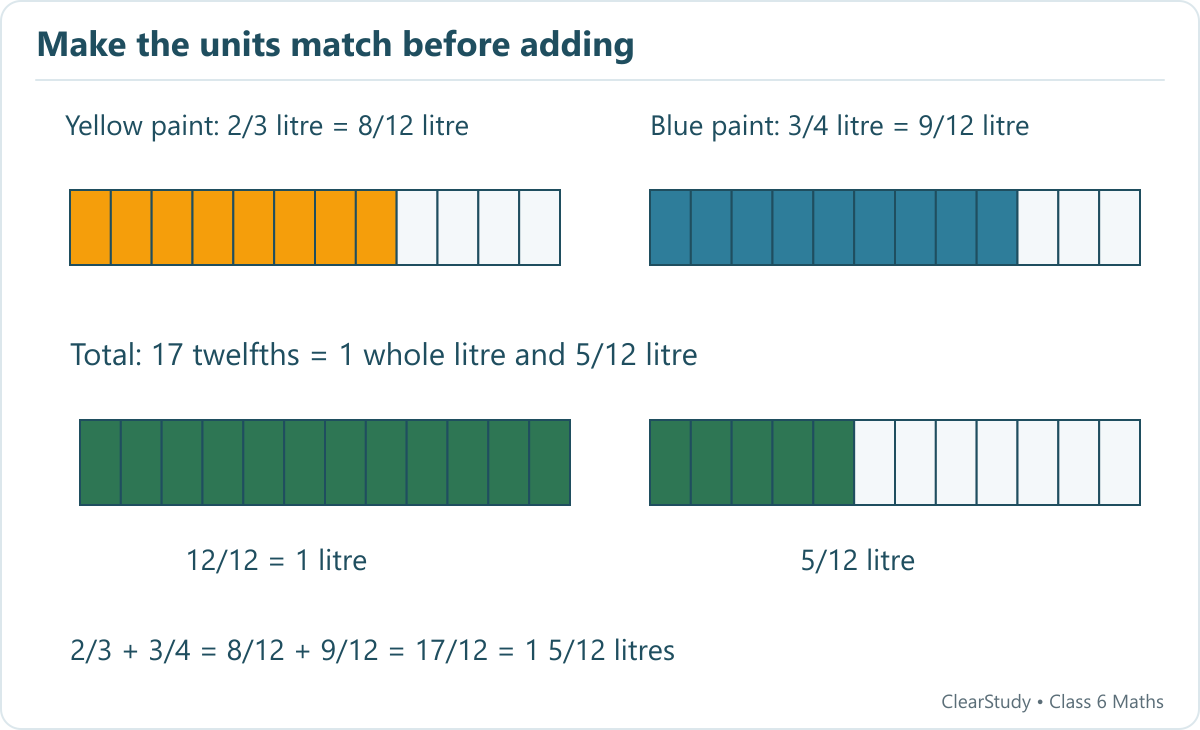
SOLUTION 2/3 + 3/4, LCM 12 = 8/12 + 9/12 = 17/12. ∴ green paint = 17/12 litres = 1 5/12 litres.
Yellow paint is eight twelfths of a litre and blue paint is nine twelfths. Two result bars show one whole litre plus five twelfths, for 17/12 litres.
Every full bar represents one litre. Colour identifies the quantities in the word problem.

3. Geeta bought 2/5 m of lace and Shamim bought 3/4 m of the same lace for a border whose perimeter is 1 m. Find the total length of lace, and will it be sufficient?

SOLUTION 2/5 + 3/4, LCM 20 = 8/20 + 15/20 = 23/20 = 1 3/20 m. Total lace = 1 3/20 m. Since 1 3/20 m > 1 m, yes, it is sufficient to cover the whole border.

Figure it Out (Page 181) — subtraction, same denominator

1. 5/8 − 3/8   2. 7/9 − 5/9   3. 10/27 − 1/27

SOLUTION 1. (5 − 3)/8 = 2/8 = 1/4. 2. (7 − 5)/9 = 2/9. 3. (10 − 1)/27 = 9/27 = 1/3.

Figure it Out (Page 182) — subtraction by Brahmagupta’s method

1. Carry out the following subtractions: a. 8/15 − 3/15   b. 2/5 − 4/15   c. 5/6 − 4/9   d. 2/3 − 1/2
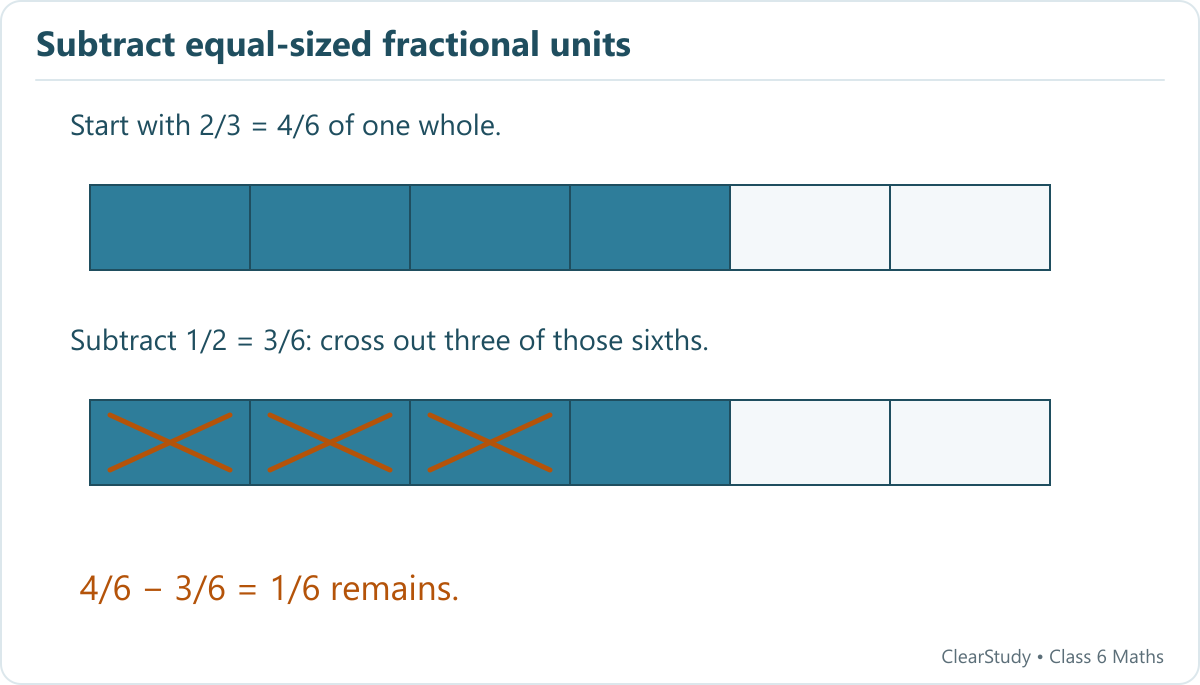
SOLUTION a. (8 − 3)/15 = 5/15 = 1/3. b. LCM 15: 6/15 − 4/15 = 2/15. c. LCM 18: 15/18 − 8/18 = 7/18. d. LCM 6: 4/6 − 3/6 = 1/6.
A bar has four of six equal parts shaded, representing 2/3. Three shaded sixths are crossed out to subtract 1/2, leaving 1/6.
For 2/3 − 1/2, use sixths as the common unit before subtracting.

2. Subtract as indicated: a. 13/4 from 10/3   b. 18/5 from 23/3   c. 29/7 from 45/7

SOLUTION a. 10/3 − 13/4, LCM 12 = 40/12 − 39/12 = 1/12. b. 23/3 − 18/5, LCM 15 = 115/15 − 54/15 = 61/15. c. 45/7 − 29/7 = (45 − 29)/7 = 16/7.

3. Solve the following problems: a. Jaya’s school is 7/10 km from home. She takes an auto for ½ km, then walks the rest. How much does she walk daily? b. Jeevika takes 10/3 minutes for a round of the park; Namit takes 13/4 minutes. Who takes less time and by how much?

SOLUTION a. Walk = 7/10 − ½, LCM 10 = 7/10 − 5/10 = 2/10 = 1/5 km. b. Compare 10/3 and 13/4, LCM 12: 10/3 = 40/12, 13/4 = 39/12. Since 39/12 < 40/12, Namit takes less time, by 40/12 − 39/12 = 1/12 minute.

Math Talk & Try This — Answered

These are the in-text reflective and short tasks in the chapter; the determinate ones are answered, the open ones are guided.
Math Talk (Section 7.1) — which fraction is greater? Which fraction is greater — 1/5 or 1/9? And is 1/100 bigger than 1/200? Answer. The more people share one roti, the smaller each share. So 1/5 > 1/9 (sharing among fewer gives more), and likewise 1/100 > 1/200. For unit fractions, the larger the denominator, the smaller the fraction.
Math Talk (Section 7.2) — same-size sixths? By dividing the whole chikki into 6 equal parts in different ways, we get 1/6 chikki pieces of different shapes. Are they of the same size? Answer. Yes. However the shapes differ, each piece is one of 6 equal parts of the same whole, so each is exactly 1/6 of the chikki — the same amount.
Math Talk (Section 7.4) — fractions between 0 and 1 How many fractions lie between 0 and 1? Answer. Infinitely many (countless). Between any two fractions you can always find another, so the list never ends.
Math Talk (Section 7.5) — whole units in a fraction How many whole units are in 7/2, and in 4/3 and 7/3? Answer. 7/2 = 3½ → 3 whole units; 4/3 = 1⅓ → 1; 7/3 = 2⅓ → 2.
Math Talk (Section 7.6) — larger share when units increase If the number of children stays the same but more units are shared, what happens to each share? Why does this explain 1/5 < 2/5, 3/7 < 4/7 and 1/2 < 5/8? Answer. Each child’s share becomes larger: with the same number of children but more to share, everyone gets more. With the same fractional unit, more units means a bigger fraction, so 1/5 < 2/5 and 3/7 < 4/7; and 1/2 = 4/8 < 5/8.
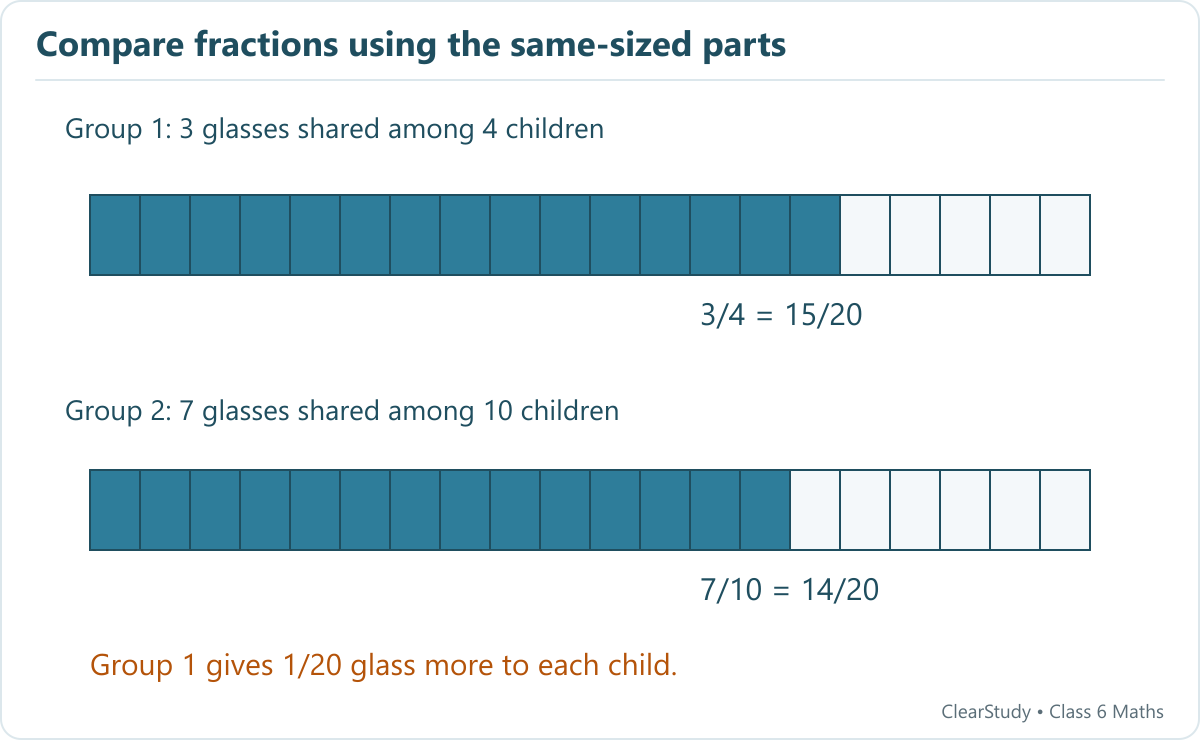
Math Talk (Section 7.6) — which group gets more juice? Group 1: 3 glasses among 4 children, or Group 2: 7 glasses among 10 children. And Group 1: 4 glasses among 7 children, or Group 2: 5 glasses among 7 children. Which were easier to compare? Answer. Pair 1: compare 3/4 and 7/10 — common denominator 20 gives 15/20 vs 14/20, so Group 1 (3/4) gives more. Pair 2: 4/7 vs 5/7 have the same denominator, so 5/7 > 4/7 and Group 2 gives more. The second pair is easier because the number of children (denominator) is already the same.
Two equal bars divided into twentieths shade 15 parts for 3/4 and 14 parts for 7/10. The first share is greater by 1/20 glass.
The bars represent the same whole glass. Compare numerators only after using a common denominator.
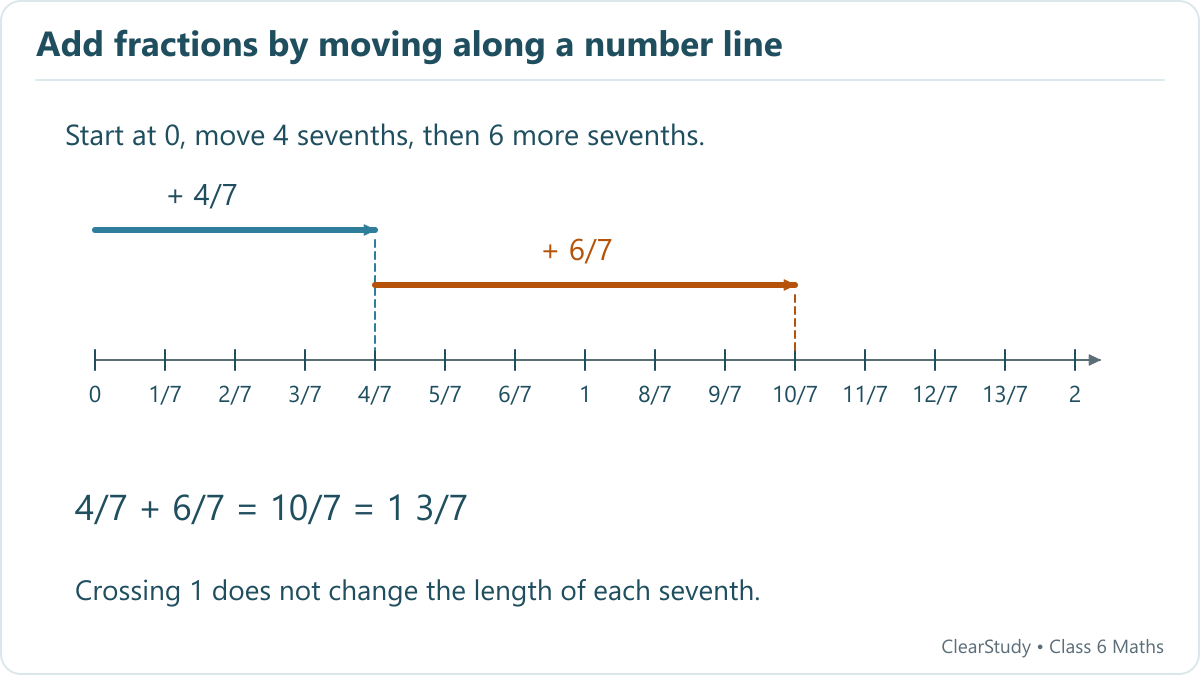
Math Talk (Section 7.8) — adding on a number line Try adding 4/7 + 6/7 using a number line. Do you get the same answer? Answer. Yes. Moving 4 sevenths then 6 more sevenths lands on 10/7 = 1 3/7 — the same as adding the numerators: 4/7 + 6/7 = 10/7.
A number line in sevenths shows a jump from 0 to 4/7 followed by a jump of 6/7 to 10/7, equal to 1 and 3/7.
When denominators match, add the numbers of equal-sized parts and keep the denominator.
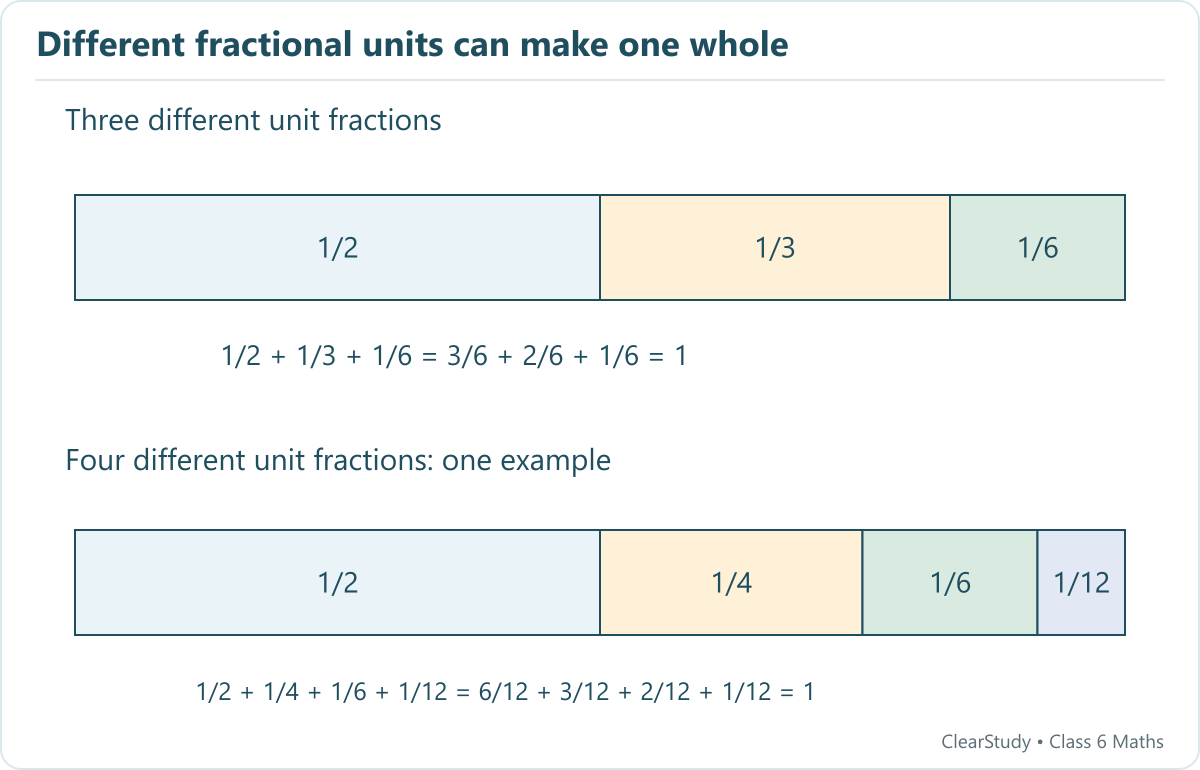
Try This (Section 7.9) — three different fractional units that add to 1 Can you find three different fractional units that add up to 1? Answer. One solution is 1/2 + 1/3 + 1/6 = 1, because 3/6 + 2/6 + 1/6 = 6/6. It is the only set of three distinct positive unit fractions, apart from changing their order. To see why, put the largest first. If it were 1/3 or smaller, three distinct terms would sum to less than 1; hence it must be 1/2. The remaining two sum to 1/2. If the larger of them were 1/4 or smaller, two distinct terms would sum to less than 1/2, so it must be 1/3. The final term is 1/2 − 1/3 = 1/6.
Try This (Section 7.9) — four different fractional units that add to 1 Can you find four different fractional units that add up to 1? Answer. One example is 1/2 + 1/4 + 1/6 + 1/12 = 1. Using twelfths gives 6/12 + 3/12 + 2/12 + 1/12 = 12/12. There are six sets of distinct positive unit fractions, ignoring order: (1/2, 1/3, 1/7, 1/42); (1/2, 1/3, 1/8, 1/24); (1/2, 1/3, 1/9, 1/18); (1/2, 1/3, 1/10, 1/15); (1/2, 1/4, 1/5, 1/20); and (1/2, 1/4, 1/6, 1/12). Check each set with a common denominator.
Two full bars are split into different unit fractions. One uses halves, thirds and sixths; the other uses halves, quarters, sixths and twelfths. Each row totals one whole.
All pieces within a row are different unit fractions, and their lengths add exactly to 1.

Common Mistakes to Avoid

Watch out for these

  • Thinking 1/9 > 1/5 “because 9 > 5” — for unit fractions a bigger denominator means a smaller fraction.
  • Adding fractions by adding both numerators and denominators — first make the denominators equal, then add only the numerators.
  • Forgetting to reduce the answer to lowest terms (e.g. leaving 9/6 instead of 3/2).
  • Converting a mixed number wrongly — use (whole × denominator + numerator)/denominator, so 3¼ = 13/4, not 7/4.
  • Comparing fractions by numerators alone when the denominators differ — rewrite with a common denominator first.
  • Counting the number of whole units as the whole number you read off plus the fraction — e.g. 7/2 = 3½ contains 3 whole units, not 4.

Practice MCQs & Assertion–Reason

1. Which of these unit fractions is the greatest?

(a) 1/5    (b) 1/8    (c) 1/3    (d) 1/10

2. The fraction 8/3 written as a mixed number is:

(a) 2⅓    (b) 2⅔    (c) 3⅓    (d) 1⅔

3. The mixed number 3¼ written as an improper fraction is:

(a) 7/4    (b) 12/4    (c) 13/4    (d) 4/13

4. Which fraction is equivalent to 2/3?

(a) 3/4    (b) 4/6    (c) 2/6    (d) 6/8

5. The fraction 16/20 in its lowest terms is:

(a) 8/10    (b) 4/5    (c) 2/3    (d) 3/4

6. 2/7 + 5/7 + 6/7 equals:

(a) 13/21    (b) 13/7    (c) 11/7    (d) 13/14

7. Which is greater, 4/9 or 3/7?

(a) 4/9    (b) 3/7    (c) they are equal    (d) cannot be decided

8. 3/4 − 2/3 equals:

(a) 1/12    (b) 1/7    (c) 1/2    (d) 5/12

9. How many pieces of 1/6 make a length of ½?

(a) 2    (b) 3    (c) 4    (d) 6

10. The general method for adding and subtracting fractions was codified by:

(a) Aryabhata    (b) Al-Hassar    (c) Brahmagupta    (d) Mahaviracharya

Answer key: 1-(c), 2-(b), 3-(c), 4-(b), 5-(b), 6-(b), 7-(a), 8-(a), 9-(b), 10-(c).

For each Assertion–Reason question, choose: (A) Both Assertion and Reason are true and the Reason is the correct explanation of the Assertion; (B) Both are true but the Reason is not the correct explanation; (C) Assertion is true but Reason is false; (D) Assertion is false but Reason is true.

A-R 1. Assertion: 1/5 is greater than 1/9.

Reason: For unit fractions, a larger denominator gives a smaller fraction.

A-R 2. Assertion: 2/3 and 4/6 are equivalent fractions.

Reason: Multiplying the numerator and denominator by the same non-zero whole number gives an equivalent fraction.

A-R 3. Assertion: To add 3/4 and 1/3 we simply add the numerators and the denominators to get 4/7.

Reason: In the common-denominator method, convert to equal fractional units, then add the numerators and keep the denominator.

A-R 4. Assertion: 16/20 in lowest terms is 4/5.

Reason: Dividing the numerator and denominator by their highest common factor (4) gives the simplest form.

A-R 5. Assertion: The fraction 7/2 contains 3 whole units.

Reason: 7/2 = 3½, so the whole-number part is 3.

Answer key: 1-(A), 2-(A), 3-(D), 4-(A), 5-(A).

Quick Revision Summary

  • A fraction is an equal share; a fractional unit (unit fraction) is one whole split into equal parts — bigger denominator means a smaller unit.
  • In 5/6, 5 is the numerator and 6 is the denominator; 3/4 = 3 times ¼.
  • For positive denominators, a fraction is greater than 1 when its numerator exceeds its denominator. Division gives a mixed number if there is a remainder, or a whole number if there is none.
  • Mixed ↔ improper: improper = (whole × denominator + numerator)/denominator.
  • Equivalent fractions are made by multiplying or dividing top and bottom by the same non-zero number; lowest terms uses the highest common factor.
  • To compare fractions, give them a common denominator and compare numerators.
  • Brahmagupta’s method: equal denominators, then add or subtract the numerators; reduce if needed.

How to score full marks in this chapter

Always show the common denominator you use before adding, subtracting or comparing, and write the equivalent fractions clearly (e.g. 2/3 = 8/12). Reduce every final answer to lowest terms and convert improper fractions to mixed numbers when the question asks for them. For word problems, set up the calculation first (sum or difference), then interpret the result in the context (litres, metres, minutes). Keep the working tidy so each step earns its mark.

Frequently Asked Questions

What is Class 6 Maths Ganita Prakash Chapter 7 about?

Chapter 7, Fractions, covers fractions as equal shares, fractional units, marking fractions on the number line, mixed fractions, equivalent fractions and lowest terms, comparing fractions, and Brahmagupta’s method for adding and subtracting fractions, with a short history of fractions in India.

How do you add two fractions with different denominators?

Use Brahmagupta’s method: first convert both fractions to equivalent fractions with the same denominator (a common multiple of the denominators), then add the numerators and keep the same denominator. Reduce the answer to lowest terms if needed — for example 3/4 + 1/3 = 9/12 + 4/12 = 13/12.

Why is 1/5 greater than 1/9?

Both are unit fractions of the same whole. When one roti is shared among 5 children each gets more than when it is shared among 9 children. So a larger denominator means a smaller share — 1/5 > 1/9.

Are these Class 6 Maths Ganita Prakash Chapter 7 solutions free?

Yes. The solutions and original diagrams are free. You can consult the official NCERT chapter linked below alongside the worked explanations.

Textbook reference: NCERT Ganita Prakash, Chapter 7 (official PDF). ClearStudy diagrams and worked explanations are original teaching aids.

Scroll to Top