Class 6 Maths Chapter 8 Solutions – Playing with Constructions
These Class 6 Maths Ganita Prakash Chapter 8 solutions explain Playing with Constructions through labelled diagrams and practical drawing steps. Use a ruler and compass for lengths and arcs, and a protractor or set-square when an angle or perpendicular is needed. Work through circles, waves, squares, rectangles, diagonals and the house, checking each finished figure against its required properties.
Chapter 8 of Ganita Prakash, Playing with Constructions, teaches you to draw accurate figures using a ruler and compass, with angle-measuring tools where needed. It begins with freehand artwork (a person, a wavy wave, eyes), then introduces the circle — the set of all points at a fixed distance (the radius) from a centre. You learn the defining properties of squares and rectangles, how to construct them using perpendiculars and a compass, how to explore points moving along their sides, and how a diagonal divides the corner angles. The chapter closes with the ‘House’ construction, which uses the idea of points equidistant from two given points. The worked solutions below include textbook exercises, construction activities and guided explorations.
Key Concepts & Definitions
Curve: any shape that can be drawn on paper with a pencil — this includes straight lines, circles and other figures.
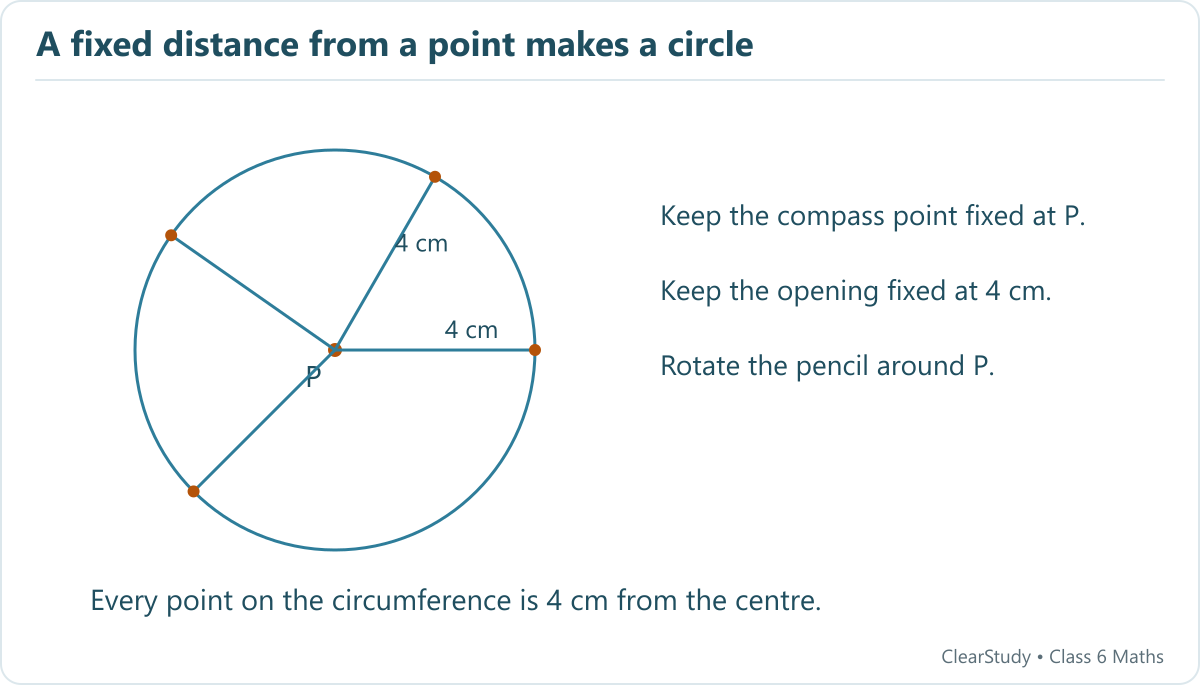
Circle: the set of all points that are the same distance from a fixed point. If you mark every point that is 4 cm from a point P, they together form a circle.
Centre & radius: the fixed point P is the centre of the circle; the equal distance from the centre to any point on the circle is the radius.
Compass: the tool used to draw circles and arcs. Open it against a ruler so the gap between its tip and the pencil equals the radius, keep the tip fixed and rotate the pencil.
Rectangle: a 4-sided figure with corners, sides and angles, where (R1) opposite sides are equal in length and (R2) all angles are 90°.
Square: a 4-sided figure where (S1) all sides are equal and (S2) all angles are 90°. Rotating a square (or rectangle) does not change its sides or angles, so it stays a square (or rectangle).
Diagonal: a line segment joining two opposite corners of a rectangle, e.g. PR and QS in rectangle PQRS.
Important Construction Ideas (Chapter 8)
Drawing a circle: fix the compass tip at the centre, open the radius against a ruler, and rotate the pencil all the way round.
Valid name of a figure: the corners must be listed in the order you travel around the figure (e.g. PQRS, QRSP, RSPQ, SPQR), starting from any corner — not jumping across, like PQSR.
Constructing a square/rectangle: draw one side, raise a perpendicular (90°) at each end on the same side of the base, mark the second side’s length with a ruler or compass, then join.
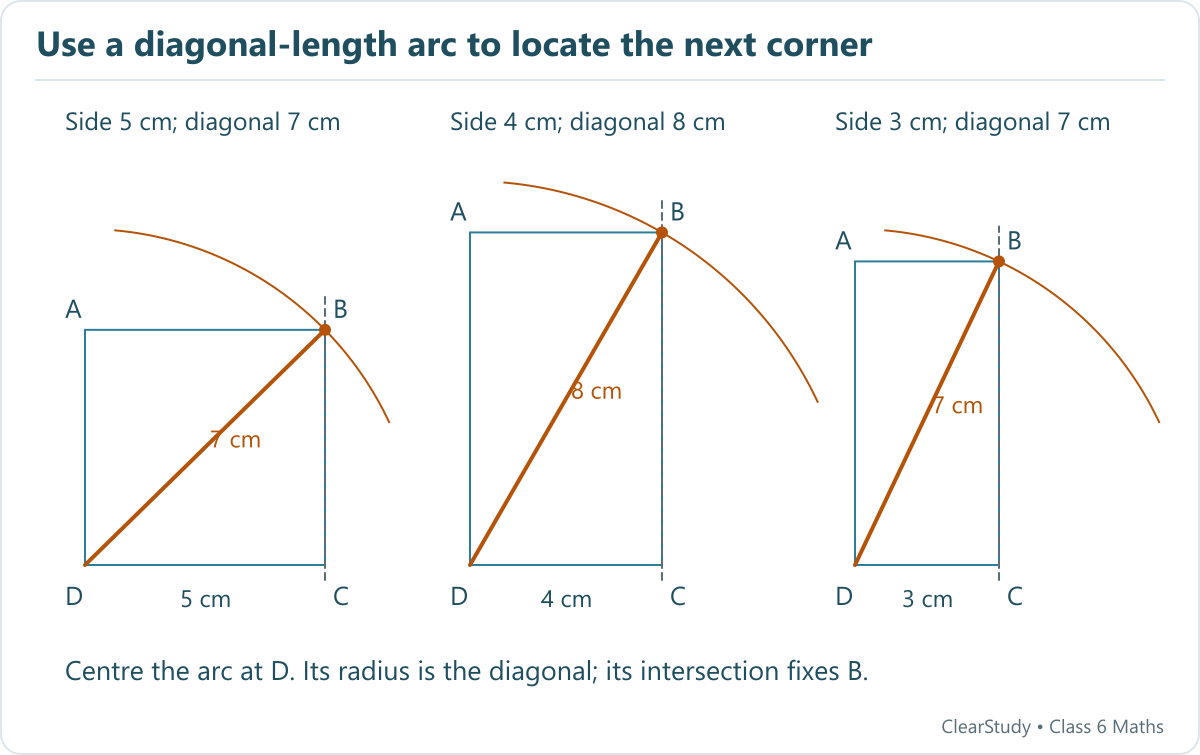
Side and diagonal given: draw the side, raise a perpendicular at one end, then with the other end as centre draw an arc of radius = diagonal; where it cuts the perpendicular is the next corner.
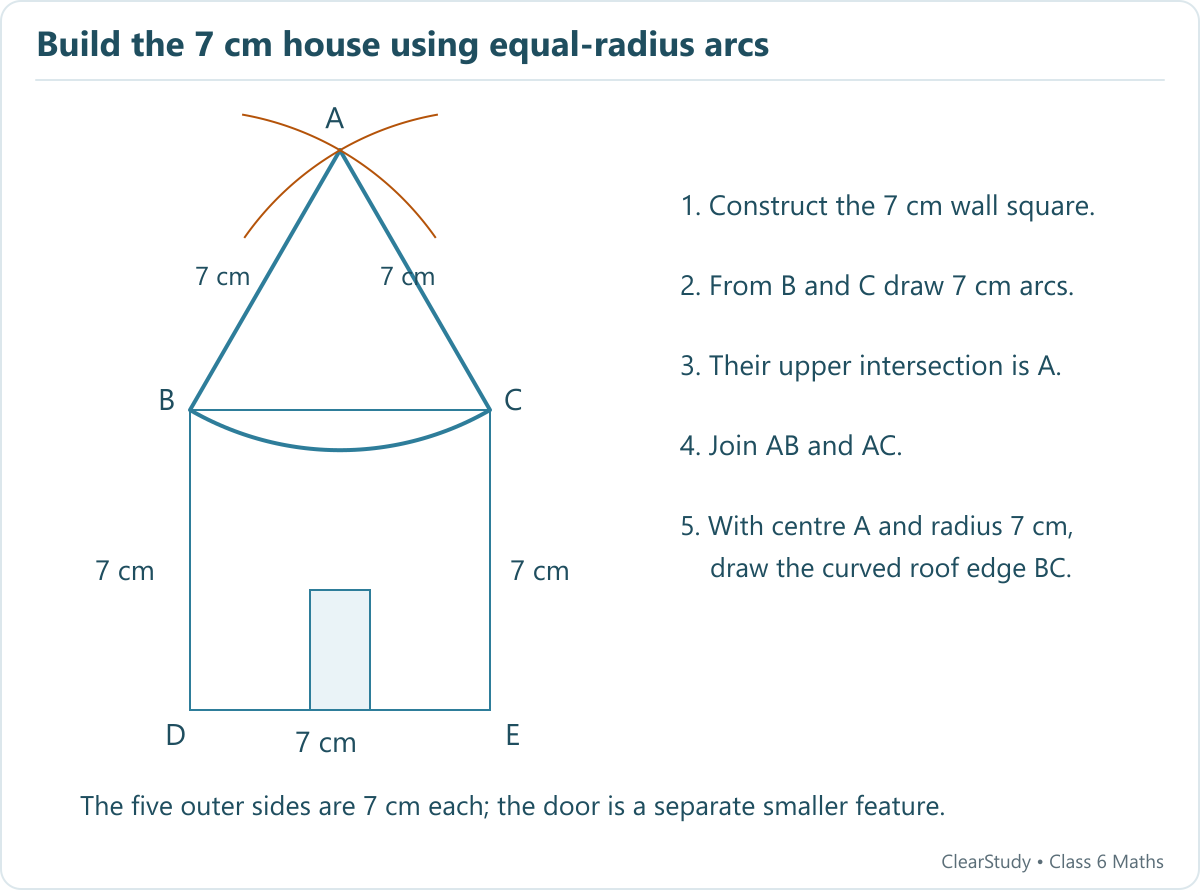
Equidistant point: a point at a specified distance r from both B and C is found where arcs of radius r centred at B and C intersect. For distinct centres, there are two such points if BC < 2r, one if BC = 2r, and none if BC > 2r.
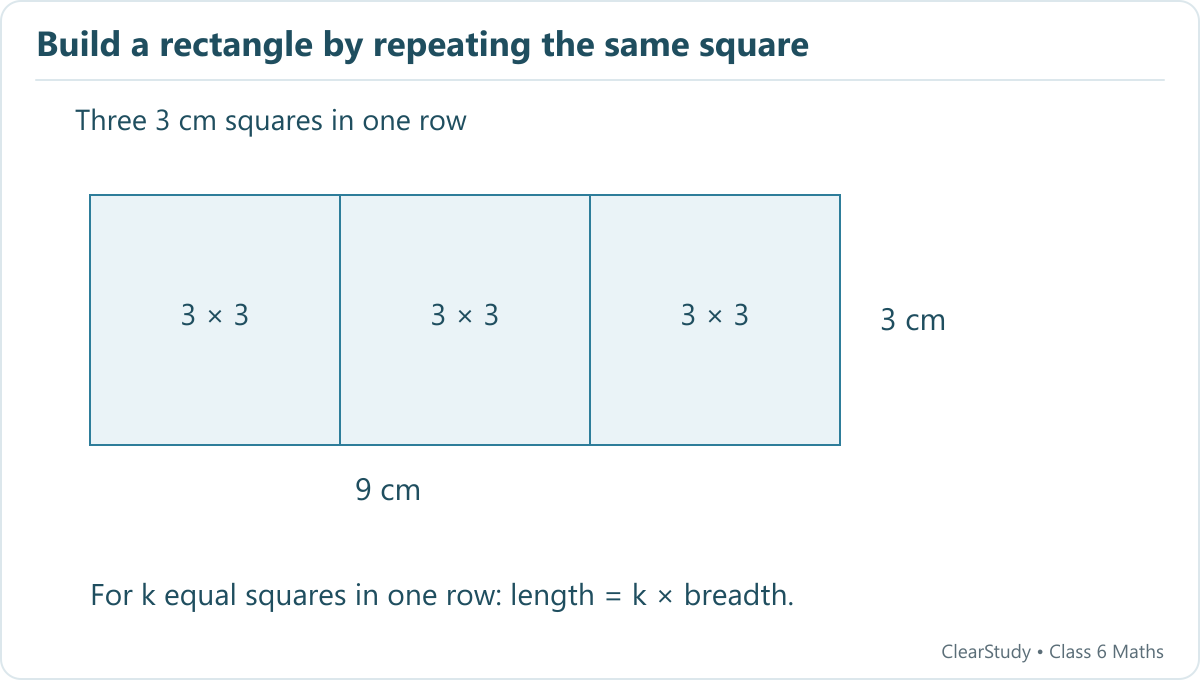
Rectangle split into k equal squares in one row: make its length = k × its breadth (e.g. length = 3 × breadth for 3 identical squares).
Figure it Out — Wavy Wave & the Circle (Section 8.1, Page 188–191)
Think (p. 188): Imagine marking all the points of 4 cm distance from the point P. How would they look?
SOLUTIONMark several points that are each 4 cm from P, in every direction. As you add more and more points, they fall along one smooth curve.On joining them, the points form a circle with P as its centre and 4 cm as its radius. You can draw this in one go with a compass opened to 4 cm.
Set the compass opening using a ruler. The radius is half the diameter, so this circle has diameter 8 cm.
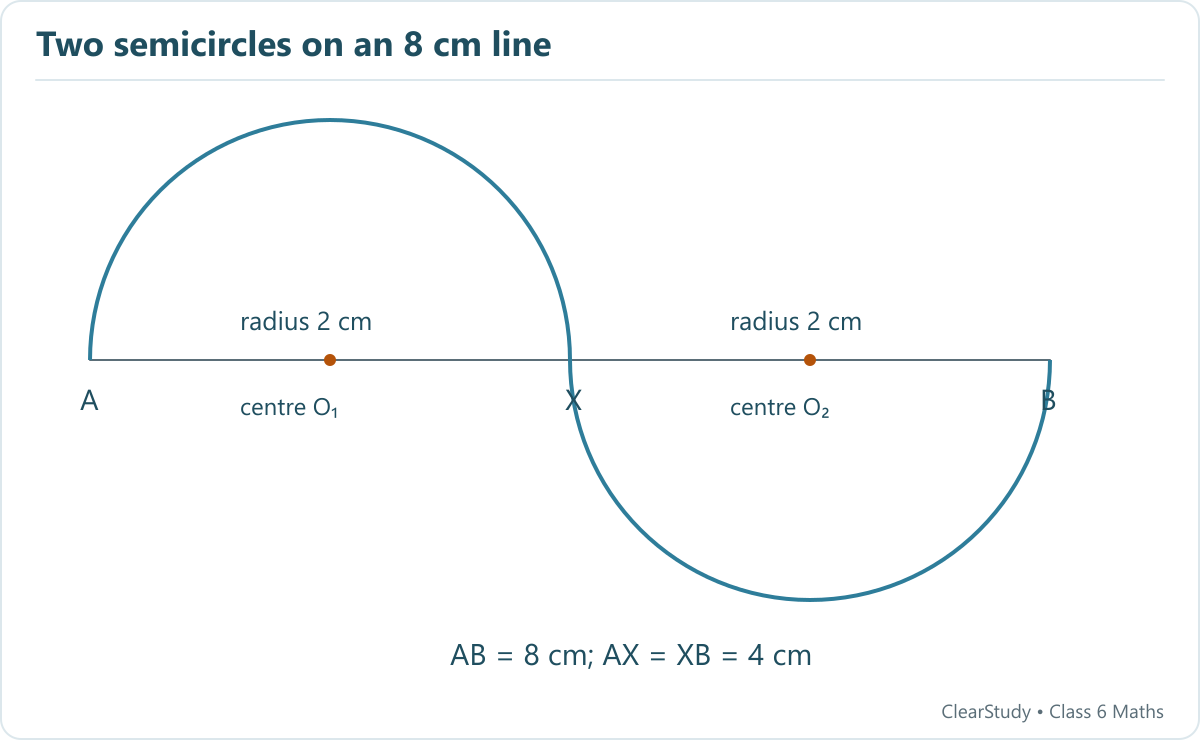
Wavy Wave — Figure it Out (p. 191) 1. What radius should be taken in the compass to get this half circle? What should be the length of AX?
SOLUTIONThe central line is AB = 8 cm, and the first wave is a half circle (semicircle) drawn on the first part of AB, from A up to the mid-point X.A half circle (semicircle) sits on a diameter, so its diameter is AX. The radius of the half circle = AX ÷ 2.For two equal waves across AB = 8 cm, take AX = 4 cm, so the diameter of each half circle is 4 cm.∴ radius = 2 cm and AX = 4 cm (the compass is opened to 2 cm and the tip is placed at the mid-point of AX for each wave).
Draw the first semicircle above the line and the second below it without changing the compass opening.
2. Take a central line of a different length and try to draw the wave on it.
SOLUTION (activity)Step 1. Draw a fresh central line, say PQ = 6 cm, and mark its mid-point M (3 cm from each end).Step 2. For the first wave, take the mid-point of PM as centre and radius 1.5 cm; draw a half circle above the line from P to M.Step 3. For the second wave, take the mid-point of MQ as centre and the same radius 1.5 cm; draw a half circle below the line from M to Q.The two equal half circles give a neat wavy curve on the 6 cm line. (Any length works — keep the radius equal to one-quarter of the line for two waves.)
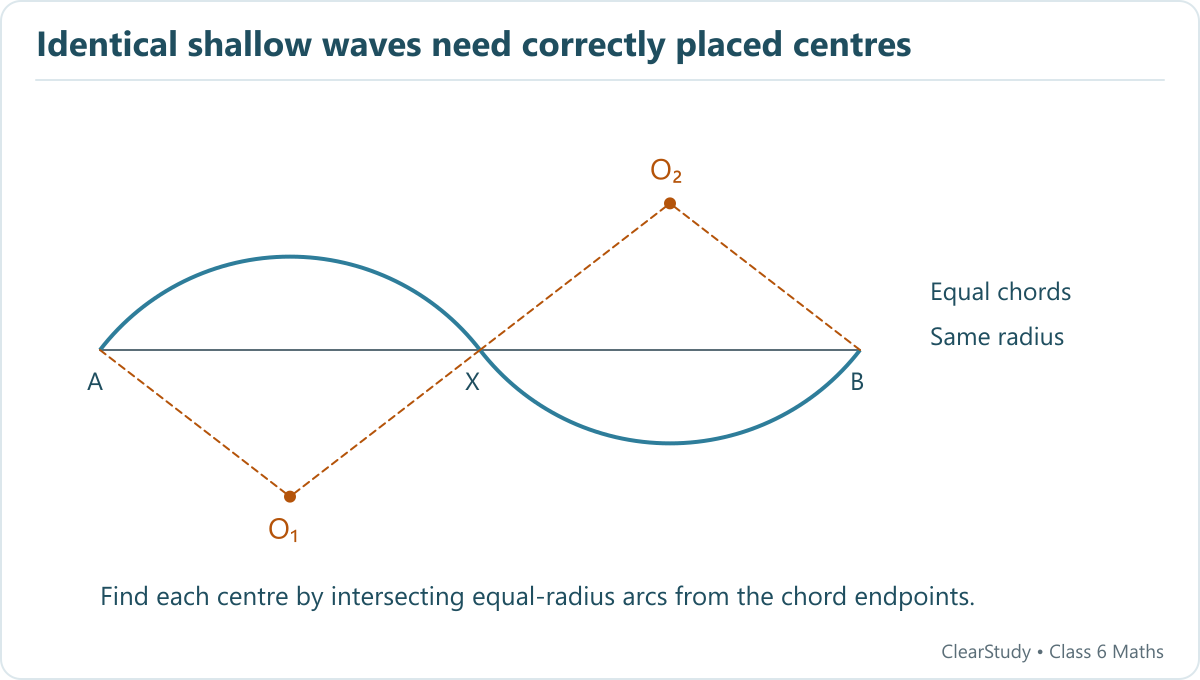
3. Try to recreate the figure where the waves are smaller than a half circle (as appearing in the neck of the figure, ‘A Person’). The challenge here is to get both the waves to be identical. This may be tricky!
SOLUTIONStep 1. Draw two equal consecutive chords AX and XB on a straight baseline. Choose one compass radius greater than half AX.Step 2. From A and X, draw equal-radius arcs. Their intersection below the baseline is a centre equally distant from A and X. With that centre and the same radius, draw the shallow arc from A to X above the baseline.Step 3. Repeat from X and B, choosing the centre above the baseline; draw the matching arc below. Equal chord lengths and the same radius give identical waves. A centre placed arbitrarily below the line need not pass through both endpoints.
A compass centre must be equally distant from both endpoints. For alternating waves, place the centres on opposite sides of the baseline.
Squares, Rectangles & their Construction (Sections 8.2–8.3, Page 193–201)
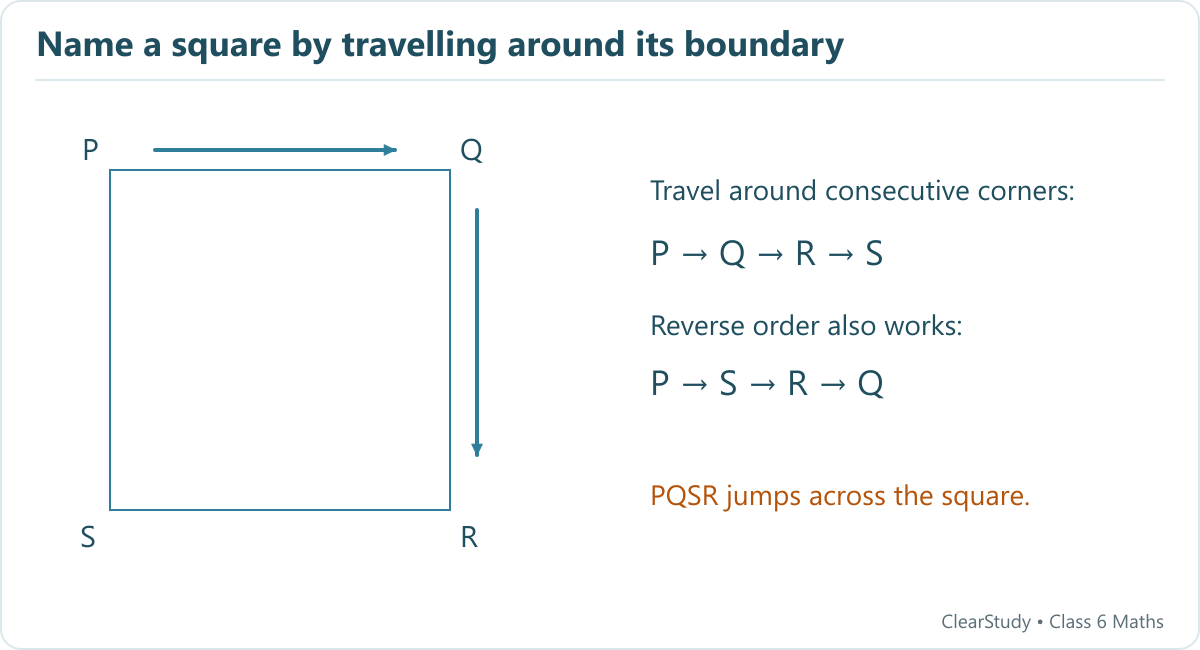
Q (p. 193): Which of the following is not a name for this square?
1. PQSR 2. SPQR 3. RSPQ 4. QRSP
SOLUTIONA valid name lists the corners in the order you travel around the figure. Going round the square the corners are P → Q → R → S (or the same loop started elsewhere): PQRS, QRSP, RSPQ, SPQR are all valid.In PQSR, after P and Q the next corner jumps to S (skipping R) — this is not the order of travel.∴ PQSR (option 1) is not a name for the square.
Start at any corner and move consistently clockwise or anticlockwise. PQSR is not a boundary-order name.
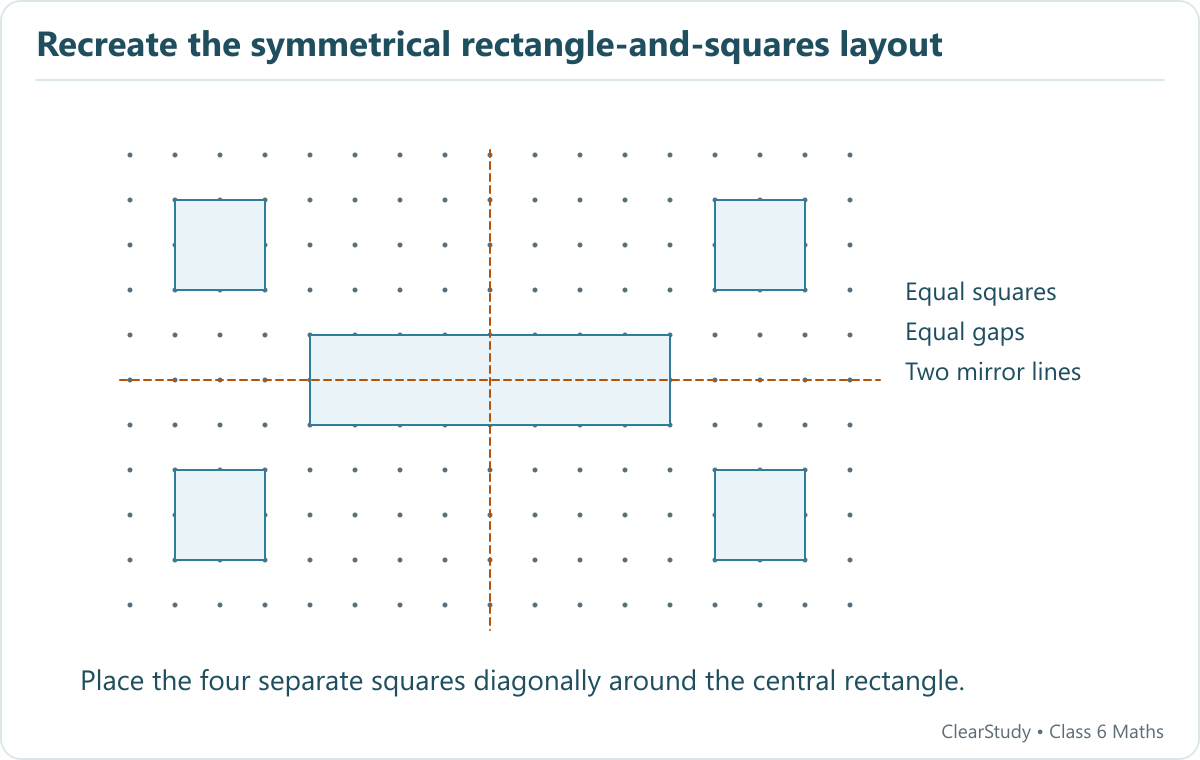
Figure it Out (p. 194) 1. Draw the rectangle and four squares configuration (shown in Fig. 8.3) on a dot paper. What did you do to recreate this figure so that the four squares are placed symmetrically around the rectangle? Discuss with your classmates.
SOLUTIONThe four small squares are separate from the rectangle, one diagonally beyond each corner. They are not attached to its sides. One possible dot-grid plan is an 8-by-2 rectangle from column 4 to 12 and row 4 to 6. Draw four 2-by-2 squares with top-left grid positions (1,1), (13,1), (1,7) and (13,7). Count rows downward from the top and columns rightward from the left.The vertical centre line is column 8; the horizontal centre line is row 5. Reflecting across either line matches the square positions and gaps. Other symmetric choices of dimensions also work.
This is a possible dot-grid reconstruction. The small squares do not attach to the rectangle’s sides.
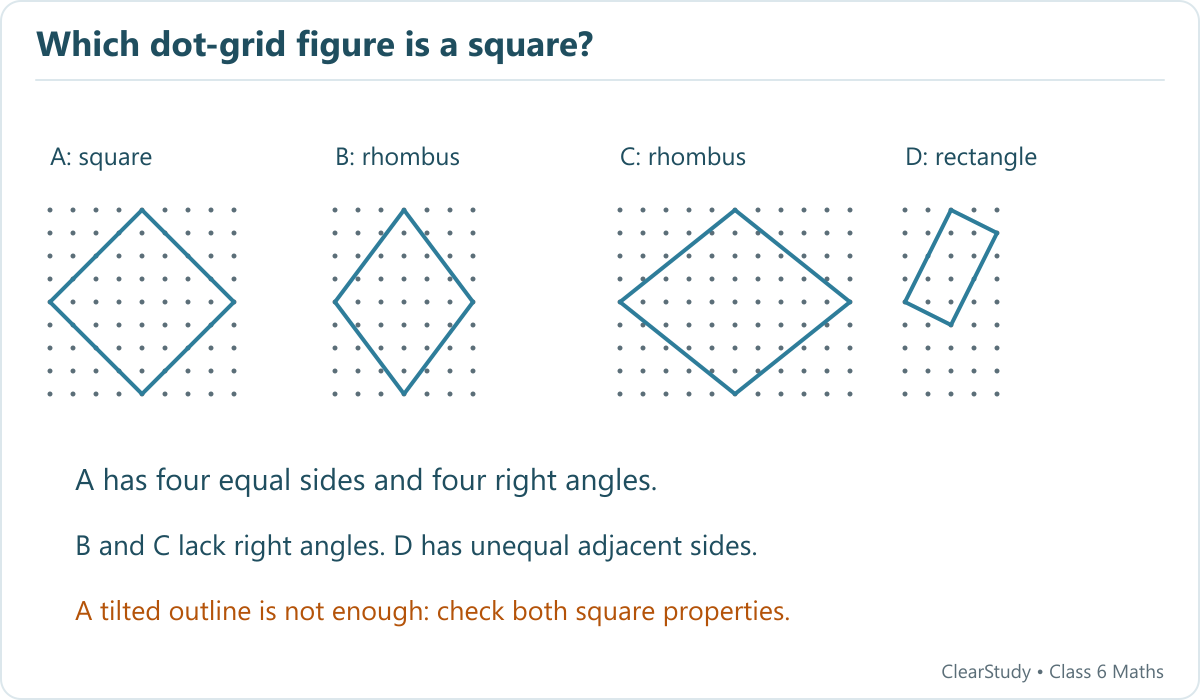
2. Identify if there are any squares in this collection. Use measurements if needed. (figures A, B, C, D on a dot grid)
SOLUTIONOnly A is a square. Its four sides use equal horizontal and vertical dot displacements, and adjacent sides are quarter-turns of one another. B and C have four equal sides, but their corner angles are not 90°. D is a rectangle with one side twice its adjacent side, so it fails the equal-sides condition. A figure must satisfy both square properties.
Only A satisfies both conditions: four equal sides and four right angles.
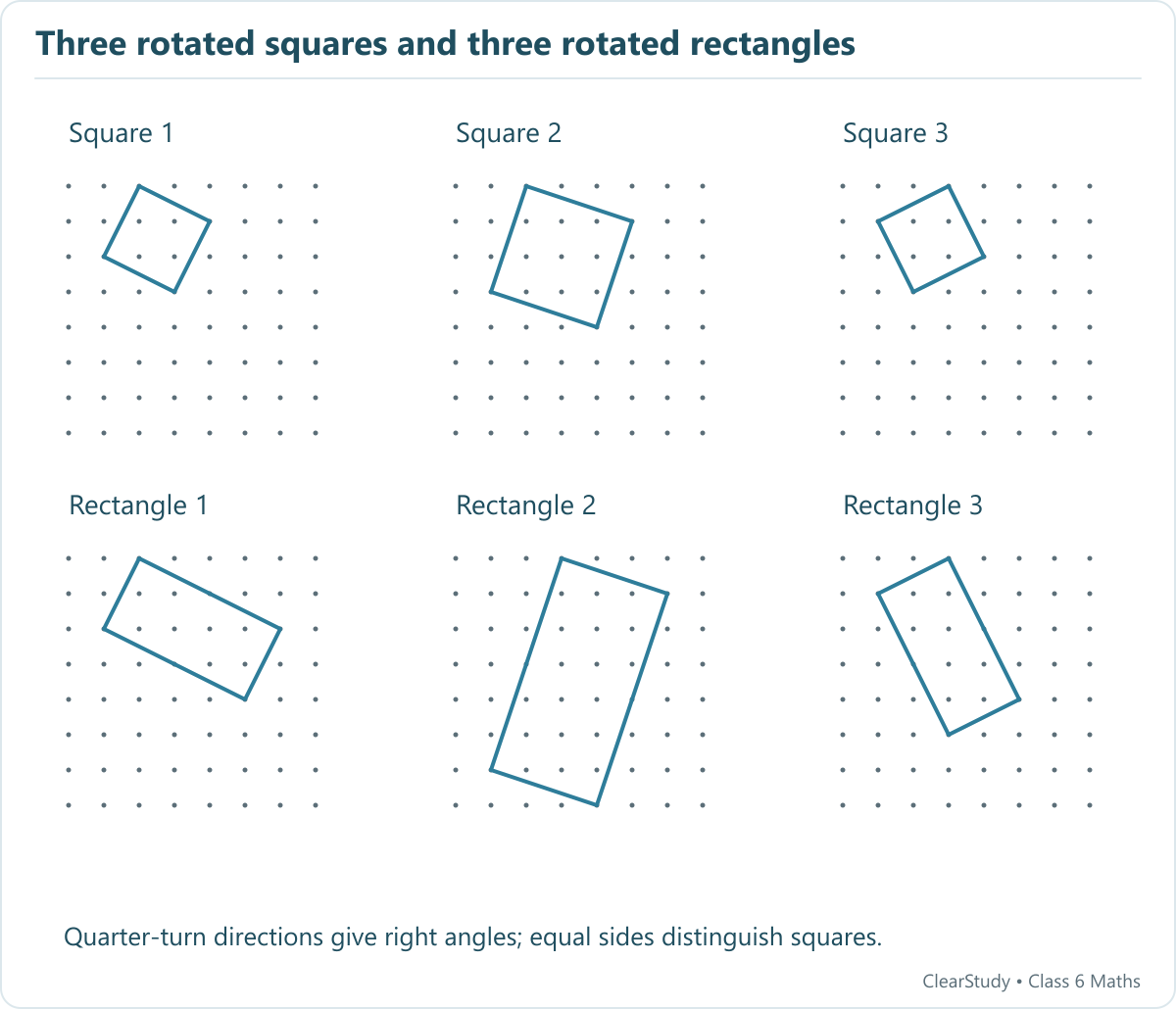
3. Draw at least 3 rotated squares and rectangles on a dot grid. Draw them such that their corners are on the dots. Verify if the squares and rectangles that you have drawn satisfy their respective properties.
SOLUTIONThe diagram gives three examples of each. To make a tilted square, take a side direction such as 2 dot intervals right and 1 down. Turn this direction through 90° for the adjacent side: 1 left and 2 down. Repeat the opposite directions to close the figure.For two more squares, use adjacent step pairs (3 right, 1 down) with (1 left, 3 down), and (1 right, 2 down) with (2 left, 1 down). Each pair represents equal-length perpendicular directions.For a rectangle with unequal adjacent sides, double one side direction while retaining the other quarter-turn direction. Examples below use (4 right, 2 down) with (1 left, 2 down); (3 right, 1 down) with (2 left, 6 down); and (2 right, 4 down) with (2 left, 1 down). Check opposite sides and the four right angles.
A direction of 2 steps right and 1 step down becomes 1 step left and 2 steps down after a quarter-turn. Scaling one direction gives a rectangle.
To draw a perpendicular, align a set-square with the base and draw along its right-angle edge, or mark 90° with a protractor. For a 6 cm square (pp. 195–196), draw PQ = 6 cm, raise perpendiculars at P and Q on the same side, mark PS = QR = 6 cm, and join S to R. Check all sides are 6 cm and all angles are 90°.
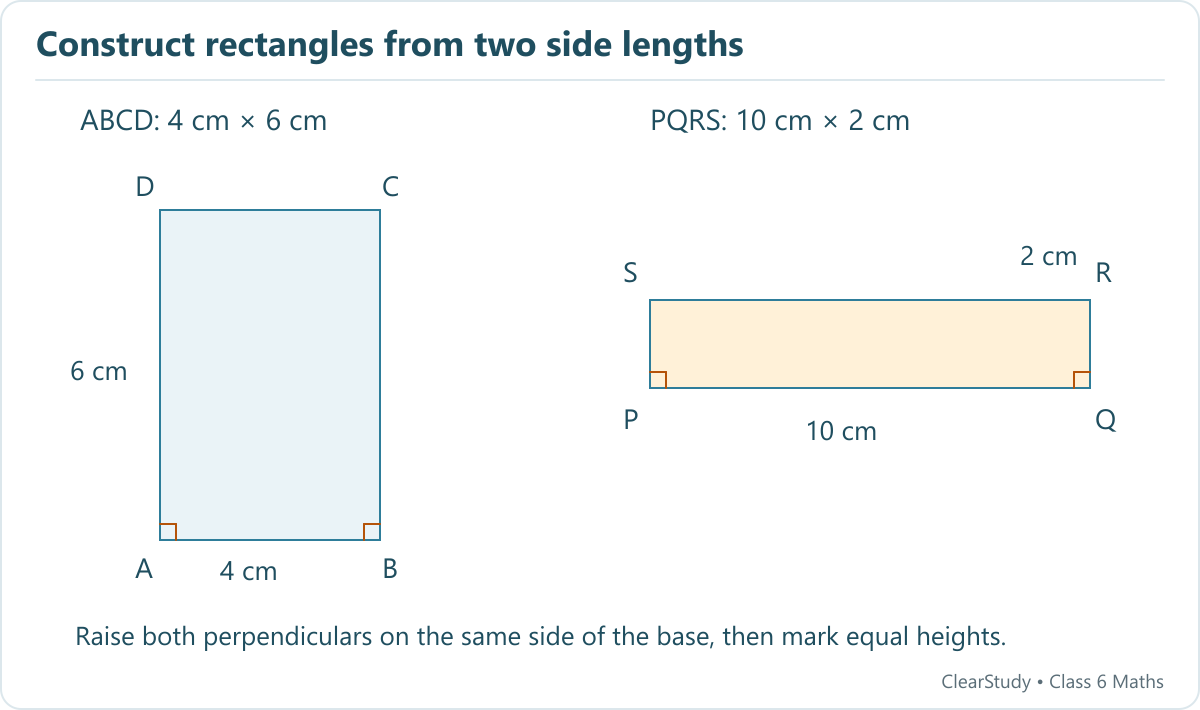
1. Draw a rectangle with sides of length 4 cm and 6 cm. After drawing, check if it satisfies both the rectangle properties.
SOLUTIONStep 1. Draw AB = 4 cm with a ruler.Step 2. At A and at B, draw perpendiculars (90°) to AB.Step 3. On each perpendicular mark 6 cm: mark D on the line through A with AD = 6 cm, and C on the line through B with BC = 6 cm.Step 4. Join D to C to complete rectangle ABCD.Check. ∠A = ∠B = ∠C = ∠D = 90° (property R2), and opposite sides are equal: AB = CD = 4 cm, AD = BC = 6 cm (property R1). Both properties hold.
2. Draw a rectangle of sides 2 cm and 10 cm. After drawing, check if it satisfies both the rectangle properties.
SOLUTIONStep 1. Draw PQ = 10 cm with a ruler.Step 2. At P and at Q, draw perpendiculars to PQ.Step 3. Mark S on the perpendicular at P with PS = 2 cm, and R on the perpendicular at Q with QR = 2 cm.Step 4. Join S to R to complete rectangle PQRS.Check. ∠P = ∠Q = ∠R = ∠S = 90°, and PQ = SR = 10 cm, PS = QR = 2 cm. Both rectangle properties are satisfied.
The two examples are drawn at different display scales. Use the labelled measurements when constructing them on paper.
3. Is it possible to construct a 4-sided figure in which—
• all the angles are equal to 90º but• opposite sides are not equal?
SOLUTIONNo. If all four angles of a 4-sided figure are 90°, the opposite sides become parallel and the figure closes up only when opposite sides are equal.If you keep all angles 90° but try to make a pair of opposite sides unequal, the last side cannot meet to close the figure. So such a figure cannot be constructed — a 4-sided figure with all right angles is always a rectangle (with equal opposite sides).
Exploration, Diagonals & the House (Sections 8.4–8.6, Page 197–215)
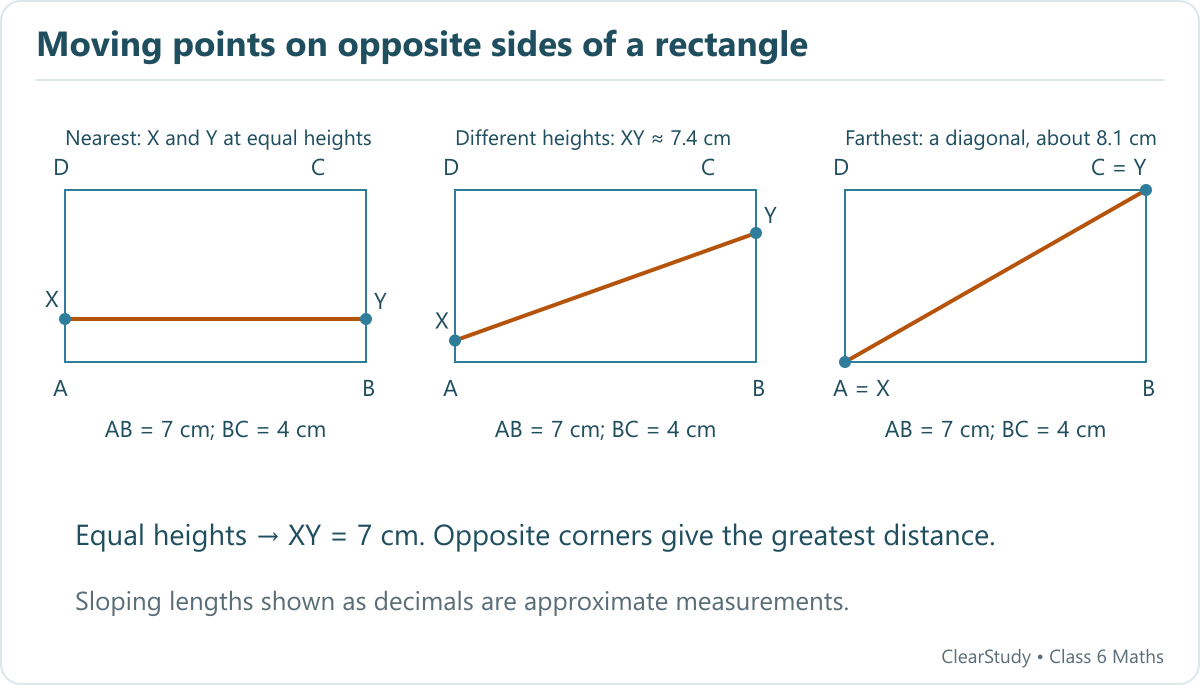
Q (p. 198, Section 8.4): Is there a shorthand way of writing it down? Record the length XY for the given positions of X (from A) and Y (from B) on rectangle ABCD with AB = 7 cm, BC = 4 cm.
SOLUTIONYes — record the three changing quantities (distance of X from A, distance of Y from B, length of XY) in a table:
Distance of X from A
Distance of Y from B
Length of XY
5 mm
3 cm
≈ 7.4 cm (7 cm 4 mm)
1 cm
1 cm
7 cm
2 cm
4 cm
≈ 7.3 cm (7 cm 3 mm)
Q (p. 199): Have you checked what happens to the length XY when X and Y are placed at the same distance away from A and B, respectively?
SOLUTIONWhen X and Y are at the same positive distance from A and B, ABYX is a rectangle, so XY equals AB. If X = A and Y = B, XY still equals AB, but the four-vertex figure collapses to the base segment:
Distance of X from A
Distance of Y from B
Length of XY
5 mm
5 mm
7 cm
1 cm
1 cm
7 cm
1 cm 5 mm
1 cm 5 mm
7 cm
Q (p. 199): In each of these cases, observe (i) how the length XY compares to that of AB, and (ii) the shape of the 4-sided figure ABYX.
SOLUTION(i) XY = AB — the distance XY equals the length of AB (7 cm) in every such case.(ii) ABYX is a rectangle — equal distances make AX and BY equal and both perpendicular to AB, so ABYX has all the rectangle properties.
Q (p. 199): How does the farthest distance between X and Y compare with the length of AC? BD?
SOLUTIONX and Y are farthest apart when they sit at the opposite corners of the rectangle, so XY then lies along a diagonal.∴ the farthest distance between X and Y is equal to AC (or BD), the diagonals of the rectangle.
The minimum is the perpendicular separation of the two parallel sides. The maximum equals either rectangle diagonal.
Construct (p. 199–201) — Breaking Rectangles & more
Construct (p. 199): Construct a rectangle that can be divided into 3 identical squares as shown in the figure.
SOLUTIONThree identical squares placed in a row need the rectangle’s length to be three times its breadth.Step 1. Choose a breadth, say 3 cm, so the length must be 3 × 3 = 9 cm.Step 2. Construct rectangle of 9 cm × 3 cm (draw a side, raise perpendiculars at both ends, mark the other side, join).Step 3. Mark points at 3 cm and 6 cm along the long side; from these, draw lines perpendicular to the length. This cuts the rectangle into 3 identical 3 cm × 3 cm squares. (Hint: take length = 3 × breadth.)
Transfer the breadth three times with an unchanged compass opening to locate the divisions.
Give the lengths of the sides of a rectangle that cannot be divided into —
• two identical squares;• three identical squares.
SOLUTIONA rectangle splits into two identical squares only if length = 2 × breadth, and into three only if length = 3 × breadth. Choose sides that break those rules.Cannot be divided into two identical squares: take length = 4 cm, breadth = 2.5 cm (since 4 ≠ 2 × 2.5 = 5). (Try for more!)Cannot be divided into three identical squares: take length = 7 cm, breadth = 2 cm (since 7 ≠ 3 × 2 = 6). (Other possibilities also work.)
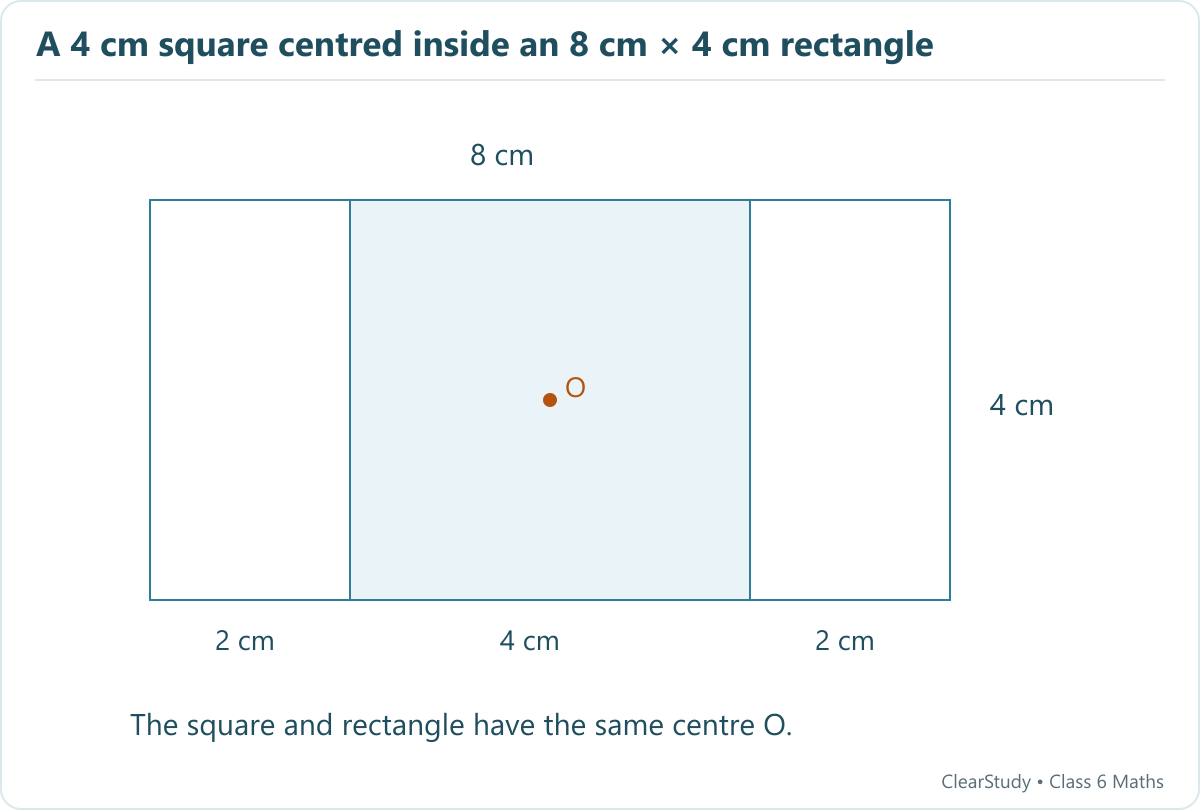
Construct 1 (p. 201): A square centred within an 8 cm by 4 cm rectangle.
SOLUTIONDraw the 8 cm × 4 cm rectangle. The square shown has side 4 cm and touches the top and bottom edges. The leftover horizontal length is 8 − 4 = 4 cm, so leave 2 cm on each side. Mark 2 cm and 6 cm along the top and bottom edges, then join the matching marks. The central region is a 4 cm square and shares the rectangle’s centre.
The square’s top and bottom edges lie on the rectangle boundary, as in the textbook figure.
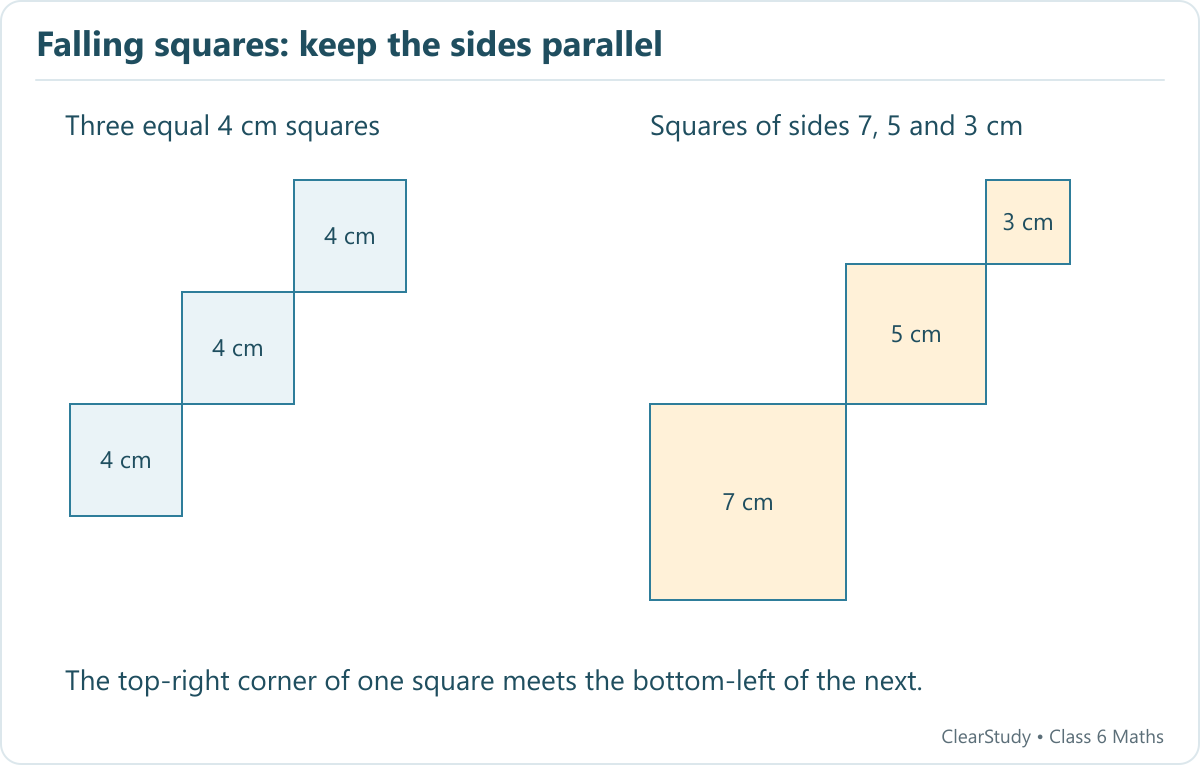
Construct 2 (p. 202): Falling squares.
SOLUTIONFirst draw a 4 cm square. At its top-right corner, draw a second 4 cm square extending up and right, so that the first square’s top-right corner is the second square’s bottom-left corner. Repeat once more. Keep corresponding sides parallel; the squares touch only at their corners.For the second arrangement, start with a 7 cm square, then continue up and right with a 5 cm square and finally a 3 cm square, keeping the same corner alignment.
Use parallel horizontal and vertical sides. Each new square begins at the previous square’s top-right corner.
Construct 3 (p. 202): Reproduce the square shading pattern.
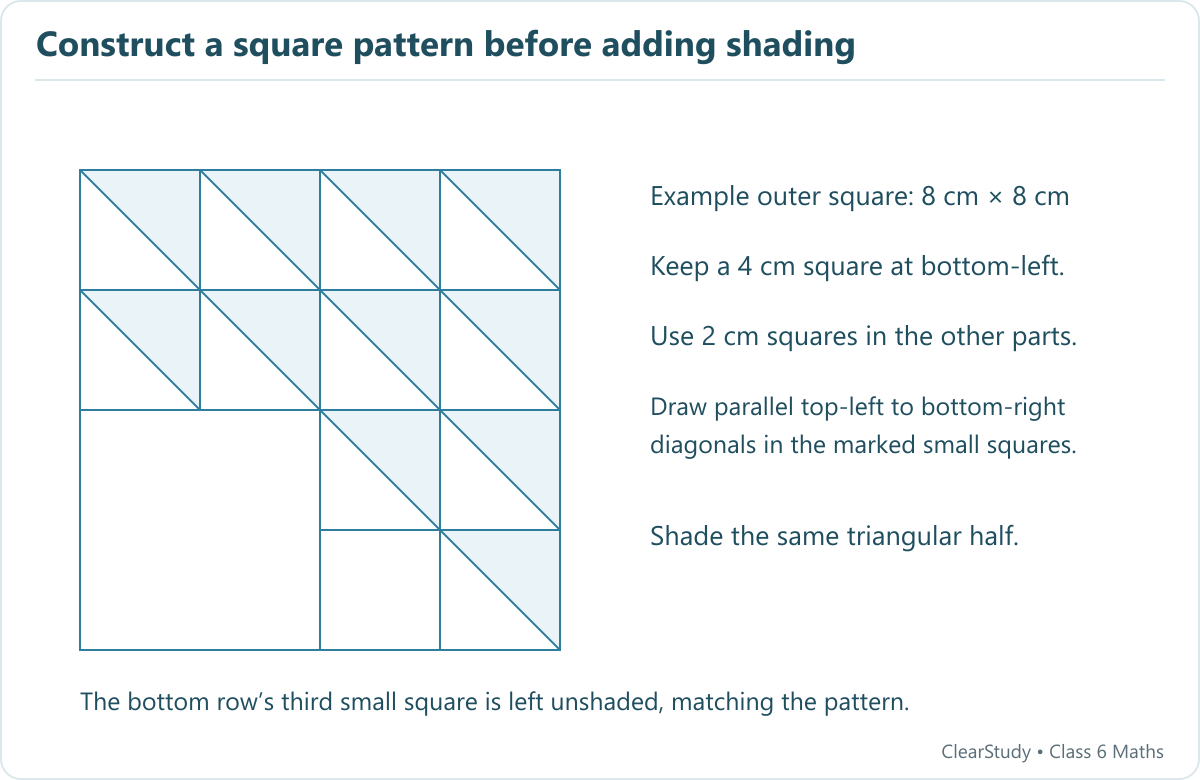
SOLUTIONOne convenient size is an 8 cm outer square. Divide it into four 4 cm squares, then subdivide the top-left, top-right and bottom-right ones into 2 cm squares. Leave the bottom-left 4 cm square undivided.In each 2 cm square in the top two rows and the third row, draw a diagonal from top-left to bottom-right and shade the upper-right half. In the bottom row, shade only the rightmost small square this way; leave its neighbour blank. The diagram shows the complete pattern.
An 8 cm outer side gives a 4 cm large inner square and 2 cm small squares; other proportional sizes work too.
Construct 4 (p. 203): Square with a Hole. (The circle and square have the same centre.)
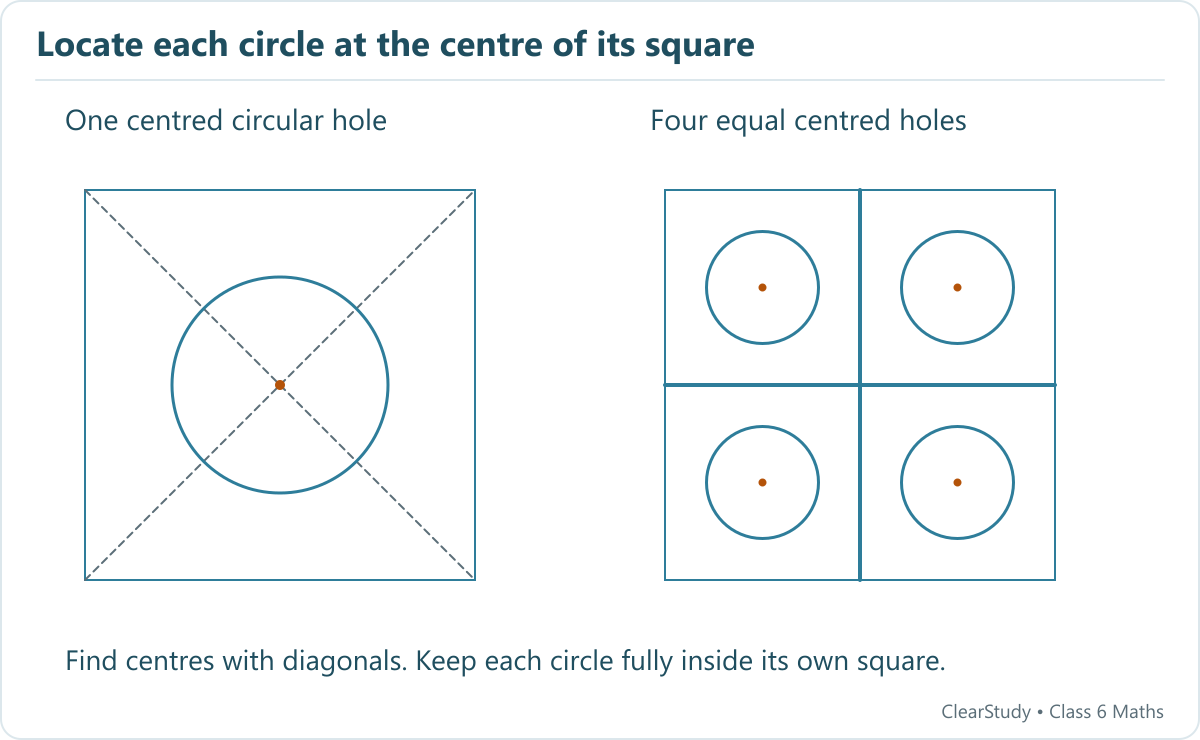
SOLUTIONThe hole must be centred at the centre of the square.Step 1. Construct the square and draw both diagonals (joining opposite corners). They cross at the centre.Step 2. Place the compass tip at this crossing point and draw a small circle with radius less than half the square’s side — that is the hole.So the centre of the circle is at the meeting point of the two diagonals (the line segments connecting opposite vertices).
Construct 5 (p. 203): A square with four equal circular holes.
SOLUTIONDivide a square into four equal smaller squares using lines through opposite side midpoints. Draw the diagonals lightly in each small square to find its centre. Choose one radius smaller than half a small square’s side, and draw a circle at each centre without changing the compass opening. Erase the diagonal guides when finished.
Choose a radius less than half the side of the containing square. Use one compass setting for the four equal holes.
Construct 6 (p. 203): An 8 cm square with four matching inward curves.
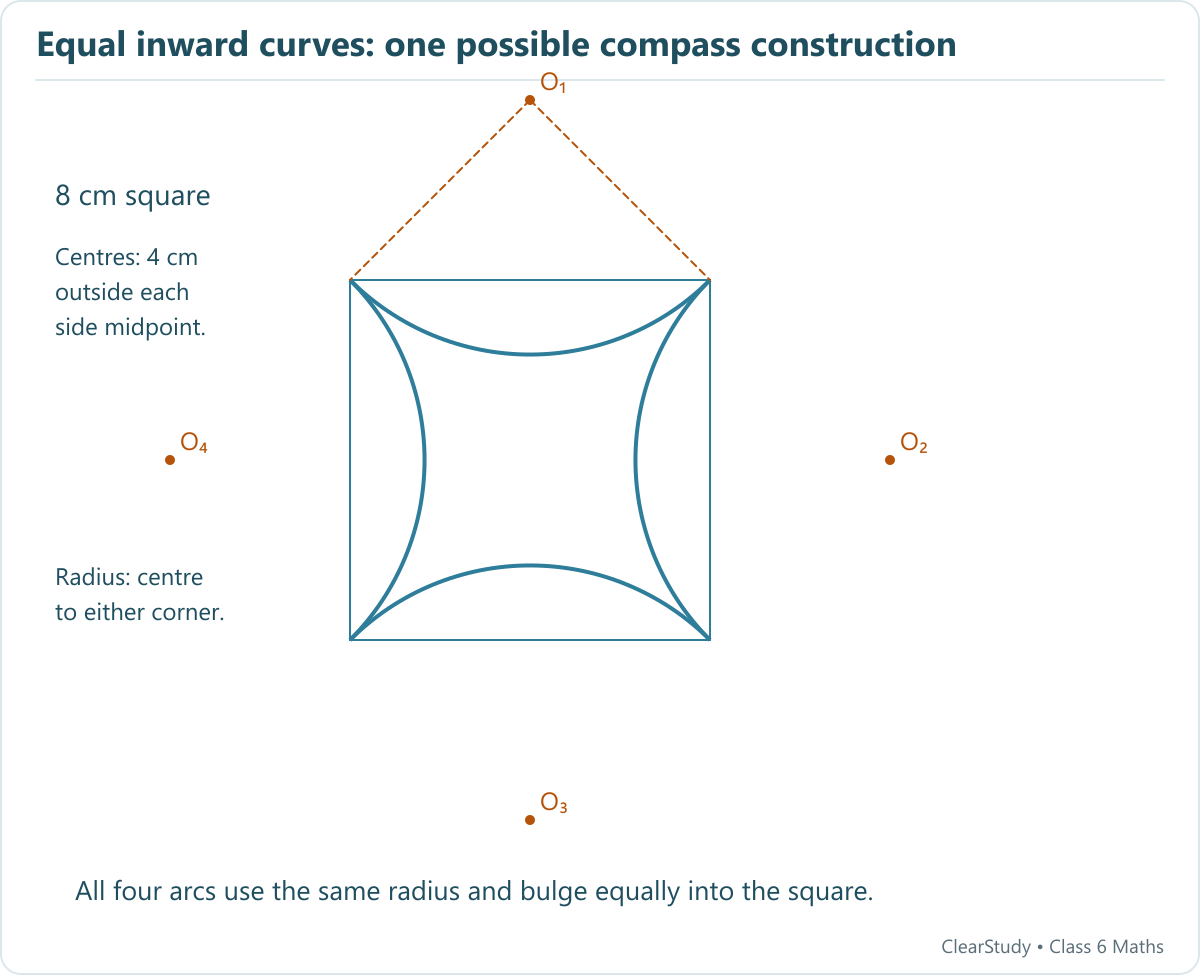
SOLUTIONConstruct an 8 cm square and mark each side midpoint. One valid choice is to extend a perpendicular 4 cm outwards from every midpoint. Use these four external points as compass centres.Set the radius equal to the distance from a centre to either endpoint of its corresponding side. The endpoints are equally distant from that centre. Draw the short arc joining them that bulges into the square. Repeat from all four centres using the same radius. Other equal outward offsets can give different but symmetric shallower or deeper curves.
This choice gives four identical shallow arcs. Join each side’s endpoints with the inward arc from its corresponding external centre.
Section 8.5 — Diagonals; Construct (p. 204–211)
Explore (p. 204): How should the rectangle be constructed so that the diagonal divides the opposite angles into equal parts?
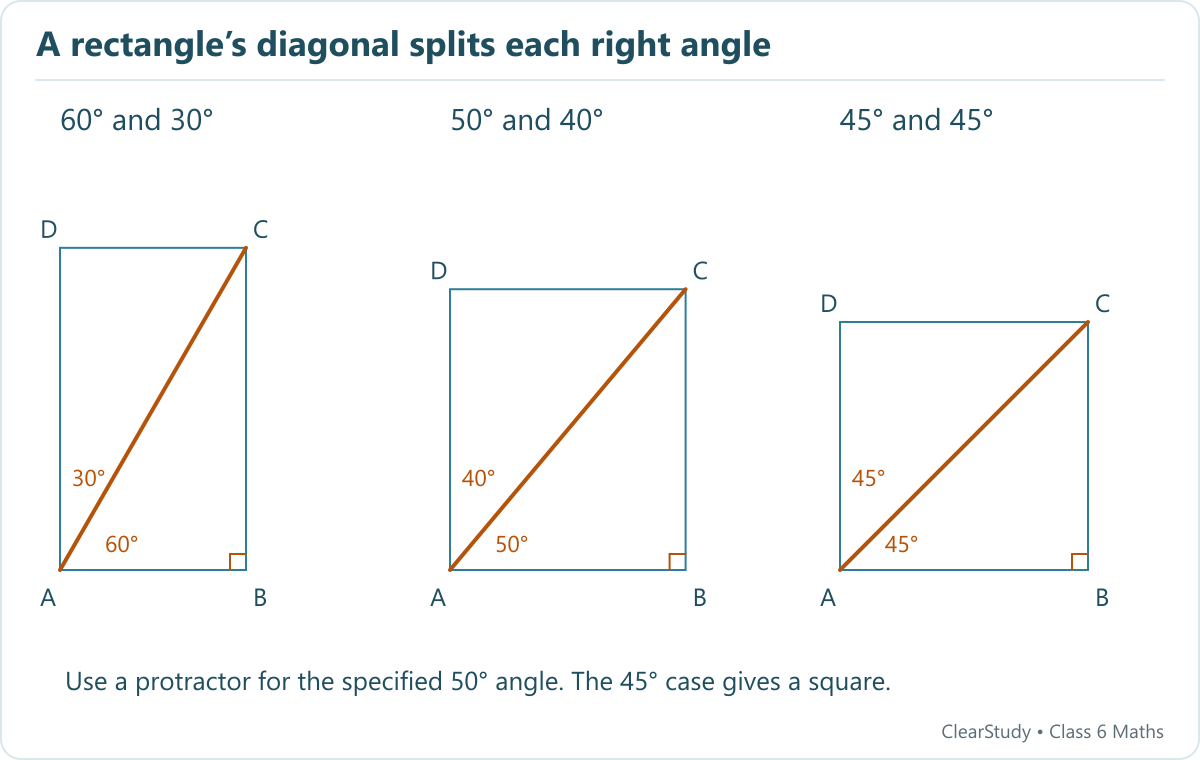
SOLUTIONA diagonal splits each 90° corner into two angles. They are equal (45° each) only when the two sides meeting at the corner are equal.∴ make the two adjacent sides equal, i.e. construct a square. In a square the diagonal divides each right angle into two equal 45° parts.
Worked example (pp. 205–207): A diagonal forming 60° and 30°.
SOLUTIONDraw any convenient base AB. At A, draw a 60° ray using a protractor or the standard equilateral-triangle compass construction. Raise a perpendicular at B; its intersection with the ray is C. Raise a perpendicular at A and draw through C a line perpendicular to BC; they meet at D. The remaining angle at A is 90° − 60° = 30°. Check the corresponding split at C.
Construct (p. 211) 1. Construct a rectangle in which one of the diagonals divides the opposite angles into 50° and 40°.
SOLUTIONStep 1. Draw the base AB of any convenient length.Step 2. At A, use a protractor to draw a ray making 50° with AB — the diagonal AC will lie along it.Step 3. At A, draw AD perpendicular (90°) to AB. The remaining part of ∠A is 90° − 50° = 40° (check). At B, draw BC perpendicular to AB.Step 4. Mark C where the 50° ray meets the perpendicular at B; then draw a perpendicular to BC at C to fix D. Join DC.ABCD is the required rectangle; diagonal AC divides ∠A into 50° and 40° (and the opposite ∠C the same way).
2. Construct a rectangle in which one of the diagonals divides the opposite angles into 45° and 45°. What do you observe about the sides?
SOLUTIONStep 1. Draw base AB.Step 2. At A, draw a ray at 45° to AB (the diagonal). At A and B draw perpendiculars to AB.Step 3. Mark C where the 45° ray meets the perpendicular at B, fix D, and join DC.Observation: the diagonal makes equal 45° parts only when the two adjacent sides are equal, so all four sides are equal — the rectangle is a square.
Choose a base length, draw the angle ray, and intersect it with the perpendicular through the other base endpoint.
Worked example (pp. 208–210): Side 5 cm and diagonal 7 cm.
SOLUTIONDraw DC = 5 cm. At C, draw a perpendicular to DC. With D as centre and radius 7 cm, draw an arc meeting that perpendicular at B. Through D draw a perpendicular to DC; through B draw a perpendicular to BC. Their intersection is A. Check DB = 7 cm, DC = AB = 5 cm, equal opposite sides and four right angles.
3. Construct a rectangle one of whose sides is 4 cm and the diagonal is of length 8 cm.
SOLUTIONStep 1. Draw the side DC = 4 cm.Step 2. At C, draw a perpendicular line l to DC (the other corner B lies on this line).Step 3. With D as centre and radius 8 cm (the diagonal), draw an arc cutting line l at B; then DB = 8 cm.Step 4. Draw perpendiculars to DC at D and to CB at B; where they meet is A. ABCD is the rectangle with side 4 cm and diagonal 8 cm. (Check R1 and R2.)
4. Construct a rectangle one of whose sides is 3 cm and the diagonal is of length 7 cm.
SOLUTIONStep 1. Draw the side DC = 3 cm.Step 2. At C, draw a perpendicular line l to DC.Step 3. With D as centre and radius 7 cm, draw an arc cutting l at B (so the diagonal DB = 7 cm).Step 4. Draw perpendiculars at D (to DC) and at B (to CB); their meeting point is A. ABCD is the required rectangle. Verify all angles are 90° and opposite sides equal.
A non-degenerate rectangle requires its diagonal to be longer than the given side. Keep the arc marks to show the construction.
Section 8.6 — The House (Construct, p. 215)
1. Construct a bigger house in which all the sides are of length 7 cm.
SOLUTIONStep 1. Construct the wall square BCED of side 7 cm, with B and C at the top, D and E at the bottom. Thus BC = CE = ED = DB = 7 cm.Step 2. Draw arcs of radius 7 cm from B and C. Choose their intersection above the square as A. Join AB and AC. Both roof slopes are 7 cm.Step 3. With A as centre and radius 7 cm, draw the short arc joining B and C and bowing down into the wall square. This curved roof edge is part of the textbook house.Step 4. Add a smaller centred door. To scale the textbook’s 5 cm house proportionally to 7 cm, use a door 1.4 cm wide and 2.8 cm high. The instruction that all sides are 7 cm refers to the five outer boundary segments, not the door or the curved arc.
Use the upper intersection for the roof. The decorative door shown is 1.4 cm wide and 2.8 cm high, proportional to the textbook’s smaller house.
2. Try to recreate ‘A Person’, ‘Wavy Wave’, and ‘Eyes’ from the section ‘Artwork’, using ideas involved in the ‘House’ construction.
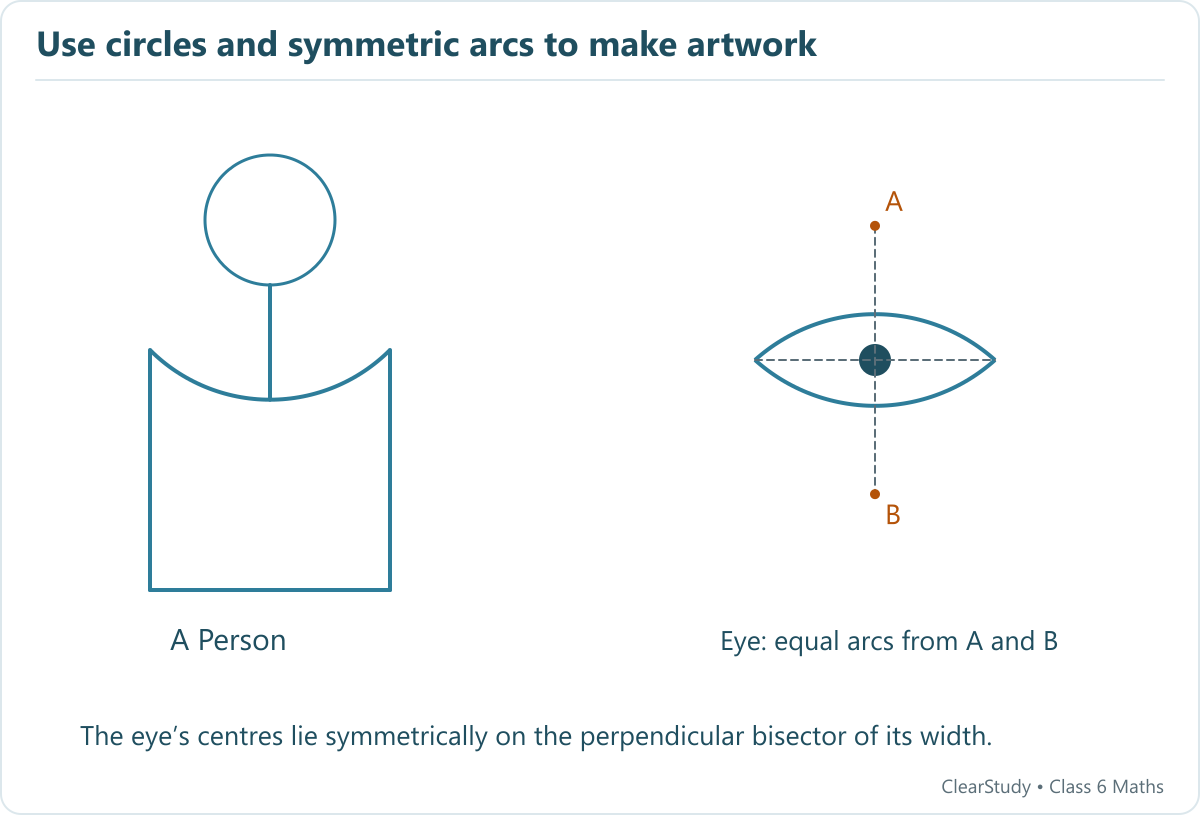
SOLUTIONA Person: Draw a circular head, a centred short neck and three straight body edges. For the curved top of the body, choose a point on the perpendicular bisector of its two upper corners, above them; use its distance to either corner as the radius. Draw the downward-bowing arc and make the neck meet its midpoint.Wavy Wave: Use the semicircle construction or the two equal-chord shallow arcs shown earlier.Eyes: Mark equal-height endpoints for one eye and their midpoint. Choose centres A and B at equal distances above and below that midpoint on the perpendicular bisector. Both centres are equally distant from the endpoints. The lower centre draws the upper arc; the upper centre draws the lower arc. Add a pupil at the midpoint. Transfer the same endpoint spacing and compass opening to draw an identical second eye.
For identical eyes, transfer the endpoint spacing and the compass opening unchanged. The centre below draws the upper arc; the centre above draws the lower arc.
3. Is there a 4-sided figure in which all the sides are equal in length but is not a square? If such a figure exists, can you construct it?
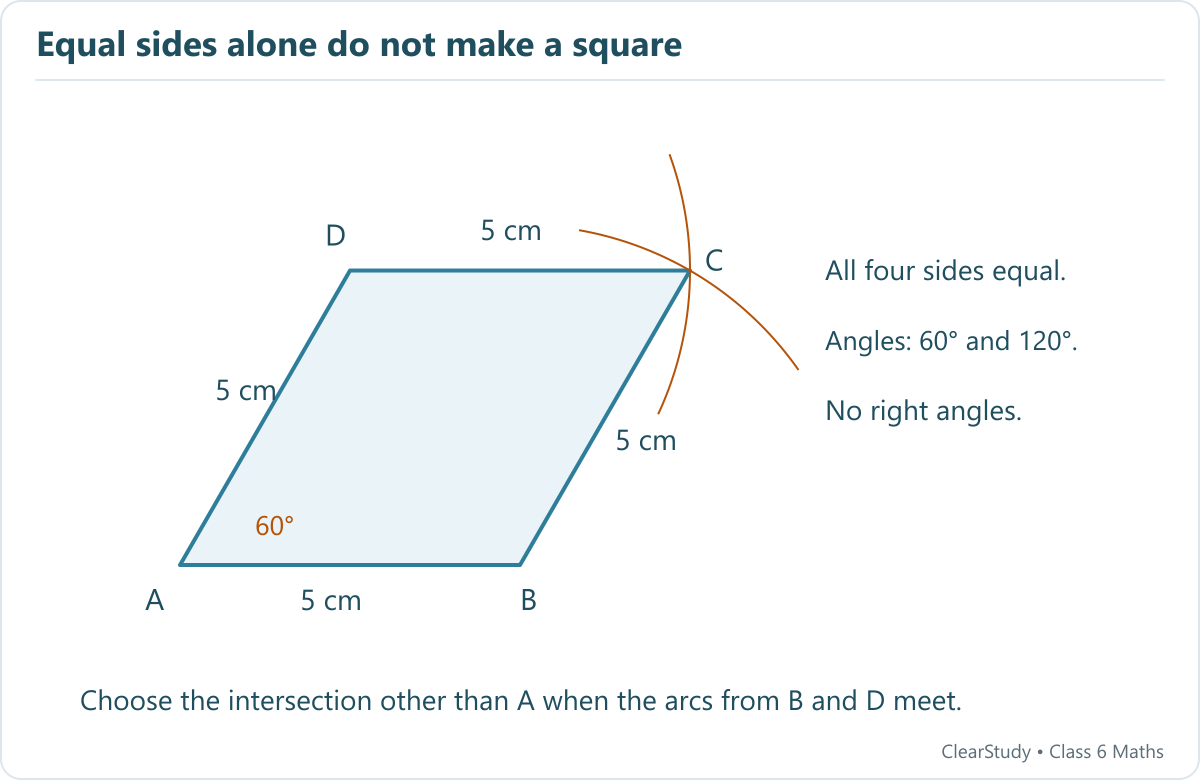
SOLUTIONYes: a non-square rhombus. Draw AB = 5 cm. At A, draw a 60° ray and mark D on it with AD = 5 cm. A 60° ray can be drawn with a protractor or by constructing an equilateral triangle.With B and D as centres, draw arcs of radius 5 cm. They meet at A and at a second point: choose the other intersection C. Join BC and CD. All four sides are 5 cm, while adjacent angles are 60° and 120°, so the figure is not a square.
Draw two adjacent 5 cm sides meeting at 60°, then use equal-radius arcs to complete the remaining vertex.
Math Talk, Think & Try This — Answered
These are the in-text reflective and short tasks in the chapter; the determinate ones are answered, the open ones are guided.
Think (p. 194) — Reasoning without measuringIs it possible to reason out if the sides are equal or not, and if the angles are right or not, without using any measuring instruments? Can we do this by only looking at the position of corners in the dot grid?Answer. Compare the horizontal and vertical displacements together. A segment going 2 dot intervals right and 1 down has the same length as one going 1 right and 2 down, since one is a rotation or reflection of the other. For a right angle, quarter-turn the direction: (2 right, 1 down) becomes (1 left, 2 down). Equal total counts of horizontal-plus-vertical steps alone do not prove equal straight-line lengths. Use both step components and the quarter-turn relationship.
Math Talk (p. 198) — Nearest and farthest X and YAt which positions will the points X and Y be at their closest? When will they be the farthest? How does the minimum distance compare to AB?Answer. X (on AD) and Y (on BC) are closest when they sit directly opposite each other (X and Y at the same distance from A and B); then XY is shortest and equals AB (7 cm). They are farthest when they sit at opposite corners, so XY lies along a diagonal and equals AC (or BD).
Math Talk (p. 204) — Laws about diagonals, angles & sidesWhat general laws did you observe with respect to the angles and sides? How can one be sure the laws will always be true?Answer. The two diagonals of a rectangle have equal lengths. A reflection across a line through the rectangle’s side midpoints maps one diagonal to the other, preserving length. Opposite parallel sides make matching angles with a diagonal, so the corresponding corner parts are equal. Adjacent parts sum to 90°; each is 45° precisely when the adjacent sides are equal, giving a square. Repeated measurements support these observations, while symmetry and angle reasoning explain why they hold.
Think (p. 213) — Do we need full circles?Was it necessary to draw two full circles to get the point A? Answer.No. We only need the parts of the circles that cross near A. So point A (or B) can be found just by drawing two short arcs of the right radius from the two centres — the place where the arcs cross is the required point.
Try This (p. 191) — Identical smaller wavesRecreate the figure where the waves are smaller than a half circle, making both waves identical.Answer. Choose equal chords and a common radius larger than half a chord. Find each centre from equal-radius arcs drawn from that chord’s endpoints. Select centres on opposite sides of the baseline for alternating waves. Equal radius and equal chord length make the arcs identical; shifting an arbitrary centre alone is not enough.
Explore (p. 200) — Two identical squaresWhat about constructing a rectangle that can be divided into two identical squares? If AF = 4 cm, what must AC be?Answer. For two identical squares side by side, the length must be twice the breadth. With breadth AF = 4 cm, the length AC = 2 × 4 = 8 cm. Construct an 8 cm × 4 cm rectangle and draw one cross-line at its mid-length to get two 4 cm × 4 cm squares. (A compass can transfer the 4 cm length to mark B and C without re-measuring.)
Common Mistakes to Avoid
Watch out for these
Naming a figure by jumping across corners (like PQSR) — a valid name follows the order of travel around the figure.
Forgetting that a perfect 90° angle is needed at each corner; a slightly slanted ‘perpendicular’ spoils the square/rectangle.
Confusing the half-circle’s radius with its diameter — for AX = 4 cm the radius is 2 cm, not 4 cm.
Changing the compass radius between two waves or two eyes — keep it constant so the parts are identical.
Thinking a 4-sided figure can have all 90° angles with unequal opposite sides — it cannot; that always makes a rectangle.
Drawing whole circles when only short arcs are needed to find an intersection point — arcs are quicker and cleaner.
Assuming a diagonal always splits a right angle into two equal halves — that happens only in a square.
Practice MCQs & Assertion–Reason
1. All the points that are exactly 4 cm from a point P together form a:
(a) straight line (b) square (c) circle (d) triangle
2. The distance from the centre of a circle to any point on the circle is called its:
(a) diameter (b) radius (c) chord (d) arc
3. Which of the following is NOT a valid name for the square PQRS?
(a) QRSP (b) RSPQ (c) PQSR (d) SPQR
4. In a rectangle, all the angles are:
(a) 45° (b) 60° (c) 90° (d) 120°
5. For a wave drawn as a half circle on a part AX of length 4 cm, the compass radius should be:
(a) 1 cm (b) 2 cm (c) 4 cm (d) 8 cm
6. A rectangle can be divided into 3 identical squares when its length is:
(a) equal to its breadth (b) 2 × breadth (c) 3 × breadth (d) 4 × breadth
7. A diagonal of a rectangle divides a corner angle into two equal parts only when the figure is a:
(a) square (b) long rectangle (c) triangle (d) circle
8. To construct a rectangle with side 4 cm and diagonal 8 cm, after drawing the side and a perpendicular you draw an arc of radius:
(a) 4 cm (b) 6 cm (c) 8 cm (d) 12 cm
9. A point that is 5 cm from both B and C is found at the intersection of:
(a) one circle (b) two arcs of radius 5 cm centred at B and C (c) two perpendiculars (d) a single straight line
10. A 4-sided figure with all sides equal but angles not 90° is a:
For each Assertion–Reason question, choose: (A) Both Assertion and Reason are true and the Reason is the correct explanation of the Assertion; (B) Both are true but the Reason is not the correct explanation; (C) Assertion is true but Reason is false; (D) Assertion is false but Reason is true.
A-R 1. Assertion: All the points of a circle are at the same distance from its centre.
Reason: A circle is defined as the set of points in a plane at one fixed positive distance from its centre.
A-R 2. Assertion: PQSR is not a valid name for the square PQRS.
Reason: A valid name lists the corners in the order of travel around the figure.
A-R 3. Assertion: A 4-sided figure can have all angles 90° while its opposite sides are unequal.
Reason: In a rectangle the opposite sides are equal in length.
A-R 4. Assertion: A rotated square is still a square.
Reason: Rotating a figure does not change its side lengths or its angles.
A-R 5. Assertion: When a diagonal of a rectangle divides the opposite angles into 45° and 45°, all its sides are equal.
Reason: A diagonal splits a right angle into two equal parts only when the two adjacent sides are equal, making the rectangle a square.
Answer key: 1-(A), 2-(A), 3-(D), 4-(A), 5-(A).
Quick Revision Summary
All points at a fixed distance from a centre form a circle; that distance is the radius, drawn with a compass.
A rectangle has equal opposite sides (R1) and all angles 90° (R2); a square has all sides equal (S1) and all angles 90° (S2).
A figure’s name must follow the order of travel around its corners; rotating a square or rectangle keeps its sides and angles.
Construct squares/rectangles by drawing a side, raising perpendiculars, marking the other side and joining; transfer lengths with a compass.
Given a side and a diagonal, draw the side, a perpendicular, then an arc of radius = diagonal to fix the next corner.
A point at a specified distance from two given points can be located where arcs of that radius cross, as in the house construction.
A diagonal splits a corner into two equal angles only in a square; the farthest two points along the sides are a diagonal apart.
How to score full marks in this chapter
Always start a construction with a neat rough diagram and mark the known lengths and angles on it. Draw genuine 90° perpendiculars, keep the compass radius unchanged when parts must be identical, and use short arcs instead of full circles to locate a point. After finishing, write the verification line — “all angles 90°, opposite sides equal” — to show the figure satisfies properties R1 and R2 (or S1 and S2).
Frequently Asked Questions
What is Class 6 Maths Ganita Prakash Chapter 8 about?
Chapter 8, Playing with Constructions, teaches drawing accurate figures with a ruler and compass: circles and their radius, the properties of squares and rectangles, constructing them, exploring diagonals, and finding points equidistant from two given points (the ‘House’ construction).
What tools do I need for Chapter 8 constructions?
You mainly need a ruler (to draw and measure straight lines) and a compass (to draw circles and arcs and to transfer lengths). Use a protractor for a specified angle such as 50°, and a set-square or protractor for perpendiculars. A pencil and eraser complete the set.
Why does a circle form when you mark all points 4 cm from a point P?
Every point that is exactly 4 cm from P lies on one curve at the same distance from P. The set of all such equidistant points is, by definition, a circle with centre P and radius 4 cm.
Are these Class 6 Maths Ganita Prakash Chapter 8 solutions free?
Yes. The solutions and original construction diagrams are free. Use the official NCERT chapter linked below alongside these explanations.