These Class 6 Maths Ganita Prakash Chapter 9 solutions cover Symmetry from the new NCF-2023 textbook (Reprint 2026–27). Worked answers and original diagrams explain the Figure it Out questions and selected Math Talk and Try This activities — lines of symmetry, reflection symmetry, rotational symmetry, angles of symmetry and order of rotation — so you can master the chapter and revise it quickly.
Class: 6Subject: MathematicsBook: Ganita PrakashChapter: 9Exercises: Figure it Out (9.1 Line of Symmetry), Figure it Out (9.2 Rotational Symmetry)Session: 2026–27
Chapter 9 of Ganita Prakash, Symmetry, begins with beautiful symmetrical objects — a flower, a butterfly, a rangoli, a pinwheel, the Taj Mahal and a gopuram — and asks what is special about them. It then builds two big ideas. The first is the line of symmetry (also called reflection symmetry): a line that cuts a figure into two parts that exactly overlap when folded along it. The second is rotational symmetry: when a figure looks exactly the same after being turned by an angle about a fixed centre of rotation. You explore how many lines and how many angles of symmetry different shapes have — squares, triangles, hexagons, circles, radial-arm figures and the Ashoka Chakra. The Class 6 Maths Ganita Prakash Chapter 9 solutions below include worked examples, completed reflection grids, folding diagrams and rotation patterns.
Key Concepts & Definitions
Symmetry: when a figure is made up of parts that repeat in a definite pattern, we say the figure has symmetry and is symmetrical. The clouds picture in the chapter is not symmetrical.
Line of symmetry (axis of symmetry): a line that cuts a plane figure into two parts that exactly overlap when the figure is folded along that line. The two halves are called mirror halves.
Reflection symmetry: a figure that has a line (or lines) of symmetry is said to have reflection symmetry — each side is the mirror image of the other across the line.
Centre of rotation: the fixed point about which a figure is turned when checking for rotational symmetry.
Angle of symmetry (angle of rotational symmetry): an angle through which a figure can be rotated so that it looks exactly the same as before.
Rotational symmetry: a figure has rotational symmetry if it has an angle of symmetry strictly between 0° and 360°. (360° alone is not counted, because every figure looks the same after a full turn.)
Order of rotational symmetry: the number of angles of symmetry a figure has, i.e. how many times it looks the same in one full turn (including the 360° turn).
Important Rules & Patterns (Chapter 9)
Lines of symmetry of regular shapes: a regular polygon with n sides has exactly n lines of symmetry (square 4, equilateral triangle 3, regular hexagon 6, etc.).
360° is always an angle of symmetry: a full turn brings every figure back to its original position.
Smallest angle rule (finite rotational order): all positive angles of symmetry are multiples of the smallest angle of symmetry. If the smallest angle is a, the angles are a, 2a, 3a, …, 360°.
Number of angles: if the smallest angle of symmetry is a, the order (number of angles up to 360°) is 360° ÷ a.
Factor rule: if the smallest angle of symmetry is a whole number of degrees, it must be a factor of 360 (e.g. 45° works, 17° does not).
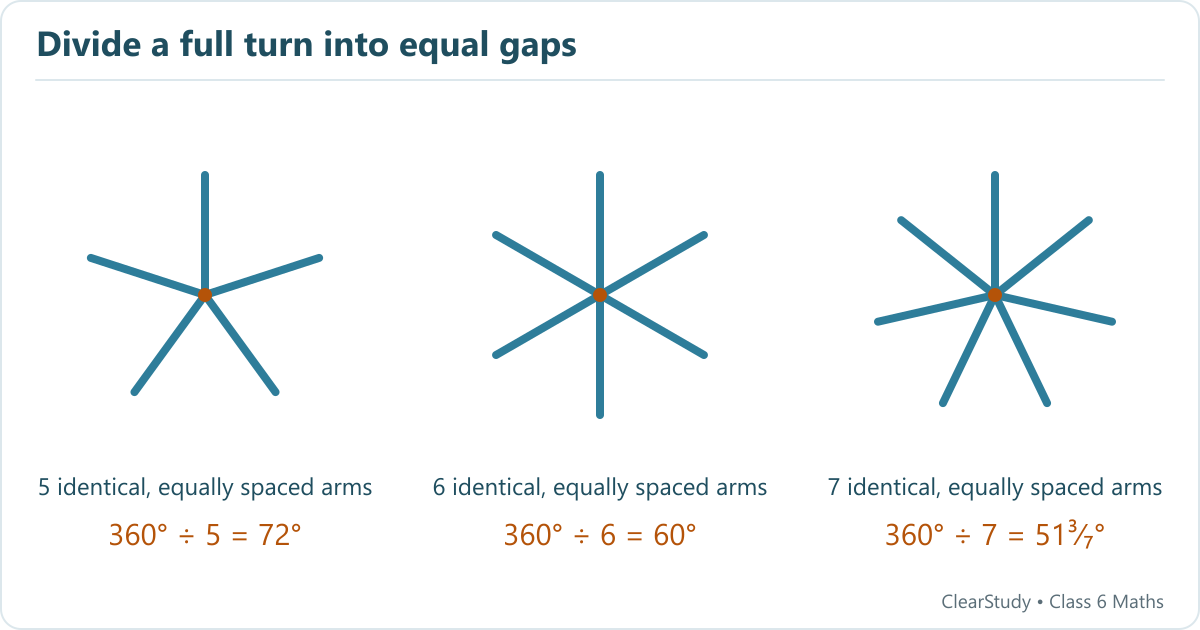
Radial-arms figure: a figure made of k identical, equally-spaced radial arms has k angles of symmetry, each a multiple of (360° ÷ k).
Circle: every angle is an angle of symmetry and every diameter is a line of symmetry — it has no smallest positive angle of symmetry.
Figure it Out — Line of Symmetry (Section 9.1)
1. Do you see any line of symmetry in the figures at the start of the chapter? What about in the picture of the cloud?
SOLUTIONYes — the opening figures are symmetrical. The flower has 6 lines of symmetry, the rangoli has 4 lines of symmetry, and the butterfly has 1 line of symmetry (the vertical line down its body).The pinwheel looks symmetrical but has no line of symmetry (its arms curve the same way, so the halves do not fold onto each other).The picture of the cloud is irregular, so it has no line of symmetry.
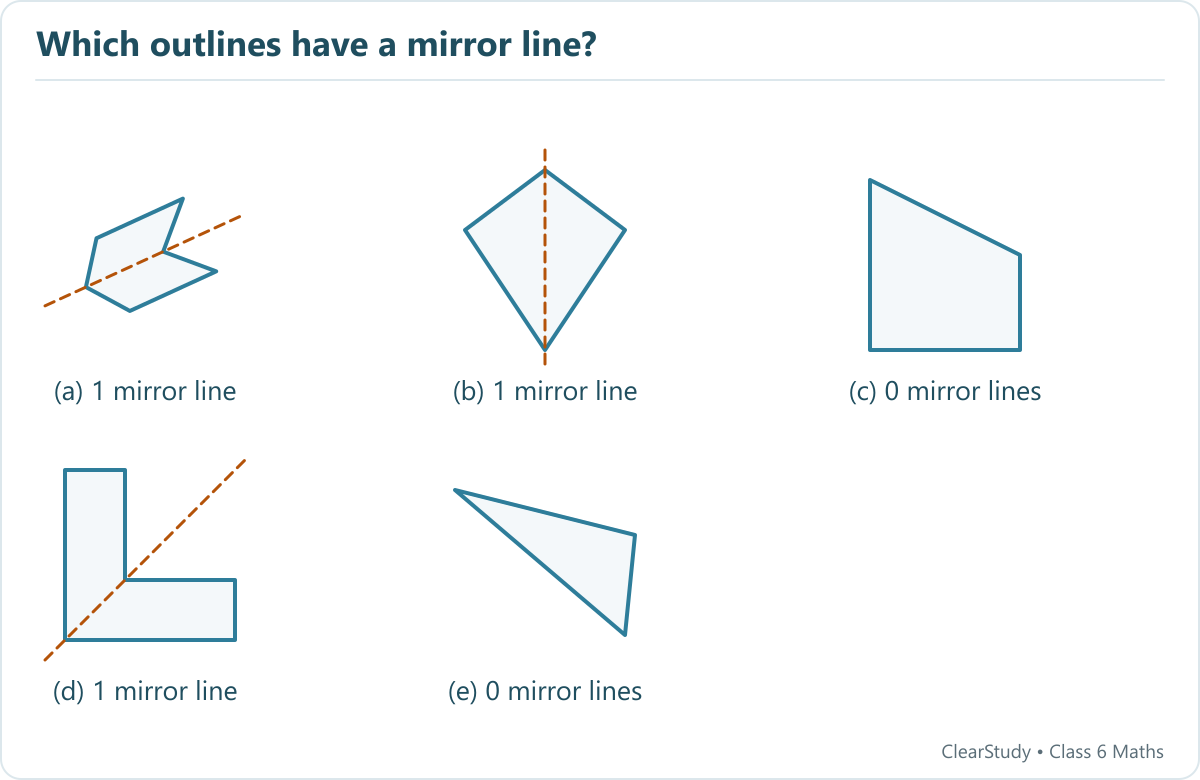
2. For each of the following figures, identify the line(s) of symmetry if it exists.
SOLUTIONRead the five textbook outlines from left to right: 1, 1, 0, 1, 0 lines of symmetry.The concave first shape has one sloping mirror line. The kite has one vertical mirror line. The sloping-top quadrilateral has none. The equal-arm L has one diagonal mirror line. The last, scalene triangle has none.
Page 219: the concave shape, kite and equal-arm L each have one mirror line; the other two shapes have none.
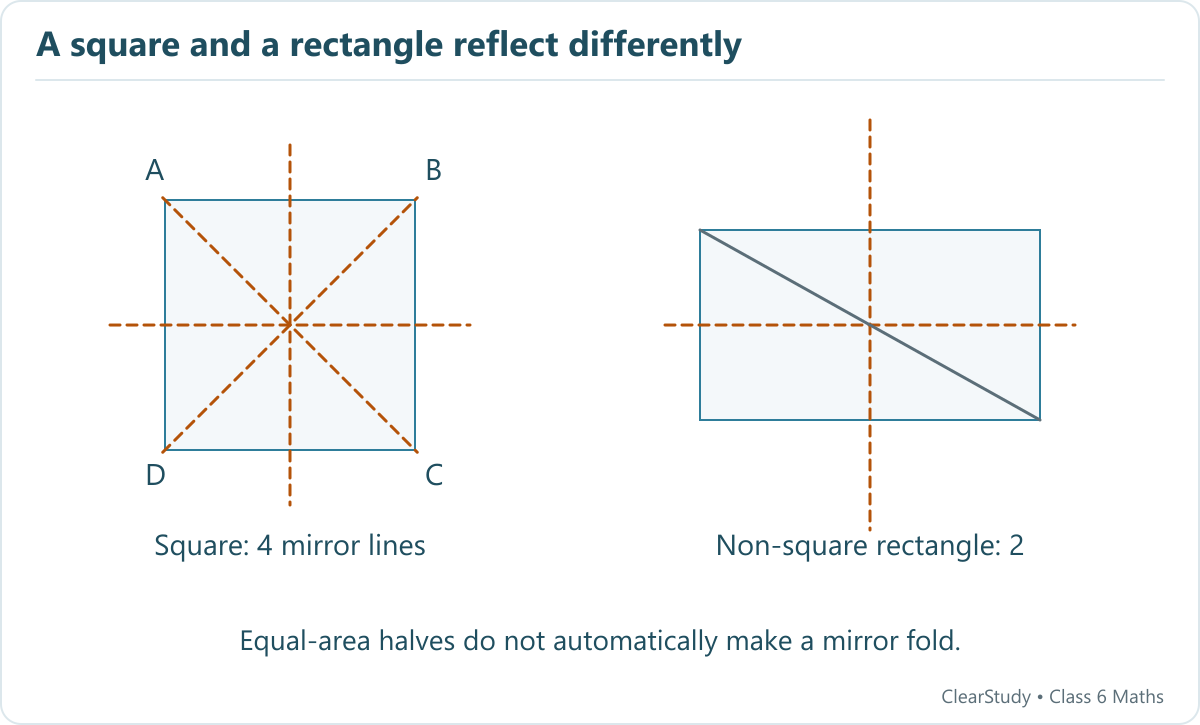
[Page 221] Is there any other way to fold the square so that the two halves overlap? How many lines of symmetry does the square shape have?
SOLUTIONNo, there is no other way to fold the square — the four folds already found (vertical, horizontal and the two diagonals) are all of them.∴ the square shape has 4 lines of symmetry.
[Page 221] We saw that the diagonal of a square is also a line of symmetry. Let us take a rectangle that is not a square. Is its diagonal a line of symmetry?
SOLUTIONNo. The diagonal divides the rectangle into two congruent triangles, but reflecting one across that diagonal does not place it on the other. At the diagonal’s endpoint, the rectangle’s unequal adjacent sides do not exchange under a mirror fold.Only the horizontal and vertical lines through the centre are mirror lines for a non-square rectangle. A square has those two lines and its two diagonals.
[Page 222] What if we reflect along the diagonal from A to C? Where do points A, B, C and D go? What if we reflect along the horizontal line of symmetry?
SOLUTIONThe square has corners A (top-left), B (top-right), C (bottom-right), D (bottom-left).Reflecting along the diagonal A–C: A and C lie on the line, so they stay in place; B and D swap — D moves to the position earlier occupied by B (and B moves to D’s position).Reflecting along the horizontal line of symmetry: the top and bottom swap — D and C move to the positions earlier occupied by A and B respectively (and A, B move down to D, C).
Across AC, A and C stay fixed while B and D swap. A rectangle’s diagonal divides it into congruent triangles, but those triangles do not overlap by that fold.
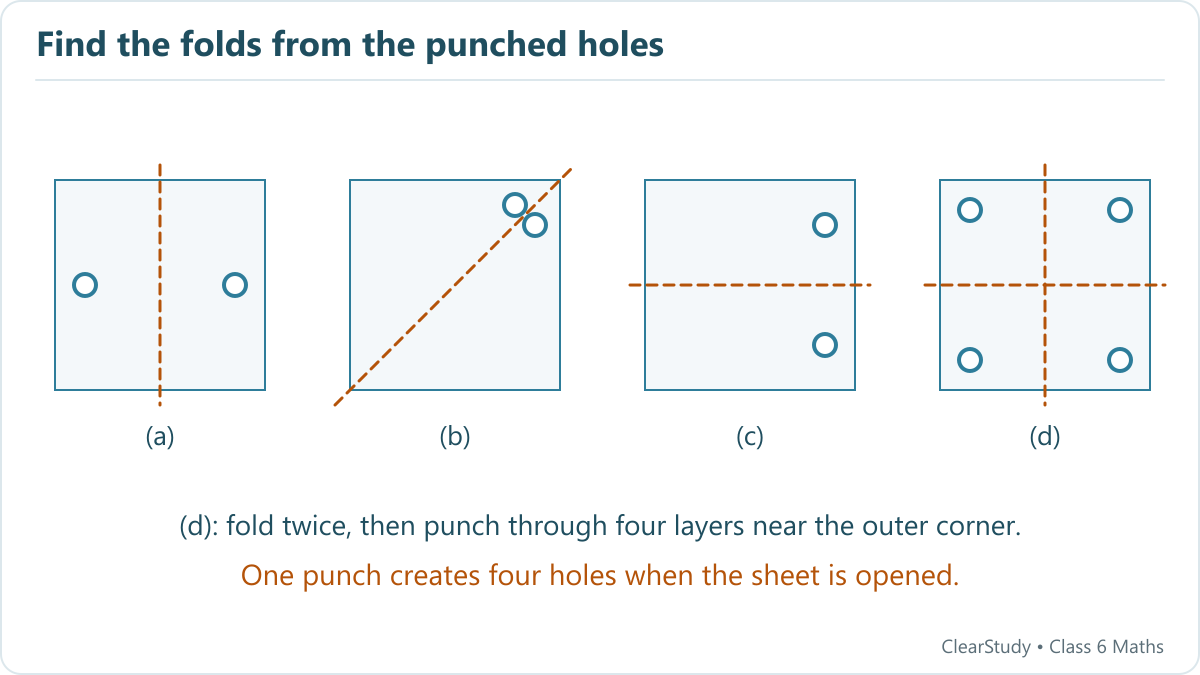
[Page 224] Punching Game — 1. In each of the following figures, a hole was punched in a folded square sheet of paper and then the paper was unfolded. Identify the line along which the paper was folded. Figure (d) was created by punching a single hole. How was the paper folded?
SOLUTIONThe fold line is the perpendicular bisector of the segment joining two corresponding hole centres; it does not run along that segment.(a) Vertical midline. (b) Diagonal from bottom left to top right. (c) Horizontal midline.(d) Fold along both midlines to make four layers. Punch near the corner corresponding to the four outer corners. The single punch produces four holes after unfolding, not one.
Page 224 Q1: the fold is the perpendicular bisector of a pair of matching holes. In (d), two midline folds produce four layers.
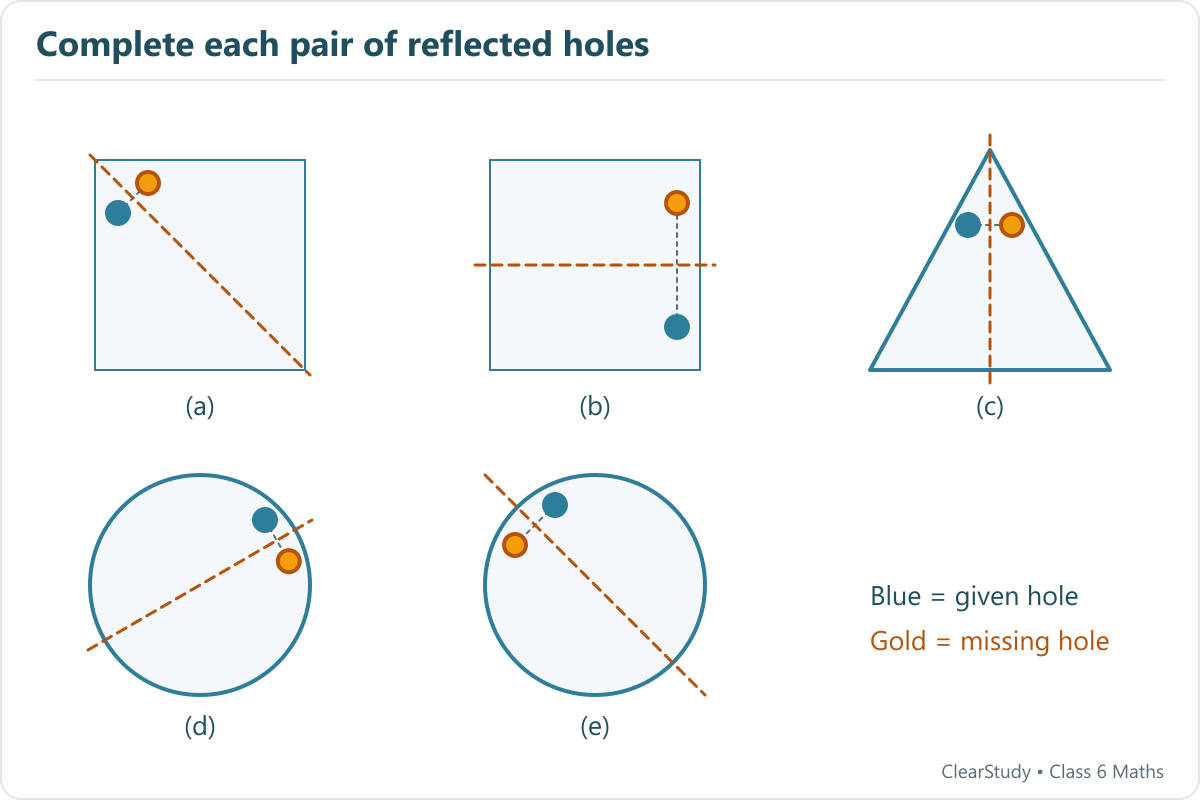
2. Given the line(s) of symmetry, find the other hole(s):
SOLUTIONAdd one reflected hole in each panel. The new hole is the same perpendicular distance from the dashed line as the given hole.(a) Above/right of the descending diagonal. (b) Above the horizontal line at the same horizontal position. (c) To the right of the vertical line. (d) Below the rising diagonal. (e) Below/left of the descending diagonal. The completed diagrams show the exact relationship.
Page 224 Q2: preserve perpendicular distance from the fold, including for the sloping mirror lines.
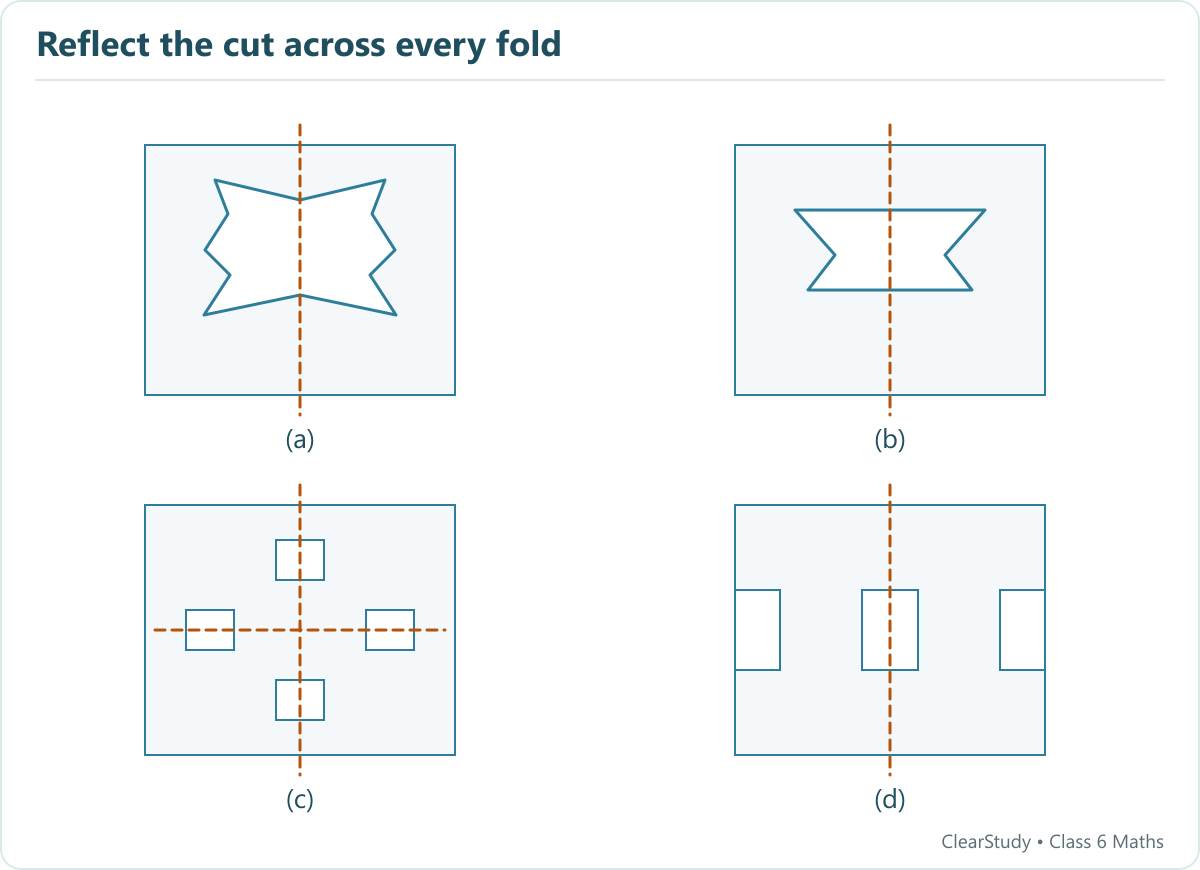
4. After each of the following cuts, predict the shape of the hole when the paper is opened. After you have made your prediction, make the cutouts and verify your answer.
SOLUTION(a) and (b) Reflect the cut contour across the vertical fold; this produces the paired jagged and bow-tie-like openings shown below.(c) Undo both folds. The notch on each folded edge produces a mirrored pair of rectangular holes: four openings in the complete sheet.(d) The notch on the folded edge becomes a central rectangular hole. The notch on the free edge becomes matching notches on the two outside edges.The drawings are schematic; the exact contour follows your cut. Check the result by folding scrap paper and unfolding in reverse order.
Page 225 Q4: these schematic results show the fold relationships. In (c), unfold the horizontal fold and then the vertical fold; in (d), distinguish the folded edge from the free edge.
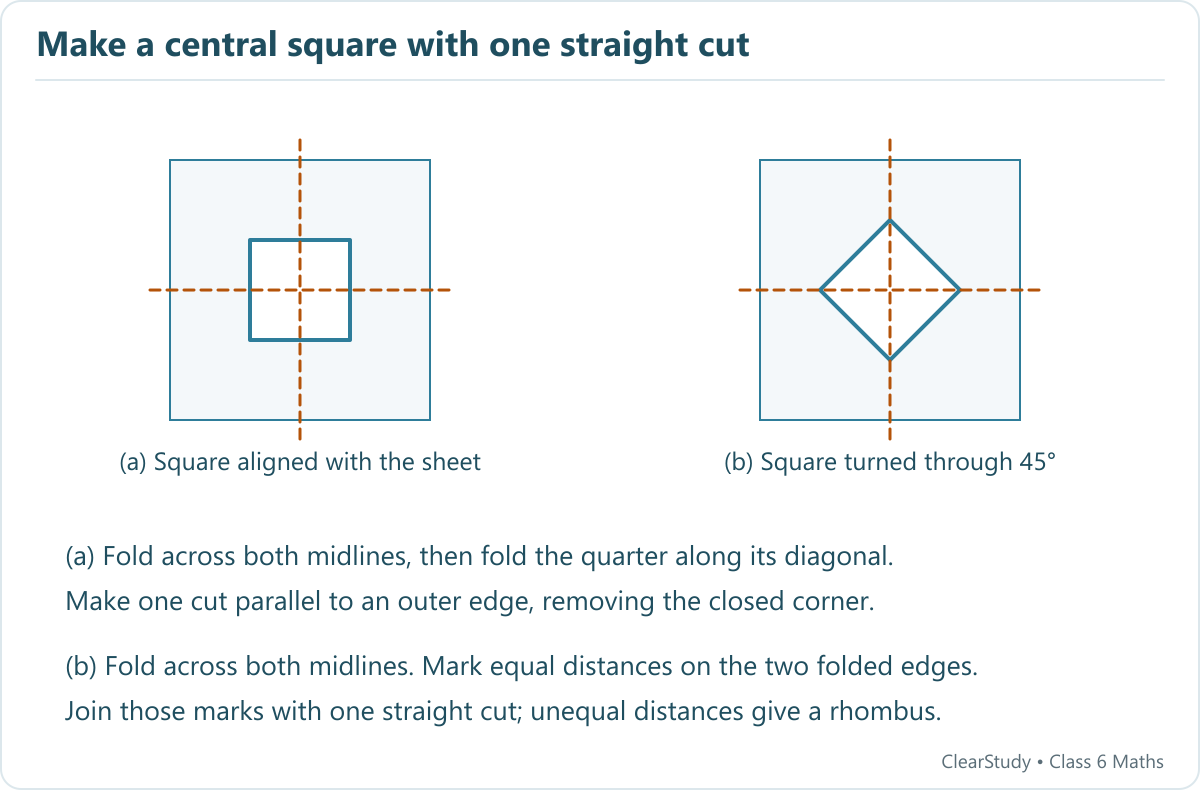
5. Suppose you have to get each of these shapes with some folds and a single straight cut. How will you do it?
a. The hole in the centre is a square.b. The hole in the centre is a square.Note: For the above two questions, check if the 4-sided figures in the centre satisfy both the properties of a square.
SOLUTION(a) Fold the square in half horizontally, then vertically. Fold this quarter-square once more along its diagonal through the original centre. On the resulting folded triangle, make one straight cut parallel to an original outer edge, removing the small closed corner. Undo all three folds: the hole is a square aligned with the sheet.(b) Fold across the two midlines. On the two folded edges meeting at the closed corner, mark equal distances from that corner. Make one straight cut joining the marks. Unfold: the hole is a square turned through 45°. Unequal marked distances would give a non-square rhombus.In both square holes all four sides are equal and all four angles are right angles.
Page 226 Q5: (a) needs an extra diagonal fold before the single cut. For (b), equal distances from the closed corner ensure all four angles of the opened hole are right angles.
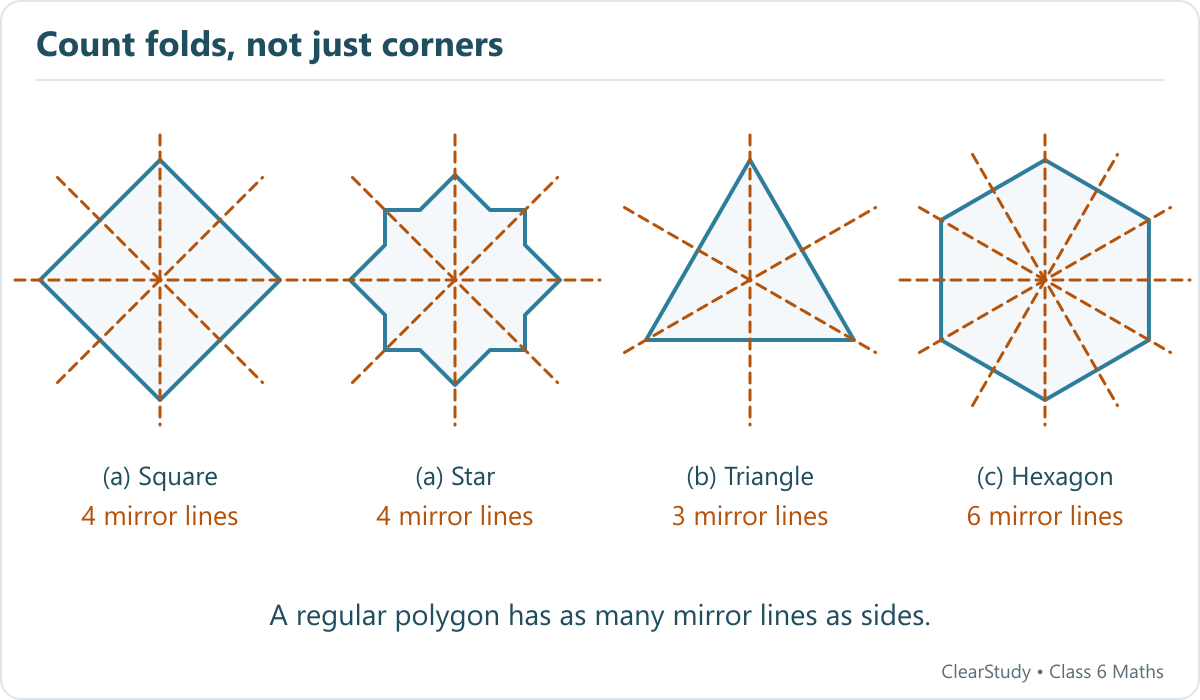
6. How many lines of symmetry do these shapes have?
a. (the figure shown)b. A triangle with equal sides and equal angles.c. A hexagon with equal sides and equal angles.
SOLUTION(a) Both the tilted square and the square-and-point star have 4 mirror lines: horizontal, vertical and two diagonal lines through the centre.(b) The equilateral triangle has 3 lines, from each vertex to the opposite side’s midpoint.(c) The regular hexagon has 6 lines: three through opposite vertices and three through opposite side midpoints.The star in (a) is not a regular polygon; its number of sides is not the number of mirror lines.
Page 226–227 Q6: both shapes in (a) have 4 lines. The star is not a regular polygon, so counting its sides would give the wrong answer.
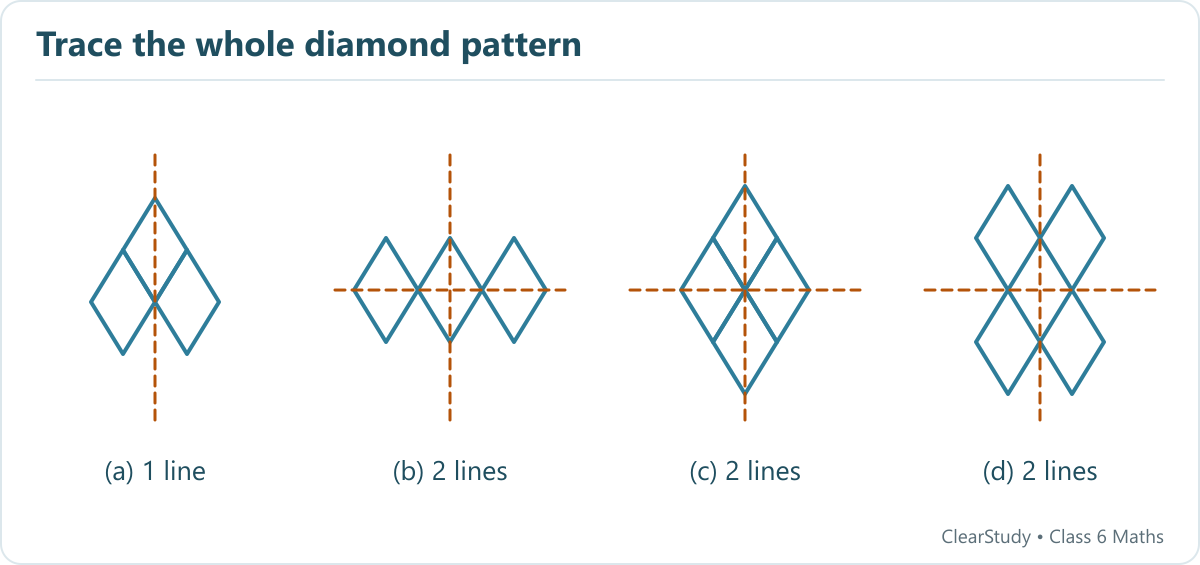
7. Trace each figure and draw the lines of symmetry, if any:
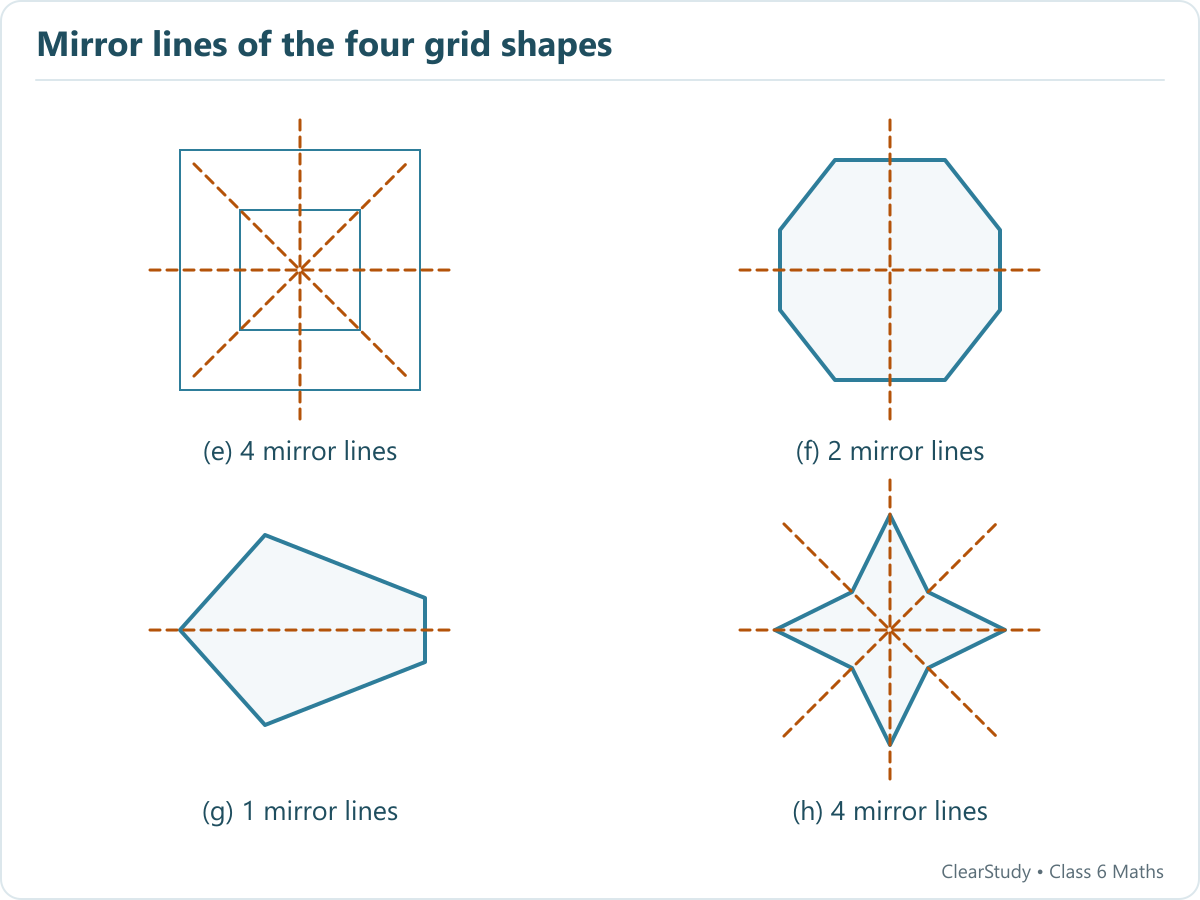
SOLUTIONReading left to right, the four diamond arrangements in the top row have 1, 2, 2, 2 mirror lines. The first has a vertical axis only; the other three have vertical and horizontal axes.For the four squared-paper figures, read row by row: 4, 2, 1, 4. The nested squares have four axes; the elongated octagon has two; the sideways pentagon has one horizontal axis; the four-point star has four.Trace the internal lines too: a mirror line must preserve the whole figure.
Page 227 Q7, top row: test all the internal edges as well as the outside boundary.Page 227 Q7, reading the grid figures row by row: 4, 2, 1, 4. The outer and inner squares have the same centre.
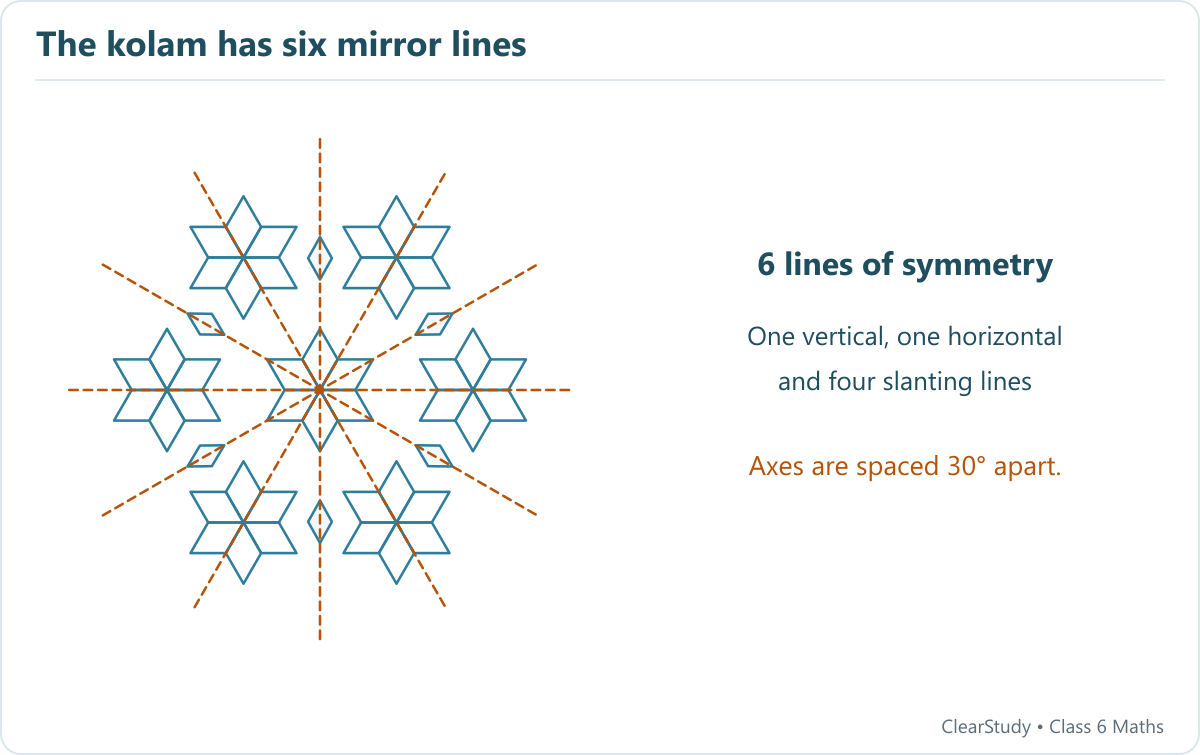
8. Find the lines of symmetry for the kolam below.
SOLUTIONThe displayed kolam has 6 lines of symmetry: one vertical, one horizontal and four slanting lines through its centre. Adjacent mirror axes are 30° apart.Its flowers and connecting diamond motifs form a hexagonal arrangement. Do not assume every kolam has the four axes of a square; inspect the actual design.
Page 228 Q8: the textbook’s kolam has hexagonal, rather than square, symmetry. Its six reflection axes pass through the centre of the complete design.
9. Draw the following.
a. A triangle with exactly one line of symmetry.b. A triangle with exactly three lines of symmetry.c. A triangle with no line of symmetry.Is it possible to draw a triangle with exactly two lines of symmetry?
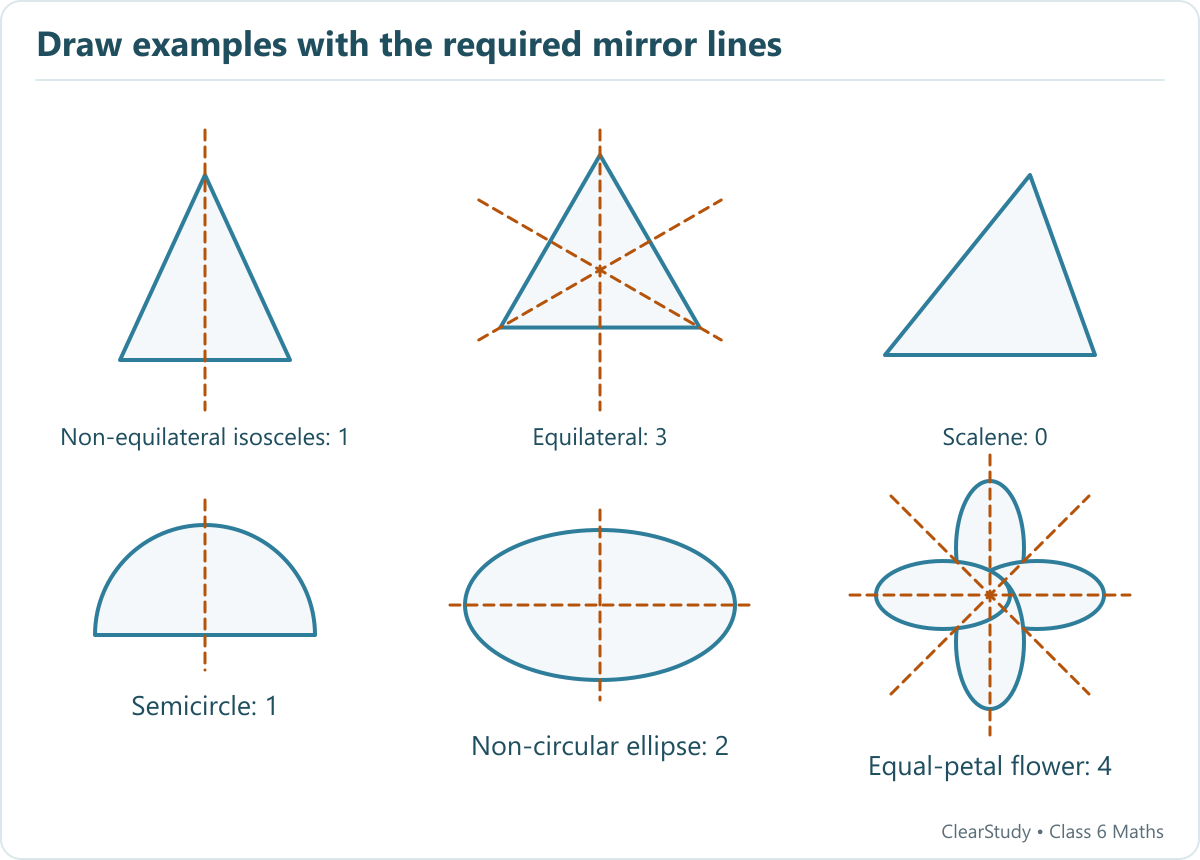
SOLUTIONa. An isosceles triangle that is not equilateral has exactly one line of symmetry.b. An equilateral triangle (all sides equal) has exactly three lines of symmetry.c. A scalene triangle (all sides different) has no line of symmetry.No, it is not possible to draw a triangle with exactly two lines of symmetry. A triangle can have only 0, 1 or 3 lines of symmetry.
10. Draw the following. In each case, the figure should contain at least one curved boundary.
a. A figure with exactly one line of symmetry.b. A figure with exactly two lines of symmetry.c. A figure with exactly four lines of symmetry.
SOLUTION(a) A semicircle has exactly one mirror line, perpendicular to its diameter through the centre.(b) A non-circular ellipse has exactly two mirror lines: its long and short axes.(c) Four identical equally spaced petals, arranged as shown, have exactly four mirror lines. A circle would not work, because it has infinitely many.
Pages 228 Q9–10: a triangle cannot have exactly two mirror lines. For curved examples, the complete outline must match across each stated axis.
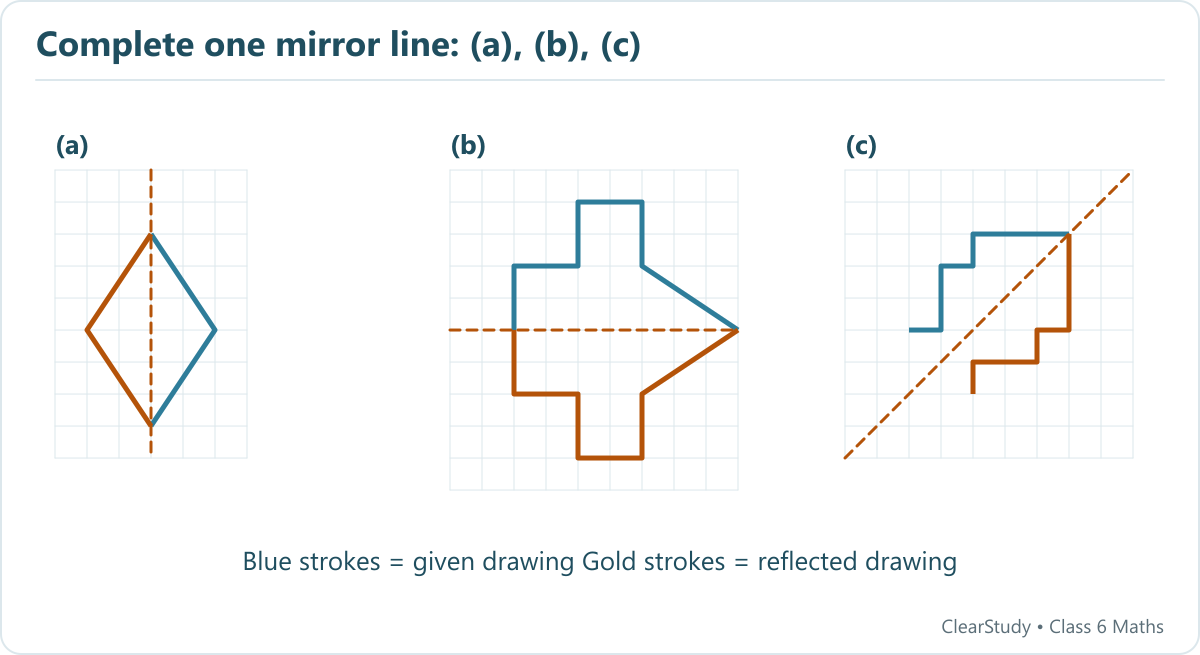
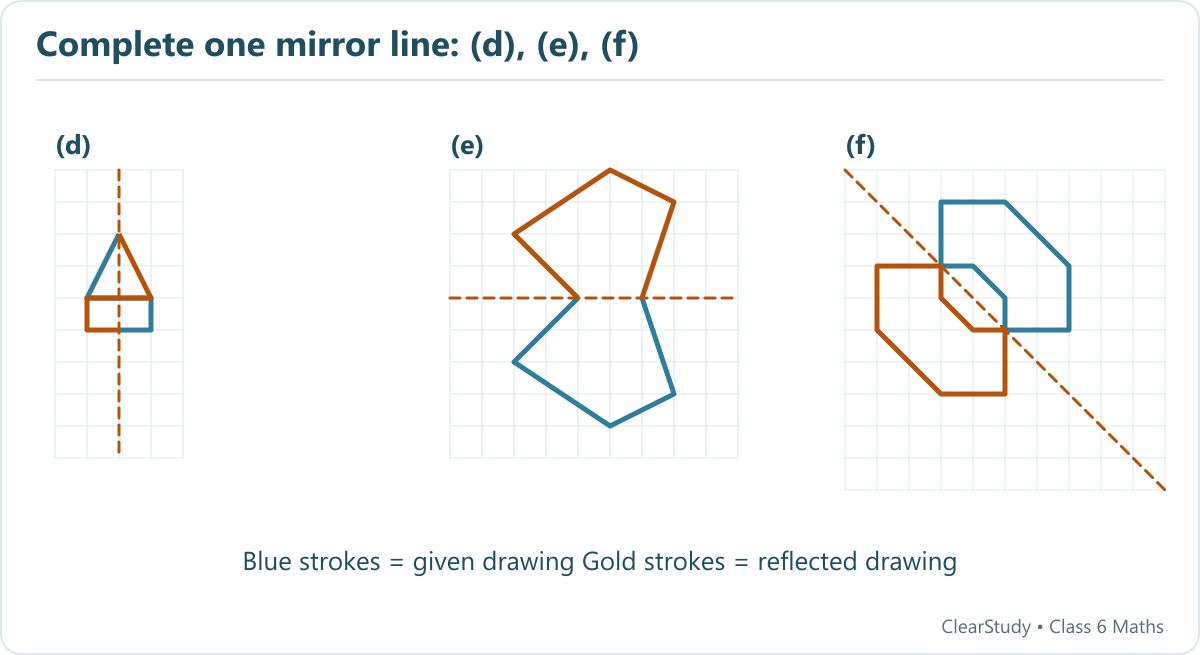
11. Copy the following on squared paper. Complete them so that the blue line is a line of symmetry. Problem (a) has been done for you.
Hint: For (c) and (f), see if rotating the book helps!
SOLUTIONThe completed drawings are below. Blue strokes are the given parts and gold strokes are the added reflections; the colour is only a teaching guide.(a), (d) Reflect left/right across the vertical axis. (b), (e) Reflect above/below across the horizontal axis. (c), (f) Reflect across the diagonal axis: swap the corresponding across-and-down distances. Each endpoint and bend must have a partner at equal perpendicular distance.
Pages 228–229 Q11: keep the perpendicular distance to the axis unchanged. With a diagonal axis, count across and down together.Pages 228–229 Q11: keep the perpendicular distance to the axis unchanged. With a diagonal axis, count across and down together.
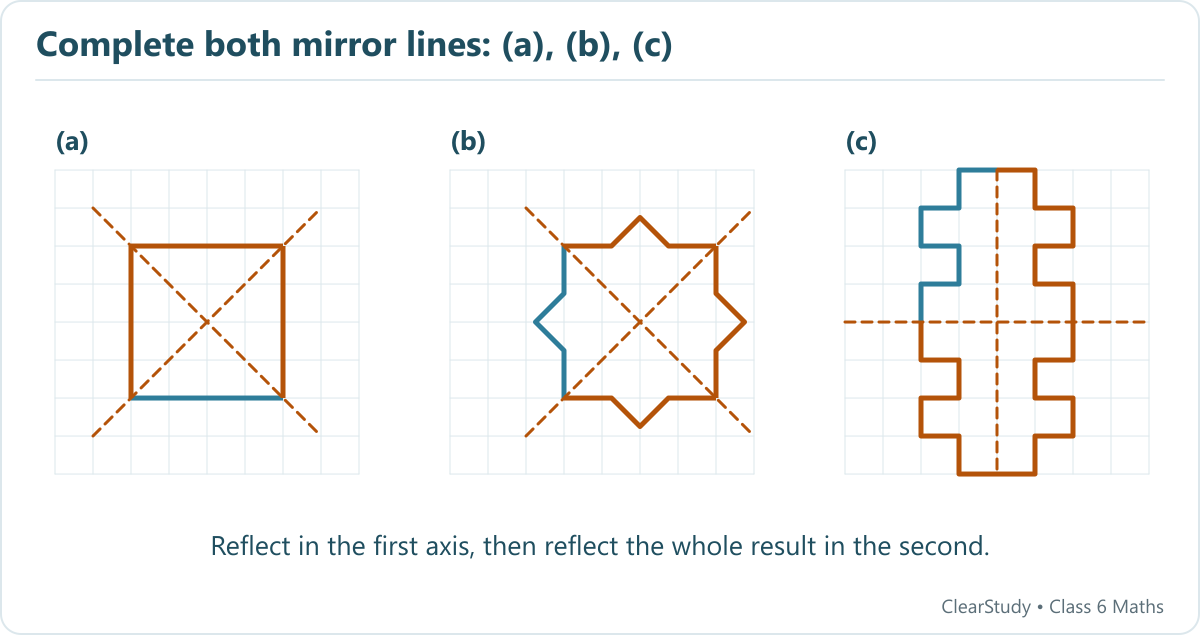
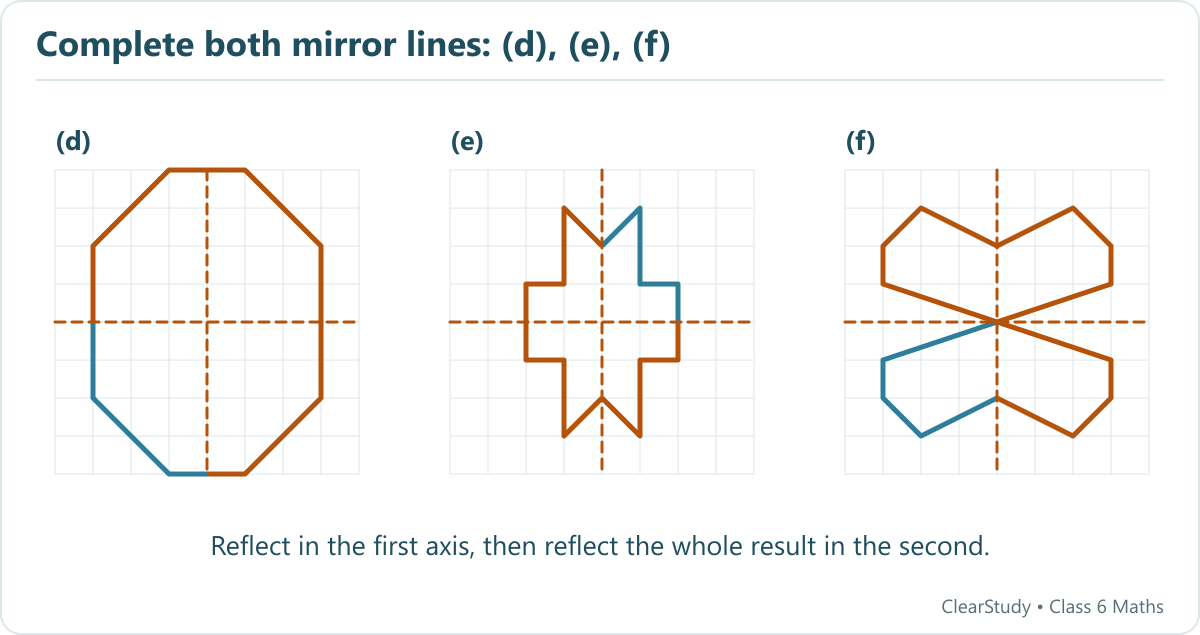
12. Copy the following drawing on squared paper. Complete each one of them so that the resulting figure has the two blue lines as lines of symmetry.
SOLUTIONReflect the given strokes across the first axis, then reflect both the original and the new strokes across the second. The six complete solutions follow.(a) The result is a square. (b) Repeat the pointed side across both diagonal axes. (c)–(f) Complete all four regions about the horizontal and vertical axes. Check both folds, not just one.
Page 229 Q12: the completed design must match when folded along either of the two given lines. Colour identifies the solution strokes, not a colour condition in the question.Page 229 Q12: the completed design must match when folded along either of the two given lines. Colour identifies the solution strokes, not a colour condition in the question.
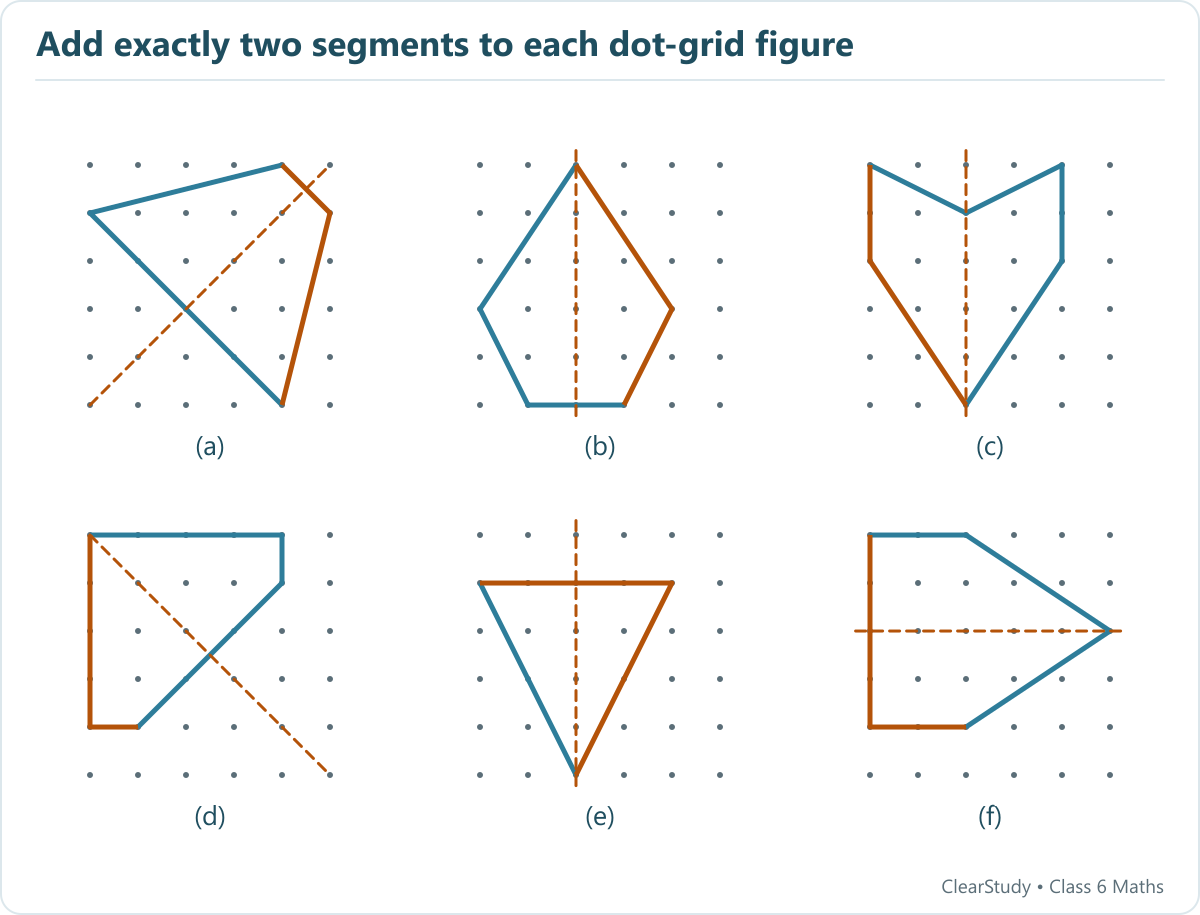
13. Copy the following on a dot grid. For each figure draw two more lines to make a shape that has a line of symmetry.
SOLUTIONAdd the two gold segments in each drawing below. Every completed outline has the dashed mirror line shown.For (a), use the rising diagonal; for (b), (c) and (e), use a vertical line; for (d), use the descending diagonal; for (f), use a horizontal line. Only two new segments are added in each case; other correct completions are possible.
Page 230 Q13: these are valid completions. In (a) the mirror line slopes from bottom left to top right; in (d) it slopes the other way. Other valid completions may exist.
Math Talk & Try This — Answered
These are the in-text exploratory and short tasks in the chapter; the determinate ones are answered, and the open ones are guided.
Math Talk — Symmetries of famous structuresWhat are the symmetries that you see in the Taj Mahal and the gopuram?Answer. The idealised front outlines have one vertical line of reflection symmetry: matching features appear on either side of the centre. They do not have a nontrivial rotational symmetry. A photograph can show small differences caused by perspective, surroundings or details.
Try This — Ink Blot DevilsFold a paper in half, spill a few drops of ink on one half, press and open. What do you see? Is the figure symmetric? Where is the line of symmetry?Answer. The ink prints a mirror image on the other half, so the figure is symmetric. The fold line is the line of symmetry. Usually there is no other line of symmetry, because random ink blots are not symmetric in any other direction.
Try This — Paper folding and cuttingA sheet is folded and a cut is made along a dotted line. Draw how the paper looks when unfolded. Do you see a line of symmetry?Answer. On unfolding, the cut appears as a shape that is the mirror image across the fold. The fold line is the line of symmetry of the cut-out design.
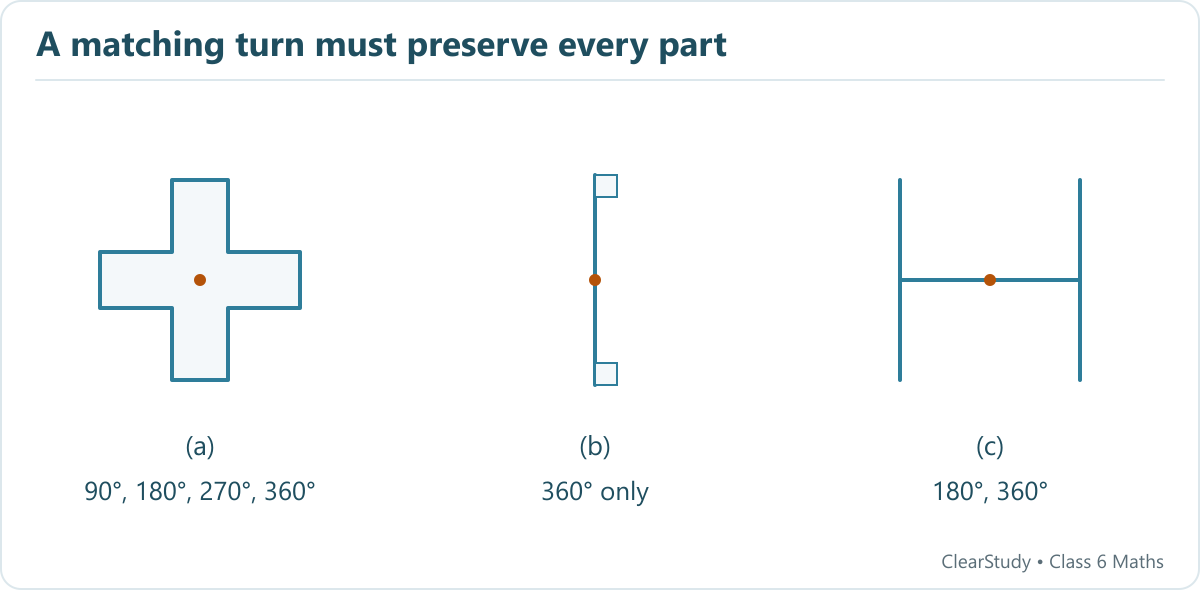
Math Talk — Angles of symmetry of the windmill / squareHow many angles of symmetry does the paper windmill have? What about a square?Answer. The windmill looks the same after a quarter turn, so its angles of symmetry are 90°, 180°, 270° and 360° — that is 4 angles. A square also returns to itself after 90°, so it has the same 4 angles of symmetry (order 4).
Math Talk — The strip exampleFind the angles of symmetry of the given strip.Answer. Rotating the strip by 180° does not give the original; only a full turn of 360° brings it back. So 360° is its only angle of symmetry, which means the strip has no rotational symmetry.
Math Talk — Three radial arms must be 120°If a figure with three radial arms has rotational symmetry, what must each angle be?Answer. The three equal angles share a full turn equally, so each angle = 360° ÷ 3 = 120°. The figure then has angles of symmetry 120°, 240° and 360° (order 3).
Try This — 5 and 6 angles of symmetry (radial arms)Can you draw a figure with radial arms that has a) exactly 5 angles of symmetry, b) 6 angles of symmetry? Find the angles in each case.Answer.(a) Use 5 identical, equally-spaced arms; smallest angle = 360° ÷ 5 = 72°. Angles of symmetry = 72°, 144°, 216°, 288°, 360°. (b) Use 6 identical, equally-spaced arms; smallest angle = 360° ÷ 6 = 60°. Angles of symmetry = 60°, 120°, 180°, 240°, 300°, 360°.
Try This — 7 angles of symmetryA radial-arms figure has exactly 7 angles of symmetry. What is its smallest angle of symmetry? Is it a whole number? If not, express it as a mixed fraction.Answer. Smallest angle = 360° ÷ 7 = 513⁄7° (since 7 × 51 = 357, remainder 3). It is not a whole number of degrees.
Equal spacing alone is insufficient if the arms have different shapes, lengths or colours. Seven equal gaps show why the smallest angle need not be a whole number.
Math Talk — Multiples of the smallest angleIn each case the angles are the multiples of the smallest angle. Will this always happen? What do you think?Answer. For a figure with a smallest positive angle of symmetry, yes: its matching turns are successive multiples up to 360°. A plain circle is different: every positive turn matches, so it has no smallest positive angle.
True or False (page 236)• Every figure will have 360 degrees as an angle of symmetry. • If the smallest angle of symmetry of a figure is a natural number in degrees, then it is a factor of 360.Answer. Both statements are True. A full 360° turn always returns any figure to itself; and since all angles are multiples of the smallest angle and 360° must be one of them, the smallest whole-number angle must divide 360 exactly (be a factor of 360).
Figure it Out — Rotational Symmetry (Section 9.2)
1. Find the angles of symmetry for the given figures about the point marked •.
(a) (b) (c)
SOLUTIONRotate each figure about the marked point and note the turns that bring it back onto itself.(a) Looks the same after a quarter turn → angles of symmetry = 90°, 180°, 270°, 360°.(b) Comes back only after a full turn → angle of symmetry = 360° (so it has no rotational symmetry).(c) Looks the same after a half turn → angles of symmetry = 180°, 360°.
Page 235 Q1: rotate about the marked point, and include 360° when listing the angles. The tabs in (b) would move to the left after 180°.
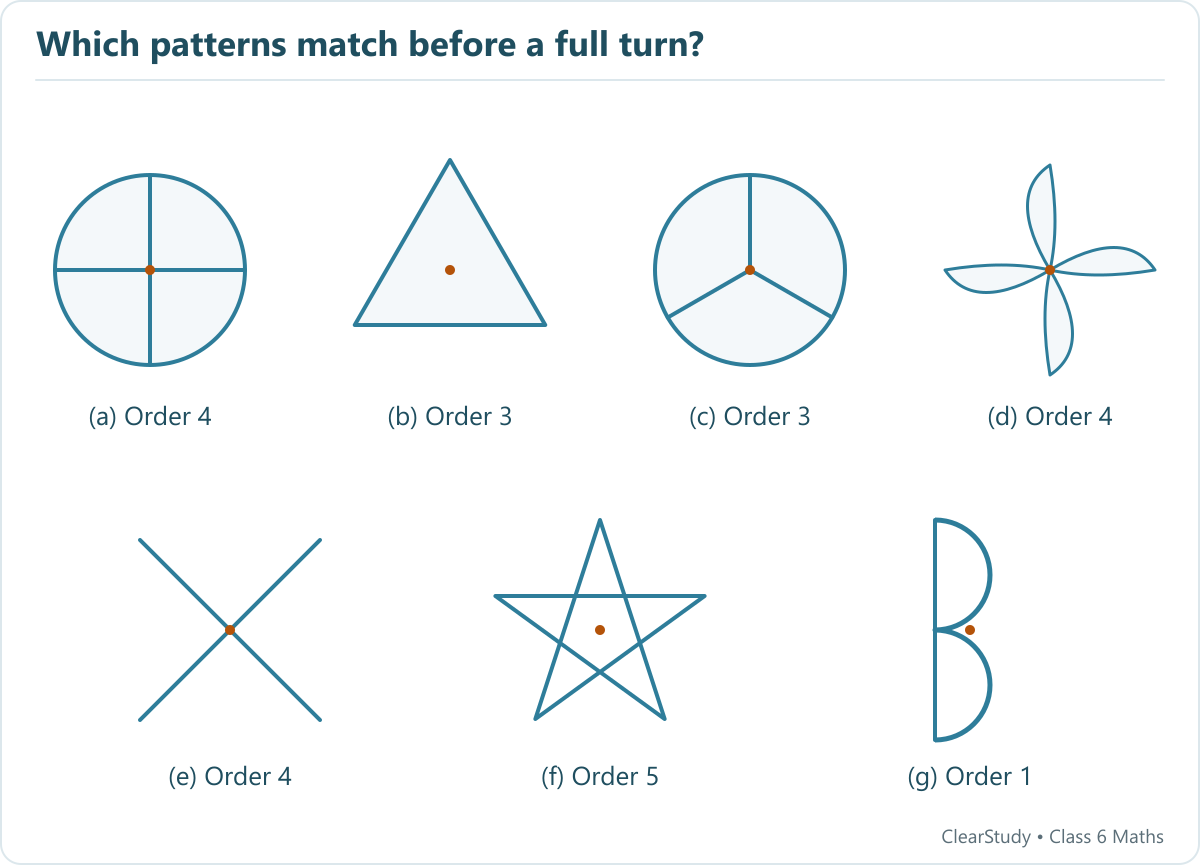
2. Which of the following figures have more than one angle of symmetry?
SOLUTIONAll except the last, B-shaped figure. Reading the figures left to right and then the next row: the divided circle, equilateral triangle, three-sector circle, pinwheel, equal perpendicular cross and regular five-point star each match before 360°.Their idealised orders are 4, 3, 3, 4, 4, 5. The B-shaped figure has order 1: its two lobes move to the opposite side after a half-turn.
Page 235 Q2: all except the last, B-shaped figure have more than one angle of symmetry. The equal perpendicular diagonal strokes shown here have order 4.
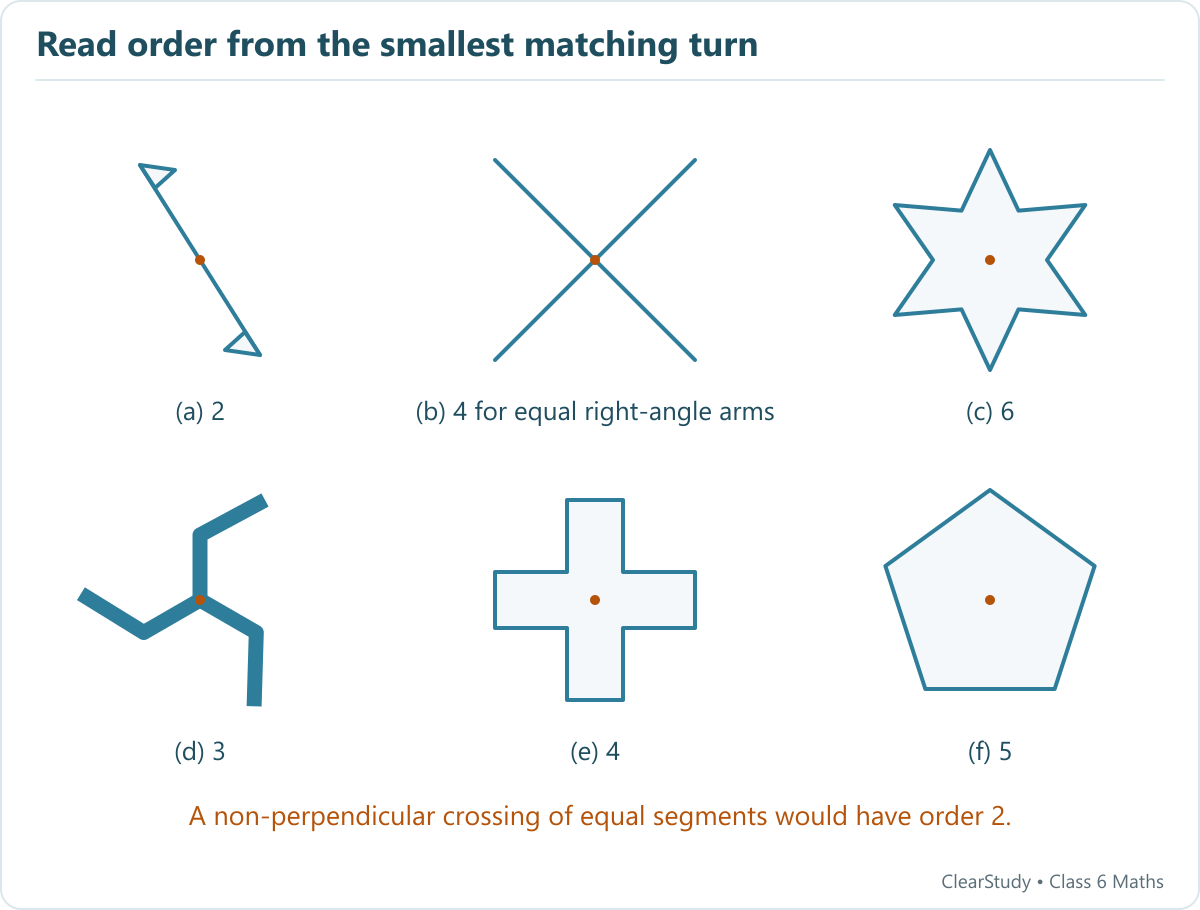
3. Give the order of rotational symmetry for each figure:
SOLUTIONRead left to right across each row. The opposite flags have order 2; the six-point star 6; the three-arm motif 3; the equal-arm plus 4; and the regular pentagon 5.Crossing-line figure: for equal perpendicular arms, as drawn in our diagram, the order is 4. For two equal segments bisecting each other at a non-right angle, it is 2. Check the actual angle and arm lengths in your copy; a curved angle marker is an annotation, not an extra arm.The smallest turns for orders 2, 3, 4, 5 and 6 are 180°, 120°, 90°, 72° and 60° respectively.
Page 236 Q3: idealised flags, a perpendicular equal-arm cross, a six-point star, a three-arm motif, an equal-arm plus and a regular pentagon. For the crossing lines, distinguish a general crossing angle from exactly 90°; an angle arc is an annotation.
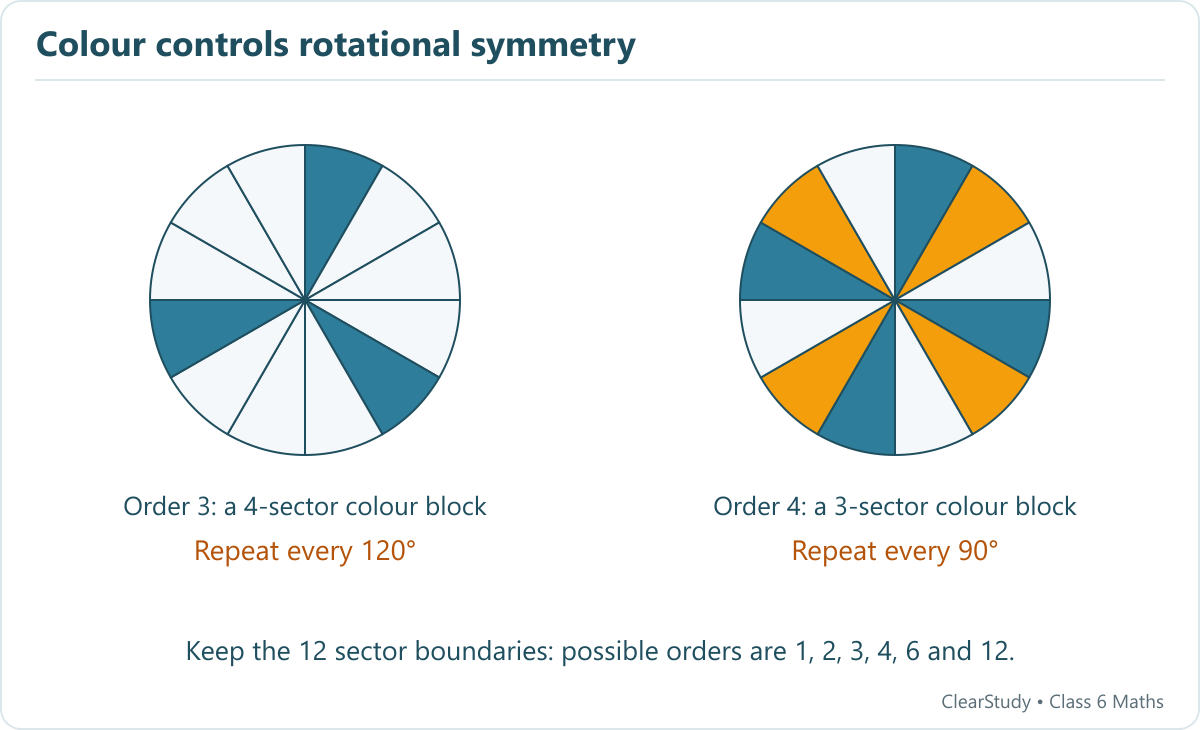
[Section 9.2, page 238] 1. Colour the sectors of the circle below so that the figure has i) 3 angles of symmetry, ii) 4 angles of symmetry, iii) what are the possible numbers of angles of symmetry you can obtain by colouring the sectors in different ways?
SOLUTIONThe circle is divided into 12 equal sectors, so each sector is 30°.(i) To get 3 angles of symmetry, colour the sectors in a pattern that repeats every 120° (every 4 sectors), giving angles 120°, 240°, 360°.(ii) To get 4 angles of symmetry, colour a pattern that repeats every 90° (every 3 sectors), giving angles 90°, 180°, 270°, 360°.(iii) The possible orders are the divisors of 12 — so 1, 2, 3, 4, 6 and 12 angles of symmetry can be obtained (up to 12, when all sectors are coloured the same and the 12 radial boundaries remain visible). If those boundaries are erased, a uniform disk has infinitely many angles of symmetry.
Page 238 Q1: the colour block must not repeat sooner. If sector boundaries are erased and the entire disk is one colour, it becomes a plain circle with infinitely many angles of symmetry.
2. Draw two figures other than a circle and a square that have both reflection symmetry and rotational symmetry.
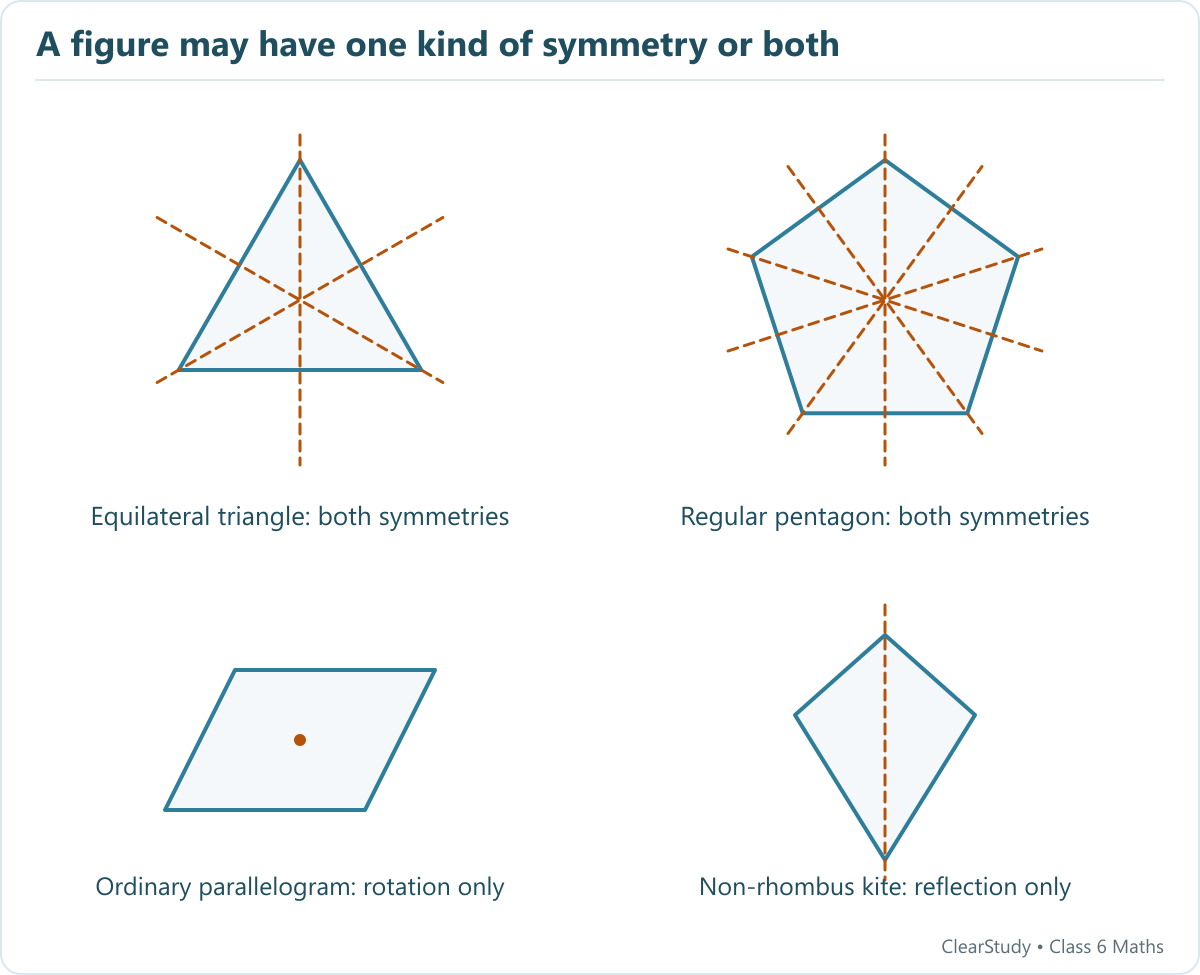
SOLUTIONAny regular polygon works. Two good examples:Equilateral triangle: number of lines of symmetry = 3, order of rotational symmetry = 3.Regular pentagon (or a regular hexagon): a regular pentagon has 5 lines of symmetry and order 5; a regular hexagon has 6 lines of symmetry and order 6. Each has both reflection and rotational symmetry.
3. Draw, wherever possible, a rough sketch of:
a. A triangle with at least two lines of symmetry and at least two angles of symmetry.b. A triangle with only one line of symmetry but not having rotational symmetry.c. A quadrilateral with rotational symmetry but no reflection symmetry.d. A quadrilateral with reflection symmetry but not having rotational symmetry.
SOLUTIONa. An equilateral triangle — it has 3 lines of symmetry and 3 angles of symmetry (so “at least two” of each is satisfied).b. A non-equilateral isosceles triangle — it has 1 line of symmetry and no rotational symmetry (only 360°).c. A parallelogram (that is not a rectangle or rhombus) — it has rotational symmetry of order 2 (angles 180°, 360°) but no line of symmetry.d. A kite that is not a rhombus — it has 1 line of symmetry (its axis) but no rotational symmetry (returns only at 360°).
Page 238 Q2–3: for a triangle with reflection only, use the non-equilateral isosceles example above. A rhombus is a special kite and would not answer part (d).
4. In a figure, 60° is the smallest angle of symmetry. What are the other angles of symmetry of this figure?
SOLUTIONAll angles of symmetry are multiples of the smallest angle (60°) up to 360°.Multiples of 60° up to 360°: 60°, 120°, 180°, 240°, 300°, 360°.∴ the other angles of symmetry = 120°, 180°, 240°, 300° and 360°.
5. In a figure, 60° is an angle of symmetry. The figure has two angles of symmetry less than 60°. What is its smallest angle of symmetry?
SOLUTION60° must be a multiple of the smallest angle a, and there must be exactly two angles of symmetry smaller than 60°, i.e. a and 2a, with 3a = 60°.So a = 60° ÷ 3 = 20°. (Check: angles 20°, 40° are the two less than 60°, and 60° = 3 × 20° is indeed an angle of symmetry.)∴ the smallest angle of symmetry = 20°.
6. Can we have a figure with rotational symmetry whose smallest angle of symmetry is:
a. 45°?b. 17°?
SOLUTIONThe smallest angle of symmetry must divide 360° exactly (be a factor of 360).a. Yes — 360° ÷ 45° = 8 (a whole number), so 45° can be the smallest angle of symmetry.b. No — 360° ÷ 17° is not a whole number, so 17° cannot be the smallest angle of symmetry.
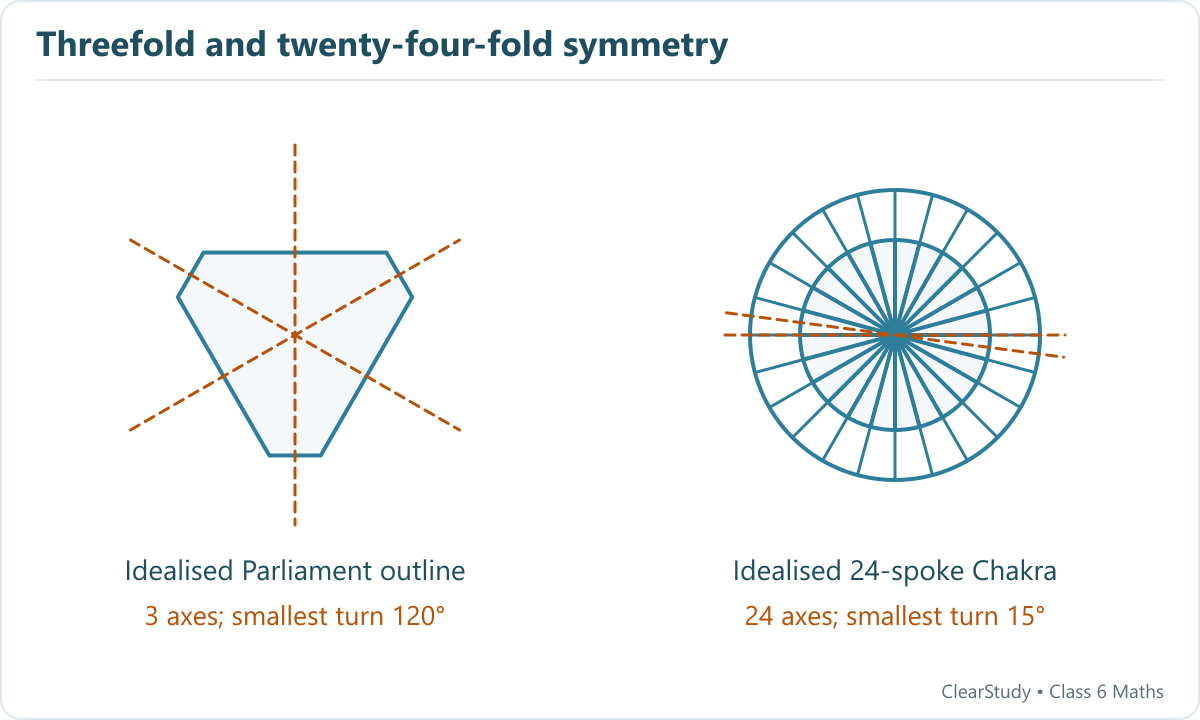
7. This is a picture of the new Parliament Building in Delhi.
a. Does the outer boundary of the picture have reflection symmetry? If so, draw the lines of symmetries. How many are they?b. Does it have rotational symmetry around its centre? If so, find the angles of rotational symmetry.
SOLUTIONUse the idealised outer outline drawn beside the building. It is a triangle with its three corners cut off equally: six sides, consisting of three long sides and three short sides.(a) It has 3 reflection axes, each through the centre and the midpoint of a short side and its opposite long side.(b) It has rotational order 3: the matching turns are 120°, 240°, 360°. The perspective photograph need not itself show exact mirror symmetry.
8. How many lines of symmetry do the shapes in the first shape sequence in Chapter 1, Table 3, the Regular Polygons, have? What number sequence do you get?
SOLUTIONA regular polygon with n sides has exactly n lines of symmetry:
Regular Polygon
No. of lines of symmetry
Triangle
3
Quadrilateral (square)
4
Pentagon
5
Hexagon
6
Heptagon
7
Octagon
8
Nonagon
9
Decagon
10
SOLUTION (contd.)∴ the number sequence is 3, 4, 5, 6, 7, 8, 9, 10, … — the counting (natural) number sequence.
9. How many angles of symmetry do the shapes in the first shape sequence in Chapter 1, Table 3, the Regular Polygons, have? What number sequence do you get?
SOLUTIONA regular polygon with n sides also has exactly n angles of symmetry (order n).Triangle 3, quadrilateral 4, pentagon 5, hexagon 6, heptagon 7, octagon 8, …∴ the number sequence is again 3, 4, 5, 6, 7, 8, … — the same counting-number sequence as the lines of symmetry.
10. How many lines of symmetry do the shapes in the last shape sequence in Chapter 1, Table 3, the Koch Snowflake sequence, have? How many angles of symmetry?
SOLUTIONThe Koch snowflake is built on an equilateral triangle and quickly becomes six-fold symmetric.Number of lines of symmetry: 3, 6, 6, 6, 6, … (the first shape is a triangle with 3, every later shape has 6).Number of angles of symmetry: 3, 6, 6, 6, 6, … — the same sequence.
11. How many lines of symmetry and angles of symmetry does Ashoka Chakra have?
SOLUTIONFor the idealised Chakra with 24 identical equally spaced spokes, there are 24 mirror lines: 12 through pairs of opposite spokes and 12 halfway between opposite spoke pairs.Its rotational order is 24. The smallest matching turn is 360° ÷ 24 = 15°; the angles are 15°, 30°, 45°, …, 360°.
Page 239: the Parliament outline has six sides with three long and three short sides. For the ideal Chakra, count 12 axes through opposite spokes plus 12 through opposite gaps.
Playing with Tiles and the 6 × 6 Game
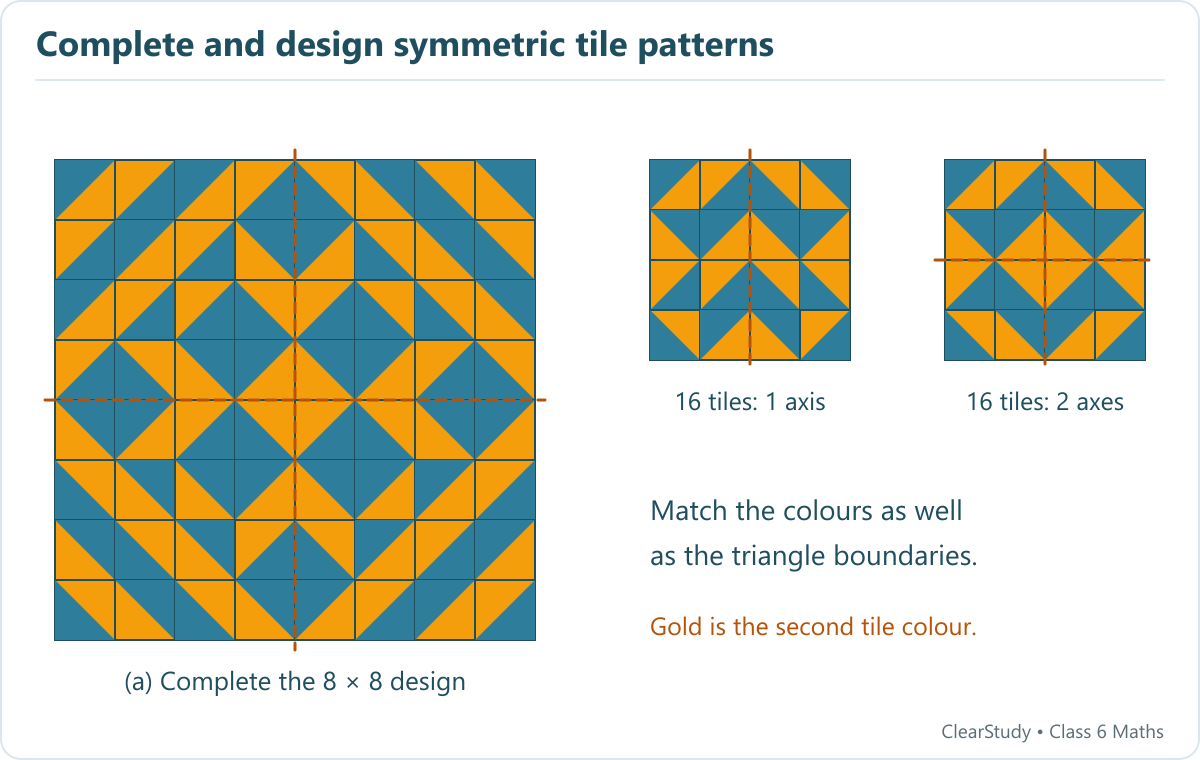
How can the tile design be completed with exactly two mirror lines?
SOLUTIONReflect the given upper-left 4 × 4 tile block across the vertical middle line. Then reflect the entire top half across the horizontal middle line. Preserve both colours in every reflection. The completed 8 × 8 pattern has exactly those two axes.The two smaller examples each use 16 tiles: one has exactly one vertical mirror line; the other has exactly two perpendicular mirror lines. The diagonal lines do not preserve their colour arrangements.
Pages 239–240: the orange dashed lines mark the mirror axes. The complete colour pattern is part of the figure; a diagonal that swaps colours is not a mirror line.
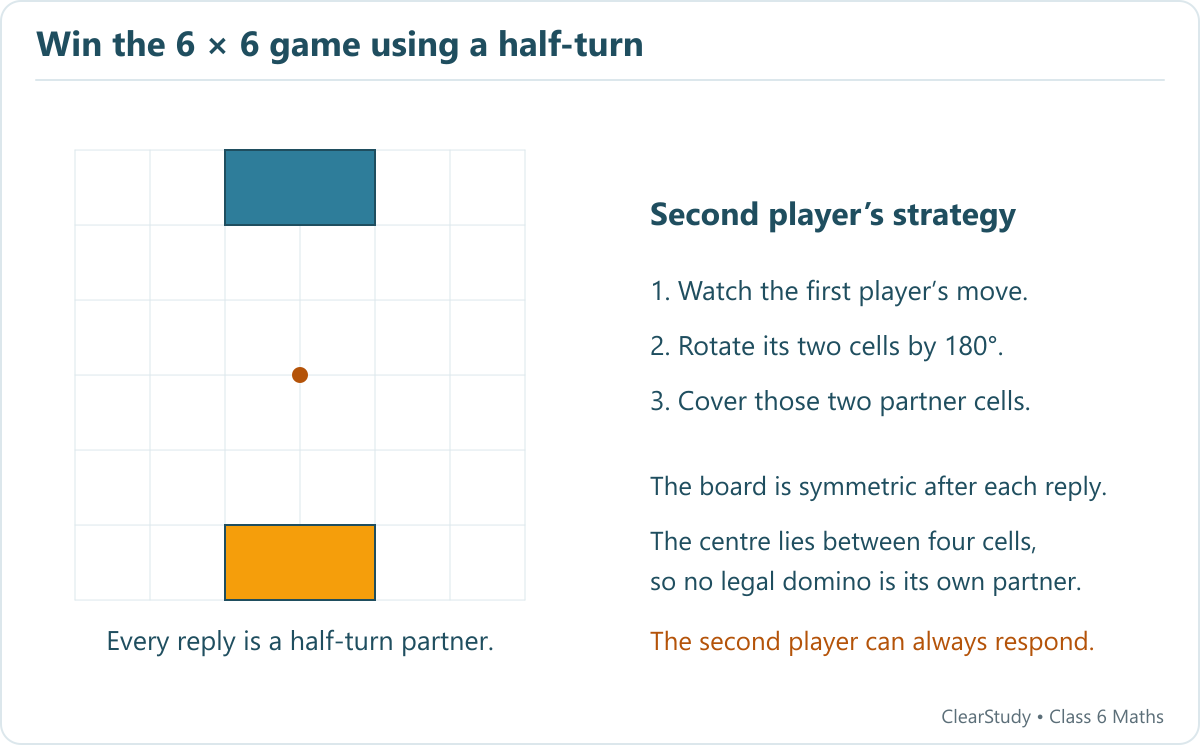
What strategy wins the two-cell covering game on a 6 × 6 board?
SOLUTIONChoose to play second. After every first-player move, cover its 180°-rotated pair of cells about the board’s centre. This works for both horizontal and vertical moves.After your reply, the occupied cells are symmetric under a half-turn. A new legal move therefore has an unused rotated partner. On an even-by-even grid no adjacent pair of cells passes through the centre in a way that makes it its own partner, so your reply is separate and legal. You can always respond; eventually the first player has no move.
Page 241: the second player mirrors every move by a 180° rotation. After each reply the occupied cells are paired, so a legal first-player move always has an unused legal partner.
Common Mistakes to Avoid
Watch out for these
Thinking a figure that “looks symmetric” must have a line of symmetry — a pinwheel/windmill has rotational symmetry but no line of symmetry.
Saying a triangle can have exactly two lines of symmetry — a triangle can only have 0, 1 or 3 lines of symmetry.
Treating a non-square rectangle’s diagonal as a line of symmetry — it is not; a non-square rectangle has only 2 lines (vertical and horizontal).
Forgetting that 360° is always an angle of symmetry, so it should be included when listing angles.
Counting 360° alone as “rotational symmetry” — a figure has rotational symmetry only if it has an angle of symmetry strictly less than 360°.
Choosing a smallest angle of symmetry that is not a factor of 360 (e.g. 17°) — the smallest whole-number angle must divide 360 exactly.
Practice MCQs & Assertion–Reason
1. A line that folds a figure into two exactly overlapping halves is called a:
(a) centre of rotation (b) line of symmetry (c) angle of symmetry (d) diameter
2. How many lines of symmetry does a square have?
(a) 1 (b) 2 (c) 4 (d) 8
3. How many lines of symmetry does an equilateral triangle have?
(a) 0 (b) 1 (c) 2 (d) 3
4. Which angle is always an angle of symmetry for every figure?
(a) 90° (b) 180° (c) 270° (d) 360°
5. The smallest angle of symmetry of a figure with 6 identical, equally-spaced radial arms is:
(a) 45° (b) 60° (c) 72° (d) 90°
6. If 60° is the smallest angle of symmetry, the order of rotational symmetry is:
(a) 3 (b) 4 (c) 6 (d) 12
7. Which of these can be the smallest angle of symmetry of a figure?
(a) 17° (b) 25° (c) 45° (d) 50°
8. How many lines of symmetry does the Ashoka Chakra have?
(a) 12 (b) 18 (c) 24 (d) 36
9. For a circle, the number of lines of symmetry (diameters) is:
(a) 0 (b) 2 (c) 4 (d) infinitely many
10. Which figure has rotational symmetry but no line of symmetry?
(a) equilateral triangle (b) square (c) parallelogram that is neither a rectangle nor a rhombus (d) non-rhombus kite
For each Assertion–Reason question, choose: (A) Both Assertion and Reason are true and the Reason is the correct explanation of the Assertion; (B) Both are true but the Reason is not the correct explanation; (C) Assertion is true but Reason is false; (D) Assertion is false but Reason is true.
A-R 1. Assertion: A square has 4 lines of symmetry.
Reason: A square can be folded along its vertical, horizontal and both diagonal lines so that the halves overlap.
A-R 2. Assertion: 360° is an angle of symmetry for every figure.
Reason: A full turn of 360° always brings a figure back to its original position.
A-R 3. Assertion: 17° can be the smallest angle of symmetry of a figure.
Reason: A whole-number smallest angle of symmetry, measured in degrees, must be a factor of 360.
A-R 4. Assertion: A non-square rectangle’s diagonal is a line of symmetry.
Reason: A non-square rectangle has exactly 2 lines of symmetry.
A-R 5. Assertion: A pinwheel (windmill) has rotational symmetry but no line of symmetry.
Reason: Rotational symmetry and reflection symmetry are independent — a figure can have one without the other.
Answer key: 1-(A), 2-(A), 3-(D), 4-(D), 5-(B).
Quick Revision Summary
A figure has symmetry when parts repeat in a definite pattern; the cloud has none.
A line of symmetry folds a figure into two exactly overlapping (mirror) halves; this is also called reflection symmetry.
A square has 4 lines of symmetry, an equilateral triangle 3, a regular hexagon 6; a regular n-gon has n lines.
A triangle can have only 0, 1 or 3 lines of symmetry — never exactly 2.
Rotational symmetry: a figure looks the same after turning by an angle of symmetry about the centre of rotation; 360° is always one.
For finite rotational order, all positive angles of symmetry are multiples of the smallest angle; the order = 360° ÷ smallest angle.
A whole-number smallest angle must be a factor of 360 (45° yes, 17° no). A circle has infinitely many lines and angles of symmetry.
How to score full marks in this chapter
For line-of-symmetry questions, mentally fold the figure and only draw a line where the two halves coincide exactly. For rotational symmetry, always start from the smallest turn that matches, then list its multiples up to 360° — and remember to include 360°. Use order = 360° ÷ smallest angle, and check that any whole-number smallest angle is a factor of 360. State the rule you use (e.g. “a regular n-gon has n lines of symmetry”) so each step earns its mark.
Frequently Asked Questions
What is Class 6 Maths Ganita Prakash Chapter 9 about?
Chapter 9, Symmetry, covers two main ideas — the line of symmetry (reflection symmetry), where a figure folds into two matching halves, and rotational symmetry, where a figure looks the same after turning about a centre of rotation. It also covers angles of symmetry, order of rotation, and the symmetries of squares, triangles, hexagons, circles and the Ashoka Chakra.
How many lines of symmetry does a square have?
A square has 4 lines of symmetry — the vertical line, the horizontal line and the two diagonals. Folding along any of these makes the two halves overlap exactly.
What is the difference between line symmetry and rotational symmetry?
Line (reflection) symmetry means a figure can be folded along a line so the two halves match. Rotational symmetry means a figure looks exactly the same after being turned by some angle (less than 360°) about a fixed centre. A figure can have one, both, or neither — a windmill has rotational symmetry but no line of symmetry.
Are these Class 6 Maths Ganita Prakash Chapter 9 solutions free?
Yes. All solutions are free and follow the official NCERT Ganita Prakash textbook for the 2026–27 session, with original worked explanations and diagrams based on the chapter.