
NCERT Solutions for Class 6 Science (Curiosity) Chapter 7: Temperature and its Measurement (NCERT 2026–27)
These Class 6 Science Curiosity Chapter 7 solutions cover Temperature and its Measurement from the new NCF textbook (2026–27). The chapter explains why our sense of touch is unreliable for judging hotness, what temperature really means, the three temperature scales (Celsius, Fahrenheit and Kelvin), and how to read clinical, laboratory and room thermometers correctly. All 14 “Let us enhance our learning” questions are answered below, with checked thermometer readings, coloured scales and worked least-count calculations.
Class 6 Science Curiosity Chapter 7 Solutions – Overview
Chapter 7 of Curiosity, Temperature and its Measurement, begins with a simple experience — we can feel that some bodies are hotter than others, but our sense of touch is not reliable for deciding exactly how hot or cold a body is. A trustworthy measure of hotness or coldness is its temperature, and the device that measures it is a thermometer. The chapter describes the clinical thermometer (used for body temperature, now mostly digital because mercury is toxic), the laboratory thermometer (range usually −10 °C to 110 °C) and the room thermometer. It introduces the three scales — Celsius (°C), Fahrenheit (°F) and Kelvin (K, the SI unit) — with the relation Kelvin = Celsius + 273.15, and stresses the correct way to read a thermometer with the eye level with the liquid column.
Key Concepts & Definitions
Temperature: a reliable measure of the hotness (or coldness) of a body. A hotter body has a higher temperature than a colder one.
Thermometer: a device used to measure temperature.
Clinical thermometer: used to measure human body temperature; modern ones are digital and run on batteries.
Laboratory thermometer: a sealed glass tube with a bulb of liquid (alcohol or mercury) and a Celsius scale; its range is usually −10 °C to 110 °C.
Temperature scales: Celsius (unit degree Celsius, °C), Fahrenheit (unit degree Fahrenheit, °F) and Kelvin (unit kelvin, K). The SI unit of temperature is the kelvin.
Key values: A commonly used normal-body reference is 37.0 °C = 98.6 °F; healthy readings vary. Kelvin = Celsius + 273.15. Absolute zero ≈ −273.15 °C (0 K).
Smallest value (least count): the smallest temperature difference a thermometer can read = (difference between two big marks) ÷ (number of divisions between them).
“Let us enhance our learning” — NCERT Solutions
Questions 1–14 follow NCERT Curiosity Chapter 7, pages 137–140. Figure-based answers have been checked against the textbook; the diagrams below are original teaching redrawings.
1. The normal temperature of a healthy human being is close to ________. (i) 98.6 °C (ii) 37.0 °C (iii) 32.0 °C (iv) 27.0 °C
2. 37 °C is the same temperature as ________. (i) 97.4 °F (ii) 97.6 °F (iii) 98.4 °F (iv) 98.6 °F
3. Fill in the blanks: (i) The hotness or coldness of a system is determined by its ________. (ii) The temperature of ice-cold water cannot be measured by a ________ thermometer. (iii) The unit of temperature is degree ________.
4. The range of a laboratory thermometer is usually ________. (i) 10 °C to 100 °C (ii) −10 °C to 110 °C (iii) 32 °C to 45 °C (iv) 35 °C to 42 °C
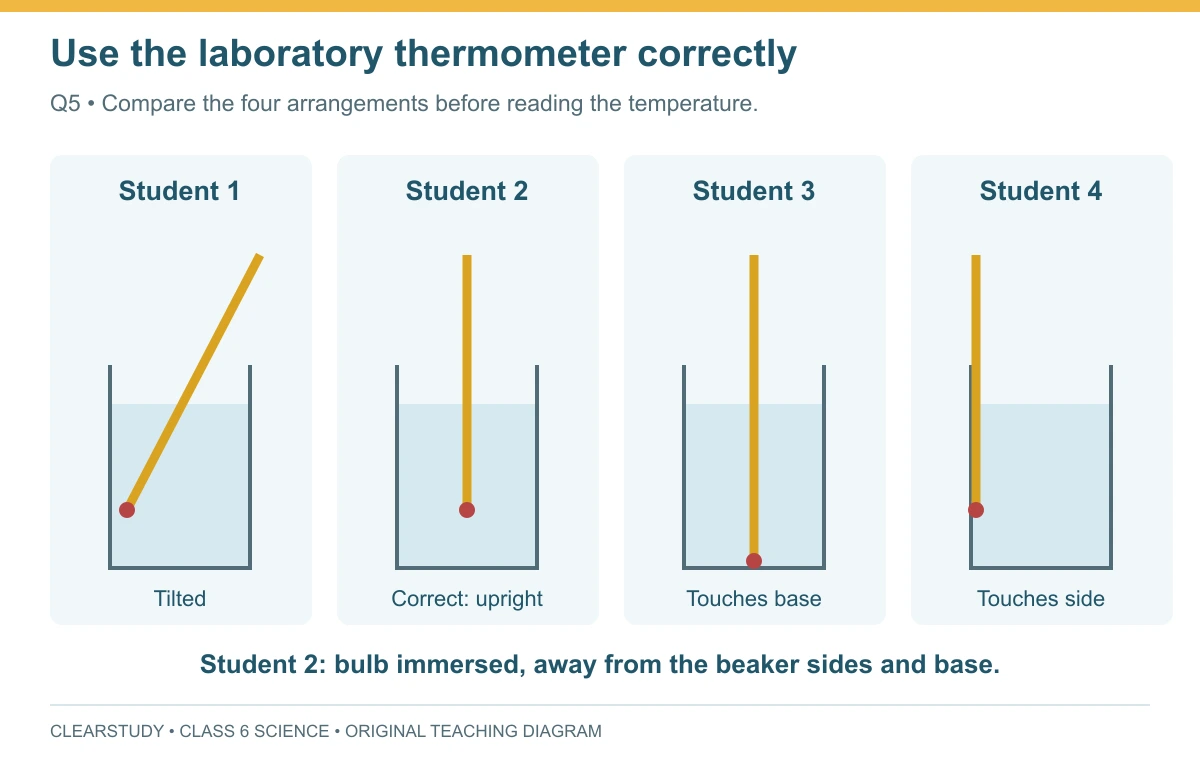
5. Four students used a laboratory thermometer to measure the temperature of water as shown in Fig. 7.6. Who do you think followed the correct way for measuring temperature? (i) Student 1 (ii) Student 2 (iii) Student 3 (iv) Student 4
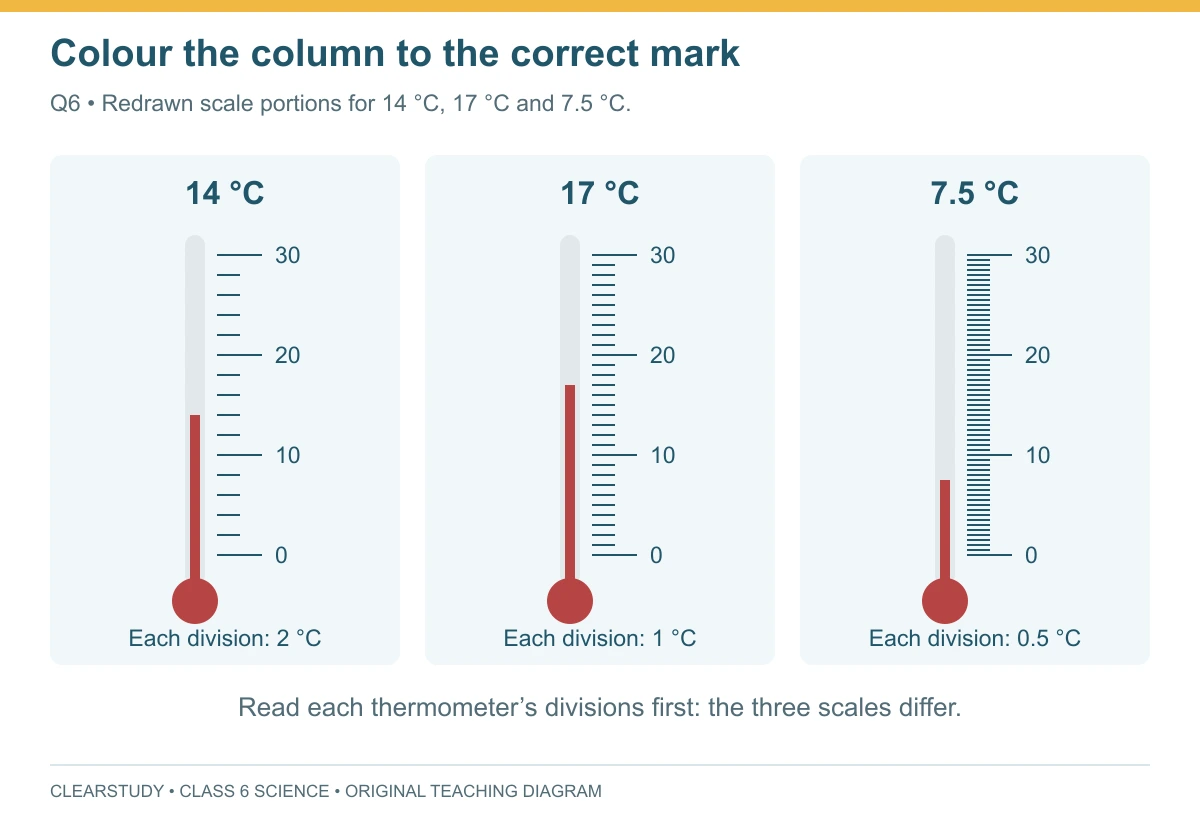
6. Colour to show the red column on the drawings of thermometers (Fig. 7.7) as per the temperatures written below: 14 °C, 17 °C, 7.5 °C.
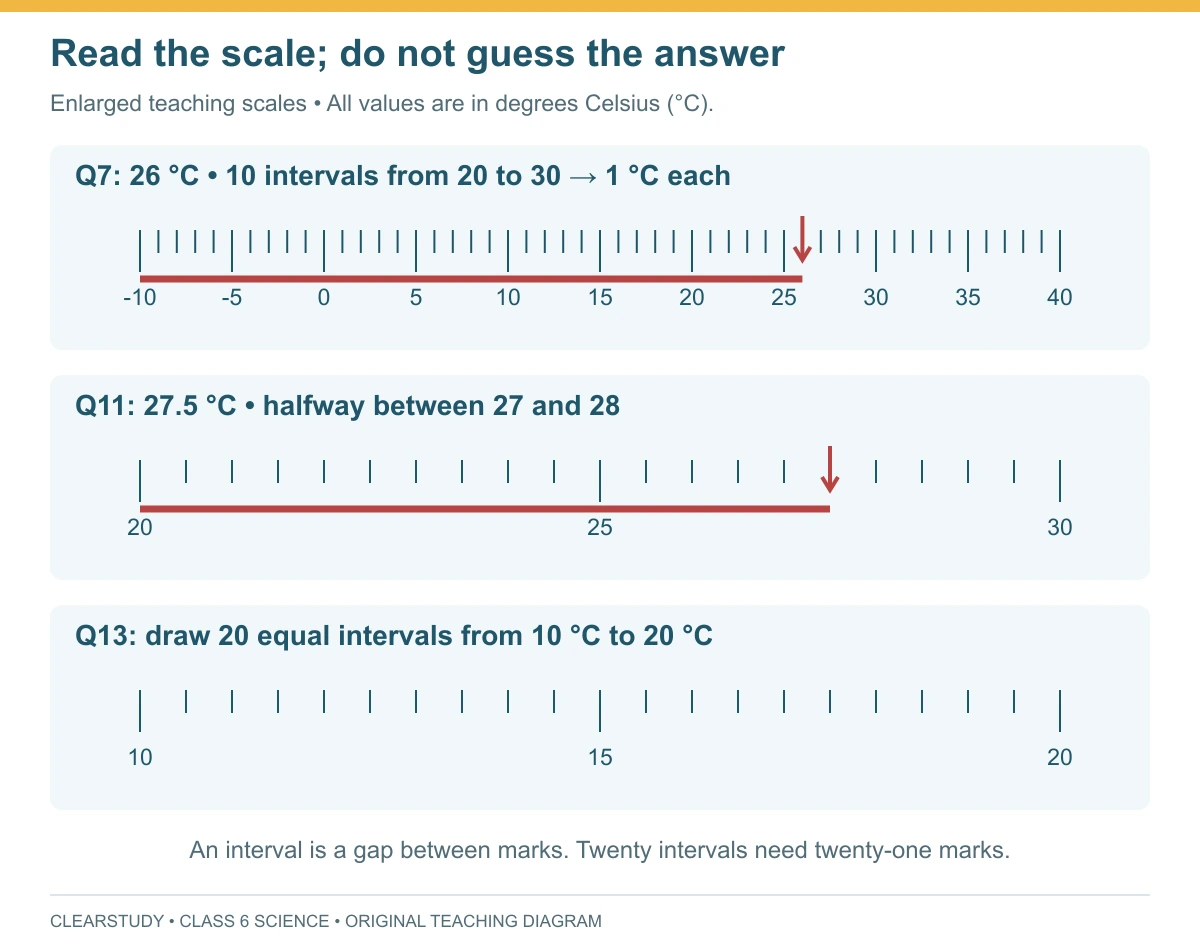
7. Observe the part of thermometer shown in Fig. 7.8 and answer the following questions: (i) What type of thermometer is it? (ii) What is the reading of the thermometer? (iii) What is the smallest value that this thermometer can measure?
8. A laboratory thermometer is not used to measure our body temperature. Give a reason.
9. Vaishnavi has not gone to school as she is ill. Her mother has kept a record of her body temperature for three days as shown in Table 7.4.
| DAY | 7 am | 10 am | 1 pm | 4 pm | 7 pm | 10 pm |
|---|---|---|---|---|---|---|
| One | 38.0 °C | 37.8 °C | 38.0 °C | 38.0 °C | 40.0 °C | 39.0 °C |
| Two | 38.6 °C | 38.8 °C | 39.0 °C | 39.0 °C | 39.0 °C | 38.0 °C |
| Three | 37.6 °C | 37.4 °C | 37.2 °C | 37.0 °C | 36.8 °C | 36.6 °C |
(i) What was Vaishnavi’s highest recorded temperature? (ii) On which day and at what time was Vaishnavi’s highest temperature recorded? (iii) On which day did Vaishnavi’s temperature return to normal?
10. If you have to measure the temperature 22.5 °C, which of the following three thermometers will you use (Fig. 7.9)? Explain.
11. The temperature shown by the thermometer in Fig. 7.10 is (i) 28.0 °C (ii) 27.5 °C (iii) 26.5 °C (iv) 25.3 °C
12. A laboratory thermometer has 50 divisions between 0 °C and 100 °C. What does each division of this thermometer measure?
13. Draw the scale of a thermometer in which the smallest division reads 0.5 °C. You may draw only the portion between 10 °C and 20 °C.
14. Komal tells you that she has a fever of 101 degrees. Does she mean it on the Celsius scale or Fahrenheit scale?
Extra Practice Questions
These questions and MCQs are ClearStudy practice, separate from the NCERT exercise.
Short Answer Type Questions
Q1. Why can we not always rely on our sense of touch to decide how hot or cold a body is?
Q2. State two precautions to be taken while using a laboratory thermometer.
Q3. Why are mercury clinical thermometers being replaced by digital ones?
Q4. Convert 27 °C into the Kelvin scale.
Q5. What is a non-contact (infrared) thermometer, and why was it useful during the COVID-19 pandemic?
Long Answer Type Questions
Q1. Describe the correct way of measuring the temperature of warm water using a laboratory thermometer.
Q2. Explain the three temperature scales and the SI unit of temperature, with the key fixed values.
Q3. Why does the normal body temperature of healthy people vary, and how is body temperature affected by various factors?
MCQs & Assertion–Reason
1. A reliable measure of how hot or cold a body is, is called its:
(a) weight (b) temperature (c) length (d) mass
2. The SI unit of temperature is:
(a) degree Celsius (b) degree Fahrenheit (c) kelvin (d) joule
3. The normal temperature of a healthy human body is:
(a) 37.0 °C (b) 27.0 °C (c) 47.0 °C (d) 100 °C
4. The usual range of a laboratory thermometer is:
(a) 35 °C to 42 °C (b) −10 °C to 110 °C (c) 0 °C to 50 °C (d) 10 °C to 100 °C
5. The liquid generally used in a laboratory thermometer is:
(a) water (b) oil (c) alcohol or mercury (d) honey
6. 37 °C on the Celsius scale is the same as:
(a) 97.4 °F (b) 98.4 °F (c) 98.6 °F (d) 100 °F
7. A thermometer that measures temperature without touching the body is a:
(a) clinical mercury thermometer (b) infrared (non-contact) thermometer (c) laboratory thermometer (d) room thermometer
8. A laboratory thermometer has 100 divisions between 0 °C and 100 °C. Each division measures:
(a) 0.5 °C (b) 1 °C (c) 2 °C (d) 10 °C
9. The temperature in Kelvin equals the temperature in Celsius:
(a) minus 273.15 (b) plus 273.15 (c) times 9/5 (d) plus 32
10. While reading a laboratory thermometer, your eye should be:
(a) above the liquid column (b) below the liquid column (c) level with the top of the liquid column (d) anywhere you like
For each Assertion–Reason question, choose: (A) Both true and the Reason correctly explains the Assertion; (B) Both true but the Reason is not the correct explanation; (C) Assertion true, Reason false; (D) Assertion false, Reason true.
A-R 1. Assertion: Our sense of touch cannot always tell correctly how hot or cold a body is.
Reason: The same water can feel warm to one hand and cool to the other depending on what each hand touched before.
A-R 2. Assertion: A clinical thermometer cannot be used to measure the temperature of boiling water.
Reason: The temperature of boiling water lies outside the range of a clinical thermometer.
A-R 3. Assertion: The bulb of a laboratory thermometer should touch the bottom of the beaker while measuring.
Reason: The bulb should measure the water itself without touching the beaker’s bottom or sides.
A-R 4. Assertion: Mercury thermometers are being replaced by digital thermometers.
Reason: Mercury is highly toxic and hard to dispose of if the thermometer breaks.
A-R 5. Assertion: The kelvin is the SI unit of temperature.
Reason: The Kelvin scale is named in honour of the scientist who developed it.
Quick Revision Summary
- Temperature is a reliable measure of how hot or cold a body is; our sense of touch is not reliable.
- A thermometer measures temperature: clinical (body), laboratory (general use) and room thermometers.
- Three scales: Celsius (°C), Fahrenheit (°F) and Kelvin (K); the SI unit is the kelvin.
- Normal body temperature = 37.0 °C = 98.6 °F; healthy readings vary; 35–42 °C is not a healthy normal range.
- Kelvin = Celsius + 273.15; absolute zero ≈ −273.15 °C = 0 K.
- Laboratory thermometer range is usually −10 °C to 110 °C; smallest value = (gap between big marks) ÷ (number of divisions).
- Read with the thermometer vertical, bulb immersed (not touching the beaker), eye level with the column.
Common Mistakes to Avoid
Watch out for these
- Writing 98.6 °C for normal body temperature — 98.6 is the Fahrenheit value; in Celsius it is 37.0 °C.
- Using a clinical thermometer for ice or boiling water — those temperatures are outside its range.
- Letting the bulb touch the bottom or sides of the beaker, or reading after taking the thermometer out of the water.
- Writing a degree sign with kelvin (°K) — the correct symbol is just K, with no degree sign.
- Forgetting the 0.5 °C step — the smallest value depends on the divisions, so read it from the scale, not by guessing.
- Reading the column with the eye too high or too low instead of level with the liquid surface.
How to write a clear answer
Memorise the key numbers exactly: 37.0 °C = 98.6 °F, laboratory range −10 °C to 110 °C, and Kelvin = Celsius + 273.15. For “smallest value” questions, always show the division: (difference between big marks) ÷ (number of small divisions). In reasoning questions (like the 101-degree one), back your answer with a fact — the human body never reaches 101 °C because it lies above boiling water. Always state units and never put a degree sign before K.
Frequently Asked Questions
What is Class 6 Science Curiosity Chapter 7 about?
Chapter 7, Temperature and its Measurement, explains that temperature is a reliable measure of hotness or coldness (unlike our sense of touch), introduces clinical, laboratory and room thermometers, and covers the Celsius, Fahrenheit and Kelvin scales, with normal body temperature being 37.0 °C (98.6 °F).
What is the normal temperature of a healthy human body?
The normal temperature of a healthy human adult is taken to be 37.0 °C on the Celsius scale, which is the same as 98.6 °F on the Fahrenheit scale. It is an average value, so a healthy person may be slightly higher or lower.
What is the SI unit of temperature?
The SI unit of temperature is the kelvin (K). We convert a Celsius temperature to kelvin using: Temperature in Kelvin = Temperature in Celsius + 273.15. Note that no degree sign is written with K.
Are these Class 6 Science Curiosity Chapter 7 solutions free?
Yes. All solutions are free and follow the official NCERT Curiosity (Grade 6) textbook for the 2026–27 session.
Sources: NCERT Curiosity Chapter 7 (official PDF); MedlinePlus body temperature norms. Use these as school explanations, not a diagnosis from a temperature reading alone.