
NCERT Solutions for Class 6 Science (Curiosity) Chapter 6: Materials Around Us (2026–27)
These Class 6 Science Curiosity Chapter 6 solutions cover Materials Around Us from the new NCF-2023 textbook (2026–27). The chapter teaches you what a material is, how objects are made from one or more materials, and how we classify materials by their properties — lustre, hardness, transparency, solubility, mass and volume — finally building up to the idea of matter. All 10 “Let us enhance our learning” questions are answered, with examples, reasons and a transparency comparison diagram.
Class 6 Science Curiosity Chapter 6 Solutions – Overview
Everything around us — a notebook, a pen, a tumbler, a brick — is made from some material such as paper, wood, cloth, glass, metal, plastic or clay. The chapter shows that a single object can be made from different materials and a single material can be used to make many objects, so we choose a material based on its properties and the purpose of the object. We learn to classify materials by appearance (lustrous or non-lustrous), by feel (hard or soft), by how much we can see through them (transparent, translucent, opaque), and by whether they dissolve in water (soluble or insoluble). Finally we meet two properties shared by all materials — mass (quantity of matter, measured in g and kg) and volume (space occupied, measured in L and mL) — which together define matter: anything that occupies space and has mass.
Key Concepts & Definitions
Material: any substance that is used to create an object — for example paper, wood, glass, metal, plastic or clay.
Classification: the method of arranging objects (or materials) into groups on the basis of a common property they share.
Lustrous and non-lustrous: materials with a shiny surface (usually metals such as iron, copper, gold) are lustrous; those without a shiny surface (paper, wood, rubber, jute) are non-lustrous.
Hard and soft: materials that are difficult to compress or scratch are hard; those that can be compressed or scratched easily are soft. These properties are relative — rubber is harder than sponge but softer than iron.
Transparent, translucent, opaque: through transparent materials (glass, water, air) things can be seen clearly; through translucent materials (butter paper, frosted glass) things are seen but not clearly; through opaque materials (wood, cardboard, metals) nothing can be seen.
Soluble and insoluble: materials such as sugar and salt are soluble in water: they dissolve to form a solution, although they are still present. Materials such as sand and sawdust do not dissolve. Spreading through water is not the same as dissolving.
Mass and volume: mass is the quantity of matter in an object (units: g, kg); volume is the space it occupies (units: L, mL; SI unit m3, where 1 m3 = 1000 L).
Matter: anything that occupies space and has mass. All materials around us — water, sand, pebbles, even air — are examples of matter.
“Let us enhance our learning” — NCERT Solutions
Questions 1–10 follow NCERT Curiosity Chapter 6, pages 119–121. Answers and the diagram are original ClearStudy teaching aids.
1. Visit your kitchen and observe how your parents have organised various edibles. Can you suggest a better sorting method? Write it in your notebook.
2. Unscramble the letters (Column I) and match with their properties (Column II).
| Column I (scrambled) | Unscrambled word | Matching property (Column II) |
|---|---|---|
| (i) T R E M A T | MATTER | (b) Occupies space and has mass |
| (ii) U L S B E L O | SOLUBLE | (d) Mixes completely in water |
| (iii) T N E R P A S N A R T | TRANSPARENT | (a) Objects can be seen clearly through it |
| (iv) E R U S T L | LUSTRE | (c) Shiny surface |
3. The containers which are used to store materials in shops and at home are usually transparent. Give your reasons for this.
4. State whether the statements given below are True [T] or False [F]. Correct the False statement(s).
(i) Wood is translucent while glass is opaque.(ii) Aluminium foil has lustre while an eraser does not.(iii) Sugar dissolves in water whereas sawdust does not.(iv) An apple is a matter because it occupies no space and has mass.
5. We see chairs made up of various materials, such as wood, iron, plastic, bamboo, cement and stones. Following are some desirable properties of materials which can be used to make chairs. Which materials used to make chairs fulfil these properties the most?
(i) Hardness (does not bend or shake on sitting even after long use).(ii) Lightweight (easy to lift or to take from one place to another).(iii) Does not feel very cold when sitting during winters.(iv) Can be cleaned regularly and made to look new even after long use.
6. You need to have containers for collection of: (i) food waste, (ii) broken glass and (iii) wastepaper. Which materials will you choose for containers of these types of waste? What properties of materials do you need to think of?
7. Air is all around us but does not hinder us from seeing each other. Whereas, if a wooden door comes in between, we cannot see each other. It is because air is ______ and the wooden door is ______. Choose the most appropriate option:
(i) transparent, opaque(ii) translucent, transparent(iii) opaque, translucent(iv) transparent, translucent
8. Imagine you have two mysterious materials, X and Y. When you try to press material X, it feels rigid and does not change its shape easily. On the other hand, material Y easily changes its shape when you press it. Now, when you mix both materials in water, only material X dissolves completely, while material Y remains unchanged. What can materials X and Y be? Can you identify whether material X is hard or soft? What about material Y? Justify your answer.
9. (i) Who am I? Identify me on the basis of the given properties.
(a) I have lustre.(b) I can be easily compressed.(c) I am hard and soluble in water.(d) You cannot see clearly through me.(e) I have mass and volume but you cannot see me.
(ii) Make your own ‘Who am I?’
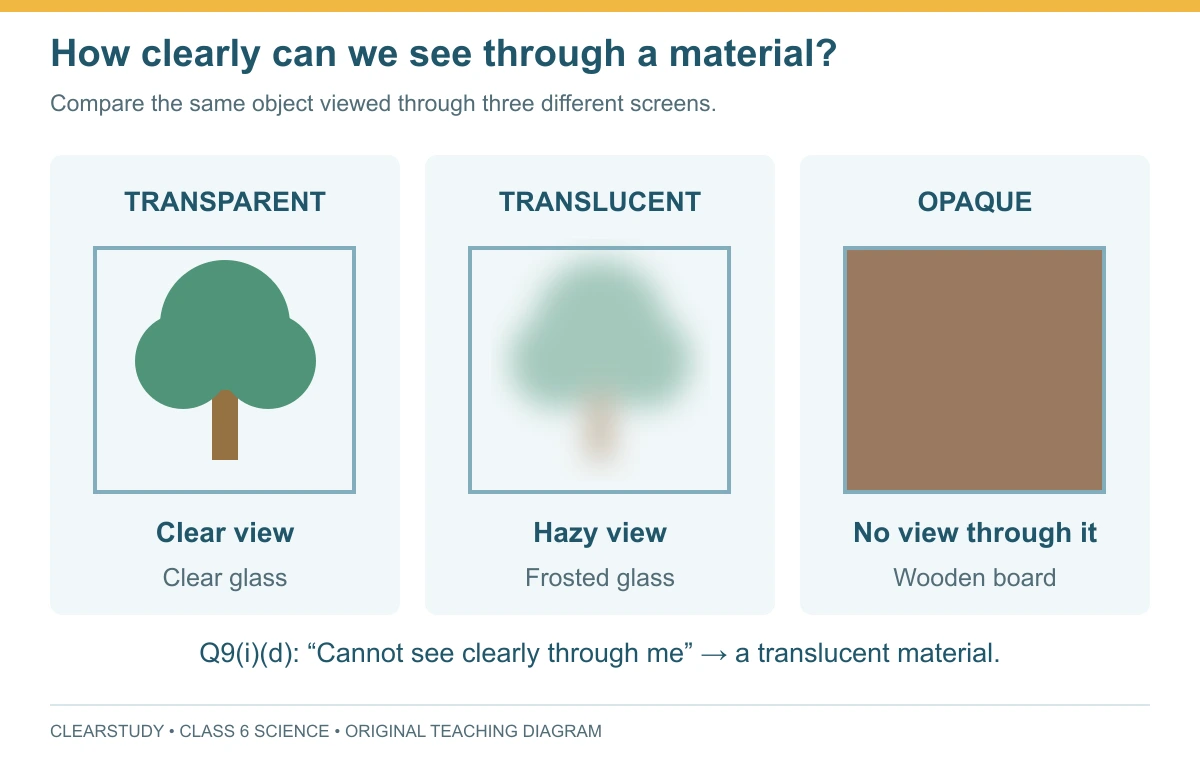
10. You are provided with the following materials—vinegar, honey, mustard oil, water, glucose and wheat flour. Make any two pairs of materials where one material is soluble in the other. Now, make two pairs of materials where one material remains insoluble in the other material.
Common Mistakes to Avoid
Watch out for these
- Confusing object and material — a chair is an object; the wood or iron it is made from is the material.
- Thinking all shiny things are metals — “all that glitters is not gold”; plastic or waxed surfaces can shine too without being metals.
- Mixing up translucent and transparent — through translucent materials (butter paper, frosted glass) you see something but not clearly; through transparent ones you see clearly.
- Believing a material that spreads out in water has dissolved — chalk powder and flour make the water cloudy but stay insoluble and settle down.
- Saying air is not matter — air is invisible but has mass and occupies space, so it is matter.
- Writing units wrongly — it is 7 kg (not “7 kgs”), and 500 mL (small m, capital L), with a space between number and unit.
Extra Practice Questions
These questions and MCQs are ClearStudy practice, separate from the NCERT exercise.
Short Answer Type Questions
Q1. What is a material? Give two examples.
Q2. Define classification. Why is it useful?
Q3. Differentiate between transparent and opaque materials with one example each.
Q4. Name two soluble and two insoluble materials in water.
Q5. Why does a tumbler made of cloth not work for storing water?
Long Answer Type Questions
Q1. Explain, with examples, why different materials are chosen to make different objects.
Q2. What is matter? Explain how mass and volume are linked to matter, with their units.
Q3. Describe an activity to find out which materials are soluble in water and which are not.
MCQs & Assertion–Reason
1. Any substance that is used to create an object is called a:
(a) machine (b) material (c) mixture (d) metal
2. The method of arranging objects into groups is called:
(a) classification (b) observation (c) prediction (d) measurement
3. Which of the following is a lustrous material?
(a) paper (b) wood (c) copper (d) rubber
4. Through which of these materials can things be seen clearly?
(a) cardboard (b) frosted glass (c) clear glass (d) wood
5. Butter paper and frosted glass are examples of materials that are:
(a) transparent (b) translucent (c) opaque (d) lustrous
6. Which of the following is insoluble in water?
(a) sugar (b) salt (c) glucose (d) sand
7. The space occupied by a material is called its:
(a) mass (b) volume (c) lustre (d) hardness
8. The units used to measure mass are:
(a) litre and millilitre (b) metre and centimetre (c) gram and kilogram (d) second and minute
9. Anything that occupies space and has mass is called:
(a) material (b) matter (c) object (d) liquid
10. Which statement is correct?
(a) all shiny materials are metals (b) rubber is harder than iron (c) rubber is harder than sponge but softer than iron (d) wood is transparent
For each Assertion–Reason question, choose: (A) Both true and the Reason correctly explains the Assertion; (B) Both true but the Reason is not the correct explanation; (C) Assertion true, Reason false; (D) Assertion false, Reason true.
A-R 1. Assertion: Metals such as iron and copper usually appear shiny.
Reason: Lustrous materials have a shiny surface and most metals are lustrous.
A-R 2. Assertion: We cannot see through a wooden door.
Reason: Wood is an opaque material.
A-R 3. Assertion: Sand is soluble in water.
Reason: Materials that settle down and do not disappear in water are insoluble.
A-R 4. Assertion: Air is matter.
Reason: Air has mass and occupies space even though we cannot see it.
A-R 5. Assertion: A tumbler can be made of cloth to store water for a long time.
Reason: The material used to make a tumbler should be capable of holding water.
Quick Revision Summary
- A material is any substance used to make an object; one object can use many materials and one material can make many objects.
- We choose a material from its properties and the object’s purpose; arranging things into groups by a common property is classification.
- By appearance: lustrous (shiny, usually metals) vs non-lustrous; by feel: hard vs soft (relative properties).
- By how much we see through them: transparent (clear), translucent (hazy), opaque (none).
- By behaviour in water: soluble (dissolves, e.g. sugar, salt) vs insoluble (does not, e.g. sand, chalk powder).
- Mass (g, kg) and volume (L, mL; SI m3, 1 m3 = 1000 L) are shared by all materials.
- Matter = anything that occupies space and has mass; even air is matter.
Real-life Applications
Choosing materials by their properties is something we do every day. Shops and kitchens use transparent jars so we can see and check what is inside; raincoats and water bottles use insoluble, waterproof plastics; sports balls are made of different materials so each gives the right bounce; winter chairs are made of wood or plastic because they do not feel as cold as metal; and waste is separated into different bins (food waste, broken glass, paper) using containers whose strength and water-resistance suit the waste. Even the labels “500 mL” or “1 L” on bottles and “kg” on packets show how the ideas of volume and mass from this chapter are used in real life.
How to write a clear answer
Always separate the object from the material it is made of, and learn the property-pairs cleanly: lustrous/non-lustrous, hard/soft, transparent–translucent–opaque, soluble/insoluble. For “True/False” questions, do not just write F — rewrite the corrected statement. Remember air is matter, and write units correctly (7 kg, 500 mL) with a space between number and unit. Back up each answer with a clear example from the chapter (sugar dissolves, sand does not; wood is opaque, glass is transparent).
Frequently Asked Questions
What is Class 6 Science Curiosity Chapter 6 about?
Chapter 6, Materials Around Us, explains what a material is and how we classify materials by their properties — lustre, hardness, transparency and solubility — and introduces mass, volume and the idea of matter (anything that occupies space and has mass).
What is the difference between transparent, translucent and opaque materials?
Through transparent materials (glass, water, air) we can see clearly; through translucent materials (butter paper, frosted glass) we can see but not clearly; through opaque materials (wood, cardboard, metals) we cannot see at all.
Is air considered matter in this chapter?
Yes. Air has mass and occupies space, even though we cannot see it, so air is matter. Anything that occupies space and has mass is called matter.
Are these Class 6 Science Curiosity Chapter 6 solutions free?
Yes. All solutions are free and follow the official NCERT Curiosity textbook for 2026–27.