
NCERT Solutions for Class 6 Science (Curiosity) Chapter 5: Measurement of Length and Motion
These Class 6 Science Curiosity Chapter 5 solutions cover Measurement of Length and Motion from the new NCF textbook (2026–27). The chapter explains why we need standard units, how to use the SI unit of length (metre) correctly, how to measure straight and curved lines, the idea of a reference point, and the three basic types of motion — linear, circular and oscillatory. All 13 “Let us enhance our learning” questions are answered, with worked unit conversions, activity guidance and labelled teaching diagrams.
Class 6 Science Curiosity Chapter 5 Solutions – Overview
Chapter 5 of Curiosity, Measurement of Length and Motion, follows Deepa and her friends as they try to measure the length of their classroom table using handspans. Because everyone’s handspan is a different size, they get different numbers — showing why the world needs standard units. The chapter introduces the International System of Units (SI), whose unit of length is the metre (m), along with the kilometre, centimetre and millimetre and the relations between them. It teaches the correct way to use a scale (contact, eye position, broken-end method), how to measure a curved line with a thread, the idea of a reference point for describing position, and how an object is in motion or at rest relative to that point. Finally it classifies motion as linear, circular and oscillatory.
Key Concepts & Definitions
Measurement: comparing an unknown length with a known fixed quantity called a unit. Every measurement has two parts — a number and a unit (e.g. 13 handspans).
Why standard units: body parts like handspan, foot and finger differ from person to person, so the same length gives different readings. A standard unit has the same agreed size for everyone. Small reading differences can still arise from the instrument or measurement method.
SI unit of length: the metre (m) is the SI unit of length. Useful relations: 1 km = 1000 m, 1 m = 100 cm, 1 cm = 10 mm (and 1 mm = 0.1 cm).
Choosing a scale: use a 15-cm scale for small objects (pencil, eraser), a metre scale or measuring tape for a room, and a flexible tape or thread for curved lengths (girth of a tree, chest).
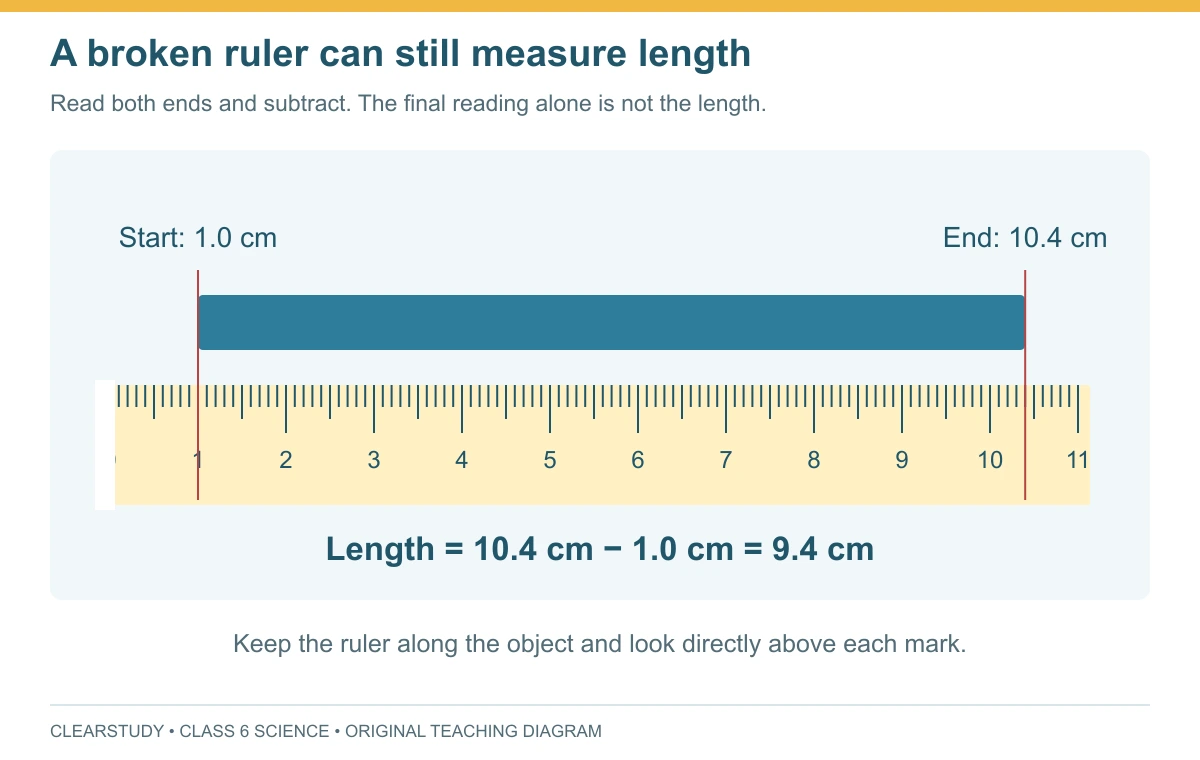
Correct way to measure: place the scale in contact along the object; keep the eye directly above the mark; if the zero end is broken, use any full mark and subtract its reading from the reading at the other end.
Reference point: a fixed object or point with respect to which the position (distance) of another object is stated — e.g. a kilometre stone gives your distance from a city.
Motion and rest: an object is in motion if its position changes with respect to a reference point with time; it is at rest if its position does not change.
Types of motion: Linear (along a straight line), Circular (along a circular path), and Oscillatory (to and fro about a fixed position). Circular or oscillatory motion is periodic when the motion repeats at equal time intervals, as in an ideal steadily turning wheel or regularly swinging pendulum.
Let us enhance our learning — NCERT Solutions
Questions 1–13 follow NCERT Curiosity Chapter 5, pages 97–99. Answers and diagrams are original ClearStudy teaching aids. Activity measurements are examples, not observations to copy.
1. Some lengths are given in Column I of Table 5.5. Some units are given in Column II. Match the lengths with the units suitable for measuring those lengths.
| Column I | Column II |
|---|---|
| Distance between Delhi and Lucknow | centimetre |
| Thickness of a coin | kilometre |
| Length of an eraser | metre |
| Length of school ground | millimetre |
| Column I (length) | Suitable unit |
|---|---|
| Distance between Delhi and Lucknow | kilometre (km) |
| Thickness of a coin | millimetre (mm) |
| Length of an eraser | centimetre (cm) |
| Length of school ground | metre (m) |
2. Read the following statements and mark True (T) or False (F) against each. (i) The motion of a car moving on a straight road is an example of linear motion. (ii) Any object which is changing its position with respect to a reference point with time is said to be in motion. (iii) 1 km = 100 cm
3. Which of the following is not a standard unit of measuring length? (i) millimetre (ii) centimetre (iii) kilometre (iv) handspan
4. Search for the different scales or measuring tapes at your home and school. Find out the smallest value that can be measured using each of these scales. Record your observations in a tabular form.
| Measuring device | Smallest value that can be measured |
|---|---|
| 15-cm geometry-box scale | 1 mm (0.1 cm) |
| Metre scale | 1 mm |
| Tailor’s measuring tape | 1 mm (0.1 cm) |
| Long steel measuring tape | 1 mm |
5. Suppose the distance between your school and home is 1.5 km. Express it in metres.
6. Take a tumbler or a bottle. Measure the length of the curved part of the base of glass or bottle and record it.
7. Measure the height of your friend and express it in (i) metres (ii) centimetres and (iii) millimetres.
8. You are given a coin. Estimate how many coins are required to be placed one after the other lengthwise, without leaving any gap between them, to cover the whole length of the chosen side of a notebook. Verify your estimate by measuring the same side of the notebook and the size of the coin using a 15-cm scale.
9. Give two examples each for linear, circular and oscillatory motion.
10. Observe different objects around you. It is easier to express the lengths of some objects in mm, some in cm and some in m. Make a list of three objects in each category and enter them in the Table 5.6.
| Size | Objects |
|---|---|
| mm | Thickness of a coin, thickness of an eraser, length of an ant |
| cm | Length of a pencil, length of a notebook, length of a spoon |
| m | Height of a door, length of a classroom, height of a person |
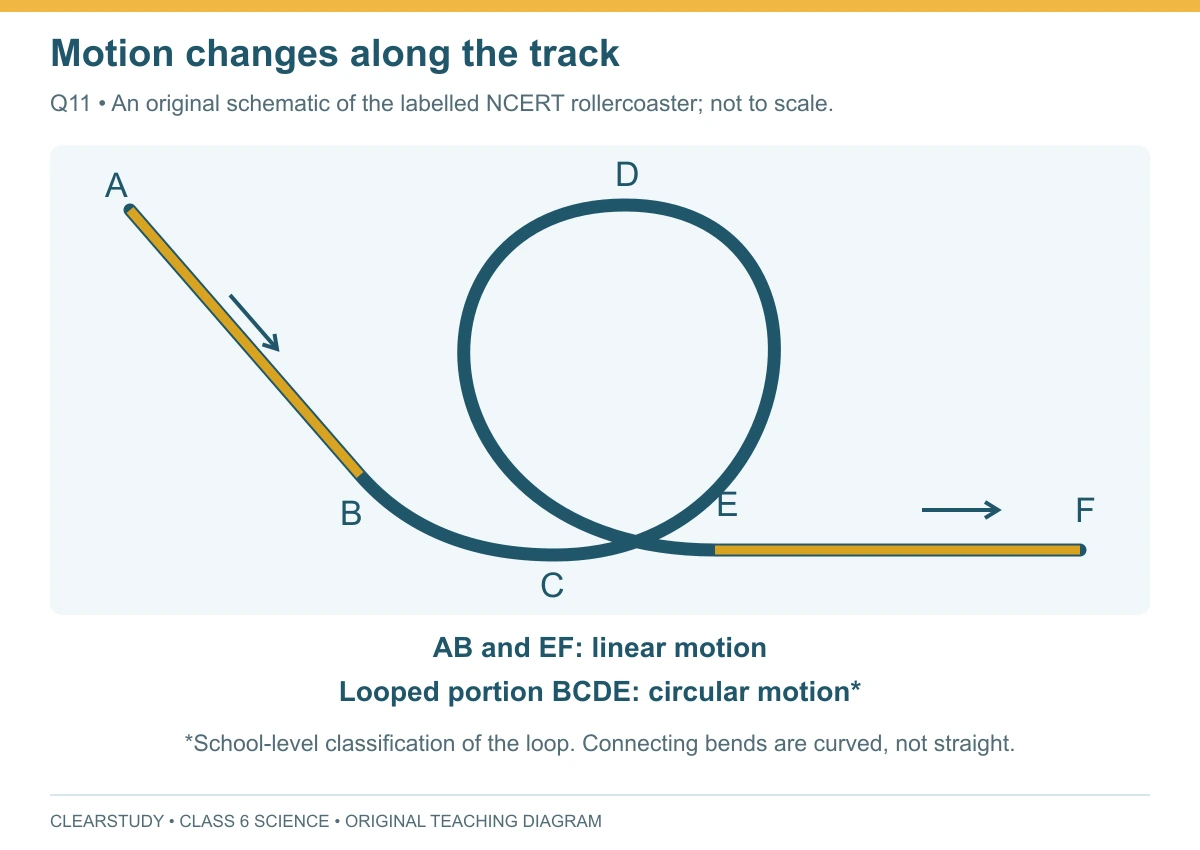
11. A rollercoaster track is made in the shape shown in Fig. 5.19. A ball starts from point A and escapes through point F. Identify the types of motion of the ball on the rollercoaster and corresponding portions of the track.
12. Tasneem wants to make a metre scale by herself. She considers the following materials for it—plywood, paper, cloth, stretchable rubber and steel. Which of these should she not use and why?
13. Think, design and develop a card game on conversion of units of length to play with your friends.
Common Mistakes to Avoid
Watch out for these
- Writing a measurement as just a number — always include the unit (e.g. write “1500 m”, not “1500”).
- Mixing up conversions — remember 1 km = 1000 m, 1 m = 100 cm, 1 cm = 10 mm (so 1 km = 1,00,000 cm).
- Reading a scale with the eye at an angle — keep the eye directly above the mark, or the reading is wrong (parallax error).
- Starting measurement from the broken/worn zero end — use a clear full mark and subtract it from the reading at the other end.
- Treating a handspan, foot or finger as a standard unit — they differ from person to person.
- Confusing rest and motion — always state motion or rest with respect to a reference point.
- Calling oscillatory motion “circular” — a swing or pendulum moves to and fro, not round and round.
Extra Practice Questions
These questions and MCQs are ClearStudy practice, separate from the NCERT exercise.
Short Answer Type Questions
Q1. What is the SI unit of length and what is its symbol?
Q2. Why do we need standard units of measurement?
Q3. What is a reference point?
Q4. How do you measure the length of a curved line?
Q5. Convert 250 cm into metres.
Long Answer Type Questions
Q1. When the friends measured the table with their handspans, they got different numbers. Explain why this happened and what it teaches us.
Q2. Explain linear, circular and oscillatory motion with one example each, and state which of them are periodic.
Q3. Padma sees kilometre stones reading “Delhi 70 km” and then “Delhi 60 km”. Explain, using the idea of reference point and motion, what this tells us.
MCQs & Assertion–Reason
1. The SI unit of length is:
(a) centimetre (b) metre (c) kilometre (d) handspan
2. Which of the following is correct?
(a) 1 m = 10 cm (b) 1 km = 100 m (c) 1 cm = 10 mm (d) 1 cm = 100 mm
3. 2.5 km is equal to:
(a) 250 m (b) 2500 m (c) 25 m (d) 25000 m
4. A handspan is not a standard unit because:
(a) it is too small (b) it cannot measure cloth (c) it differs from person to person (d) it is too large
5. The correct position of the eye while reading a scale is:
(a) to the left of the mark (b) to the right of the mark (c) directly above the mark (d) far away from the scale
6. To measure the girth of a tree, the most suitable device is a:
(a) metre scale (b) 15-cm scale (c) flexible measuring tape (d) wooden rod
7. A swing moving to and fro is an example of:
(a) linear motion (b) circular motion (c) oscillatory motion (d) no motion
8. An object is said to be in motion if, with time, its position with respect to a reference point:
(a) stays the same (b) changes (c) disappears (d) doubles
9. Using a scale with a broken zero end, the length of an object reading from 1.0 cm to 10.4 cm is:
(a) 10.4 cm (b) 11.4 cm (c) 9.4 cm (d) 1.0 cm
10. Which pair can show periodic motion when repeated at equal time intervals?
(a) linear and circular (b) circular and oscillatory (c) linear and oscillatory (d) only linear
For each Assertion–Reason question, choose: (A) Both true and the Reason correctly explains the Assertion; (B) Both true but the Reason is not the correct explanation; (C) Assertion true, Reason false; (D) Assertion false, Reason true.
A-R 1. Assertion: Standard units like the metre are needed for measuring length.
Reason: Body-based units such as handspan differ from person to person.
A-R 2. Assertion: A swing shows circular motion.
Reason: A swing moves to and fro about a fixed position.
A-R 3. Assertion: Whether an object is at rest or in motion depends on the reference point chosen.
Reason: An object is in motion only if its position changes with respect to a reference point with time.
A-R 4. Assertion: 1 km is equal to 100 cm.
Reason: 1 km = 1000 m and 1 m = 100 cm.
A-R 5. Assertion: A flexible measuring tape or a thread is used to measure a curved line.
Reason: A rigid metre scale cannot bend to follow a curved path.
Quick Revision Summary
- A measurement has two parts: a number and a unit.
- Body parts are not standard units; the SI unit of length is the metre (m).
- 1 km = 1000 m, 1 m = 100 cm, 1 cm = 10 mm (and 1 mm = 0.1 cm).
- Measure correctly: scale in contact, eye directly above the mark; for a broken end, subtract the start reading from the end reading.
- Measure curved lines with a thread or flexible tape.
- A reference point is a fixed point used to state position; an object is in motion if its position changes with respect to it with time, else at rest.
- Types of motion: linear (straight line), circular (circular path), oscillatory (to and fro). Regular circular and oscillatory motions are periodic when they repeat at equal time intervals.
How to write a clear answer
Learn the conversion chain km → m → cm → mm by heart and always write the unit with the number. In motion questions, never forget to mention the reference point. For “type of motion” questions, match the path to the right word — straight line = linear, circular path = circular, to-and-fro = oscillatory — and check whether the motion repeats at equal time intervals before calling it periodic. For measuring questions, mention correct scale placement, eye position and the broken-end (subtraction) method to explain your method clearly.
Frequently Asked Questions
What is Class 6 Science Curiosity Chapter 5 about?
Chapter 5, Measurement of Length and Motion, explains why we need standard units, the SI unit of length (the metre) and its conversions, the correct way to use a scale, how to measure curved lines, the idea of a reference point, and the three types of motion — linear, circular and oscillatory.
What is the SI unit of length and the main conversions?
The SI unit of length is the metre (m). The key conversions are 1 km = 1000 m, 1 m = 100 cm and 1 cm = 10 mm (so 1 mm = 0.1 cm).
What are the three types of motion in this chapter?
Linear motion (along a straight line), circular motion (along a circular path) and oscillatory motion (to and fro about a fixed position). Regular circular and oscillatory motion are periodic when the motion repeats at equal time intervals.
Are these Class 6 Science Curiosity Chapter 5 solutions free?
Yes. All solutions are free and follow the official NCERT Curiosity textbook for session 2026–27.
Source: NCERT Curiosity Chapter 5 (official PDF). Diagrams are schematic teaching aids; use a real ruler for measurements.