
NCERT Solutions for Class 6 Science (Curiosity) Chapter 8: A Journey through States of Water
These Class 6 Science Curiosity Chapter 8 solutions cover A Journey through States of Water from the new NCF textbook (2026–27). The chapter follows Aavi and Thirav as they discover that ice, water and water vapour are simply three states of the same substance. You will learn about evaporation, condensation, melting, freezing, the cooling effect, clouds, rain and the water cycle — with every “Let us enhance our learning” question solved step by step.
Class 6 Science Curiosity Chapter 8 Solutions – Overview
Chapter 8 of Curiosity, A Journey through States of Water, shows that water is one substance that can exist in three states — solid (ice), liquid (water) and gas (water vapour). Through simple activities, Aavi and Thirav explore why puddles dry up and why water on a steel plate disappears (evaporation), why droplets form on the outside of a glass of cold water (condensation), and how heating and cooling change one state into another (melting and freezing). They learn that evaporation is faster with larger exposed area, more air movement and less humidity, and that evaporation causes a cooling effect — the reason a matka keeps water cold. Finally, condensation in the sky forms clouds that bring rain, completing the water cycle that circulates water between the Earth’s surface and the atmosphere.
Key Concepts & Definitions
States of water: water exists in three states — solid (ice), liquid (water) and gaseous (water vapour). They are different forms of the same substance.
Evaporation: the process of conversion of water into its vapour state. It takes place continuously, even at room temperature (e.g. drying of wet clothes, a mopped floor and sweat).
Condensation: the process of conversion of water vapour into its liquid state, which happens when water vapour in the air meets a cold surface (e.g. droplets on a cold glass, dew drops).
Melting: the process of conversion of a solid into the liquid state, such as ice changing into water on heating.
Freezing: the process of conversion of a liquid into the solid state, such as water turning into ice in a freezer.
Humidity: the amount of water vapour present in the air. Rainy days are more humid.
Cooling effect: evaporation takes away heat and so cools the surroundings — the reason an earthen pot (matka) keeps water cold and a fan makes sweat feel cooling.
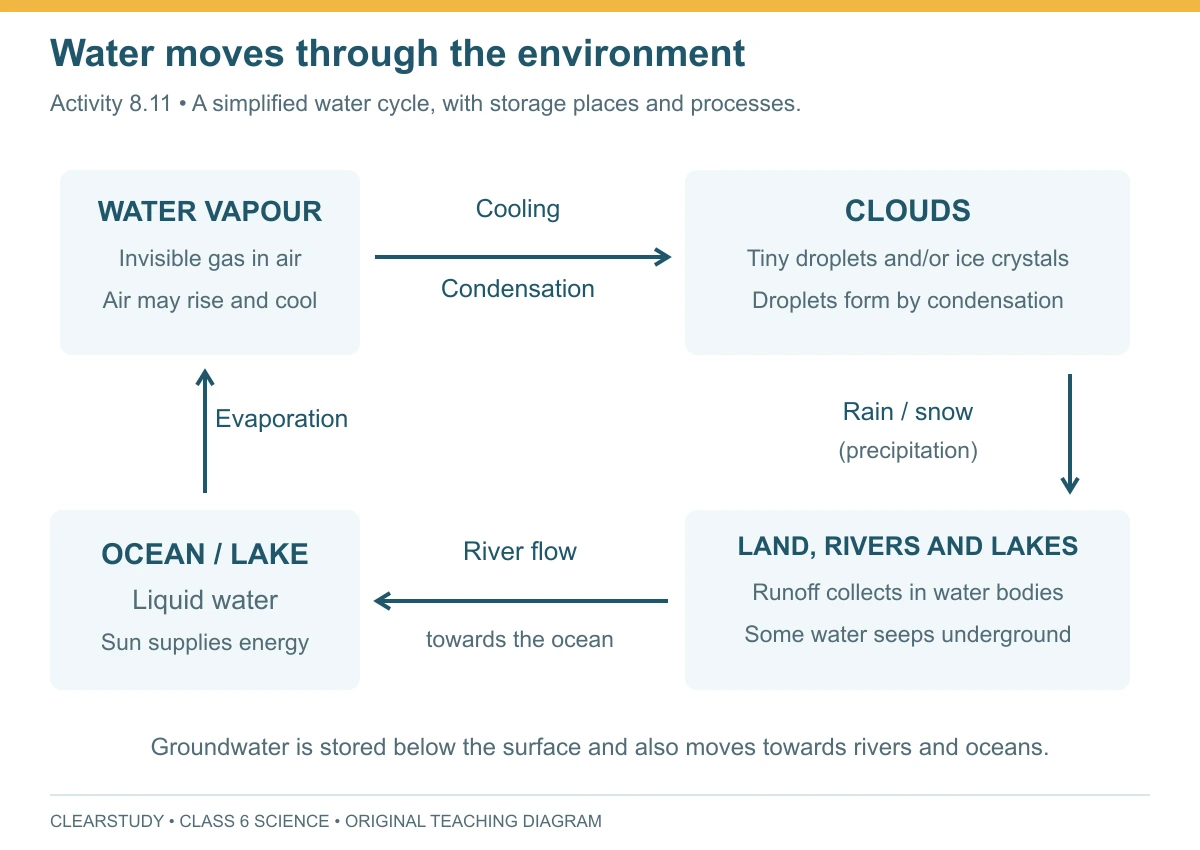
Water cycle: the circulation of water between the Earth’s surface and the atmosphere through evaporation, condensation and rain (or hail/snow).
Comparing the Three States of Water (Activity 8.5)
In Activity 8.5 the textbook asks you to compare ice, water and water vapour by their shape, ability to flow and ability to spread. The completed Table 8.3 is given below.
| Property | Ice (solid state) | Water (liquid state) | Water vapour (gaseous state) |
|---|---|---|---|
| Shape | Has a fixed shape; keeps its shape in any container | No fixed shape; takes the shape of the container | No fixed shape; fills the whole space available |
| Ability to flow | Does not flow | Flows easily | Flows and spreads through the air |
| Ability to spread | Does not spread | Spreads while keeping its volume constant | Spreads out into the entire available space |
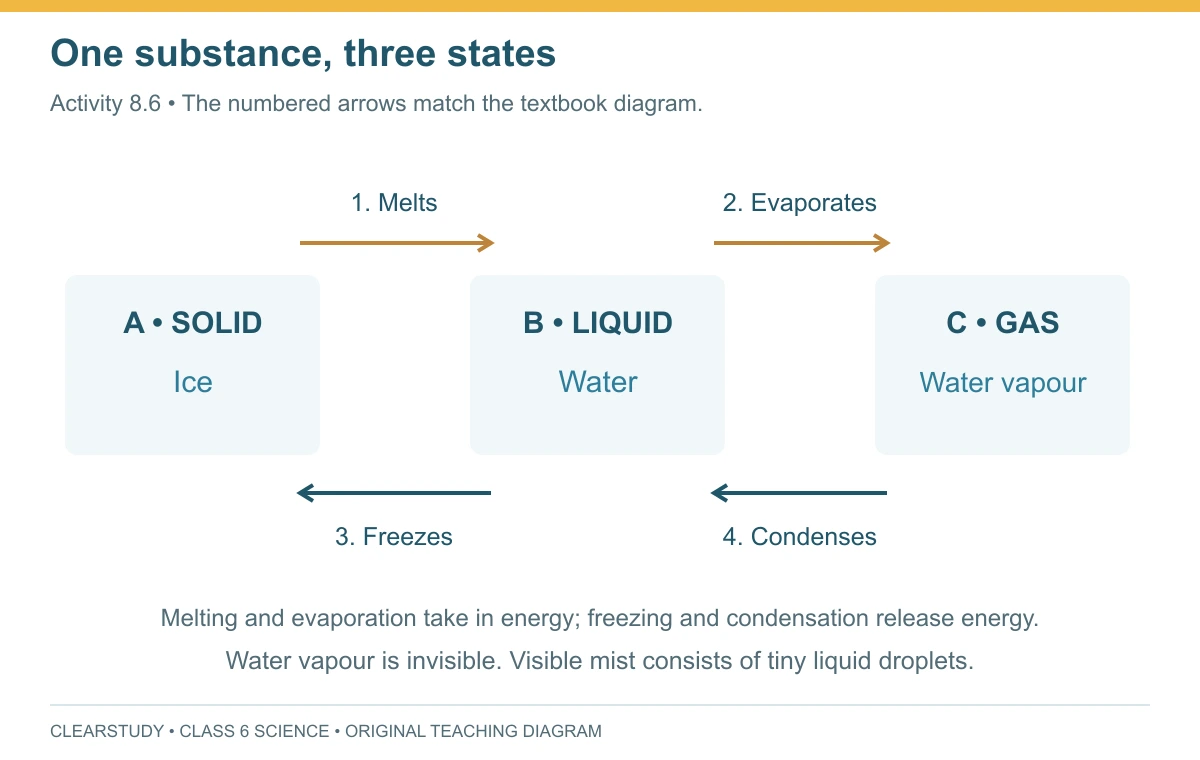
Activity 8.6 (Fig. 8.5) completed: A = Solid, B = Liquid, C = Gas; 1 = Melts, 2 = Evaporates, 3 = Freezes, 4 = Condenses.
“Let us enhance our learning” — NCERT Solutions
Questions 1–10 follow NCERT Curiosity Chapter 8, pages 161–162. Answers and diagrams are original ClearStudy teaching aids.
1. Which of the following best describes condensation? (i) The conversion of water into its vapour state. (ii) The process of water changing from a liquid into gaseous state. (iii) The formation of clouds from tiny water droplets. (iv) The conversion of water vapour into its liquid state.
2. Identify in which of the given processes, evaporation is very important— (i) Colouring with (a) crayons (b) water colours (c) acrylic colours (d) pencil colours (ii) Writing on paper with (a) pencil (b) ink pen (c) ball point pen
3. We see green coloured plastic grass at many places these days. Space around natural grass feels cooler than space around the plastic grass. Can you find out why?
4. Give examples of liquids other than water that evaporate.
5. Fans move air around, creating a cooling sensation. It might seem strange to use a fan to dry wet clothes since fans usually make things cooler, not warmer. Normally, when water evaporates, it requires heat, not cold air. What do you think about this?
6. Usually, when sludge is removed from drains, it is left in heaps next to the drain for 3–4 days. Afterward, it is transported to a garden or a field where it can be used as manure. This approach reduces transportation cost of the sludge and enhances the safety of individuals handling it. Reflect upon it and explain how.
7. Observe the activities in your house for a day. Identify the activities that involve evaporation. How does understanding the process of evaporation help us in our daily activities?
8. How is water present in the solid state in nature?
9. Reflect on the statement “Water is our responsibility before it is our right.” Share your thoughts.
10. The seat of a two-wheeler parked on a sunny day has become very hot. How can you cool it down?
Common Misconceptions to Avoid
Watch out for these
- Thinking ice and water are different substances — they are simply two states (solid and liquid) of the same substance, water.
- Believing water in a puddle “disappears” into nothing — it changes into invisible water vapour by evaporation.
- Confusing evaporation (liquid → vapour) with condensation (vapour → liquid).
- Thinking the droplets outside a cold glass have seeped through the glass — they form by condensation of water vapour already in the air.
- Believing evaporation happens only on heating — it goes on continuously, even at room temperature.
- Thinking a matka cools water by “magic” — water seeps out and evaporates, and evaporation causes the cooling effect.
- Assuming clothes dry faster on a rainy day — high humidity makes evaporation slower, so they dry slowly.
Extra Practice Questions
These questions and MCQs are ClearStudy practice, separate from the NCERT exercise.
Short Answer Type Questions
Q1. Define evaporation and give one example.
Q2. Why do water droplets appear on the outer surface of a glass containing cold water and ice?
Q3. Name the three states of water and give one example of each in nature.
Q4. Why does water in an earthen pot (matka) stay cool?
Q5. State two conditions that make evaporation faster.
Long Answer Type Questions
Q1. Explain how clouds are formed and how they give us rain.
Q2. Describe the water cycle and explain why we should use water wisely.
Q3. With the help of an activity, explain how evaporation produces a cooling effect.
MCQs & Assertion–Reason
1. The conversion of water into its vapour state is called:
(a) condensation (b) evaporation (c) freezing (d) melting
2. Water droplets forming on the outer surface of a cold glass is an example of:
(a) evaporation (b) melting (c) condensation (d) freezing
3. The process of conversion of a solid into the liquid state is called:
(a) freezing (b) melting (c) evaporation (d) condensation
4. Which of the following is the gaseous state of water?
(a) ice (b) dew (c) water vapour (d) rain
5. Clothes dry slowly on a rainy day because the air is:
(a) very dry (b) more humid (c) very hot (d) still and warm
6. Water in an earthen pot stays cool mainly because of:
(a) condensation (b) freezing (c) evaporation (d) melting
7. Evaporation becomes faster when:
(a) the exposed area is smaller (b) the air is still (c) humidity is high (d) air movement increases
8. The amount of water vapour present in the air is called:
(a) condensation (b) humidity (c) the water cycle (d) evaporation
9. The circulation of water between the Earth’s surface and the atmosphere is called the:
(a) water cycle (b) freezing cycle (c) cooling effect (d) condensation cycle
10. Which property is true for ice but not for water?
(a) it flows easily (b) it has a fixed shape (c) it takes the shape of the container (d) it spreads out
For each Assertion–Reason question, choose: (A) Both true and the Reason correctly explains the Assertion; (B) Both true but the Reason is not the correct explanation; (C) Assertion true, Reason false; (D) Assertion false, Reason true.
A-R 1. Assertion: Ice and water are the same substance in different states.
Reason: Ice melts to give water and water freezes to give ice.
A-R 2. Assertion: Water droplets appear on the outside of a glass of cold water.
Reason: Water seeps out through the wall of the glass tumbler.
A-R 3. Assertion: Wet clothes dry faster on a windy day.
Reason: Increased movement of air makes evaporation faster.
A-R 4. Assertion: Sprinkling water on the floor in summer cools the room.
Reason: Evaporation of the water takes away heat and produces a cooling effect.
A-R 5. Assertion: Evaporation takes place only when water is heated strongly.
Reason: Evaporation goes on continuously, even at room temperature.
Quick Revision Summary
- Water exists in three states: solid (ice), liquid (water) and gas (water vapour) — all the same substance.
- Evaporation = water → water vapour; condensation = water vapour → water.
- Melting = solid → liquid; freezing = liquid → solid. Heating and cooling change the state of water.
- Evaporation is faster with a larger exposed area, more air movement, higher temperature and lower humidity.
- Evaporation produces a cooling effect (matka, sweat under a fan, sprinkling water in summer).
- Water vapour condenses around dust particles to form clouds; heavy drops fall as rain (or hail/snow).
- The water cycle circulates water between the Earth’s surface and the atmosphere — so we must use water wisely.
Real-life Applications
The ideas in this chapter are all around us. Farmers and city dwellers use evaporative cooling — matkas, surahis, pot-in-pot coolers and desert (air) coolers all rely on water evaporating to cool air or stored food. People dry clothes, papads and pickles faster by spreading them out in sunlight and breeze, using the rules of evaporation. Atmospheric Water Generators collect moisture from humid air by condensation; water intended for drinking also needs suitable treatment and quality checks. The same condensation forms dew, fog and the water drops under a pot lid. On a large scale, the water cycle waters our fields, fills our rivers and reservoirs, and refills groundwater — which is why saving water and keeping water bodies clean matters so much.
How to write a clear answer
Learn the four key definitions exactly — evaporation, condensation, melting, freezing — and never mix them up. In experiment-based questions, always state which factor you change (exposed area, air movement, humidity) and which you keep the same to make a fair test. Remember that droplets on a cold glass come from condensation of air’s water vapour, not seeping, and that evaporation causes cooling. Use the textbook’s own examples — the matka, drying clothes, the cold glass and the water cycle — to make your answers strong.
Frequently Asked Questions
What is Class 6 Science Curiosity Chapter 8 about?
Chapter 8, A Journey through States of Water, explains that water exists in three states — ice (solid), water (liquid) and water vapour (gas) — and how it changes between them through evaporation, condensation, melting and freezing. It also covers the cooling effect, how clouds give rain and the water cycle.
What is the difference between evaporation and condensation?
Evaporation is the conversion of liquid water into water vapour (a gas). Condensation is the opposite — the conversion of water vapour back into liquid water, which happens when vapour meets a cold surface.
Why does water in an earthen pot stay cold?
Water slowly seeps through the tiny pores of the earthen pot and evaporates from its surface. Evaporation takes heat from the water, producing a cooling effect that keeps the stored water cold.
Are these Class 6 Science Curiosity Chapter 8 solutions free?
Yes. All ClearStudy NCERT Solutions for Class 6 Science Curiosity are free and follow the official NCERT textbook for the 2026–27 session.
Sources: NCERT Curiosity Chapter 8 (official PDF); CDC/NIOSH information on treated sludge and pathogens.