
NCERT Solutions for Class 6 Science (Curiosity) Chapter 9: Methods of Separation in Everyday Life
These Class 6 Science Curiosity Chapter 9 solutions cover Methods of Separation in Everyday Life from the new NCF textbook (session 2026–27). Following Malli and Valli on their tour of India, this chapter explains how we separate the useful parts of a mixture from the unwanted ones using simple methods such as handpicking, threshing, winnowing, sieving, sedimentation, decantation, filtration, evaporation, churning and magnetic separation. Every “Let us enhance our learning” exercise question is reproduced and solved below.
Class 6 Science Curiosity Chapter 9 Solutions – Overview
Chapter 9 of Curiosity, Methods of Separation in Everyday Life, shows that the things around us are often mixtures — two or more substances mixed together. We separate them either to remove a useless or harmful part (like stones from pulses) or to obtain a useful part (like butter from curd, or salt from seawater). The chapter follows Malli and Valli across India, where each place teaches a method that depends on a clever difference between the components — their size, weight, magnetic nature, or whether they dissolve in water. Solid–solid mixtures are sorted by handpicking, threshing, winnowing, sieving or magnetic separation; solids dissolved or suspended in liquids are separated by sedimentation, decantation, filtration and evaporation; and butter is taken from curd by churning.
Key Concepts & Definitions
Mixture: a substance made when two or more substances are mixed together, such as grains mixed with small stones and husk.
Handpicking: picking out small quantities of unwanted material (stones, husk) from a mixture by hand, based on differences in size, colour and shape.
Threshing: beating harvested stalks to separate the grains from them.
Winnowing: separating lighter husk from heavier grains by dropping the mixture in wind or by blowing air; the lighter husk is blown away.
Sieving: separating components of a solid–solid mixture that have different particle sizes, using a sieve — fine particles pass through while bigger ones stay on top.
Sedimentation: the settling down of a heavier, insoluble component at the bottom of a liquid.
Decantation: gently pouring off (or tilting) the upper liquid after the heavier solid has settled.
Filtration: separating insoluble solids from a liquid by passing it through a filter (cloth, filter paper, etc.); the solid stays as residue and the clear liquid passes as filtrate.
Evaporation: the process in which a liquid changes into vapour; used to recover a solid dissolved in a liquid (e.g. salt from salt solution).
Churning: agitating curd or cream so that fat droplets join to form butter, which separates from the liquid. In the textbook example, butter is collected from churned curd.
Magnetic separation: separating magnetic substances (like iron) from non-magnetic ones using a magnet.
Let us enhance our learning — NCERT Solutions
These original explanations cover Questions 1–10 on pages 178–180 of NCERT Curiosity, Reprint 2026–27. Read them alongside your textbook.
1. What purpose does handpicking serve in the process of separation? (i) Filtration (ii) Sorting (iii) Evaporation (iv) Decantation
2. Which of the following substances are commonly separated using the churning method? (i) Oil from water (ii) Sand from water (iii) Cream from milk (iv) Oxygen from air
3. Which factor is usually essential for the filtration? (i) Apparatus size (ii) Presence of air (iii) Pore size (iv) Temperature of the mixture
4. State with reason(s) whether the following statements are True [T] or False [F]. Also, correct the False statement(s). (i) Salt can be separated from salt solution by keeping it under the Sun. [ ] (ii) Handpicking should be used only when the quantity of one component is less. [ ] (iii) A mixture of puffed rice and rice grains can be separated by threshing. [ ] (iv) A mixture of mustard oil and lemon water can be separated by decantation. [ ] (v) Sieving is used to separate a mixture of rice flour and water. [ ]
5. Match the mixtures in Column I with their method of separation in Column II.
| Column I | Column II |
|---|---|
| (i) Gram flour mixed with black gram | (a) Handpicking |
| (ii) Chalk powder mixed with water | (b) Magnetic separation |
| (iii) Corn mixed with potatoes | (c) Decantation |
| (iv) Iron powder mixed with sawdust | (d) Sieving |
| (v) Oil mixed with water | (e) Filtration |
6. In what situations would you use decantation instead of filtration to separate solids from liquids?
7. Can you relate the presence of nasal hair to any separation process?
8. During the COVID-19 pandemic, all of us wore masks. Generally, what material are they made of? What is the role of these masks?
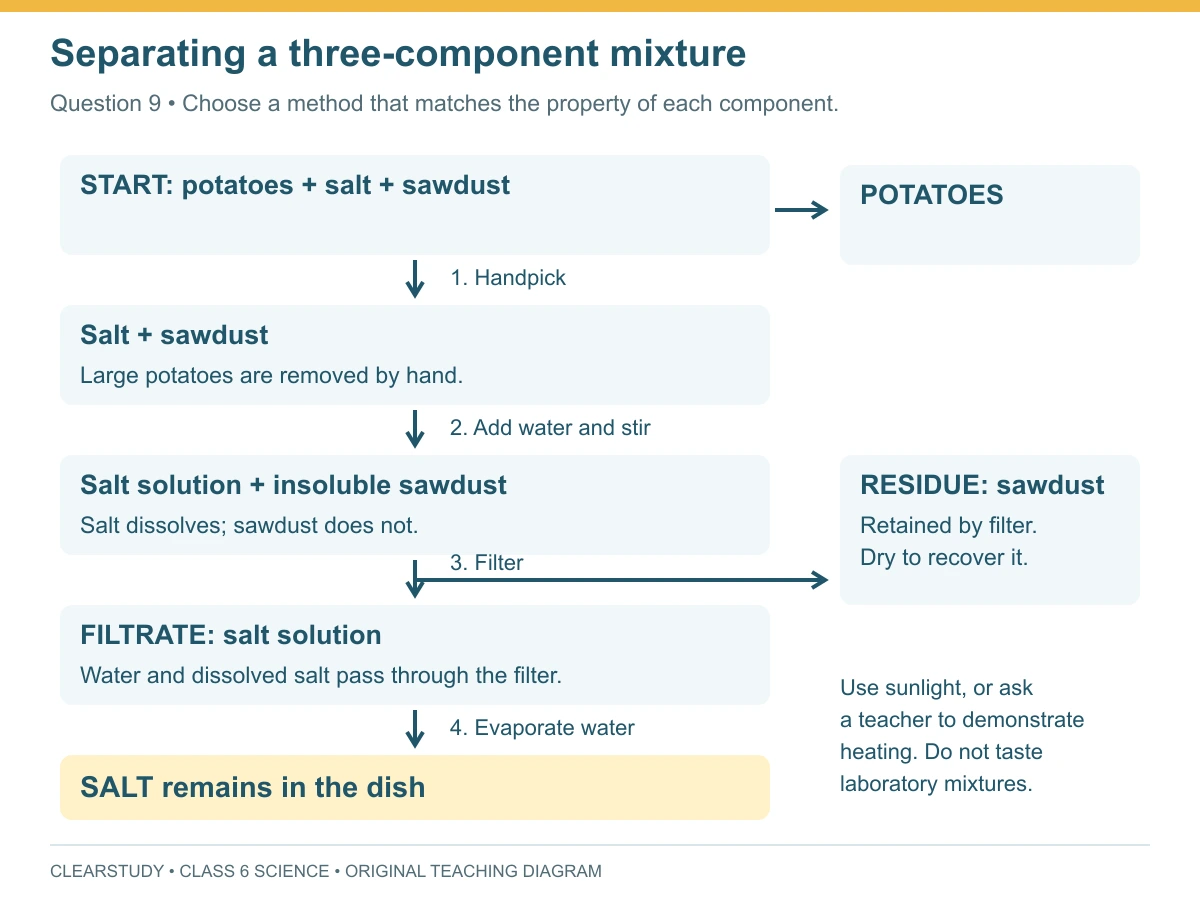
9. A mixture containing potatoes, salt and sawdust has been given to you. Outline a stepwise procedure for separating each component from this mixture.
10. Read the following story titled ‘Intelligent Leela’ and tick the most appropriate options. Provide a suitable title of your choice for the paragraph.
Leela was working in the farm with her father when she realised that they left their drinking water at home. Before her father felt thirsty/hungry, she went to the nearby pond to fetch some water/grains. After obtaining some water in the container, she noticed that the water was muddy and fit/unfit for drinking. To purify the water, she kept it for some time and then she filtered/churned the muddy water using a piece of paper/muslin cloth. Leela, then, cooled/boiled the water for about 10 minutes in a covered pan. After cooling/boiling, she filtered/churned it again and made it fit/unfit for drinking. She served this water to her father while having food, who blessed her and appreciated her efforts.
Textbook story versus real drinking-water safety: “fit” is the intended story choice. Cloth filtration removes some suspended matter and boiling kills many disease-causing germs, but neither guarantees removal of harmful dissolved chemicals. Do not drink pond water from a classroom filtration activity. Use a known safe supply; prevent treated water from being contaminated again. See CDC drinking-water guidance.
Extra Practice Questions
These questions and MCQs are ClearStudy practice, separate from the NCERT exercise.
Short Answer Type Questions
Q1. What is a mixture? Give one example.
Q2. Why do we separate the substances in a mixture? Give two reasons.
Q3. Differentiate between threshing and winnowing.
Q4. How is salt obtained from seawater?
Q5. Define sedimentation and decantation.
Long Answer Type Questions
Q1. Explain how suspended mud can be removed from pond water. Does clear water prove it is safe to drink?
Q2. Describe the method of separating grains from harvested crops as practised by farmers.
Q3. A shopkeeper has a mixture of iron filings, salt, sand and water. Explain how each component can be separated.
MCQs & Assertion–Reason
1. Picking small stones out of rice by hand is called:
(a) sieving (b) handpicking (c) winnowing (d) filtration
2. Beating harvested stalks to separate grains is known as:
(a) winnowing (b) churning (c) threshing (d) sedimentation
3. Lighter husk is separated from heavier grains by:
(a) winnowing (b) sieving (c) decantation (d) magnetic separation
4. A sieve is used to separate components of a mixture that differ in:
(a) colour (b) particle size (c) smell (d) magnetic nature
5. Salt is recovered from salt solution by the process of:
(a) filtration (b) decantation (c) evaporation (d) threshing
6. Tea leaves are removed from tea most completely by:
(a) decantation (b) filtration (using a strainer) (c) winnowing (d) sieving
7. In filtration, the clear liquid that passes through the filter is called the:
(a) residue (b) mixture (c) filtrate (d) sediment
8. Butter is separated from curd by:
(a) sieving (b) churning (c) filtration (d) evaporation
9. Iron nails can be separated from sawdust using a:
(a) sieve (b) filter paper (c) magnet (d) bamboo tray
10. The settling down of a heavier insoluble solid at the bottom of a liquid is called:
(a) decantation (b) sedimentation (c) evaporation (d) filtration
For each Assertion–Reason question, choose: (A) Both true and the Reason correctly explains the Assertion; (B) Both true but the Reason is not the correct explanation; (C) Assertion true, Reason false; (D) Assertion false, Reason true.
A-R 1. Assertion: Winnowing is used to separate husk from grains.
Reason: The husk is lighter than the grains, so it is carried away by the wind.
A-R 2. Assertion: Salt can be obtained from seawater by evaporation.
Reason: On heating or exposure to sunlight, the water turns into vapour and the dissolved salt is left behind.
A-R 3. Assertion: Decantation completely separates all the tea leaves from tea.
Reason: In decantation the heavier solid settles down and only the clear liquid is poured off.
A-R 4. Assertion: A magnet can be used to separate iron filings from a mixture.
Reason: Iron is a magnetic substance and is attracted towards a magnet.
A-R 5. Assertion: Sieving can be used to separate rice flour from water.
Reason: Sieving separates solid components of a mixture that have different particle sizes.
Quick Revision Summary
- A mixture contains two or more substances; we separate them to remove an unwanted part or to obtain a useful part.
- Handpicking separates small amounts of stones/husk by differences in size, colour and shape.
- Threshing beats stalks to free the grains; winnowing blows away the lighter husk in the wind.
- Sieving separates solid–solid mixtures of different particle sizes.
- Sedimentation + decantation separate a settled heavy solid from a liquid; filtration removes insoluble solids (residue) and gives clear filtrate.
- Evaporation recovers a dissolved solid (salt) from a liquid; churning extracts butter from curd.
- Magnetic separation uses a magnet to pull out magnetic substances like iron. Mixtures of more than two components need a combination of methods.
Real-life Applications
Methods of separation are used everywhere in daily life. Farmers thresh and winnow grain; cooks sieve flour, strain tea and churn curd into butter; and salt is harvested from seawater and lakes (such as Sambhar Lake in Rajasthan) by evaporation. At construction sites, sieves separate pebbles from sand. Our own body uses filtration — nasal hair traps dust from the air we breathe — and masks work on the same principle. Recyclers and industries use giant magnets fitted to cranes to pull scrap iron out of waste heaps so it can be reused. Water treatment can combine several methods, but removing visible mud alone does not establish drinking-water safety. Learning these methods helps us choose the right one based on the property — size, weight, solubility or magnetism — that makes the components different.
How to write a clear answer
Always link the method to the property being used: size (sieving, handpicking), weight (winnowing, sedimentation), solubility (filtration, evaporation) or magnetism (magnetic separation). In “separate the mixture” questions, write a clear stepwise procedure and remember that a mixture with more than two components needs a combination of methods. Use the correct terms — residue, filtrate, threshing, winnowing — and add a real-life example to strengthen your answer.
Frequently Asked Questions
What is Class 6 Science Curiosity Chapter 9 about?
Chapter 9, Methods of Separation in Everyday Life, explains why and how we separate the components of a mixture using everyday methods — handpicking, threshing, winnowing, sieving, sedimentation, decantation, filtration, evaporation, churning and magnetic separation — each chosen according to a property such as size, weight, solubility or magnetism.
What is the difference between winnowing and sieving?
Winnowing separates lighter and heavier components (like husk and grain) using wind or blowing air, so it depends on weight. Sieving separates solid components of different particle sizes using a sieve, where fine particles pass through and bigger ones stay on top.
How is salt separated from a salt solution?
By evaporation. The salt solution is heated or left in sunlight so the water evaporates as vapour, leaving the solid salt behind. To get the water back too, the vapour can be cooled and condensed.
Are these Class 6 Science Curiosity Chapter 9 solutions free?
Yes. All solutions are free and follow the official NCERT Curiosity textbook for 2026–27.