
NCERT Solutions for Class 6 Science (Curiosity) Chapter 10: Living Creatures: Exploring their Characteristics (NCERT 2026–27)
These Class 6 Science Curiosity Chapter 10 solutions cover Living Creatures: Exploring their Characteristics from the new NCF textbook (2026–27). The chapter teaches you how to tell living beings apart from non-living things, the conditions needed for seed germination, how plants grow and move, and the life cycles of plants, mosquitoes and frogs. Every question of the “Let us enhance our learning” exercise is reproduced exactly and solved below in simple, exam-ready language.
Class 6 Science Curiosity Chapter 10 Solutions – Overview
Chapter 10 of Curiosity, Living Creatures: Exploring their Characteristics, begins with a simple puzzle — how can a still seashell be part of a living snail? It then explores the features that set living beings apart from non-living things: they move, need food (nutrition), grow, respire, excrete, respond to stimuli, reproduce and finally die. The chapter shows that even plants move (Drosera traps insects, touch-me-not folds its leaves) and respire (through tiny pores called stomata). Through activities, it studies the conditions needed for seed germination (water and air, with light not essential for most seeds), how shoots grow towards light and roots grow downward, and the life cycles of a bean plant, a mosquito (egg → larva → pupa → adult) and a frog (egg → tadpole → froglet → adult).
Key Concepts & Definitions
Living beings: organisms with life processes such as nutrition, respiration, excretion and response to stimuli, and a life cycle involving growth and reproduction of their kind. Not every characteristic is visible in every individual at every moment; for example, an adult may have stopped growing in height.
Non-living things: things that do not show these characteristics (e.g. a pencil, a car, a chair). A car can move but does not grow, respire or reproduce, so it is non-living.
Respiration: the process that releases usable energy from food in living cells. Breathing helps many animals exchange gases needed for respiration. Plants also respire; gases pass through stomata and other surfaces. Breathing and respiration are related, but are not identical.
Excretion: removal of waste products from the body — for example, sweat and urine in animals, and droplets of excess water and minerals on leaves in plants.
Stimulus: anything or any event that prompts a living being to respond (e.g. stepping on a thorn or touching a hot cup). Touch-me-not folds its leaves when touched.
Reproduction: the process of producing new ones of one’s own kind; it is necessary for the continuity of life.
Germination: the process in which a seed turns into a sprout. A viable seed needs water, oxygen and a suitable temperature. Most seeds, including beans, do not need light to germinate, but some species do.
Life cycle: the whole journey from a seed/egg through various growth stages to an adult that produces the next generation, and finally death.
“Let us enhance our learning” — NCERT Solutions
Original explanations for Questions 1–9 on pages 203–204 of NCERT Curiosity, Reprint 2026–27. Figures 10.9 and 10.10 have been checked against the textbook.
1. List the similarities and differences in life cycles of plants and animals.
2. The table on the next page shows some data. Study the data and try to find out examples appropriate for the conditions given in the second and third columns. If you think that an example for any of the conditions given below is not possible, explain why.
| S. no. | Does it grow? | Does it respire? | Example | Remarks |
|---|---|---|---|---|
| 1. | No | No | A stone / a pencil / a car | Non-living thing — it neither grows nor respires. |
| 2. | No | Yes | A fully grown adult human | No further growth in height, but respiration continues. Cells can still be renewed and repaired; “No” refers to overall size during the observation period. |
| 3. | Yes | No | A crystal / an icicle (or a non-living thing that increases in size) | Such growth is only an increase in size by addition of material from outside; it is not true biological growth and the thing does not respire, so it is non-living. |
| 4. | Yes | Yes | A growing seedling / puppy / child | Living being — it grows and respires, and shows all other life characteristics. |
3. You have learnt that different conditions are required for seed germination. How can we use this knowledge for proper storage of grains and pulses?
4. You have learnt that a tail is present in a tadpole but it disappears as it grows into a frog. What is the advantage of having a tail in the tadpole stage?
5. Charan says that a wooden log is non-living as it cannot move. Charu counters it by saying that it is living because it is made of wood obtained from trees. Give your arguments in favour or against the two statements given by Charan and Charu.
6. What are the similarities and distinguishing features in the life cycles of a mosquito and a frog?
Key difference: the mosquito has a pupal stage; the frog does not. The adult mosquito flies, whereas a typical adult frog moves using its legs and can swim.
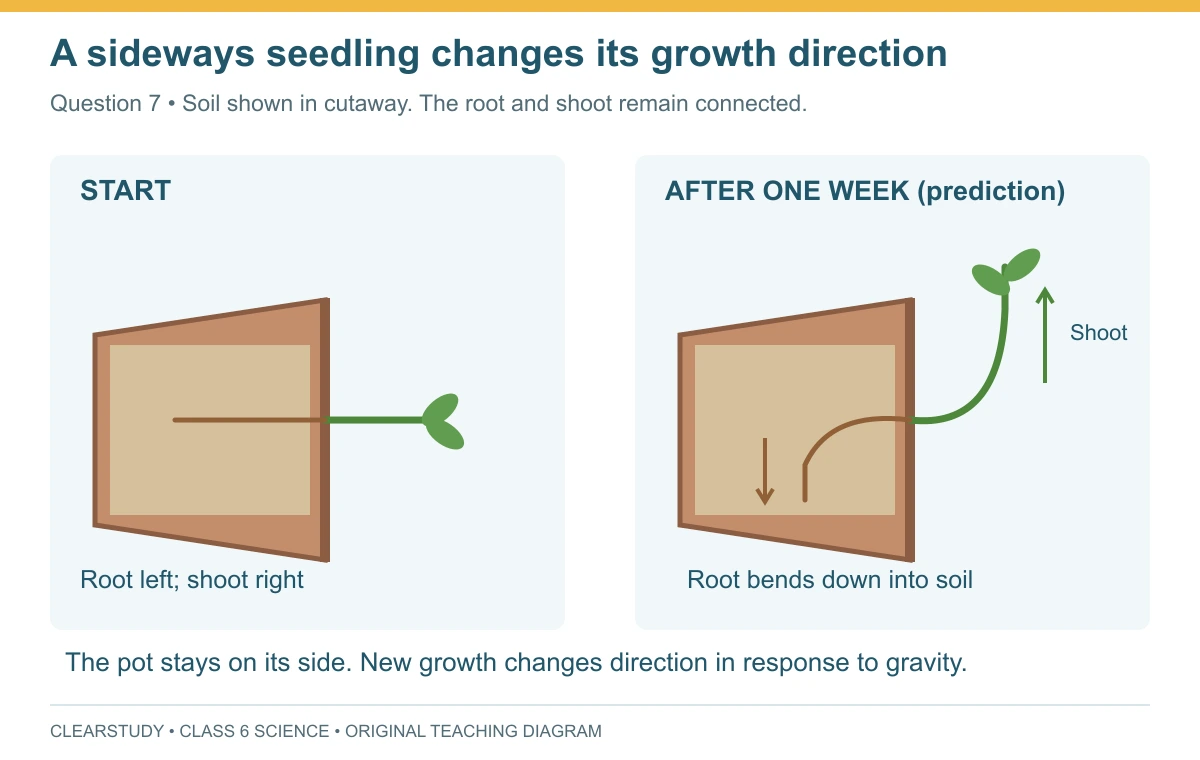
7. A plant is provided with all the conditions suitable for its growth (Fig. 10.9). Draw what you expect to see in the shoot and the root of the plant after one week. Write down the reasons.
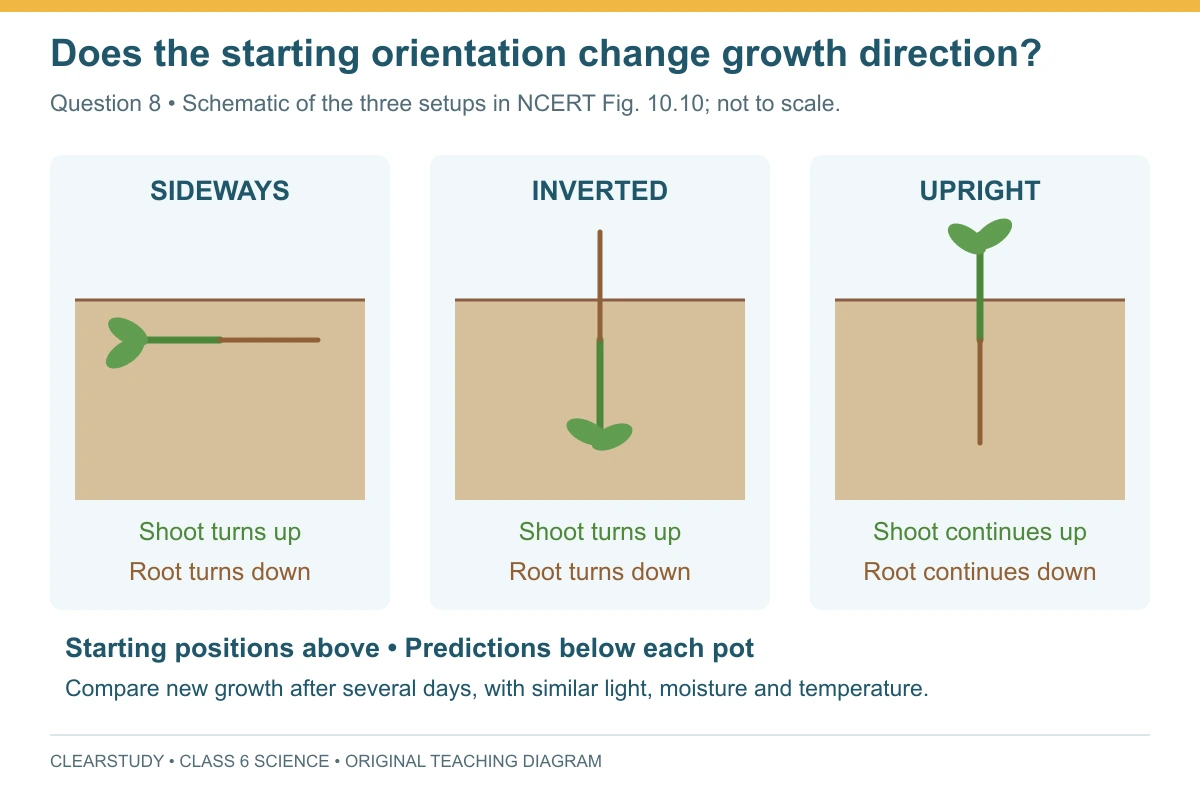
8. Tara and Vijay set up the experiment shown in the picture (Fig. 10.10). What do you think they want to find out? How will they know if they are correct?
9. Design an experiment to check if temperature has an effect on seed germination.
Common Mistakes to Avoid
Watch out for these
- Thinking that anything which moves is living — a car moves but does not grow, respire or reproduce, so it is non-living.
- Thinking that plants are non-living because they do not move from place to place — plants do show movements (opening flowers, folding leaves) and have all life characteristics.
- Forgetting that light is not essential for the germination of most seeds — seeds need moisture, oxygen and a suitable temperature; light is needed for the seedling to grow afterwards.
- Mixing up the life-cycle stages — mosquito: egg → larva → pupa → adult; frog: egg → tadpole → froglet → adult.
- Saying excretion happens only in animals — plants also excrete (droplets of excess water and minerals on leaves).
- Confusing the increase in size of a non-living thing (like a crystal) with true biological growth.
Extra Practice Questions
These questions and MCQs are ClearStudy practice, separate from the NCERT exercise.
Short Answer Type Questions
Q1. Name any four characteristics of living beings.
Q2. What is a stimulus? Give one example of a plant responding to a stimulus.
Q3. Why do mosquito larvae and pupae come up to the surface of water?
Q4. Why does spraying kerosene oil on stagnant water kill mosquito larvae and pupae?
This explains the textbook example; it is not a home experiment. Do not pour kerosene into water. Instead, regularly empty and scrub water-holding containers and keep storage tanks covered. Follow local mosquito-control advice. See CDC guidance on removing breeding sites.
Q5. Through which tiny pores do plants take air in and out?
Long Answer Type Questions
Q1. Explain how an experiment with four pots of bean seeds shows the conditions needed for seed germination.
Q2. Describe the life cycle of a frog.
Q3. How do living beings differ from non-living things? Explain with examples.
MCQs & Assertion–Reason
1. Which of the following is a non-living thing?
(a) pigeon (b) plant (c) car (d) child
2. The process of removal of waste products from the body is called:
(a) respiration (b) excretion (c) reproduction (d) germination
3. Tiny pores on the surface of leaves that help plants take air in and out are called:
(a) stomata (b) spawn (c) embryo (d) seed coat
4. Which condition is NOT essential for the germination of most seeds?
(a) water (b) air (c) light (d) suitable warmth
5. The folding of leaves of the touch-me-not plant when touched is an example of:
(a) excretion (b) reproduction (c) response to a stimulus (d) respiration
6. The correct order of stages in the life cycle of a mosquito is:
(a) egg → pupa → larva → adult (b) egg → larva → pupa → adult (c) larva → egg → pupa → adult (d) egg → adult → larva → pupa
7. In a germinating seed, the part that develops into a new plant is the:
(a) seed coat (b) embryo (c) stomata (d) spawn
8. When a plant is kept upright with all suitable conditions, the root grows:
(a) upwards (b) downwards (c) towards light (d) sideways only
9. The jelly-like cluster of frog eggs found on the surface of water is called:
(a) froglet (b) tadpole (c) spawn (d) pupa
10. Reproduction is necessary because it ensures the:
(a) movement of living beings (b) excretion of waste (c) continuity of life (d) breathing of plants
For each Assertion–Reason question, choose: (A) Both true and the Reason correctly explains the Assertion; (B) Both true but the Reason is not the correct explanation; (C) Assertion true, Reason false; (D) Assertion false, Reason true.
A-R 1. Assertion: A car is a non-living thing.
Reason: A car can move but it does not grow, respire or reproduce.
A-R 2. Assertion: Light is essential for the germination of most seeds.
Reason: Viable seeds generally need moisture, oxygen and a suitable temperature; most can germinate in darkness.
A-R 3. Assertion: Plants are living beings.
Reason: Plants grow, respire, excrete, respond to stimuli and reproduce.
A-R 4. Assertion: Seeds in a pot with excess water above the soil do not germinate well.
Reason: Excess water fills the spaces between soil particles, so air cannot reach the seeds.
A-R 5. Assertion: The tail of a tadpole disappears as it becomes an adult frog.
Reason: During metamorphosis, tail tissue is broken down and reabsorbed as the frog develops legs.
Quick Revision Summary
- Things around us are of two types — living and non-living.
- Living things show a combination of life processes across their life cycle. Lack of visible movement or growth at one moment does not by itself show that something is non-living.
- Plants also move (Drosera, touch-me-not), respire through stomata, and excrete excess water on their leaves.
- A viable seed needs moisture, oxygen and a suitable temperature; light requirements depend on the species.
- In growing plants, roots grow downward and shoots grow upward and towards light.
- A plant’s life cycle: seed → germination → growth → flowering → fruit/seeds → new plants.
- Mosquito life cycle: egg → larva → pupa → adult; frog life cycle: egg → tadpole → froglet → adult.
Real-life Applications
Understanding the characteristics of living beings has many everyday uses. Knowing that seeds need moisture and air to germinate helps us store grains and pulses safely by drying them and keeping them in airtight, cool, dry containers. Knowing that mosquito larvae and pupae need air at the water surface helps explain why removing breeding sites matters. Empty and scrub containers that hold stagnant water, cover stored water and seek local advice for water that cannot be drained. Do not add kerosene to water. Gardeners use the fact that shoots grow towards light and roots grow downward when they plant and train climbers. Recognising the life cycles of frogs and insects also helps us protect these creatures and their habitats, keeping the living world healthy.
How to write a clear answer
Learn the eight characteristics of living beings in order and be ready to explain why a car or a wooden log is non-living. For experiment questions, always state the aim, what you change (only one factor), what you keep the same (fair test) and what you observe. Remember the exact stages of the mosquito and frog life cycles, and that shoots grow towards light while roots grow downward. Use the textbook’s own examples — touch-me-not, Drosera, stomata, seed germination — to show you have read the chapter.
Frequently Asked Questions
What is Class 6 Science Curiosity Chapter 10 about?
Chapter 10, Living Creatures: Exploring their Characteristics, explains how living beings differ from non-living things (movement, nutrition, growth, respiration, excretion, response to stimuli, reproduction and death), the conditions needed for seed germination, how plant roots and shoots grow, and the life cycles of a plant, a mosquito and a frog.
What conditions are needed for a seed to germinate?
A viable seed needs moisture, oxygen and a suitable temperature. Light requirements vary by species; bean seeds can germinate in darkness. Seedlings later need light for photosynthesis.
What are the stages in the life cycle of a mosquito and a frog?
A mosquito passes through four stages: egg → larva → pupa → adult. A frog passes through egg → tadpole → froglet → adult frog, changing both its body shape and its habitat.
Are these Class 6 Science Curiosity Chapter 10 solutions free?
Yes. All solutions are free and follow the official NCERT Curiosity textbook for 2026–27.