
NCERT Solutions for Class 6 Science (Curiosity) Chapter 11: Nature’s Treasures
These Class 6 Science Curiosity Chapter 11 solutions cover Nature’s Treasures from the new NCF-2023 textbook (2026–27). The chapter introduces the natural resources that nature gives us — air, water, energy from the Sun, forests, soil, rocks, minerals and fossil fuels — and explains how to classify them as renewable or non-renewable and why we must use them wisely. Every “Let us enhance our learning” question is reproduced verbatim and answered in clear, exam-ready style.
Class 6 Science Curiosity Chapter 11 Solutions – Overview
In Nature’s Treasures, Bhoomi and Surya visit their Ajji’s village on the edge of a forest in the Western Ghats and discover the many gifts of nature. The chapter explains that air is a mixture of gases (78% nitrogen, 21% oxygen, and 1% argon, carbon dioxide and others) and supplies the oxygen we need to survive; moving air is wind, which can turn a firki or a windmill to generate electricity. Water covers about two-thirds of Earth, but most is salty, so we must conserve precious freshwater through methods like rainwater harvesting. The Sun is the main source of energy for all living beings. Forests, soil, rocks, minerals and fossil fuels (coal, petroleum, natural gas) are other natural treasures. Resources are classified as renewable (renewed in a reasonable time, e.g. air, water, forests) or non-renewable (limited and not replenished quickly, e.g. minerals, soil, rocks, fossil fuels). The big message: use natural resources judiciously.
Key Concepts & Definitions
The 78% / 21% / 1% figures are rounded values for dry air. Real air also contains a variable amount of water vapour. “Renewable” does not mean inexhaustible: forests need time to regrow and local clean-water supplies can be depleted. See NOAA’s atmosphere explanation.
Natural resources: resources we get from nature that are essential to sustain life — air, water, energy from the Sun, forests, soil, rocks, minerals and fossil fuels.
Human-made resources: useful things created by human beings, such as electric bulbs, furniture, solar panels and bicycles.
Composition of air: a mixture of gases — nitrogen 78%, oxygen 21%, and argon, carbon dioxide and other gases together 1%.
Wind: moving air; it rotates a firki and the wings of a windmill, which can run flour mills, pull up water or generate electricity.
Freshwater & rainwater harvesting: most water on Earth is saline; only a small fraction is usable freshwater. Collecting and storing rainwater (e.g. stepwells — Bawadi in Rajasthan, Vav in Gujarat) for later use is rainwater harvesting.
Fossil fuels: petroleum, natural gas and coal, formed over millions of years from the buried remains of microorganisms and plants; found in limited quantities.
Renewable resources: resources that get renewed, replenished or restored by natural processes within a reasonable time — air, water, forests.
Non-renewable resources: resources in limited quantities that are not replenished within a reasonable time — minerals, soil, rocks, coal, petroleum, natural gas.
“Let us enhance our learning” — NCERT Solutions
These original explanations cover Questions 1–16 on pages 227–229 of NCERT Curiosity, Reprint 2026–27. The picture questions and resource chart have been checked against the textbook.
1. Fig. 11.9 shows items related to natural resources. Match them with their jumbled up names. Make another table and write the names of these resources. Classify these resources as renewable or non-renewable.
| Jumbled name | Resource (correct name) | Renewable / Non-renewable |
|---|---|---|
| ocrk | Rock | Non-renewable |
| refost | Forest | Renewable |
| ndiw | Wind (air) | Renewable |
| atwre | Water | Renewable |
Match the pictures from top to bottom: running tap → water (atwre); wind turbine → wind (ndiw); trees → forest (refost); stone → rock (ocrk). The turbine is human-made; the natural resource it uses is wind.
2. State whether the following statements are True [T] or False [F]. If False, correct them.
(i) Nature has all the resources to meet human needs. [ ]
(ii) Machines are a resource found in nature. [ ]
(iii) Natural gas is a non-renewable resource. [ ]
(iv) Air is a renewable resource. [ ]
3. Fill in the blanks using the most appropriate option—
(i) A fuel that is commonly used in two wheelers like scooters or bikes is……… (a) Kerosene (b) Petrol (c) Diesel (d) LPG
(ii) An example of a renewable resource is ……………… (a) Coal (b) Water (c) Natural gas (d) Petrol
4. Classify the following as renewable or non-renewable resources—coal, natural gas, forests and minerals.
| Resource | Classification |
|---|---|
| Coal | Non-renewable |
| Natural gas | Non-renewable |
| Forests | Renewable |
| Minerals | Non-renewable |
5. Why do we say that petroleum is a non-renewable resource?
6. It is difficult to regrow forests. Justify this statement.
7. Make a list of five daily activities in which you use natural resources. Suggest ways by which you can reduce their use.
| Daily activity | Natural resource used | Way to reduce its use |
|---|---|---|
| Bathing | Water | Take a bucket bath instead of a long shower; turn off the tap. |
| Travelling to school | Fossil fuel (petrol/diesel) | Walk, cycle, carpool or use public transport. |
| Lighting and fans at home | Energy sources used to generate electricity, such as coal, sunlight, wind or flowing water | Switch off lights and fans when not needed; use solar energy. |
| Cooking food | Natural gas / LPG | Use a lid on pots and a solar cooker; cook efficiently. |
| Using paper / notebooks | Forests (wood) | Use both sides of paper and recycle paper to save trees. |
8. List four activities that are possible due to the presence of air.
9. How can you contribute towards enhancing the green cover of your locality? Make a list of actions to be taken.
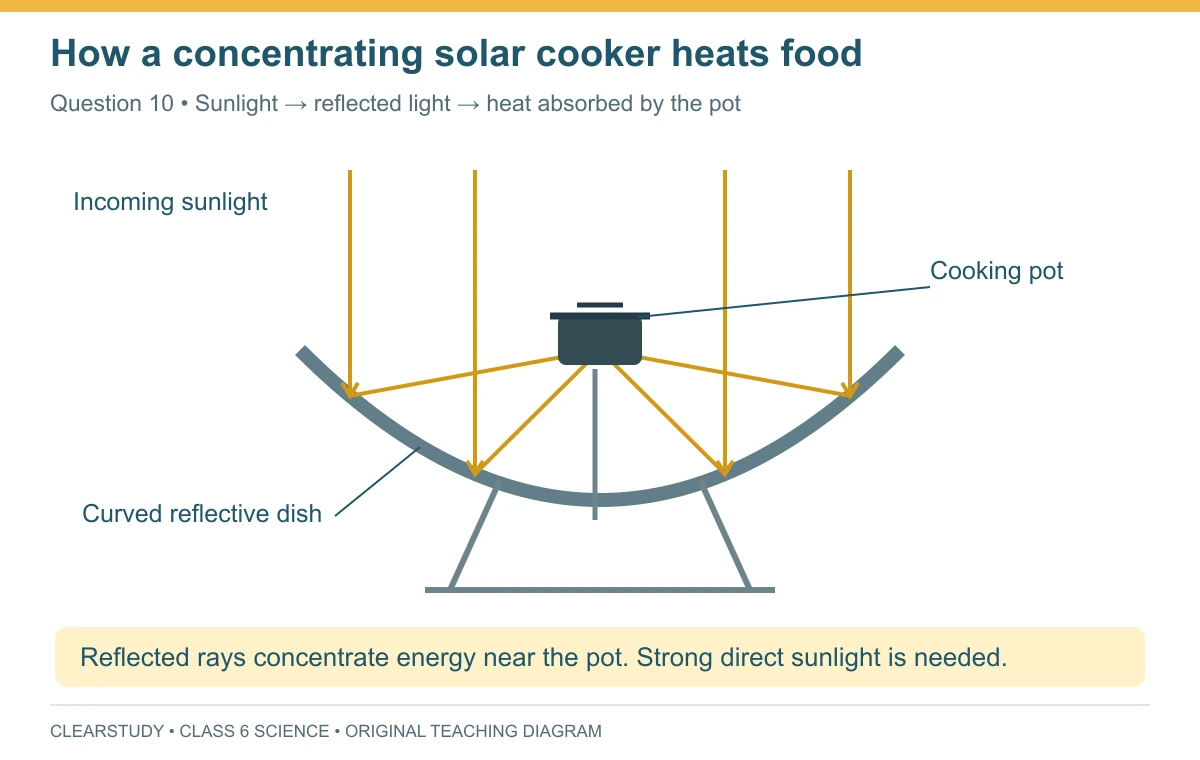
10. In the given illustration, we see that food is being cooked.
Answer the following questions—
(i) What type of energy is being used for cooking?
(ii) Name one benefit and one drawback of using this type of energy for cooking.
11. Cutting down trees on a large scale impacts the quality of the soil. Why do you think it is so?
12. Explain two ways in which human activities pollute the air. Propose one action which can help in reducing air pollution.
13. A family uses solar panels to generate electricity, a gas stove to cook food and a windmill for pumping water from a well. What would happen if there were no sunlight for a week?
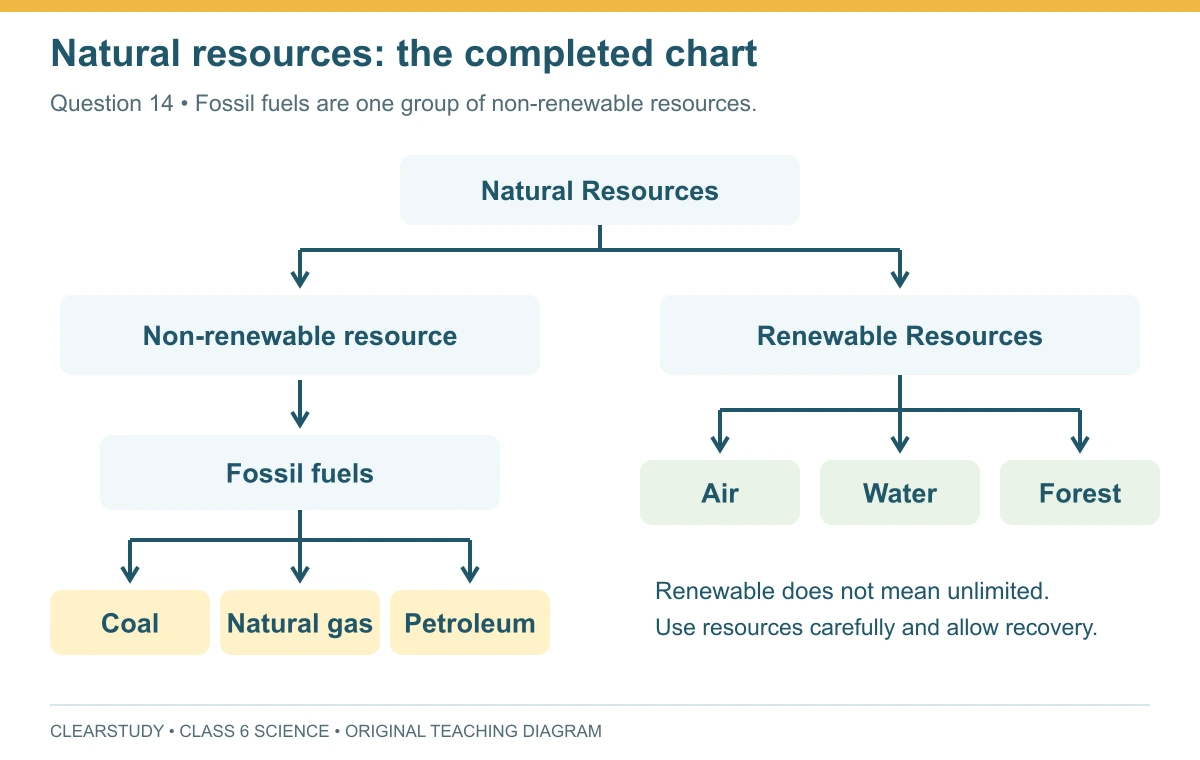
14. Fill up the blanks using the following terms—(fossil fuels, forest, air, petroleum, coal, water and non-renewable resource)
| Position in chart | Correct term |
|---|---|
| Natural Resources → Renewable Resources (examples) | air, water and forest |
| Natural Resources → Non-renewable resource (category) | non-renewable resource |
| Non-renewable resource → Fossil fuels (group) | fossil fuels |
| Fossil fuels (examples, with Natural gas) | coal and petroleum |
15. There is an increasing demand of trees to meet the requirements of industries and for housing. Therefore, trees are being felled. Is it justified? Discuss and prepare a brief report.
16. Propose a plan to use less water in your school. What steps would you take to make this plan happen and how would it help the environment?
Common Mistakes to Avoid
Watch out for these
- Calling soil, rocks and minerals renewable — they form over thousands to millions of years, so they are non-renewable.
- Mixing up the air composition — remember nitrogen 78%, oxygen 21%, and argon + carbon dioxide + others = 1%.
- Thinking we can live longest without oxygen — we can survive days without food or water but only minutes without oxygen.
- Confusing natural and human-made resources — machines, bulbs and bicycles are human-made, not natural.
- Believing all water on Earth is usable — most water is saline; only a small fraction is accessible freshwater.
- Forgetting that fossil fuels (coal, petroleum, natural gas) are all non-renewable and cause air pollution when burnt.
Extra Practice Questions
These questions and MCQs are ClearStudy practice, separate from the NCERT exercise.
Short Answer Type Questions
Q1. What is the composition of air?
Q2. Why can we not survive without air even for a few minutes?
Q3. What is rainwater harvesting? Give one traditional example.
Q4. Differentiate between renewable and non-renewable resources with one example each.
Q5. Why is the Sun called the main source of energy on Earth?
Long Answer Type Questions
Q1. What are fossil fuels? How are they formed and why must we conserve them?
Q2. How can water get polluted, and what can we do to conserve and protect it?
Q3. Describe how wind energy is useful to us.
MCQs & Assertion–Reason
1. The gas present in the largest amount in air is:
(a) oxygen (b) carbon dioxide (c) nitrogen (d) argon
2. The percentage of oxygen in air is about:
(a) 78% (b) 21% (c) 1% (d) 50%
3. Moving air is called:
(a) breeze only (b) wind (c) storm only (d) firki
4. Which of the following is a renewable resource?
(a) coal (b) petroleum (c) forest (d) natural gas
5. Petrol, diesel and kerosene are obtained from:
(a) coal (b) petroleum (c) natural gas (d) water
6. The main source of energy on Earth is:
(a) coal (b) wind (c) the Sun (d) water
7. Stepwells known as Bawadi and Vav are used for:
(a) mining (b) water harvesting (c) generating electricity (d) drying chillies
8. Which of the following is a human-made resource?
(a) air (b) soil (c) bicycle (d) forest
9. Which of these is a non-renewable resource?
(a) water (b) air (c) minerals (d) forest
10. The famous Chipko movement was associated with:
(a) saving water (b) protecting trees (c) reducing air pollution (d) mining marble
For each Assertion–Reason question, choose: (A) Both true and the Reason correctly explains the Assertion; (B) Both true but the Reason is not the correct explanation; (C) Assertion true, Reason false; (D) Assertion false, Reason true.
A-R 1. Assertion: Fossil fuels are called non-renewable resources.
Reason: They take millions of years to form and are found in limited quantities.
A-R 2. Assertion: We must conserve freshwater.
Reason: Most of the water on Earth is saline and only a small fraction of freshwater is easily accessible.
A-R 3. Assertion: A solar cooker does not work at night.
Reason: A solar cooker uses natural gas to cook food.
A-R 4. Assertion: Cutting trees on a large scale lowers the quality of soil.
Reason: Roots hold the soil and fallen leaves decay to enrich it, so removing trees causes soil to wash away and lose nutrients.
A-R 5. Assertion: Air is a non-renewable resource.
Reason: Air is renewed by natural processes within a reasonable period of time.
Quick Revision Summary
- Resources we get from nature are natural resources: air, water, energy from the Sun, forests, soil, rocks, minerals and fossil fuels.
- Things made by humans (bulbs, furniture, solar panels, bicycles) are human-made resources.
- Air = 78% nitrogen + 21% oxygen + 1% (argon, CO₂ and others); moving air is wind, used in windmills.
- Most water is saline; conserve freshwater by saving water and rainwater harvesting (Bawadi, Vav).
- The Sun is the main source of energy; fossil fuels (coal, petroleum, natural gas) form over millions of years.
- Renewable resources (air, water, forests) can be replenished naturally, but renewal may take time and does not justify overuse; non-renewable resources (minerals, soil, rocks, fossil fuels) do not — use all of them judiciously.
Real-life Applications
The lessons of Nature’s Treasures appear all around us. Windmill farms like Muppandal in Tamil Nadu and the Jaisalmer Wind Park turn free wind into electricity; solar panels on rooftops, street lights and traffic signals harvest sunlight; and homes, schools and stepwells across India store rainwater for the dry season. Switching to CNG, LPG and electric vehicles reduces the smoke from fossil fuels, while events like Van Mahotsav and the spirit of the Chipko movement remind us to protect forests and soil. Practising small habits — turning off taps, walking or cycling, using both sides of paper, and planting trees — helps conserve nature’s treasures for the future, exactly as Gandhiji said: “Earth provides enough to satisfy every man’s need but not for every man’s greed.”
How to write a clear answer
Memorise the air composition (78% / 21% / 1%) and the two lists — renewable (air, water, forests) and non-renewable (minerals, soil, rocks, coal, petroleum, natural gas). In “justify” answers (e.g. why petroleum is non-renewable, why forests are hard to regrow), always give the reason of time taken to form/grow and limited quantity. For diagram questions like the natural-resources chart, place fossil fuels under non-renewable and list coal, petroleum and natural gas as examples. Use the textbook’s real examples — Bawadi, Vav, Chipko movement, Van Mahotsav — to show you have read the chapter.
Frequently Asked Questions
What is Class 6 Science Curiosity Chapter 11 about?
Chapter 11, Nature’s Treasures, is about natural resources — air, water, energy from the Sun, forests, soil, rocks, minerals and fossil fuels. It explains how to classify resources as renewable or non-renewable and why we should conserve and use them judiciously.
What is the difference between renewable and non-renewable resources?
Renewable resources get renewed, replenished or restored by natural processes within a reasonable period of time (for example air, water and forests). Non-renewable resources are limited in quantity and are not replenished within a reasonable time (for example minerals, soil, rocks, coal, petroleum and natural gas).
What is the composition of air according to this chapter?
Air is a mixture of gases — about 78% nitrogen, 21% oxygen, and 1% argon, carbon dioxide and other gases together.
Are these Class 6 Science Curiosity Chapter 11 solutions free?
Yes. All solutions are free and follow the official NCERT Curiosity textbook for 2026–27.