
NCERT Solutions for Class 6 Science (Curiosity) Chapter 12: Beyond Earth (NCERT 2026–27)
These Class 6 Science Curiosity Chapter 12 solutions cover Beyond Earth from the new NCF-2023 textbook (2026–27). The chapter takes you on a journey from the night sky — stars, constellations and the Pole Star — to our Solar System with the Sun, eight planets, moons, asteroids and comets, and finally to the Milky Way Galaxy and the wider Universe. Every “Let us enhance our learning” question is reproduced exactly from the textbook and answered in clear, exam-ready style.
Class 6 Science Curiosity Chapter 12 Solutions – Overview
Chapter 12 of Curiosity, Beyond Earth, is the final chapter of the Grade 6 book. It begins with the wonder of the night sky as seen from dark places like Nubra in Ladakh, and explains how groups of stars form patterns called constellations (the sky is divided into 88 constellations by the International Astronomical Union). It describes the Pole Star (Dhruva tārā), which appears nearly stationary in the North and helps find direction, and well-known patterns like Orion, the Big Dipper (Saptaṛiṣhi) and the Little Dipper. The chapter then explores our Solar System — the Sun (our nearest star), the eight planets (Mercury, Venus, Earth, Mars, Jupiter, Saturn, Uranus, Neptune), natural satellites like the Moon, asteroids, comets and dwarf planets such as Pluto — and ends by zooming out to the Milky Way Galaxy (Ākāśha Gangā) and the vast Universe.
Key Concepts & Definitions
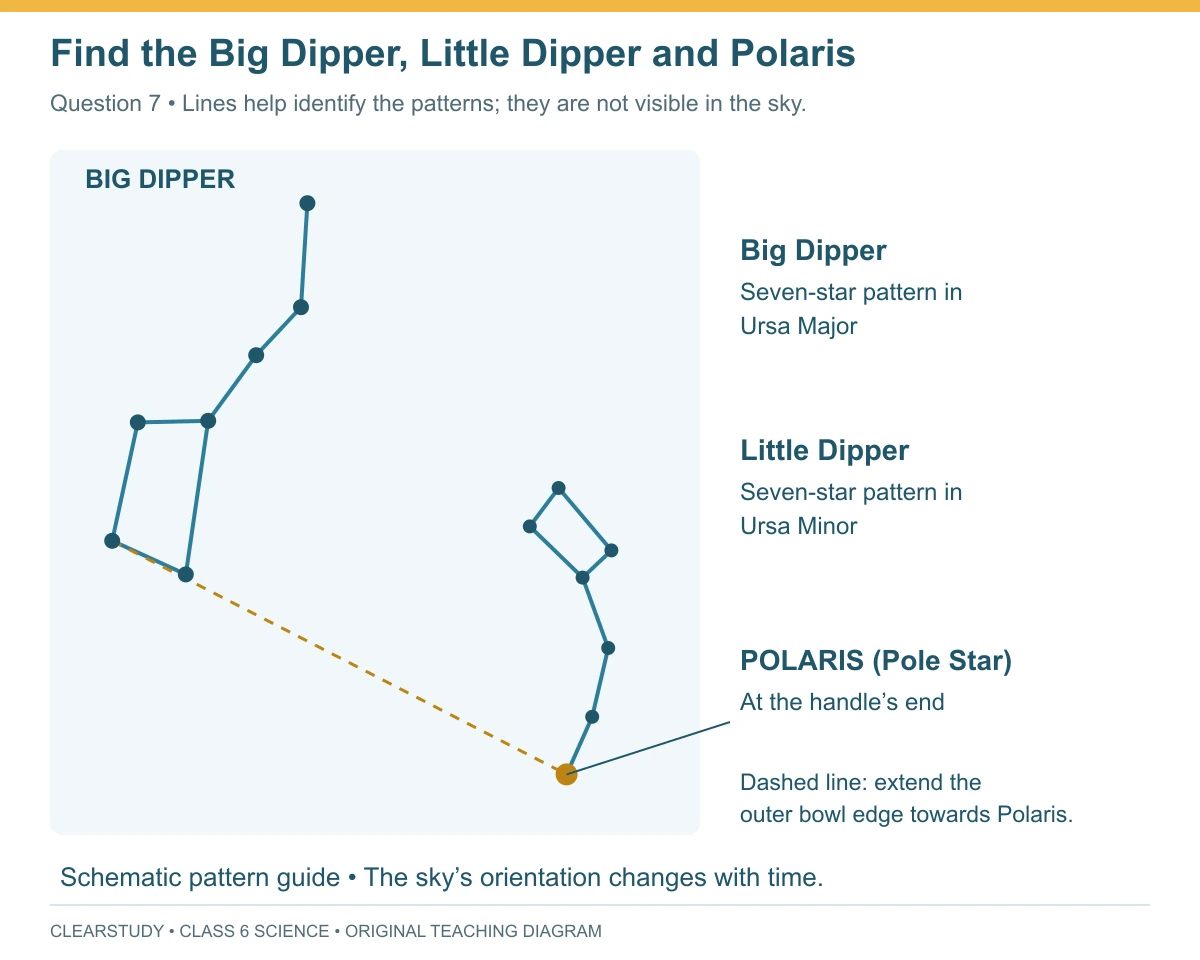
The Big Dipper and Little Dipper are star patterns (asterisms) within Ursa Major and Ursa Minor. They are not two additional official constellations. See the IAU constellation explanation.
Star: a huge, hot ball of gases that shines with its own light. The Sun is the star nearest to us.
Constellation: a defined region of the sky that usually includes a recognisable pattern of stars. The whole sky is divided into 88 constellations.
Pole Star (Polaris): a star in the Little Dipper that appears nearly stationary in the North and helps locate the North direction in the Northern hemisphere.
Revolution: the movement of an object around another object, e.g. the Earth around the Sun.
Planet: in this chapter, one of eight large, nearly spherical bodies orbiting the Sun. The full IAU definition also requires it to have cleared its orbital neighbourhood; Pluto does not meet that criterion and is a dwarf planet.
Satellite: an object that moves around a planet. The Moon is Earth’s natural satellite.
Asteroids: small, rocky, irregular objects revolving around the Sun, mostly in the asteroid belt between Mars and Jupiter.
Comets: icy-rocky visitors made of dust, gases, rocks and ice that grow a long tail as they approach the Sun.
Solar System: the Sun, eight planets, their moons, and many smaller objects (asteroids, comets) together.
Milky Way Galaxy (Ākāśha Gangā): our home galaxy, containing billions of stars; our Solar System is a part of it.
Class 6 Science Curiosity Chapter 12 – “Let us enhance our learning” Solutions
Original explanations for Questions 1–11 on pages 249–251 of NCERT Curiosity, Reprint 2026–27. The planet-order and star-pattern figures have been checked against the textbook.
1. Match the column:
| Column I | Column II |
|---|---|
| (i) Satellite of Earth | (d) Moon |
| (ii) Red planet | (c) Mars |
| (iii) Constellation | (a) Orion |
| (iv) Planet which is commonly called an evening star | (b) Venus |
2. (i) Solve the following riddle.
My first alphabet is in MAN but not in CAN
My second alphabet is in ACE and also in FAN
My third alphabet is in RAT and not in CAT
My fourth alphabet is in SUN but not in FUN
I am a planet that moves around the Sun.
(ii) Make two similar riddles by yourself.
3. Which of the following is not a member of our Solar System?
(i) Sirius (ii) Comets (iii) Asteroids (iv) Pluto
4. Which of the following is not a planet of the Sun?
(i) Jupiter (ii) Pluto (iii) Neptune (iv) Saturn
See the IAU’s adopted 2006 planet definition.
5. Which is the brighter star, the Pole Star or Sirius?
6. An artist’s representation of the Solar System is given in Fig. 12.12. Is the order of the planets correct? If not, write the correct order in the boxes in the figure.
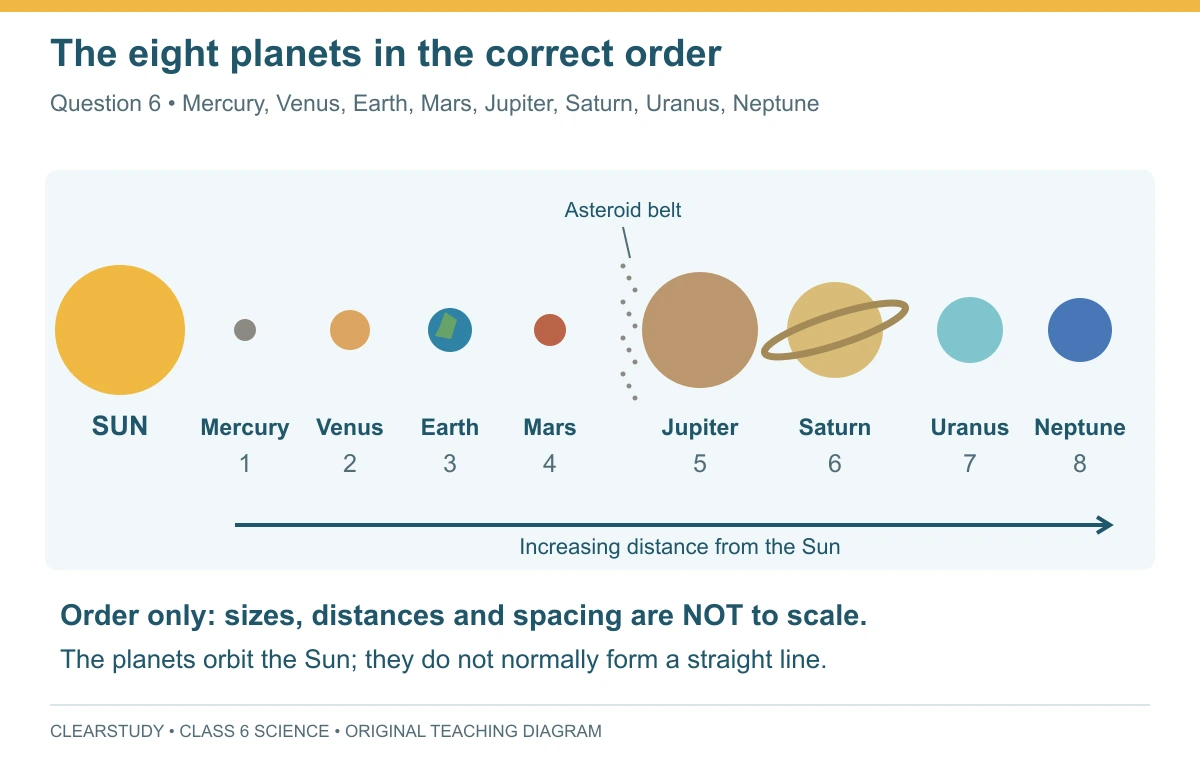
7. A portion of night sky with stars is shown in Fig. 12.13. Look carefully and identify the groups of stars that form the patterns—the Big Dipper and the Little Dipper. Draw lines to connect the stars for these patterns and label them. Also, identify and label the Pole Star. You may refer to Fig. 12.4 for help.
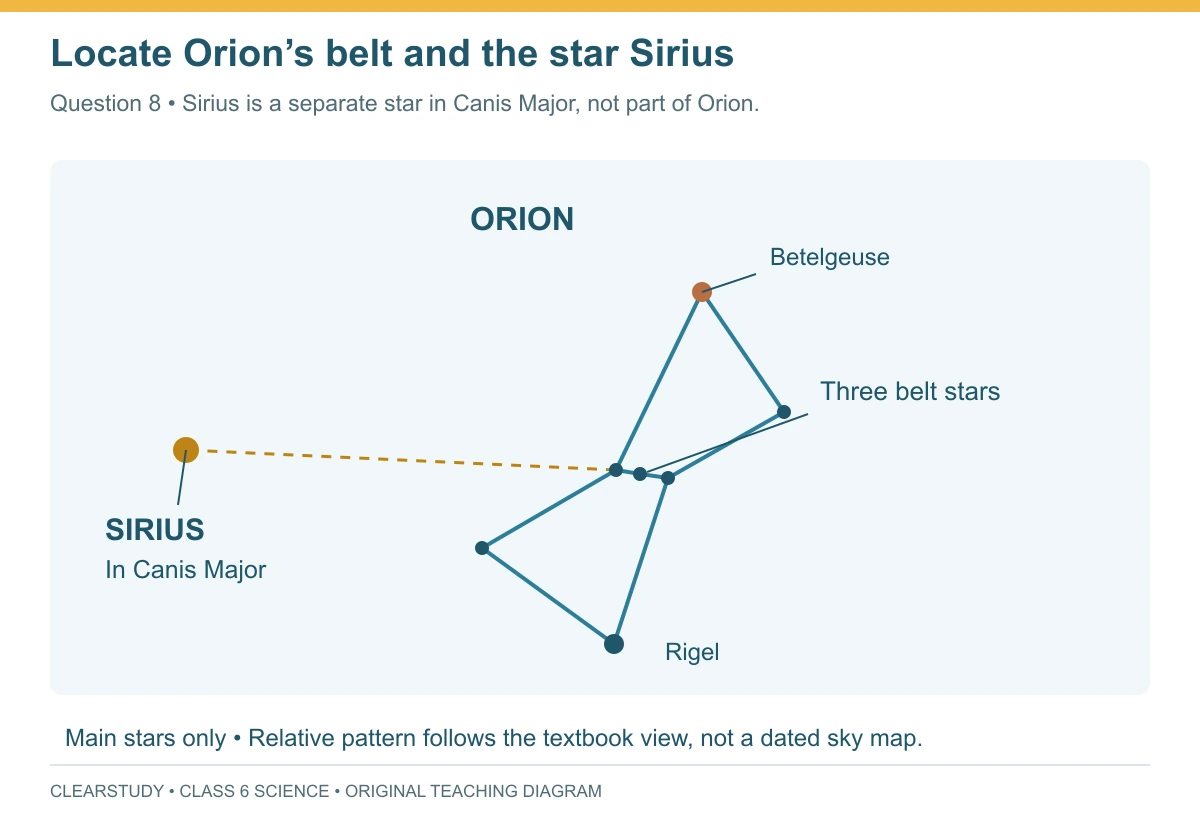
8. A portion of the night sky is shown in Fig. 12.14. Draw lines to connect the stars for Orion and label the star Sirius. You may refer to Fig. 12.3.
9. From Earth, you can see stars fading away at dawn and appearing at dusk. During the day we do not see the stars. Explain why.
10. During a clear night, try to observe the Big Dipper 3–4 times at an interval of 2 to 3 hours. Also try to locate the Pole Star each time. Does the Big Dipper appear to move? Draw a rough sketch to illustrate this, mentioning the time in each case.
11. Think about the night sky and write a poem or a story on it.
Stars are sprinkled like grains of sand.
The Pole Star marks the northern sky,
The Dipper turns as hours go by.
The Moon, our friend, glows soft and bright,
Guarding the Earth all through the night.
So far away, yet shining clear —
The wonders of the sky, beyond our Earth, are near.
Extra Practice Questions
These questions and MCQs are ClearStudy practice, separate from the NCERT exercise.
Short Answer Type Questions
Q1. Why is the Sun called a star?
Q2. Why does Venus appear much brighter than the other planets?
Q3. How can we tell a planet apart from a star in the night sky?
Q4. What are craters on the Moon, and how are most of them formed?
Q5. Why is Mars called the Red Planet?
Long Answer Type Questions
Q1. Describe the main objects that make up our Solar System.
Q2. How does the Pole Star help in finding directions, and why is it useful?
Q3. What are comets? Describe how a comet’s tail forms and why comets are no longer feared.
MCQs & Assertion–Reason
1. The star closest to the Earth is:
(a) Sirius (b) the Pole Star (c) the Sun (d) Proxima Centauri
2. The brightest star in the night sky is:
(a) the Pole Star (b) Sirius (c) Betelgeuse (d) Aldebaran
3. The number of planets in our Solar System is:
(a) seven (b) eight (c) nine (d) ten
4. The Pole Star helps us locate which direction in the Northern Hemisphere?
(a) East (b) West (c) North (d) South
5. Which of these is a natural satellite of the Earth?
(a) Venus (b) the Moon (c) Sirius (d) an asteroid
6. The Big Dipper lies in the constellation:
(a) Orion (b) Taurus (c) Ursa Major (d) Canis Major
7. Pluto is now classified as a:
(a) planet (b) star (c) dwarf planet (d) comet
8. The asteroid belt mostly lies between the orbits of:
(a) Earth and Mars (b) Mars and Jupiter (c) Jupiter and Saturn (d) Venus and Earth
9. Our home galaxy is called the:
(a) Solar System (b) Milky Way Galaxy (c) asteroid belt (d) Universe
10. The Moon takes about how long to complete one revolution around the Earth?
(a) 1 day (b) 7 days (c) 27 days (d) 365 days
For each Assertion–Reason question, choose: (A) Both true and the Reason correctly explains the Assertion; (B) Both true but the Reason is not the correct explanation; (C) Assertion true, Reason false; (D) Assertion false, Reason true.
A-R 1. Assertion: We cannot see other stars during the daytime.
Reason: The extreme brightness of the Sun overpowers the faint light of the far-away stars.
A-R 2. Assertion: The Pole Star helps us find the North direction.
Reason: The Pole Star appears nearly stationary in the North while other stars seem to move.
A-R 3. Assertion: Venus is called the Morning Star or the Evening Star.
Reason: Venus is actually a star that shines at dawn and dusk.
A-R 4. Assertion: All the planets shine with their own light.
Reason: We see planets mainly by the sunlight they reflect.
A-R 5. Assertion: A comet grows a long tail as it comes close to the Sun.
Reason: Near the Sun, comet ice releases gas and dust, which sunlight and the solar wind push into tails.
Quick Revision Summary
- The sky is divided into 88 constellations, including Orion, Ursa Major and Ursa Minor. The Big Dipper and Little Dipper are patterns within the last two regions.
- The Pole Star appears nearly stationary in the North and helps locate direction in the Northern hemisphere.
- The Sun is a star — the star closest to us — that produces heat and light and is the main source of energy on Earth.
- A planet is a large, nearly spherical object that revolves around the Sun; the eight planets in order from the Sun are Mercury, Venus, Earth, Mars, Jupiter, Saturn, Uranus, Neptune.
- The Earth revolves around the Sun in nearly one year; the Moon revolves around the Earth in nearly 27 days.
- The Solar System = the Sun, eight planets, their moons, and many smaller objects including asteroids and comets. Pluto is a dwarf planet.
- Our Solar System is part of the Milky Way Galaxy (Ākāśha Gangā), and there are many more galaxies in the vast Universe.
Common Mistakes to Avoid
Watch out for these
- Calling Sirius or the Pole Star a member of the Solar System — they are far-away stars, not Solar System objects.
- Treating Pluto as a planet — since 2006 it is a dwarf planet.
- Thinking Venus is a star because it is called the Morning/Evening Star — it is actually a planet.
- Believing stars disappear in the daytime — they are always there; the Sun’s glare just hides them.
- Mixing up rotation (spinning on its axis, about 24 hours for Earth) with revolution (going around the Sun, about one year for Earth).
- Forgetting the correct order of planets from the Sun — use a memory sentence to remember it.
How to write a clear answer
Learn the order of the eight planets and the difference between a planet, a satellite, an asteroid and a comet. Remember key facts with numbers — the sky has 88 constellations, the Moon takes about 27 days to revolve around the Earth and is about a quarter of Earth’s diameter, and Pluto is a dwarf planet (since 2006). For activity-based questions (Big Dipper, Orion, Pole Star), describe the steps clearly even if you cannot draw, and always give reasons (e.g. why stars are invisible by day, why the Big Dipper seems to move) instead of one-word answers.
Frequently Asked Questions
What is Class 6 Science Curiosity Chapter 12 Beyond Earth about?
Chapter 12, Beyond Earth, explores the night sky and space — stars and constellations, the Pole Star and how it helps find direction, our Solar System (the Sun, eight planets, moons, asteroids and comets), and finally the Milky Way Galaxy and the wider Universe.
How many planets are there in our Solar System, and in what order?
There are eight planets. In order of increasing distance from the Sun they are Mercury, Venus, Earth, Mars, Jupiter, Saturn, Uranus and Neptune.
Is Pluto a planet?
No. Pluto was once called a planet, but in 2006 the International Astronomical Union (IAU) redefined a planet, and Pluto is now classified as a dwarf planet.
Why can we not see stars during the day?
Sunlight scattered by Earth’s atmosphere makes the daytime sky bright. Other stars are still present, but their faint light is normally difficult to distinguish against this background with the unaided eye.
Are these Class 6 Science Curiosity Chapter 12 solutions free?
Yes. All solutions are free and follow the official NCERT Curiosity textbook for session 2026–27.