
NCERT Solutions for Class 6 Social Science (Exploring Society) Chapter 11: Grassroots Democracy – Part 2: Local Government in Rural Areas (NCERT 2026–27)
These Class 6 Social Science Exploring Society Chapter 11 solutions cover Grassroots Democracy – Part 2: Local Government in Rural Areas from Exploring Society: India and Beyond, the NCERT textbook (2026–27 reprint). The chapter belongs to the theme Governance and Democracy and explains the Panchayati Raj system, its three-tier structure (Gram Panchayat, Panchayat Samiti and Zila Parishad), the role of the Gram Sabha and the Sarpanch, and why local self-government is so important in a democracy. Below you get step-by-step answers to all Questions, activities and projects, clear notes on key terms, extra practice, MCQs, Assertion–Reason and FAQs.
Class 6 Social Science Exploring Society Chapter 11 – Overview
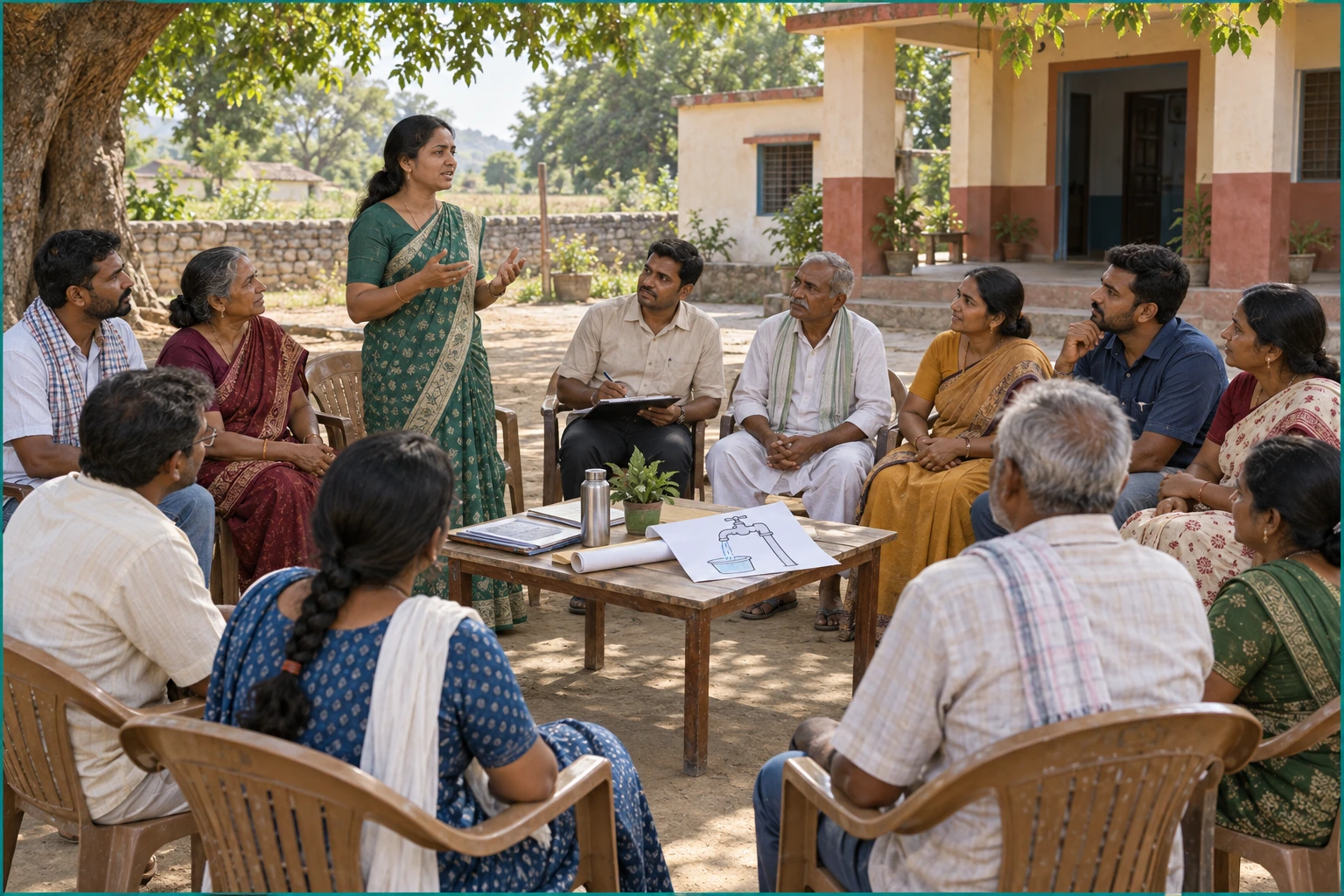
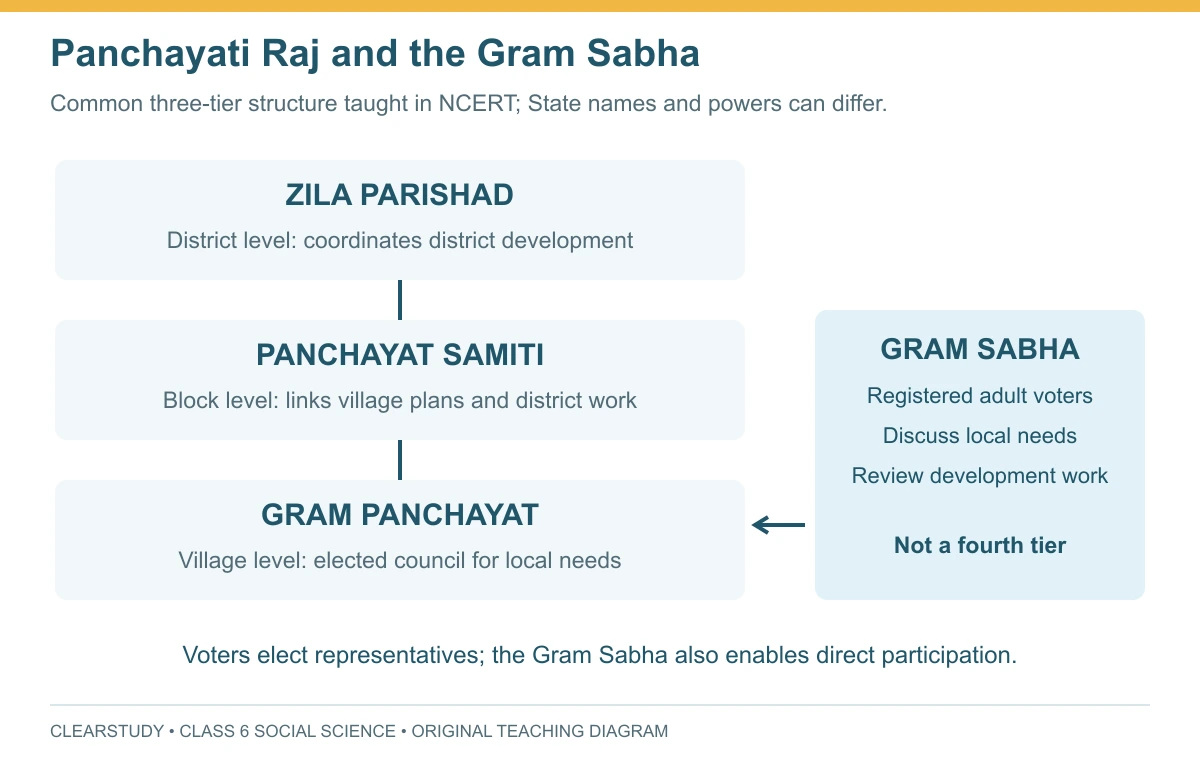
Chapter 11, Grassroots Democracy – Part 2: Local Government in Rural Areas, shows how the government works at the local level in rural India. NCERT gives rounded background figures of about 600,000 villages and a large rural population; these are textbook context, not a live population count. Using the example of Lakshmanpur, a small Himalayan village, it explains that villages participate in local self-government through institutions such as the Panchayat (village council). This Panchayati Raj works as a three-tier system — the Gram Panchayat at the village level, the Panchayat Samiti at the block level and the Zila Parishad at the district level. The Gram Panchayat is elected by the Gram Sabha (all adult voters of the village) and is headed by a Sarpanch or Pradhan. The chapter highlights inspiring Sarpanchs, Child-Friendly Panchayat initiatives, the constitutional minimum reservation of one-third of directly elected seats for women, and even Kauṭilya’s ancient Arthaśhāstra, to show how local democracy lets villagers manage their own development.
Key Concepts & Terms
Panchayat: a village council; the system of local self-government in rural India, also called Panchayati Raj. It brings governance closer to the people and lets them take part in decision-making.
Panchayati Raj (three-tier system): local government in rural areas organised at three levels — the village (Gram Panchayat), the block (Panchayat Samiti) and the district (Zila Parishad).
Gram Sabha: the group of all adults of a village (or group of neighbouring villages) who are enrolled as voters. Members discuss local matters in Gram Sabha meetings. Registered voters elect Panchayat representatives through the local election process.
Gram Panchayat: the village-level council, closest to the people, whose members are elected directly by the Gram Sabha.
Sarpanch (or Pradhan): the elected head or president of a Gram Panchayat. In recent years, more and more women have become Sarpanchs.
Panchayat Secretary: an official who assists the Gram Panchayat with administrative work such as calling meetings and maintaining records.
Patwari: an officer in many parts of India who maintains the villagers’ land records and sometimes keeps very old maps.
Panchayat Samiti: the block-level institution that links the Gram Panchayats with the Zila Parishad and coordinates development plans across villages.
Zila Parishad: the district-level institution at the top of the three-tier Panchayati Raj system.
Reservation of seats: the constitutional minimum is one-third of directly elected Panchayat seats for women, including seats reserved for SC/ST women. Many States provide 50%. SC/ST seats are also reserved in proportion to their population in the area.
“Questions, activities and projects” — Full Solutions
These solutions follow NCERT’s end-of-chapter questions. Answers and teaching illustrations are ClearStudy explanations; personal and group activities use model responses to adapt.
1. Test yourself — without looking at the text above, can you name the three tiers of the Panchayati Raj system? What are the key functions of each of the three tiers?
2. Write a letter to the Sarpanch regarding the issue of plastic bags lying on the roadside in the village.
The Sarpanch,
Gram Panchayat, Lakshmanpur,
District — (your district) Subject: Request to clear plastic bags lying on the village roadside Respected Sir/Madam, I am a student living in our village. I wish to draw your kind attention to a serious problem. A large number of plastic bags are lying scattered along the roadsides of our village. They make the village look dirty, choke the drains, and are sometimes eaten by stray cows and goats, which harms their health. Burning them also pollutes the air. I request you to please arrange for the regular collection and proper disposal of this plastic waste, place dustbins at suitable places, and encourage villagers to use cloth or paper bags instead of plastic. Please place this issue before the Gram Sabha and coordinate waste reduction and collection under the applicable rules. Thank you for your kind attention. I hope you will take quick action to keep our village clean and healthy. Yours sincerely,
(Your name)
(Address)
Date: __________
3. In your view, what type of person should be a Gram Panchayat member?
4. Let us suppose that you study in a village school. The school is located next to a highway and students find it difficult to cross the road when they come to school or leave at the end of the day. What are the options to solve this issue? Which institutions in the Panchayati Raj can help you? What can the students do?
Extra Practice Questions
These questions and MCQs are ClearStudy practice, separate from the NCERT exercise.
Short Answer Type Questions
Q1. What is a Panchayat?
Q2. What is the Gram Sabha?
Q3. Who is a Sarpanch?
Q4. Why is the Panchayati Raj called a ‘three-tier system’?
Q5. How does the Panchayati Raj system support women and disadvantaged groups?
Long Answer Type Questions
Q1. Explain the structure and working of the Panchayati Raj system in India.
Q2. Why are the Panchayati Raj institutions important for democracy in India?
Q3. Describe, with examples, how Gram Panchayats and Bal Panchayats have brought positive change in villages.
MCQs & Assertion–Reason
1. The system of local self-government in rural India is called:
(a) Municipality (b) Panchayati Raj (c) Legislative Assembly (d) Parliament
2. The Panchayati Raj works as a:
(a) one-tier system (b) two-tier system (c) three-tier system (d) four-tier system
3. The members of the Gram Panchayat are elected directly by the:
(a) Sarpanch (b) Gram Sabha (c) Zila Parishad (d) Panchayat Secretary
4. The elected head of a Gram Panchayat is called the:
(a) Patwari (b) Secretary (c) Sarpanch (d) Mayor
5. The institution at the block level in the Panchayati Raj system is the:
(a) Gram Panchayat (b) Panchayat Samiti (c) Zila Parishad (d) Gram Sabha
6. The topmost tier of the Panchayati Raj system is the:
(a) Gram Panchayat (b) Panchayat Samiti (c) Zila Parishad (d) Gram Sabha
7. The official who maintains the villagers’ land records is called the:
(a) Sarpanch (b) Patwari (c) Pradhan (d) Mayor
8. What is the constitutional minimum fraction of directly elected Panchayat seats reserved for women?
(a) one-half (b) one-fourth (c) one-third (d) two-thirds
9. The Pradhan Mantri Gram Sadak Yojana promotes the construction of:
(a) schools (b) hospitals (c) all-weather roads in rural areas (d) dams
10. The ancient text Arthaśhāstra, which describes administration from the village upwards, was written by:
(a) Kauṭilya (Chāṇakya) (b) Kalidasa (c) Ashoka (d) Aryabhata
For each Assertion–Reason question, choose: (A) Both true and the Reason correctly explains the Assertion; (B) Both true but the Reason is not the correct explanation; (C) Assertion true, Reason false; (D) Assertion false, Reason true.
A-R 1. Assertion: The Panchayat is a form of self-government.
Reason: It brings governance closer to the people and lets them actively take part in decision-making.
A-R 2. Assertion: The Gram Panchayat is the tier closest to the people in rural areas.
Reason: The Zila Parishad works at the district level.
A-R 3. Assertion: The constitutional minimum reservation for women in directly elected Panchayat seats is one-third.
Reason: This provision helps more women take part in local government.
A-R 4. Assertion: The structure and functions of Panchayati Raj institutions differ a little across States.
Reason: The States have authority over those institutions.
A-R 5. Assertion: People must go to the State or national capital to solve every small village problem.
Reason: The Panchayati Raj system lets villagers manage local issues themselves.
Exam Tips & Common Mistakes
How to write a clear answer
Memorise the three tiers in order — Gram Panchayat (village), Panchayat Samiti (block), Zila Parishad (district) — and one key function of each. Clearly separate the Gram Sabha (all adult voters who elect) from the Gram Panchayat (the elected council). Remember the constitutional minimum of one-third for women (many States provide 50%) and the meaning of direct democracy (Gram Sabha) versus elected representatives. For letter and activity questions, follow proper format and give practical, village-based solutions. Use the textbook’s own examples — Lakshmanpur, Hiware Bazar, Bal Panchayats, the Pradhan Mantri Gram Sadak Yojana and Kauṭilya’s Arthaśhāstra — to show you have studied the chapter.
Common mistakes to avoid
- Confusing the Gram Sabha (all adult voters) with the Gram Panchayat (the elected council).
- Mixing up the three tiers — remember village → block → district.
- Thinking the Sarpanch is appointed; the Sarpanch is elected as the head of the Gram Panchayat.
- Treating one-third as an exact uniform figure: it is the constitutional minimum for directly elected seats reserved for women.
- Writing the letter (Q2) without a proper format — include To, Subject, body, and signature.
- Leaving activity questions blank — give practical solutions and your own examples.
Frequently Asked Questions
What is Chapter 11 of Class 6 Social Science Exploring Society about?
Chapter 11, Grassroots Democracy – Part 2: Local Government in Rural Areas, explains the Panchayati Raj system — the three-tier rural local government made up of the Gram Panchayat, Panchayat Samiti and Zila Parishad — the role of the Gram Sabha and Sarpanch, and why local self-government is important in a democracy.
What are the three tiers of the Panchayati Raj system?
The three tiers are the Gram Panchayat at the village level, the Panchayat Samiti at the block level and the Zila Parishad at the district level. This is why the Panchayati Raj is called a three-tier system.
What is the exercise heading for Chapter 11 of Exploring Society Class 6?
The end-of-chapter exercise in Exploring Society: India and Beyond Chapter 11 is headed Questions, activities and projects and contains 4 questions, all answered step by step on this page.
Reviewed against NCERT, Exploring Society: India and Beyond, Chapter 11 (2026–27 reprint). Content reviewed 9 October 2026.
Further checks: Ministry of Panchayati Raj: women’s reservation; State Acts and rules; MoRTH technical circulars, including removal of speed breakers on National Highways.