
NCERT Solutions for Class 6 Social Science (Exploring Society) Chapter 12: Grassroots Democracy – Part 3: Local Government in Urban Areas
These Class 6 Social Science Exploring Society Chapter 12 solutions cover Grassroots Democracy – Part 3: Local Government in Urban Areas from Exploring Society: India and Beyond, the NCERT textbook (2026–27 reprint). The chapter belongs to the theme Governance and Democracy and explains what urban local bodies are, how cities and towns are divided into wards, the functions these bodies perform, the three types of urban local body (Municipal Corporation, Municipal Council and Nagar Panchayat), and the duties of citizens in a participatory democracy. Below you get step-by-step answers to all Questions, activities and projects, clear notes on key terms, extra practice, MCQs, Assertion–Reason and FAQs.
Class 6 Social Science Exploring Society Chapter 12 – Overview
Chapter 12, Grassroots Democracy – Part 3: Local Government in Urban Areas, completes the story of grassroots democracy by moving from the village to the city. Cities like Kolkata, Chennai and Mumbai are larger, busier and more diverse than villages, so their governance must be more complex too. Local government structures in towns and cities are called urban local bodies. They are decentralised, which means local communities have a direct say in how their areas are managed. Cities are divided into smaller units called wards, looked after by ward committees. Urban local bodies care for infrastructure, garbage collection and disposal, burial grounds, government schemes and the collection of local taxes and fines. The three types are Municipal Corporation for larger urban areas, Municipal Council for smaller urban areas, and Nagar Panchayat for areas transitioning from rural to urban. Actual classifications follow State law and notifications. Because this is a participatory democracy, citizens too have duties, such as segregating waste and reporting problems promptly.
Key Concepts & Terms
Urban local bodies: the local government structures in urban areas (towns and cities) that manage civic affairs close to the people.
Decentralised governance: a system in which, instead of all decisions being taken by a central authority at the top, local communities have a direct say in how their areas are managed and the issues they face.
Participatory democracy: a system of good governance that empowers citizens so they may actively take part in their country’s functioning — at the rural, regional, urban, state or national level.
Ward: a smaller unit into which a city or town is divided; the ward committee facilitates activities such as health camps and anti-plastic campaigns and reports local problems (water leaks, blocked drains, damaged roads) to the authorities.
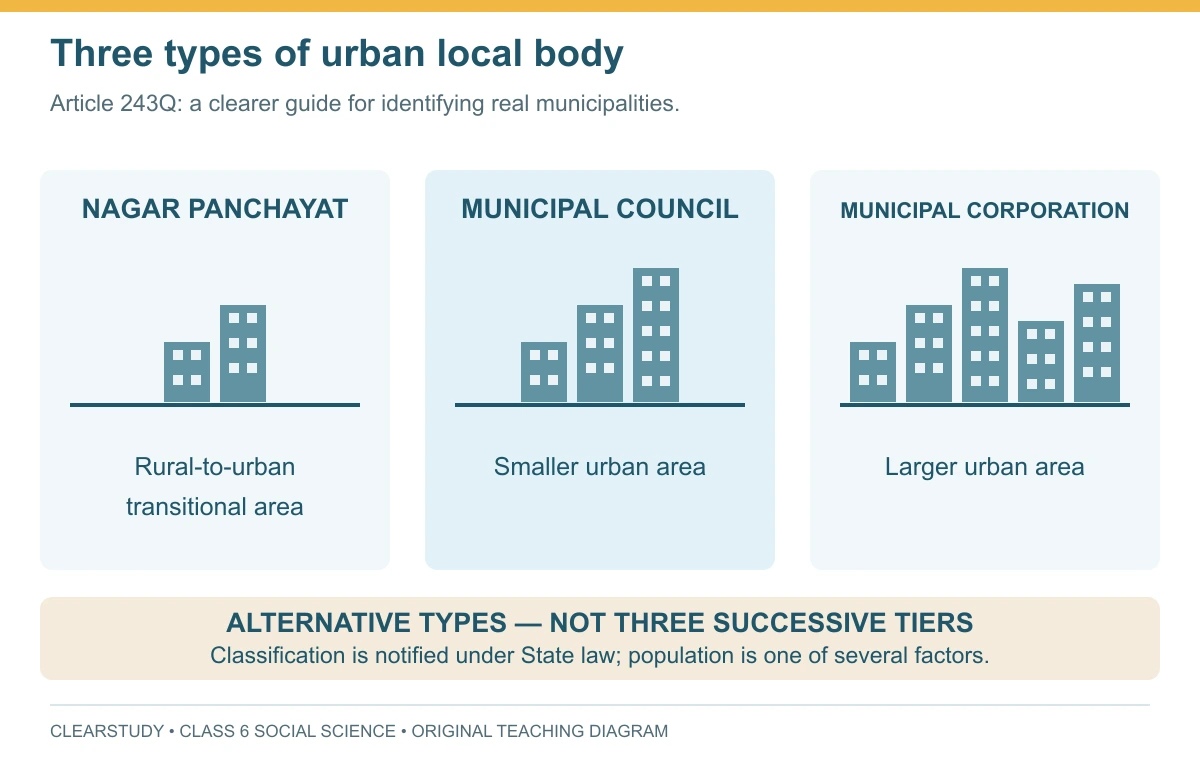
Municipal Corporation (Mahanagar Nigam): a municipality for a larger urban area, as notified under the applicable law.
Municipal Council (Nagar Palika): a municipality for a smaller urban area, as notified under the applicable law.
Nagar Panchayat: a municipality for an area transitioning from rural to urban.
The pyramid of governance: the Indian system of governance rises from the local level (closest to the people) to the State level and then the Union Government at the national level; the local level has a rural side (Panchayati Raj Institutions) and an urban side (urban local bodies).
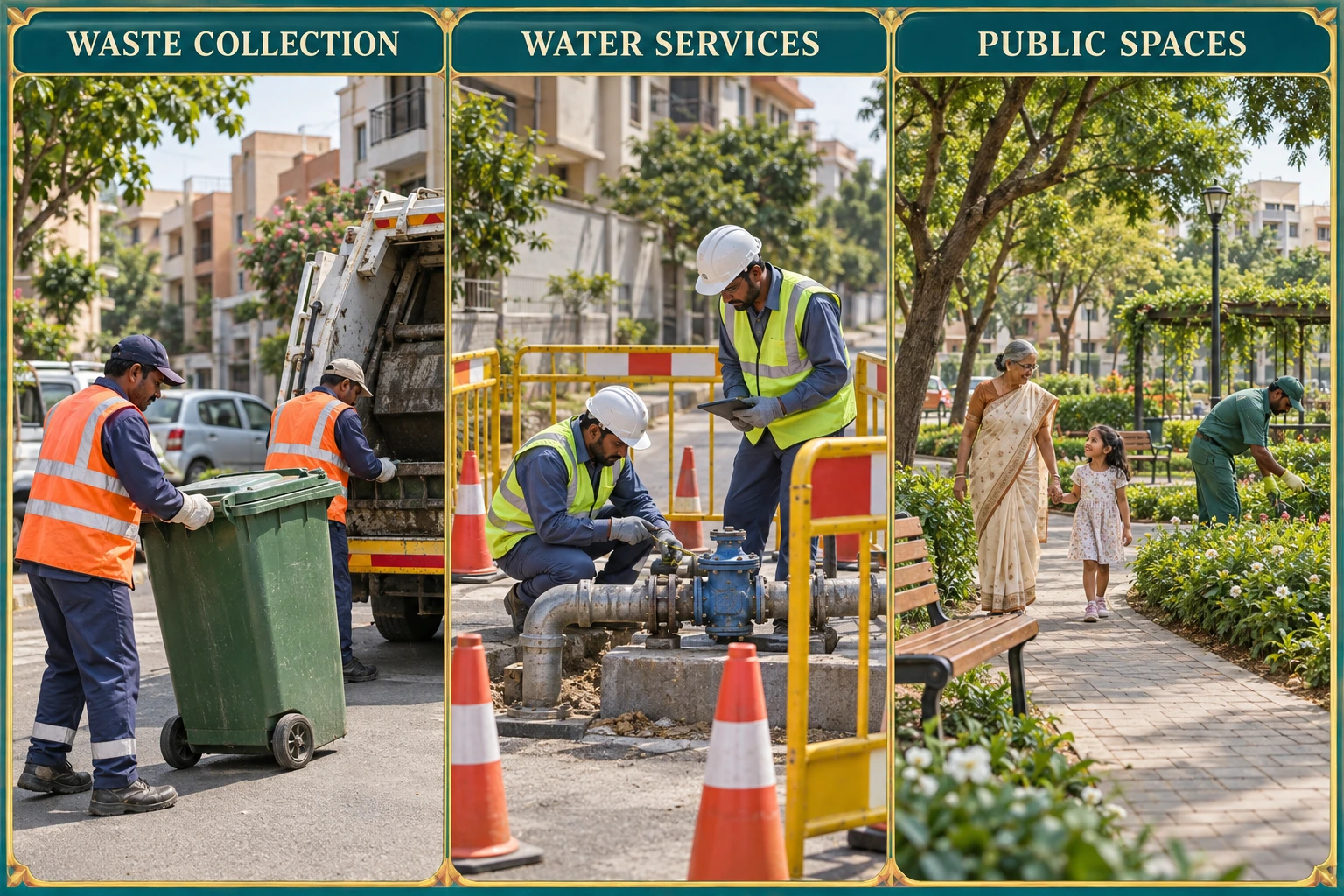
Functions of urban local bodies: caring for infrastructure, maintaining the burial ground, garbage collection and disposal, checking the implementation of government schemes, collecting local taxes and fines, and planning for the area’s economic and social development.
Citizens’ duties: showing care and concern for one’s area — following waste-segregation instructions, reporting water leaks promptly, and cooperating with the local bodies so they can work efficiently.
Some facts from the chapter: the Madras Corporation (now Greater Chennai Corporation), established on 29 September 1688, is the oldest municipal institution in India; the Municipal Corporation of Greater Mumbai was created in 1865; and the textbook’s seven-year Indore example refers to the run ending with Swachh Survekshan 2023, whose awards were announced in January 2024. Indore shared that edition’s top rank with Surat; this is a historical example, not the latest result.
A ward is an electoral area represented by a councillor. Ward committees may cover one or more wards; their formation and functioning depend on constitutional and State provisions. Do not assume every ward has its own separate committee.
“Questions, activities and projects” — Full Solutions
These solutions follow NCERT’s end-of-chapter questions. Answers and teaching illustrations are ClearStudy explanations; personal and group activities use model responses to adapt.
1. On your way to school, you and your friends notice that a water pipe is leaking. A lot of water is being wasted on account of the leak. What would you and your friends do in such a situation?
2. Invite a member of an urban local body near you to your class. Discuss with them their role and responsibilities. Prepare a set of questions to ask them so that the meeting is fruitful.
3. Discuss with adult members of your family and neighbourhood, and make a list of their expectations from the urban local bodies.
4. Make a list of characteristics of a good urban local body.
5. What are the similarities and differences between the Panchayati Raj system in rural areas and the urban local bodies?
| Basis | Panchayati Raj (rural) | Urban local bodies (urban) |
|---|---|---|
| Area | Villages and rural areas | Towns and cities |
| Structure | Gram Sabha & Gram Panchayat, Panchayat Samiti, Zila Panchayat | One notified municipality: Nagar Panchayat, Municipal Council or Municipal Corporation; wards provide local representation |
| Participation | Registered voters participate in the Gram Sabha | Residents contact councillors and use ward forums or committees where constituted |
| Common needs | Village roads, drinking water, sanitation and rural development | Dense urban infrastructure, waste collection, drains and civic services |
| Highest body | Zila Panchayat | The notified Municipal Corporation, Municipal Council or Nagar Panchayat |
Extra Practice Questions
These questions and MCQs are ClearStudy practice, separate from the NCERT exercise.
Short Answer Type Questions
Q1. What are urban local bodies?
Q2. What is a ward, and what does a ward committee do?
Q3. Name the three types of urban local body and the population each is meant for.
Q4. Why does urban governance need to be more complex than rural governance?
Q5. Which is the oldest municipal institution in India, and when was it established?
Long Answer Type Questions
Q1. Describe the main functions performed by urban local bodies.
Q2. Explain the pyramid of governance in India from the local to the national level.
Q3. ‘In a participatory democracy, citizens also have duties.’ Discuss with reference to urban local bodies.
MCQs & Assertion–Reason
1. Local government structures in urban areas are called:
(a) Gram Panchayats (b) urban local bodies (c) Zila Panchayats (d) the Union Government
2. The smaller units into which a city or town is divided are called:
(a) wards (b) districts (c) states (d) villages
3. In NCERT’s simplified population guide, a Municipal Corporation is associated with a population:
(a) below 1 lakh (b) between 1 and 10 lakh (c) above 10 lakh (d) of any size
4. In NCERT’s simplified population guide, the body associated with 1 to 10 lakh is the:
(a) Municipal Corporation (b) Municipal Council (Nagar Palika) (c) Nagar Panchayat (d) Gram Sabha
5. Which urban local body serves an area transitioning from rural to urban?
(a) Nagar Panchayat (b) Municipal Corporation (c) Zila Panchayat (d) State Government
6. The oldest municipal institution in India is the:
(a) Municipal Corporation of Greater Mumbai (b) Indore Municipal Corporation (c) Madras Corporation (Greater Chennai Corporation) (d) Kolkata Municipal Corporation
7. The Madras Corporation was established on:
(a) 29 September 1688 (b) 13 October 1949 (c) in 1865 (d) in 1792
8. A system in which local communities have a direct say in managing their areas, rather than a central authority at the top, is called:
(a) centralised governance (b) decentralised governance (c) monarchy (d) dictatorship
9. Which city does NCERT use as its example of seven consecutive Swachh Survekshan wins, through the 2023 edition?
(a) Mumbai (b) Chennai (c) Indore (d) Kolkata
10. Which of the following is a duty of citizens that helps urban local bodies work efficiently?
(a) ignoring water leaks (b) littering public places (c) following waste-segregation instructions and reporting problems (d) refusing to pay any taxes
For each Assertion–Reason question, choose: (A) Both true and the Reason correctly explains the Assertion; (B) Both true but the Reason is not the correct explanation; (C) Assertion true, Reason false; (D) Assertion false, Reason true.
A-R 1. Assertion: Urban governance needs to be more complex than rural governance.
Reason: Cities are generally more complex and diverse than villages and towns.
A-R 2. Assertion: Urban local bodies are decentralised.
Reason: Local communities have a direct say in how their areas are managed instead of a central authority deciding everything at the top.
A-R 3. Assertion: Every city in India has a Municipal Corporation as its highest urban local body.
Reason: Urban local bodies include Municipal Corporations, Municipal Councils and Nagar Panchayats, classified under the applicable State framework.
A-R 4. Assertion: In a participatory democracy, citizens also have duties towards their area.
Reason: Urban local bodies can perform their functions efficiently only when people show care and concern, such as segregating waste and reporting leaks.
A-R 5. Assertion: Ward committees report local problems such as blocked drains to the authorities.
Reason: Wards are the largest administrative unit of the country, bigger than a state.
Exam Tips & Common Mistakes
How to write a clear answer
Remember the three types of urban local body with NCERT’s simplified population guide — Municipal Corporation (above 10 lakh), Municipal Council (1–10 lakh) and Nagar Panchayat (smaller towns). Learn the meaning of decentralised and participatory democracy, and be ready to list the functions of urban local bodies and the duties of citizens. For comparison questions, use a clear two-column table of similarities and differences between the Panchayati Raj system and urban local bodies. Use the textbook’s own facts — the Madras Corporation (29 September 1688) as the oldest municipal institution, Greater Mumbai’s corporation (1865) and Indore’s Swachh Survekshan record — to show you have studied the chapter.
Common mistakes to avoid
- Using NCERT’s population bands as universal legal cutoffs: check State rules and the official classification of a real city.
- Confusing the rural structure (Gram Panchayat, Panchayat Samiti, Zila Panchayat) with the urban structure (ward committee, then Corporation/Council/Nagar Panchayat).
- Forgetting that a ward is the smallest unit of a city, not a large region.
- Thinking only the government has duties — in a participatory democracy, citizens have duties too.
- Writing that all decisions are taken at the top — urban local bodies are decentralised.
- Leaving activity questions (Q2, Q3) blank — prepare your own questions and lists from real discussions.
Frequently Asked Questions
What is Chapter 12 of Class 6 Social Science Exploring Society about?
Chapter 12, Grassroots Democracy – Part 3: Local Government in Urban Areas, explains what urban local bodies are, how cities are divided into wards, the functions these bodies perform, the three types of urban local body (Municipal Corporation, Municipal Council and Nagar Panchayat) based on population, and the duties of citizens in a participatory democracy.
What is the difference between a Municipal Corporation, a Municipal Council and a Nagar Panchayat?
A Municipal Corporation serves a larger urban area, a Municipal Council a smaller urban area, and a Nagar Panchayat an area transitioning from rural to urban. State law and notifications determine the classification; NCERT’s population bands are a simplified guide, not uniform national cutoffs.
What is the exercise heading for Chapter 12 of Exploring Society?
The end-of-chapter exercise in Exploring Society: India and Beyond Chapter 12 is headed Questions, activities and projects and contains 5 numbered questions, all answered step by step on this page.
Reviewed against NCERT, Exploring Society: India and Beyond, Chapter 12 (2026–27 reprint). Content reviewed 9 October 2026.
Sources for clarification: Election Commission for UTs: municipalities and ward committees; Swachh Survekshan 2023 results, announced January 2024.