
NCERT Solutions for Class 6 Social Science (Exploring Society) Chapter 2: Oceans and Continents (NCERT 2026–27)
These Class 6 Social Science Exploring Society Chapter 2 solutions cover Oceans and Continents from Exploring Society: India and Beyond, the NCERT textbook (2026–27 reprint). The chapter belongs to the theme India and the World: Land and the People and explains why the Earth is called the ‘blue planet’, how water and land are distributed between the hemispheres, the names and sizes of the five oceans and seven continents, what islands are, and how oceans shape climate, support marine life and affect human history. Below you get step-by-step answers to all questions in Questions, activities and projects, clear notes on key terms, extra practice, MCQs, Assertion–Reason and FAQs.
Class 6 Social Science Exploring Society Chapter 2 – Overview
Chapter 2, Oceans and Continents, begins with the view of Earth from space — mostly blue, because almost three-fourths of its surface is covered by water, which is why astronauts lovingly call it the ‘blue planet’. The largest water bodies are oceans, while a large continuous expanse of land is a continent. Water and land are not distributed equally: the Northern Hemisphere has more land than the Southern Hemisphere, but water still covers more than half of each hemisphere. The chapter names the five oceans (Pacific, Atlantic, Indian, Southern and Arctic) and explains that they are all connected. It shows how continents can be counted in different ways — from four to seven — with seven being the most widely used count, and introduces islands such as the Andaman & Nicobar and Lakshadweep groups. Finally, it explains how oceans send rain, produce more than half the world’s oxygen, support rich marine life, and have shaped human migration, trade and culture — while also causing disasters such as cyclones and tsunamis, and now facing serious pollution.
Key Concepts & Terms
Blue planet: a loving name for the Earth, used by early astronauts because almost three-fourths of its surface is covered with water, making it appear mostly blue from outer space.
Ocean: the largest water bodies we see on the globe. The oceans together hold most of the water on the planet, but this seawater is salty and unfit for most land animals to drink.
Landmass & continent: a large body of land is a landmass, and a large continuous expanse of land is a continent. Land covers a little over one-fourth of the globe.
The five oceans: the Pacific Ocean (largest), the Atlantic Ocean (second), the Indian Ocean (third), the Southern or Antarctic Ocean (fourth) and the Arctic Ocean (smallest). The oceans are all interconnected; their dividing lines on a map are only conventions.
Sea, bay and gulf: smaller extensions of the oceans that have various names — such as the Arabian Sea and the Bay of Bengal, the two parts of the Indian Ocean on either side of India.
The seven continents: Africa, Antarctica, Asia, Australia, Europe, North America and South America — the most widely adopted count. Continents may also be counted as four, five or six landmasses (e.g. Eurasia, Africa-Eurasia).
Island: a smaller piece of land surrounded by water on all sides. Greenland is the largest island in the world; India has more than 1,300 small islands.
Marine, flora and fauna: marine means related to the oceans and seas; flora is the plant life (algae and seaweeds) and fauna the animal life (fish, dolphins, whales) of a region or period.
Tsunami: a series of powerful waves caused by a sudden displacement of water, commonly by a strong undersea earthquake; it can travel thousands of kilometres and submerge coastal areas. The 26 December 2004 tsunami affected India and 13 other countries.
Other key terms: Freshwater (the small proportion of water in glaciers, rivers, lakes, the atmosphere and groundwater), cyclone (a violent storm with extreme rainfall or strong winds), and the ‘planet’s lungs’ (the oceans, because their flora produces more than half the world’s oxygen).
“Questions, activities and projects” — Full Solutions
These solutions follow the NCERT end-of-chapter questions (pp. 39–40). Answers and teaching maps are ClearStudy explanations. Complete drawing activities yourself before consulting the labelled map.
1. Explain the following terms: (a) Continent (b) Ocean (c) Island
2. Let us draw – Without looking at the maps in this chapter, draw the continents free hand on a sheet of paper and colour them. Then compare your drawing with the map of oceans and continents in the chapter.
Figure-based activity: this question asks you to draw and then compare with the chapter map, so the answer is given as guidance rather than a fixed solution.
3. Let us do – On the outline map of the world given below, label all the continents and oceans.
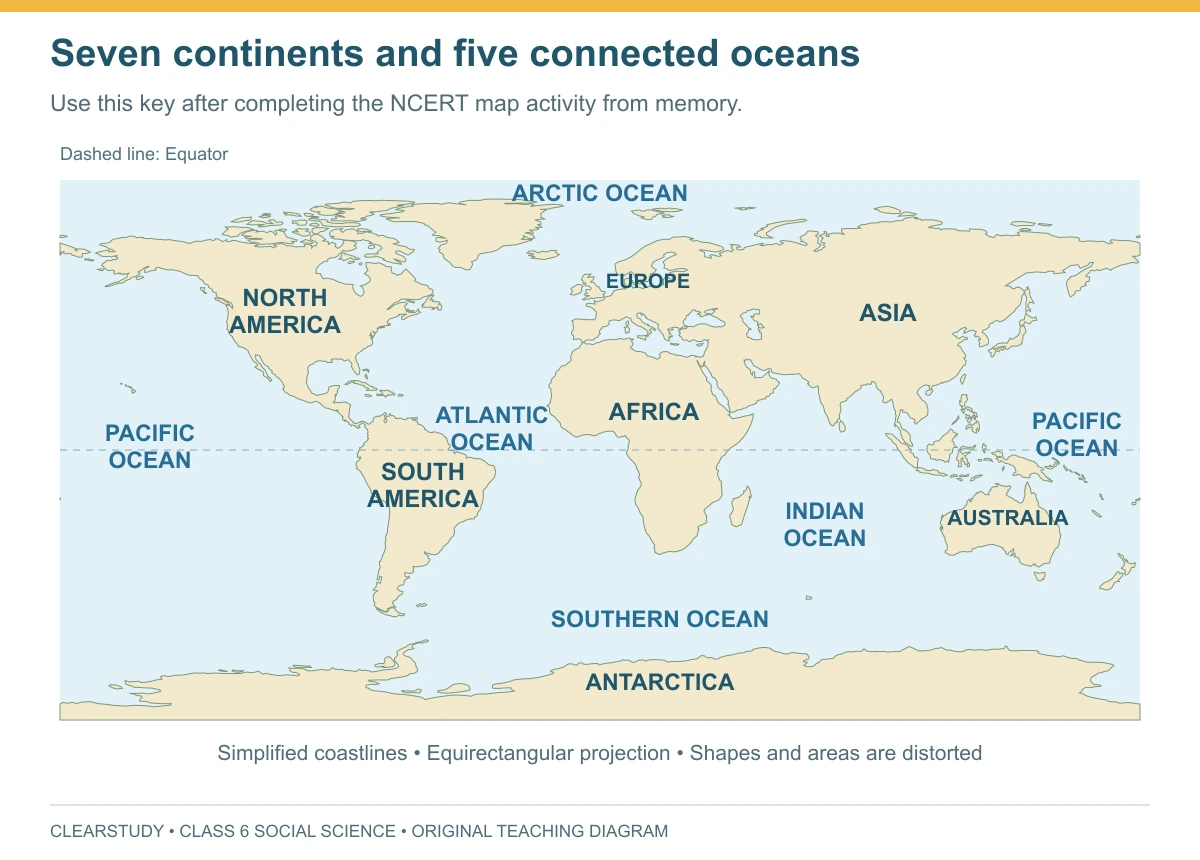
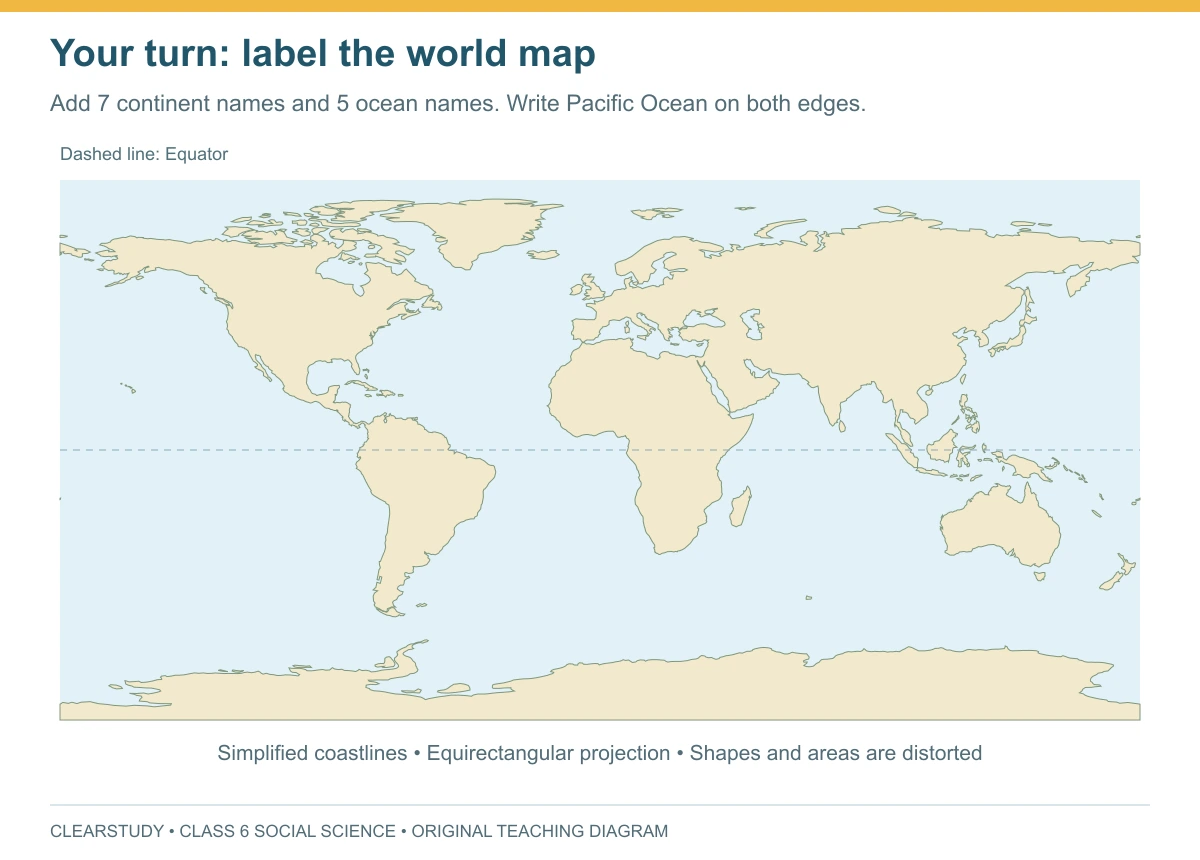
Figure-based activity: the labelling must be done on the outline world map provided in the textbook.
4. Solve this crossword Across 1. Abundantly produced by the oceans 3. A large expanse of landmass 6. A large continent of which India is a part 8. A major source of pollution of the oceans 10. The coldest continent Down 2. The largest island on Earth 4. A huge destructive wave from the ocean 5. The smallest continent 7. The largest body of water on the Earth 9. A landmass (but not a continent) surrounded by the sea or ocean
| Clue | Direction | Answer |
|---|---|---|
| 1. Abundantly produced by the oceans | Across | Oxygen |
| 3. A large expanse of landmass | Across | Continent |
| 6. A large continent of which India is a part | Across | EURASIA (7 squares) |
| 8. A major source of pollution of the oceans | Across | Plastic |
| 10. The coldest continent | Across | Antarctica |
| 2. The largest island on Earth | Down | Greenland |
| 4. A huge destructive wave from the ocean | Down | Tsunami |
| 5. The smallest continent | Down | Australia |
| 7. The largest body of water on the Earth | Down | Pacific |
| 9. A landmass (but not a continent) surrounded by the sea or ocean | Down | Island |
In-text map activities: quick check
| Ocean | Hemisphere(s) |
|---|---|
| Pacific, Atlantic and Indian | Northern and Southern |
| Southern | Southern |
| Arctic | Northern |
In the polar views, circular lines are parallels of latitude; lines meeting at the poles are meridians of longitude. Continents from smallest to largest: Australia, Europe, Antarctica, South America, North America, Africa, Asia. Eurasia is larger than South America.
Extra Practice Questions
These questions and MCQs are ClearStudy practice, separate from the NCERT exercise.
Short Answer Type Questions
Q1. Why is the Earth called the ‘blue planet’?
Q2. Name the five oceans in order from the largest to the smallest.
Q3. Which two parts of the Indian Ocean lie on either side of India?
Q4. What is a tsunami and how is it caused?
Q5. Why are oceans called ‘the planet’s lungs’?
Long Answer Type Questions
Q1. Explain how continents can be counted in different ways, and state the count that is most widely used.
Q2. Describe the many ways in which oceans affect life on Earth, including human life.
Q3. Why is water scarcity a problem even though there is so much water on the planet, and how can we save water?
MCQs & Assertion–Reason
1. Almost what proportion of the Earth’s surface is covered with water?
(a) one-fourth (b) one-half (c) three-fourths (d) nine-tenths
2. Which is the largest ocean on Earth?
(a) Atlantic Ocean (b) Indian Ocean (c) Arctic Ocean (d) Pacific Ocean
3. Which is the smallest of the five oceans?
(a) Southern Ocean (b) Arctic Ocean (c) Indian Ocean (d) Atlantic Ocean
4. The two parts of the Indian Ocean on either side of India are the:
(a) Arabian Sea and the Bay of Bengal (b) Red Sea and the Black Sea (c) Caspian Sea and the Dead Sea (d) North Sea and the Baltic Sea
5. Which is the most widely used count of the number of continents?
(a) four (b) five (c) six (d) seven
6. Which is the largest island in the world?
(a) Greenland (b) Madagascar (c) Sri Lanka (d) Andaman
7. A huge and powerful wave caused by an undersea earthquake or volcanic eruption is called a:
(a) cyclone (b) tsunami (c) tide (d) monsoon
8. The oceans are called ‘the planet’s lungs’ because they:
(a) hold salty water (b) produce more than half the world’s oxygen (c) cause storms (d) connect the continents
9. Which hemisphere contains more land than the Southern Hemisphere?
(a) Southern Hemisphere (b) Eastern Hemisphere (c) Northern Hemisphere (d) Western Hemisphere
10. On which date in 2004 did a powerful tsunami strike India and 13 other countries?
(a) 15 August (b) 2 October (c) 26 December (d) 1 January
For each Assertion–Reason question, choose: (A) Both true and the Reason correctly explains the Assertion; (B) Both true but the Reason is not the correct explanation; (C) Assertion true, Reason false; (D) Assertion false, Reason true.
A-R 1. Assertion: The Earth is called the ‘blue planet’.
Reason: Almost three-fourths of the Earth’s surface is covered with water, which makes it appear mostly blue from space.
A-R 2. Assertion: The five oceans are completely separate from one another.
Reason: The lines that divide the oceans on a map are only conventions, and seawater constantly flows across different oceans.
A-R 3. Assertion: Seawater cannot be used for drinking by most land animals.
Reason: Seawater is salty, while the freshwater we can use forms only a very small proportion of the planet’s water.
A-R 4. Assertion: Oceans bring rainfall to the continents.
Reason: The monsoon rains and the clouds that water the continents originate over the oceans as part of the water cycle.
A-R 5. Assertion: Antarctica has a warm and pleasant climate.
Reason: Since 1981 the Indian Antarctica Programme has been studying the continent’s climate and environment.
Exam Tips & Common Mistakes
How to write a clear answer
Memorise the five oceans in size order (Pacific > Atlantic > Indian > Southern > Arctic) and the seven continents in alphabetical order. Remember the key fractions — water covers about three-fourths and land a little over one-fourth of the Earth. For definition questions (continent, ocean, island), give a one-line meaning plus one example. Practise labelling a blank world map with all continents, all five oceans, and the Arabian Sea and Bay of Bengal around India. Use the textbook’s own facts — Greenland as the largest island, the 2004 tsunami, the oceans as ‘the planet’s lungs’, and World Oceans Day (8 June) — to make answers complete.
Common mistakes to avoid
- Saying there are “seven oceans” — there are five oceans but seven continents.
- Calling the oceans separate — they are all interconnected; the dividing lines are only conventions.
- Confusing the largest ocean (Pacific) with the largest island (Greenland).
- Mixing up a continent (a very large landmass) with an island (a smaller land surrounded by water).
- Forgetting that the Northern Hemisphere has more land than the Southern Hemisphere.
- Leaving drawing or map-labelling activities (Q2 and Q3) blank — complete them neatly on paper.
Frequently Asked Questions
What is Chapter 2 of Class 6 Social Science Exploring Society about?
Chapter 2, Oceans and Continents, explains why the Earth is called the ‘blue planet’, how water and land are distributed between the hemispheres, the names and sizes of the five oceans and seven continents, what islands are, and how oceans shape climate, support marine life and affect human history.
How many oceans and continents are there?
There are five oceans — the Pacific, Atlantic, Indian, Southern (Antarctic) and Arctic. Continents can be counted as four, five, six or seven, but the most widely used count is seven: Africa, Antarctica, Asia, Australia, Europe, North America and South America.
What is the exercise heading for Chapter 2 of Exploring Society?
The end-of-chapter exercise in Exploring Society: India and Beyond Chapter 2 is headed Questions, activities and projects and contains 4 items, all answered step by step on this page.
Reviewed against NCERT, Exploring Society: India and Beyond, Chapter 2, pp. 27–40 (2026–27 reprint). Oxygen explanation: NOAA Ocean Service. Map coastlines: Natural Earth, public-domain 1:110m land data; labels and design by ClearStudy. Reviewed 9 October 2026.