
NCERT Solutions for Class 6 Social Science (Exploring Society) Chapter 3: Landforms and Life (NCERT 2026–27)
These Class 6 Social Science Exploring Society Chapter 3 solutions cover Landforms and Life from Exploring Society: India and Beyond, the NCERT textbook (2026–27 reprint). The chapter belongs to the theme India and the World: Land and the People and explores the three major landforms — mountains, plateaus and plains — their physical features, environments, flora and fauna, and the challenges and opportunities of life in each. Below you get step-by-step answers to every question in the Questions, activities and projects exercise, clear notes on key terms, extra practice, MCQs, Assertion–Reason questions and FAQs.
Class 6 Social Science Exploring Society Chapter 3 – Overview
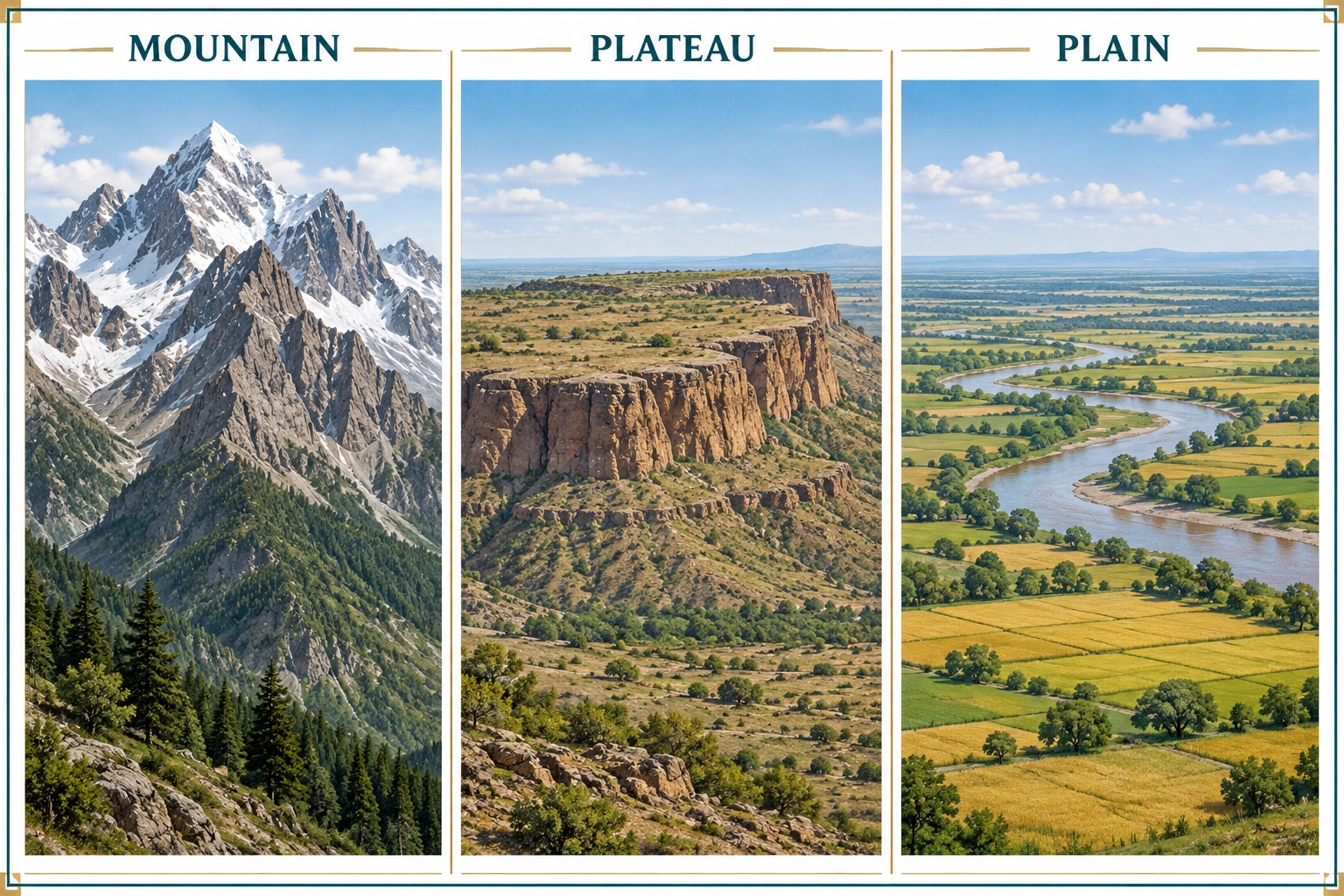
Chapter 3, Landforms and Life, explains that a landform is a physical feature on the surface of the Earth, shaped over millions of years, with a deep connection to the environment and to human life. Landforms are broadly divided into three categories — mountains (much higher than the surrounding land, with a broad base, steep slopes and a narrow summit), plateaus (raised land with a more or less flat surface and often steep sides), and plains (extensive flat or gently undulating land, usually below 300 metres). Each landform has its own climate, flora and fauna, and its own occupations — terrace farming, herding and tourism in the mountains; mining and waterfalls on plateaus; and farming, fishing and river navigation in the fertile plains. The chapter shows how people have adapted to mountains, plateaus, plains and even deserts, facing challenges such as landslides, flash floods and groundwater depletion, while celebrating these landforms in culture, poetry and worship. It is a testimony to human adaptability and resilience.
Key Concepts & Terms
Landform: a physical feature on the surface of the Earth that takes shape over millions of years; the three broad categories are mountains, plateaus and plains.
Altitude: the height of an object above sea level — for example, the altitude of a mountain, a plane in flight or a satellite.
Mountains: landforms much higher than the surrounding landscape, with a broad base, steep slopes and a narrow summit; tall and sharp peaks like the Himalayas are ‘young’, while rounded ones like the Aravalli Range are old.
Hills: highlands with a lower height, less steep slopes and rounded tops — they belong to the same broad type as mountains.
Plateau: a landform that rises up from the surrounding land and has a more or less flat surface, often with steep sides; rich in minerals and called ‘storehouses of minerals’.
Plains: landforms with an extensive flat or gently undulating surface, without large hills or deep valleys, generally not more than 300 metres above sea level; floodplains made fertile by river sediments are ideal for farming.
Precipitation: water from the atmosphere reaching the ground in any form — rain, snow and hail are the most common forms.
Terrace farming: cultivation done on steep mountain slopes by cutting steps into the slope.
Montane forest: a forest that grows in mountainous regions, where conifers such as pines, firs, spruce and deodar are common.
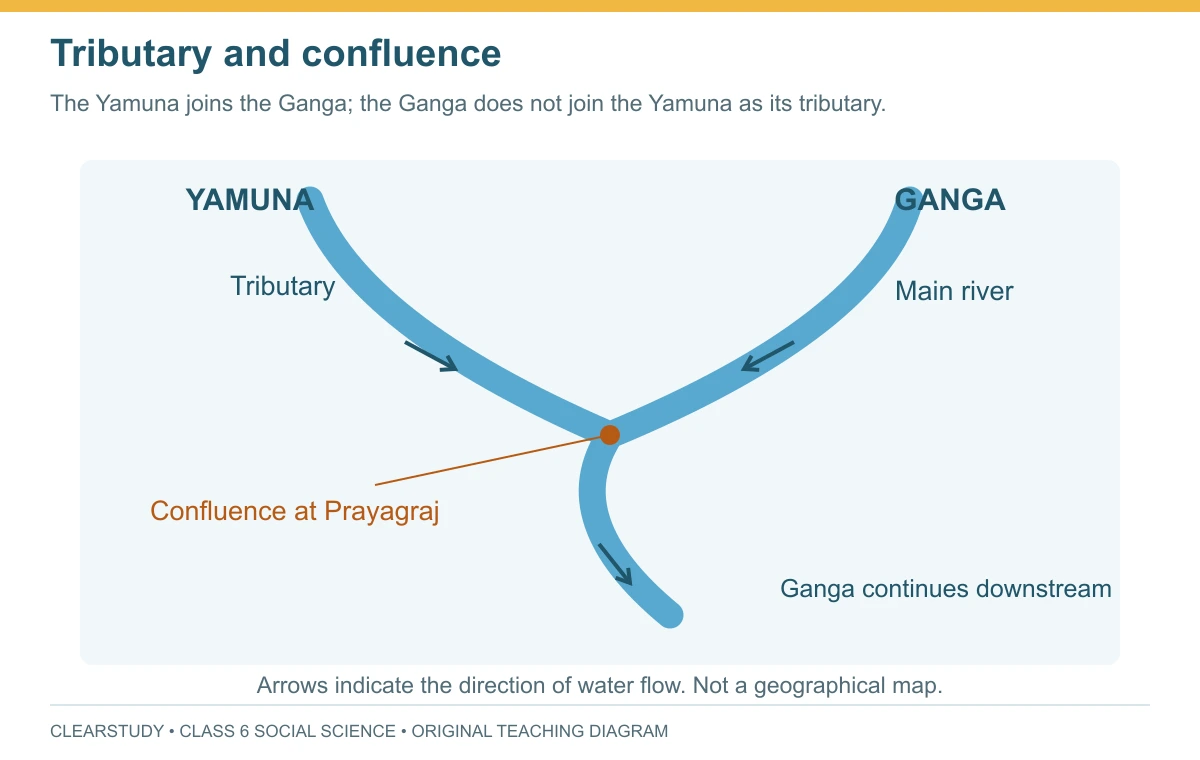
Confluence: the meeting point of two or more rivers, often regarded as sacred.
Other key terms: Terrain (a stretch of land seen from the point of view of its physical features), Valley (a lower area between hills or mountains, often with a river flowing through it), Sediments (particles of rock, sand and silt carried and deposited by rivers), Sea level (the average level of the ocean surface), Resilience (the capacity to meet challenges and adapt to or overcome them), and the desert (a large, dry expanse with very little precipitation and unique flora and fauna).
“Questions, activities and projects” — Full Solutions
These solutions follow NCERT’s five end-of-chapter questions (p. 58). Answers and diagrams are original teaching explanations. For the local-landform activity, replace the model response with your own observations.
1. In what type of landform is your town / village / city located? Which features mentioned in this chapter do you see around you?
2. Let us go back to our initial trip from Chhota Nagpur to Prayagraj and Almora. Describe the three landforms you came across on the way.
3. List a few famous pilgrimage spots in India along with the landforms in which they are found.
| Pilgrimage spot | Landform |
|---|---|
| Kedarnath, Badrinath, Amarnath (Uttarakhand / Kashmir) | Mountains (Himalayas) |
| Vaishno Devi (Trikuta hills, Jammu) | Mountains / hills |
| Prayagraj (Triveni Sangam), Varanasi | Plains (Ganga plain) |
| Tirupati (Tirumala hills, Andhra Pradesh) | Hills (Tirumala in the Seshachalam range) |
| Puri (Jagannath Temple), Odisha | Coastal plain |
| Rameswaram, Tamil Nadu | Low-lying island off the coast |
4. State whether true or false —
• The Himalayas are young mountains with rounded tops.
• Plateaus usually rise sharply at least on one side.
• Mountains and hills belong to the same type of landform.
• Mountains, plateaus and rivers in India have the same types of flora and fauna.
• Ganga is a tributary to the Yamuna.
• Deserts have unique flora and fauna.
• Melting snow feeds rivers.
• Sediments from rivers deposited in the plains makes the land fertile.
• All deserts are hot.
5. Match words in pairs:
| Word | Match |
|---|---|
| Mount Everest | climbing |
| rafting | river |
| camels | desert |
| plateau | roof of the world |
| Gangetic plains | rice fields |
| waterway | Ganga |
| Mount Kilimanjaro | Africa |
| Yamuna | tributary |
Extra Practice Questions
These questions and MCQs are ClearStudy practice, separate from the NCERT exercise.
Short Answer Type Questions
Q1. What is a landform? Name the three major types.
Q2. What is the difference between a mountain and a hill?
Q3. Why are plateaus called ‘storehouses of minerals’?
Q4. How are floodplains formed, and why are they ideal for farming?
Q5. What is terrace farming, and where is it practised?
Long Answer Type Questions
Q1. Describe the mountain environment and the main occupations of people living in the mountains.
Q2. Explain life in the plains, with reference to the Ganga plain.
Q3. What challenges and opportunities are associated with life in the mountains?
MCQs & Assertion–Reason
1. A physical feature on the surface of the Earth that takes shape over millions of years is called a:
(a) climate (b) landform (c) sediment (d) terrain
2. The three broad categories of landforms are:
(a) hills, valleys and deserts (b) mountains, plateaus and plains (c) rivers, lakes and oceans (d) forests, grasslands and deserts
3. The height of an object above sea level is called its:
(a) altitude (b) precipitation (c) confluence (d) terrain
4. Which of these is described as a ‘young’ mountain range with tall and sharp peaks?
(a) Aravalli Range (b) Himalayas (c) Vindhya Range (d) Western Ghats
5. The largest and highest plateau in the world, nicknamed the ‘Roof of the World’, is the:
(a) Deccan Plateau (b) Chhota Nagpur Plateau (c) Tibetan Plateau (d) East African Plateau
6. Cultivation done on steep mountain slopes by cutting steps into the slope is called:
(a) shifting cultivation (b) terrace farming (c) plantation farming (d) mixed farming
7. Plains are generally not more than how many metres above sea level?
(a) 100 metres (b) 300 metres (c) 1,000 metres (d) 4,500 metres
8. The highest mountain in south India, also known as ‘Anai Peak’, is:
(a) Mount Everest (b) Kanchenjunga (c) Anamudi (d) Mont Blanc
9. Which of the following is a cold desert?
(a) Sahara Desert (b) Thar Desert (c) Gobi Desert (d) Kalahari Desert
10. The meeting point of two or more rivers is called a:
(a) valley (b) confluence (c) summit (d) floodplain
For each Assertion–Reason question, choose: (A) Both true and the Reason correctly explains the Assertion; (B) Both true but the Reason is not the correct explanation; (C) Assertion true, Reason false; (D) Assertion false, Reason true.
A-R 1. Assertion: Melting snow on mountains feeds rivers.
Reason: At lower altitudes, snow melts every summer and turns into water that flows into rivers.
A-R 2. Assertion: Floodplains are ideal for growing crops.
Reason: Rivers deposit sediments of rock, sand and silt in the plains, making the soil very fertile.
A-R 3. Assertion: All deserts in the world are hot.
Reason: Deserts are large, dry expanses with very little precipitation.
A-R 4. Assertion: Regular farming is difficult in the mountains.
Reason: The mountain terrain is usually rugged and has steep slopes.
A-R 5. Assertion: The Himalayas have rounded tops like the Aravalli Range.
Reason: The Himalayas are relatively young mountains with many tall, sharp peaks.
Exam Tips & Common Mistakes
How to write a clear answer
Learn the three landforms (mountains, plateaus, plains) and the distinguishing features of each — for mountains: broad base, steep slopes, narrow summit; for plateaus: raised, flat top, steep sides; for plains: flat or gently undulating, often low-lying; river floodplains are commonly fertile. Always link each landform to its environment and main occupations (terrace farming and tourism in mountains, mining on plateaus, agriculture and fishing in plains). Remember the textbook’s named examples — Mount Everest, Kanchenjunga, Anamudi, the Tibetan and Deccan plateaus, the Chhota Nagpur Plateau, the Ganga plain, and hot deserts (Sahara, Thar) versus cold deserts (Gobi). For true/false questions, give a one-line reason for each answer.
Common mistakes to avoid
- Saying the Himalayas have rounded tops — they are young mountains with tall, sharp peaks; rounded tops belong to old ranges like the Aravalli.
- Writing that the Ganga is a tributary of the Yamuna — it is the reverse; the Yamuna is a tributary of the Ganga.
- Assuming all deserts are hot — the Gobi is a cold desert.
- Confusing plateau (raised flat land with steep sides) with plains (extensive flat or gently undulating land, generally low-lying in the textbook examples).
- Forgetting that mountains and hills belong to the same type of landform.
- Leaving observation/activity questions (Q1) blank — write your own example based on where you live.
Frequently Asked Questions
What is Chapter 3 of Class 6 Social Science Exploring Society about?
Chapter 3, Landforms and Life, explains the three major landforms — mountains, plateaus and plains — their physical features, climates, flora and fauna, and the challenges and opportunities of life in each, along with deserts and the cultural importance of landforms in India.
What are the three major types of landforms?
The three major types of landforms are mountains (much higher than the surrounding land, with a broad base, steep slopes and a narrow summit), plateaus (raised land with a flat surface and steep sides) and plains (extensive flat land, usually not more than 300 metres above sea level).
What is the exercise heading for Chapter 3 of Exploring Society?
The end-of-chapter exercise in Exploring Society: India and Beyond Chapter 3 is headed Questions, activities and projects and contains 5 questions (including a true/false set and a matching exercise), all answered step by step on this page.
Reviewed against NCERT, Exploring Society: India and Beyond, Chapter 3, pp. 41–58 (2026–27 reprint). Location checks: Tirupati District; Ramanathapuram District. Reviewed 9 October 2026.