
NCERT Solutions for Class 6 Social Science (Exploring Society) Chapter 5: India, That Is Bharat (NCERT 2026–27)
These Class 6 Social Science Exploring Society Chapter 5 solutions cover India, That Is Bharat from Exploring Society: India and Beyond, the NCERT textbook (2026–27 reprint). The chapter belongs to the theme Tapestry of the Past and explores the ‘Big Questions’ — how we define India and what its many ancient names were. You will learn how Indians named their land (Sapta Sindhava, Jambudvīpa, Bhārata) and how foreigners named it (Hindu, Indoi, Yindu, Hindustān and finally India). Below you get step-by-step answers to all Questions, activities and projects, clear notes on key terms, extra practice, MCQs, Assertion–Reason and FAQs.
Class 6 Social Science Exploring Society Chapter 5 – Overview
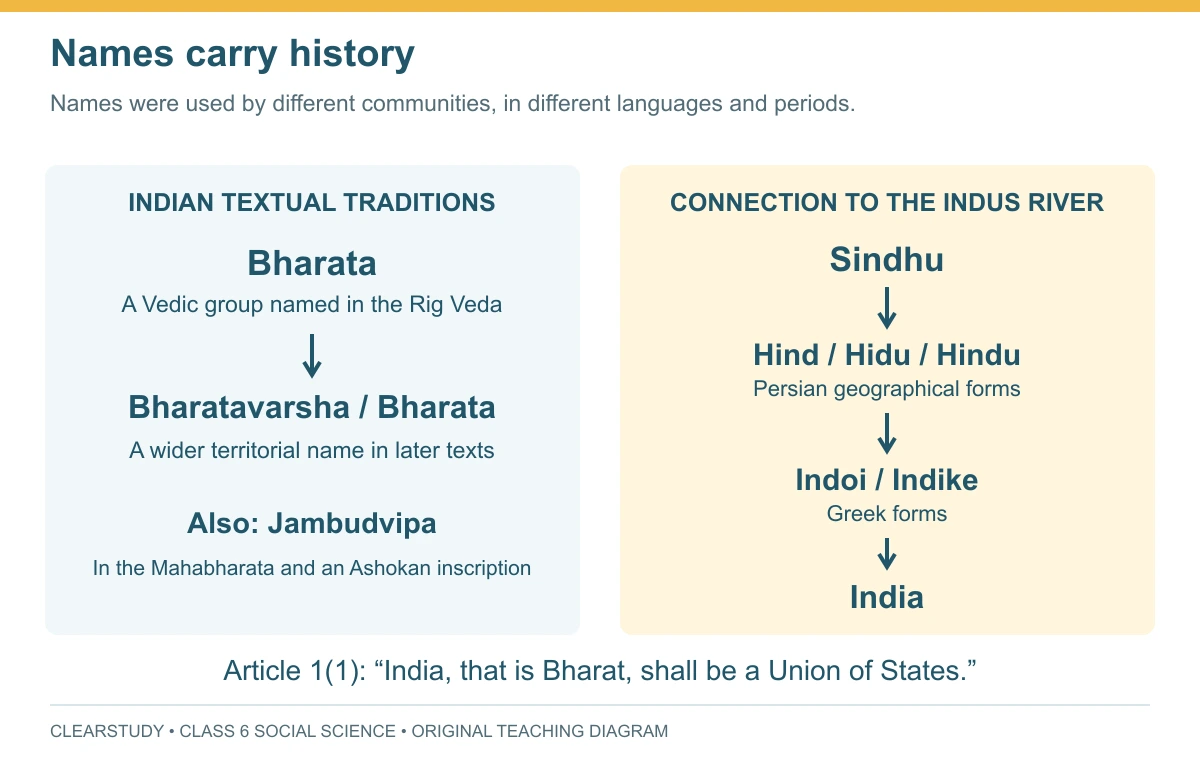
Chapter 5, India, That Is Bharat, answers two ‘Big Questions’: how do we define India, and what were the ancient names for India? The India we know today is a modern nation with fixed borders, but the region often called the Indian Subcontinent has had many names and shifting boundaries over thousands of years. We learn about its past from ancient texts, travellers’ accounts and inscriptions. Indians themselves gave the northwest the name Sapta Sindhava (‘land of the seven rivers’, from Sindhu, the Indus). The Mahābhārata listed many regions and used the terms Bhāratavarṣha (‘the country of the Bharatas’) and Jambudvīpa; Emperor Aśhoka also used ‘Jambudvīpa’ in his inscriptions around 250 BCE. Later, Bhārata became the common name, used even in the opening words of Article 1(1) of the Constitution ‘India, that is Bharat’. Foreigners — Persians, Greeks and Chinese — took names from Sindhu, giving us Hind/Hindu, Indoi/Indike, Yindu, Hindustān and ultimately India.
Key Concepts & Terms
Indian Subcontinent: the large region of the world that today includes India, Pakistan, Bangladesh and neighbouring areas; in the past it had many names and shifting boundaries.
Inhabitants: people who live in a particular place — here, the people who lived in ancient India.
Sources of the past: we learn India’s ancient names from three main sources — ancient texts, accounts of travellers and pilgrims, and inscriptions.
Sapta Sindhava: meaning the ‘land of the seven rivers’, the name the Ṛig Veda (India’s most ancient text) gives to the northwest region. ‘Sindhava’ comes from Sindhu, the Indus River.
Bhāratavarṣha: meaning ‘the country of the Bharatas’, a term in the Mahābhārata that extends to the whole Subcontinent. ‘Bharata’ first appears in the Ṛig Veda as one of the main Vedic groups of people.
Jambudvīpa: meaning ‘the island of the fruit of the jamun (jambul) tree’, a term used in the Mahābhārata and by Emperor Aśhoka (about 250 BCE) for the whole of India, which then included parts of today’s Afghanistan, Bangladesh and Pakistan.
Bhārata / Bharat / Bharatam: the name that became most widespread in time and is still used today — written ‘Bharat’ in north India and often ‘Bharatam’ in the south. The Viṣhṇu Purāṇa describes Bhārata as the country north of the ocean and south of the snowy mountains (the Himalayas).
Constitution: a document that spells out the basic principles and laws of a nation. Article 1(1) of the Indian Constitution, which came into force in 1950, begins with the phrase ‘India, that is Bharat’ (and ‘Bhārat arthāth India’ in Hindi).
Foreign names from Sindhu: the Persians called India Hind / Hidu / Hindu (a purely geographical term, not the religion); the Greeks dropped the ‘h’ to get Indoi / Indike; the Chinese said Yintu / Yindu and Tianzhu (‘heavenly master’). Hindustān first appeared in a Persian inscription about 1,800 years ago and was used by later invaders.
“Questions, activities and projects” — Full Solutions
These solutions follow NCERT’s end-of-chapter questions. Answers and teaching illustrations are ClearStudy explanations; personal and group activities use model responses to adapt.
1. Discuss what could be the meaning of the quotation at the start of the chapter.
This is an interpretation of Sri Aurobindo’s idea of cultural unity. It does not mean that every region had identical beliefs or that the entire Subcontinent always formed one political state.
2. True or false? • The Ṛig Veda describes the entire geography of India. • The Viṣhṇu Purāṇa describes the entire Subcontinent. • In Aśhoka’s time, ‘Jambudvīpa’ included what is today India, parts of Afghanistan, Bangladesh and Pakistan. • The Mahābhārata lists many regions, including Kashmir, Kutch, and Kerala. • The term ‘Hindustān’ first appeared in a Greek inscription more than 2,000 years ago. • In ancient Persian, the word ‘Hindu’ refers to the Hindu religion. • ‘Bhārata’ is a name given to India by foreign travellers.
3. If you were born some 2,000 years ago and had the chance to name our country, what name or names might you have chosen, and why? Use your imagination!
4. Why did people travel to India from various parts of the world in ancient times? What could be their motivations in undertaking such long journeys? (Hint: There could be at least four or five motivations)
Activity (LET’S EXPLORE): The chapter asks you to complete a table of the many names of India. Using the chapter, the names are: Persian — Hind / Hidu / Hindu (and later Hindustān); Greek — Indoi / Indike; Latin — India; Chinese — Yintu / Yindu (also Tianzhu); Arabic & Persian — Hind / al-Hind (Arabic), Hind / Hindustān (Persian); English — India; French — Inde.
Extra Practice Questions
These questions and MCQs are ClearStudy practice, separate from the NCERT exercise.
Short Answer Type Questions
Q1. From which three kinds of sources do we learn the ancient names of India?
Q2. What does the name ‘Sapta Sindhava’ mean, and which text gives this name?
Q3. How did the name ‘India’ develop from the word ‘Sindhu’?
Q4. What does ‘Bhāratavarṣha’ mean, and where does the word ‘Bharata’ first appear?
Q5. Which phrase about India’s name appears at the beginning of the Indian Constitution?
Long Answer Type Questions
Q1. Describe how Indians named their own land in ancient times.
Q2. Explain how foreigners named India and where these names came from.
Q3. Why is it difficult to find a single ancient name for the whole of India, and how do we know ancient Indians understood their geography well?
MCQs & Assertion–Reason
1. India’s most ancient text, which gives the name ‘Sapta Sindhava’, is the:
(a) Mahābhārata (b) Ṛig Veda (c) Viṣhṇu Purāṇa (d) Constitution
2. The name ‘Sapta Sindhava’ means:
(a) land of the snowy mountains (b) land of the seven rivers (c) island of the jamun tree (d) country of the Bharatas
3. ‘Bhāratavarṣha’ means:
(a) the country of the Bharatas (b) the land of the seven rivers (c) the heavenly master (d) the island of the jamun tree
4. The word ‘Jambudvīpa’ refers to the fruit of which tree?
(a) Mango tree (b) Banyan tree (c) Jamun (jambul) tree (d) Peepal tree
5. Emperor Aśhoka, who used ‘Jambudvīpa’ in an inscription, can be dated to about:
(a) 250 BCE (b) 600 CE (c) 1950 CE (d) 5,000 years ago
6. The first foreigners to mention India in their records were the:
(a) Greeks (b) Chinese (c) Persians (d) Arabs
7. The Greeks called India ‘Indoi’ or ‘Indike’ because they:
(a) added an extra letter (b) dropped the initial ‘h’ of ‘Hindu’ (c) translated ‘Bhārata’ (d) named it after a king
8. The Chinese pilgrim who travelled to India in the 7th century CE and collected Buddhist texts was:
(a) Aśhoka (b) Sri Aurobindo (c) Xuanzang (d) Bharata
9. The term ‘Hindustān’ first appeared in a Persian inscription about:
(a) 500 years ago (b) 1,800 years ago (c) 5,000 years ago (d) 250 years ago
10. Article 1(1), beginning ‘India, that is Bharat’, belongs to the:
(a) Ṛig Veda (b) Mahābhārata (c) Indian Constitution (d) Viṣhṇu Purāṇa
For each Assertion–Reason question, choose: (A) Both true and the Reason correctly explains the Assertion; (B) Both true but the Reason is not the correct explanation; (C) Assertion true, Reason false; (D) Assertion false, Reason true.
A-R 1. Assertion: Many foreign names for India come from the word ‘Sindhu’.
Reason: The Persians, Greeks and Chinese all formed their names for India from ‘Sindhu’, the Indus River.
A-R 2. Assertion: In ancient Persian, the word ‘Hindu’ referred to the Hindu religion.
Reason: In ancient Persian, ‘Hindu’ was a purely geographical term derived from ‘Sindhu’.
A-R 3. Assertion: The name ‘Bhārata’ is still in use in India today.
Reason: ‘Bhārata’ is written as ‘Bharat’ in north India and often as ‘Bharatam’ in south India.
A-R 4. Assertion: It is hard to find a single early name for the whole of India.
Reason: Ancient Indian texts are difficult to date, and the region had many names and shifting boundaries.
A-R 5. Assertion: Ancient Indians knew their geography well.
Reason: Texts from north and south India described India from the Himalayas to the southern cape and the two oceans.
Exam Tips & Common Mistakes
How to write a clear answer
Remember the three sources of India’s ancient names — texts, travellers’ accounts and inscriptions. Learn the meaning of each name (Sapta Sindhava = land of seven rivers, Bhāratavarṣha = country of the Bharatas, Jambudvīpa = island of the jamun fruit) and which text or people it comes from. Keep the foreign chain clear: Sindhu → Hindu → Indoi/Indike → India (Persian → Greek), and Sindhu → Hindhu → Indu → Yindu (Chinese). Quote the Constitution’s phrase ‘India, that is Bharat’ and use the dates — Aśhoka about 250 BCE, the Constitution in 1950 — to show you have studied the chapter.
Common mistakes to avoid
- Thinking the Ṛig Veda describes the whole of India — it only names the northwest as ‘Sapta Sindhava’.
- Saying ‘Hindustān’ first appeared in a Greek inscription — it was a Persian inscription, about 1,800 years ago.
- Believing ‘Hindu’ in ancient Persian meant the religion — it was a purely geographical term.
- Calling ‘Bhārata’ a foreign name — it developed within Indian traditions; Bharata names a Vedic group and Bhāratavarṣha is a later territorial name.
- Mixing up the meanings of Bhāratavarṣha and Jambudvīpa.
- Leaving the imagination question (Q3) blank — give any sensible name with a reason.
Frequently Asked Questions
What is Chapter 5 of Class 6 Social Science Exploring Society about?
Chapter 5, India, That Is Bharat, explains how we define India and the many ancient names for the Indian Subcontinent. It covers names given by Indians (Sapta Sindhava, Bhāratavarṣha, Jambudvīpa, Bhārata) and by foreigners (Hindu, Indoi, Yindu, Hindustān and finally India), all learnt from texts, travellers’ accounts and inscriptions.
What do the names Bhāratavarṣha and Jambudvīpa mean?
‘Bhāratavarṣha’ means ‘the country of the Bharatas’ (the Bharatas were a Vedic group named in the Ṛig Veda). ‘Jambudvīpa’ means ‘the island of the fruit of the jamun (jambul) tree’. Both terms appear in the Mahābhārata and refer to the whole Indian Subcontinent.
What is the exercise heading for Chapter 5 of Exploring Society?
The end-of-chapter exercise in Exploring Society: India and Beyond Chapter 5 is headed Questions, activities and projects and contains 4 numbered questions (including a True/False set), all answered step by step on this page.
Reviewed against NCERT, Exploring Society: India and Beyond, Chapter 5 (2026–27 reprint). Content reviewed 9 October 2026.
Constitution reference: Government of India, Constitution of India, Article 1. On Arabic al-Hind: American Journal of Islam and Society study of al-Biruni.