NCERT Solutions for Class 6 Social Science (Exploring Society) Chapter 6: The Beginnings of Indian Civilisation
These Class 6 Social Science Exploring Society Chapter 6 solutions cover The Beginnings of Indian Civilisation from Exploring Society: India and Beyond, the NCERT textbook (2026–27 reprint). The chapter introduces what a civilisation is and tells the story of India’s oldest civilisation — the Indus, Harappan or Sindhu-Sarasvatī Civilisation (about 2600–1900 BCE). You will learn how villages grew into planned cities, how the Harappans managed water, what they ate, how they traded, the objects they made, and why this remarkable civilisation finally declined. Below you get step-by-step answers to all Questions, activities and projects, clear notes on key terms, extra practice, MCQs, Assertion–Reason and FAQs.
Class: 6Subject: Social ScienceBook: Exploring Society: India and BeyondChapter: 6Theme: Tapestry of the PastSession: 2026–27
Class 6 Social Science Exploring Society Chapter 6 – Overview
Chapter 6, The Beginnings of Indian Civilisation, first explains that a civilisation is an advanced stage of human society that usually has some form of government and administration, urbanism (town-planning, cities, water management, drainage), a variety of crafts, internal and external trade, some form of writing, cultural ideas expressed through art and architecture, and a productive agriculture to feed both villages and cities. It then tells the story of India’s first civilisation in the northwest, watered by the Indus and the now-seasonal Sarasvatī rivers. From about 3500 BCE villages grew into towns and, by around 2600 BCE, into well-planned cities like Harappa, Mohenjo-daro, Dholavira, Rakhigarhi and Kalibangan — the ‘First Urbanisation of India’. The chapter describes their town-planning, drainage and reservoirs, their diverse food, brisk trade with distant lands (using seals and the dockyard at Lothal), and the many objects and figurines they left behind. Around 1900 BCE the urban system declined, with environmental changes among the proposed causes, and people returned to a rural life, though much of their culture survived.
Key Concepts & Terms
Civilisation: an advanced stage of human society that has at least these features — some form of government/administration, urbanism (town-planning and cities), a variety of crafts, internal and external trade, some form of writing, cultural ideas (art, architecture, literature, customs), and a productive agriculture to feed villages and cities.
Indus / Harappan / Sindhu-Sarasvatī civilisation: India’s oldest civilisation, flourishing about 2600–1900 BCE in the northwest of the Subcontinent. It has several names; its inhabitants are called ‘Harappans’.
Metallurgy: the techniques of extracting metals from nature, purifying or combining them, and the scientific study of metals and their properties.
Tributary: a river that flows into a larger river or lake — for instance, the Yamuna is a tributary of the Ganga.
First Urbanisation of India: the growth of villages into towns and then into planned cities in the Indus-Sarasvatī region around 2600 BCE.
Fortification: a massive wall surrounding a settlement or city, generally built for protection.
Elite: the higher layers of society such as rulers, officials, administrators and often priests; the Harappan ‘upper town’ is where the elite probably lived.
Reservoir: a large natural or artificial place where water is stored — Dholavira had at least six large reservoirs, the longest about 73 metres.
Pulses: a category of crops that includes beans, peas and lentils (dal), grown by the Harappans along with cereals.
Great Bath: a small but elaborate waterproofed tank (about 12 × 7 metres) at Mohenjo-daro whose exact purpose is still debated.
Seals: small steatite objects (a few centimetres) showing animal figures and writing signs, probably used to identify goods and traders in trade.
Dockyard: a structure used to receive and send boats; Lothal in Gujarat has a huge basin (217 × 36 metres) thought to be a dockyard.
Bronze: a metal harder than copper, made by adding tin to copper; the Harappans used it for tools, vessels and figurines like the ‘Dancing Girl’.
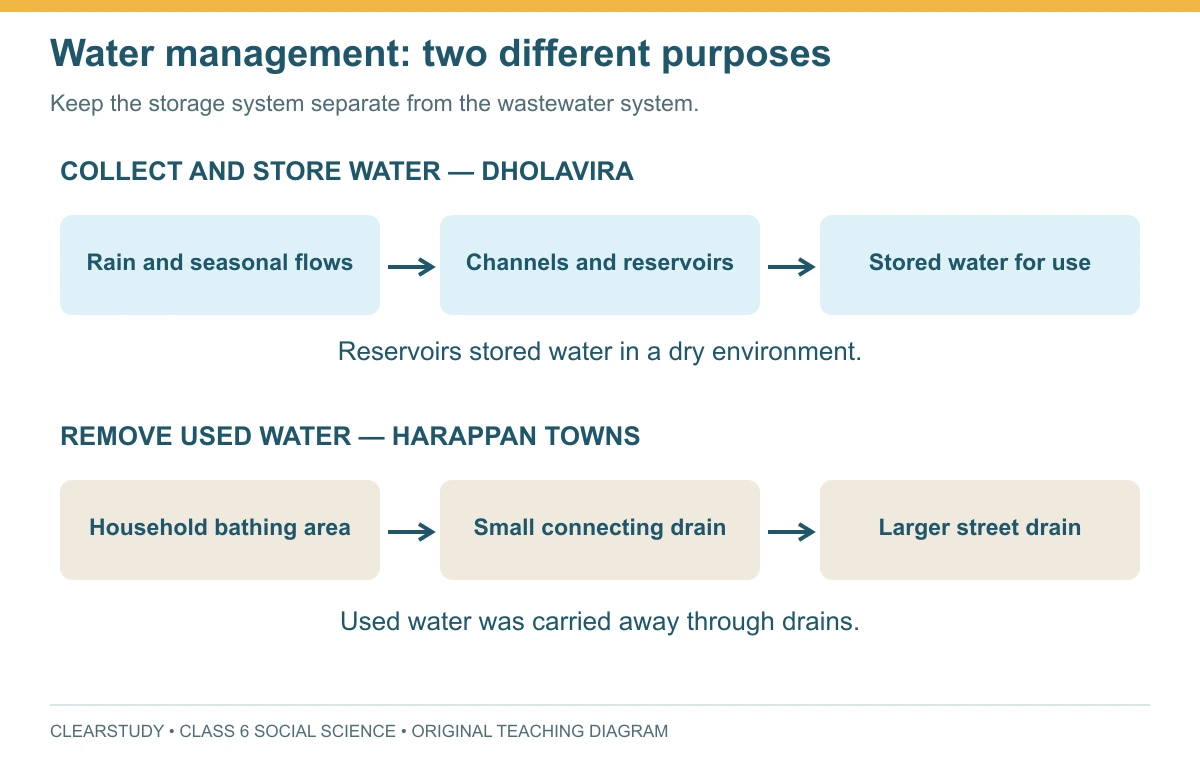
Concept diagram based on NCERT’s water-management discussion. It is not an excavated site plan. Reservoir water and wastewater are shown as separate systems. Tap to view at full size.
“Questions, activities and projects” — Full Solutions
These solutions follow NCERT’s end-of-chapter questions. Answers and teaching illustrations are ClearStudy explanations; personal and group activities use model responses to adapt.
1. Why does the civilisation studied in this chapter have several names? Discuss their significance.
ANSWERHarappan refers to Harappa, the first major site excavated in 1920–21. Indus or Indus Valley refers to the river region where major early discoveries, including Harappa and Mohenjo-daro, were made.Indus-Sarasvatī or Sindhu-Sarasvatī, the additional names used by NCERT, emphasise the many sites in the Ghaggar-Hakra basin as well as the Indus region. The chapter identifies the Ghaggar-Hakra with the Sarasvatī of ancient texts.The names highlight either the first excavated site or the geographical distribution. NCERT prefers terms without “Valley” because the sites extend well beyond the Indus valley. However, “Indus Valley Civilisation” remains common in historical writing; it is not a forbidden or universally abandoned name. Ancient river courses and their identification remain subjects of research.
2. Write a brief report (150 to 200 words) summing up some of the achievements of the Indus-Sarasvatī civilisation.
ANSWERSample report (within 150–200 words):The Harappan civilisation flourished in its mature urban phase around 2600–1900 BCE. Its cities show achievements in planning, water management, crafts and trade. Streets often followed an orderly layout, with houses and lanes arranged around them. Builders used standardised bricks at many sites, while Dholavira also used stone extensively. Homes often had bathing areas connected to drains, and Mohenjo-daro had hundreds of brick-lined wells. Dholavira’s reservoirs show how communities collected and stored scarce water.Farmers supported these settlements by growing wheat, barley, pulses and other crops; cotton was also cultivated. Craftspeople made finely drilled carnelian beads, shell bangles, pottery and metal objects. Traders exchanged goods within the region and with distant lands, travelling by land and water. Seals and standardised weights helped organise exchange, although the script on seals remains undeciphered. Lothal’s large basin is interpreted in the textbook as a dockyard. These achievements suggest skilled work, cooperation and organised urban life. They do not, by themselves, reveal exactly how government worked or prove that society was completely equal.
3. Imagine you have to travel from the city of Harappa to Kalibangan. What are your different options? Can you make a rough estimation of the amount of time each option might take?
ANSWERPossible modes include walking, a bullock cart, and boats on navigable river sections. Do not assume a direct navigable river connected the two cities, or that a loaded cart was necessarily faster than walking.Illustrative calculation: suppose the chosen land route were 400 km. This is an assumed route length for the activity, not a measured ancient route. At 20 km of walking per day: 400 ÷ 20 = 20 travel days. At 15 km per day with a loaded cart: 400 ÷ 15 ≈ 27 travel days. Add time for rest, weather, supplies and crossings.For a hypothetical 120 km navigable section at 30 km per day, boating would take 4 days for that section only, plus the remaining overland journey. Actual river courses, currents and access are uncertain. State your assumptions and calculate time = distance ÷ daily distance.
Note: This is a figure/map-based activity (see Fig. 6.3). The exact distance depends on the route chosen; the estimates above are approximate and meant to compare the options.
4. Let us imagine a Harappan man or woman being transported to an average kitchen in today’s India. What are the four or five biggest surprises awaiting them?
ANSWERThis is an imagination activity; here is a model answer. A Harappan visitor would find some foods familiar (wheat, barley, rice, pulses, vegetables, dairy, turmeric, ginger and banana were all known to them), but several things in a modern kitchen would surprise them:1. The gas stove or electric cooktop — cooking with a flame that has no firewood, smoke or open hearth.2. The refrigerator — a machine that keeps food and water cold for days, even in hot weather.3. Tap water and metal/plastic pipes — water delivered through a modern piped supply, instead of being drawn from wells, ponds or reservoirs.4. Steel and plastic utensils and packaged food — shiny steel pans and colourful plastic containers and packets, instead of their terracotta pots, bronze vessels and stone weights.5. New foods and gadgets — potatoes, tomatoes and chillies (American crops introduced to India much later), and machines like the mixer-grinder, pressure cooker and microwave.
5. Looking at all the pictures in this chapter, make a list of the ornaments / gestures / objects that still feel familiar in our 21st century.
ANSWERMany things shown in the chapter’s pictures still feel familiar today:Ornaments: beads of carnelian and bead necklaces; shell bangles — and the ‘Dancing Girl’ figurine wears bangles covering her whole arm, a way of wearing bangles still seen in parts of Gujarat and Rajasthan.Gestures: a terracotta figurine seated in a ‘namaste’ — the same greeting Indians use today.Objects and symbols: the comb, the bronze mirror, the chisel and other tools; a gamesboard and a whistle (toys and games still loved by children); the plough, still used by farmers; the swastika symbol; and a pot design that NCERT interprets as resembling the thirsty-crow story. This resemblance is an interpretation, not a deciphered written account.
6. What mindset does the system of reservoirs at Dholavira reflect?
ANSWERThe huge system of reservoirs at Dholavira reflects a careful, far-sighted and well-organised mindset. Dholavira lies in the dry Rann of Kutch, so the Harappans built at least six large reservoirs — some cut into solid rock, the largest about 73 metres long — and connected them with underground drains for efficient water harvesting and distribution.This shows they valued water conservation and planned ahead to store rainwater for the dry season. It also reflects great engineering skill, teamwork and good administration, because such large structures needed many workers, careful planning and someone to organise and maintain them. Above all, it shows a respect for cleanliness and the wise use of natural resources — a mindset we still need today.
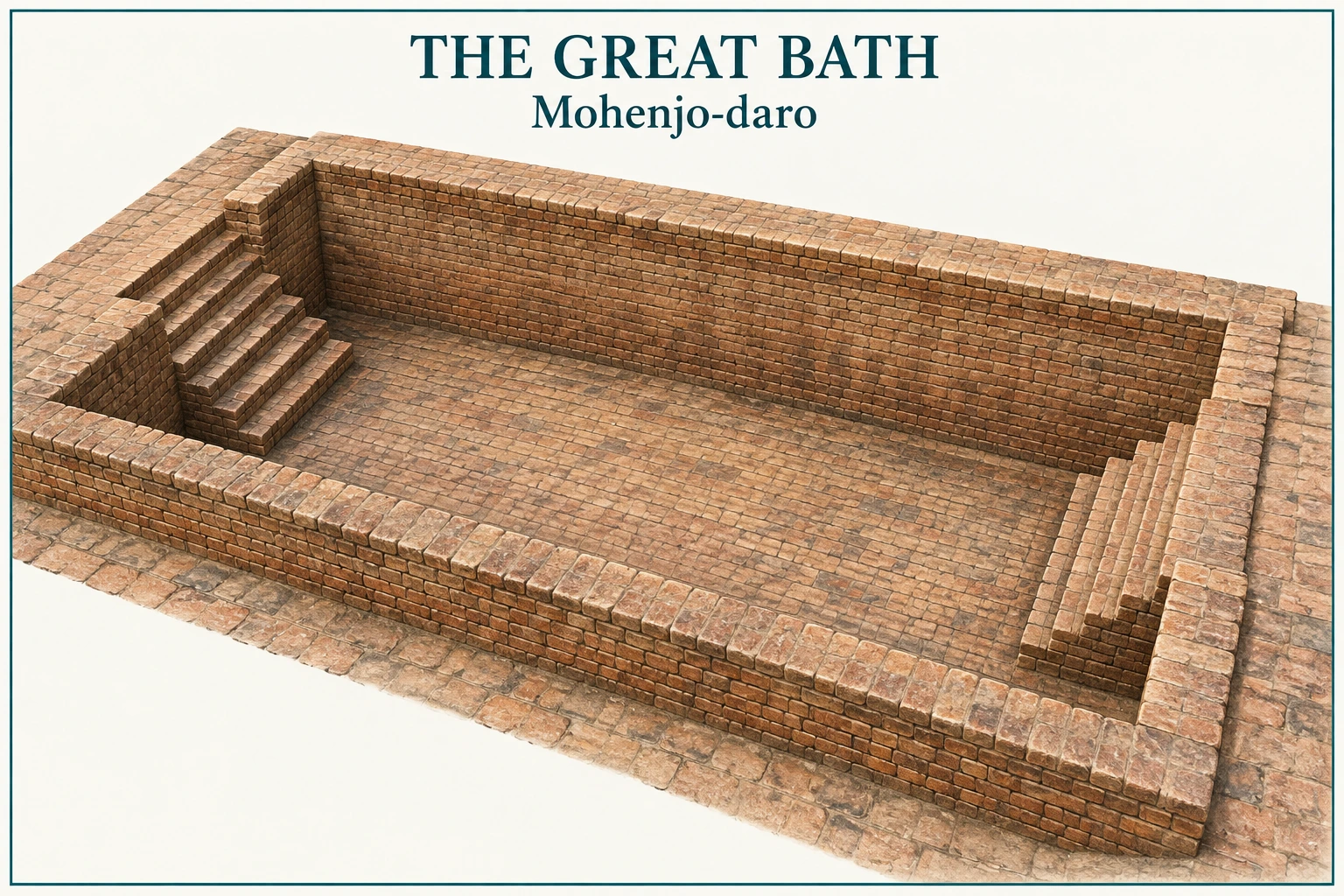
Illustrative reconstruction of the tank, not a site photograph or a complete archaeological plan. NCERT gives approximate dimensions of 12 × 7 metres. Surrounding rooms and waterproofing layers are not shown; its precise purpose remains debated. Archaeological reference for the tank and staircases. Tap to view at full size.
7. In Mohenjo-daro, about 700 wells built with bricks have been counted. They seem to have been regularly maintained and used for several centuries. Discuss the implications.
ANSWERAbout 700 brick-built wells, maintained over centuries, suggest that access to water was an important part of city planning. Many wells would reduce the distance people had to carry water.Brick linings and repeated maintenance suggest skilled construction, organised labour and continuing care. Together with bathing areas and drains, they indicate attention to water use and cleanliness.However, the number of wells alone does not prove that all water was safe to drink, every household had equal access, or society was fully equal. Archaeologists infer organisation from the remains, but the exact officials, rules and social arrangements are not known.
8. It is often said that the Harappans had a high civic sense. Discuss the significance of this statement. Do you agree with it? Compare with citizens in a large city of India today.
ANSWERCivic sense means responsibility towards shared facilities and the well-being of others. Planned streets, maintained wells, reservoirs and drainage suggest that Harappan communities organised work for their settlements. This is good evidence for cooperation and care of infrastructure, although it cannot tell us how every individual behaved.Modern Indian cities also depend on municipal workers, engineers and residents to maintain water supply, drainage and public spaces. Some areas work well; others face shortages, blocked drains or pollution. Causes include inadequate infrastructure, population pressure, maintenance failures and individual behaviour.Both then and now, public services need collective effort. We can conserve water, avoid dumping waste into drains and report damaged facilities. The useful comparison is about shared responsibility, rather than declaring all ancient citizens better than all modern citizens.
Extra Practice Questions
These questions and MCQs are ClearStudy practice, separate from the NCERT exercise.
Short Answer Type Questions
Q1. List any four characteristics that a society must have to be called a ‘civilisation’.
ANSWERFour characteristics of a civilisation are: (i) some form of government and administration; (ii) urbanism — town-planning, cities, water management and drainage; (iii) a variety of crafts; and (iv) trade, both internal and external. (Other features are some form of writing, cultural ideas expressed through art and architecture, and a productive agriculture.)
Q2. Why are the people of this civilisation called ‘Harappans’?
ANSWERThey are called ‘Harappans’ because the city of Harappa (today in Pakistan’s Punjab) was the first site of this civilisation to be excavated, in 1920–21, over a century ago. The civilisation and its people were then named after this first-discovered city.
Q3. What was the ‘Great Bath’ and where was it found?
ANSWERThe Great Bath was a small but elaborate tank found at Mohenjo-daro. It measured about 12 × 7 metres, was made of carefully laid bricks coated with waterproof natural bitumen, and had a drain to empty and refill it. Its exact purpose — perhaps a bath for the royal family or a tank for religious rituals — is still debated.
Q4. Why were thousands of small seals made by the Harappans?
ANSWERThe seals, usually made of steatite, were mainly used in trade — to help traders identify their goods and one another. They were only a few centimetres in size and showed animal figures with a few writing signs above them. The writing and the meaning of the animals are still not understood.
Q5. Name any two crops grown by the Harappans, and state what they were the first in Eurasia to grow.
ANSWERThe Harappans grew cereals such as barley and wheat (also millets and sometimes rice), along with pulses and vegetables. They were the first in Eurasia to grow cotton, which they wove into clothes.
Long Answer Type Questions
Q1. Describe the town-planning of the larger Harappan cities.
ANSWERThe larger Harappan cities, such as Harappa, Mohenjo-daro and Dholavira, were built according to precise plans. They had wide streets, often oriented to the cardinal directions, with houses lining the streets and smaller lanes. Most cities were surrounded by fortifications (massive walls) and were divided into two distinct parts — an ‘upper town’, where the local elite probably lived, and a ‘lower town’ for common people (Dholavira even had three zones). Some large buildings, such as warehouses, were used for collective purposes, and individual houses came in various sizes — yet, remarkably, the quality of construction was the same for small and big houses. Most buildings were made of standardised bricks. Water management was central to the plan: covered drains ran below the streets, homes had bathing areas, and there were wells and reservoirs. This careful planning is why the period is called the ‘First Urbanisation of India’.
Q2. Explain how the Harappans carried on their trade.
ANSWERThe Harappans were engaged in a very brisk trade, both within their own civilisation and with distant lands. They exported ornaments, timber, objects of daily use, and probably gold and cotton; their most favoured ornaments were beads of carnelian, a reddish stone found mostly in Gujarat, and beautiful shell bangles. In exchange they imported goods such as copper, which was not common at home. To carry goods they used land routes, rivers and the sea — this was India’s first intensive maritime activity, and many Harappan settlements lay along the coasts of Gujarat and Sindh. Lothal in Gujarat had a huge basin, about 217 × 36 metres, believed to be a dockyard for receiving and sending boats. To identify their goods and each other, traders used thousands of small steatite seals showing animals and writing signs. All this shows the Harappans were active and well-connected traders.
Q3. What caused the decline of the Indus-Sarasvatī civilisation? Did its culture disappear completely?
ANSWERThe mature urban phase began changing around 1900 BCE. Many large settlements shrank or were abandoned, while people continued living in smaller settlements. NCERT highlights reduced rainfall and changes in river water availability, including in the region it calls the Sarasvatī basin.These environmental pressures could affect farming, food supply and urban life. However, the timing and relative importance of different causes varied by region and remain debated. Research on the Ghaggar-Hakra palaeochannel shows that some major river shifts happened long before the mature cities, so one sudden river disappearance cannot explain every site.A single invasion destroying the whole civilisation is not an established explanation. Nor can we prove from limited evidence that no fighting or army ever existed. Many crafts and cultural practices continued: urban decline was not the disappearance of the people.
MCQs & Assertion–Reason
1. The most ancient civilisation of India is also known as the:
For each Assertion–Reason question, choose: (A) Both true and the Reason correctly explains the Assertion; (B) Both true but the Reason is not the correct explanation; (C) Assertion true, Reason false; (D) Assertion false, Reason true.
A-R 1. Assertion: The Harappan civilisation is also called the Indus-Sarasvatī civilisation.
Reason: Many of its sites have been found along both the Indus and the Sarasvatī (Ghaggar-Hakra) rivers.
A-R 2. Assertion: The Harappan civilisation extended beyond the Indus valley.
Reason: Harappan sites have also been found in Gujarat and the Ghaggar-Hakra basin.
A-R 3. Assertion: Archaeologists have completely deciphered the Harappan script.
Reason: The signs on Harappan seals are still not fully understood.
A-R 4. Assertion: The Harappans gave great importance to water management.
Reason: They built covered drains below the streets, wells and large reservoirs.
A-R 5. Assertion: Reduced water availability could make Harappan urban life harder.
Reason: Harappan cities depended on water and agricultural supplies from the surrounding region.
Answer key: 1-(A), 2-(A), 3-(D), 4-(A), 5-(A).
Exam Tips & Common Mistakes
How to write a clear answer
Memorise the seven features of a civilisation and be ready to give one example of each. Learn the key dates — villages from about 3500 BCE, cities by about 2600 BCE, decline around 1900 BCE — and the several names of the civilisation with their reasons. Link each major city to one fact (Harappa = first excavated; Mohenjo-daro = Great Bath and 700 wells; Dholavira = reservoirs; Lothal = dockyard; Kalibangan = wide streets/Sarasvatī basin). For long answers, use the textbook’s own examples and numbers (Great Bath 12 × 7 m, Lothal basin 217 × 36 m, reservoir 73 m) to show you have studied the chapter. Explain the two environmental factors highlighted by NCERT, while remembering that the causes and timing of urban decline are still researched.
Common mistakes to avoid
Assuming every Harappan site lay in the Indus valley — the civilisation extended well beyond it.
Treating one invasion or one river change as a proven explanation for every settlement — the transition was complex and varied by region.
Confusing the cities — the Great Bath is at Mohenjo-daro, the dockyard at Lothal, the rock-cut reservoirs at Dholavira.
Saying the Harappan culture vanished completely — much of it survived and passed to the next phase of Indian civilisation.
Mixing up the dates — cities grew by about 2600 BCE, decline began around 1900 BCE.
Leaving imagination/activity questions (Q3, Q4, Q5) blank — write your own sensible answers with reasons.
Frequently Asked Questions
What is Chapter 6 of Class 6 Social Science Exploring Society about?
Chapter 6, The Beginnings of Indian Civilisation, explains what a civilisation is and tells the story of India’s oldest civilisation — the Indus, Harappan or Sindhu-Sarasvatī civilisation (about 2600–1900 BCE). It covers its planned cities, water management, food, trade, crafts and the reasons for its decline.
Why does this civilisation have several names?
It is called ‘Harappan’ after Harappa, the first site excavated (1920–21); ‘Indus’ or ‘Indus Valley’ because many sites lay in the Indus plains; and ‘Indus-Sarasvatī’ or ‘Sindhu-Sarasvatī’ because a large number of sites were also found along the Sarasvatī (Ghaggar-Hakra) River.
What is the exercise heading for Chapter 6 of Exploring Society?
The end-of-chapter exercise in Exploring Society: India and Beyond Chapter 6 is headed Questions, activities and projects and contains 8 numbered questions, all answered step by step on this page.
Reviewed against NCERT, Exploring Society: India and Beyond, Chapter 6 (2026–27 reprint). Content reviewed 9 October 2026.