NCERT Solutions for Class 6 Social Science (Exploring Society) Chapter 7: India’s Cultural Roots (NCERT 2026–27)
These Class 6 Social Science Exploring Society Chapter 7 solutions cover India’s Cultural Roots from Exploring Society: India and Beyond, the NCERT textbook (2026–27 reprint). The chapter belongs to the theme Our Cultural Heritage and Knowledge Traditions and explains the Vedas and Vedic culture, the new schools of thought that emerged in the 1st millennium BCE — Vedanta, Yoga, Buddhism and Jainism — and the rich contribution of folk and tribal traditions to Indian culture. Below you get step-by-step answers to every question in Questions, activities and projects, the True or false set and the Class activity, plus key terms, extra practice, MCQs, Assertion–Reason and FAQs.
Class: 6Subject: Social ScienceBook: Exploring Society: India and BeyondChapter: 7Theme: Our Cultural Heritage and Knowledge TraditionsSession: 2026–27
Class 6 Social Science Exploring Society Chapter 7 – Overview
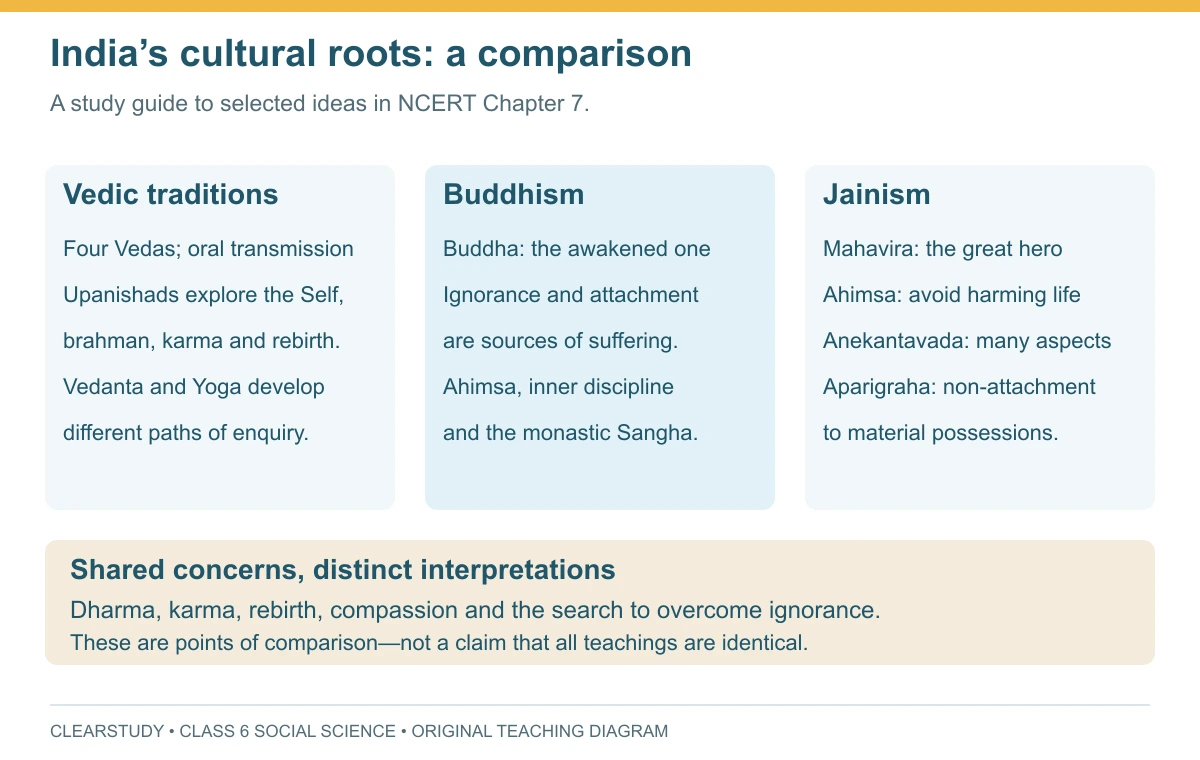
Chapter 7, India’s Cultural Roots, compares Indian culture to an ancient tree: many roots nurture a common trunk, from which spread many branches. One major textual root is the Vedas — the Ṛig, Yajur, Sāma and Atharva Vedas — thousands of hymns composed by rishis and rishikas and transmitted orally with great care (UNESCO proclaimed the tradition in 2003 and inscribed it on its Representative List in 2008). The Upanishads added ideas like rebirth, karma, brahman and ātman, and schools such as Vedanta and Yoga grew from the Vedas to form the foundations of Hinduism. In the 1st millennium BCE, Buddhism (founded by the Buddha) and Jainism (linked to Mahāvīra) emerged with values like ahimsa, while folk and tribal traditions enriched Indian culture through a constant, two-way exchange of deities, stories and rituals. Different as they were, these schools shared a common ‘trunk’ of values — dharma, karma, rebirth and the search to end suffering and ignorance.
Key Concepts & Terms
The Vedas: India’s four most ancient texts — the Ṛig Veda, Yajur Veda, Sāma Veda and Atharva Veda. The word ‘Veda’ comes from the Sanskrit vid, meaning ‘knowledge’. They include hymns preserved for many generations by oral recitation and memorisation; written manuscripts came later.
Rishis and rishikas: the male seers/sages (rishis) and female seers (rishikas) who composed the Vedic hymns in an early form of Sanskrit, addressing deities such as Indra, Agni, Varuṇa, Mitra, Sarasvatī and Uṣhas.
‘ekam sat viprā bahudhā vadanti’: a famous Vedic hymn meaning “The Existent (the supreme reality) is one, but sages give it many names” — reflecting the belief that the many gods are really one.
Janas: the ‘clans’ or larger groups into which early Vedic society was organised; the Ṛig Veda lists over 30, such as the Bharatas, Purus, Kurus and Yadus. Sabhā and samiti were assemblies or gatherings.
Upanishads: a group of texts that built on the Vedas and introduced ideas like rebirth (taking birth again and again), karma (our actions and their results), brahman (the one divine essence) and ātman (the Self that is one with brahman).
Vedanta and Yoga: schools of thought that grew from the Vedas. The chapter presents a Vedantic view of one divine essence (brahman) and describes Yoga as a path of spiritual discipline. Different schools interpret these ideas differently. Together such schools became the foundations of Hinduism.
Buddhism: founded by Siddhārtha Gautama, the ‘Buddha’ (the ‘enlightened’ one), who taught that avidyā (ignorance) and attachment cause suffering. He preached ahimsa (non-hurting) and founded the Sangha, a community of monks and nuns.
Jainism: a school linked with Vardhamāna, who became ‘Mahāvīra’ (great hero). Its key ideas are ahimsa, anekāntavāda (truth has many aspects) and aparigraha (non-possession). ‘Jaina’ comes from jina, ‘conqueror’ — of ignorance and attachment, not of territory.
Chārvāka (Lokāyata): a school that believed only the material world exists and there is no life after death; it shows how diverse India’s belief systems were and how people were free to choose.
Folk and tribal traditions: teachings and practices transmitted orally by common people (folk) and by tribes. They exchanged deities, legends and rituals freely with the major schools of thought — for example, according to the tradition described by NCERT, Jagannath of Puri has tribal origins.
Tribe (janjāti): a close-knit community of families or clans sharing common descent, culture and language, with diverse forms of leadership, property and livelihoods. NCERT cites 2011 figures of 705 recognised tribal groups and about 104 million people; these are dated census figures, not a current total.
“Questions, activities and projects” — Full Solutions
These solutions follow NCERT’s end-of-chapter questions. Answers and teaching illustrations are ClearStudy explanations; personal and group activities use model responses to adapt.
1. If you were Nachiketa, what questions would you like to ask Yama? Write them down in 100-150 words.
ANSWERThis is a creative activity, so answers will vary. A model answer: If I were Nachiketa standing before Yama, the god of death, I would ask, “What truly happens to us after the body dies? Does something in us continue, and if so, what is it?” I would ask about the ātman or Self — “Is the Self really immortal, neither born nor dying, as the wise say? How can I come to know my own Self?”I would also ask, “Why do people suffer, and how can a person live a good and fearless life? What is more valuable — wealth, pleasure and long life, or true knowledge?” Finally I would ask, “What is the highest goal a human being can reach, and how should I act every day to move towards it?” These are the deep questions that made Nachiketa worthy of Yama’s teaching. (You may add your own questions.)
2. Explain a few central ideas of Buddhism. Briefly comment upon them.
ANSWERBuddhism was founded by Siddhārtha Gautama, who became the Buddha (‘the enlightened one’) after meditating under a pipal tree at Bodh Gaya. A few of its central ideas are:(i) The cause of suffering: the Buddha realised that avidyā (ignorance) and attachment are the roots of human suffering, and he taught a method to remove these two causes. This idea is important because it asks us to look honestly at our own minds.(ii) Ahimsa: usually translated as ‘non-violence’, but originally meaning ‘non-hurting’ or ‘non-injuring’ in deed, word and even thought. It teaches compassion towards all living beings.(iii) Inner discipline and self-conquest: the Buddha said purity comes not from bathing in sacred rivers but from truth and dharma in the heart, and that “conquering oneself is greater than conquering a thousand men”. This shows that real victory is over one’s own faults.(iv) The Sangha: he founded a community of monks (bhikṣhus) and later nuns (bhikṣhuṇīs) to practise and spread his teachings. Together these ideas had an enormous influence on India and the whole of Asia.
Revision guide to the chapter. Shared terms do not mean that these traditions have identical doctrines. Tap to view at full size.
3. Discuss in class the quotation of the Buddha which begins with “Not by water is one made pure, though many people may bathe here [in sacred rivers]” to make sure that its meaning has been understood by all.
ANSWERThis is a class-discussion activity. Points to bring out in the discussion: the Buddha is saying that simply bathing in holy rivers does not, by itself, make a person pure. True purity comes from within — from a heart in which truth and dharma (right conduct) reside.In the second part he says, “Conquering oneself is greater than conquering a thousand men on the battlefield a thousand times.” This means that controlling one’s own anger, greed and bad habits is a far greater victory than defeating others in war. The overall message is that good actions, honesty and self-control matter more than outward rituals. We can connect this to our own lives by trying to be truthful and kind rather than relying only on outer ceremonies.
4. Explain a few central ideas of Jainism. Briefly comment upon them.
ANSWERJainism became widespread at the same time as Buddhism, though its roots are said to be much more ancient. It is linked with Prince Vardhamāna, who, after twelve years of ascetic discipline, gained supreme wisdom and became ‘Mahāvīra’ (great hero). The word ‘Jaina’ comes from jina, ‘conqueror’ — of ignorance and attachment, not of land. A few central ideas are:(i) Ahimsa: Mahāvīra taught that all living, breathing, sentient creatures “should not be slain, nor treated with violence, nor abused, nor tormented”. Jain ahimsa is especially strict and extends even to the tiniest creatures.(ii) Anekāntavāda: ‘not just one’ aspect — the truth has many sides and cannot be fully captured by a single statement. This idea teaches humility and respect for other points of view.(iii) Aparigraha: ‘non-possession’ — detachment from material things, limiting oneself to what is truly necessary. It encourages simple living.Jainism also stresses the interconnectedness and interdependence of all creatures, a truth that scientists studying nature have confirmed again and again.
5. Consider and discuss in class André Béteille’s thought (see page 122).
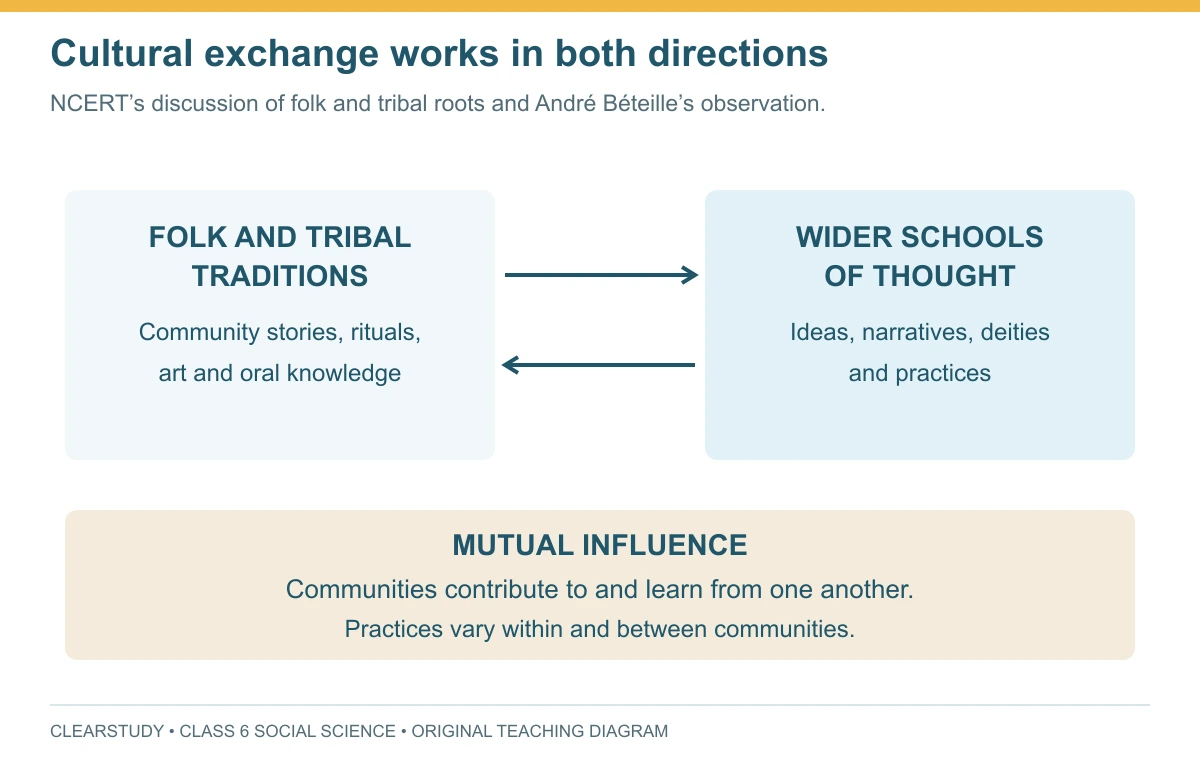
ANSWERThis is a discussion activity based on the sociologist André Béteille’s words. He pointed out that the thousands of castes and tribes of the Indian subcontinent “have influenced each other in their religious beliefs and practices since the beginning of history and before.”The key point to discuss is that the influence has been two-way. It is widely accepted that tribal religions were influenced by Hinduism; but Béteille reminds us that it is “equally true” that Hinduism — both in its early phase and throughout its history — was influenced by tribal religions. This means folk and tribal traditions are not ‘lower’ or merely receivers; they have given as much as they have taken. The result of this long exchange has been mutual enrichment, and folk and tribal beliefs are therefore a genuine part of India’s cultural roots.
The exchange described by André Béteille is mutual; the arrows do not imply that every community follows the same beliefs. Tap to view at full size.
6. Make a list of popular gods and goddesses in your region and the festivals they are associated with.
ANSWERThis is an activity, so your list should be from your own region. A sample list is given below; replace it with the deities and festivals of your area.
God / Goddess
Festival associated with them
Ganesha
Ganesh Chaturthi
Durga / the Mother-goddess
Navaratri & Durga Puja
Lakshmi
Diwali
Krishna
Janmashtami
Rama
Ram Navami & Dussehra
Shiva
Maha Shivaratri
Jagannath (Puri)
Rath Yatra
(Add the popular local deities and festivals of your own region.)
7. As a class activity, list two or three tribal groups from your region or State. Document some of their art and belief systems.
ANSWERThis is a class project, so collect details about tribes near you. A sample answer using tribes named or hinted at in the chapter:(i) The Toda (Nilgiris, Tamil Nadu): they regard over thirty peaks of the Nilgiri range as the residences of gods and goddesses; these peaks are so sacred that the Todas avoid even pointing at them with a finger. They are known for their distinctive embroidery and barrel-shaped huts.(ii) The Munda and Santhal (eastern India): they worship Singbonga, a supreme deity believed to have created the whole world, and are well known for their folk songs, dances and wall paintings.(iii) Tribes of Arunachal Pradesh: several worship Donyipolo, a combined form of the Sun and the Moon who rose to the status of a supreme god. (Replace these with two or three tribal groups from your own State and note their art, music and beliefs.)
“True or false” — Answers
1. The Vedic hymns were written on palm-leaf manuscripts.
ANSWERFalse in the context of their early transmission. NCERT emphasises that the hymns were recited and memorised orally through careful training. This does not mean Vedic texts were never written down: manuscripts were produced in later periods.
2. The Vedas are India’s oldest texts.
ANSWERTrue. The four Vedas are the most ancient texts of India, and indeed among the most ancient in the whole world.
3. The Vedic statement ekam sat viprā bahudhā vadanti reflects a belief in the unity of cosmic powers.
ANSWERTrue. It means “The Existent is one, but sages give it many names” — showing the belief that the many deities are really one single reality, a unity behind all cosmic powers.
4. Buddhism is older than the Vedas.
ANSWERFalse. The Vedas are far more ancient. Buddhism emerged only in the 1st millennium BCE, long after the Vedas, and in fact did not accept the authority of the Vedas.
5. Jainism emerged as a branch of Buddhism.
ANSWERFalse. Jainism is an independent school of thought whose roots are said to be much more ancient; it became widespread around the same time as Buddhism but did not grow out of it.
6. Both Buddhism and Jainism advocated for peaceful coexistence and the avoidance of harm to all living beings.
ANSWERTrue. Both teach ahimsa — non-hurting in deed, word and thought — and stress compassion and peaceful coexistence with all living beings.
7. Tribal belief systems are limited to belief in spirits and minor deities.
ANSWERFalse. Although tribes worship many deities linked to natural elements, many tribal groups also have a concept of a higher divinity or supreme being — such as Singbonga, Donyipolo or Khandoba — so their beliefs are not limited to spirits and minor deities.
“Class activity”
1. Stage a small play with Yama, god of death, surrounded by several Nachiketas asking him questions about life.
HOW TO DO THIS ACTIVITYThis is a classroom dramatisation of the Katha Upanishad story, so work in a group. The dialogue presents beliefs within that tradition. A simple way to stage it:Roles: one student plays Yama (the god of death) seated ‘in his world’; four or five students play different ‘Nachiketas’ who come forward one by one.Script idea: each Nachiketa bows and asks one deep question about life and death — for example, “What happens after the body dies?”, “Is the ātman immortal?”, “What is more valuable, wealth or knowledge?”, “How should I live a good life?” At first Yama tries to avoid answering, but, pleased by their persistence, he explains that the Self is hidden in all creatures and is immortal — neither born nor dying.Close: the Nachiketas thank Yama and return ‘home’ with new knowledge. Keep costumes simple (a shawl for Yama) and speak the questions clearly so the audience understands the message.
Extra Practice Questions
These questions and MCQs are ClearStudy practice, separate from the NCERT exercise.
Short Answer Type Questions
Q1. From which Sanskrit word does ‘Veda’ come, and what does it mean?
ANSWERThe word ‘Veda’ comes from the Sanskrit root vid, which means ‘knowledge’ (the same root gives the word vidyā). The Vedas are therefore collections of sacred knowledge.
Q2. Name the four Vedas.
ANSWERThe four Vedas are the Ṛig Veda, the Yajur Veda, the Sāma Veda and the Atharva Veda. The Ṛig Veda is the most ancient of the four.
Q3. What new ideas did the Upanishads introduce?
ANSWERThe Upanishads built on Vedic concepts and introduced new ones such as rebirth (being born again and again), karma (our actions and their results), brahman (the one divine essence) and ātman (the Self that is ultimately one with brahman).
Q4. Why did the Buddha leave his palace life?
ANSWERAccording to the traditional account, when he saw an old man, a sick man and a dead body, and then a calm ascetic, Siddhārtha was deeply moved. He gave up his palace life to search, as an ascetic, for the root cause of human suffering.
Q5. What do the words anekāntavāda and aparigraha mean?
ANSWERAnekāntavāda means ‘not just one’ aspect — truth has many sides and cannot be fully described by a single statement. Aparigraha means ‘non-possession’ — detachment from material things and limiting oneself to what is truly necessary.
Long Answer Type Questions
Q1. Describe the Vedas and the way they were preserved over thousands of years.
ANSWERThe Vedas are India’s four oldest texts — the Ṛig, Yajur, Sāma and Atharva Vedas — and are among the most ancient texts in the world. They consist of thousands of hymns, that is, prayers in the form of poems and songs, composed by rishis (male seers) and rishikas (female seers) in an early form of Sanskrit. The hymns were addressed to many deities such as Indra, Agni, Varuṇa and Sarasvatī, yet the seers saw these gods as one, as the hymn ‘ekam sat viprā bahudhā vadanti’ shows. Remarkably, the Vedas were never written down at first; they were recited orally and committed to memory through rigorous training, then passed on for anything between 100 and 200 generations with hardly any change. UNESCO proclaimed the tradition in 2003 and added it to its Representative List of intangible cultural heritage in 2008.
Q2. Compare Buddhism and Jainism, bringing out their similarities and differences.
ANSWERBuddhism and Jainism both emerged in the 1st millennium BCE and both rejected the authority of the Vedas, developing their own systems. Buddhism was founded by Siddhārtha Gautama, the Buddha, who taught that ignorance and attachment cause suffering and who founded the Sangha of monks and nuns. Jainism is linked with Vardhamāna, who became Mahāvīra, and whose key ideas are ahimsa, anekāntavāda and aparigraha. Similarities: both stress ahimsa (non-hurting in deed, word and thought), both seek an end to suffering and ignorance, and both sent monks and nuns across the land to spread their teachings, often living in rock-cut caves. Differences: Jain ahimsa is even stricter, extending to the tiniest creatures, and Jainism adds anekāntavāda and aparigraha as central ideas; its roots are said to be more ancient. Despite differences, both shared the ‘trunk’ of common values — dharma, karma and rebirth.
Q3. How have folk and tribal traditions contributed to Indian culture?
ANSWERBesides the cultural roots preserved in texts, India has rich oral traditions transmitted by common people (folk traditions) and by tribes (tribal traditions). These have contributed greatly to Indian culture through a constant, two-way exchange with the major schools of thought: deities, concepts, legends and rituals have moved freely in both directions. For example, according to the tradition described in NCERT, Jagannath, worshipped at Puri, has tribal origins, and various forms of the mother-goddess have similar origins; some tribes, in turn, adopted Hindu deities and have their own versions of the Mahābhārata and Rāmāyaṇa. Folk, tribal and Hindu belief systems share many concepts — treating mountains, rivers, trees and animals as sacred — and many tribes also believe in a supreme being such as Singbonga or Donyipolo. As the sociologist André Béteille noted, the influence has been mutual: tribal religions shaped Hinduism just as Hinduism shaped them. The result has been mutual enrichment, making folk and tribal beliefs a true part of India’s cultural roots.
MCQs & Assertion–Reason
1. The word ‘Veda’ comes from the Sanskrit word vid, which means:
(a) prayer (b) knowledge (c) fire (d) truth
2. How many Vedas are there?
(a) Two (b) Three (c) Four (d) Five
3. Which tradition was inscribed on UNESCO’s Representative List of intangible cultural heritage in 2008?
(a) Yoga (b) Vedic chanting (c) the Jataka tales (d) the Ellora caves
4. The Upanishads introduced which of these concepts?
(a) janas (b) sabhā and samiti (c) rebirth and karma (d) yajṇa
5. Siddhārtha Gautama attained enlightenment after meditating under a pipal tree at:
(a) Lumbini (b) Vaiṣhālī (c) Bodh Gaya (d) Hampi
6. The word ‘Buddha’ means the:
(a) great hero (b) enlightened or awakened one (c) conqueror (d) seeker
7. Prince Vardhamāna became famous as:
(a) the Buddha (b) Mahāvīra (c) Uddālaka (d) Yājṇavalkya
8. ‘Aparigraha’ in Jainism means:
(a) non-violence (b) many aspects of truth (c) non-possession (d) knowledge
9. The school of thought that believed only the material world exists and there is no life after death was the:
For each Assertion–Reason question, choose: (A) Both true and the Reason correctly explains the Assertion; (B) Both true but the Reason is not the correct explanation; (C) Assertion true, Reason false; (D) Assertion false, Reason true.
A-R 1. Assertion: The Vedas were preserved with great care and very little alteration for many generations.
Reason: They were committed to memory and passed on orally through rigorous training.
A-R 2. Assertion: The hymn ‘ekam sat viprā bahudhā vadanti’ shows a belief in many separate, unrelated gods.
Reason: The early rishis and rishikas saw the gods and goddesses as one, not as separate beings.
A-R 3. Assertion: Buddhism and Jainism both stress ahimsa.
Reason: Both teach non-hurting in deed, word and thought towards all living beings.
A-R 4. Assertion: Folk and tribal traditions are a genuine part of India’s cultural roots.
Reason: There has been a constant, two-way exchange of deities, legends and rituals between tribal traditions and the major schools of thought.
A-R 5. Assertion: The Vedic, Buddhist and Jain schools had nothing in common.
Reason: They shared concepts such as dharma, karma and rebirth, and all sought an end to suffering and ignorance.
Answer key: 1-(A), 2-(D), 3-(A), 4-(A), 5-(D).
Exam Tips & Common Mistakes
How to write a clear answer
Remember the ‘tree’ image: roots → trunk → branches. Be able to name the four Vedas and say who composed them (rishis and rishikas) and how they were preserved (oral memorisation, UNESCO 2008). Keep the key Sanskrit terms ready with one-line meanings — brahman, ātman, karma, rebirth, ahimsa, anekāntavāda, aparigraha, jina. For comparison questions on Buddhism and Jainism, give a clear two-sided structure (similarities and differences). Use the textbook’s own examples — the Upanishad stories (Śhvetaketu, Nachiketa, Gārgī), Jagannath of Puri, the Toda, Munda–Santhal and Arunachal tribes, and André Béteille’s ‘two-way influence’ — to show you have studied the chapter.
Common mistakes to avoid
Confusing early oral transmission with later written manuscripts: the original preservation method was oral recitation.
Thinking Buddhism is older than the Vedas — the Vedas are far more ancient.
Calling Jainism a branch of Buddhism — it is an independent school with even older roots.
Confusing brahman (the divine essence) with the god Brahmā.
Mixing up anekāntavāda (many aspects of truth) with aparigraha (non-possession).
Saying tribal beliefs are only about spirits — many tribes also worship a supreme being (Singbonga, Donyipolo).
Leaving activity/project questions blank — write your own examples from your region.
Frequently Asked Questions
What is Chapter 7 of Class 6 Social Science Exploring Society about?
Chapter 7, India’s Cultural Roots, explains the Vedas and Vedic culture, the new schools of thought of the 1st millennium BCE — Vedanta, Yoga, Buddhism and Jainism — and the contribution of folk and tribal traditions to Indian culture, showing how all these ‘roots’ nurture a common trunk of shared values.
What are the Vedas and how were they preserved?
The Vedas are India’s four oldest texts — the Ṛig, Yajur, Sāma and Atharva Vedas — made of thousands of hymns composed by rishis and rishikas. Their early transmission was oral, using rigorous recitation and memorisation; written manuscripts came later. UNESCO listed the chanting tradition in 2008, following its 2003 proclamation.
What is the exercise heading for Chapter 7 of Exploring Society?
The end-of-chapter exercise in Exploring Society: India and Beyond Chapter 7 is headed Questions, activities and projects (7 items), followed by a True or false set (7 statements) and a Class activity — all answered on this page.
Reviewed against NCERT, Exploring Society: India and Beyond, Chapter 7 (2026–27 reprint). Content reviewed 9 October 2026.