
Three Days to See — Class 7 English Poorvi Questions and Answers
Three Days to See questions and answers for Class 7 Poorvi explain Helen Keller’s imagined plan, sensory language and modal verbs. Find textbook reading answers, a transcript-based listening key and adaptable speaking and writing examples.
Source: NCERT Poorvi, Grade 7, Unit 1, printed pages 28–38 (listening transcript 41–42); supplied reprint 2026–27. Open-ended and personal responses are examples to adapt. These explanations are study support, not an official NCERT answer key.
About the chapter
“Three Days to See” is a moving first-person prose extract from Unit 1, ‘Learning Together’. In it, Helen Keller, who was blind and deaf, imagines what she would most like to do if she were given the gift of sight for just three short days. She would spend the first day looking at the faces of the people she loves, the second day watching the dawn and visiting museums to see the history of the earth, and the third day exploring the busy, everyday life of the city. Through her wish, she gently reminds those who can see, hear, touch, smell and taste to value and make full use of each precious sense.
About the author
NCERT credits this first-person extract to Helen Keller. The narrator describes experiencing nature through touch and imagines three days of sight. Her plan is hypothetical; the extract does not say that she actually regained sight for three days.
Summary
In this extract, Helen Keller, who cannot see, describes how she finds hundreds of joys through the sense of touch. She feels the delicate shape of a leaf, the smooth bark of a silver birch and the rough bark of a pine; in spring she searches the branches for the first bud, and is overjoyed when she feels the happy quiver of a singing bird. Yet her heart longs to see all these things, for she believes that if touch gives so much pleasure, sight must reveal far greater beauty.
She then imagines having sight for just three days, and divides the time into three parts. On the first day, she would look at the faces of the friends whose kindness and companionship have made her life worth living – people she now ‘sees’ only through her fingertips. On the second day, she would rise with the dawn to watch night turn into day and the sun awaken the earth. That day she would visit museums to see the history of the world – the animals, the early races of men and the giant dinosaurs and mastodons that lived long before human beings appeared.
On the third day, she would spend her time in the ordinary, busy world of the city. Standing at a crowded street corner, she would watch people and try to understand their daily lives, sharing their happiness, pride and suffering. At midnight, she knows, darkness would close in on her once more, and only then would she realise how much she had left unseen. She ends with a gentle piece of advice: use your eyes, ears and other senses as if you would lose them tomorrow, and glory in all the beauty the world offers – for of all the senses, she is sure that sight is the most delightful.
Theme & message
The central theme is the value of our senses and the importance of appreciating life’s everyday wonders. Helen Keller, who lived without sight and hearing, shows us how much beauty surrounds us – beauty we often ignore because we take our senses for granted. Her message is clear and timeless: make the most of every sense, every day, as if you might lose it tomorrow. The lesson also teaches gratitude, hope and respect for people with disabilities, who experience the world in remarkable and courageous ways.
Word meanings
| Word | English meaning | Hindi meaning |
|---|---|---|
| symmetry | balanced, even shape or arrangement | सममिति / समरूपता |
| birch | a slender tree with thin, peeling bark | भोजपत्र (एक पेड़) |
| shaggy | rough and hairy | रूखा-सूखा / झबरा |
| quiver | a slight shiver or tremble | कंपन / थर्राहट |
| longing | a strong desire or wish | तीव्र इच्छा / ललक |
| behold | to see or look at | देखना / निहारना |
| panorama | a wide, complete view of a scene | विस्तृत दृश्य / नज़ारा |
| awe | a feeling of wonder mixed with respect | श्रद्धामिश्रित विस्मय |
| glimpse | a brief or quick look | झलक / एक नज़र |
| pageant | a grand display or show | भव्य प्रदर्शन |
| condensed | made short and brief | संक्षिप्त / संक्षेप में |
| carcasses | the dead bodies or remains of animals | शव / अवशेष |
| mastodons | large extinct animals like furry elephants | मैस्टोडॉन (हाथी जैसा विलुप्त प्राणी) |
| stature | height or build of the body | कद-काठी / शारीरिक आकार |
| haunts | places one visits often | आना-जाने की जगहें |
| merely | only; simply; just | मात्र / केवल |
| strains | tunes or pieces of music | संगीत की धुनें / स्वर |
| tactile sense | the sense of touch | स्पर्श की शक्ति |
| morsel | a small piece of food | निवाला / ग्रास |
| facets | different aspects or sides of something | पहलू / आयाम |
| relish | great enjoyment or delight | बड़े चाव / आनंद |
Let us discuss
I. True statements: 3, 4, 6 and 7. Statements 1, 2 and 5 are false: she imagines sight, wants to observe a range of city experiences, and does not say touch gives everyone the greatest joy.
II. Her three-day plan
| Day | What she would see | Priority |
|---|---|---|
| 1 | People whose kindness and companionship enrich her life; friends’ faces and eyes. | Relationships |
| 2 | Dawn and the changing light; museums showing the earth’s past and human progress. | Nature and knowledge |
| 3 | Everyday city life; people’s smiles, determination and suffering. | Understanding others |
Feeling friends’ faces is how she already recognises them; it is not a new activity made possible by sight.
III. Feelings: Through touch, she recognises facial outlines and expressions such as laughter and sorrow. The eye as a window to the soul is figurative language, not a literal medical claim.
Let us think and reflect
I.1. Extract – “I feel the delicate symmetry of a leaf. I pass my hands lovingly about the smooth skin of a silver birch, or the rough, shaggy bark of a pine. In spring, I touch the branches of trees hopefully in search of a bud, the first sign of awakening Nature after her winter’s sleep. Occasionally, I am very fortunate; I place my hand gently on a small tree and feel the happy quiver of a bird in full song.”
I.2. Extract – “The next day I should arise with the dawn and see the thrilling miracle by which night is transformed into day. I should behold with awe the magnificent panorama of light with which the sun awakens the sleeping earth. This day I should devote to a hasty glimpse of the world, past and present. I should want to see the pageant of man’s progress, and so I should go to the museums.”
II. Answer the following questions.
Let us learn
I. Sensory words table
I. Complete the table with sensory words from the text in Column 2 for the five senses in Column 1. Add new words in Column 3.
| Sense (Column 1) | From the text (Column 2) | New words (Column 3 – sample) |
|---|---|---|
| What you see | panorama (also: glimpse, behold) | bright, glowing, colourful |
| What you hear | music (also: song, strains) | loud, melodious, whisper |
| What you smell | perfume | fragrant, sweet, fresh |
| What you taste | relish (also: morsel) | sweet, sour, spicy |
| What you feel | rough (also: smooth, shaggy, delicate) | soft, warm, silky |
II. Underline the verbs (modal + main verb)
II. Read the following sentences from the text and underline the verbs.
III. Identify the modal verbs and their functions
III. Identify the modal verbs in the following sentences. Choose the functions they express from those given in the box (possibility, necessity, polite request, ability, moral obligation).
IV. Fill in the blanks with modal verbs
IV. Read the situations and functions, and fill in the blanks in Column 4 with appropriate modal verbs.
Listening, speaking, writing and exploration
Let us listen — p. 36; transcript pp. 41–42
Let us speak — p. 36
Sample: I value hearing because it helps me enjoy music and follow conversations. I especially like the sound of rain on leaves. I would need different ways to communicate if I lost hearing. This makes me appreciate both my experiences and the importance of accessible communication. Adapt this to a sense you value, and avoid assuming that a person with a sensory disability cannot have a rich life.
Let us write — p. 37: sample paragraph
The lake shone like a silver sheet beneath the morning sun. Green reeds swayed at its edge, and ducks left narrow ripples behind them. I heard soft splashes and distant voices. Damp earth scented the cool air. A warm snack tasted spicy after our walk, and the smooth railing felt cold under my hand. The quiet water and lively birds made the place memorable. I left wanting to return and notice more of its small details.
This is an invented example. Describe a place you actually visited and details you noticed; do not claim unexperienced sensations.
Let us explore — pp. 37–38
I. Braille: Use the textbook chart to arrange your own name as raised dots. In reading view, a six-dot cell has positions 1–2–3 down the left and 4–5–6 down the right. Lowercase a uses dot 1, b uses 1 and 2, and c uses 1 and 4. The diagram below illustrates these examples. A visual image cannot replace tactile Braille.
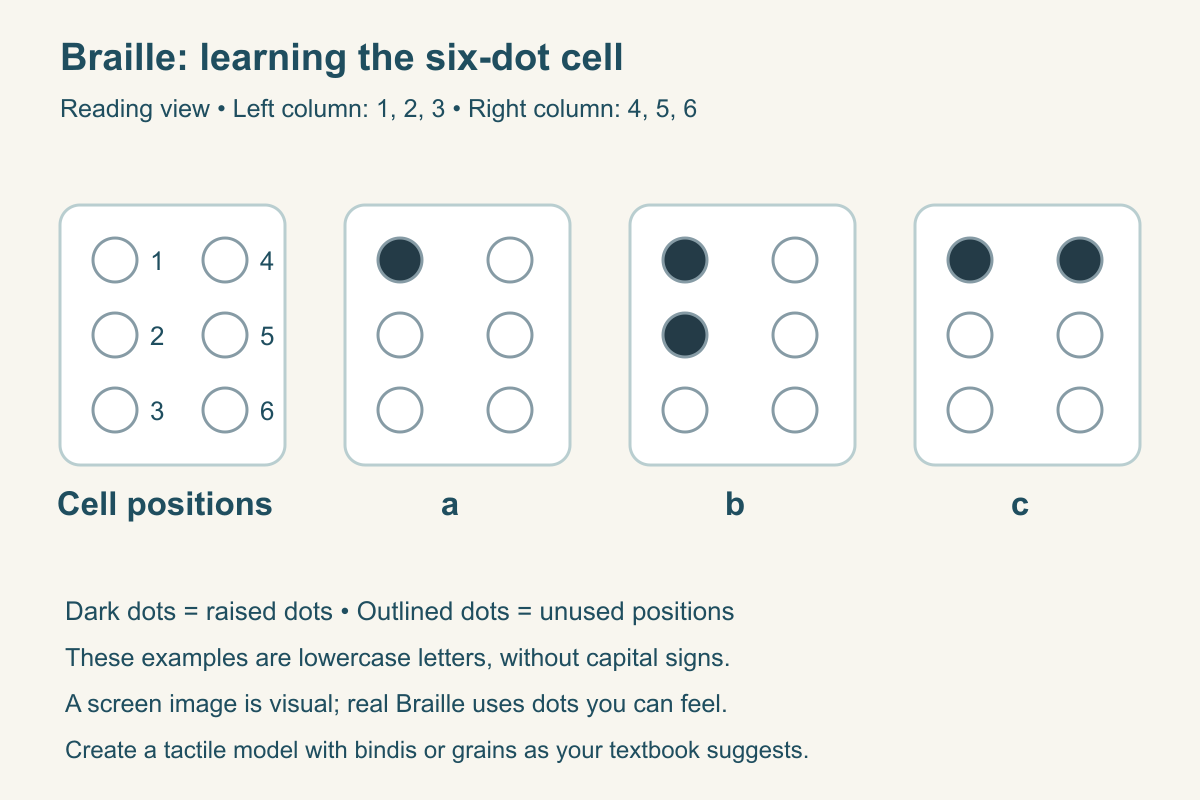
Open the Braille diagram at full size. Its dot patterns are also explained in the paragraph above.
II. The International Day of Persons with Disabilities is observed on 3 December. For the India-specific activity, research a real local or national event and record its organiser, date and source; do not invent participation or a current annual theme.
III. Study the NCERT Indian Sign Language resource linked in the textbook. Sign language is a language for communication; Braille is a tactile writing code. They serve different purposes.
Additional ClearStudy questions
This practice is separate from the printed textbook exercises.
Short answer (30–40 words)
1. What things in nature does Helen Keller enjoy through her sense of touch?
2. How would Helen Keller spend the first of her three days of sight?
3. Why would Helen Keller visit the museums on the second day?
4. What would Helen Keller do at a busy street corner on the third day?
5. What advice does Helen Keller give to those who can see?
Long answer (100–120 words)
6. Describe how Helen Keller plans to spend her imagined three days of sight and what each day reveals about her.
7. How does ‘Three Days to See’ teach us to value our senses and live gratefully?
ClearStudy MCQs and assertion–reason practice
1. Through which sense does Helen Keller mainly experience the world?
(a) sight (b) hearing (c) touch (d) taste
2. Into how many parts does the author divide her three days?
(a) two (b) three (c) four (d) five
3. Whom would the author wish to see on the first day?
(a) famous people (b) strangers (c) the people whose kindness made her life worth living (d) her doctors
4. What does the author call the eye?
(a) the gift of life (b) the window of the soul (c) the mirror of nature (d) the light of the world
5. Where would the author go on the second day to see the history of the earth?
(a) the library (b) the museums (c) the seashore (d) the mountains
6. Which ancient animals does the author wish to see in the museum?
(a) lions and tigers (b) dinosaurs and mastodons (c) horses and elephants (d) whales and sharks
7. How would the author spend the third day?
(a) resting at home (b) in the workaday world of the city (c) at the seaside (d) in a forest
8. When she sees suffering, the author says she feels …
(a) proud (b) happy (c) compassionate (d) afraid
9. What hint does the author give to those who can see?
(a) to read more books (b) to use their eyes as if they would be blind tomorrow (c) to travel widely (d) to rest their eyes often
10. According to the author, which is the most delightful of all the senses?
(a) hearing (b) touch (c) sight (d) smell
Assertion–Reason – choose: (a) A and R true, R explains A; (b) A and R true, R does not explain A; (c) A true, R false; (d) A false, R true.
1. Assertion (A): Helen Keller finds great pleasure in nature even though she cannot see.
Reason (R): Her sense of touch lets her feel leaves, bark and the quiver of a singing bird.
2. Assertion (A): The author would spend her first day of sight looking at her dear friends.
Reason (R): She wants to look into the faces of those whose kindness and companionship have made her life worth living.
3. Assertion (A): The author believes that touch is the most delightful of all the senses.
Reason (R): She gets hundreds of pleasures from touch alone.
4. Assertion (A): The author advises people to use their senses as if they might lose them tomorrow.
Reason (R): Imagining the loss of a sense helps people truly value and enjoy it.
5. Assertion (A): The author knows she would not be able to see everything in just three days.
Reason (R): She says only when darkness descended again would she realise how much she had left unseen.
Exam tips & common mistakes
Exam tips
• Remember the plan clearly: Day 1 = loved ones’ faces, Day 2 = dawn + museums (history), Day 3 = city + everyday people. Use this sequence when explaining her priorities.
• Mention the author where relevant (Helen Keller) and mention that she was blind and deaf in long answers.
• Quote her key advice – “use your eyes as if tomorrow you would be stricken blind” – in value-based questions.
• For theme questions, link her message to gratitude, appreciating our senses and respecting people with disabilities.
Common mistakes
• Do not write that the author longs most for hearing – her deepest longing is for sight.
• Do not confuse the days: she visits the museums on Day 2, not Day 3.
• She finds great joy in touch, but does not say touch gives the greatest joy – she says sight would be the most delightful.
• ‘Window of the soul’ refers to the eye, not the heart – read such phrases carefully.
FAQs
Who wrote ‘Three Days to See’ and what is special about the author?
It was written by Helen Keller, an American author and activist who was both blind and deaf, yet became a highly educated and inspiring writer and speaker.
What is the main message of ‘Three Days to See’?
The lesson teaches us to value our senses and appreciate the beauty around us – to use our eyes, ears and other senses as if we might lose them tomorrow.
How does Helen Keller plan to use her three days of sight?
On the first day she would see her loved ones, on the second she would watch the dawn and visit museums, and on the third she would observe everyday people in the city.
Why does the author call the eye the ‘window of the soul’?
Because she believes that looking into a person’s eyes lets one see their true inner self – their feelings and character – something she can only sense through touch.
Textbook-based exercises and additional ClearStudy practice are identified separately. Use your textbook alongside these explanations.