
Animals, Birds, and Dr. Dolittle — Class 7 English Poorvi Questions and Answers
Animals, Birds, and Dr. Dolittle questions and answers for Class 7 Poorvi explain the humorous story, Polynesia’s teaching and the language exercises. Check the corrected hidden-animal answers, listening details and sample notice with your textbook.
Source: NCERT Poorvi, Grade 7, Unit 2, printed pages 43–58 (listening transcript 88); supplied reprint 2026–27. Open-ended and personal responses are examples to adapt. These explanations are study support, not an official NCERT answer key.
About the chapter
“Animals, Birds, and Dr. Dolittle” is a delightful, humorous story from Unit 2, ‘Wit and Humour’. It is an extract from Hugh Lofting’s famous book about Doctor John Dolittle, a kind people’s doctor who lives in the little town of Puddleby. On the advice of the Cat’s-food-Man and his clever parrot, Polynesia, the doctor learns that animals have their own language. Polynesia teaches him bird and animal speech, and he gives up treating people to become an animal doctor instead. From a plough horse who needs green spectacles to harvest mice waiting in a tunnel, all creatures soon flock to his garden, and Dr. Dolittle becomes famous among animals all over the world.
About the author
NCERT credits this fictional extract to Hugh Lofting. John Dolittle learns animal languages from Polynesia and becomes an animal doctor. The story uses fantasy and humour to encourage attention and kindness towards animals.
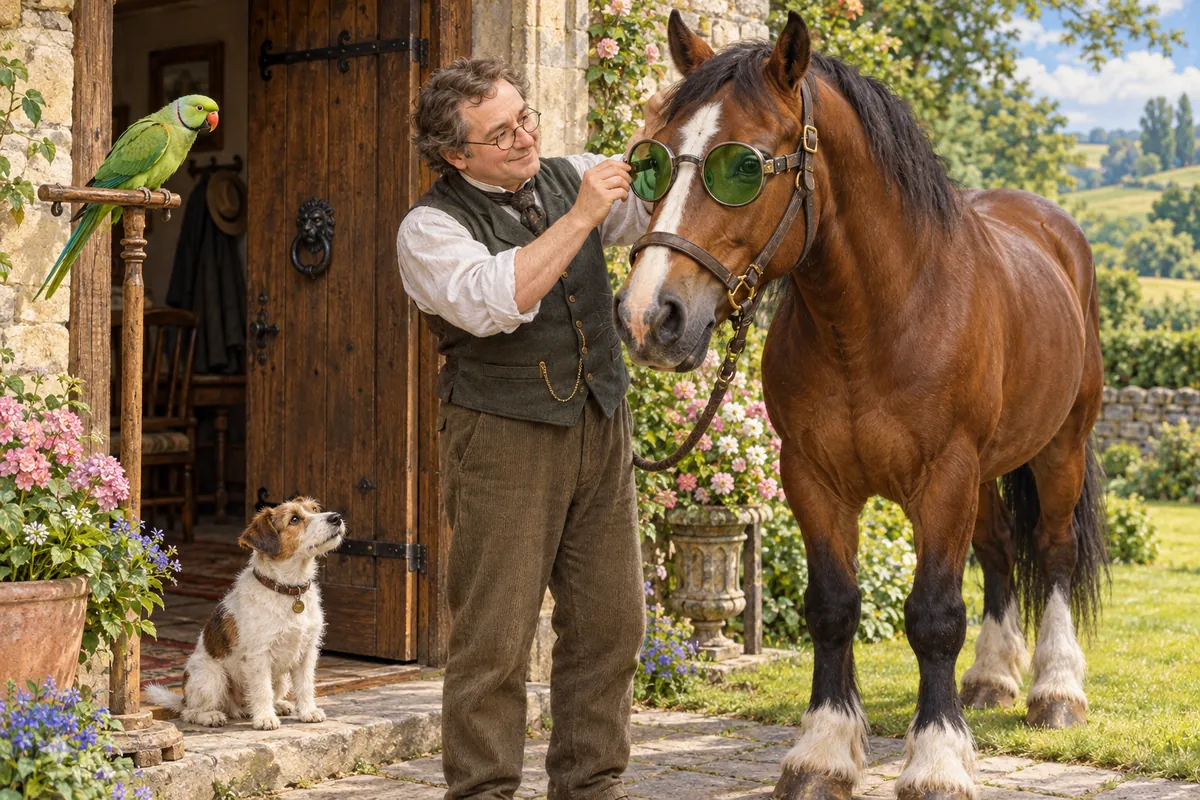
Green spectacles and instant communication are features of the fantasy. The story is not a guide to treating a real horse’s eye problem.
Summary
Doctor Dolittle was sitting in his kitchen one rainy day, talking to the Cat’s-food-Man, who had come with a stomach-ache. The man suggested that the doctor should give up treating people and become an animal doctor instead, because Dolittle understood animals far better than the local vets did. After the man left, the doctor’s parrot, Polynesia, encouraged the same idea. She surprised the doctor by revealing that animals can talk – parrots in both people’s language and bird language – and even taught him that animals speak with their ears, feet and tails, not only their mouths.
Excited by this discovery, the doctor fetched a book and pencil and wrote down the ‘Birds’ A.B.C.’ as Polynesia patiently dictated bird words all afternoon. With her help he soon learned animal language so well that he could talk to creatures himself and understand everything they said. He then gave up being a people’s doctor altogether.
Once word spread, old ladies brought their over-fed pugs and poodles, and farmers came from miles away with sick cows and sheep. A plough horse explained that he was going blind in one eye and simply needed green spectacles – something the stupid vet over the hill had never understood. The doctor fitted him with green glasses, and soon farm animals wearing spectacles became a common sight around Puddleby. Because he could speak their language, treating animals became easy, and they told their friends. Soon his garden was always crowded, so he made separate doors for horses, cows and sheep, and even a tiny tunnel for the mice. In a few years, every living thing for miles knew of John Dolittle, M.D., and the migrating birds carried his fame to foreign lands. He became famous among animals all over the world, and he was very happy with his life.
Theme & message
The central theme is the power of understanding, communication and compassion towards animals. By taking the time to truly ‘listen’ to animals – even in their silent body language – Dr. Dolittle is able to heal them where others fail. The story, told with gentle humour, also shows the value of listening to different viewpoints (the Cat’s-food-Man’s and Polynesia’s advice) and of treating every living being with kindness and respect. Its light, witty tone reminds us that real skill comes not just from knowledge, but from patience, empathy and a willingness to understand others.
Word meanings
| Word | English meaning | Hindi meaning |
|---|---|---|
| scholar | a learned person | विद्वान / पंडित |
| cracker | a thin, dry biscuit usually eaten with cheese | एक पतला, सूखा बिस्कुट |
| vet (veterinarian) | a doctor who treats animals | पशु चिकित्सक |
| porridge | a soft food made by boiling oats in water or milk | दलिया / लपसी |
| countryside | rural area away from towns | ग्रामीण इलाका / देहात |
| cellar | a room below ground level often used for storage | तहखाना / भू-गृह |
| spectacles | a pair of glasses worn to help one see | चश्मा / ऌंक |
| plough horse | a strong horse used to pull a plough | हल खींचने वाला घोड़ा |
| twitching | making small, sudden movements | फड़कना / सिकुड़ना |
| badgers | burrowing wild animals with black-and-white striped heads | बिज्जू (एक जंगली जीव) |
| harvest mice | tiny field mice found among crops | खेत में पाए जाने वाले छोटे चूहे |
| flowerpots | containers in which plants are grown | गमले / फूलदान |
| windowsill | the ledge at the bottom of a window | खिड़की की देहली |
| famous | known about by many people | प्रसिद्ध / मशहूर |
| excited | very enthusiastic and eager | उत्साहित / रोमांचित |
| crumbs | very small pieces of bread or biscuit | मुलायम / चूरा |
| foreign lands | countries other than one’s own | विदेशी / पराये देश |
Let us discuss
Part I – Let us discuss
I. Complete the following sentence by selecting a suitable reason.The Cat’s-food-Man suggests to Doctor Dolittle that he should become an animal doctor because he believes that Dolittle ______. (1. earns less fee by treating human patients / 2. enjoys the company of animals as they speak less / 3. dislikes spending time with human patients / 4. knows more about animals than the local veterinarians)
II. Fill in the blanks by choosing the suitable option given in the brackets.Doctor Dolittle reacts to Polynesia’s information about animal languages with both excitement and ______ (certainty/curiosity). He rushes to ______ (write/memorise) the bird words she provides and is interested in learning more.
III. Do you think Doctor Dolittle would be famous as an animal doctor? If yes, why? If not, why not?
Part II – Let us discuss
I. What became a common sight in Puddleby after Doctor Dolittle started treating animals?1. Humans talking to farm animals / 2. Farm animals wearing glasses / 3. Farm animals learning bird language / 4. Birds riding atop farm animals
II. What challenges do you think Doctor Dolittle might face if more and more animals come to him for help?1. How might he overcome these challenges to ensure that he provides good treatment?
III. Arrange the following events in correct order according to the story. (Two have been done for you: (i) = event 3 and (ii) = event 6.)
Let us think and reflect
I.1. Extract – “If I say, ‘Polly wants a cracker’, you understand me. But hear this: Ka-ka oi-ee, fee-fee?” … “What would have been the good?” said Polynesia, dusting some cracker crumbs off her left wing. “You wouldn’t have understood me if I had.”
I.2. Extract – “I would like a pair like yours,” said the horse—“only green…” … “it takes a much cleverer man to be a really good animal doctor than it does to be a good people’s doctor.”
II. Answer the following questions.
Let us learn
I. Compound words – sorting the table
Complete the table correctly by choosing words from the box (sailor song, harvest mice, teatime, windowsill, plough horse, well-bred, check-in). Sort them into Hyphenated, Open Compound and Closed Compound words. (Example done: check-in = hyphenated.)
II. Create compound words and complete the paragraph
Match Column A (fun, high, never, early, song, over, tree) with Column B (head, birds, flying, loving, tops, ending, risers) to form compound words, then complete the paragraph. (Example: A. fun-loving.)
III. Hidden animals in sentences — corrected key
2. ANT: began to.
3. HORSE: author sees — the letters h-o-r-s-e run across the words.
4. MICE: from ice.
5. CAMEL: came late.
Read letters continuously across a word boundary, ignoring the space. Answers 3 and 4 are horse and mice, not ewe and hare.
IV. Palindromes
A palindrome is a word, phrase, or sequence that reads the same backwards as forwards. Identify the palindrome words and sentences from the list.
V. Verbs and tense (present continuous / simple present)
Underline the verbs and identify the tense form in the following sentences from the text.
VI. Present perfect tense
Fill in the blanks using the correct form of verbs (present perfect) given within brackets.
Listening, speaking, writing and exploration
Let us listen — p. 55; transcript p. 88
II. 1. Woodstock; 2. Rose; 3. 9; 4. birds; 5. best care; 6. pets.
Woodstock is the town in this separate listening announcement; Puddleby is the town in the reading story.
Let us speak — pp. 55–56
Work through the textbook’s four doctor–patient cue cards: cough/cold, dry lips, sore throat and fatigue. Use greeting → problem → symptoms → questions → advice → next appointment → thanks. Sample language: “Good morning. What is troubling you?” / “I have felt tired recently.” / “Could you tell me more?” / “When should I come back?” This is language-role-play practice, not an individual medical diagnosis; use the printed cues for the classroom exercise.
Let us write — p. 57
Draft blanks: Heading: Health Check-up; inform; Thursday and Friday; assembly hall; health card; queries; please contact.
12 July 20XX
Annual Health Check-up
Students of Grades 6–8 are informed that the annual health check-up will be held on 27 and 28 July 20XX, from 9:00 a.m. to 12:15 p.m., in the assembly hall. Collect your health cards from your class teacher and bring them. For queries, contact the undersigned.
Asma
In-charge
The textbook supplies Thursday and Friday for its example dates. 20XX is a placeholder, so check weekdays when adapting to a real year. The sample notice body is about 50 words.
Let us explore — p. 58
I. Goshala combines go (cow) and śālā (shed/hall). During a teacher-led visit, ask about food, water, hygiene and veterinary care, then record actual observations.
II. With the teacher, identify real animal-welfare organisations in your area. Record each organisation’s name, purpose, official contact and source rather than inventing findings.
III. Suggested discussion: Food and water can meet immediate needs; a suitable shelter may help an injured or abandoned animal; responsible adoption can provide lasting care when an adult is willing and able to meet its needs. These choices depend on the animal and circumstances. Seek help from adults and trained carers instead of handling an unfamiliar animal alone.
Additional ClearStudy questions
This practice is separate from the printed textbook exercises.
Short answer (30–40 words)
1. Who was the Cat’s-food-Man and what did he suggest to Doctor Dolittle?
2. What two languages did Polynesia say parrots could speak?
3. How did Polynesia explain that animals talk in many ways?
4. What did the plough horse really need, and what was wrong with the other vet?
5. Why did Doctor Dolittle have special doors made for his house?
Long answer (100–120 words)
6. Trace how Doctor Dolittle changed from a people’s doctor into a world-famous animal doctor.
7. How does the story use humour and gentle wit to make its point about animals?
ClearStudy MCQs and assertion–reason practice
1. Why had the Cat’s-food-Man come to see Doctor Dolittle?
(a) with a headache (b) with a stomach-ache (c) to buy medicine (d) to sell cat food
2. What was the name of Doctor Dolittle’s parrot?
(a) Polly (b) Theodosia (c) Polynesia (d) Jip
3. What did ‘Ka-ka oi-ee, fee-fee?’ mean in bird language?
(a) Polly wants a cracker (b) Is the porridge hot yet? (c) Has it stopped raining? (d) Good morning
4. According to Polynesia, animals also talk with their…
(a) only mouths (b) eyes only (c) ears, feet and tails (d) wings only
5. What was the name of the dog who came in at teatime?
(a) Towzer (b) Jip (c) Polly (d) Best
6. What did the plough horse really need?
(a) big pills (b) green spectacles (c) a new vet (d) rest in the stable
7. In which town did Doctor Dolittle live?
(a) London (b) Lanfield (c) Puddleby (d) Woodstock
8. Why did Doctor Dolittle make a tiny tunnel into the cellar?
(a) for the cows (b) for the mice (c) for storage (d) for the parrot
9. Who carried news of Doctor Dolittle to foreign lands?
(a) farmers (b) the Cat’s-food-Man (c) the birds who flew to other countries (d) old ladies
10. Who is the author of ‘Animals, Birds, and Dr. Dolittle’?
(a) Ruskin Bond (b) Hugh Lofting (c) Natalie Joan (d) G.C. Thornley
Assertion–Reason – choose: (a) A and R true, R explains A; (b) A and R true, R does not explain A; (c) A true, R false; (d) A false, R true.
1. Assertion (A): Doctor Dolittle gave up being a people’s doctor and became an animal doctor.
Reason (R): With Polynesia’s help he learned animal language so well that he could talk to animals and understand them.
2. Assertion (A): Farm animals wearing glasses became a common sight around Puddleby.
Reason (R): The plough horse was given green spectacles and could see well again.
3. Assertion (A): The vet over the hill could not cure the plough horse.
Reason (R): The vet could not understand horse language and kept giving the horse big pills.
4. Assertion (A): Polynesia had often spoken to the Doctor in bird language before this day.
Reason (R): She said the Doctor would not have understood her if she had.
5. Assertion (A): It takes a cleverer person to be a good animal doctor than a good people’s doctor.
Reason (R): Animals do not complain, so the doctor must understand their problems without being told in words.
Exam tips & common mistakes
Exam tips
• Remember the order of events: stomach-ache man → Polynesia’s advice → learning bird words → quits human practice → plough horse → special doors → world fame. This sequence follows the story.
• Name the author where relevant (Hugh Lofting), the doctor (John Dolittle, M.D.), the parrot (Polynesia), the dog (Jip) and the town (Puddleby).
• For value questions, mention kindness to animals, listening to different viewpoints, and the power of communication.
• Quote the horse’s line about it taking ‘a much cleverer man’ to be a good animal doctor – explain it as the horse’s viewpoint within the fantasy.
Common mistakes
• The plough horse needed green spectacles, not pills – it was the wrong vet who gave pills.
• ‘Ka-ka oi-ee, fee-fee?’ means ‘Is the porridge hot yet?’, not ‘Polly wants a cracker’.
• Polynesia is a parrot, while Jip is the dog – do not mix them up.
• Do not say the doctor still treated people – he gave up being a people’s doctor altogether.
FAQs
Who wrote ‘Animals, Birds, and Dr. Dolittle’?
NCERT credits the extract to Hugh Lofting. Doctor Dolittle is a fictional doctor who learns to communicate with animals.
How did Doctor Dolittle learn animal language?
His parrot, Polynesia, taught him. She revealed that animals can talk and patiently dictated bird words, which the doctor wrote down in a book until he could understand all animals.
Why did the plough horse visit Doctor Dolittle?
The horse was going blind in one eye and needed green spectacles. The other vet had failed to help him because he could not understand horse language.
What is the main message of the story?
The story teaches kindness towards animals, the importance of listening to and understanding others, and the value of communication and compassion in caring for all living beings.
Textbook-based exercises and additional ClearStudy practice are identified separately. Use your textbook alongside these explanations.