
A Funny Man — Class 7 English Poorvi Questions and Answers
A Funny Man questions and answers for Class 7 Poorvi explain Natalie Joan’s nonsense poem, its humour and mixed sensory descriptions. Use the corrected reading key, phrasal verbs, listening sequence and sample limerick with your textbook.
Source: NCERT Poorvi, Grade 7, Unit 2, printed pages 59–69 (listening transcript 88–89); supplied reprint 2026–27. Open-ended and personal responses are examples to adapt. These explanations are study support, not an official NCERT answer key.
- Poem Overview
- About the Poet
- Central Idea & Stanza Summary
- Word Meanings
- Poetic Devices
- NCERT textbook exercises
- Phrasal verbs
- Listening and activities
- Extra Questions
- MCQs & Answer Key
- Assertion–Reason Questions
- FAQs
Poem Overview
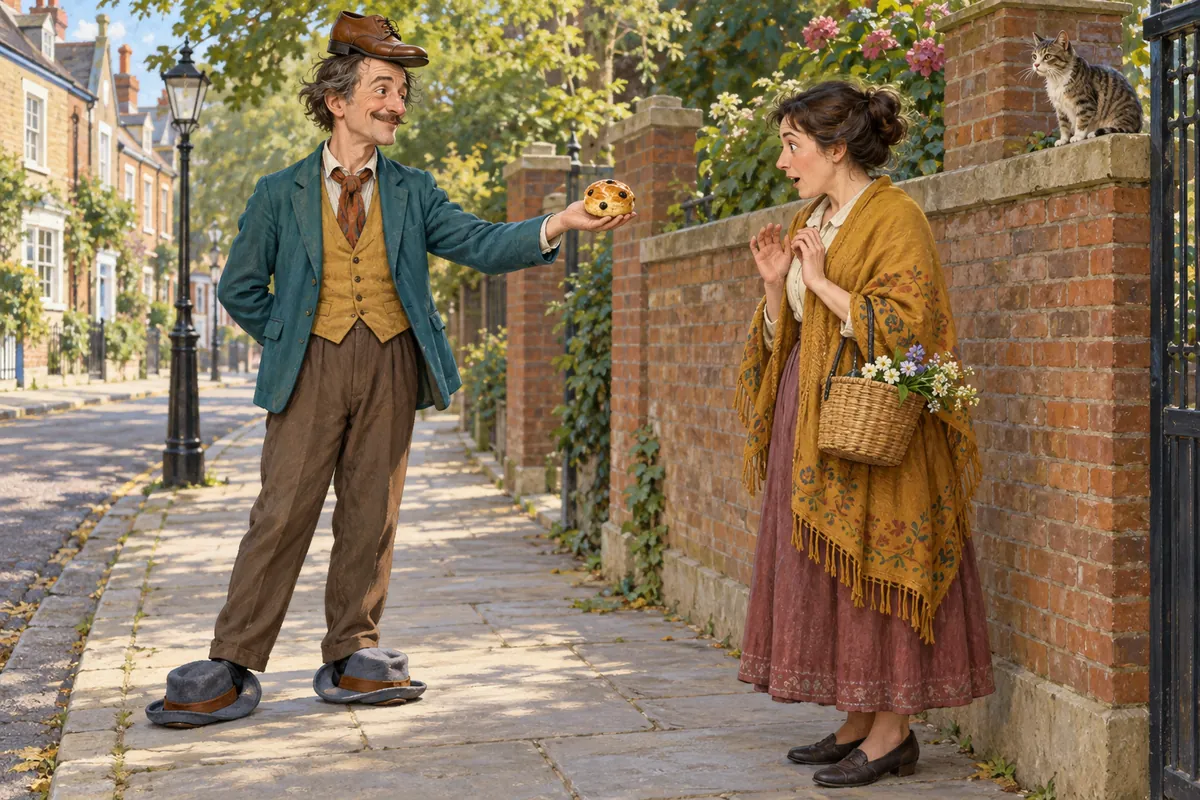
“A Funny Man” is a light, nonsensical poem that belongs to the Unit “Wit and Humour”. The speaker describes a strange, comical man she meets one day walking down her street. This funny man does everything upside-down and back-to-front: he wears a shoe on his head and hats upon his feet, he offers a currant bun while calling it a rose, sings a strange song, and finally hops home on his head. The poem’s whole charm lies in this topsy-turvy behaviour, which delights and bewilders the speaker. With its playful rhythm, vivid images and gentle humour, the poem celebrates silliness, imagination and the simple joy of laughter, inviting young readers to enjoy the absurd without worrying about logic or meaning.
About the Poet – Natalie Joan
NCERT credits A Funny Man to Natalie Joan. It is nonsense verse: impossible actions and unexpected combinations create humour. The speaker’s dialogue helps make the scene lively; the events are imaginative rather than actions to imitate.
Central Idea & Stanza Summary
Central idea: The poem celebrates harmless silliness and the joy of the absurd. Through the antics of a “funny man” who does everything the wrong way round, the poet shows that humour and imagination can turn an ordinary moment into something delightful. The poem teaches young readers to relax, laugh and enjoy nonsense without searching for logic in it.
Stanza 1: One day a strange, funny man comes walking down the speaker’s street. Unlike everyone else, he has worn a shoe on his head and hats upon his feet — the very opposite of how clothes should be worn. This odd appearance at once tells us the poem will be playful and topsy-turvy.
Stanza 2: The funny man politely raises the shoe (as one would lift a hat to greet someone) and smiles at the speaker. His manners are good, yet the speaker says she had never before seen “such a funny sounding sight” — a deliberately silly mixing of sound and sight that adds to the comedy.
Stanza 3: The man grandly addresses the speaker as “Your Highness” and offers to present her with a rose. But instead he takes out a currant bun and holds it to her nose, again confusing one thing with another in a comical way.
Stanza 4: Startled, the speaker staggers back against the wall and replies that she has never seen “a rose with such a funny looking smell” — once more jumbling the senses (a smell that “looks” funny) for humorous effect.
Stanza 5: The man then begins to sing a song and sits down on the ground. The speaker declares it is “such a funny feeling sound” — another nonsensical mixing of feeling and sound — stressing how unusual and amusing his behaviour is.
Stanza 6: Finally the speaker asks why he wears two hats upon his feet. Without answering, the funny man simply turns around and hops home on his head, ending the poem on a perfectly absurd, laugh-out-loud note.
Word Meanings (शब्दार्थ)
| Word | English Meaning | हिंदी अर्थ |
|---|---|---|
| funny | amusing; strange and laughable | हास्यास्पद, विचित्र |
| raised | lifted up | उठाया |
| manners | way of behaving; politeness | आचरण, शिष्टाचार |
| polite | well-mannered and courteous | विनम्र, शिष्ट |
| present (verb) | to give or offer formally | भेंट करना, प्रस्तुत करना |
| Your Highness | a respectful title for royalty | महामहिम (राजसी संबोधन) |
| currant | a small dried seedless grape/raisin | छोटी सूखी किशमिश |
| currant bun | a sweet bread roll baked with currants | किशमिश वाली मीठी बन |
| staggered | moved unsteadily, as if about to fall | लड़खड़ाकर पीछे हटना |
| against | touching or leaning on | के सहारे, से सटकर |
| sounding | making a sound; seeming (here used playfully) | ध्वनि करने वाला; प्रतीत होने वाला |
| sight | something that is seen; a view | दृश्य, नज़ारा |
| hopped | jumped on one leg or in short jumps | उछला, फुदका |
| the other way about | in the opposite direction; turned around | विपरीत दिशा में, घूमकर |
| amusing | causing laughter; entertaining | मनोरंजक, हँसाने वाला |
| inversion | changing the normal order of words | शब्द-क्रम का उलटाव |
| nonsensical | having no sense; silly but funny | निरर्थक, बेतुका |
Poetic Devices in the Poem
| Device | Explanation / Example from the poem |
|---|---|
| Nonsense verse | The whole poem describes impossible, illogical actions (a shoe on the head, hopping home on the head) purely for fun. |
| Imagery | Vivid pictures such as “He wore a shoe upon his head / And hats upon his feet” help us see the comical scene clearly. |
| Alliteration | Repetition of beginning sounds: “funny sounding sight”, “funny feeling”, “hopped home on his head” (the ‘h’ sound). |
| Synaesthesia / mixed senses | Senses are jumbled for humour: a “sounding sight”, a “rose with such a funny looking smell”, a “funny feeling sound”. |
| Repetition | The word “funny” is repeated many times to keep the comic, playful mood and stress the man’s strangeness. |
| Dialogue | Direct speech — “Allow me to present Your Highness with a rose” and “My friend, why do you wear two hats…” — makes the scene lively and dramatic. |
| Inversion | “But never had I seen before / Such a funny sounding sight” reverses normal word order to keep the rhyme and rhythm. |
| Rhyme & Rhythm | The poem has a regular songlike rhythm with rhymes (feet/street, rose/nose, ground/sound) that make it bouncy and fun to read aloud. |
NCERT textbook exercises
Let us discuss
I. Work in pairs. Identify the true statements. Check your answers with the teacher. 1. The poet says that she had never heard such an amusing song. 2. The funny man was quite ill-mannered. 3. The funny man wore two hats on his feet. 4. The funny man hopped on his head to reach home. 5. The funny man gave a rose to the poet. 6. The funny man smiled at the poet.
II. Identify the words from the poem based on the meanings given. Share your answers with your classmates and the teacher. 1. a small seedless raisin – C _ R _ _ _ T 2. moved unsteadily – S _ _ G G _ _ _ D
III. Complete the following sentences with a reason. 1. The tone of the poem is ___________ because ___________. 2. The rhyme scheme of the poem is ___________; and it gives a ___________ quality to the poem. 3. The poet has frequently repeated the word ‘funny’ in order to ___________.
IV. Choose the correct answer from the options given in the brackets. 1. The poem uses vivid imagery to create a _______ (humorous and nonsensical / confusing but thought-provoking) scene. 2. The structure of the poem is in ___________ (monologue / dialogue) form. 3. The phrases ‘sounding sight’ and ‘hopped home’ are examples of ___________. (alliteration / simile)
V.1. Rewrite the following line from the poem in the correct order. But never had I seen before / Such a funny sounding sight.
V.2. Why has the poet used phrases like ‘funny sounding sight’ and ‘funny feeling sound’ with reference to the funny man?
VI. Can you think of any real-world situations where people do similar things for fun, entertainment, or performance? Share with your classmates and the teacher.
Let us think and reflect
I.1. Read the extract given below and answer the questions that follow. “He said, ‘Allow me to present / Your Highness with a rose.’ / And taking out a currant bun / He held it to my nose. / I staggered back against the wall / And then I answered, ‘Well!'”
(i) Why does the funny man address the poet as ‘Your Highness’?
(ii) Choose a phrase from the extract which indicates a polite request.
(iii) Choose the option which shows a ‘currant bun’. A. Image 1 B. Image 2 C. Image 3 D. Image 4
(iv) Complete the sentence with an appropriate reason. When the poet says, ‘Well!’, it expresses surprise. This was so because _________________.
I.2. Read the extract given below and answer the questions that follow. “You never heard in all your life / Such a funny feeling sound. / ‘My friend, why do you wear two hats / Upon your feet?’ I said. / He turned the other way about, / And hopped home on his head.”
(i) Choose the line from the extract which tells us that the sound was unique.
(ii) Complete the sentence with an appropriate reason. The poet calls the funny man ‘my friend’ because _________________.
(iii) What does the reaction of the funny man to the poet’s question tell us about him?
(iv) Choose the correct option to complete the sentence. The last line of the extract makes the readers feel _________________. A. dreamy B. impatient C. worried D. cheerful
II. Answer the following questions.
His cheerful playfulness and his complete lack of self-consciousness appealed to me most. He does the silliest things — wearing a shoe on his head, hopping home on his head — without caring what people think, yet he stays polite and smiling throughout. This carefree, fun-loving spirit makes him lovable and reminds us that it is fine to be a little silly and to enjoy life with laughter. 2. The funny man does unusual things in the poem. How does it affect the overall mood of the poem?
His unusual, illogical actions fill the poem with humour and light-heartedness. Every stanza brings a fresh surprise — a shoe on the head, a bun offered as a rose, a song sung while sitting on the ground — keeping the mood bright, cheerful and amusing. The strange behaviour turns an ordinary street scene into comic entertainment, so the reader feels playful and happy rather than serious. 3. What alternative title would you suggest for the poem? Give reason(s) for your choice.
A good alternative title would be “The Topsy-Turvy Man” or “A Man Upside Down”, because the man does everything the wrong way round — clothes worn upside-down, things confused with one another, and walking on his head. Such a title would highlight the central idea of the poem: everything about him is reversed and comical. 4. Why do you think the poet has included dialogues in the poem?
The poet includes dialogues — the man’s grand “Allow me to present Your Highness with a rose” and the speaker’s “My friend, why do you wear two hats…” — to make the poem lively and dramatic, almost like a little play. The direct speech lets us hear the characters, brings out the humour of the situation, and makes the funny man’s strange politeness even more amusing. 5. What does the poet wish to convey by highlighting the unusual behaviour of the funny man?
By highlighting his unusual behaviour, the poet wishes to convey that there is joy in harmless silliness and imagination. Not everything has to make sense; sometimes nonsense is simply fun. The poet invites readers to relax, laugh and look at the world in a playful way, without always demanding logic or seriousness.
Let us learn — pp. 63–65
I. Phrasal verbs
| Verb | Matching meaning |
|---|---|
| take up | (iii) begin an activity |
| take after | (v) resemble a family member |
| take in | (i) understand |
| take over | (ii) assume control |
| take off | (iv) become successful quickly |
II. Sample combinations and sentences
| Combination | Meaning and original example |
|---|---|
| look after | Care for: I look after our plants. |
| run away | Escape: The frightened rabbit ran away. |
| put off | Postpone: We put off the picnic because of rain. |
| break down | Stop functioning: The bus broke down. |
| call off | Cancel: They called off the match. |
Other suitable combinations are possible; give their meaning and use each in context.
III. Increasing pace
Listening, speaking, writing and exploration
Let us listen — pp. 65–66; transcript pp. 88–89
I. Picture 4, the presentation preparation at a laptop, best reflects the activity occupying the girl’s thoughts. Picture 3 also shows a real event in the narration—eating lunch—so discuss the broad wording with the teacher if a different related picture is accepted.
II. Suggested sequence: 6 → 2 → 1 → 5 → 4 → 3 → 7: presentation preparation, shoes off, lunch, plate mistakenly in room, laughter, shoes returned to their proper place, plate in kitchen. The transcript explicitly says she retrieves her shoes, but does not expressly state the final act of placing them in the room; item 3 is inferred from her intended correction.
Let us speak — p. 66
Retell the textbook joke using a matter-of-fact narrator, a respectful questioning voice and a calm reply. Its humour depends on “a minute” meaning a million years in the fictional conversation. Original sample joke: “Why did you put your homework in the fridge?” “I wanted to keep my ideas fresh!” Practise the pause before the punchline.
Let us write — pp. 66–67
I. Both sample limericks use AABBA: lines 1, 2 and 5 rhyme, and lines 3 and 4 rhyme.
There was a young child from the bay,
Who painted the clouds every day.
A gust from the sea
Blew paint on a tree,
And the leaves wore a rainbow till May.
Rhyme words: bay/day/May and sea/tree. Make your own silly story with an unexpected ending.
Let us explore — pp. 67–69
I. Choose a wit-and-humour tale about Tenali Rama, Birbal, Mullah Nasruddin or Vikramaditya and Betal. Name its source and explain the clever moment without claiming it is a verified historical event.
II. Relate the poem to clowns, theatre or children’s comedy: unusual dress and surprise create humour. The head-hopping ending is deliberate impossibility.
III. Read an age-appropriate nonsense poem in your language, such as a selection from Sukumar Ray’s Abol Tabol, and discuss the humour.
IV. “My Lost Pencil” exaggerates repeated pencil loss to make an everyday frustration funny. It is a reading-enjoyment activity without a fixed answer.
Additional ClearStudy questions
This practice is separate from the printed textbook exercises.
Short Answer Questions (30–40 words)
The funny man was dressed in a completely topsy-turvy way. He wore a shoe upon his head and hats upon his feet — exactly the opposite of how things are normally worn, which is why he looked so strange and amusing. Q2. What did the funny man offer the poet, and how?
He grandly said he would present “Your Highness” with a rose, but instead he took out a currant bun and held it to her nose. He confused a bun with a flower, which startled and amused the poet. Q3. How did the poet react to the funny man’s behaviour?
The poet was surprised. She staggered back against the wall and exclaimed “Well!” She then jokingly said she had never seen a rose with such a funny looking smell, joining in his nonsensical, playful spirit. Q4. How does the poem end?
When the poet asks the man why he wears two hats on his feet, he does not answer. He simply turns around and hops home on his head, ending the poem on a delightfully absurd and funny note. Q5. Why is the poem placed in the unit ‘Wit and Humour’?
The poem is full of nonsense, silliness and laughter. The funny man’s reversed clothing, jumbled words and impossible actions are meant purely to entertain. Its light, comic spirit fits perfectly into a unit about wit and humour.
Long Answer Questions (100–120 words)
The funny man is a comical figure who does everything the wrong way round. He comes walking down the street wearing a shoe on his head and hats on his feet. Politely he raises the shoe and smiles, and then grandly offers the poet a “rose” — which turns out to be a currant bun held to her nose. He sings a song while sitting on the ground, producing “a funny feeling sound”. When the poet asks why he wears two hats on his feet, he gives no answer; he simply turns around and hops home on his head. Through these absurd, illogical actions, he becomes a perfect picture of harmless silliness and fun. Q2. How does the poet create humour in ‘A Funny Man’?
The poet creates humour mainly through nonsense and the reversal of normal behaviour. Everything the man does is upside-down: clothes are worn in the wrong places, a bun is offered as a rose, and he walks home on his head. The poet also jumbles the senses with phrases like “funny sounding sight” and “funny feeling sound”, which sound delightfully silly. The repeated word “funny”, the lively dialogue, the bouncy rhythm and rhyme, and the surprising ending all add to the comedy. Because the man stays polite and smiling while doing such absurd things, the contrast between his good manners and his crazy actions makes the poem even funnier. Q3. What message or value can young readers take from this nonsense poem?
Although “A Funny Man” is a nonsense poem written mainly to amuse, it gently teaches young readers some valuable things. It shows that there is great joy in laughter, imagination and harmless silliness, and that we need not take everything in life too seriously. The funny man is carefree and confident, doing what makes him happy without worrying about others’ opinions, while still being polite and kind. The poem encourages children to use their imagination, to enjoy the unexpected, and to find delight in simple, playful moments. In a busy, rule-bound world, it reminds us that a little fun and nonsense can brighten an ordinary day.
ClearStudy MCQ practice
1. Who is the poet of ‘A Funny Man’?
(a) Edward Lear (b) Natalie Joan (c) Sukumar Ray (d) Ruskin Bond
2. Where did the funny man wear a shoe?
(a) On his feet (b) On his hands (c) Upon his head (d) Around his neck
3. What did the funny man wear upon his feet?
(a) Shoes (b) Socks (c) Hats (d) Boots
4. The funny man said he would present the poet with a —
(a) currant bun (b) rose (c) hat (d) song
5. What did he actually hold to the poet’s nose?
(a) A rose (b) A flower (c) A currant bun (d) A shoe
6. How did the poet address the funny man while questioning him?
(a) Sir (b) My friend (c) Your Highness (d) Stranger
7. What did the funny man do after singing his song?
(a) Walked away (b) Sat down on the ground (c) Climbed the wall (d) Slept
8. How did the funny man finally go home?
(a) He walked normally (b) He ran (c) He hopped on his head (d) He flew
9. ‘Funny sounding sight’ and ‘hopped home’ are examples of —
(a) simile (b) metaphor (c) alliteration (d) personification
10. The overall tone of the poem is —
(a) sad and serious (b) light and humorous (c) angry and bitter (d) frightening
ClearStudy assertion–reason practice
For each, choose: (a) Both A and R are true and R is the correct explanation of A. (b) Both A and R are true but R is NOT the correct explanation of A. (c) A is true but R is false. (d) A is false but R is true.
1. Assertion (A): The poem ‘A Funny Man’ belongs to the unit ‘Wit and Humour’.
Reason (R): The poem describes the silly, nonsensical actions of a man purely to amuse the reader.
Answer: (a) — R correctly explains why the poem fits the unit.
2. Assertion (A): The funny man was polite in his manners.
Reason (R): He raised the shoe and smiled at the poet and offered her a rose.
Answer: (a) — R correctly explains the assertion; the text says “His manners were polite”.
3. Assertion (A): The funny man gave the poet a real rose.
Reason (R): He took out a currant bun and held it to her nose.
Answer: (d) — A is false (he offered a bun, not a rose); R is true.
4. Assertion (A): The poet repeats the word ‘funny’ many times in the poem.
Reason (R): The repetition keeps the comic, playful mood and stresses how strange the man is.
Answer: (a) — R correctly explains the purpose of the repetition.
5. Assertion (A): The funny man answered the poet’s question about his hats clearly.
Reason (R): He turned the other way about and hopped home on his head.
Answer: (d) — A is false (he gave no answer); R is true.
📌 Exam Tips
• Remember the reversals: shoe on the head, hats on the feet, hops home on his head — these are the most-asked details.
• Learn the “mixed-sense” phrases — “funny sounding sight” and “funny feeling sound” — and be ready to say they create humour and are alliteration.
• Know the rhyme scheme (abcb) and that the poem is a nonsense / humorous poem in dialogue form.
• For tone questions, use words like light, playful, humorous, cheerful and support with a short quotation.
⚠ Common Mistakes to Avoid
• Do not write that the man gave the poet a rose — he only said he would; he actually held out a currant bun.
• Do not call the man rude — the poem clearly says “His manners were polite.”
• Do not treat “funny sounding sight” / “funny feeling sound” as mistakes — they are deliberate nonsense for humour.
• “Staggered” means moved unsteadily, not “walked happily”.
• Spell the key words correctly: currant (not “current”), staggered, polite, nonsensical.
Frequently Asked Questions (FAQs)
Who wrote the poem ‘A Funny Man’ in Class 7 Poorvi?
The poem ‘A Funny Man’ in the Class 7 English textbook Poorvi (Unit 2, Wit and Humour) was written by Natalie Joan, an early twentieth-century writer of light, humorous verse for children.
What is the central idea of the poem ‘A Funny Man’?
The poem celebrates harmless silliness and the joy of nonsense. Through a man who wears a shoe on his head, offers a bun as a rose and hops home on his head, the poet shows that humour and imagination can make an ordinary moment delightful, and that we need not always look for logic.
Why are the phrases ‘funny sounding sight’ and ‘funny feeling sound’ used in the poem?
These phrases deliberately mix up the senses (sound with sight, feeling with sound) to match the topsy-turvy behaviour of the funny man. They create humour, are examples of alliteration, and stress how strange and comical he is.