
Say the Right Thing — Class 7 English Poorvi Questions and Answers
Say the Right Thing questions and answers for Class 7 Poorvi explain Mary’s conversational mistakes, the play’s humour and its grammar exercises. Find reading answers, suffixes, listening checks, sentence-stress guidance and a sample story retelling.
Source: NCERT Poorvi, Grade 7, Unit 2, printed pages 70–87 (listening transcript 89–90); supplied reprint 2026–27. Open-ended and personal responses are examples to adapt. These explanations are study support, not an official NCERT answer key.
About the play
“Say the Right Thing” is a short, humorous one-act play from Unit 2, ‘Wit and Humour’. Set in the small town of Lanfield, it tells how Mrs. Shaw coaches her talkative young daughter Mary to be polite before two important guests – Mrs. Harding (the wife of a wealthy man) and Mrs. Lee (Mr. Harding’s sister) – arrive. In Scene I the mother gives careful advice; in Scene II Mary innocently breaks every rule, insulting the guests’ relatives, clothes, habits and even their dog. The play shows, through comedy, how thoughtless words can embarrass everyone and why tactful, kind speech matters.
About the author
NCERT credits this humorous play in two scenes to G.C. Thornley. Mary’s confident promises contrast with her careless comments during the guests’ visit. Dialogue, awkward silences and the reversed closing invitation create the comedy.
Summary
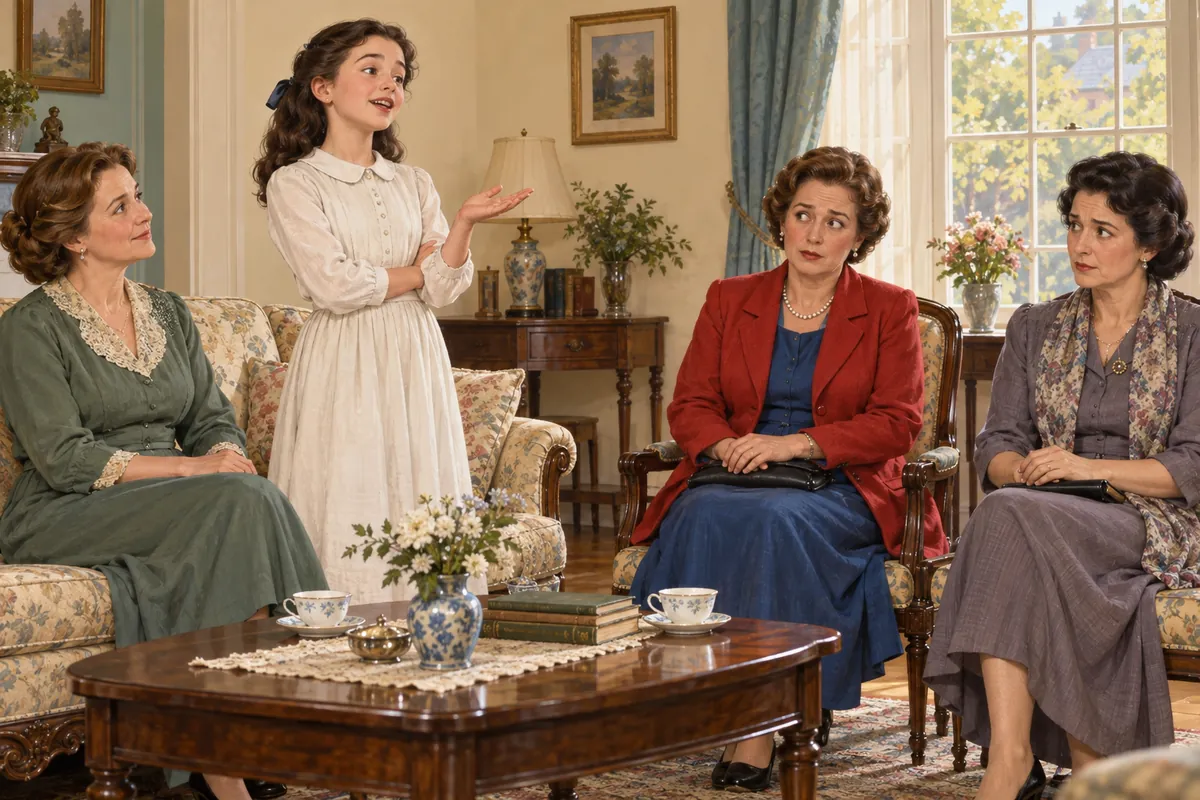
The play opens in Mrs. Shaw’s sitting room as she tidies up before two guests arrive. She scolds her daughter Mary for leaving clothes around and explains that Mrs. Harding, the wife of a wealthy man who has just moved to Lanfield, and Mrs. Lee, his sister, are coming to visit. Mrs. Shaw is keen to make friends with them, so she gently suggests that Mary go out for a walk, fearing she may not “say the right thing.” Mary, however, is confident she can talk well and insists on staying.
Mrs. Shaw then gives Mary careful advice: be kind, say things that please people, laugh and make them laugh, keep the conversation going if it stops, and never say anything that makes the guests angry. She even teaches Mary the polite words to use when guests prepare to leave – “Must you go? Can’t you stay?” Mary repeats this confidently and promises to remember everything.
In Scene II the guests arrive, and Mary’s good intentions collapse into a string of blunders. She praises Mrs. Harding’s “beautiful children” – but Mrs. Harding has none. She mocks bankers, only to learn Mrs. Lee’s brother is one. She laughs at a blue dress with a red coat, which Mrs. Harding herself wears; criticises a woman who stays in bed and calls the doctor, habits the guests share; and insults a dirty dog that turns out to be the Hardings’. Each remark is met with awkward silence. At last, when Mrs. Shaw politely asks the guests to stay longer, Mary delivers the funniest blunder of all, reversing her mother’s words: “Oh, must you stay? Can’t you go?”
Theme & message
The central theme is the importance of tact and polite conversation. Through Mary’s comic mistakes, the play shows how careless, blunt remarks – even when honestly meant – can hurt and embarrass others. It teaches that good manners require us to think before we speak, to be kind and considerate, and to be aware of our listeners’ feelings. The humour comes from the gap between Mrs. Shaw’s sensible advice and Mary’s thoughtless words, but the underlying message is serious: knowing how and when to say something is just as important as what we say.
Word meanings
| Word | English meaning | Hindi meaning |
|---|---|---|
| hilariously | in a very funny way | बहुत हसाने वाले झंच में |
| blunders | careless mistakes | बड़ी भूलें / लापरवाही |
| embarrasses | makes someone uncomfortable | शर्मिंदा / असहज कर देना |
| wealthy | having a lot of money; rich | धनी / समृद्ध |
| polite | showing good manners | विनम्र / शिष्ट |
| guidance | help and advice | मार्गदर्शन / सलाह |
| talkative | fond of talking a great deal | बातूनी / ज्यादा बोलने वाला |
| banker | a person who works in a bank | बैंकर / बैंक कर्मचारी |
| staggered | moved unsteadily, almost falling | लड़खड़ाते हुए चलना |
| rectify | to correct something | सुधारना / ठीक करना |
| diagnose | to identify an illness or problem | रोग की पहचान करना |
| countryside | land outside towns; rural area | ग्रामीण इलाका / देहात |
| spectacles | a pair of glasses worn to see better | चश्मा / एनक |
| cautious | careful to avoid problems | सावधान / सतर्क |
| inexperienced | having little knowledge or skill | अनुभवहीन / कच्चा |
| atmosphere | the general mood of a place | माहौल / वातावरण |
| impulsive | acting without thinking first | आवेग में बिना सोचे काम करने वाला |
Let us discuss (Scene I)
I. Complete the table based on Scene I
Complete the table given below based on Scene I of the play. (An example has been done for you.)
| Speaker | Words of the Speaker | Reason |
|---|---|---|
| Mrs. Shaw | The room looks cleaner now. Put that coat away in your bedroom. | To instruct Mary to keep the room tidy. (given) |
| Mary | You’re always telling me to put things away. I’m not a child! | To protest that she is grown up and does not like being corrected again and again. |
| Mrs. Shaw | I can’t tell you everything, but you’ll always be right if you’re kind to people. Say things that will please them. | To highlight the importance of being kind as a way to ensure Mary says the appropriate things when guests arrive. |
II. Do you think Mary will be able to follow her mother’s advice successfully when Mrs. Harding and Mrs. Lee visit? Why or why not?
Let us discuss (Scene II)
I. Rectify the false statements
Rectify the false statements given below from Scene II of the play. (An example has been done for you.)
Let us think and reflect
I.1. Extract – “Mary: What are you going to talk about? … Mrs. Shaw: Oh, I don’t think so. You can go out for a walk. It will be better if you do that.”
I.2. Extract – “Mary: I saw Mrs. Cotter this afternoon… I’ve never been to a doctor in my life. Mrs. Harding: I stay in bed in the morning myself.”
II. Answer the following questions.
Let us learn
I. Root words and suffixes — p. 80
I. Suffixes – root words and endings
Divide the following words from the text as root words and suffixes: gladly, banker, guidance, quietly, walking.
I.1. Match the suffixes in Column 2 with their meanings/purpose in Column 3 and give examples (Column 4).
| Column 1 (word) | Suffix | Meaning / purpose | Examples |
|---|---|---|---|
| Biology | (i) -logy | C. a study of | Sociology, Zoology, Geology |
| tolerance | (ii) -ance | F. change to a noun | guidance, importance, performance |
| stopped | (iii) -ed | E. change to past tense | walked, jumped, played |
| backward | (iv) -ward | G. in a certain direction | forward, upward, homeward |
| courageous | (v) -ous | H. change to adjective | humorous, dangerous, famous |
| quietly | (vi) -ly | A. change to adverb | gladly, kindly, slowly |
| toughest | (vii) -est | D. change to superlative | tallest, kindest, fastest |
| tomatoes | (viii) -es | B. change to plural | potatoes, boxes, dishes |
I.2. Fill in the blanks using words given in the brackets by adding suitable suffixes.
II. ‘Say’ vs ‘tell’ and confusing word pairs
Is there a difference in the meanings of ‘say’ and ‘tell’? (Yes/No)
II.1. Fill in the blanks with suitable words (fetch/bring, see/look, live/stay, study/learn, speak/talk, hear/listen), changing the verb forms if necessary.
III. Tenses – present continuous and present perfect continuous
Underline the verbs in: “They lived in London before.”; “I met her in a shop and asked her to come.”; “She has been staying with them for a while.”
III.1. Fill in the blanks using the verbs given in brackets in present continuous or present perfect continuous tense.
IV. Kinds of sentences
IV.1. Identify the kinds of sentences and punctuate them appropriately.
Before reading, listening, speaking and writing
Before reading — p. 70
I. Atithi Devo Bhava expresses treating a guest with respect and hospitality. II. Polite choices: 1, 2 and 5. III. Sample strategies: let each person finish, disagree with an idea rather than insult someone, and ask a teacher to help if the exchange becomes hurtful.
Let us listen — p. 84; transcript pp. 89–90
II. True statements: 1, 2, 3 and 7. Statements 4 and 5 contradict the conversation, and 6 overstates his ready acceptance: he initially questions waiting in a queue.
Let us speak — pp. 84–86
I–II. Practise a falling pitch for the statements and emphasise the textbook’s highlighted content words. Emphasis need not mean shouting.
IV. Raise the pitch at the end of “I saw Mrs. Cotter this afternoon” to turn the statement into a checking question. Practise the highlighted stress separately from the rising intonation.
Let us write — p. 86: sample story retelling
Mary Shaw wanted to prove that she could entertain guests as well as anyone. Before Mrs. Harding and Mrs. Lee arrived, her mother asked her to tidy her clothes, speak kindly and encourage the visitors to stay when they were ready to leave. Mary confidently promised to remember.
During the visit, Mary admired children who did not belong to Mrs. Harding, criticised bankers without knowing that Mrs. Lee’s brother was one, and laughed at a blue dress worn with a red coat. Each comment touched something familiar to the guests. She went on to criticise resting in the morning, visiting doctors, talkative women and a dog that turned out to be the Hardings’ Towzer. Awkward silences followed.
At last the guests prepared to leave. Mrs. Shaw invited them to stay longer, but Mary mixed up the very words she had practised. She asked whether they had to stay and whether they could go. Her final mistake showed that polite conversation requires attention to others’ feelings, not merely memorised phrases.
This original retelling condenses the main events; adapt its wording and retain the play’s humorous tone.
Let us explore — pp. 86–87
I. Assign roles for a short enactment, including director, narrator and characters. Use stage directions to convey awkward pauses, surprise and Mary’s embarrassment.
II. Collect greetings in languages classmates actually speak, check pronunciation with speakers and explain where each is appropriate. A greeting alone does not replace considerate listening.
III. Vasudhaiva Kutumbakam means “the world is one family”. Connect the idea to kindness and cooperation across differences, using the textbook’s explanation rather than inventing a new historical claim.
Additional ClearStudy questions
This practice is separate from the printed textbook exercises.
Short answer (30–40 words)
1. Why was Mrs. Shaw so keen to make a good impression on Mrs. Harding?
2. What advice did Mrs. Shaw give Mary about how to behave when the guests wanted to leave?
3. How did Mary insult Mrs. Harding without realising it during the talk about children?
4. Why did Mary’s remark about the dirty dog cause embarrassment?
5. How does the play end, and why is the ending funny?
Long answer (100–120 words)
6. Describe the advice Mrs. Shaw gave Mary in Scene I and explain how completely Mary failed to follow it.
7. How does ‘Say the Right Thing’ use humour to teach a serious lesson about polite conversation?
ClearStudy MCQs and assertion–reason practice
1. Who wrote the play ‘Say the Right Thing’?
(a) Ruskin Bond (b) G.C. Thornley (c) Hugh Lofting (d) Natalie Joan
2. In which town is the play set?
(a) London (b) Puddleby (c) Lanfield (d) Woodstock
3. Why was Mrs. Shaw keen to know Mrs. Harding well?
(a) to borrow money (b) to make more friends in Lanfield (c) to sell her house (d) to find a job
4. What polite words did Mrs. Shaw teach Mary to use when guests prepare to leave?
(a) “Good afternoon” (b) “Must you go? Can’t you stay?” (c) “How are you?” (d) “Please come again”
5. Why was Mrs. Harding not pleased when Mary praised her “beautiful children”?
(a) the children were rude (b) she had no children (c) the children were ill (d) she disliked compliments
6. What did Mary rudely say about bankers?
(a) they are very kind (b) they work too hard (c) bankers can’t think (d) bankers are rich
7. Whose brother turned out to be a banker?
(a) Mrs. Shaw’s (b) Mary’s (c) Mrs. Lee’s (d) Mrs. Best’s
8. What was the name of the dog Mary insulted?
(a) Polynesia (b) Jip (c) Towzer (d) Rover
9. Which stage direction is repeated to show the awkward silence after Mary’s remarks?
(a) ‘everyone laughs’ (b) ‘no one speaks’ (c) ‘they leave’ (d) ‘Mary smiles’
10. What did Mary blurt out at the very end of the play?
(a) “Must you go? Can’t you stay?” (b) “Please stay longer” (c) “Must you stay? Can’t you go?” (d) “Goodbye and thank you”
Assertion–Reason – choose: (a) A and R true, R explains A; (b) A and R true, R does not explain A; (c) A true, R false; (d) A false, R true.
1. Assertion (A): Mrs. Shaw advised Mary to say only kind and pleasing things to the guests.
Reason (R): Mrs. Shaw wanted to become friends with Mrs. Harding and be invited to her house.
2. Assertion (A): Mrs. Harding was not pleased when Mary mentioned her children.
Reason (R): Mrs. Harding had no children of her own.
3. Assertion (A): Mary’s remarks repeatedly created an awkward silence in the room.
Reason (R): Her comments unknowingly insulted the guests and their relatives.
4. Assertion (A): Mary successfully followed all of her mother’s advice during the visit.
Reason (R): At the end she reversed the intended invitation and said, “Must you stay? Can’t you go?”
5. Assertion (A): Mrs. Harding and Mrs. Lee remained calm and dignified despite Mary’s blunders.
Reason (R): They were well-mannered and corrected Mary gently instead of getting angry.
Exam tips & common mistakes
Exam tips
• Name the author when relevant (G.C. Thornley) and the setting (Lanfield) in long answers.
• Learn the four characters: Mary, Mrs. Shaw, Mrs. Harding (no children) and Mrs. Lee (Mr. Harding’s sister).
• Remember the chain of blunders in order: children → bankers → blue dress and red coat → staying in bed/doctor → talkative women → the dog → horses/shooting → the final reversed line.
• For theme questions, focus on tact, kindness and thinking before you speak.
Common mistakes
• Distinguish restraint from comfort: Mrs. Harding is explicitly “not very pleased”, and the silences show discomfort, although the guests remain outwardly restrained.
• Mrs. Harding has no children; Mary mistook someone else’s children for hers.
• The banker is Mrs. Lee’s brother (Mr. Harding), not Mary’s relative.
• Mary’s final line is “Must you stay? Can’t you go?” – the reverse of the correct words. Do not mix this up.
FAQs
Who wrote ‘Say the Right Thing’ and what type of text is it?
It was written by G.C. Thornley. It is a short, humorous one-act play in two scenes from Unit 2, ‘Wit and Humour’, of the Class 7 English book Poorvi.
What is the main message of ‘Say the Right Thing’?
The play teaches the importance of tact and polite conversation – we must think before we speak and choose kind words, because thoughtless remarks can hurt and embarrass others.
What is Mary’s funniest blunder in the play?
At the end, trying to use the polite words her mother taught her, Mary reverses them and tells the guests, “Oh, must you stay? Can’t you go?” – the exact opposite of what she meant.
Textbook-based exercises and additional ClearStudy practice are identified separately. Use your textbook alongside these explanations.