
My Brother’s Great Invention — Class 7 English Poorvi Questions and Answers
My Brother’s Great Invention questions and answers for Class 7 Poorvi follow Anand and Anita’s comic mystery. Study the event sequence, character evidence, sound words, binomials, idioms and tenses, with transcript-based listening checks and a sample vocation paragraph.
Source: NCERT Poorvi, Grade 7, Unit 3, printed pages 91–108 (listening transcript 136); supplied reprint 2026–27. Open-ended and personal responses are examples to adapt. These explanations are study support, not an official NCERT answer key.
About the chapter
“My Brother’s Great Invention” is a humorous first-person story from Unit 3, ‘Dreams and Discoveries’, told by fourteen-year-old Anita about her younger brother Anand, who believes he is a born scientist. Anand is forever building ‘inventions’ that go hilariously wrong – first a burglar alarm that soaks his own father, and then a homemade time machine. When a real burglar, Boppa, breaks in one night, Anand cleverly misdirects him into his own room, and the thief mysteriously vanishes near the humming time machine. The story celebrates a child’s curiosity, imagination and inventiveness, told with warmth and gentle comedy.
About the author
NCERT credits the story to Anita Rau Badami. The narrator named Anita is a fourteen-year-old character; she should not automatically be identified with the author. Her thirteen-year-old brother Anand is imaginative, confident and experimental.
Summary
The narrator, fourteen-year-old Anita, introduces her thirteen-year-old brother Anand, who is convinced he is a scientist. He loves tinkering with electrical gadgets, tools and dynamos, and keeps creating ‘inventions’ that never work as planned. After a spate of thefts in their colony, Anand decides to build a burglar alarm. The contraption is meant to clang and drop a water bag on a thief who opens the door gently. Unfortunately, it is their own father, who always opens the door softly, who gets soaked and furious. Anita, who had warned Anand and refused to be blamed, watches the chaos unfold.
A week later, after watching the film ‘Back to the Future’, Anand decides to build a time machine. He dismantles gadgets all over the house for parts, filling his room with wires, springs, levers and bulbs. Their father forbids him from testing it, but when their parents leave for a wedding in Kharagpur, the children are left alone for one night. Anand promises half-heartedly not to touch the machine. Late that night, Anita hears scratching at the door, and soon a rough-looking man with a green scarf – Boppa, the colony sweeper – breaks in. He locks the children in and demands to know where their father’s room is.
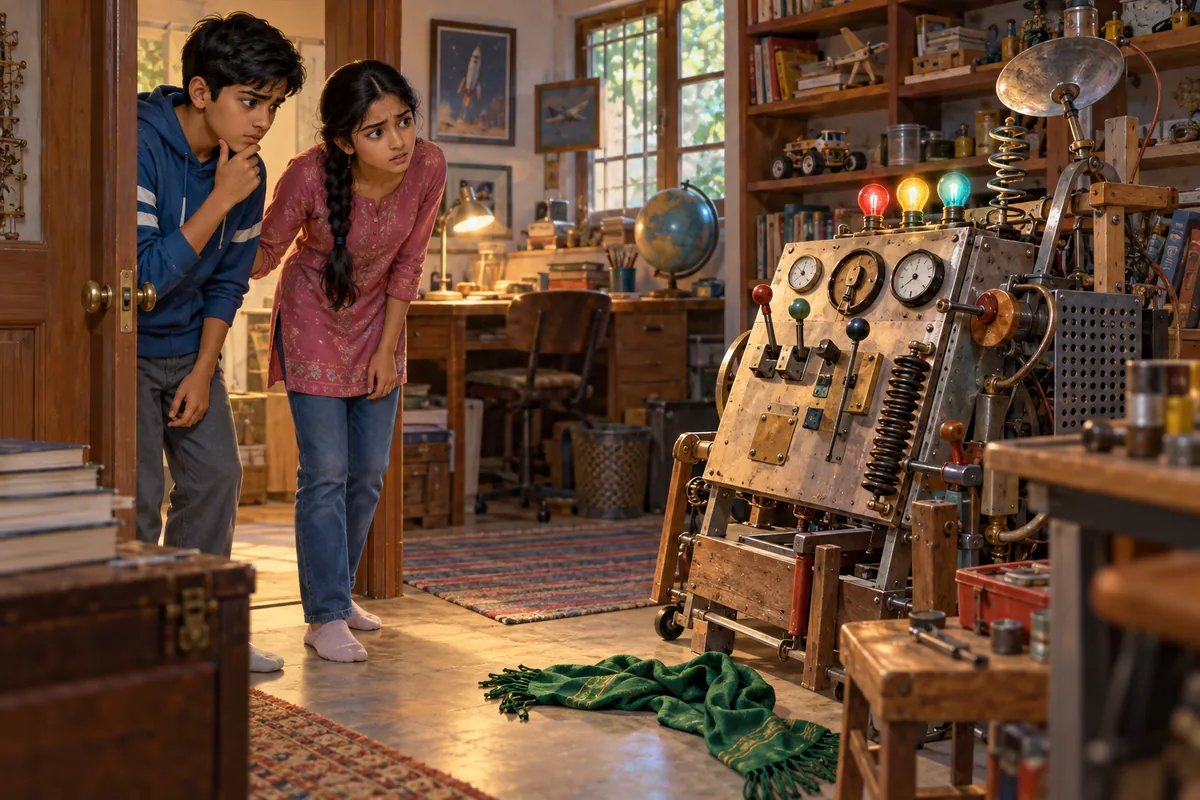
With quick thinking, Anand misdirects Boppa into his own room, where the time machine stands. Suddenly there are crashes, screams, an eerie whine and a humming sound. The children shout for help, and neighbours – the Sharmas and Dr. Mohan – rush in and unlock the door. When they search, Boppa is nowhere to be found; only his green scarf lies near the switch panel. Anand insists his time machine worked and the thief vanished into the past. Boppa is never seen again, the machine is later dismantled as unsafe, and Anand – ever the genius in his own eyes – happily begins a new project to contact creatures in outer space.
Theme & message
The central theme is childhood curiosity, imagination and the inventive spirit, treated with affectionate humour. Anand’s endless experiments – however disastrous – show how a young mind dreams, plans and refuses to give up. The story also highlights the warm, teasing bond between siblings and the patient amusement of parents. Its gentle message is that curiosity and creativity should be encouraged, not crushed: even when inventions fail comically, they spring from a wonderful willingness to think differently, take risks and keep trying.
Word meanings
| Word | English meaning | Hindi meaning |
|---|---|---|
| racket | a loud and disturbing noise | शोर-शराबा |
| sopping | soaking wet | पूरी तरह भीगा हुआ |
| scowling | having an angry or frowning expression | त्यौरी चढ़ाए हुए |
| rigged up | assembled something temporarily | जुगाड़ कर बनाया हुआ |
| tinkering | experimenting or fiddling | छेड़छाढ़ करना / प्रयोग करना |
| dynamos | electric generators | बिजली बनाने वाले यंत्र |
| elaborate | detailed | विस्तृत / बारीक |
| clanging | a loud ringing sound of metal being hit | धातु की खनखनाहट |
| smugly | proudly | आत्म-संतुष्ट भाव से |
| stealthily | quietly or carefully so as not to be seen or heard | चुपके से / चोरी-छिपे |
| sceptical | doubtful | संदेहास्पद / शंकित |
| frantic | hurried and disorganised | उतावला और अस्त-व्यस्त |
| crestfallen | sad and disappointed in appearance | मायूस / निराश |
| offended | felt upset or hurt | आहत / नाराज |
| groggily | sleepily | लिफापैा-से / नींद में |
| ruffianly | rough or violent looking | गुंडे जैसा / दबंगी |
| brandishing | waving | लहराते हुए |
| cudgel | a short, thick stick used as a weapon | डंडा / सोंटा |
| eerie | strange and frightening | भयानक / रहस्यमय |
| indulgently | fondly | स्नेहपूर्वक |
| dismantled | taken apart | तोड़ दिया गया |
| niggling | a slight, persistent feeling of doubt | हल्की / टिस़टी आशंका |
Let us discuss
Part I – Complete the cause-and-effect table
I. Complete the cause-and-effect table given below.
| Causes | Effects |
|---|---|
| 1. Anand set up his burglar alarm and rigged it to work when the door was opened softly. | Papa, who always opens the door softly, was soaked by the water bag and became very angry, demanding to know who was behind the ‘nonsense’. |
| 2. Anita repeatedly warned Anand that she would not be blamed, and made it clear she was not involved in his scheme. | Anita was able to avoid any responsibility as Anand faced the consequences alone. |
| 3. We watched the movie ‘Back to the Future’. | Anand: decided that he too had to build a time machine, and ended the peace and quiet of the house by taking apart all the gadgets to collect parts for it. |
| 4. Papa firmly said ‘NO’ to trying out the time machine. | Anand felt crestfallen and disappointed; the children were only allowed to take a look at the machine, and it could not be tested before the parents left for Kharagpur. |
II. Do you think Anand was able to keep his promise regarding the time machine? If yes, why? If no, why not?
Part II – Arrange the events in the correct order
Arrange the following events in the correct order of occurrence.
Let us think and reflect
I. Read the extracts and answer the questions
1. “Before beginning this story, let me put you in the picture. I am Anita, fourteen years old. My brother Anand, one year younger than me, caused all that hoo-ha with his burglar alarm. The trouble with him is that he thinks he is a scientist… And he keeps creating ‘inventions’ that never work out as they are supposed to.”
2. “I was about to direct him upstairs, when Anand said quickly, ‘The one next to this one.’ ‘You silly goose!’ I said angrily as soon as the man had gone… All of a sudden there was a crash followed by a loud scream. More strange noises emerged from the next room—a few muffled thumps, an eerie whine, and a low, humming sound.”
II. Complete the table of character traits with evidence
Complete the table with the suitable traits of the characters based on evidence from the text. Choose from: creative, curious, careful, responsible, confident. (An example – ‘bothersome’ – has been done for you.)
| Character | Traits | Evidence from the Text |
|---|---|---|
| Anand | 1. bothersome (given) | And this is not the first time he’s got on Papa’s nerves or frightened someone half to death in the house. |
| 2. creative | He loves tinkering with all sorts of electrical gadgets, tools, dynamos, planks of wood, and things like that. And he keeps creating ‘inventions’ that never work out as they are supposed to. | |
| 3. confident | “Nothing will go wrong this time. I’ve planned it out carefully. See the blueprint.” | |
| Anita | 1. responsible | “We’re old enough to look after ourselves, Ma…” |
| 2. curious | “But how does the alarm know that a burglar is opening the door?” | |
| 3. careful | “Now clean up this mess before anyone gets home.” |
III. Answer the following questions
Let us learn
I. Onomatopoeia – match the sound words
Read the sound words used in the story in Column 1. Complete Column 2 by matching expressions from the box (whispered angrily; constant and loud construction noises; sudden loud sound of breaking; a continuous low and soothing sound). An example has been done for you.
II. Binomials
1. Match the words in Column 1 with the correct pairs in Column 2 to make binomials. (Column 1: safe, odds, make, pros, now, give · Column 2: A. break, B. cons, C. never, D. take, E. sound, F. ends.)
2. Complete the following sentences with suitable binomials from 1.
3. Complete the paragraph by using the phrasal verbs given in the box (tripped off, let up, turned out, ran out of, rigged up).
III. Idioms
Complete the following sentences by filling in the blanks with suitable idioms from the text (leaving the coast clear; frighten me half to death; get on our nerves; get a shelling; fell over ourselves).
IV. Simple past and past perfect tense
1. Underline the verbs in simple past and past perfect tense for the following sentences from the text.
2. Fill in the blanks with the simple past or past perfect form of the verbs given in brackets.
3. Combine the pairs of sentences using the time expressions in the box (before, after, by the time, when) and rewrite them using the past perfect tense. (Example: Rohan had packed his suitcase before he left for the airport.)
Before reading, listening, speaking and writing
Before reading — p. 91
I. Riddle answers: 1. zero; 2. yoga. II. Discuss how tools, transport and communication would differ without inventions. III. Grid words in order: CREATIVITY, CURIOSITY, RISK-TAKING, DETERMINATION, IMAGINATION.
Let us listen — p. 105; transcript p. 136
II. 1. people; 2. Martians, energy; 3. chocolates; 4. one; 5. clouds, metals.
Toby is a fictional Martian in a separate listening exercise. These details are not scientific claims about life on Mars.
Let us speak — pp. 105–106
| Sound group | Textbook words |
|---|---|
| oo, like too | through |
| off | cough |
| o, like low | dough |
| ow, like cow | bough, plough |
| aw | thought |
For the reading passage, rough, tough, enough rhyme with puff, while trough has the off sound in the pronunciation practised here. Say the passage and tongue twister slowly and clearly before increasing speed.
Let us write — pp. 106–107: sample vocation paragraph
I would like to become a graphic designer because I enjoy combining pictures and words to explain ideas. I would need training in drawing, layout, typography and design software. A computer, suitable software and a sketchbook would help me work. I could collaborate with writers, illustrators and developers, listening carefully to their ideas. I would ask clients about their audience and purpose, present drafts and revise them after feedback. Teamwork would help us create clearer designs. I would take pride in work that is useful, accessible and original.
This is an adaptable sample, not a claim about your career plans.
Let us explore — pp. 107–108
Start with the textbook’s examples—Sushruta, Janaki Ammal, A.P.J. Abdul Kalam and Narinder Singh Kapany—then research one more inventor or scientist. Record a specific contribution and a reliable source. Distinguish a contribution to a field from inventing it single-handedly.
For the space example, ISRO’s SLV-3 account records the successful 18 July 1980 launch placing Rohini in orbit. Kalam led the SLV-3 project; do not describe him as the director of the whole ISRO organisation on that basis.
Additional ClearStudy questions
This practice is separate from the printed textbook exercises.
Short answer (30–40 words)
1. How was Anand’s burglar alarm supposed to work?
2. Which film inspired Anand to build a time machine?
3. Who was Boppa, and why was he the perfect burglar?
4. What did the neighbours find when they searched for Boppa?
5. What new project did Anand begin at the end of the story?
Long answer (100–120 words)
6. Describe the night Boppa broke into the house and how the children handled the situation.
7. How does the story present Anand as a likeable character despite his failed inventions?
ClearStudy MCQs and assertion–reason practice
1. Who is the narrator of the story?
(a) Anand (b) Anita (c) Ma (d) Mrs. Sharma
2. How old is Anita in the story?
(a) thirteen (b) fourteen (c) fifteen (d) twelve
3. What prompted Anand to build a burglar alarm?
(a) a school project (b) a rush of thefts in the colony (c) his father’s order (d) a science fair
4. Why did the burglar alarm soak Papa instead of a thief?
(a) Papa shook the door (b) Papa always opens the door softly (c) the alarm was broken (d) Papa pulled a wire
5. Which film inspired Anand to build a time machine?
(a) Star Wars (b) Back to the Future (c) E.T. (d) The Time Machine
6. Where did the parents go, leaving the children alone?
(a) Calcutta (b) a wedding in Kharagpur (c) the office (d) Sharma Aunty’s house
7. Who turned out to be the burglar?
(a) Dr. Mohan (b) Mr. Sharma (c) Boppa, the sweeper (d) a stranger
8. Into which room did Anand misdirect Boppa?
(a) the kitchen (b) Papa’s room upstairs (c) his own room with the time machine (d) Anita’s room
9. What did the neighbours find near the time machine after Boppa vanished?
(a) a cudgel (b) a green scarf (c) a torch (d) a glove
10. What new project did Anand begin at the end?
(a) a robot (b) a telephone to contact creatures in outer space (c) another burglar alarm (d) a flying machine
Assertion–Reason – choose: (a) A and R true, R explains A; (b) A and R true, R does not explain A; (c) A true, R false; (d) A false, R true.
1. Assertion (A): Papa, and not a thief, was soaked by the burglar alarm.
Reason (R): The alarm was rigged to work only when the door was opened gently, and Papa always opens the door softly.
2. Assertion (A): Anand began building a time machine.
Reason (R): The family had watched the film ‘Back to the Future’, which is about a time machine.
3. Assertion (A): Anand misdirected Boppa into his own room rather than upstairs.
Reason (R): Anand wanted to give the children some time to think and to shout for help.
4. Assertion (A): Mr. Sharma believed that Anand’s time machine had really sent the burglar into the past.
Reason (R): Boppa’s green scarf was found lying near the panel of switches.
5. Assertion (A): Anita refused to take any blame for Anand’s burglar alarm.
Reason (R): She had repeatedly warned Anand that she was not involved in his scheme.
Exam tips & common mistakes
Exam tips
• Remember the sequence: burglar alarm → Papa soaked → ‘Back to the Future’ → time machine built → parents leave → Boppa breaks in → Anand misdirects him → thief vanishes. Use the sequence to support your explanation.
• Name the author when relevant (Anita Rau Badami) and the narrator (Anita) in long answers.
• For character questions, contrast Anita (sceptical, responsible, curious) with Anand (creative, confident, inventive).
• For value-based answers, highlight curiosity, imagination and never giving up.
Common mistakes
• Do not confuse the narrator: Anita narrates; Anand is the inventor brother.
• The alarm worked when the door was opened gently (not violently) – that is why Papa, not a thief, was caught.
• Anand sent Boppa into his own room, not upstairs to Papa’s room.
• The clue left behind was a green scarf, not a cudgel – check the detail carefully.
FAQs
Who wrote ‘My Brother’s Great Invention’?
The story was written by Anita Rau Badami and appears in Unit 3, ‘Dreams and Discoveries’, of the Class 7 English textbook Poorvi. It is narrated by Anita about her younger brother Anand.
What are Anand’s two main inventions in the story?
Anand first builds a burglar alarm that ends up soaking his own father, and then a homemade time machine made from gadgets taken apart around the house.
What happened to the burglar Boppa?
After Anand misdirected him into the room with the time machine, Boppa mysteriously vanished, leaving only his green scarf behind. He was never seen again, and Anand insisted the machine had sent him into the past.
What is the message of the story?
The story celebrates childhood curiosity, imagination and inventiveness, suggesting with gentle humour that a child’s creative spirit should be encouraged even when experiments fail.
Textbook-based exercises and additional ClearStudy practice are identified separately. Use your textbook alongside these explanations.