
Paper Boats — Class 7 English Poorvi Questions and Answers
Paper Boats questions and answers for Class 7 Poorvi explain the child’s hopes, Tagore’s imagery and the language tasks. Find the reading key, sensory meanings, origami listening answers and sample craft presentation and rainy-day diary.
Source: NCERT Poorvi, Grade 7, Unit 3, printed pages 109–117 (listening transcript 137–138); supplied reprint 2026–27. Open-ended and personal responses are examples to adapt. These explanations are study support, not an official NCERT answer key.
- Poem Overview
- About the Poet
- Central Idea & Summary
- Word Meanings
- Poetic Devices
- NCERT textbook exercises
- Listening and activity examples
- Extra Questions
- MCQs & Answer Key
- Assertion–Reason Questions
- FAQs
Poem Overview
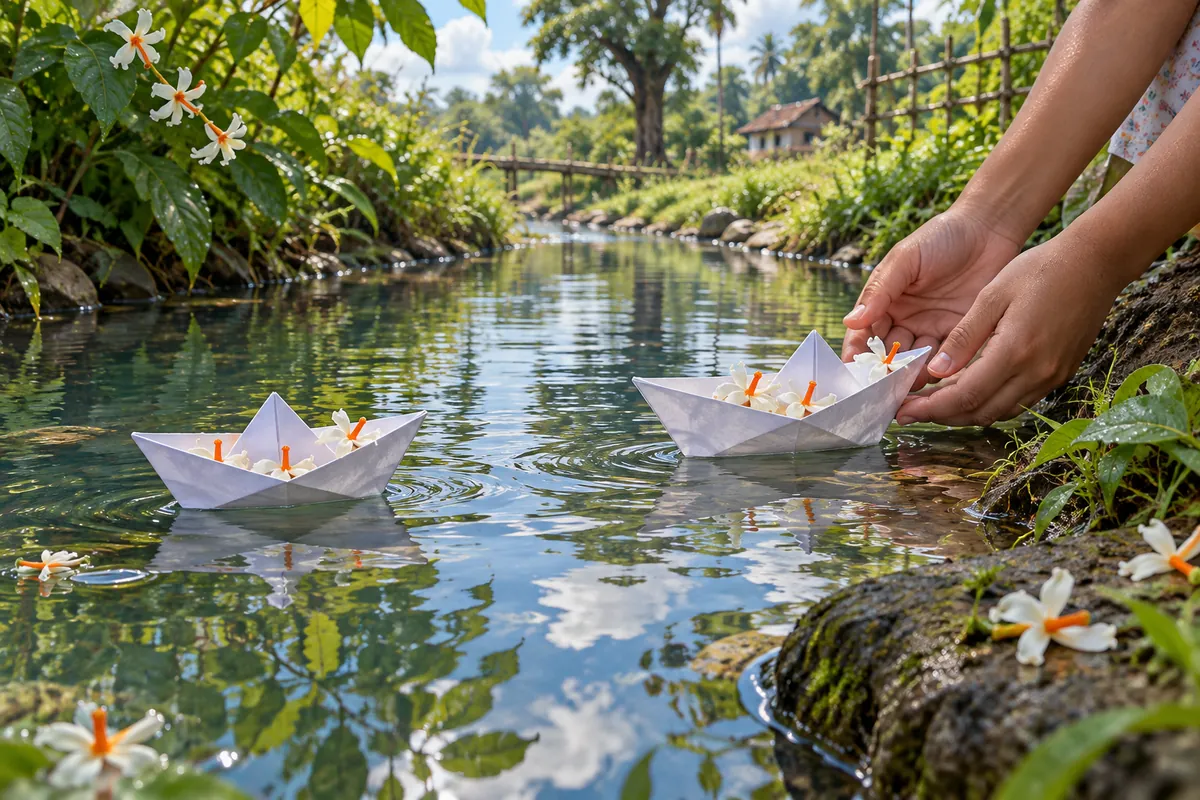
“Paper Boats” is a tender prose-poem in which a young child plays beside a flowing stream, floating little paper boats down the water one by one, day after day. On each boat the child writes his name and the name of his village, hoping that someone far away in a strange land will find the boats and come to know who he is. The child loads the boats with shiuli flowers from the garden, gazes at the clouds drifting in the sky as though they were playmates racing his boats, and at night dreams that the boats sail on under the midnight stars carrying the “fairies of sleep” and baskets full of dreams. The poem beautifully captures a child’s innocence, boundless imagination and longing for friendship and connection with the wider world. Its gentle, wishful mood and dream-like imagery are typical of Rabindranath Tagore’s writing for children.
About the Poet – Rabindranath Tagore
NCERT credits Paper Boats to Rabindranath Tagore. The poem’s child speaker sends small boats into the world and imagines distant friendship. Distinguish the speaker’s imagined experience from a factual account of the poet’s own childhood.
Central Idea & Summary
Central idea: The poem celebrates the pure imagination and innocent hopes of childhood. Through the simple, joyful act of floating paper boats down a stream, a child dreams of reaching out to the wider world, making unknown friends, and sending his thoughts and wishes far beyond his little village. The poem shows how a child blends reality and fantasy, turning an everyday game into a beautiful dream of connection, wonder and hope.
Stanza-wise summary: The child floats his paper boats, one by one, down the running stream every single day. On each boat he writes his name and the name of his village in big black letters, hoping that someone in a distant, unknown land will find the boats and learn who he is. He loads each little boat with shiuli flowers from his garden and hopes that these “blooms of the dawn” will be carried safely to land during the night.
As he launches the boats, the child looks up at the sky and imagines that the little clouds are setting their own white, bulging sails. He fancies that some unseen “playmate” in the sky is sending the clouds down to race with his paper boats. When night falls, he buries his face in his arms and dreams that his boats keep floating on and on beneath the midnight stars — and that the “fairies of sleep” are sailing in them, their baskets filled with dreams. The whole poem turns a small game into a dreamy voyage of a child’s imagination, hope and longing for friendship.
Word Meanings (शब्दार्थ)
| Word / Phrase | English Meaning | हिंदी अर्थ |
|---|---|---|
| float (boats) | to make something rest and move on water | पानी पर बहाना / तैराना |
| running stream | a small flowing river of water | बहती हुई जलधारा |
| strange land | an unknown, faraway place | अजनबी / अनजानी भूमि |
| load (lade) | to fill or pile something with goods | लादना, भरना |
| shiuli | the fragrant night-flowering jasmine (parijat / harsingar) | शिउली / हरसिंगार का फूल |
| blooms | flowers in full blossom | खिले हुए फूल |
| dawn | the first light of the morning | भोर, उषाकाल |
| launch | to set a boat afloat; to start something off | (नाव को) पानी में छोड़ना |
| bulging | swelling outward, puffed up | फूला हुआ, उभरा हुआ |
| sails | sheets of cloth that catch wind to move a boat | पाल (नाव का) |
| playmate | a friend one plays with | खेल का साथी |
| race | to compete in moving fast | दौड़ लगाना, होड़ करना |
| bury (my face) | to hide or press the face into something | (चेहरा) छिपाना / दबाना |
| midnight | twelve o’clock at night; the middle of the night | अर्धरात्रि, आधी रात |
| fairies | tiny magical, imaginary beings | परियाँ |
| lading | the cargo or load carried in a boat | नाव में लदा हुआ माल |
| baskets | containers woven from cane or straw | टोकरियाँ |
Poetic Devices in the Poem
| Device | Explanation / Example from the poem |
|---|---|
| Imagery | Vivid pictures fill the poem: “shiuli flower from our garden”, “little clouds setting the white bulging sails”, “float on and on under the midnight stars”. |
| Personification | The clouds are given human action — they “set the white bulging sails”; the “fairies of sleep” sail the boats like little people. |
| Alliteration | Clear examples include “big black”, “see … sails” and “sleep … sailing”: nearby words repeat the same initial consonant sound. |
| Repetition | “day by day”, “one by one” and “on and on” repeat words to suggest the passing of time and the endless drifting of the boats. |
| Symbolism | The paper boats stand for the child’s dreams, hopes and messages sent out into the world; shiuli flowers suggest purity and a new dawn; the midnight stars suggest the vast universe. |
| Metaphor / imaginative comparison | Clouds are imagined as sailing boats. “Blooms of the dawn” refers to actual flowers; it is not automatically a metaphor just because it uses “of”. |
| Free verse | The poem is written in flowing, unrhymed prose-poetry lines, which gives it a gentle, dream-like rhythm. |
NCERT textbook exercises
Let us discuss
I. Choose the correct words from the brackets to complete the summary of the poem given below. The poet sends paper boats down a 1. ____ (stream/river) each day, writing his name and the name of his 2. ____ (school/village) on them. He hopes that someone in a 3. ____ (strange/familiar) land will find them and know who he is. The poet fills his boats with 4. ____ (rose/shiuli) flowers from his garden, hoping they will be safely carried to another land at 5. ____ (night/morning). As he launches his boats, he imagines that the 6. ____ (clouds/birds) in the sky are like friends, racing with his boats. At night, he dreams that his paper boats continue to 7. ____ (swim/float) under the midnight stars, with the fairies of sleep sailing in them, their baskets full of 8. ____ (dreams/fruits).
II. Choose the correct option for the following. The theme of the poem is ____. 1. innocence 2. imagination 3. ignorance 4. playfulness 5. travel (i) 1, 2 and 3 (ii) 3, 4 and 5 (iii) 1, 4 and 5 (iv) 1, 2 and 4
III. Identify whether the following statement is true or false. The setting of the poem is a natural, outdoor environment.
IV. Complete the following sentence by choosing the correct word given within the brackets. The tone is ____ (sad and serious/gentle and wishful) and the mood is ____ (thoughtful/boring).
V. Identify the examples of alliteration from the poem.
VI. Fill in the blanks with suitable words from the poem. 1. The repetition of words ____ and ____ emphasises the passage of time. 2. The poet uses imagery like ____ and ____ to create a clear picture in the minds of the readers.
VII. Match the descriptions in Column 1 with what they symbolise in Column 2.
| Column 1 (Symbol) | Column 2 (What it symbolises) |
|---|---|
| (ii) paper boats | 1. the child’s innocence, dreams, hopes, and messages sent out into the world |
| (iii) shiuli flowers | 2. purity, beauty, and the start of a new day |
| (i) midnight stars | 3. the vast universe and the child’s dreams continuing through the night |
Let us think and reflect
I.1. Read the extract given below and answer the questions that follow. “When night comes I bury my face in my arms and dream that my paper boats float on and on under the midnight stars. The fairies of sleep are sailing in them, and the lading is their baskets full of dreams.”
(i) Select the option that is most likely to be the speaker as per the extract. (A. / B. / C. / D. — the four pictures given in the textbook)
(ii) What can be inferred about the speaker’s feelings when night comes?
(iii) What kind of beings are the ‘fairies of sleep’ imagined as? Select the most appropriate option. A. mischievous B. gentle C. fearsome D. playful
(iv) Fill in the blank by selecting the correct option from those given in the brackets. The phrase ‘lading is their baskets full of dreams’ suggests that the speaker imagines the fairies of sleep carefully ____ (carrying his dreams / collecting his wishes) in their baskets.
II. Answer the following questions.
The child writes his name and the name of his village on the boats so that whoever finds them in a faraway land will know who sent them and where he lives. It shows his longing to reach out, to make new friends and to connect with the wider, unknown world beyond his own little village. 2. The poet talks about the imagination of a child. Support this view with examples from the poem.
The whole poem is filled with a child’s imagination. He believes a stranger in some “strange land” will find his boats and know him. He thinks the clouds in the sky are setting their own sails and that an unseen “playmate” in the sky is racing him. At night he dreams that his boats sail on under the stars carrying “fairies of sleep” with baskets full of dreams. These fanciful ideas show the rich, free imagination of a child. 3. How does the poet bring together imagination and reality to make the poem more interesting?
The poet starts with real, everyday actions — floating paper boats on a stream, writing his name on them, loading them with shiuli flowers from the garden — and then blends them with pure imagination, such as clouds becoming sailing boats, a sky-playmate racing him, and fairies of sleep carrying dreams. By mixing the real (stream, flowers, boats) with the imagined (fairies, sky-playmate), Tagore turns a simple game into a magical, dream-like experience that draws the reader in.
Let us learn
I. The poet has used phrases like ‘blooms of the dawn’ and ‘fairies of sleep’ in the poem. In the same way we can create phrases. Now, select words from Column 1 and Column 2 and combine them with ‘of’. Write as many phrases as possible in Column 3. (Column 1: wings, waves, dreams, songs, glimmers, cries, tears, roars, shadows; Column 2: the birds, the wind, the evening, the children, the rain, the stars, the thunder, the ocean, the clouds)
| Phrase (Column 3) | Phrase (Column 3) |
|---|---|
| wings of the wind (example given) | roars of the thunder |
| wings of the birds | roars of the ocean |
| waves of the ocean | shadows of the clouds |
| dreams of the children | shadows of the evening |
| songs of the birds | cries of the children |
| glimmers of the stars | tears of the rain |
II. The poet uses words like ‘dawn’, ‘night’ and ‘midnight’ to show different parts of the day. The box given below has some more words. Write the words in the appropriate columns. (Words: twilight, dawn, nightfall, sunset, noontime, night-time, dusk, midnight, noonday, sunrise, noon, daybreak, sunup, forenoon, sundown, midday)
| Morning | Afternoon | Evening | Night |
|---|---|---|---|
| dawn, sunrise, daybreak, sunup, forenoon | noontime, noonday, noon, midday | twilight, sunset, dusk, sundown, nightfall | night-time, midnight |
III. Match the words from the text given in Column 1 with their opposites in Column 2. (1. strange, 2. dawn, 3. launch, 4. bulging, 5. float, 6. lading — opposites: (i) halt, (ii) emptying, (iii) sink, (iv) dusk, (v) ordinary, (vi) shrinking)
| Word (Column 1) | Opposite (Column 2) |
|---|---|
| 1. strange | (v) ordinary |
| 2. dawn | (iv) dusk |
| 3. launch | (i) halt |
| 4. bulging | (vi) shrinking |
| 5. float | (iii) sink |
| 6. lading | (ii) emptying |
Before reading, listening, speaking and writing
Before reading — p. 109
I. Sample ideas: Paper boats suggest rain, play and journeys. A child might hope that someone far away receives a message. Compare your prediction with the poem after reading.
Let us listen — pp. 114–115; transcript pp. 137–138
These are answers based on the fictional dialogue. A thousand cranes making a wish come true is presented as a cultural belief, not a guaranteed result.
Let us speak — p. 115: sample craft presentation
Today I am showing a bookmark made from reused paper. First, I cut a strip and folded a stronger edge. Then, I drew a leaf pattern and coloured it green. The hardest part was keeping the edge straight. It helps me mark a page without folding the book. I like it because it turns leftover paper into something useful. Thank you for listening. Adapt this to a craft you actually made.
Let us write — p. 116: sample diary entry
Friday, 15 July 20XX — 6:30 p.m.
Dear Diary,
The afternoon began hot and humid, but on my way home the sky grew grey. Soon rain tapped on my umbrella and cooled the air. The trees looked fresh, and I loved the smell of wet earth. From our covered porch I watched ripples spreading through a shallow puddle. Later, I folded a paper boat and tested it in a bowl. The rain made an ordinary day feel full of small discoveries. I hope tomorrow brings another chance to notice nature closely.
This is an invented sample. Use a real date, check its weekday and record your own feelings.
Let us explore — pp. 116–117
I. Shiuli flowers have white petals and orange centres or tubes. Ask a speaker of your language for the local name. List real fragrant plants from your area and draw two from observation; local names vary.
Additional ClearStudy questions
This practice is separate from the printed textbook exercises.
Short Answer Questions (30–40 words)
Day by day the child floats his paper boats, one by one, down the running stream. On each boat he writes his name and his village’s name, hoping a stranger in a faraway land will find them and come to know who he is. Q2. Why does the child load his boats with shiuli flowers?
The child loads his little boats with shiuli flowers from his garden as a small, beautiful gift. He hopes these “blooms of the dawn” will be carried safely across the water and reach some far-off land during the night. Q3. What does the child imagine about the clouds?
When the child launches his boats and looks up, he imagines that the little clouds in the sky are setting their own white, bulging sails, as if some unseen playmate in the sky has sent them down to race against his paper boats. Q4. What happens to the boats in the child’s dream at night?
At night the child buries his face in his arms and dreams that his paper boats keep floating on and on under the midnight stars, with the gentle “fairies of sleep” sailing in them and their baskets full of dreams. Q5. What do the paper boats symbolise in the poem?
The paper boats symbolise the child’s innocent dreams, hopes and messages, which he sends out into the wide world. They stand for his wish to connect with unknown people and faraway places far beyond his small village.
Long Answer Questions (100–120 words)
“Paper Boats” lovingly captures the boundless imagination of a child. A simple game — floating paper boats on a stream — becomes a magical adventure. The child writes his name on the boats, hoping a stranger far away will read it and befriend him. He turns ordinary clouds into sailing boats steered by an unseen sky-playmate who races him. At night his dream carries the boats under the midnight stars, sailed by gentle “fairies of sleep” with baskets full of dreams. Tagore shows how a child mixes the real world of streams, flowers and clouds with pure fantasy, finding wonder and friendship in everything. The poem reminds us how rich, hopeful and free a child’s inner world can be. Q2. Discuss the imagery and symbolism used in ‘Paper Boats’.
Tagore fills the poem with soft, vivid imagery: paper boats drifting down a “running stream”, shiuli flowers from the garden, clouds with “white bulging sails”, and boats floating “under the midnight stars”. These pictures appeal strongly to our senses and create a dreamy mood. The poem is also rich in symbolism. The paper boats stand for the child’s dreams, hopes and the messages he longs to send into the world. The shiuli flowers, “blooms of the dawn”, suggest purity, beauty and the start of a new day. The midnight stars represent the vast universe and the way a child’s dreams continue endlessly through the night. Together, the imagery and symbols give a simple game deep emotional meaning. Q3. What does the child’s act of writing his name and village on the boats tell us about him?
The child’s act of writing his name and the name of his village in “big black letters” reveals his deep longing for friendship and connection. He does not want his boats simply to drift away; he wants whoever finds them in a “strange land” to know exactly who he is and where he comes from. This shows a curious, hopeful and outward-looking child who dreams of reaching people far beyond his own small world. It also shows his innocent faith that his boats really will travel great distances and that a kind stranger will respond. Through this small act, Tagore beautifully expresses a universal childhood wish — to be known, remembered and connected to others.
ClearStudy MCQ practice
1. Who is the poet of ‘Paper Boats’?
(a) Sarojini Naidu (b) Rabindranath Tagore (c) Ruskin Bond (d) Helen Keller
2. How often does the child float his paper boats?
(a) once a year (b) day by day (c) only at night (d) once a week
3. What does the child write on the paper boats?
(a) a poem (b) a riddle (c) his name and his village’s name (d) a drawing
4. With which flowers does the child load his boats?
(a) rose (b) lotus (c) shiuli (d) marigold
5. The phrase ‘blooms of the dawn’ refers to the —
(a) clouds (b) shiuli flowers (c) stars (d) paper boats
6. The child imagines that the clouds are setting their —
(a) white bulging sails (b) golden oars (c) bright lamps (d) silver wings
7. Who does the child imagine is sending the clouds to race his boats?
(a) his mother (b) a playmate in the sky (c) the boatman (d) the fairies
8. What does the child do when night comes?
(a) sails a real boat (b) lights a lamp (c) buries his face in his arms and dreams (d) goes to school
9. In the child’s dream, the boats float under the —
(a) bright sun (b) midnight stars (c) rainbow (d) full moon only
10. The ‘fairies of sleep’ carry baskets full of —
(a) flowers (b) fruits (c) dreams (d) gold
ClearStudy assertion–reason practice
For each, choose: (a) Both A and R are true and R is the correct explanation of A. (b) Both A and R are true but R is NOT the correct explanation of A. (c) A is true but R is false. (d) A is false but R is true.
1. Assertion (A): The child writes his name and his village’s name on the paper boats.
Reason (R): He hopes that someone in a strange land will find the boats and know who he is.
Answer: (a) — R correctly explains why he writes his details on the boats.
2. Assertion (A): The poem ‘Paper Boats’ is full of a child’s imagination.
Reason (R): The child imagines clouds as sails and fairies of sleep sailing his boats.
Answer: (a) — R correctly supports the assertion with examples from the poem.
3. Assertion (A): The child loads his boats with shiuli flowers.
Reason (R): The shiuli flowers are a symbol of fear and sadness in the poem.
Answer: (c) — A is true, but R is false; shiuli flowers symbolise purity, beauty and a new dawn, not fear.
4. Assertion (A): The mood of the poem is gentle and dreamy.
Reason (R): The poem describes a violent storm at sea.
Answer: (c) — A is true, but R is false; there is no storm — the poem is calm and dream-like.
5. Assertion (A): The repeated phrases ‘day by day’ and ‘on and on’ add to the poem’s meaning.
Reason (R): The repetition emphasises the passing of time and the endless drifting of the boats.
Answer: (a) — R correctly explains the effect of the repetition.
📌 Exam Tips
• Remember the three “moves” of the child: he floats and names the boats, loads them with shiuli flowers, and at night dreams they sail under the stars.
• Learn the symbol pairs: paper boats = dreams/messages; shiuli flowers = purity/new dawn; midnight stars = the vast universe.
• Quote short phrases — “big black letters”, “blooms of the dawn”, “fairies of sleep” — to support your answers when they support your explanation.
• For device questions, name the device (imagery, personification, alliteration) and give a one-line example from the poem.
⚠ Common Mistakes to Avoid
• Do not write that the child floats real boats — they are little paper boats.
• The flowers are shiuli (night jasmine), not roses; spell the name correctly.
• The theme is not ignorance or actual travel — it is innocence, imagination and playfulness.
• ‘Lading’ means the load/cargo carried in a boat, not “leading” or “landing”.
• Remember the poet is Rabindranath Tagore (from The Crescent Moon) — do not confuse him with the poet of the previous chapter.
Frequently Asked Questions (FAQs)
Who wrote the poem ‘Paper Boats’ in Class 7 Poorvi?
The poem was written by Rabindranath Tagore (1861–1941), the great Indian poet and the first Asian to win the Nobel Prize in Literature. “Paper Boats” comes from his collection The Crescent Moon.
What is the central idea of ‘Paper Boats’?
The poem celebrates childhood innocence and imagination. A child floats paper boats down a stream, writes his name on them, and dreams of reaching unknown friends in faraway lands, blending a simple game with beautiful dreams of hope and connection.
What do the paper boats and shiuli flowers symbolise?
The paper boats symbolise the child’s dreams, hopes and messages sent out into the world, while the shiuli flowers (“blooms of the dawn”) symbolise purity, beauty and the start of a new day.