
North, South, East, West — Class 7 English Poorvi Questions and Answers
North, South, East, West questions and answers for Class 7 Poorvi follow Shaana’s postcards across India. Use the dated sequence, corrected word-search key, picture matches, subject–verb agreement and sample leave application alongside your textbook.
Source: NCERT Poorvi, Grade 7, Unit 3, printed pages 118–135 (listening transcript 138); supplied reprint 2026–27. Open-ended and personal responses are examples to adapt. These explanations are study support, not an official NCERT answer key.
About the chapter
“North, South, East, West” is a travel piece from Unit 3, ‘Dreams and Discoveries’, told entirely through postcards. A young girl named Shaana, who lives on Rameswaram island, travels “the length and breadth” of India with her parents (Amma and Appa). From the Thajiwas glacier in Kashmir in the far north to the Olaikaadu beach near home in the south, she sends letters to her classmates describing the glaciers, forests, wetlands, deserts, rivers, plateaus and beaches she sees. Through her cheerful, curious voice the chapter celebrates the amazing diversity of India’s geography, people and cultures – and gently notes how some of these places are changing.
About the author
NCERT credits these excerpts to C.G. Salamander. The postcards belong to the fictional traveller Shaana. Their personal voice combines observations, humour and impressions; they are not a current travel itinerary or comprehensive geography reference.
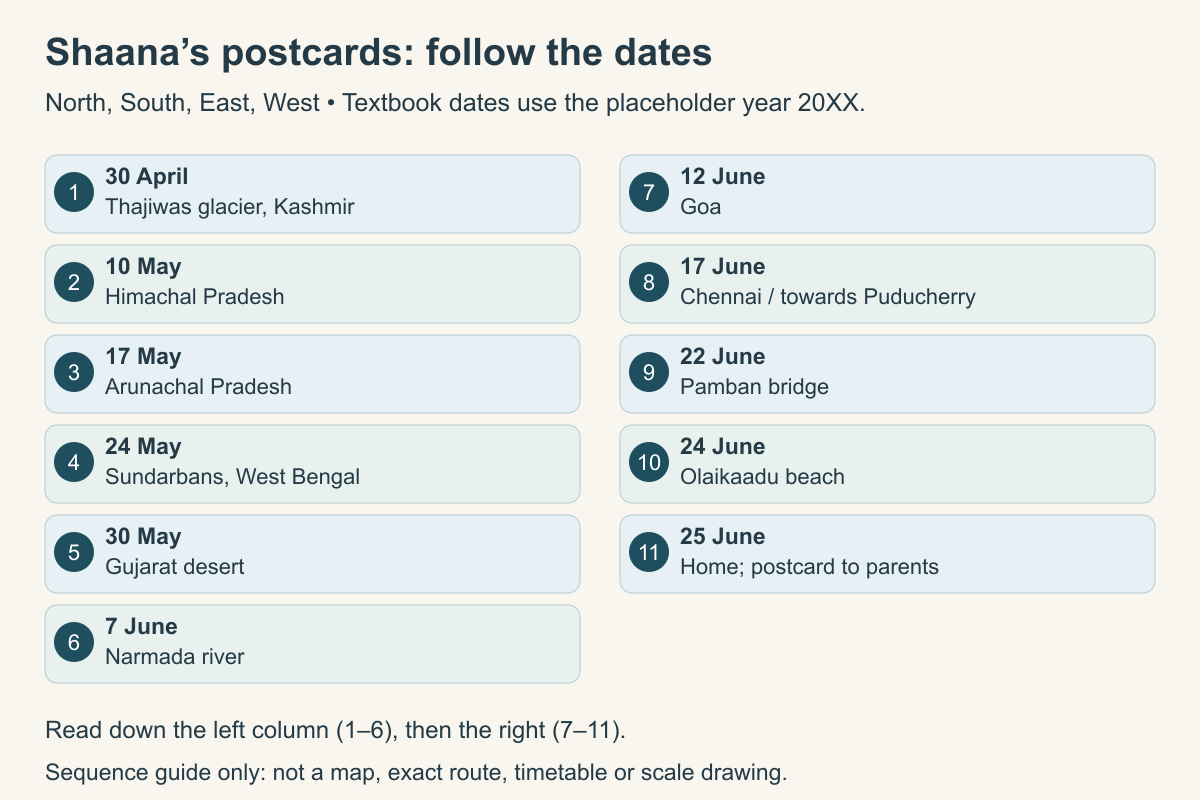
Open the postcard sequence at full size. The text summary below follows the same order.
Summary
Shaana lives on Rameswaram island and sets off on a long journey across India with her parents, writing postcards home all the way. Her first card comes from the Thajiwas glacier in Kashmir, far up north, where everyone wears four layers of clothing and her parents throw snowballs – though they say there was more snow the year before. Next she reaches Himachal Pradesh, all mountains and birdsong, where she jokes that the “growling bears” are really only Appa snoring. She is surprised to learn that Arunachal Pradesh, though also a ‘Pradesh’, is far away in the east, with a forest so thick you could get lost tying your shoelaces.
Travelling on, she visits the Sundarbans in West Bengal, a wetland where mangrove trees grow in seawater and crocodiles and a snake appear during a boat ride; her mother is sad about how much it floods now. From east to west she crosses to the hot, sandy desert of Gujarat with its beautiful colourful clothes, then drives to the Narmada river in central India for some wild, scary rafting. In Goa she admires the plateaus, hills, beaches and train tunnels she once feared. Finally she returns south – learning to surf near Chennai and Puducherry, crossing the sea on the Pamban bridge, and stopping at Olaikaadu beach to float and collect pebbles. In her last card to Amma and Appa, she marvels that they crossed the whole country, and hopes to travel like this again, next time with her friends.
Theme & message
The central theme is the vast diversity and beauty of India’s geography and culture, seen through the wonder-filled eyes of a child. Travelling from glaciers to deserts to beaches, Shaana discovers that one country can hold snow, forests, wetlands, rivers, plateaus and seas, and many different languages and people. A quieter message runs underneath: nature is changing – there is less snow on the glaciers and more flooding in the Sundarbans – a gentle hint about climate change. The chapter also celebrates family, curiosity and the joy of learning by exploring, and shows how travel broadens our understanding and love for our own land.
Word meanings
| Word | English meaning | Hindi meaning |
|---|---|---|
| glacier | a large, slow-moving mass of ice | हिमनद / ग्लेशियर |
| chirping | short, sharp sound made by birds | चहचहाना |
| snoring | making a loud noise while sleeping | खर्राटे लेना |
| treehouse | a small house built in a tree | पेड़ पर बना घर |
| wetlands | land covered with shallow water; marsh | आर्द्रभूमि / दलदल |
| mangroves | trees that grow in coastal salty water | मैंग्रोव (ज्वारीय वन) |
| plateaus | high, flat areas of land | पठार / प्लेटो |
| desert | a dry, sandy region with little rain | रेगिस्तान / मरुस्थल |
| rafting | travelling down a river in a rubber boat | रबर की नाव से नदी में सैर (रैफ्टिंग) |
| surf | to ride waves while standing on a board | समुद्र की लहरों पर बोर्ड से बहना |
| dive | (here) to swim underwater with equipment | गोता लगाना / पानी में डुबकी लगाना |
| pebbles | small, smooth stones | कंकड़ / छोटे चिकने पत्थर |
| landscapes | the natural features of an area of land | भू-दृश्य / प्राकृतिक दृश्य |
| length and breadth | all over; from one end to the other | चारों ओर; सम्पूर्ण फैलाव |
| postcards | cards sent by post without an envelope | पोस्टकार्ड / पत्रक कार्ड |
| diversity | variety; many different kinds | विविधता / अनेकता |
| extinct | no longer existing | विलुप्त / समाप्त |
Let us discuss
Complete the table given below based on Shaana’s postcards. An example has been done for you. (Places Visited | Interesting Descriptions and Activities)
| Places Visited | Interesting Descriptions and Activities |
|---|---|
| 1. Thajiwas glacier, Kashmir | white and blue glaciers; throwing snowballs (given) |
| 2. Himachal Pradesh | quiet hills with many mountains seen from the cabin; colourful birds chirping at sunrise; she jokes that the “bears growling” are really Appa snoring |
| 3. Arunachal Pradesh | walking through a thick forest to reach the tree house |
| 4. Gujarat | hot, dry desert with sand everywhere – “a beach without the sea”; pretty, colourful clothes; she scored 88% in a surprise test |
| 5. The Narmada river | went rafting in the wild, fast water; got fully wet; Appa was so scared he decided never to raft again |
| 6. Chennai | learnt to surf on the way to Puducherry; fell only twice; the beaches have rougher waves and browner water than her island |
| 7. Olaikaadu beach | floating and looking at the fish; Appa and Amma went for a dive |
Note: The Sundarbans (West Bengal) and Goa postcards also appear in the lesson; the table above lists only the rows printed in the NCERT book. The Sundarbans card describes a boat ride past mangroves, crocodiles and a snake, and the Goa card describes plateaus, hills, beaches and train tunnels.
Let us think and reflect
I.1. Extract – “Amma tells me that places like the Sundarbans are called wetlands… We also saw crocodiles and a lonely snake while boating. I hope they don’t follow us home. How is everyone? Are you missing me yet?”
I.2. Extract – “Amma and Appa are fast asleep, and I should be sleeping too, but I just love looking out of the window… I used to be afraid of tunnels, but I’m not any more. Someday, I wish we could all go on a tour of the plateaus.”
II. Answer the following questions.
Let us learn
I. Match the words with suitable pictures
Read the words from the text in Column 1 and match them with suitable pictures in Column 2: 1. glaciers, 2. treehouse, 3. wetlands, 4. plateaus, 5. pebbles, 6. rafting.
II. Choose the associated word for each situation
Read the situations in Column 1. Choose the associated words from the box (blink, scary, existed, amazing, splashed, floating) and write them in Column 2. An example has been done for you.
III. Word grid (travel words)
The word grid has six words related to ‘travel’ used in the lesson. Circle the words; you can search horizontally and vertically.
IV. Underline the subject and the verb
Read the sentences and underline the subject and the verb. 1. Amma and Appa are fast asleep. 2. It’s hot, dry, and there is sand everywhere. 3. There are so many hills here, and beaches too.
V. Choose the correct verb (subject–verb agreement)
Choose the correct option from the words given in the brackets.
Before reading, listening, speaking and writing
Before reading — p. 118
I–II. Describe a real journey and your own State/UT: region, capital, languages, rivers, attractions and food. Check facts with a reliable source rather than assuming one language represents everyone.
III. The four Pradesh states are Andhra Pradesh (South), Arunachal Pradesh (Northeast), Himachal Pradesh (North) and Madhya Pradesh (Central). Suggested features include Andhra Pradesh’s coast, Arunachal Pradesh’s forested mountains, Himachal Pradesh’s mountain landscapes and Madhya Pradesh’s central location. These are broad regional descriptions.
Let us listen — pp. 131–132; transcript p. 138
This key reports the supplied listening script. It should not be used to infer current conservation status or prove every historical claim in the narration.
Let us speak — pp. 132–133
Sample choices: I prefer trains for the changing views; a family trip for time together; mountains for walking; sightseeing for learning; winter for cooler weather; historic monuments for their stories; and a short trip that fits our schedule. Give your own seven preferences with reasons; there is no single correct set.
Let us write — p. 133: sample leave application
12, Sample Street
Sample City, Sample State
10 August 20XX
The Principal
Sample School
Sample City, Sample State
Subject: Request for three days’ leave
Dear Madam/Sir,
I request leave from 18 to 20 August 20XX to attend a family event in my hometown. I will obtain the missed lessons and assignments from my teachers and classmates and complete them promptly after returning. I would be grateful if you could grant me leave.
Yours sincerely,
Sample Student
Class VII A, Roll No. 12
All names, address and dates are placeholders. Use your actual details and include every requested school day.
Let us explore — pp. 134–135
I. Crossword, grid answers:
| Across | Answer | Down | Answer |
|---|---|---|---|
| 2 Pangong Lake | LADAKH | 1 Dampa Tiger Reserve | MIZORAM |
| 7 Thar Desert | RAJASTHAN | 3 Cellular Jail | ANDAMAN |
| 9 Serenity Beach | PUDUCHERRY | 4 Living Root Bridge | MEGHALAYA |
| 11 Hampi | KARNATAKA | 5 Dudhsagar Falls | GOA |
| 12 Nagarjuna Sagar Dam | TELANGANA | 6 Gangotri Glacier | UTTARAKHAND |
| 14 Thangka paintings | SIKKIM | 8 Chilika Lake | ODISHA |
| 15 Rann of Kutch | GUJARAT | 10 Chota Nagpur Plateau | JHARKHAND |
| 16 Nalanda | BIHAR | 13 Kurukshetra | HARYANA |
ANDAMAN is the seven-letter grid form; the full UT name is Andaman and Nicobar Islands. Telangana is the grid fit for the dam on the Telangana–Andhra Pradesh boundary. Sikkim fits the six-letter clue, but thangka art is not exclusive to that state.
II. The textbook names Kailasa at Ellora and Rani-ki-Vav at Patan. For your local-place project, record its name, location, distinctive feature and source. Explain why it interests you without inventing a visit.
III. The Nagaland Tourism website identifies the Hornbill Festival as a showcase of Naga cultural heritage held at Kisama near Kohima, traditionally 1–10 December. Research the relevant year’s programme for specific participants and events; dates and activities should be checked for that year.
Additional ClearStudy questions
This practice is separate from the printed textbook exercises.
Short answer (30–40 words)
1. Where does Shaana live, and how does she share her travel experiences?
2. Why was Shaana surprised about Arunachal Pradesh?
3. What did Shaana see during her boat ride in the Sundarbans?
4. Describe Shaana’s rafting experience on the Narmada river.
5. What did Shaana do near Chennai and on the Pamban bridge?
Long answer (100–120 words)
6. Trace Shaana’s journey across India from north to south, naming the main places she visited.
7. How does ‘North, South, East, West’ show both the beauty of India and the changes happening in nature?
ClearStudy MCQs and assertion–reason practice
1. On which island does Shaana live?
(a) Majuli (b) Rameswaram (c) Sundarbans (d) Goa
2. How does Shaana share her travel experiences with her friends?
(a) phone calls (b) emails (c) postcards (d) a travel diary
3. Which glacier does Shaana visit in Kashmir?
(a) Siachen (b) Gangotri (c) Thajiwas (d) Pindari
4. What does Amma say Shaana hears in the “west” at Himachal Pradesh, instead of growling bears?
(a) the wind (b) Appa snoring (c) a waterfall (d) chirping birds
5. The Sundarbans, where mangroves grow in seawater, are called …
(a) plateaus (b) wetlands (c) deserts (d) glaciers
6. In which state did Shaana visit a hot, sandy desert?
(a) Rajasthan (b) Gujarat (c) West Bengal (d) Goa
7. On which river did Shaana and her parents go rafting?
(a) Ganga (b) Narmada (c) Kaveri (d) Yamuna
8. What did Shaana learn to do on the way to Puducherry?
(a) dive (b) raft (c) surf (d) sail
9. Which bridge did Shaana cross, seeing the ocean on both sides?
(a) Bandra–Worli (b) Howrah (c) Pamban (d) Bogibeel
10. Who is the author of ‘North, South, East, West’?
(a) Ruskin Bond (b) C.G. Salamander (c) Anita Rau Badami (d) Rabindranath Tagore
Assertion–Reason – choose: (a) A and R true, R explains A; (b) A and R true, R does not explain A; (c) A true, R false; (d) A false, R true.
1. Assertion (A): Shaana’s parents say there was much more snow at the glacier last year.
Reason (R): The postcard compares the snow now with what her parents remember from last year.
2. Assertion (A): Shaana was surprised that Arunachal Pradesh was far from Himachal Pradesh.
Reason (R): She had thought that all the ‘Pradesh’ states sat next to each other.
3. Assertion (A): Shaana enjoyed rafting on the Narmada river.
Reason (R): Appa enjoyed the rafting so much that he wanted to go again.
4. Assertion (A): The text is written in the form of postcards.
Reason (R): The postcard form gives the writing a personal tone and lets readers follow Shaana’s journey day by day.
5. Assertion (A): Shaana is no longer afraid of tunnels.
Reason (R): During her train journey through Goa she passed through many tunnels and got used to them.
Exam tips & common mistakes
Exam tips
• Learn the order of places: Kashmir → Himachal → Arunachal → Sundarbans (Bengal) → Gujarat → Narmada → Goa → Chennai/Puducherry → Pamban → Olaikaadu. The dates establish the order.
• Name the author when relevant (C.G. Salamander), the narrator (Shaana) and the postcard / epistolary form in long answers.
• For environment questions, quote the three ‘change’ clues: less snow, more flooding in the Sundarbans, and less water in the Narmada.
• For subject–verb agreement, remember: ‘a pair of’ takes a singular verb, and with ‘or/nor’ the verb agrees with the nearer subject.
Common mistakes
• Do not say the desert was in Rajasthan – in this text the desert is in Gujarat.
• Himachal Pradesh is in the north and Arunachal Pradesh in the east – do not mix them up.
• Shaana goes rafting on the Narmada and learns to surf near Chennai – these are different activities; do not confuse them.
• The crossing with the ocean on both sides is the Pamban bridge, not the tunnels in Goa.
FAQs
Who wrote ‘North, South, East, West’ and what is its form?
It was written by C.G. Salamander and is presented as a series of dated postcards written by a young traveller, Shaana, to her classmates.
What is the main theme of ‘North, South, East, West’?
The main theme is the rich diversity and beauty of India’s geography and culture, seen through a curious child’s eyes, along with gentle hints about environmental change.
Which places does Shaana visit on her journey?
She visits Kashmir, Himachal Pradesh, Arunachal Pradesh, the Sundarbans in West Bengal, Gujarat, the Narmada river, Goa, Chennai and Puducherry, and finally Olaikaadu beach near her home in Rameswaram.
Textbook-based exercises and additional ClearStudy practice are identified separately. Use your textbook alongside these explanations.