
Travel — Class 7 English Poorvi Questions and Answers
Travel questions and answers for Class 7 Poorvi explain Edna St. Vincent Millay’s longing for journeys. Read the poem’s double-negative wording carefully, then check rhyme, imagery, sound vocabulary, listening corrections and the original diamante example.
Source: NCERT Poorvi, Grade 7, Unit 4, printed pages 157–165 (listening transcript 177); supplied reprint 2026–27. Open-ended and personal responses are examples to adapt. These explanations are study support, not an official NCERT answer key.
- Poem Overview
- About the Poet
- Central Idea & Stanza Summary
- Word Meanings
- Rhyme Scheme & Poetic Devices
- NCERT textbook exercises
- Extra Questions
- MCQs & Answer Key
- Assertion–Reason Questions
- FAQs
Poem Overview
“Travel” is a short, three-stanza lyric in which the speaker expresses an irresistible longing to journey and explore the world. Although the railroad track is “miles away” from where she lives, she can constantly hear a train’s whistle by day and imagine its glowing sparks (cinders) lighting the night sky. The train becomes a symbol of adventure, freedom and endless possibility. In the final stanza the speaker admits that even though she is happy and surrounded by good friends, nothing can hold back her wanderlust — there is no train she would refuse to board, “No matter where it’s going”. The poem celebrates the human desire to travel, discover new places and embrace the unknown, capturing the restless excitement of someone who hears the call of the open road.
About the Poet – Edna St. Vincent Millay
NCERT credits this three-stanza poem to Edna St. Vincent Millay. Its speaker values existing friends while longing to travel. The speaker’s wishes should not automatically be treated as a factual account of the poet’s life.
Central Idea & Stanza Summary
Central idea: Affection for friends can coexist with a desire to explore. The train symbolises adventure and opportunity, and the speaker would take one regardless of its destination.
Stanza 1: The railway is miles away, and the day is noisy, yet the speaker notices the whistle whenever a train passes.
Stanza 2: The night is quiet, but the train remains vivid through glowing cinders and the sound of steam. The imagery strengthens the pull of travel.
Stanza 3: The speaker cannot imagine better friends, yet would take any train. The poem does not say that friendship has become worthless.
Word Meanings (शब्दार्थ)
| Word | English Meaning | हिंदी अर्थ |
|---|---|---|
| railroad track | the rails on which a train runs | रेल की पटरी |
| miles away | at a great distance | मीलों दूर, बहुत दूर |
| loud | full of noise and sound | शोरगुल भरा, तेज़ आवाज़ वाला |
| voices | sounds of people speaking | लोगों की आवाज़ें |
| whistle | the sharp sound made by a train | रेल की सीटी |
| shrieking | making a loud, sharp, piercing sound | तीखी चीख निकालना |
| still | quiet and motionless | शांत, स्थिर |
| dreaming | imagining things while asleep | स्वप्न देखना |
| cinders | tiny pieces of burning or burnt coal; sparks | अंगारे, चिंगारियाँ |
| red on the sky | glowing red against the sky | आकाश में लाल चमकता हुआ |
| engine | the machine that pulls the train | रेल का इंजन |
| steaming | giving off steam; running on steam power | भाप छोड़ता हुआ चलना |
| heart is warm | full of love and affection | हृदय स्नेह से भरा होना |
| knowing | (here) having or finding | पाना, जानना |
| no matter where | regardless of the place | चाहे कहीं भी हो |
Rhyme Scheme & Poetic Devices in the Poem
| Device | Explanation / Example from the poem |
|---|---|
| Rhyme scheme | ABAB in each stanza — e.g. away–day (a), speaking–shrieking (b). |
| Personification | The whistle is said to be “shrieking”, a human-like cry, giving the train a living quality. |
| Imagery | “the day is loud with voices speaking”, “cinders red on the sky”, “engine steaming” create vivid pictures of sound and sight. |
| Symbolism | The train symbolises adventure, freedom and the chance to explore the unknown. |
| Repetition / Refrain | “there isn’t a train goes by” recurs in all three stanzas, stressing the speaker’s constant awareness of the train. |
| Contrast | The busy, noisy day is contrasted with the quiet, still night — yet in both the speaker senses the train. |
| Sound pattern | “sleep and dreaming” is not alliteration because the initial sounds differ. Use the clearly established rhyme and repetition instead of inventing a device. |
| Hyperbole | “there isn’t a train I wouldn’t take, / No matter where it’s going” exaggerates the speaker’s boundless love of travel. |
NCERT textbook exercises
Let us discuss — pp. 159–160
II. Rhymes: stanza 1: away/day, speaking/shrieking; stanza 2: by/sky, dreaming/steaming; stanza 3: make/take, knowing/going.
III. Option 3, ABAB.
IV. “shrieking” gives the whistle a voice-like quality.
V. Suggested tone words: excited, enthusiastic and curious for the desire to travel; content or joyful for the affection expressed about friends. Support a choice from the relevant lines.
VI. 2 and 4: adventure and opportunities.
VII. The repeated construction highlights fascination with trains; the last stanza changes its wording to willingness to take any train.
VIII. The train occupies the speaker’s attention in both the busy day and quiet night.
IX. Imagery: voices and a shrieking whistle evoke sound; red cinders evoke sight; the steaming engine evokes movement and sound. A warm heart expresses affection figuratively, not a literal touch sensation.
Let us think and reflect — p. 160
II.1. Red cinders suggest sparks or glowing pieces from a steam engine against the night sky.
II.2. The whistle represents the repeated call of travel, even amid daily noise and at a distance.
II.3. The journey and discovery appeal more than any particular destination.
II.4. Reasoned response: The speaker may hear distant real trains and notice their sparks; being miles away does not by itself prevent sound from travelling. The poem’s wording says whenever a train passes it attracts attention. A reader may also discuss heightened imagination in the night imagery, but should not argue that “there isn’t a train goes by” means there are no trains.
Let us learn — pp. 161–162
Blanks: 1. heart is warm (or was warm to maintain the past-tense context); 2. engine steaming; 3. day is loud; 4. cinders red; 5. miles away.
Paragraph sample: 1. hollering; 2. yelling; 3. bawling; 4. whimpering; 5. screeching. Some alternatives can fit when the meaning and grammar remain appropriate.
Before reading — p. 157
Suggested word web: transport—train, bus, bicycle; reasons—work, study, family visits; adventure—trekking, exploring; feelings—joy, curiosity; destinations—mountains, riverside; challenges—bad weather, delays. Plan an imagined teacher-led camp with travel arrangements, suitable supplies, activities and duration. State that it is a plan.
Let us listen — pp. 162–163; transcript p. 177
I. Incorrect statements: 1, 2, 3, 4, 5 and 7. Statement 6 is correct.
Let us speak — p. 163
Soft c: cell, race, decide, receive. Hard c: cable, cake, echo, uncle. Both: concert, circle and bicycle have a first c pronounced /s/ and a later c pronounced /k/. Practise each occurrence, not just the word as a whole.
Let us write — pp. 163–165
I. Original sample diamante:
Quiet, absorbing
Turning, imagining, learning
Books, stories, journeys, discoveries
Exploring, climbing, discovering
Bold, exhilarating
Adventure
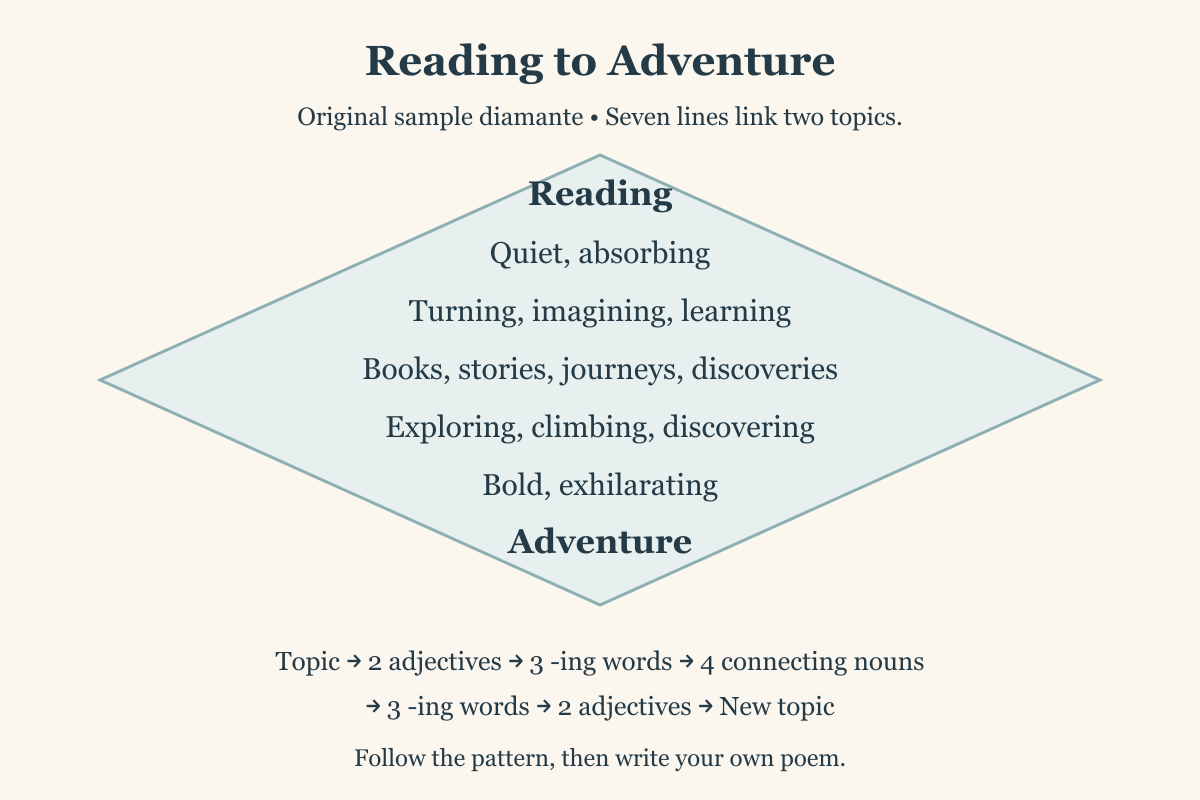
Open the diamante example at full size. Follow the seven-line pattern to write your own version.
II. Sample character description: On a train I met a cheerful ticket examiner named Mr. Kumar. He wore a neat uniform and spoke clearly. When a passenger was unsure about her seat, he listened patiently and guided her to the correct coach. His calm manner helped everyone feel more settled. This is an invented model; replace it with someone you really met, then draft, check, seek feedback and revise as the textbook asks.
Let us explore — p. 165
I. The UNESCO Mountain Railways of India entry covers Darjeeling Himalayan Railway, Nilgiri Mountain Railway and Kalka–Shimla Railway. Choose one and explain how its engineering fits mountainous terrain, citing your source.
II–III. Research Vande Bharat and an underwater tunnel from official sources. Distinguish design/test speeds from a particular service’s operating speed; do not assume every Vande Bharat journey runs at 160 km/h. Kolkata’s underwater metro section runs beneath the Hooghly, while the Channel Tunnel links England and France.
IV. Give a personal preference with a reason: for example, a hill railway interests me because its curves and changing landscape would make the journey memorable.
Additional ClearStudy questions
This practice is separate from the printed textbook exercises.
Additional ClearStudy practice
1. Does longing for travel mean disliking friends? No. The speaker praises existing friends; love for them and curiosity about journeys coexist.
2. How does distance affect the poem? The distant track emphasises how strongly trains attract attention. It does not prove their sounds are imagined.
3. What changes between day and night? The background becomes quiet, but the train remains central through whistle, steam and cinder imagery.
ClearStudy MCQ practice
1. Who is the poet of ‘Travel’?
(a) Ruskin Bond (b) Edna St. Vincent Millay (c) Rabindranath Tagore (d) Sarojini Naidu
2. How far is the railroad track from the speaker?
(a) just outside her house (b) a few steps away (c) miles away (d) across the street
3. During the day, the speaker hears the train’s —
(a) engine steaming (b) whistle shrieking (c) wheels clattering (d) doors slamming
4. At night the speaker imagines seeing the train’s —
(a) bright headlights (b) red cinders on the sky (c) passengers waving (d) green signal lights
5. The rhyme scheme of the poem is —
(a) AABB (b) ABCA (c) ABAB (d) ABBC
6. The word ‘shrieking’ is an example of —
(a) simile (b) personification (c) metaphor (d) hyperbole
7. For the poet, the train mainly symbolises —
(a) education (b) comfort (c) adventure and opportunities (d) fear
8. ‘My heart is warm’ means the speaker’s heart is —
(a) full of love (b) filled with worry (c) feeling upset (d) full of anger
9. According to the last stanza, the speaker would take a train —
(a) only to a famous city (b) only with her friends (c) no matter where it is going (d) only in the daytime
10. The ‘cinders’ in the poem are —
(a) raindrops (b) glowing sparks from the engine (c) street lamps (d) stars in the sky
ClearStudy assertion–reason practice
Additional ClearStudy practice: (a) both true and R explains A; (b) both true without that explanation; (c) A true, R false; (d) A false, R true.
A: The speaker values current friends. R: The speaker says better friends will not be found. Answer: (a).
A: The poem says no trains ever pass. R: Its double-negative construction means the speaker notices every passing train. Answer: (d).
A: Trains symbolise adventure. R: The speaker would take a train regardless of its destination. Answer: (a).
Frequently Asked Questions (FAQs)
Who wrote the poem ‘Travel’ in Class 7 Poorvi?
The poem ‘Travel’ was written by Edna St. Vincent Millay (1892–1950), a famous American poet and Pulitzer Prize winner known for her musical, deeply felt lyric poetry.
What is the central idea of the poem ‘Travel’?
The poem expresses the speaker’s powerful longing for travel and adventure. The train, heard by day and imagined by night, becomes a symbol of freedom, and the speaker says she would take any train, no matter where it is going.
What is the rhyme scheme of the poem ‘Travel’?
The rhyme scheme of each stanza is ABAB — the first and third lines rhyme, and the second and fourth lines rhyme (for example, away–day and speaking–shrieking in the first stanza).