
NCERT Solutions for Class 7 Science (Curiosity) Chapter 9: Life Processes in Animals (NCERT 2026–27)
These Class 7 Science Curiosity Chapter 9 solutions cover Life Processes in Animals from the new NCF-2023 textbook (2026–27). The chapter explains two key life processes in detail — nutrition (how food is digested in humans and other animals) and respiration (how we breathe and how oxygen releases energy from food). Every “Let Us Enhance Our Learning” exercise question is reproduced verbatim and answered in step-by-step, exam-ready style below.
Class 7 Science Curiosity Chapter 9 Solutions – Overview
Chapter 9 of Curiosity, Life Processes in Animals, builds on the Grade 6 idea that nutrition, respiration, excretion and reproduction are the life processes essential for survival. This chapter studies two of them closely. In nutrition, food travels through the alimentary canal — mouth, oesophagus (food pipe), stomach, small intestine, large intestine and anus — helped by the liver and pancreas, and the digested nutrients are absorbed mainly in the small intestine. Animals like ruminants (cows) and birds (using a gizzard) digest differently. In respiration, the respiratory system carries air to the lungs, gases are exchanged in the alveoli, and oxygen breaks down glucose to release energy: Glucose + Oxygen → Carbon dioxide + Water + Energy. The chapter clearly separates breathing (a physical process) from respiration (a chemical process).
Key Concepts & Definitions
Life processes: processes that maintain life, including nutrition, circulation, respiration and excretion. Reproduction continues the species; it is not necessary for the survival of an individual.
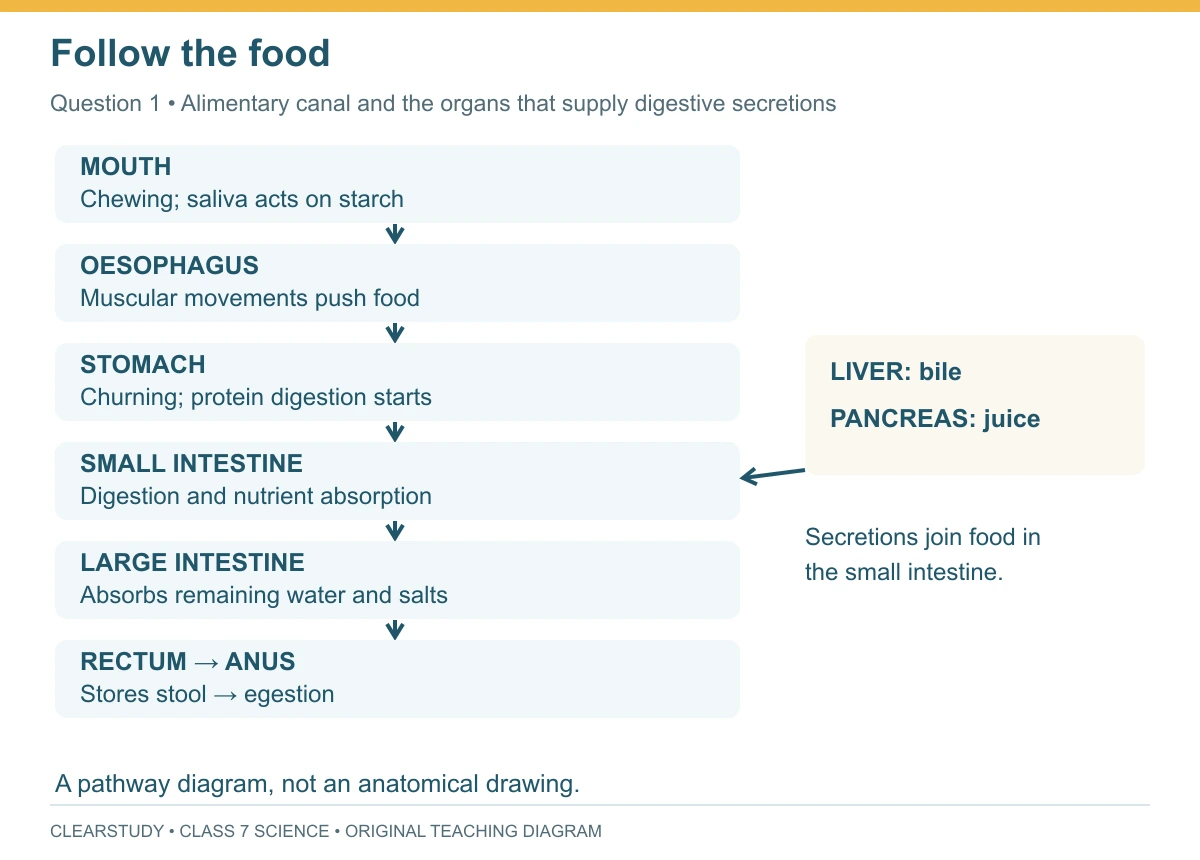
Alimentary canal: a long tube from mouth to anus where complex food is broken into simpler forms; includes mouth, oesophagus, stomach, small intestine, large intestine and anus.
Mechanical digestion: the initial breakdown of food into fine pieces by crushing and chewing with the teeth.
Digestion: the process of breaking complex food components into simpler forms in the body; saliva, for example, breaks starch into sugar.
Absorption: the passing of digested nutrients from the small intestine into the blood; finger-like projections increase the surface area for this.
Egestion: the removal of semi-solid undigested waste (stool) through the anus.
Rumination: grass-eating animals (ruminants like cows) partially chew and swallow food, then bring it back to the mouth for thorough chewing.
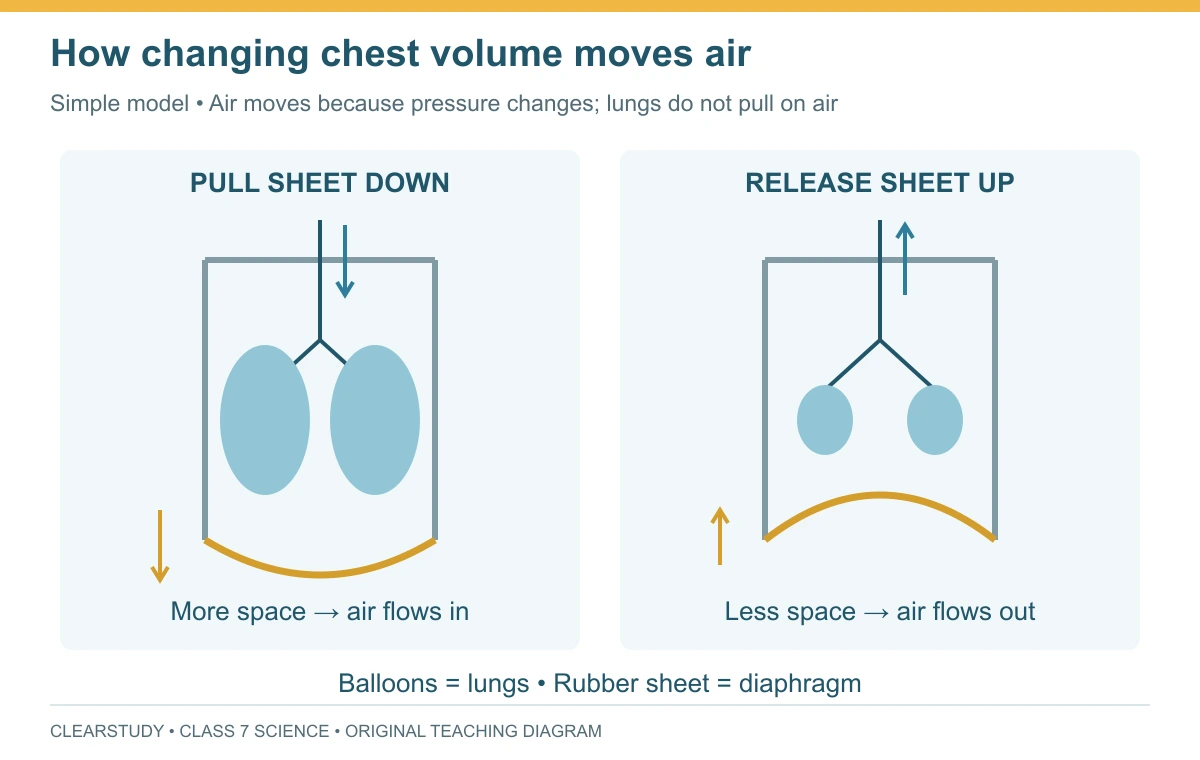
Breathing: the physical process of inhaling and exhaling air; the diaphragm and ribs change the space inside the chest.
Aerobic respiration: chemical reactions in cells that use oxygen to release energy from glucose — Glucose + Oxygen → Carbon dioxide + Water + Energy.
Alveoli: tiny balloon-like sacs in the lungs where exchange of oxygen and carbon dioxide takes place.
“Let Us Enhance Our Learning” — NCERT Solutions
All questions below are reproduced verbatim from the NCERT Curiosity textbook (Grade 7), in the exact order printed. Answers are original and exam-ready.
1. Complete the journey of food through the alimentary canal by filling up the boxes with appropriate parts—
Food → Mouth → ____ → Stomach → ____ → ____ → Anus
2. Sahil placed some pieces of chapati in test tube A. Neha placed chewed chapati in test tube B, and Santushti took boiled and mashed potato in test tube C. All of them added a few drops of iodine solution to their test tubes—A, B, and C, respectively. What would be their observations? Give reasons.
3. What is the role of the diaphragm in breathing?
(i) To filter the air (ii) To produce sound (iii) To help in inhalation and exhalation (iv) To absorb oxygen
4. Match the following
| Name of the part | Function |
|---|---|
| (i) Nostrils | (a) fresh air from outside enters |
| (ii) Nasal passages | (d) tiny hair and mucus help to trap dust and dirt from the air we breathe |
| (iii) Windpipe | (e) air reaches our lungs through this part |
| (iv) Alveoli | (b) exchange of gases occurs |
| (v) Ribcage | (c) protects lungs |
5. Anil claims to his friend Sanvi that respiration and breathing are the same process. What question(s) can Sanvi ask him to make him understand that he is not correct?
6. Which of the following statements is correct and why?
Anu: We inhale air. Shanu: We inhale oxygen. Tanu: We inhale air rich in oxygen.
7. We often sneeze when we inhale a lot of dust-laden air. What can be possible explanations for this?
8. Paridhi and Anusha of Grade 7 started running for their morning workout. After they completed their running, they counted their breaths per minute. Anusha was breathing faster than Paridhi. Provide at least two possible explanations for why Anusha was breathing faster than Paridhi.
9. Yadu conducted an experiment to test his idea. He took two test tubes, A and B, and added a pinch of rice flour to the test tubes, half-filled with water and stirred them properly. To test tube B, he added a few drops of saliva. He left the two test tubes for 35–45 min. After that, he added iodine solution into both the test tubes. Experimental results are as shown in Fig. 9.15. What do you think he wants to test?
10. Rakshita designed an experiment taking two clean test tubes, A and B and filled them with lime water as shown in the figure. In test tube A, the surrounding air that we inhale was passed on by sucking air from the pipe, and in test tube B, the exhaled air was blown through the pipe (Fig. 9.16). What do you think she is trying to investigate? How can she confirm her findings?
Extra Practice Questions
These questions and MCQs are ClearStudy practice, separate from the NCERT exercise.
Short Answer Type Questions
Q1. Why is starchy food like chapati tasting sweet when chewed for a long time?
Q2. Why is the small intestine called “small” even though it is the longest part of the alimentary canal?
Q3. What is the role of bile in digestion?
Q4. How do fish breathe under water?
Q5. Why should we breathe through the nose and not the mouth?
Long Answer Type Questions
Q1. Describe the journey of food through the human alimentary canal, naming the parts and what happens at each.
Q2. Explain the mechanism of breathing in humans, including the role of the diaphragm and ribs.
Q3. How is the digestive system of a ruminant (cow) and a bird different from that of humans?
MCQs & Assertion–Reason
1. The breaking down of complex food into simpler forms in the body is called:
(a) absorption (b) digestion (c) egestion (d) respiration
2. The longest part of the human alimentary canal is the:
(a) oesophagus (b) stomach (c) small intestine (d) large intestine
3. Iodine gives a blue-black colour when it reacts with:
(a) sugar (b) starch (c) fat (d) protein
4. Bile is secreted by the:
(a) pancreas (b) stomach (c) liver (d) small intestine
5. The exchange of gases in the lungs takes place in the:
(a) windpipe (b) nostrils (c) alveoli (d) diaphragm
6. Which animals chew the partially digested food again, a process called rumination?
(a) birds (b) fish (c) ruminants like cows (d) frogs
7. Birds break down food using a muscular chamber called the:
(a) gizzard (b) rumen (c) rectum (d) alveolus
8. The word equation for respiration is Glucose + Oxygen → :
(a) Starch + Water (b) Carbon dioxide + Water + Energy (c) Oxygen + Sugar (d) Protein + Energy
9. Lime water turns milky in the presence of:
(a) oxygen (b) nitrogen (c) carbon dioxide (d) water vapour
10. Which of these is a chemical process that occurs inside the body?
(a) breathing (b) inhalation (c) exhalation (d) respiration
For each Assertion–Reason question, choose: (A) Both true and the Reason correctly explains the Assertion; (B) Both true but the Reason is not the correct explanation; (C) Assertion true, Reason false; (D) Assertion false, Reason true.
A-R 1. Assertion: The inner lining of the small intestine has thousands of finger-like projections.
Reason: These projections increase the surface area for efficient absorption of nutrients.
A-R 2. Assertion: Breathing and respiration are exactly the same process.
Reason: Breathing is a physical process, while respiration is a chemical process that releases energy.
A-R 3. Assertion: Chewed chapati shows little colour change with iodine.
Reason: Saliva breaks down the starch in chapati into simple sugars while chewing.
A-R 4. Assertion: We should breathe through the nose rather than the mouth.
Reason: Tiny hair and mucus in the nostrils trap dust and dirt from the inhaled air.
A-R 5. Assertion: Exhaled air turns lime water milky.
Reason: Exhaled air contains more carbon dioxide than inhaled air, and carbon dioxide turns lime water milky.
Quick Revision Summary
- Nutrition, circulation, respiration and excretion maintain individuals; reproduction continues the species.
- The alimentary canal: mouth → oesophagus → stomach → small intestine → large intestine → anus, with the liver and pancreas as associated parts.
- Saliva breaks starch into sugar; the stomach breaks down proteins; bile emulsifies fats; pancreatic and intestinal enzymes digest food, while alkaline secretions help neutralise acid.
- Nutrients are absorbed mainly in the small intestine; the large intestine absorbs water and salts.
- Ruminants (cows) chew food again (rumination); birds use a gizzard instead of teeth.
- Breathing (physical) moves air in/out using ribs and diaphragm; gases are exchanged in the alveoli.
- Respiration (chemical): Glucose + Oxygen → Carbon dioxide + Water + Energy.
- Exhaled air has more carbon dioxide (turns lime water milky) and less oxygen than inhaled air.
Common Mistakes to Avoid
Watch out for these
- Confusing breathing (physical, air in/out) with respiration (chemical, energy release) — they are not the same.
- Thinking we inhale pure oxygen — we inhale air rich in oxygen, a mixture of gases.
- Calling the small intestine “small” because of length — it is the longest part; it is only narrower than the large intestine.
- Forgetting that iodine turns blue-black with starch, not with sugar — chewed/saliva-treated food shows little colour.
- Mixing up the liver (secretes bile) with the pancreas (secretes pancreatic juice).
- Writing that gills are in the lungs — gills are separate breathing organs in fish.
How to write a clear answer
Learn the order of the alimentary canal and one job for each part — examiners love “name the part and its function” questions. Always write the respiration word equation correctly. In experiment-based questions (iodine–starch or lime water–carbon dioxide), state both the observation and the reason. Clearly distinguish breathing from respiration in one line. Use the textbook’s own examples — saliva on rice, lime water, ruminants and the gizzard — to show you have studied the chapter.
Frequently Asked Questions
What is Class 7 Science Curiosity Chapter 9 about?
Chapter 9, Life Processes in Animals, explains two key life processes in detail: nutrition (digestion of food through the alimentary canal in humans and other animals) and respiration (breathing and how oxygen releases energy from glucose). It also covers digestion in ruminants and birds, and the difference between breathing and respiration.
What is the difference between breathing and respiration?
Breathing is a physical process — the movement of air into the lungs (inhalation) and out of the lungs (exhalation). Aerobic respiration is a chemical process in cells that uses oxygen to release energy from glucose: Glucose + Oxygen → Carbon dioxide + Water + Energy.
Why does chewed rice or chapati taste sweet?
Saliva contains a digestive juice that breaks down the starch in rice or chapati into simple sugars. The longer you chew, the more sugar is formed, so the food begins to taste sweet.
Are these Class 7 Science Curiosity Chapter 9 solutions free?
Yes. All solutions are free and follow the official NCERT Curiosity textbook for session 2026–27.