
NCERT Solutions for Class 7 Social Science (Exploring Society) Chapter 11: From Barter to Money (NCERT 2026–27)
These Class 7 Social Science Exploring Society Chapter 11 solutions cover From Barter to Money from Exploring Society: India and Beyond (Part 1), the NCERT textbook (2026–27 reprint). The chapter belongs to the theme Economic Life Around Us and explains how people exchanged goods through the barter system before money, why the limitations of barter (the double coincidence of wants, lack of a common measure of value, problems of divisibility, portability and durability) led to the invention of money, the basic functions of money, and how money has evolved from commodities and coins to paper currency and today’s digital money. Below you get step-by-step answers to all Questions and activities, clear notes on key terms, extra practice, MCQs, Assertion–Reason and FAQs.
From Barter to Money – Chapter Overview
From Barter to Money explains direct exchange without money and why a commonly accepted medium makes trade easier. The farmer’s story illustrates double coincidence of wants, valuation, divisibility, portability and storage difficulties. Money serves as a medium of exchange, unit of account, store of value and standard of deferred payment. The chapter surveys commodity money, coins, paper currency and electronic payments. These forms overlapped: barter still exists, and cards or UPI are payment tools rather than separate currencies.
Key Concepts & Terms
Barter system: direct exchange of goods or services without using money, such as exchanging a spare eraser for a pencil. It is an old form of exchange that can still be practised today.
Commodities: products or goods that can be traded, bought and sold — in barter, items like cowrie shells, salt, tea, tobacco, cloth, cattle and seeds were used.
Money: something generally accepted as payment within a community or economy. It need not be accepted by literally every person or in every country.
Transaction: a piece of business done between people, especially an act of buying or selling.
Double coincidence of wants: a situation where two people each have something the other wants and can exchange them directly — a basic requirement (and a major difficulty) of barter.
Common standard measure of value: an agreed-upon worth for a transaction that helps in determining the value of goods and services in the economy; barter lacked it.
Divisibility, portability, durability: divisibility is the capacity of an object to be split into pieces; portability is the ability to carry or move it; durability is its longevity and ability to be stored for a long time — barter goods (like an ox or bags of wheat) often failed on these counts.
Functions of money: money is a medium of exchange, a store of value, a common denomination that measures value, and a standard of deferred payment.
Coinage, minting and alloy: minting means producing coins. An alloy combines a metal with one or more other elements; these need not all be metals. Alloys can improve hardness and durability. Gold and silver are precious metals; copper is a base metal.
Kārṣhāpaṇas / paṇas and rūpas: names discussed in the textbook for ancient Indian money and punched symbols. Ancient coinage varied by period and issuer; not every ancient coin had the same name, metal or production method. The book also connects paṇa with later words for money in Indian languages.
Obverse and reverse: the obverse is the head side of a coin bearing the principal design; the reverse is the tail side.
Currency and denominations: the rupee is India’s monetary unit; denominations are face values, such as ₹10, ₹50 or ₹100. Do not list the old ₹1000 note as an ordinary current banknote: it ceased to be legal tender in November 2016.
Reserve Bank of India (RBI): issues banknotes. The Government of India issues coins and ₹1 notes; RBI distributes coins. The textbook’s “only RBI” wording needs this exception. RBI currency FAQ.
Digital money and payment tools: money can be held electronically, for example in a bank account. UPI, cards and net banking are ways to make payments. A debit card generally uses account funds; a credit card uses credit repayable later. A payment QR code encodes payment information such as a payee identifier; it is neither money itself nor necessarily the full bank-account details.
“Questions and activities” — Full Solutions
All questions below are reproduced verbatim from the NCERT textbook’s end-of-chapter Questions and activities section. Answers are original, written in exam-ready style.
1. How does the barter system take place and what kinds of commodities were used for exchange under the system?
2. What were the limitations of the barter system?
3. What were the salient features of ancient Indian coins?
4. How has money as a medium of exchange transformed over time?
5. What steps might have been taken in ancient times so that Indian coins could become the medium of exchange across countries?
6. Read the following lines from the Arthaśhāstra.“An annual salary of 60 paṇas could be substituted by an āḍhaka of grain per day, enough for four meals…” (One āḍhaka is equal to about 3 kg) What does this indicate about the value of one paṇa?The fine for failing to help a neighbour was 100 paṇas. Compare this with the annual salary. What conclusion can you draw about the human values being encouraged through this?
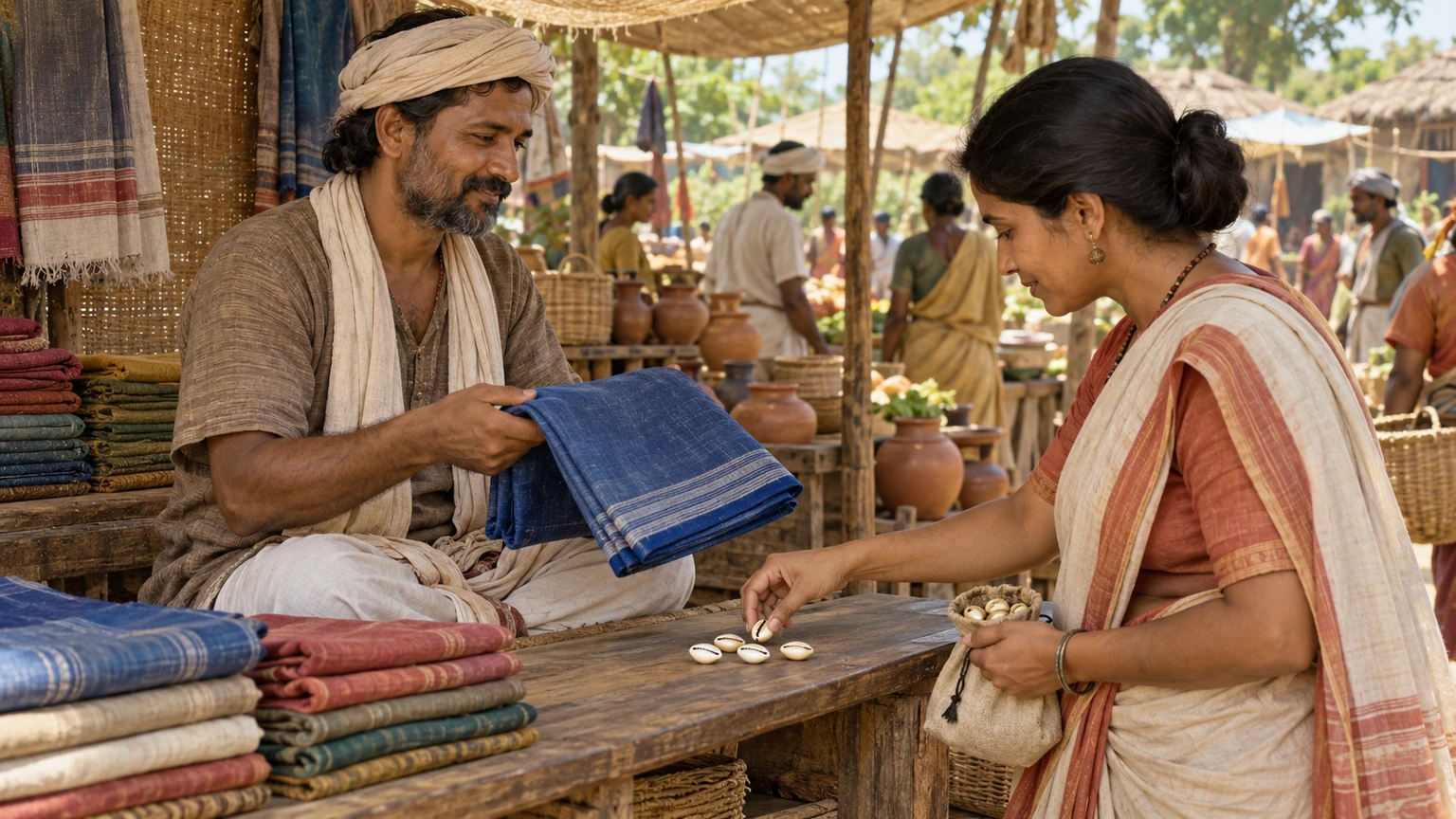
7. Write and enact a skit to show how people may have persuaded each other to use cowrie shells (or other such items) as the medium of exchange.
8. The RBI is the only legal source that prints and distributes paper currency in India. To prevent illegal printing of notes and their misuse, the RBI has introduced many security features. Find out what some of these measures are and discuss them in class.
9. Interview a few of your family members and local shopkeepers, and ask them their preferences in making and receiving payments — do they prefer cash or UPI? Why?
Extra Practice Questions
These questions and MCQs are ClearStudy practice, separate from the NCERT exercise.
Short Answer Type Questions
Q1. What is the barter system?
Q2. What is meant by ‘double coincidence of wants’?
Q3. Name the four basic functions of money.
Q4. Who controls the issue of currency in India, and why is this important?
Q5. What is digital money? Give two examples.
Long Answer Type Questions
Q1. Using the farmer’s story, explain how money makes exchange easier than barter.
Q2. Trace the journey of money in India from barter to digital money.
Q3. Describe the limitations of the barter system and explain how money overcomes each one.
MCQs & Assertion–Reason
1. Exchanging goods or services for other goods or services without using money is called the:
(a) money system (b) barter system (c) credit system (d) digital system
2. Which of the following was NOT used as a commodity in barter?
(a) Cowrie shells (b) Salt (c) Cattle (d) Debit cards
3. When two people each have exactly what the other wants and can exchange directly, it is called:
(a) divisibility (b) double coincidence of wants (c) durability (d) deferred payment
4. You cannot exchange only a part of an ox for a sweater. This is the problem of:
(a) portability (b) durability (c) divisibility (d) value
5. When the farmer keeps money instead of wheat to use later, money is acting as a:
(a) store of value (b) medium of exchange (c) measure of value (d) commodity
6. Ancient Indian coins of gold, silver and copper were called:
(a) rūpas (b) kārshāpaṇas or paṇas (c) annas (d) tajaderos
7. The symbols punched on ancient Indian coins were called:
(a) rūpas (b) paṇas (c) motifs (d) alloys
8. Paper money was first used in which country?
(a) India (b) China (c) Micronesia (d) Mexico
9. Which institution issues Indian banknotes other than the government-issued ₹1 note?
(a) State Bank of India (b) Government mint (c) Reserve Bank of India (d) local rulers
10. A grid of black-and-white squares scanned by a phone to make digital payments is a:
(a) QR code (b) watermark (c) security thread (d) rūpa
For each Assertion–Reason question, choose: (A) Both true and the Reason correctly explains the Assertion; (B) Both true but the Reason is not the correct explanation; (C) Assertion true, Reason false; (D) Assertion false, Reason true.
A-R 1. Assertion: The barter system made everyday exchange difficult.
Reason: Barter required a double coincidence of wants and had no common standard measure of value.
A-R 2. Assertion: Money can act as a store of value.
Reason: Money can be kept for a longer time and used for making purchases later.
A-R 3. Assertion: Coins were the earliest form of money ever used by humans.
Reason: Before coins, people used the barter system and commodities such as cowrie shells.
A-R 4. Assertion: In ancient India, anyone could mint and issue coins.
Reason: Coin issue depended on recognised authority and accepted standards rather than any individual making arbitrary coins.
A-R 5. Assertion: Paper currency is used for higher denominations while coins are used for smaller ones.
Reason: Carrying and storing a large number of coins became difficult, leading to the use of paper money.
What do the ₹50 and ₹100 notes show?
In the Mahatma Gandhi (New) Series, the reverse of the ₹50 note shows Hampi with the stone chariot; the ₹100 note shows Rani ki Vav, the stepwell at Patan. Older series have different designs, so first identify the series. Check the note against RBI’s denomination guide; raised and colour-changing features vary by note.
In-text activity guidance
₹100 book with ₹50 available: the unpaid amount would be ₹50. A deferred payment needs the seller’s agreement and a clear due date; otherwise save more or choose an affordable alternative. The activity illustrates a function of money, not a right to borrow.
Coin study: With permission, record the date, denomination, visible inscriptions and designs on both faces. Treat metal identification from colour as a guess; verify it with an official mint or museum source.
Barter nearby: Describe a real book swap or goods exchange you observed, and explain the agreed terms. NCERT also discusses Junbeel Mela in Assam. Do not invent a visit or interview.
Payment safety: A QR code can initiate a payment; check the payee and amount. You do not enter a UPI PIN merely to receive money. Keep PINs private. Schoolwork does not require making a real payment.
Next: Connect exchange to buyers, sellers and prices in Understanding Markets.
Reviewed against NCERT Exploring Society: India and Beyond, Class 7, Part 1, Chapter 11, pp. 229–245 (2026–27 reprint), with issuer details checked against RBI and payment terminology against NPCI on 10 October 2026. The activity’s original question wording is retained where a clarification follows.
Exam Tips & Common Mistakes
How to write a clear answer
Learn the five limitations of barter (double coincidence of wants, no common measure of value, divisibility, portability, durability) and the four functions of money (medium of exchange, store of value, measure of value, standard of deferred payment) — questions are framed straight from these. Remember the evolution order: barter → cowrie → metal coinage → paper money → digital money. Use the textbook’s own terms — kārshāpaṇas/paṇas, rūpas, obverse/reverse, RBI, UPI, QR code — and back answers with its examples (the farmer’s ox, Roman coins at Pudukkottai, Chalukya/Chola coins, Junbeel Mela) to show you have studied the chapter. For the Arthaśhāstra question, show the calculation clearly.
Common mistakes to avoid
- Saying barter used “money” — barter means exchange without money.
- Confusing divisibility (splitting a good) with portability (carrying it) and durability (storing it).
- Calling coins the “first money ever” — barter and commodities (like cowrie shells) came first.
- Forgetting the issuer distinction: RBI banknotes versus government-issued coins and ₹1 notes.
- Mixing up the obverse (head side) with the reverse (tail side) of a coin.
- Leaving activity questions (skit, interview, security features) blank — write a model answer or your own findings.
Frequently Asked Questions
What is Chapter 11 of Class 7 Social Science Exploring Society about?
Chapter 11, From Barter to Money, explains how people exchanged goods through the barter system before money, why the limitations of barter (double coincidence of wants, no common measure of value, divisibility, portability and durability) led to the invention of money, the basic functions of money, and how money evolved from commodities and coins to paper currency and digital money in India.
What are the limitations of the barter system?
The barter system needed a double coincidence of wants, had no common standard measure of value, and faced the problems of divisibility (an ox cannot be split), portability (heavy goods are hard to carry) and durability (goods like wheat rot or get eaten). These limitations led to the development of money.
What is the exercise heading for Chapter 11 of Exploring Society?
The end-of-chapter exercise in Exploring Society: India and Beyond (Part 1) Chapter 11 is headed Questions and activities and contains 9 questions, all answered step by step on this page.